This guide is independent and contains no paid placement. If affiliate links are added later, they will be clearly marked and will not change our editorial checks.
Hubberholme is one of the smallest, quietest places in Wharfedale: a riverside church, a pub, a handful of stone houses and the River Wharfe running past the door. Come for an hour of slow riverside walking, a look inside the church, and a drink by the river — not for shops, crowds or a full day of attractions. Dogs on leads fit in perfectly here, provided you respect the sheep, the churchyard and the narrow lane.
A hamlet that asks you to slow down
Hubberholme is not a village in the usual sense. There is no shop, no square, no queue of cars and no list of things to tick off. What there is, arranged along a short stretch of the River Wharfe in Upper Wharfedale, is a small stone church, a pub, a scattering of stone houses and barns, and a river that sets the pace of everything. Most visitors arrive on foot, walking the Dales Way between Kettlewell and Buckden, and they leave an hour later wondering why they had not heard of the place sooner. That is the whole point of Hubberholme: it rewards people who are willing to stop.
For a dog, this is a very particular kind of good day out. There are no busy pavements to navigate, no traffic to dodge and no crowds to push through. The walking is level, riverside and rich in smells — damp grass, sheep, river water, woodsmoke on a cold day — and the distances are short enough that an older dog, a small dog or a dog that simply prefers a wander to a march will be comfortable. A young, high-energy dog will not be tired out by Hubberholme alone, which is why most people pair it with a longer walk to Buckden or Kettlewell rather than treating the hamlet as the whole outing. Think of it as the quiet centre of a longer riverside day, not as a destination that needs to entertain you for six hours.
The hamlet sits in the Yorkshire Dales National Park, on the B6160 between Kettlewell to the south and Buckden to the north, and the River Wharfe runs right past the churchyard wall. The surrounding fields climb gently into open moorland, and the valley here is narrow enough that the hills feel close without ever feeling closed in. On a fine evening the light on the river is the best thing in the dale, and on a grey morning the place has a stillness that the busier Dales villages have mostly lost. Either way, the right approach is the same: park the car, put the dog on a lead, and walk slowly.
That slowness is also a practical matter. Hubberholme has almost no facilities, so everything you need — water for the dog, a lead you trust, a towel for wet paws, a snack — should be in your bag before you arrive. There is no shop to buy a forgotten poo bag from and no cafe to shelter in if the rain arrives early. This is not a warning so much as a description of the deal: the hamlet gives you quiet and beauty, and in return it asks you to come prepared. Visitors who arrive with a flask, a lead and a plan have a lovely time; visitors who arrive expecting a visitor centre do not.
The little church by the river
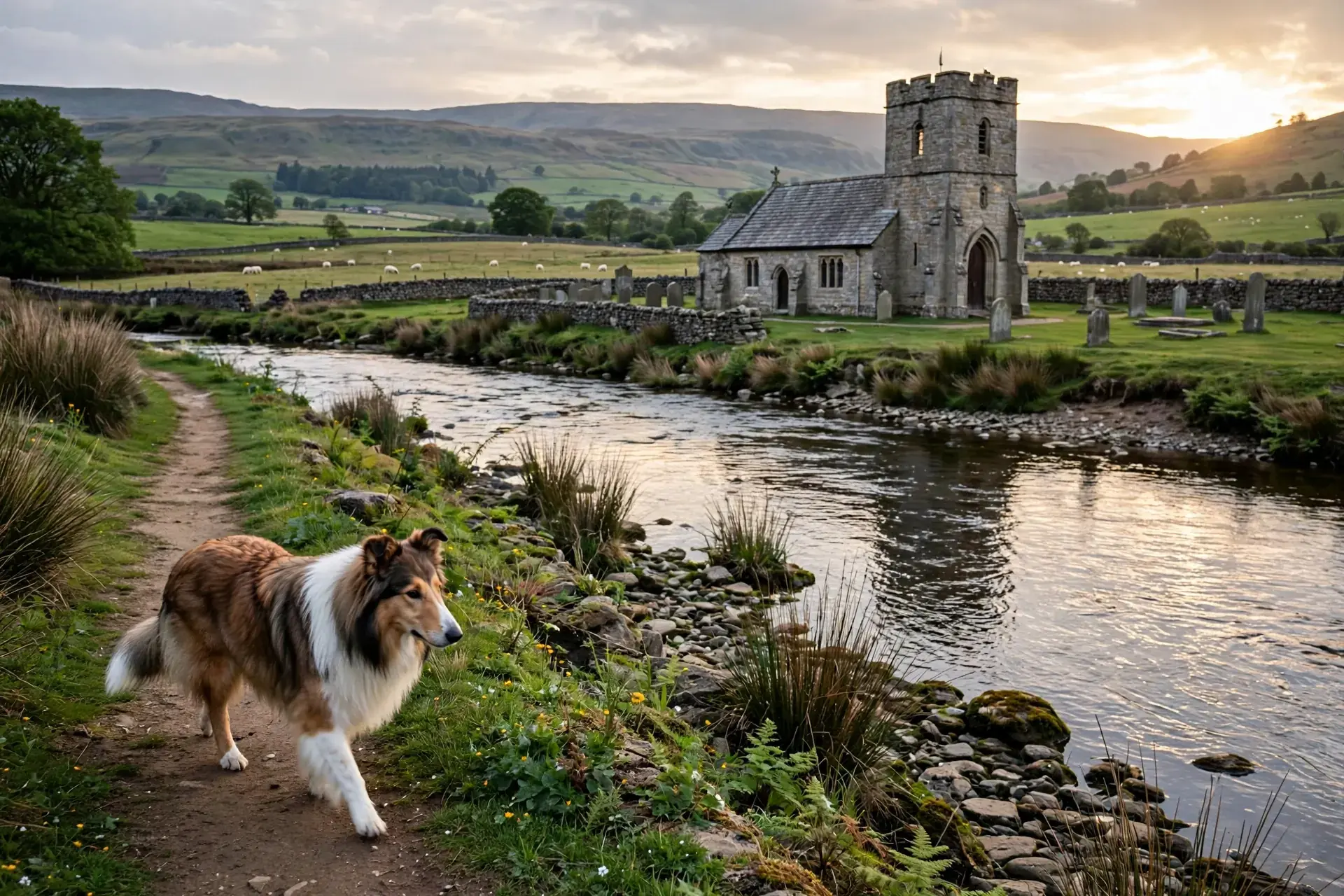
The church of St Michael and All Angels is the reason most people stop in Hubberholme at all, and it is worth the stop. It is a small, plain stone church with Norman origins, standing so close to the River Wharfe that you can hear the water from the churchyard. The building has been altered and repaired over the centuries, but its scale has never changed: it is a hamlet church, built for a handful of farming families, and it still feels like one. Inside, the light is soft, the stone is cool, and the atmosphere is one of long, quiet use rather than display.
For dog owners, the churchyard is the part that matters most. It is a small, walled, grassy space with old gravestones, a view down to the river and a bench or two where you can sit while the dog rests in the shade. Keep your dog on a lead here — it is a burial ground and a place of worship, not a dog exercise field — and keep them away from the graves themselves. A calm dog that can settle for ten minutes while you look around the church will be fine; a dog that barks at strangers or pulls hard on the lead will find the confined space awkward, so judge your own dog honestly before you go in.
Whether dogs are allowed inside the church depends on the day and on who is looking after the building. Many small rural churches tolerate a quiet, well-behaved dog on a lead, especially outside service times, but this is a courtesy rather than a right, and it can change. The polite approach is to ask if anyone is around, keep the visit short, and be ready to wait in the churchyard if the answer is no. Never leave a dog tied up outside a church while you go inside: it is stressful for the dog, unfair on other visitors, and unnecessary when the churchyard is such a pleasant place to sit together.
What to look for inside is modest but rewarding. The font, the simple stonework and the small windows tell the story of a church that served a farming community for centuries, and the visitors' book records a steady stream of walkers, cyclists and Dales Way travellers who have passed through. Take a moment to read a few entries: they give a better sense of the place than any guidebook paragraph, because they are written by people who arrived on foot, tired and grateful, and sat down in the same pews. If the church happens to be locked when you visit — small rural churches sometimes are, particularly in winter — the outside is still worth a slow circuit, and the churchyard and riverbank give you the best of the setting anyway.
One more thing the church gives you, which no map can: a sense of how old this valley is. The Wharfe has run past this spot for far longer than the church has stood here, and the fields, walls and lanes around Hubberholme follow lines laid down centuries ago. Walking here with a dog, at a dog's pace, is one of the few ways to notice that. Your dog will notice it first, in fact — in the smells along the wall, the sound of the water and the sheer number of things worth sniffing that a faster walker would miss entirely.
Priestley country: reading the village before you walk it
Hubberholme's other claim to fame is literary, and it changes the way you see the place. The writer J. B. Priestley, born in Bradford in 1894 and one of the best-known English writers of the twentieth century, is buried in the churchyard of St Michael and All Angels. Priestley lived in the Dales in his later years and wrote about the valley with deep affection; his ashes were laid to rest here, in the churchyard of the little riverside church, and his grave is a quiet, unshowy spot that many visitors seek out.
There is no grand monument and no signposted trail, which suits the place. The grave is a modest stone in a quiet corner, and finding it is a small act of attention in itself — the kind of slow looking that Hubberholme rewards. If you go looking for it, do so respectfully: stay on the paths, keep your dog on a short lead, and do not let them walk over graves. It is a place for a pause rather than a photograph, and the churchyard as a whole deserves the same courtesy.
Priestley matters here for a second reason, which is the way he wrote about the Dales. He loved the valley not as scenery but as a working place — farms, pubs, chapels, weather, neighbours — and his writing about Yorkshire is full of the small, ordinary details that make a place feel lived in. Reading a few pages of his work before you visit, or even just knowing that this was a landscape he chose to be buried in, gives the walk a different texture. You start noticing the things he would have noticed: the way the light falls on a stone wall, the sound of the river under the bridge, the patience of a farmer moving sheep along a lane.
This is also a useful way to plan the visit with a dog. Priestley's Hubberholme is not a place of big views and dramatic peaks; it is a place of small, close detail, and that is exactly the scale at which dogs experience the world. A dog does not admire a panorama. A dog reads a wall, a gate, a patch of damp grass, a scent on the wind. Walking the hamlet in that spirit — slowly, with the dog's nose setting the pace — is the most faithful way to see it. If you arrive with a list of viewpoints to photograph and a timetable to keep, you will miss the point; if you arrive ready to wander, you will understand why a writer chose to rest here.
One practical suggestion follows from all of this. Bring a book, or at least bring the willingness to sit still for a while. The best hour in Hubberholme is often not the walking hour but the sitting hour: on the churchyard wall, on a bench by the river, or outside the pub with the dog settled at your feet. The valley does not put on a show, and the pleasure of the place is cumulative — the river, the church, the fields, the quiet — rather than sudden. Dogs are very good at this kind of visit. They do not get bored by stillness the way people do, and a dog that can lie down and watch the world go by is the perfect companion for a hamlet that asks nothing more of you than that.
Riverside walks from the churchyard gate
The best walking from Hubberholme starts at the churchyard gate and follows the River Wharfe. The river here is narrower and quieter than it is downstream at Bolton Abbey or Grassington, and the paths along it are level, grassy and easy underfoot in dry weather. In wet weather they can be soft and muddy, especially in the riverside meadows, so wear boots with grip and expect your dog to come back with wet legs. That is part of the deal in Wharfedale, and a towel in the car is worth more than any amount of complaining about the mud.
A short, satisfying loop begins by following the river upstream for a while, then cutting back through the fields towards the hamlet. There is no single marked circular route from Hubberholme itself, so the honest way to describe the walking here is as a series of out-and-back stretches along the river, joined by field paths and the occasional lane. This is not a drawback: out-and-back walking suits dogs very well, because the return leg is full of smells they missed on the way out, and it means you can turn back at any point if the weather changes or the dog gets tired. There is no pressure to complete a loop, and no shame in a short walk that ends at the pub.
Keep your dog on a lead for the riverside stretches, for three reasons. First, the fields beside the river are grazed by sheep for much of the year, and the sheep here are used to walkers but not to loose dogs. Second, the river runs close to the path in places, and the Wharfe can be fast and deep after rain, even where it looks calm; a dog that loves water can get into trouble quickly in a spate. Third, the paths are shared with other walkers, including Dales Way travellers with heavy packs who do not want a friendly dog jumping up at them. A long line gives a dog freedom to sniff while keeping all three risks under control, and it is the single most useful piece of kit for this valley.
What your dog will actually do on these paths is worth describing, because it is the reason to come. They will sniff the gateposts, wade in the shallow edges where the river slows, investigate the sheep from a safe distance, and lie down in the grass when you stop on a bench. The riverside meadows in spring and summer are full of birdsong, and the hedgerows and walls hold more scent than any pavement walk. In autumn the leaves along the river turn and the air smells of wet earth, and in winter the valley is stark and beautiful in a way that suits a brisk, short walk followed by a long sit somewhere warm. Each season gives the same paths a different character, which is why Hubberholme repays repeat visits rather than a single tick on a list.
A note on river safety, because it matters more than most visitors expect. The Wharfe is a spate river: after heavy rain upstream it can rise quickly, turn brown and run much faster than it did an hour earlier. Never let a dog swim in the river after rain, and be cautious even in dry weather if your dog is not a strong swimmer. If your dog does go in, watch from the bank and do not go in after them — call them to a shallow edge and let them find their own way out. The shallow gravel edges near the hamlet are the safest places for a paddle, and even there a lead is sensible until you have judged the current. Check the official guidance before you travel if you are unsure about conditions after wet weather.
The Dales Way passes through
Hubberholme sits directly on the Dales Way, the long-distance path that runs for about 80 miles from Ilkley in West Yorkshire to Bowness-on-Windermere in Cumbria. Walkers on the Dales Way pass through the hamlet as a matter of course, and the path is the reason the church visitors' book is full of entries from people who arrived tired, footsore and grateful for a bench. For a day visitor with a dog, the Dales Way is less a trail to complete than a well-made, well-signed route to borrow for a few miles.
The Dales Way through Upper Wharfedale is, for the most part, gentle. It follows the river valley rather than climbing the fells, which makes it one of the more forgiving long-distance paths for dogs. The surface is a mix of riverside grass, field paths, farm tracks and short stretches of quiet lane, with stiles and kissing gates at field boundaries. Some of the stiles are awkward for larger dogs, so be ready to lift a dog over or find a gate nearby — most stiles in this valley have a gate or a gap close by, but not all of them, and a dog that cannot be lifted needs a plan. A harness with a handle helps here, as it does on any walk with stiles.
Walking a short section of the Dales Way with a dog is also a good way to understand the valley's geography. Heading north, the path follows the Wharfe towards Buckden, passing through riverside meadows and past farm buildings that have worked this land for generations. Heading south, it runs towards Kettlewell, with the valley narrowing and the hills closing in. Either direction gives you the same essential experience — river on one side, fields and walls on the other, hills above — and the choice of direction matters less than the decision to walk slowly and stop often.
One thing to remember about the Dales Way is that it is a shared path in the fullest sense. You will meet long-distance walkers with heavy packs, runners, families, and other dog walkers, and the etiquette is simple: keep your dog close when others approach, step aside on narrow stretches, and say hello. Most people on this path are friendly, and a well-behaved dog is a conversation starter rather than a problem. A dog that barks or lunges at strangers, however, will make a shared path miserable for everyone, so if your dog is reactive, choose the quieter field paths away from the main route and keep the lead short.
Walking north to Buckden
The walk from Hubberholme to Buckden is the natural extension of a visit, and it is the one most dog owners should plan for. The route follows the Dales Way north along the River Wharfe for roughly two miles, on mostly level riverside paths with a few stiles and gates. Allow 45 minutes to an hour each way at a dog's pace, and longer if your dog stops to investigate every interesting smell — which, on this stretch, they will, because the riverside meadows are full of them.
Buckden itself is a proper village rather than a hamlet, and that makes it a good turning point. It has a pub, the Buckden Village Shop, a village hall, and more parking than Hubberholme, as well as a bridge over the Wharfe and a small green where dogs can have a breather on a lead. The village sits at the junction of the valleys that lead up to Cray, Oughtershaw and the head of Wharfedale, and it has a slightly busier, more lived-in feel than Hubberholme. For a dog, the practical difference is simple: there are more people, more smells and more chances of a treat, which most dogs regard as an improvement.
From Buckden, the ambitious can continue up the valley towards Cray or take the path up to the waterfalls at Hubberholme's neighbouring dale, but for most dogs the riverside walk there and back is enough. If you do want to extend the day, the walk from Buckden towards Cray follows the river into wilder, quieter country, and the paths get rougher and the stiles more frequent — better suited to a fit, confident dog than to an older one. Judge the extension by how your dog is moving after the first two miles: if they are still bright and pulling gently, carry on; if they are lagging or lying down at every gate, turn back and save the longer walk for another day.
Practical points for the Buckden walk: there is little shade on the open riverside stretches, so on a hot day carry water for the dog and walk early or late. The fields are grazed, so keep the lead on. The path can be muddy after rain, particularly in the low meadows, so boots with grip are worth wearing even when the day starts dry. And if you plan to eat in Buckden, check the pub's dog policy before you travel — policies change, and a dog that is welcome in the garden may not be welcome inside. The village shop is useful for a forgotten item, but it is a small shop with limited hours, so do not rely on it for a full picnic.
Walking south to Kettlewell
The walk south from Hubberholme to Kettlewell is shorter, prettier and busier than the Buckden walk, and it suits a different mood. The route follows the Dales Way downstream along the Wharfe for about a mile and a half, passing through riverside meadows with the valley narrowing around you, and arrives in Kettlewell — a village with three pubs, a shop, a garage and a proper village green. Our guide to Kettlewell with a dog covers the village in detail, including the beck, the stepping stones and the walks up to Arncliffe and Littondale, so this section is about the link between the two places rather than a repeat of that guide.
What makes the Hubberholme to Kettlewell stretch worth walking is the change in the river. Upstream of Hubberholme the Wharfe is a small, fast beck of a river; by Kettlewell it has gathered more water and more character, and the riverside path gives you a close-up view of that change. There are shallow gravel edges where a dog can paddle, deeper pools where the water runs dark, and a stone bridge or two worth pausing on. The path is generally level and well trodden, but it can be soft underfoot after rain, and there are stiles and gates where the path crosses field boundaries.
Kettlewell itself is a good lunch stop, and it is also the place to pick up anything you forgot in Hubberholme — which, given the hamlet's lack of shops, is a real possibility. The village has more parking, more places to sit outside with a dog, and more choice of walks if you want to extend the day up into Littondale or over towards Arncliffe. For dogs that need a longer day, the combination of Hubberholme, Kettlewell and a loop up one of the side valleys makes a satisfying full day; for dogs that need a shorter one, the walk between the two villages and back is enough on its own.
One warning about this direction: the path between Hubberholme and Kettlewell is popular, particularly on fine weekends, and you will meet other walkers, other dogs and the occasional group of Dales Way travellers. Keep your dog on a lead on the narrow stretches and be ready to step aside. It is also worth knowing that the return walk, back upstream to Hubberholme, is slightly uphill in feel even though the gradient is gentle — a tired dog will notice it, so factor in a slower return and a rest at the churchyard wall before the drive home.
Arriving, parking and the first ten minutes
Hubberholme is reached by the B6160, the single road that runs up Wharfedale from Threshfield and Grassington through Kettlewell and Buckden. The road is narrow, winding and busy with farm traffic, walkers and cyclists in summer, so drive slowly and expect to pull in for oncoming vehicles. There is no train station in Upper Wharfedale; the nearest stations are in Skipton and Ilkley, from where a bus runs up the valley — check the official guidance before you travel for current timetables, as rural bus services change and Sunday services are limited.
Parking is the single most important practical fact about Hubberholme, and it is this: there is almost none. The hamlet has a small area near the church and the pub, but it holds only a handful of cars, fills quickly on fine weekends, and is not a car park in any formal sense. There are no marked bays, no ticket machine and no overflow. If you arrive to find it full, do not block the lane, a farm gate or a passing place — the lane is a working road for farms and residents, and a blocked lane causes real problems. The better plan, on any busy day, is to park in Buckden or Kettlewell and walk in along the river, which is a pleasant walk in itself and removes the parking problem entirely.
Arrive early if you can. Hubberholme before ten in the morning, on any day of the week, is a different place from Hubberholme at noon on a sunny Saturday: quieter, softer in the light, and with space to park and sit. Early arrival also suits dogs, who do their best walking in the cool of the morning and are less bothered by other dogs and strangers when the paths are quiet. If you cannot arrive early, arrive late — the evening light on the river is the best in the dale, the day visitors have gone, and the hamlet returns to its normal, unhurried self.
The first ten minutes should be boring, and that is a compliment. Let the dog out of the car on a lead, give them water, let them sniff the verge and the wall, and walk slowly towards the churchyard rather than striding off on the Dales Way. A dog that has just spent an hour in a car needs time to stretch, toilet and take in the new smells before it is asked to walk two miles. Use those ten minutes to check the weather, look at the river level, and decide which direction to walk. A calm start makes for a calm dog, and a calm dog makes for a good day in a place that is, above all, calm.
Leads, livestock and the river: the rules that matter here
Hubberholme's rules are few, but they are worth taking seriously, because the hamlet has no margin for error. The first is the lead. Keep your dog on a lead in the churchyard, on the riverside paths near livestock, on the road, and whenever other walkers approach. The fields around the hamlet are grazed by sheep for much of the year, and the law is clear: a dog that worries livestock can be shot by the farmer, and the owner can be liable for the damage. That sounds harsh because it is harsh, and it is also entirely avoidable. A lead is a small price for a safe walk.
The second rule is about the river. The Wharfe is beautiful and inviting, and many dogs will want to swim in it. In dry weather, at a shallow gravel edge, with a calm current, a paddle is usually fine. After rain, when the river is high, brown and fast, it is not. The Wharfe rises quickly after rain upstream, and a dog that is a confident swimmer in a lake can be in trouble in a spate river within seconds. If you are unsure, keep the dog on the bank. If your dog does go in and gets into difficulty, do not go in after them — call them to a shallow edge, throw a stick to guide them if it helps, and seek help if they cannot get out. This is the single most important safety point in this guide.
The third rule is about the churchyard and the church itself. Keep your dog on a short lead, keep them off the graves, pick up after them immediately, and do not let them bark inside the church or in the churchyard. These are matters of respect rather than law, but they matter to the people who look after the building and to the other visitors who come here for quiet. A dog that can settle quietly for ten minutes is welcome almost everywhere in the Dales; a dog that cannot should wait outside with one of you while the other looks around.
Finally, the usual countryside code applies: close gates behind you, take your litter home, pick up after your dog even on remote paths, and do not let your dog chase birds, rabbits or other wildlife. Ground-nesting birds are a particular concern in spring and early summer, and the moorland above the valley is sensitive habitat. The Dales are a working landscape as well as a beautiful one, and the farmers, gamekeepers and residents who keep it that way deserve the same courtesy you would want in your own street. None of this is onerous. It is the price of walking in a place this special, and most dog owners pay it gladly.
Where to eat, drink and stay with a dog
The George Inn, beside the church, is Hubberholme's pub and its social centre. It is a small, traditional Dales pub — stone walls, a fire in cold weather, and a garden or terrace where walkers and their dogs gather on fine days. Pubs like the George are the natural reward at the end of a riverside walk, and a dog that has walked well deserves a lie-down under a table and a bowl of water. Whether dogs are welcome inside, however, depends on the pub's current policy, which can change with the season or the management, so check the official guidance before you travel rather than assuming. Even when dogs are welcome, the polite approach is to ask on arrival, keep the dog on a lead under the table, and be ready to sit outside if the room is busy or if another customer is uncomfortable.
Food in Hubberholme means the pub, and on a busy day that means booking ahead if you can. The hamlet has no cafe, no takeaway and no shop, so a picnic is a sensible backup: bring sandwiches, a flask and something for the dog, and eat on a bench by the river or on the churchyard wall. If you prefer a proper meal, Kettlewell and Buckden both have pubs with more capacity, and Grassington, further down the valley, has cafes, tea rooms and a wider choice of places to eat. Our guide to Grassington with a dog covers the village's dog-friendly eating options in detail, and it is worth reading if you plan to end the day with a meal rather than a sandwich.
Overnight, Hubberholme itself offers almost nothing, which is part of its charm and part of its limitation. There is no hotel in the hamlet and very little self-catering accommodation within walking distance. Most visitors who want to stay overnight base themselves in Kettlewell, Buckden or Grassington, where there are dog-friendly pubs with rooms, bed and breakfasts and self-catering cottages, and walk into Hubberholme as part of a longer day. Skipton with a dog is a useful base further down the valley if you want a market town with more choice — canal walks, a castle, and a wider range of places to stay — and the drive up Wharfedale from Skipton to Hubberholme is one of the prettiest in the Dales.
Whatever you book, confirm the dog policy in writing before you pay. Ask whether there is a pet charge, how many dogs are allowed, whether dogs can be left alone in the room, and where the nearest evening toilet walk is. Small Dales pubs and bed and breakfasts are often genuinely dog-friendly in a way that larger hotels are not — the dog may be welcome in the bar, given a bed by the fire and treated as a guest rather than a problem — but they also have limited rooms, and dog-friendly rooms book out first. Book early for weekends, school holidays and the summer months, and have a backup plan: the Dales are popular, and the best dog-friendly rooms go quickly.
A slow half-day plan for Hubberholme
The best way to enjoy Hubberholme is to stop trying to fill the day and let the hamlet set the pace. Here is a half-day plan that works for most dogs, including older ones, and that can be stretched into a full day by adding the Buckden or Kettlewell walks described above. It is deliberately unambitious. That is the point.
Start by arriving early and parking in Buckden or Kettlewell if Hubberholme's small parking area looks full. Walk in along the river on the Dales Way, at a dog's pace, and let the dog set the rhythm — sniffing, paddling, stopping. Arrive at the churchyard, sit on the wall for ten minutes, and let the dog rest in the shade. Go inside the church if it is open and dogs are welcome, or sit outside and read the visitors' book if it is not. This first hour, from the car to the churchyard, is the heart of the visit, and it should not be rushed.
Next, walk the riverside path in the other direction for half an hour or so, out and back, and let the dog have the walk they actually want: a slow, sniff-heavy wander rather than a march. Stop at a gravel edge and let them paddle if the river is calm. Sit on a bench. Watch the sheep. Let the dog lie down in the grass. Then walk back to the hamlet and have lunch — at the pub if it suits your dog, or a picnic on the riverbank if it does not. A dog that has walked, sniffed, paddled and rested is a contented dog, and a contented dog will settle happily under a pub table or on a picnic rug.
After lunch, decide by the dog rather than by the clock. If the dog is still bright, walk to the other village — Buckden if you came from Kettlewell, Kettlewell if you came from Buckden — and have a drink there before walking back. If the dog is tired, stay put: sit by the river, read a book, and let the dog sleep. There is no prize for covering more miles, and the valley will still be there next time. Finish by walking slowly back to the car, giving the dog water and a towel-down, and driving home with a dog that is tired in the good way — the way that comes from a day of fresh air, new smells and gentle exercise, not from being marched until they dropped.
Wet weather and quiet-season visits
Hubberholme in the rain is a different place, and it is not a worse one. The river rises and runs faster, the fields smell of wet earth, the church is a dry and peaceful refuge, and the pub fire — if it is lit — feels earned rather than expected. But wet weather does change the practicalities, and a wet-weather visit needs a slightly different kit list: waterproofs for you, a drying coat for the dog, a towel in the car, and boots with grip for the riverside paths, which get soft and slippery when the ground is saturated.
The riverside meadows are the first places to get muddy, and the field paths can be churned by livestock in wet weeks. If the paths are very wet, stick to the better-drained tracks and the lane, and keep the walk shorter than you planned. A dog that is cold and wet is a dog that will not enjoy the second half of the walk, and there is no shame in cutting a walk short. The churchyard and the pub are both good wet-weather pauses, and a short walk followed by a long, dry sit is a better day than a long walk that ends with a shivering dog.
Winter is the quietest season in Hubberholme, and in some ways the best. The day visitors are gone, the Dales Way is empty, the light is low and the valley feels like it belongs to the people who live there. The trade-offs are real: the days are short, the church may be locked more often, the pub may keep shorter hours, and the paths can be icy in a cold snap. Walk in the middle of the day, carry a torch if you might be out late, and check the official guidance before you travel for current opening times and conditions. A winter walk here, done properly, is one of the finest quiet experiences in the Dales — but it is a walk that rewards preparation and punishes improvisation.
Spring brings lambs, and with them the strictest lead discipline of the year. From late winter through spring, the fields around Hubberholme are full of ewes and lambs, and a loose dog in a lambing field is a serious problem. Keep the dog on a lead at all times in the fields, stay on the marked paths, and do not let the dog approach the sheep even from a distance. Summer brings the opposite problem: heat. The riverside paths have little shade, and a dog walking in the midday sun on a hot day can overheat quickly. Walk early, carry water, let the dog paddle in the shallows, and watch for the signs of heat stress — heavy panting, drooling, wobbliness — and stop immediately if you see them.
A practical checklist before you set off
A good Hubberholme visit is a prepared one, and the checklist is short because the hamlet is small. Start with the dog: a lead you trust, a long line if you use one, a harness with a handle for stiles, poo bags, water and a collapsible bowl, a towel and a drying coat in wet or cold weather, and any medication the dog needs. Add the usual: treats, a favourite toy if it helps the dog settle, and a blanket for the car so a wet dog does not soak the seats.
For yourself, the list is just as simple: waterproofs, boots with grip, a map or a charged phone with the route downloaded — mobile signal in Upper Wharfedale can be patchy, so do not rely on live data — a flask, a picnic or a plan for lunch, and cash or a card for the pub. A book is not essential but it is very much in the spirit of the place. If you are walking the Dales Way, a paper map of the valley is worth carrying: the path is well signed, but a map turns a walk into an exploration, and it works when the phone does not.
Before you leave home, check three things. First, the weather and the river: if heavy rain is forecast upstream, expect a high river and muddy paths, and plan a shorter walk. Second, the pub and any accommodation: check the official guidance before you travel for current dog policies and opening hours, because both change. Third, your route and your parking plan: decide whether you will try to park in Hubberholme or walk in from Buckden or Kettlewell, and have a backup in mind. A visit that starts with a plan and ends with a quiet sit by the river is a visit that has gone right.
Finally, remember what Hubberholme is for. It is not a place to conquer or to collect. It is a place to slow down, to sit by a river, to look inside a small church, and to walk at the pace of the dog beside you. The writers and walkers who love it do not love it for what it has, but for what it does not have: noise, crowds, queues and hurry. Bring a dog that can enjoy that, bring a little patience, and the hamlet will give you one of the quietest, loveliest hours in the Yorkshire Dales. That is a fair exchange, and it is the reason people keep coming back to a place with no shop, no square and nothing to do — except be still, together, by the river.
Practical questions
Before you go
Is Hubberholme dog friendly?
Yes, in a quiet, low-key way. Hubberholme is a tiny hamlet with riverside paths, a churchyard and the Dales Way passing through, and dogs on leads are a normal sight. There are no shops or busy pavements to negotiate, but there are sheep in the riverside fields, so keep your dog on a lead near livestock and check the official guidance before you travel for current access rules.
Can dogs go inside the church at Hubberholme?
Well-behaved dogs on leads are generally tolerated in many small rural churches, but this is not a guaranteed right and it can depend on who is looking after the building that day. If the church is open, ask first, keep your dog close and quiet, and be ready to wait outside in the churchyard if the answer is no. The churchyard itself is a peaceful place to sit with a dog on a lead.
Where can I park in Hubberholme with a dog?
Parking in Hubberholme is very limited. There is a small area near the church and the pub, but it fills quickly on fine weekends and there is no large car park in the hamlet itself. Arrive early, park considerately without blocking farm gates or the narrow lane, and consider parking in nearby Buckden or Kettlewell and walking in along the river instead.
How far is the walk from Hubberholme to Buckden?
The riverside walk from Hubberholme to Buckden is roughly two miles each way along the Dales Way, mostly on level riverside paths with a few stiles and gates. Allow about 45 minutes to an hour each way at a dog's pace, longer if your dog stops to sniff every gatepost. Buckden has a pub, a village shop and more parking, so it works well as a turning point or a lunch stop.
Is the Dales Way at Hubberholme suitable for dogs?
Yes. The Dales Way through Hubberholme follows the River Wharfe on generally level, well-trodden paths, which suit most dogs including older ones. Expect stiles, kissing gates, sheep in the fields and stretches where the river runs close to the path, so keep your dog on a lead near livestock and water, and carry water on hot days because there is little shade on the open stretches.
Where can I stay overnight near Hubberholme with a dog?
Hubberholme itself has almost no overnight accommodation, so most visitors stay in nearby Kettlewell, Buckden or Grassington, where there are dog-friendly pubs with rooms, bed and breakfasts and self-catering cottages. Book well ahead for weekends and school holidays, confirm the dog policy and any pet charge in writing, and check the official guidance before you travel for current availability.