This guide is independent and contains no paid placement. If affiliate links are added later, they will be clearly marked and will not change our editorial checks.
Plan Huddersfield around its water and its high ground. Walk the Huddersfield Narrow Canal towpath in the morning, climb Castle Hill or head out to Marsden Moor in the afternoon, and finish in a canal-side pub. Keep dogs on a lead near locks, roads and livestock, and check the official guidance before you travel for towpath closures and moorland access rules.
Start on the canal, not in the centre
Huddersfield is a canal town before it is anything else, and that is the first thing to understand when you arrive with a dog. The Huddersfield Narrow Canal runs through the town on its way from Ashton-under-Lyne in Greater Manchester to Huddersfield, climbing through locks and passing under the Pennines through the Standedge Tunnel, the longest canal tunnel in Britain. The Huddersfield Broad Canal runs the other way, down towards the River Calder. Between them they give the town a flat, traffic-free spine that is far better suited to a dog walk than any town-centre pavement, and they set the shape of a good visit: start on the water, then decide how far up the hills you want to go.
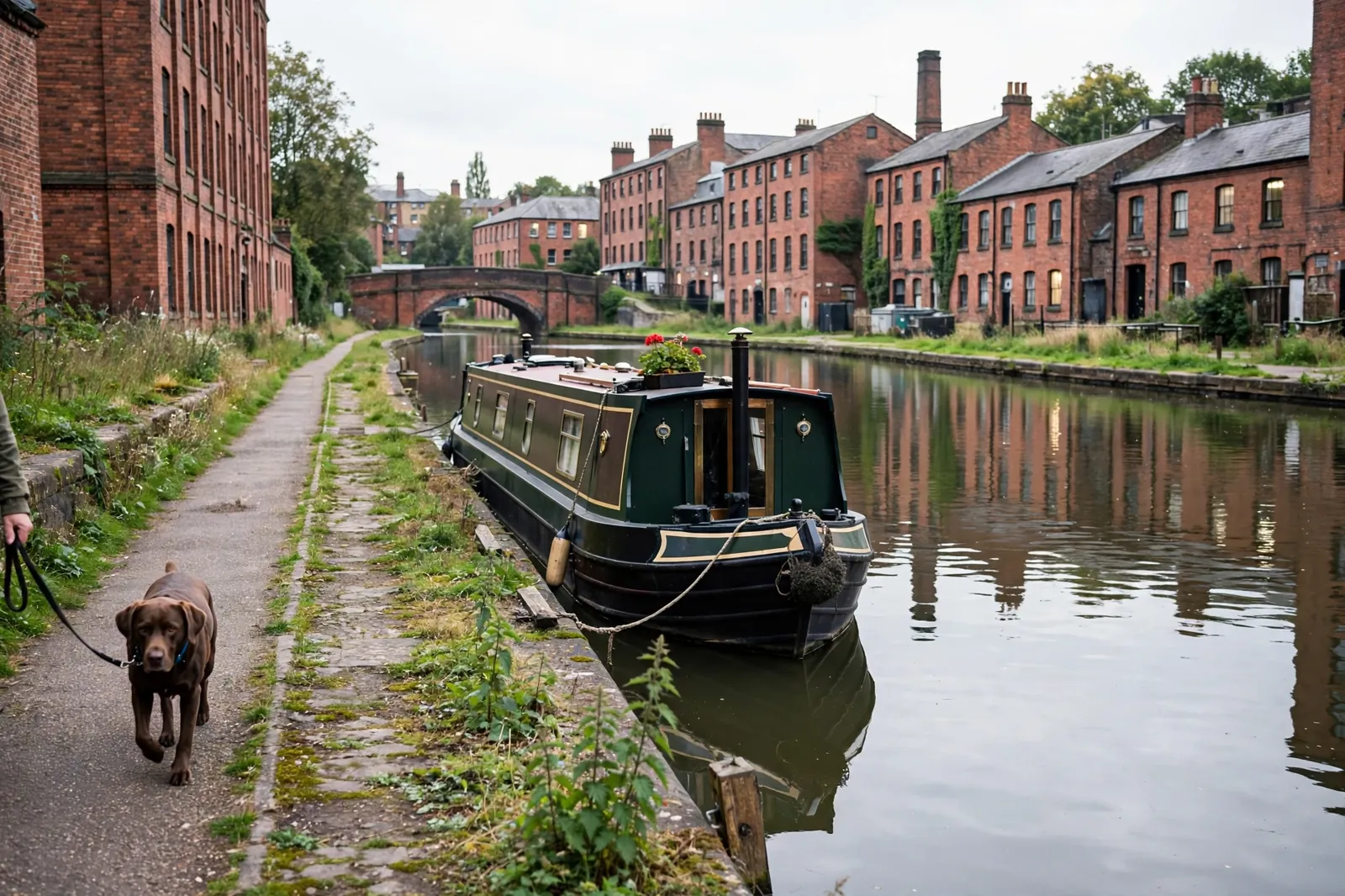
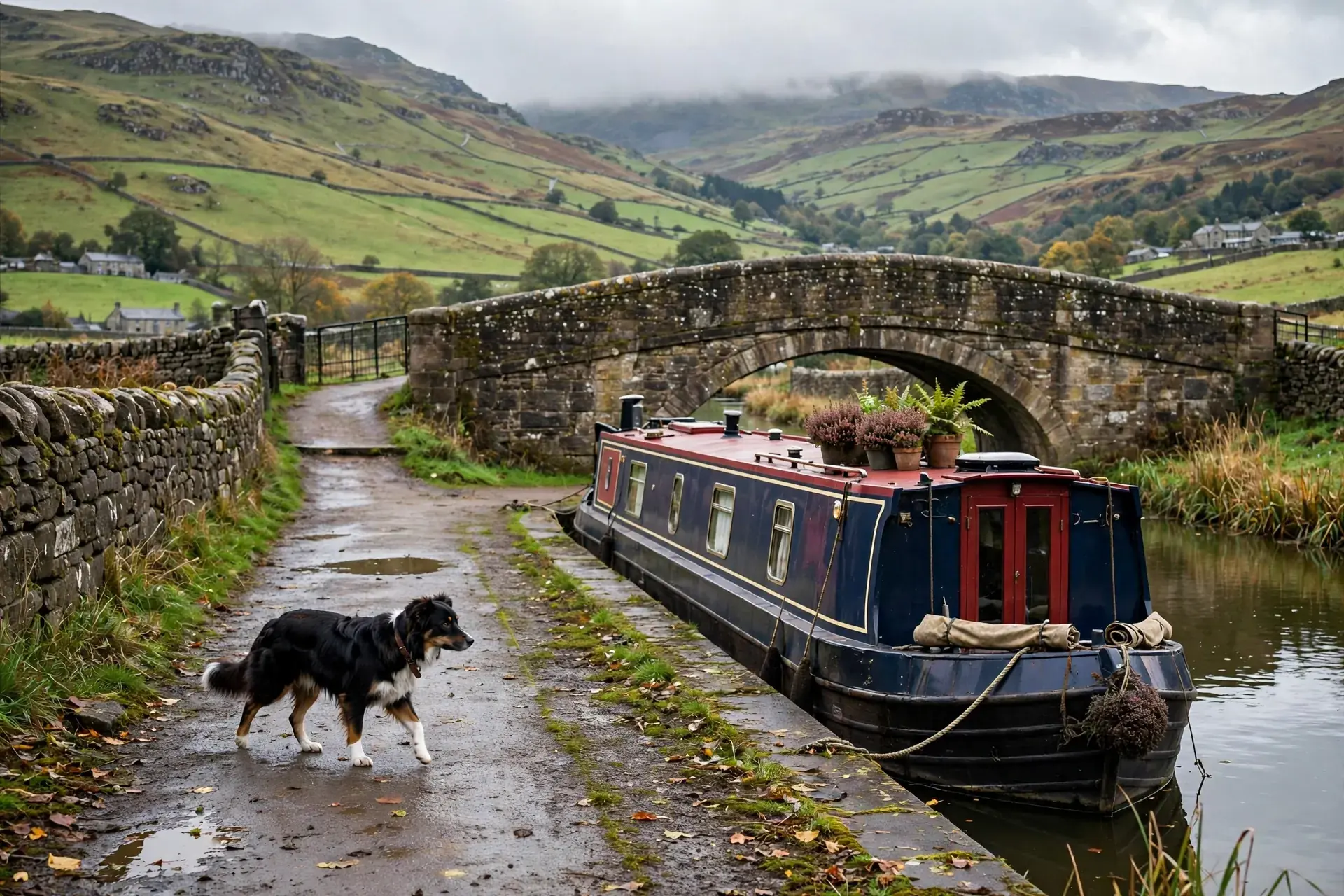
The towpath beside the Narrow Canal is the walk most visitors should try first. From the town centre it runs west towards Slaithwaite and Marsden, passing locks, stone bridges and moored narrowboats, with the ground rising on both sides as the valley narrows. The surface is mostly firm and level, which suits older dogs, puppies building up their mileage and anyone who wants a walk without a steep climb. Distances are easy to control: walk out for twenty minutes and turn back, or keep going to Slaithwaite, about four miles, and catch a train back. The railway follows the same valley, so the canal-and-train combination is one of the most practical dog-walking arrangements in the Pennines, provided you check the official guidance before you travel for train times and any engineering works.
Towpath manners matter more here than on a wide park path. The path is often narrow, with water on one side and a wall, hedge or drop on the other, and it is shared with cyclists, runners, anglers and other dog walkers. Keep your dog on a lead on the narrow stretches, near locks and bridges, and whenever a boat is passing or moored. A long line is a poor choice on a busy towpath: it trips cyclists and can tangle around a lock gate. A short lead, a dog that walks to heel past other dogs, and a habit of stepping aside at bridges will keep the walk pleasant for everyone. Do not let dogs swim in the canal or drink from it. Canal water can carry bacteria and blue-green algae in warm weather, and the steep stone edges and lock chambers are dangerous for a dog that falls in. Carry water for your dog instead, and use the waste bins and dog-waste bins provided along the towpath.
The locks themselves are worth slowing down for, and they are also the places where a lead is non-negotiable. Lock gates move, the ground beside them is wet and uneven, and a dog that darts across a lock beam can end up in deep water or under a moving gate. Stand well back while a boat is locking through, keep the dog on the towpath side, and use the wait as a rest stop rather than a photo opportunity at the water's edge. Anglers deserve the same courtesy: give them a wide berth, keep the dog from sniffing at their tackle, and pass quietly. The same applies to moored boats, where dogs live aboard and may be protective of their patch. A short lead and a calm pass is all it takes.
East of the town centre, the Broad Canal offers a quieter, shorter alternative. The walk towards Cooper Bridge and the River Calder is flatter and less visited than the Narrow Canal route, and it suits a gentle evening walk after a day on the moors. Either direction works as a first walk on arrival: it lets the dog stretch its legs, empty itself and learn the smells of a new place without traffic, crowds or a long drive. That first towpath walk also tells you a lot about your dog's state after the journey. A dog that is still buzzing from the car needs a longer out-and-back; a dog that is tired needs the shortest loop and an early night. Plan the rest of the trip around what you see on that first walk, not around what you hoped to fit in.
The town centre on a lead
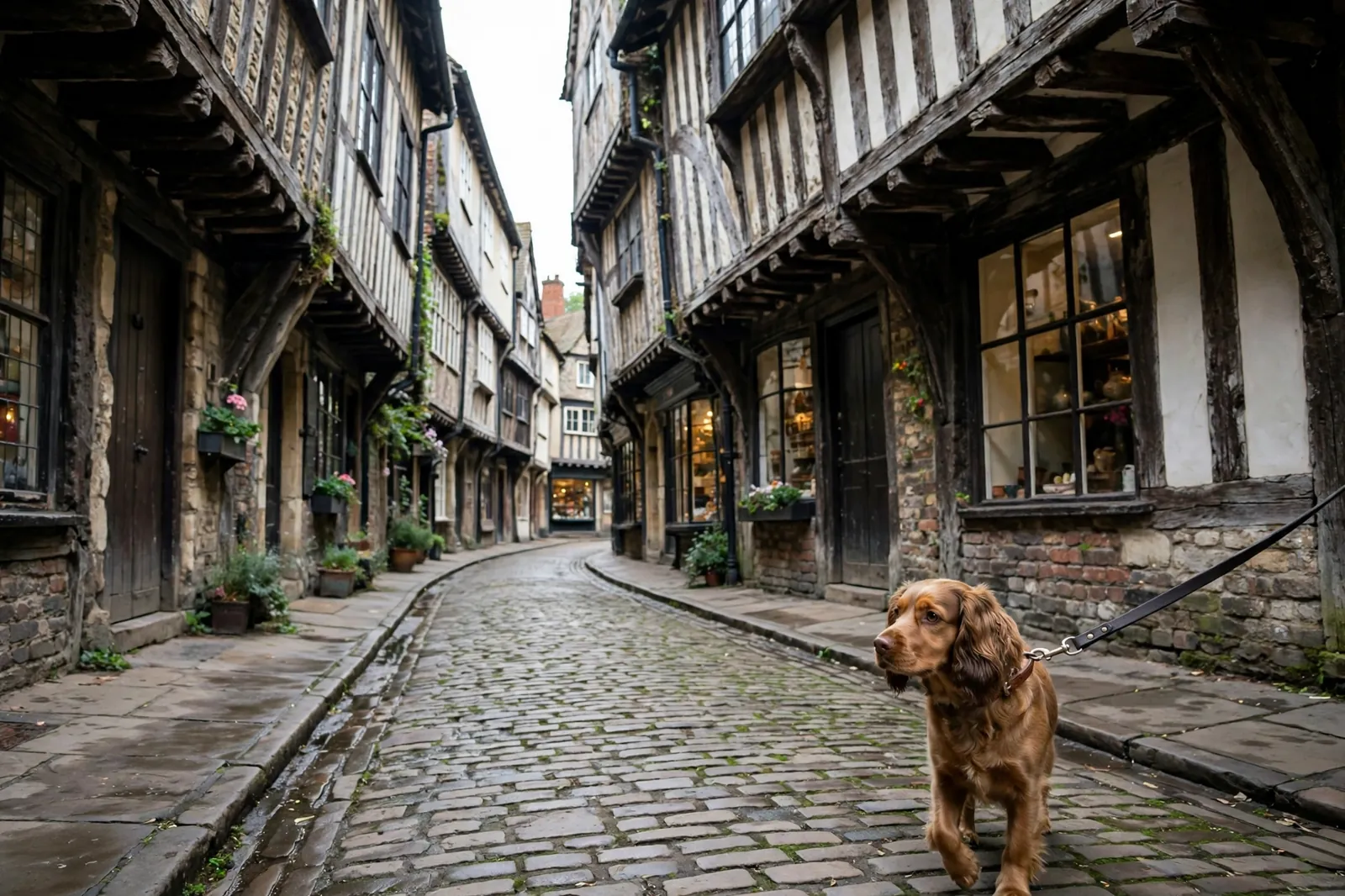
Huddersfield town centre is a handsome Victorian mill town, built largely in honey-coloured stone, and it rewards a slow walk on a lead far more than a rushed dash between shops. St George's Square, in front of the station, is the natural starting point: a broad paved square with the station's classical facade on one side and a statue of the former prime minister Harold Wilson, who was born in the town, at its centre. It is a good place to get your bearings, but it is also a busy interchange of buses, taxis and pedestrians, so keep the dog close and do not linger in the middle of the flow. From the square, the main shopping streets run south and east, and the covered markets and the Piazza area give the centre its everyday character.
The practical question in any town centre is where the dog can actually go, and in Huddersfield the honest answer is that the streets are fine and the interiors vary. Most shops decide their own dog policy, and many independent shops welcome a well-behaved dog, but the big chain stores usually do not, and food shops are the strictest of all. The workable approach is the split visit: one person stays outside with the dog while the other goes in, then swap. It is slower than shopping alone, but it avoids the awkward moment of being turned away at the door with a full basket. For a longer browse, leave the dog at your accommodation or in the car only if the car is cool, shaded and ventilated, and never in warm weather. A dog left in a car on a mild day can overheat far faster than most people expect.
Green space in the centre itself is limited, which is why the canal and the parks in the next sections matter so much. The river Colne runs through the town, but its banks in the centre are mostly walled and built up, and there is no riverside promenade of the kind you find in some other Yorkshire towns. That is not a flaw in the town so much as a fact to plan around: use the centre for an hour of looking around, a coffee and a look at the station and the square, then take the dog back to the towpath or a park for its real exercise. Trying to tire a dog out on town-centre pavements is a losing strategy, and a tired dog is a calmer companion for the parts of the day that humans enjoy most.
Noise and crowds deserve a mention, because Huddersfield centre can be loud on a Saturday. Market days, football crowds heading to the John Smith's Stadium and students from the University of Huddersfield all add footfall, and a nervous or reactive dog will find the narrow pavements stressful. If your dog is noise-sensitive, visit the centre early on a weekday morning, stick to the wider streets and the square, and retreat to the canal at the first sign of stress. A dog that is panting, yawning repeatedly, pulling hard or trying to hide behind your legs is telling you the centre has done its job for the day. There is no prize for pushing on, and the towpath is only a few minutes away.
One more centre detail is worth knowing before you go: Huddersfield station itself is a listed building with a long, impressive facade, and it is also your main transport hub. Dogs are welcome in the station and on the trains, on a lead and under control, and the station concourse has room to wait without blocking the doors. If you are arriving by train, the walk from the platform to the canal towpath is short, which makes a train-and-towpath day genuinely practical. Leave the station, cross St George's Square, and head for the canal rather than into the shopping streets, and the dog gets its walk within ten minutes of arrival.
Castle Hill and the climb above town
Castle Hill is the landmark that dominates Huddersfield from the south, and the Victoria Tower on its summit is visible for miles around. The hill has been a fortified site since the Iron Age, and the tower was built to mark the Diamond Jubilee of Queen Victoria in 1897. For a dog owner, the important facts are simpler: it is a steep, exposed hilltop with wide views, a car park and a pub nearby, and a climb that rewards fit dogs and tests unfit ones. The most popular approach is the road and footpath from the village of Almondbury, to the south-east of the hill, and there are several routes up, some of them steep and uneven underfoot.
Plan the climb as a proper hill walk, not as a casual stroll. The ascent from the nearest parking takes around twenty to thirty minutes for a fit adult, longer with a dog that wants to sniff every wall, and the ground is a mix of tarmac, grass and worn stone steps. Small dogs and older dogs may struggle with the steepest sections, and a dog that is carried part of the way needs a carrier or a sling rather than being lifted by the lead. At the top there is almost no shelter. The wind on Castle Hill is famous locally, and it can be strong and cold even on a day when the town below feels mild. Bring a windproof layer for yourself and a coat for a short-coated or older dog, and do not plan a long picnic at the summit in bad weather. The views are the point: across Huddersfield, the Colne and Holme valleys, and on a clear day to the Pennine moors and the hills beyond.
Dogs should be on a lead for the climb and at the summit. The hilltop is close to a road and a car park, the edges are steep in places, and the tower and its surroundings attract visitors, children and other dogs. A dog off the lead at the top can be over a wall or into the road before you can react. There is also livestock on the surrounding farmland, so keep the dog close on the lower slopes and do not let it run through fields or over walls. The hill is a good test of whether your dog is ready for the bigger moorland walks in the next section: if the Castle Hill climb leaves the dog tired but happy, Marsden Moor is a realistic next step. If it leaves the dog exhausted, lame or unwilling, stick to the canal and the parks for the rest of the trip.
The pub at the foot of the hill, the Castle Hill area's long-standing inn, is a useful staging post, and the village of Almondbury itself is worth a short wander. Its church and stone cottages give a quieter, older picture of the area than the town centre, and the lanes around it are pleasant for a short lead walk. Check the official guidance before you travel for the pub's current dog policy and opening hours, as both can change with the season. If you drive to Castle Hill, arrive early on a sunny weekend, because the car park fills quickly and the lanes are narrow. A full car park is a signal to come back on a weekday rather than to park on a verge and add to the congestion.
Marsden Moor and the Pennine fringe
West of Huddersfield, the land rises into the Pennines, and Marsden Moor is where the town's walks turn into proper moorland. The moor is managed by the National Trust and covers more than 2,300 hectares of open moor, blanket bog, reservoirs and gritstone edges around the village of Marsden. It is a landscape of big skies, rough grass, heather and peat, and it is one of the best places within easy reach of Huddersfield to give a fit dog a long, open walk. It is also a working landscape, grazed by sheep, home to ground-nesting birds, and crossed by the Pennine Way, so the rules are stricter than in a town park and the weather changes faster.
The most accessible moorland walk starts in Marsden village itself, which is about seven miles west of Huddersfield on the Huddersfield Narrow Canal and the railway line. From the village you can walk up onto the moor on a network of paths, or follow the canal to the Standedge Tunnel visitor centre and the tunnel's eastern portal. The tunnel is a remarkable piece of engineering, more than three miles long, and boat trips through it run in season, although dogs are not usually able to join the tunnel trips, so check the official guidance before you travel if that is part of your plan. The area around the tunnel mouth is still worth a visit on foot, with the canal, the old railway and the moor edge all meeting in one small valley.
Livestock is the single most important safety issue on Marsden Moor. Sheep graze freely across the open moor, often out of sight until you are close, and a dog that chases sheep can cause injury, abortion in ewes and, in the worst cases, the death of the animals. Under the law, a farmer may shoot a dog that is worrying livestock, and the owner can be liable for the damage. The practical rule is simple and non-negotiable: keep your dog on a lead whenever sheep are anywhere in sight, and keep it on a lead by default during the lambing season and the bird-breeding season from March to July. Ground-nesting birds such as curlew, lapwing and golden plover nest on the open moor in spring and summer, and a dog running free through the heather can destroy a nest in seconds. Even a well-trained dog with a reliable recall should be on a lead on the moor in these months, because a bird or a sheep can appear from behind a rise faster than any recall can work.
The ground itself needs respect. Blanket bog is soft, wet and uneven, and the peat hags and groughs can be knee-deep in places after rain. Dogs can cross most of it happily, but a small dog can vanish into a peat gully, and an older dog can strain a leg on the uneven surface. Stick to the marked paths where they exist, especially after wet weather, and be ready to turn back if the ground becomes too boggy. The weather is the other variable: mist can come down quickly on the high moor, the wind is stronger than in the valley, and there is very little shelter. Carry a map or a charged phone with an offline map, a lead, water for the dog and a waterproof layer for yourself, even on a day that starts sunny in Huddersfield. Tell someone your route if you are walking alone, and keep the dog in sight at all times.
For a shorter moorland taste without the full commitment, the moor edge around Meltham and Holme, south of Huddersfield, offers gentler paths and reservoir walks. The reservoirs of the Holme valley, including the waters above Holmfirth, give a middle ground between a town park and open moor: firm paths, water views and open grass, with the moor rising behind. Holmfirth itself, famous as the setting for the television series Last of the Summer Wine, is a small Pennine town of stone cottages and steep lanes, and it makes a pleasant stop after a reservoir walk. The same livestock and lead rules apply there, and the lanes are narrow, so keep the dog close. If you want a longer day, our guide to Leeds with a dog covers the other end of the Leeds-Liverpool Canal and the big city park that pairs well with a Pennine weekend, while Manchester with a dog follows the canal in the opposite direction towards the city.
Parks and green space in town
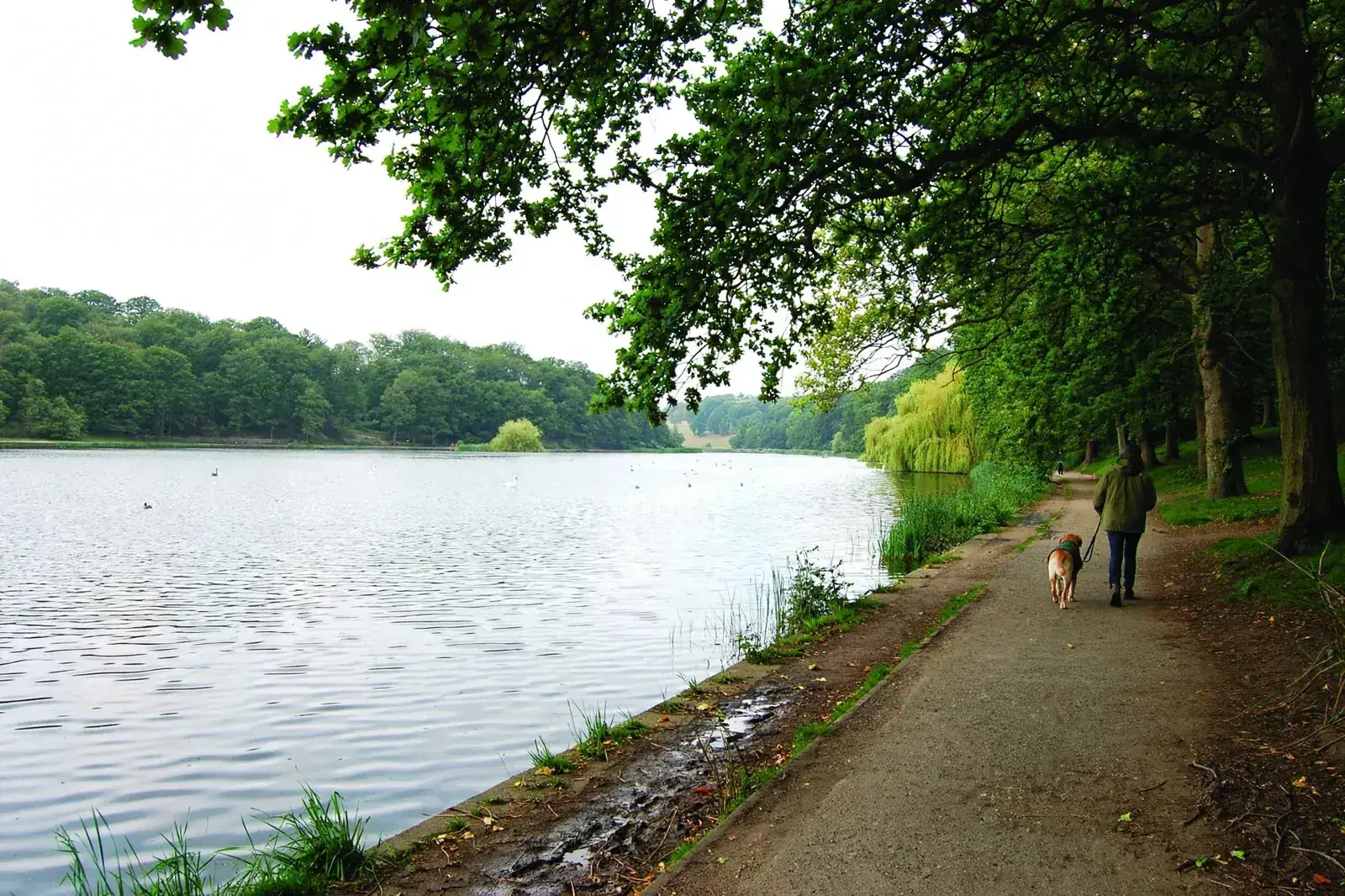
Not every Huddersfield walk needs a drive to the moors. Greenhead Park, to the west of the town centre, is the town's main Victorian park and the most useful green space for a dog owner staying in town. It has broad lawns, mature trees, a lake, tennis courts, a playground and a network of paths that make a forty-minute circuit easy. The park is popular with families, joggers and other dog walkers, especially at weekends, so keep the dog on a lead on the main paths and near the playground and the lake, and only let it off where other dogs are clearly playing freely and the signs allow it. The lake is a particular hazard: dogs should not be encouraged to swim in it, and the water quality is not managed for swimming, so check the official guidance before you travel if your dog is a keen swimmer.
Beaumont Park, south of the centre towards Crosland Moor, is a different kind of park and in many ways a better one for dogs. It is a wooded valley park with steep paths, streams, waterfalls and dense tree cover, laid out in the Victorian era and restored by volunteers. The paths climb through the woods, the ground is uneven and can be muddy after rain, and the stream crossings need care with a dog on a lead. It suits a dog that likes sniffing and exploring more than one that wants a flat game of fetch, and the tree cover makes it a good choice on a hot day or in light rain. Keep the dog on a lead near the stream and the steeper drops, and watch for the small bridges and steps that can be slippery when wet.
Ravensknowle Park, in the Moldgreen area east of the centre, is smaller and quieter, with lawns, a pond and the Tolson Museum at its edge. It works as a short morning or evening walk from a nearby stay, and its quieter atmosphere suits nervous dogs better than the busier Greenhead Park. The same general rules apply in all three parks: clean up after your dog, use the bins provided, keep dogs out of the children's play areas and the formal flower beds, and respect any local orders about dogs on leads. Kirklees Council, which manages the parks, can change the rules for individual sites, so check the signs at the entrance rather than assuming the rules from a previous visit. A park that allowed off-lead play last year may have a new lead requirement this year, and the sign at the gate is the authority.
For dogs that need a safe, enclosed space to run, the area around Huddersfield has several secure dog fields that can be hired by the hour, and these are worth booking in advance, especially at weekends. An enclosed field is the best answer for a dog with an unreliable recall, a reactive dog that needs space without other dogs, or a puppy that is still learning. Search for the current listings and check the official guidance before you travel, as fields open and close and their fencing, size and booking terms vary. A field session also pairs well with a canal walk: use the towpath for the steady exercise and the field for the off-lead running, rather than expecting one walk to do both jobs. Between the three town parks, the canal and the hired fields, a dog staying in Huddersfield can get a full day's exercise without ever leaving the town boundary, which is useful on a wet day or when the car is not available.
Pubs and cafes that welcome dogs
Huddersfield's pub culture is one of its strengths for dog owners, and the canal-side pubs are the natural place to finish a walk. The pubs along the Narrow Canal west of the town, around Slaithwaite and Marsden, have long welcomed walkers and their dogs, and several have beer gardens beside the water where a dog can settle under a table. In the town centre, the picture is more mixed: some bars and cafes welcome dogs throughout, some allow them only in the bar area or on a terrace, and some do not allow them indoors at all. The policy can also change with the time of day or the season, with a terrace that is dog-friendly in summer becoming less practical in winter. The only reliable approach is to check the venue's current policy before you set out, and to have a second option in mind.
A few practical habits make pub visits work. Bring a mat or a blanket for the dog to lie on, so it has a defined place and is not sprawled across a walkway. Bring a chew or a stuffed toy to keep a young dog occupied while you eat, and order the dog's water first, before your own drink, so it settles quickly. Keep the dog on a lead indoors at all times, even if other dogs are off the lead, and be ready to move to a quieter corner or outside if your dog starts to bark, pace or beg from neighbouring tables. A pub is a test of a dog's training in a way that a park is not: there are food smells, strangers leaning down to say hello, other dogs under other tables and staff carrying hot plates past at knee height. If your dog is not ready for that, choose a pub with a beer garden or an outdoor terrace, where the dog has more space and the stakes are lower.
Cafes follow a similar pattern, with the added detail that food hygiene rules mean dogs are rarely allowed in the main dining area of a cafe that serves food. The cafes that welcome dogs most reliably are the ones with a terrace, a courtyard or a separate bar area, and the canal-side cafes and the independent coffee shops around the town centre are the best places to look. Breakfast is often the easiest meal with a dog: cafes are quieter, the dog is fresher, and a short visit is enough. Lunch is the hardest, because the dog is tired from the morning walk and the cafe is at its busiest. If you are planning a long lunch, consider eating after the dog has had a proper rest, or choose a pub with a garden rather than a small cafe. Either way, clean up any crumbs the dog drops and leave the space as you found it, because a dog-friendly venue stays dog-friendly only as long as dog owners behave well in it.
Staying overnight with a dog
Huddersfield is a good base for a Pennine weekend, and the overnight options for dog owners fall into three groups: hotels and inns in the town, bed and breakfasts and guest houses in the surrounding villages, and self-catering cottages in the Colne and Holme valleys. The town-centre hotels are convenient for the station and the canal, but they vary widely in their dog policies. Some accept dogs in selected rooms only, some charge a per-night pet fee, and some limit dogs to one per room or to dogs below a certain size. The village inns around Slaithwaite, Marsden and Holmfirth are often the better choice: they are closer to the walks, they usually have a garden or a yard, and the landlord is more likely to know the local dog-friendly pubs and paths. Self-catering cottages give the most freedom, especially for multi-dog households, because the dog has its own space and you can set your own routine, but they also need the most careful checking.
Whatever you book, ask the same questions before you pay. Is there a pet fee, and is it per night or per stay? Is there a limit on the number or size of dogs? Are dogs allowed in all rooms or only in selected ones? Can the dog be left alone in the room, and if so for how long and under what conditions? Is there an enclosed garden or a nearby toilet area for last thing at night? What happens if the dog barks or damages something? Get the answers in writing, with the pet fee itemised on the booking confirmation, and keep the email with your travel documents. A verbal promise at the time of booking is hard to rely on if the person on reception on the night has a different understanding of the policy. For a longer stay, also ask about cleaning: some places charge a deep-clean fee for dogs, and some provide a dog bed, bowls and towels, which saves packing space.
Pack for the stay as carefully as for the walks. Bring the dog's own bed or blanket, so it has a familiar smell in a strange room, and its usual food, measured out for the trip, because a change of food on top of a change of place is a recipe for an upset stomach. Bring a towel for muddy paws, a lead and a spare lead, poo bags, a torch for the last walk of the night and any medication the dog needs. If your dog is a chewer, bring a chew and check the room for cables, remote controls and anything else at dog height before you let it explore. On arrival, walk the dog first, let it empty itself and sniff the area around the accommodation, and only then unpack. A dog that has had a walk and a toilet break settles into a new room far more easily than one that has been shut in while its owner unloads the car.
Location matters as much as the room itself. A stay beside the canal or on the edge of a village gives you a doorstep walk at 6am and at 11pm without a drive, and that changes the whole shape of the trip. A stay in the town centre gives you pubs and shops on foot but needs a short walk or drive to reach the towpath or a park. A stay up a steep valley lane may have wonderful views and a long drive to the nearest shop. Weigh the trade-off against your dog's needs: an older dog that needs frequent, short toilet trips wants a ground-floor room with a door to a garden; a young, energetic dog wants a stay near a long walk; a nervous dog wants a quiet lane rather than a busy road. The cheapest room is rarely the best room for a dog, and the room that is closest to the morning walk is usually worth paying a little more for.
Getting there and getting around
Huddersfield sits on the TransPennine rail route between Manchester and Leeds, which makes it one of the easiest Pennine towns to reach by train with a dog. Trains from Manchester Piccadilly take around thirty-five to forty minutes, and trains from Leeds take a similar time, with services running frequently through the day. The town is also served by Northern trains to Sheffield, Bradford and the Calder Valley, and by buses across Kirklees. If you are travelling from further afield, the usual approach is a train to Leeds or Manchester and a change onto a TransPennine service, or a drive on the M62, which passes just north of the town, and then down into the Colne valley. Check the official guidance before you travel for timetables and any engineering works, as the TransPennine route is being upgraded and weekend services can be replaced by buses.
Dogs travel free on most UK trains, with a usual limit of two dogs per passenger, and they should be on a lead and kept off the seats. On a busy train, keep the dog at your feet and out of the aisle, and be ready to move if another passenger is allergic or nervous. A mat for the dog to lie on helps on a long journey, and a chew or a stuffed toy can keep a young dog settled. If your dog is large, avoid the busiest peak services, and if it is reactive to other dogs, choose a quieter carriage and a seat at the end of a row. For the return journey, remember that the last trains from Huddersfield to Manchester and Leeds leave in the late evening, so plan your last walk to finish in good time. Our guides to Leeds with a dog and Manchester with a dog both cover the same rail line from the other end, and they are useful if you are combining Huddersfield with a city day at either end of the trip.
By car, Huddersfield is reached from the M62 at junctions 23 or 24, and from the M1 via the A650 and the A629. The town centre has several car parks, and the canal and the parks have their own parking, but the valley lanes around Marsden, Slaithwaite and Holmfirth are narrow and can be congested on sunny weekends. Arrive early for the popular walks, and do not park on verges or block passing places, as the lanes are used by farm vehicles and buses. If you are staying in a village, ask your host about parking before you arrive, as some cottages have no dedicated space and the nearest public car park may be a walk away. For getting around without a car, the local buses serve the Colne and Holme valleys and the villages around the town, and dogs are generally allowed on buses at the driver's discretion, on a lead and under control. Check the official guidance before you travel, as bus operators can set their own conditions.
Once you are in Huddersfield, the most practical way to get around with a dog is on foot, using the canal towpath as your main route. The towpath connects the town centre to Slaithwaite and Marsden in one direction and to the Broad Canal in the other, and it avoids the traffic, the hills and the busy roads. For the moors and Castle Hill, you will need a car, a bus or a train to the starting point, and then a walk. Plan each day around one car journey rather than several: drive to Marsden in the morning, walk the moor, eat in the village and catch the train back, rather than driving between three different walks in one day. That keeps the dog's day calm and the driving to a minimum, and it leaves the afternoon free for a canal walk or a pub garden.
A wet-weather and mud plan
Huddersfield is a Pennine town, and Pennine weather is changeable. Rain is not a reason to cancel a trip, but it is a reason to plan for it. The canal towpath is the best wet-weather walk in the area: it is flat, firm and easy to follow, and it stays usable when the moorland paths have turned to bog. Beaumont Park, with its tree cover, is the next best option, and the town's parks are usable in light rain. The moors are the worst choice in heavy rain or mist, because the ground becomes soft, the visibility drops and there is no shelter. If the forecast is poor, swap a moorland day for a canal day, and save the moor for the clearer morning. Check the forecast the night before and again in the morning, and be ready to change the plan at breakfast.
Mud is the other constant. The canal towpath can be muddy in places after rain, the park paths can be churned up, and the moorland peat is wet for much of the year. Pack two towels rather than one, a drying coat for a short-coated dog, and a waterproof mat for the car boot or the back seat. A portable dog shower or a bottle of water and a sponge is useful for washing muddy paws before the dog gets back into the car or the accommodation. If you are staying in a hotel or a cottage, ask where you can dry the dog and wash the towels, and bring a spare set of bedding for the dog's bed. A wet dog in a small room dries slowly and smells strongly, and a little preparation makes the evening far more comfortable for everyone.
For a genuinely wet day, the town itself offers a few indoor options, although dogs are not usually allowed inside the main attractions. The Lawrence Batley Theatre, the Tolson Museum and the town's art gallery are not dog-friendly indoors, so plan these as split visits, with one person staying outside with the dog. The covered markets are a better bet for a short browse, and the canal-side pubs with a covered terrace are the most reliable wet-weather shelter. A long lunch in a dog-friendly pub, with the dog settled on its mat under the table, is a legitimate wet-weather plan, and it is often more enjoyable than a forced march through the rain. If the rain is heavy and persistent, consider a short drive to a covered shopping centre or a larger town, but check the official guidance before you travel for the dog policy of any indoor venue you plan to visit.
Safety, water, livestock and vets
Most dog-safety issues in Huddersfield are the same as anywhere in the Pennines: water, livestock, weather and the ground underfoot. The canal and the reservoirs are the main water hazards. Dogs should not swim in the canal, the river Colne or the reservoirs, and they should not drink from them either, especially in warm weather when blue-green algae can be present. The reservoirs above Holmfirth and Meltham are working water supplies with steep banks and cold, deep water, and a dog that falls in can struggle to get out. Keep dogs on a lead near reservoir edges and canal locks, and carry fresh water for them on every walk. If your dog does swim somewhere, rinse it afterwards and watch for vomiting, diarrhoea or lethargy, and contact a vet promptly if any of these appear.
Livestock and wildlife need the same care on the moors as in the valleys. Sheep graze the moors and the valley fields, cattle may be present in some fields, and horses are kept in paddocks around the villages. Keep dogs on a lead near all livestock, never let a dog chase or worry farm animals, and close gates behind you. Adders are present on some Pennine moorland in the warmer months, although they are shy and bites are uncommon. If your dog is bitten, keep it calm and still, do not try to suck out the venom or apply a tourniquet, and get to a vet as quickly as possible. Ticks are also present in long grass and bracken from spring to autumn, so check your dog after moorland and woodland walks, remove any ticks promptly with a tick remover, and ask your vet about tick prevention before the trip.
Before you travel, save the details of a vet in Huddersfield and, if you plan to walk on Marsden Moor, a vet in Marsden or Slaithwaite as well. Note their opening hours and the number for the nearest out-of-hours emergency vet, because a rural practice may close early and the nearest emergency clinic may be a drive away. Carry a basic first-aid kit for the dog: a bandage, a tick remover, a spare lead and the vet's number. Make sure the dog's identification tag is up to date and the microchip details are current, as required by law in England, and that the dog is wearing a collar with your phone number on it. A dog that slips its lead on the moor or bolts from a pub garden is far easier to recover if it is properly identified and if someone nearby can call you directly.
A one-day canal-and-moors plan
If you have only one day in Huddersfield with a dog, the canal-and-moors plan below packs the best of the town into a single day without rushing the dog. Start early, before the towpath gets busy. Walk from the town centre along the Huddersfield Narrow Canal towards Slaithwaite, going as far as the dog is comfortable with and then turning back, or walking one way to Slaithwaite and catching the train back to Huddersfield. This is the gentle part of the day: flat, scenic and easy, and it lets the dog wake up properly. Stop for a coffee at a canal-side cafe if one is open, and let the dog rest in the shade while you plan the afternoon.
After lunch, drive or take the train to Marsden for the moorland part of the day. Walk from the village up onto Marsden Moor on a marked path, keeping the dog on a lead near sheep and birds, and enjoy the open views back down the Colne valley. An hour to ninety minutes on the moor is enough for most dogs, and it is better to finish with the dog still keen than to push on until it is tired. Return to the village for a drink at a dog-friendly pub, and let the dog settle under the table while you rest. If the weather turns, swap the moor for Castle Hill, which is shorter and closer to shelter, or for a second canal walk in the other direction along the Broad Canal.
For a second day, reverse the pattern: spend the morning in the parks, with Greenhead Park for a longer circuit and Beaumont Park for a woodland walk, and the afternoon in Holmfirth and the Holme valley reservoirs, finishing in a village pub. A third day could be a longer canal walk to Marsden and back, or a day trip by train to Leeds or Manchester, both of which are under an hour away and both of which have their own dog-friendly walks. The point of the plan is not to tick off every sight in the town, but to give the dog a rhythm it can settle into: a long walk in the morning, a rest at midday, a shorter walk in the afternoon and a pub garden in the evening. A dog that knows what is coming next is a calmer dog, and a calm dog makes a better travelling companion.
Finally, leave time at the end of the trip for the practical jobs. Check the dog for ticks after the last moorland walk, wash the mud off its paws and coat, and pack the wet towels and the drying coat separately from the clean clothes. If you hired a secure field or booked a table at a pub, leave a review or a thank-you, because the dog-friendly places that welcome dogs well depend on dog owners recommending them. Huddersfield rewards the visitor who plans around the dog rather than in spite of it: the canal is flat when the hills are steep, the pubs are welcoming when the weather is not, and the moors are open when the town feels crowded. Follow the water, respect the livestock, and the town will give you and your dog a proper Pennine break.
Practical questions
Before you go
Can dogs walk the Huddersfield Narrow Canal towpath?
Yes, the towpath is one of the best dog walks in the town, and it is free to use. Keep your dog on a lead near locks, bridges and moored boats, and be ready for cyclists and other walkers on narrow stretches. Do not let dogs swim in the canal or drink from it, and check the official guidance before you travel for any closures or towpath works.
Is Castle Hill dog-friendly?
Yes, the hilltop and its paths are open to dogs, and the views across Huddersfield and the Pennines are the reward for the climb. Keep dogs on a lead near the road, the car park and the tower, and expect strong wind and no shelter at the top. The climb is steep in places, so it suits fit dogs better than older or very small ones.
Where can dogs go off the lead in Huddersfield?
Open moorland away from livestock, some park areas and enclosed dog fields are the realistic options, but there is no single town-wide off-lead rule. Dogs should stay on a lead on canal towpaths near locks, in busy parks, near roads and wherever livestock or ground-nesting birds are present. Check the signs at each site, because the rules change from one green space to the next.
Are dogs allowed on trains to Huddersfield?
Yes, dogs travel free on most UK trains, including the TransPennine and Northern services that serve Huddersfield, with a usual limit of two dogs per passenger. Dogs should be on a lead and kept off seats, and they may be refused if they are a nuisance to other passengers. Check the official guidance before you travel, as operator rules can change.
What should I do if my dog meets sheep on Marsden Moor?
Put your dog on a lead immediately and move calmly away from the flock, keeping a wide distance. Sheep graze freely across Marsden Moor, and a dog that chases livestock can cause serious harm and can be dealt with severely under the law. Between March and July, when ground-nesting birds are also breeding, keep dogs on a lead or on a short lead on the moor as a matter of routine.
Where can I eat with my dog in Huddersfield?
Canal-side pubs, several town-centre cafes and some bars welcome dogs, usually in the bar area or on a terrace rather than in the main dining room. Policies vary by venue and by season, so check before you set out and have a backup in mind. Bring a mat and a chew so your dog can settle while you eat, and keep them on a lead indoors.