This guide is independent and contains no paid placement. If affiliate links are added later, they will be clearly marked and will not change our editorial checks.
Use the canal towpaths as your walking spine, take Heaton Park for a proper run, browse the Northern Quarter with the dog at heel outside peak hours, split the big museums because most interiors are assistance-dogs only, and check Metrolink and bus conditions before you travel. Verify every venue on its official site before you go.
The canals are the walking network
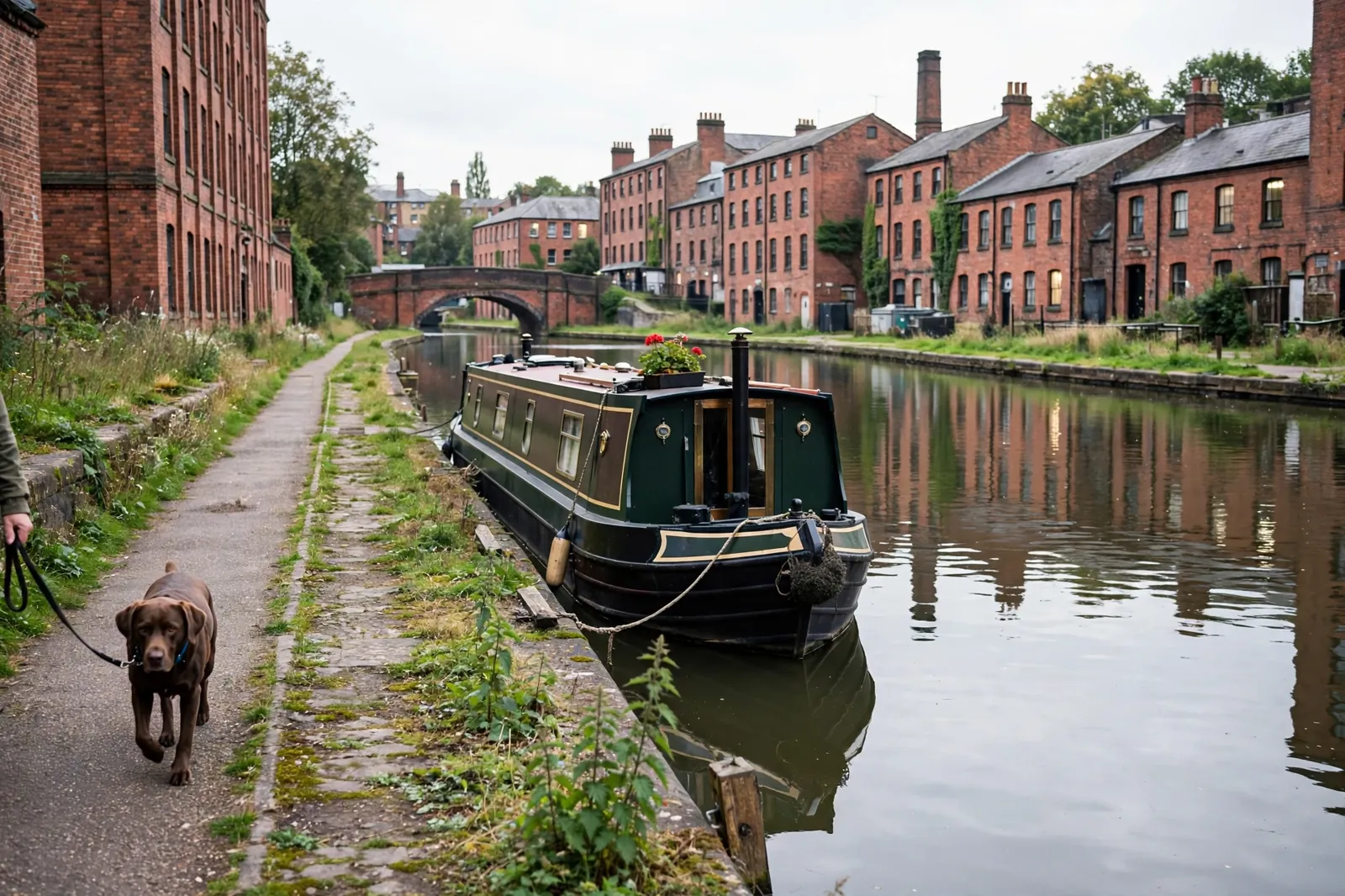
Manchester was built on canals, and for a visiting dog that history is a gift. The Rochdale Canal runs through the city centre past locks, basins and converted mills; the Bridgewater and Ashton canals add further towpath miles, and together they form a ready-made walking network that avoids traffic, connects neighbourhoods and gives a dog long, interesting, mostly level routes in every direction. Start at Castlefield, the canal basin quarter at the city's south-western centre, where basins, viaducts and waterside paths make the gentlest introduction: wide towpaths, moored boats to inspect and an easy loop back into town whenever you have had enough.
Towpath etiquette decides whether canals suit your dog. Keep the lead short where the path narrows under bridges and at locks, step aside for cyclists rather than letting the dog drift across the path, and keep dogs out of the water — canal water is not swimming water, banks can be steep and slippery, and moored boats often have resident owners who expect control near their homes. After dark the towpaths vary in lighting, so plan winter walks for daylight or use the lit, populated stretches near the centre. In wet weather the unsurfaced sections muddy and puddle badly; the paved central stretches are the rainy-day choice.
Plan the canals as one-way walks with a different return. Walk out along the Rochdale towards the northern neighbourhoods or south towards the university and Chorlton direction, then return by bus or tram from a different point, and the city stops feeling like a set of disconnected sights and starts working as a system. That system also solves the exercise problem on sightseeing days: a dog that has had forty towpath minutes in the morning will settle through a cafe lunch and an afternoon of street wandering in a way that a dog walked round the block will not. For the wider pattern of planning city days this way, see our UK weekend breaks with dogs guide.
Heaton Park: the big green day out
Every dog city break needs one place where the dog, not the sightseeing, is the point, and in Manchester that place is Heaton Park, north of the centre and among the largest municipal parks in Europe. Lawns, woodland, a boating lake, an animal centre area, a tram museum on site and acres of open ground make it a half-day or full-day outing rather than a leg-stretch. Dogs enjoy extensive space here, with the usual responsibilities: leads or close control near the lake and its birds, around the animal areas, play spaces, sports and the cafe terraces, and respect for signage wherever the park hosts events. Check the park's official information before you go, because Heaton also stages concerts and large events that fence areas, fill the park and change parking and access completely.
The journey is part of the practicality. Heaton Park has its own stop on the Metrolink Bury line, which makes it reachable without a car, but read the transport section below before relying on the tram with a dog, and allow for busy services on event days and matchdays. Drivers will find large car parks that fill early on fine weekends and event days. Inside the park, the scale cuts both ways: carry water, because the distance between facilities can surprise you, and decide your circuit before you set off rather than following the dog into the far woodland at dusk. In autumn the woodland is the highlight; in summer the open lawns need a shade plan for the middle of the day.
Closer to the centre, smaller parks fill the daily gaps. Whitworth Park by the university, Alexandra Park in Moss Side with its lake and broad paths, and the green spaces of the southern suburbs all serve the morning and evening routine for stays in those areas. The principle from our dog-friendly hotels in the UK guide applies to Manchester with force: choose the base by its nearest decent walk, because a dog staying ten minutes from a real park has a better holiday than a dog in a grander room above a traffic junction.
The Northern Quarter and the city centre on a lead
The Northern Quarter, Manchester's grid of independent shops, cafes, bars and street art between Piccadilly and Ancoats, is the centre's most enjoyable lead walk — at the right hour. Mornings are the sweet spot: deliveries still happening, cafes opening, pavements wide enough for a dog to walk at heel and browse with you. Many independent cafes and bars in the quarter welcome dogs, some enthusiastically, but verify each venue rather than assuming, because the same street holds dog-positive bars and small dining rooms where a pet dog does not fit. By Friday and Saturday evening the quarter becomes one of the city's nightlife hearts, and that version is for humans; a dog weaved through crowded pavements and pub queues is having nobody's good time.
Ancoats, next door across the canal, extends the walk usefully: newer public spaces, the canal basin at New Islington and a calmer, more residential feel, with waterside paths that link back to the towpaths described above. Between the two neighbourhoods you can build a satisfying central loop — Northern Quarter streets, Ancoats basin, a towpath stretch, Castlefield — that gives a dog variety without ever needing the busiest shopping core. The Arndale and main retail streets are best treated as crossings rather than destinations with a dog: go through early or late if you must, and do shopping on a split basis if it matters to the trip.
Football shapes central Manchester in a way visitors should plan around rather than discover. On home matchdays the city fills in waves, trams and trains run crowded, and pubs near the centre and along the routes to the grounds operate at full stretch. Check fixtures before booking dates and before planning a central Saturday; if you are here for the football, arrange the dog's day with the same care as your ticket — a long morning walk, a settled base, and no assumption that the dog joins the matchday crowds. Assistance dog arrangements at venues are a separate matter, explained in our guide to assistance dog access rights in the UK.
Museums and attractions: the split-visit pattern
Manchester's major museums and galleries — the science and industry collections on the Castlefield side, the art galleries, the football museums and the university museum quarter — generally admit assistance dogs only in their interiors, not pet dogs. Individual venues set their own policies, temporary exhibitions can differ, and a few outdoor or partly outdoor sites take a different line, so check the official site before you go for every single attraction and treat any general statement, including this one, as a prompt to verify rather than a guarantee. Arriving with a pet dog at a ticket hall on the strength of an old listing is the most avoidable disappointment in city travel.
The split visit works well here because the museums sit beside good dog walking. Castlefield's basins and towpaths serve the science and industry side of the city; the university quarter has Whitworth Park a short walk from its museums; the centre's gallery visits pair with a Northern Quarter loop. One adult tours for ninety minutes while the other gives the dog a proper walk and a cafe stop, then you swap or reunite for lunch. Book timed tickets where offered so the dog's half can be scheduled precisely, and limit yourselves to one interior highlight a day — museum fatigue is real for the waiting human as well as the walked dog.
Solo travellers have three honest options: enjoy Manchester as the outdoor, neighbourhood city it rewards being; book trusted local dog care for one museum window; or choose the attractions whose outdoor elements carry the visit. Leaving a dog in a car, or alone in unfamiliar accommodation against the property's rules, is not an option on that list. Build the wet-weather plan around this reality in advance — a towpath walk in full waterproofs, a long dog-welcoming pub lunch at off-peak, a browse of the covered markets area from the outside — and a rainy Manchester day stays a holiday rather than becoming an argument with a ticket desk.
Where to stay with a dog in Manchester
Manchester's dog-welcoming stays range from large central hotels that accept dogs in selected rooms to aparthotels and self-catering flats in the residential neighbourhoods, and the base decision follows the familiar rule: geography first. A Castlefield or Deansgate base gives you the canals at the door and the centre on foot, with pavement walks early and late. A Northern Quarter or Ancoats base suits owners who want the cafe scene and do not mind a bus or tram for big green space. Didsbury, Chorlton and the southern suburbs invert the bargain — parks, a village high street feel and calmer evenings, with a tram or bus ride into the centre — and many dogs vote for that version with their behaviour.
Ask the full set of questions before booking, in writing where possible: which rooms accept dogs, what is the fee per dog per night or per stay, are there size, breed or number limits, where may the dog go inside the building, can it be left alone in the room, and what is the nearest grass for the late-night walk. Converted mills and warehouses — some of Manchester's most characterful stays — can involve long corridors, lifts that stop at loading-bay levels and interesting staircases, so ask about access for older or large dogs rather than discovering it with luggage in hand. Our dog-friendly hotels guide sets out the complete checklist and how to get answers that hold up on arrival.
Prices and availability swing with the city's event calendar more than with the seasons. Concerts at the big arenas, festivals, conferences and home fixtures at either football ground can fill the centre and lift rates sharply, and the best-located dog-welcoming rooms go first. If your dates are flexible, a quieter week gives you the same city with emptier towpaths. Bring the usual settling kit — own bed or blanket, chew for the first evening, bags in every coat, towel by the door — and expect the towel to earn its place: Manchester's rain reputation is exaggerated in the telling and entirely real in the packing.
Eating out with a dog: cafes, pubs and markets
Manchester feeds dog owners well if you pick your format. Independent cafes in the Northern Quarter, Ancoats, Chorlton and Didsbury are the most reliably welcoming, pubs with bar areas and beer gardens follow closely, and the city's food halls and market-style venues are worth checking individually — some welcome dogs in shared seating areas, others do not, and the pattern changes often enough that the venue's own website or a phone call beats any list. Formal restaurants are the least likely format. Our UK dog-friendly cafes guide covers the etiquette that keeps the welcome warm: a walked, toileted dog, a short lead out of the walkways, no dogs on seats, and a mat to mark the dog's place if you carry one.
Timing matters more than venue-hunting. Weekend brunch in the Northern Quarter and evening peaks everywhere test even a settled dog; the same cafe at 10am on a Tuesday is a different, calmer proposition. In good weather, canal-side terraces at Castlefield and Ancoats and the beer gardens of the suburbs are the city's dog dining at its best — arrive with a water bowl anyway, because bowls provided by venues disappear on busy days. In winter, the fireside-pub-after-Heaton-Park combination is the Manchester equivalent of a reward, for the human as much as the dog.
If your dog cannot settle indoors, build the trip around takeaways, bakeries and park picnics and treat that as a design choice rather than a failure. The city makes it easy: deli counters near the parks, bakeries in every neighbourhood and benches along every towpath. Watch the dropped-food risk on central pavements at night and around food stalls, rinse paws after gritty winter towpaths, and remember that a dog fed, walked and rested before you sit down is the single biggest predictor of a relaxed meal — for everyone at the table and the tables nearby.
Getting around: Metrolink, trains and buses
Read this section before you plan, because Manchester's tram rules differ from many systems. Metrolink's dog policy has changed in recent years, moving from a small-dogs-in-carriers position towards allowing dogs more generally under conditions, but the current rules, any restrictions by size or number, and peak-time conditions are set by the operator and must be checked on the latest official guidance before you travel — do not build an itinerary, especially the Heaton Park trip, on an out-of-date assumption. If dogs are not permitted for your journey as planned, the same trips work by train to suburban stations plus a walk, or by bus, so hold a plan B for each tram-dependent outing.
Trains follow the national pattern described in our guide to taking a dog on UK trains: dogs travel on a lead, off seats, with consideration for other passengers and any operator conditions. Manchester's main stations, Piccadilly and Victoria, are large and busy; Oxford Road and Deansgate are smaller alternatives for some journeys. Give a nervous dog a pause between platform and street, travel off-peak where you can, and remember that matchdays transform loadings on the routes serving the football grounds. Buses carry dogs at the driver's discretion in the usual way — lead on, aisles clear, off the seats — and fill the gaps the trams and trains leave, including most of the southern neighbourhoods.
Taxis and private hire vary by operator and driver, so declare the dog when booking and carry a clean blanket. Drivers coming into the centre should park once and use the walking network; central parking is priced accordingly and event days change availability. However you move, keep one principle: the towpaths mean you rarely need transport for the dog's exercise itself. Most Manchester days can be built as walk-out, ride-back, which keeps a tired dog off crowded evening services and gives you the freshest version of the city in the morning.
Seasons, matchdays and finishing well
Spring suits Manchester: towpaths dry out, Heaton Park comes into leaf and the cafe terraces reopen, and the city has long evenings without summer's event crush. Summer adds the festival season, park concerts — including major events in Heaton Park that can close or fence large areas, so check the official park information before you go — and hot spells in which the paved centre holds heat; walk early, rest the dog at midday and treat canal shade as a planned resource. Autumn brings the woodlands of Heaton and Alexandra parks into colour and a calmer Northern Quarter. Winter is short days, dark towpaths by late afternoon and rain as a standing plan: choose the lit central stretches, keep the big park days for the bright weekends and lean on the pubs.
Two calendar forces override the seasons. Matchdays, covered above, reshape transport and the centre for hours around kick-off. Large concerts and festivals reshape Heaton Park and the arena districts in the same way. Neither should put you off — Manchester on a big day has an energy many visitors come for — but both belong in the plan before booking, not discovered at the hotel desk. A dog that dislikes crowds, noise and fireworks also needs the city's winter celebrations and any stadium pyrotechnics factored into evening walks, with a settled indoor base as the default during the loudest hours.
Finish the trip the way you started it: one unplanned half day, the vet details saved before you need them, tick checks after Heaton and woodland walks in season, and paws rinsed after grit and towpath mud. Manchester rewards owners who treat it as a set of neighbourhoods joined by water rather than a checklist of sights. Walk the canals, give the dog its big park day, split the museums without resentment, and the city that powered an industrial revolution turns out to power a very good dog holiday as well.
Practical questions
Before you go
Are dogs allowed on Manchester trams?
Metrolink dog rules have changed in recent years and are set by the operator, including conditions on size, numbers and leads, so check the latest official guidance before you travel and before relying on the tram for trips such as Heaton Park. If your journey is not permitted as planned, trains to suburban stations and buses provide alternatives. Never assume an out-of-date listing still applies.
Can dogs go inside Manchester museums?
Most major museum and gallery interiors in Manchester admit assistance dogs only, not pet dogs, though individual venues and temporary exhibitions vary. Check the official site before you go for each attraction. Pairs commonly split the visit, with one person touring while the other walks the dog at Castlefield, along the canals or in Whitworth Park, then swapping or meeting for lunch.
Where can dogs go off lead in Manchester?
Heaton Park offers the most extensive space for exercise, with leads or close control near the lake, animal areas, play spaces, sports and event zones, and Alexandra Park and Whitworth Park serve more central stays. Always follow local signage, keep dogs on leads near roads and shared cycle paths, and use a long line where recall is not secure. Canal towpaths are lead-walking routes, not off-lead runs.
Are dogs allowed in Northern Quarter cafes and pubs?
Many independent cafes and pubs in the Northern Quarter and Ancoats welcome dogs, particularly in bar areas and at off-peak times, but policies vary by venue and can change. Check the venue's own website or phone ahead, walk and toilet the dog before you sit down, keep the lead short and out of walkways, and avoid Friday and Saturday evening peaks, when the quarter is at its busiest.
When is the best time to visit Manchester with a dog?
Spring and autumn usually offer the best balance of daylight, milder weather and manageable crowds. Summer brings festivals and large park concerts that can close parts of Heaton Park, so check official information before visiting. Matchdays at either football ground fill transport and the centre at any time of year, so check fixtures before booking, and plan winter walks around short days and darker towpaths.