This guide is independent and contains no paid placement. Beach restrictions, venue policies and cliff conditions change, so check the official guidance before you travel.
Walk the promenade, use the dog-friendly beach stretches outside the signed summer zone, keep dogs off the Wash mud and away from the cliff base, and stay for the sunset. Hunstanton is at its best as a slow promenade day.
The striped cliffs and the beach
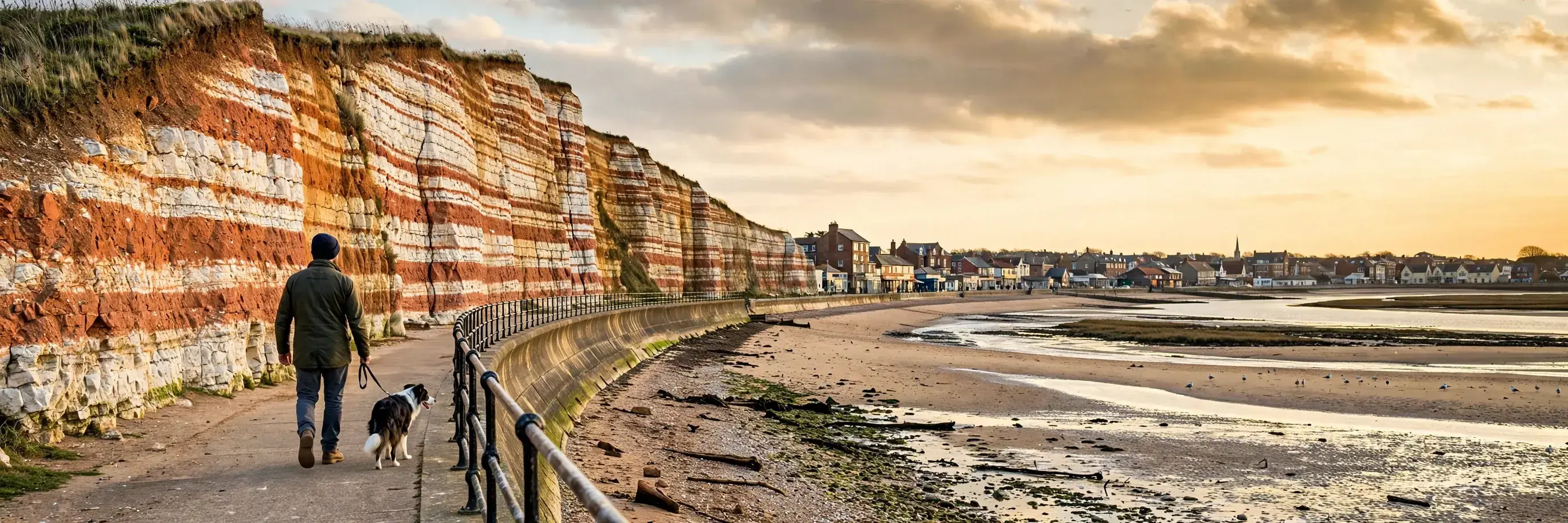
Seen from the sand below the lighthouse, Hunstanton's strata read like a painted cross-section through two Cretaceous seas, with a rust-red band of Hunstanton chalk resting between dark, iron-stained carrstone below and pale white chalk above, each layer holding its own texture against the weather and its own colour under shifting light. Walking southward toward the resort frontage, the sequence lowers and softens, while moving northward the bands grow taller and more insistently striped, until the full red, white, and brown stack stands exposed above a foreshore scattered with fallen chalk blocks and rounded carrstone boulders, a horizontal geometry that makes the cliffs instantly recognisable from across the Wash.
Following the tide line at low water, when the Wash has drawn back to a distant silver ribbon, the beach beneath the cliffs widens into a broad apron of sand ribbed with shallow runnels, broken here and there by low carrstone platforms where limpets grip the stone and small crabs shelter in damp crevices. Scattered across the sand, fragments of red and white chalk, smoothed by seasons of wave action, tell the cliff story, while the protected status of the cliff face itself means fossils and rock are left where they lie rather than carried away, a restraint that keeps the foreshore as interesting for the next visitor as for the first. Under a morning sky the red band glows almost brick-like, whereas by late afternoon the same band deepens toward russet and the white chalk above it turns briefly warm before the light leaves.
Moving along the shore from the resort frontage toward the north, the character of the sand changes step by step, from the groomed, shingle-fringed strip in front of the promenade cafes to a wilder, more open expanse where dune grass takes hold behind the beach and the crowds thin to scattered walkers and their dogs. Beneath the tallest cliffs the sand stays firmer and cleaner, washed twice daily by tides sweeping the Wash in and out, while closer to the town the beach carries shells, seaweed, and chalk pebbles that dogs investigate. At the foot of the northern cliffs, where the carrstone platforms emerge, shallow pools hold tiny fish and anemones after the tide retreats, offering a slow, sniff-filled diversion that suits older dogs and curious puppies far better than a long run across open sand. Returning southward with cliffs on one side and the emptying Wash on the other, the walk feels like a slow tour through deep time, measured in bands of stone rather than minutes.
The promenade and the town
Stretching for well over a mile along the Hunstanton seafront, the broad promenade offers a level, hard-surfaced walk suiting every kind of dog, from stiff-legged seniors to excitable first-time visitors, with benches set at comfortable intervals, shelters against sudden showers, and the whole sweep of the Wash opening to the west. Built as part of the Victorian resort that grew up in the nineteenth century, the promenade still carries that era's confidence, running from the amusements at the southern end past gardens, cafes, and the green, all the way to the lighthouse standing above the northern cliffs. Because the surface never climbs steeply and never turns to soft sand, an outing here can stretch to a full hour or shrink to ten minutes without any awkward turning point, a flexibility that matters when wind off the Wash sharpens or a dog's energy fades early.
Turning inland from the seafront, the resort behind the promenade reveals its planned Victorian origins in wide streets, generous squares, and large houses built of the same dark carrstone forming the base of the cliffs, their warm brown stone giving Hunstanton a visual warmth paler seaside towns lack. Along the main shopping streets, independent cafes, bakeries, and gift shops sit beside hotels and guest houses that have served holidaymakers for generations, and the bustle here has a distinctly family-resort rhythm, with children, ice creams, buckets, and other dogs passing constantly on summer afternoons. For a dog, that bustle is both entertainment and test, since the scents of fish and chips, the sight of other dogs on every corner, and the sudden movements of children require a steady temperament and a short lead through the busiest stretches, especially around the green and the seafront gardens.
Arriving at the lighthouse at the far northern end, a squat, striped tower that has guided shipping at the mouth of the Wash since the seventeenth century, the promenade walk reaches its natural landmark, with striped cliffs falling away below and Old Hunstanton village visible along the coast to the north. From this point the hard surface gives way to the coast path, and many walkers turn back toward the town, retracing their steps past gardens and cafes with sunset light now colouring the Wash behind them. As a standalone outing, the full promenade there and back measures roughly two miles of easy walking, with a cafe stop at either end, making it the choice for a first morning, a wet-weather fallback, or a gentle evening walk when the beach feels too exposed.
The Wash: tides, mud and sunsets
Dominating every view from the Hunstanton promenade, the Wash is a vast, shallow tidal bay where the sea twice daily advances toward the seafront and then retreats for miles, leaving behind glistening mudflats, winding channels, and sandbanks stretching toward Lincolnshire. At high water the town feels like a conventional resort, with waves breaking close beneath the promenade wall and the horizon reduced to a simple line of sea and sky, whereas at low water the same viewpoint opens into a lunar landscape, where the retreating tide exposes acres of silt crossed by narrow creeks catching the light like veins of silver. That twice-daily transformation governs everything about a visit here, from how far a dog can run on the sand to whether the beach at the foot of the cliffs is even reachable, since the tide timetable, rather than any clock, decides when the foreshore belongs to walkers and when it belongs to the sea again.
Spreading eastward from the Hunstanton shoreline, the mudflats that make the Wash so spectacular are also its one serious danger, because the silt here runs deep, soft, and deceptively firm-looking, while hidden channels cut through it and the returning tide races across the flats far faster than a walker standing on the sand would expect. A dog sprinting after a gull or a ball across that surface can sink, panic, and become trapped within minutes, and rescue across such ground endangers the rescuer as much as the rescued, which is why the firm sand of the upper beach and the promenade above it are the only sensible ground for dogs at Hunstanton.
Filling those flats with life through autumn and winter, the Wash supports one of Britain's great bird spectacles, as tens of thousands of waders, wildfowl, and pink-footed geese gather on the mud and the nearby salt marsh, their movements tracking the tide with a precision that turns a Hunstanton walk into an improvised birdwatching outing. Knots and dunlins sweep across the flats in dense, shape-shifting flocks as the water advances, while the salt marshes toward Snettisham and the reserves further along the coast hold brent geese and wigeon, all visible from the promenade with the naked eye on a clear day. For dogs, that abundance of birds is another reason to keep the walk on the upper beach and the promenade, since a single chase across the flats disturbs feeding flocks that have travelled thousands of miles to reach this estuary, and the birds' need for undisturbed feeding time outweighs any dog's curiosity.
Old Hunstanton and the coast path
Lying about a mile north of the resort town along the coast, Old Hunstanton is the village from which the Victorian resort took its name, and the contrast between the two places could hardly be sharper, since the village offers a church, a green, a golf course, and a scatter of carrstone cottages in place of the resort's amusements, arcades, and promenade crowds. Reaching it on foot means following the promenade to the lighthouse, then continuing along the cliff-top coast path as it curves past the striped cliffs, the dunes, and the open grassland above the beach, a route staying mostly level but including a handful of steps and short slopes where the path dips toward the shore. Along the way the views open in both directions, back toward the resort town with its cliffs glowing in the light, and forward toward the wilder, emptier coastline running on toward Holme-next-the-Sea, a prospect making the walk feel like a genuine coastal journey.
Arriving in the village, the pace slows, with the church of St Mary standing beside the green, its tower visible from the coast path, and the village street winding past cottages built from the same dark carrstone underlying the Hunstanton cliffs. The beach here, backed by dunes and rough grass rather than a promenade wall, opens at low tide into a wide, quiet expanse of sand suiting dogs far better than the resort frontage, since crowds thin out, space widens, and the shoreline feels more like a natural coast than a managed resort beach. Families still come here, especially on fine weekends, but on weekdays the beach can feel almost empty, with long stretches of sand shared only by walkers, their dogs, and gulls working the tide line.
Continuing past the village green toward the dunes, the golf course stretching inland behind the beach introduces the walk's one firm boundary, since the fairways are private playing land where dogs stay on the marked paths and well clear of golfers, whose drives carry across the open ground. Keeping to the beach side of that boundary, the walk remains generous, with dunes offering shelter from the wind off the Wash and grass behind the sand giving dogs a softer surface to explore after the promenade miles. The village pub, tucked near the green, provides the natural turning point for an out-and-back walk, a place to rest with a dog settled under a table before retracing the coast path southward, with the light now changed and the cliffs showing a different face than on the outward leg.
Family seaside: fairground, food and dogs
Gathered around the southern end of the promenade, Hunstanton's fairground and amusements set the tone for the resort's family trade, with rides, arcades, and stalls filling the seafront with noise, flashing lights, and crowds delighting children while testing the composure of even steady dogs. Most dogs cope better with that end of town observed from a distance than entered directly, since the combination of music, sudden movement, and other dogs in close quarters overwhelms senses already working hard on a seaside day, and the rides and arcades themselves are not places where dogs are taken inside. Planning around that reality means treating the fairground as the humans' diversion and the beach, the promenade, and the Old Hunstanton path as the dog's, with one member of the party staying outside with the dog while others enjoy the rides, or with the fairground saved for a time when the dog is resting back at dog-friendly accommodation.
Turning to food, Hunstanton's seafront trade runs on the classic repertoire of fish and chips, ice cream, and cafe lunches, served from takeaway counters and terraced cafes along the promenade where dogs settle beneath tables as their owners eat within sight of the Wash. A takeaway eaten on a promenade bench, with the dog lying on a blanket at its owner's feet and gulls circling hopefully overhead, captures the town at its most characteristic, provided the food stays guarded, since Hunstanton's gulls have learned every trick for snatching an unguarded chip and will not hesitate over a paper tray left on a bench.
Settling into a Hunstanton cafe or pub with a dog, the pattern emerging is one of terraces first and bar areas second, with many venues along the promenade and in the town centre making room for dogs outdoors and a smaller number welcoming them inside, a distinction shifting with the seasons as terraces fill on fine days and indoor space tightens on wet ones. Water bowls appear outside many doorways in summer, and staff in a resort this accustomed to dogs tend to greet them as a matter of course, yet individual venues still vary, and the only reliable way to know a given day's arrangement is to look at the doorway and ask the people working there rather than assuming last year's welcome still holds. Mentioning the dog when reserving a table for an evening meal avoids an awkward arrival, especially for larger dogs and for parties eating at the busiest times, when terrace tables turn over quickly and space is at a premium.
Parking, facilities and seasons
Arranged around the seafront and the town centre, Hunstanton's car parks put drivers near the promenade, with the largest areas serving the southern seafront near the amusements and smaller ones tucked behind the town centre, while Old Hunstanton offers its own quieter parking near the village green for walkers starting the coast path from the northern end. On fine days, the seafront areas fill early, and a late arrival can mean a longer walk from a town-centre space or a decision to start instead from Old Hunstanton, where the quieter car park turns the day's walk around. Payment arrangements at these car parks have changed over recent seasons, with machines and tariffs revised from time to time, so the board standing beside the seafront car park office on the morning of the visit remains the version to trust over anything printed in a guide, including this one.
Walking the promenade from any of those car parks, the facilities mattering most to dog owners appear at intervals, with public toilets on the seafront, cafes and kiosks along the promenade, fresh water points for bottles, and waste bins placed where the beach paths meet the promenade, within easy reach of the car. Hunstanton has no large indoor attraction built around dogs, so wet weather calls for a different rhythm, with short promenade dashes between showers, a long pub lunch. Packing a drying towel, a waterproof coat for the dog as well as its owner, and a spare lead turns a showery Hunstanton day from a washout into a perfectly ordinary seaside outing, with the car near the seafront offering a warm, dry retreat.
Changing with the seasons more dramatically than the quieter Norfolk villages inland, Hunstanton in summer runs at full resort pitch, with every cafe open, the fairground in full voice, the promenade crowded, and the beach at its busiest, while spring and autumn soften everything, thinning the crowds, lengthening the quiet stretches of sand, and giving the cliffs their clearest light for photography. Winter strips the town back further, with some seasonal businesses closed, the promenade exposed to strong winds off the Wash, and the beach largely empty, a combination suiting hardy walkers and their dogs but calling for warm clothing, a shorter route, and a pub with a fire at the end of it. Each season asks for a different Hunstanton day, and the visits working best are the ones matching the dog in front of the owner to the season in front of the town, rather than forcing a summer plan onto January.
Beach zones, cliff safety and hot sand
Marked by signs where the promenade steps meet the sand, the summer arrangement on Hunstanton's resort frontage confines dogs away from the main town beach, leaving the quieter northern stretches toward Old Hunstanton and the promenade itself as the places where a dog day continues uninterrupted through the summer. That signed boundary defines the stretch and the dates in force, and the signs posted at the promenade entrances on the day of the visit carry the authority that matters, since boundaries and dates have been adjusted in past seasons and the enforcement following them, under public space protection orders, is real. For the wider picture of how seasonal beach rules work across Britain, the guide to how Hunstanton's summer beach zoning sits inside the wider patchwork of British seaside dog rules explains the system producing arrangements like the one on this frontage.
Standing beneath the striped cliffs, the safety consideration mattering most is the cliff face itself, which sheds chalk and carrstone, especially after heavy rain, frost, or a long dry spell followed by sudden wet weather, when loosened blocks can fall onto the sand below. Keeping well back from the base, where fallen debris litters the foreshore, and keeping a dog close on the cliff-top path above, where gusts off the Wash can unsettle even a large dog near an unfenced edge, are the two habits making the cliff walk safe, while digging at the cliff foot or scrambling on fallen blocks invites exactly the hazard the warning signs describe. After storms, the cliff line deserves even more room, since fresh falls are likeliest in the days following.
Baking under a July sun, the Hunstanton seafront presents a heat problem with a very local shape, since the promenade paving stores warmth through the afternoon, the sand in front of the resort heats fastest where it lies dry above the tide line, and shade on the open beach is nonexistent, leaving the gardens behind the promenade and the waterline itself as the only cool ground. Dogs with flat faces, heavy coats, or advancing years feel that heat first, showing it in heavy panting, a reluctance to keep walking, and a search for any damp sand or shadow, at which point the sensible response is a retreat to the gardens, a cafe terrace, or the car, rather than pressing on toward Old Hunstanton. Early morning and late evening walks, when the sand has cooled and the promenade has released its stored heat, turn the same route into an entirely different and far kinder outing.
A seaside day plan for Hunstanton
Beginning on the promenade while the town still sleeps, a well-judged Hunstanton day opens with the easy seafront walk from the southern amusements toward the lighthouse, letting the dog greet the sea breeze, the gulls, and the first other dogs of the day. From the lighthouse, the choice depends on the tide and the dog's energy, with the cliff-top coast path to Old Hunstanton offering the longer, quieter outing and the beach below the northern cliffs offering a shorter, sand-based alternative at low water, while a less energetic dog may simply retrace the promenade with a cafe stop as its morning's work. That opening hour, unhurried and close to the car, sets the tone for everything following, since a dog already walked, sniffed, and settled is far easier company through the busier middle of the day.
Settling into the middle of the day, the plan turns toward food, shade, and rest, with a cafe terrace or a pub table in the town centre giving the dog a blanket, a drink, and a lie-down while the humans eat, and with the gardens behind the promenade offering a grassy alternative for a dog preferring open air to a busy interior. Younger dogs, rested and watered, may return to the sand as the tide falls again in the afternoon, while older dogs often prefer a second, slower promenade stroll, watching the beach from above rather than crossing it, and both patterns fit the town, since Hunstanton's attractions all lie within a mile of each other. The fairground and amusements, meanwhile, belong to this middle stretch for families, enjoyed by the children while the dog rests with a companion or back at accommodation.
Drawing toward evening, the day's best hours arrive with the light changing over the Wash, and the final walk, whether a return along the coast path from Old Hunstanton or a promenade loop past the gardens, is timed so that the western sky is colouring as the dog trots the last stretch. An evening meal in a town-centre pub or a takeaway eaten on a promenade bench then closes the day, with the dog settled at its owner's feet, lamps coming on along the seafront, and cliffs fading to silhouette against the last of the light. For walkers deciding whether Norfolk or a longer journey north suits their next break better, the comparison of what a Norfolk base at Hunstanton offers against a Northumberland coastal break for dogs puts the resort's short walks, flat promenade, and village coast path in a wider context.
Practical questions
Before you go
Are dogs allowed on Hunstanton beach?
The resort frontage in Hunstanton carries a signed summer arrangement that keeps dogs off the main town beach during the warmest months, while the northern sand toward Old Hunstanton and the promenade above it remain open for dogs. Reading the signs at the promenade steps on the day itself gives the current boundary, since past seasons have adjusted both the stretch and the dates.
Why is Hunstanton famous for its sunsets?
Hunstanton faces west across the Wash, an orientation almost unique on England's east coast, so the sun sinks into the sea. Wide skies, tidal flats, and the red band of the striped cliffs each catch a different stage of the fading light, and the promenade provides the simplest vantage point for watching it with a dog.
Is the cliff walk to Old Hunstanton suitable for dogs?
Most dogs manage the mile from the resort promenade to Old Hunstanton village, since the route stays largely level with only a few steps and short slopes where the path dips near the shore. Dogs stay close on the cliff-top stretches, well back from the cliff base, and the walk is best avoided in high winds or after heavy rain when the cliffs are least stable.
Can dogs go in Hunstanton cafes and pubs?
Many Hunstanton venues make room for dogs, most reliably on terraces and in bar areas, with water bowls outside numerous doorways in summer. Arrangements vary from venue to venue and from season to season, so looking at the doorway and asking the staff on the day gives a surer answer than any general statement, and mentioning the dog when reserving avoids surprises.
Is the Wash mud dangerous for dogs?
The Wash mudflats are deep, soft, and cut by hidden channels, and the returning tide crosses them far faster than it appears to from the shore. Dogs stay on the firm upper beach and the promenade, never venturing onto the mud itself, since a dog that sinks or panics out on the flats creates an emergency that endangers anyone attempting a rescue.
What is the best time of year to visit Hunstanton with a dog?
Spring and autumn suit most dogs best, with thinner crowds, cooler sand, the full run of the northern beach, and the cliffs under their clearest light. Summer brings the resort at its liveliest but also its busiest, while winter offers empty beaches and dramatic skies at the cost of strong winds and several seasonal businesses closed.