This guide is independent and contains no paid placement. If affiliate links are added later, they will be clearly marked and will not change our editorial checks.
Start at the harbour while it is still working, walk the quay out to Verity, then time the Tunnels Beaches around low tide. Dogs go through the tunnels on a lead but not onto the beaches, so plan the swim at Hele Bay or Wildersmouth instead, and keep dogs on a lead on the cliff sections of the coast path in both directions.
The harbour at work in the morning
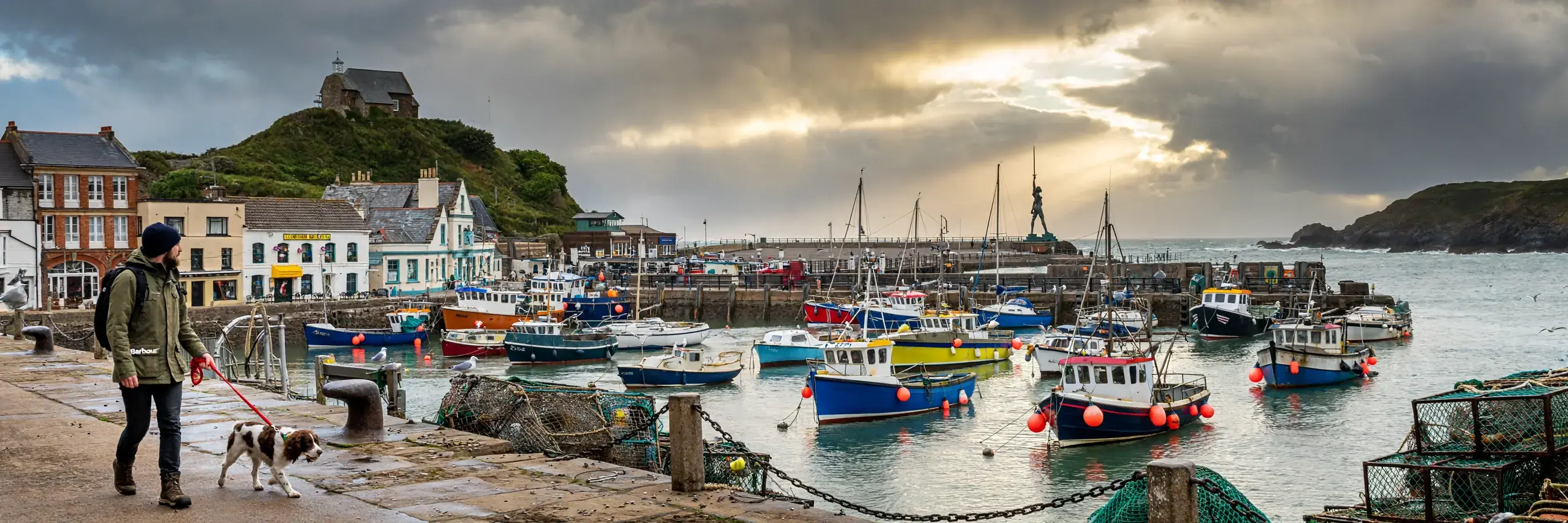
Ilfracombe wakes up at the harbour. Before the shops open and before the day visitors arrive, the quay belongs to the boats: fishing craft tied up in rows, crates and coiled rope on the stone, gulls circling the masts, and the smell of salt and diesel drifting across the water. This is the best hour to bring a dog. The town is quiet, the light is low over the Bristol Channel, and there is enough going on to keep a curious nose busy without the crowds that fill the same stones by midday.
Walk the harbour slowly and let the dog read it first. The inner harbour sits in a natural hollow between steep hills, so the sound carries: engines turning over, a radio somewhere on a boat, gulls arguing over the first catch of the day. Keep the lead short here. The quay edge has no fence in places, the stone can be slick with weed and fish water, and a dog that lunges at a gull can be at the water before you have time to react. A harness with a handle helps on the harbour steps, and a towel in the car earns its keep if paws pick up harbour grime.
The harbour is a working port, not a museum, and that shapes the whole visit. Boats come and go with the tide, so the water level in the inner harbour rises and falls through the day and the small sandy patch known as Harbour Beach, or Strand Beach, only shows itself at low tide. Pleasure boats and the Lundy ferry use the same quay, which means the busiest moments are boarding times rather than the middle of the afternoon. Dogs are excluded from the Lundy Island voyages, so treat a sailing day as a humans-only plan and use the harbour time for a walk instead. Check the official guidance before you travel if you are hoping to book any boat trip with a dog in mind.
Morning is also when you learn what kind of day the coast will give you. Stand on the quay and look west towards the open sea: if the wind is already pushing spray over the pier, the cliff paths will be harder work and the tunnels will be the better call. If the water is flat and the hills are clear, that is the day to climb. Either way, the harbour loop makes a calm first walk of about twenty to thirty minutes, and it sets the geography for everything else: the pier and Verity at one end, the town climbing uphill at the other, and the coast path leaving town in both directions.
Bring water for the dog even on a short harbour walk. There is plenty of sea water around and none of it is safe to drink, and a dog that has been sniffing fish crates will be thirsty. A collapsible bowl fits in a pocket and saves a hunt for a tap. Poo bags matter here more than on a country lane, because the quay is shared with people eating ice cream and sitting on the harbour wall, and the town notices who cleans up. Bin the bag in one of the harbour bins rather than leaving it by a bollard for later.
The quay, the pier and Verity
From the inner harbour, the quay runs out towards the sea along the pier, and the walk changes character as you go. The inner end is boats and buildings and the smell of the catch. The outer end is wind, open water and the full height of the cliffs behind you. Dogs tend to settle into the rhythm of it: sniff the ropes, watch the boats, then lift their heads as the wind picks up. Keep the lead short for the whole length, because the pier is narrow in places and the drop to the water is direct.
At the far end of the pier stands Verity, the bronze statue by Damien Hirst that has become Ilfracombe's most argued-about landmark. Installed in 2012, the figure of a pregnant woman holding a sword aloft stands about twenty metres tall, with one side showing the musculature and the unborn child beneath the skin. It divides opinion exactly as public art is supposed to, and it is free to look at from the pier. For a dog walk it works as a natural turning point: walk out, look back at the town stacked up the hillside behind you, let the dog have a drink, and walk back along the quay with the view the other way round.
The view back from the pier is the one to remember. The harbour sits in a bowl of steep green hills, with pastel houses climbing the slopes and the white chapel of St Nicholas on Lantern Hill above the harbour mouth. The chapel is said to be the oldest working lighthouse in the country, and its light still marks the entrance for boats coming in after dark. You do not need to climb Lantern Hill with a dog on your first day, but knowing it is there helps you read the town: everything in Ilfracombe is either up a hill or down towards the water, and the harbour is the flat bit in the middle.
Watch the weather on the pier. There is no shelter at the far end, and a squall that feels like a breeze in the town can be a proper soaking on the exposed stone. If the wind is strong, walk the pier with the dog on your sheltered side and cut the visit short rather than pushing on to the statue in a gust. In summer the pier is also where the crowds gather, so an early or late walk is kinder to a dog that dislikes being stepped over. In winter the same walk can be empty for an hour at a time, which suits nervous dogs, provided you dress for the wind and keep the walk short.
The quay is lined with places to sit, and that matters more than it sounds. A dog that has walked the harbour and the pier needs somewhere to lie down while you work out the rest of the day, and the harbour wall and the benches along the quay give you that pause. Sit for ten minutes, watch the boats, and decide whether the tide is right for the tunnels, whether the cliffs look inviting, or whether the town centre is the better next step. Ilfracombe rewards that kind of unhurried decision, because the tide and the weather change the options every few hours.
The Tunnels Beaches and tide timing
The Tunnels Beaches sit a short walk from the harbour, below the main road at Bath Place, and they are the strangest and most memorable place to take a dog in Ilfracombe. In the 1820s, workers hand-carved a series of tunnels through the rock so that Victorian bathers could reach a sheltered cove and a tidal pool away from the town. The tunnels are still there: cool, dim, dripping in places, with the sound of the sea growing louder as you walk through. Dogs are allowed through the tunnels on a lead, which makes the walk itself the attraction for them, even though the rules change at the far end.
That rule is the one to get right before you go. According to North Devon Council, dogs are allowed through the tunnels on a lead but not onto the beaches themselves, and the Tunnels Beaches are privately owned, so the operator's own conditions apply on top of the council position. Do not plan a swim here. Walk the tunnels with the dog on a short lead, look at the tidal pool and the rock pools from the tunnel mouths and the beach edge, and save the paddling for Hele Bay or Wildersmouth. Check the official guidance before you travel, because opening hours, admission charges and the dog rules can change with the season.
Tide timing decides whether the visit works at all. The beaches at the far end of the tunnels are covered at high tide, and the tidal pool only shows its shape as the water drops. Arrive on a falling tide, a couple of hours before low water, and you get the tunnels, the pool and the rock pools in one visit. Arrive at high tide and you get the tunnels and a wall of water, which is still interesting but not the full experience. Check the tide times for Ilfracombe the night before, and build the day around them rather than trying to fit the tide around lunch.
The tunnels themselves need a little care with a dog. The floors are uneven and can be wet, the light changes sharply between the tunnel and the open beach, and the sound of the sea echoes in a way that startles some dogs. Walk through slowly, keep the lead short enough that the dog cannot slip ahead around a bend, and let a nervous dog stop and sniff rather than dragging them on. The tunnels are not long, but a dog that is rushed through them will remember the rush rather than the place. On the way back, the climb from the beach level to the road is the harder half of the visit, so save some energy and some water for it.
There is an admission charge for the Tunnels Beaches, and the site opens seasonally, so treat it as a planned stop rather than a passing whim. That is actually a kindness to the dog: a timed visit means you arrive with water, a towel and a plan, rather than stumbling in hot and thirsty. If the tunnels are closed on the day you visit, the walk to the entrance and back still gives you the cliff views above the cove, and Wildersmouth Beach is a short walk away for the paddle you missed.
Beaches in and around town
Ilfracombe does not have one big town beach. It has a scatter of small coves, each with its own character, its own tide and its own dog rules, and part of the pleasure of the town is learning which cove suits your dog. The council-owned beaches in Ilfracombe allow dogs, subject to the district-wide rules on picking up after your dog and putting your dog on a lead when requested, but the privately owned Tunnels Beaches have their own conditions, and the beaches outside the town boundary change again. Read the signs at each beach entrance, because the sign on the day is the rule that counts.
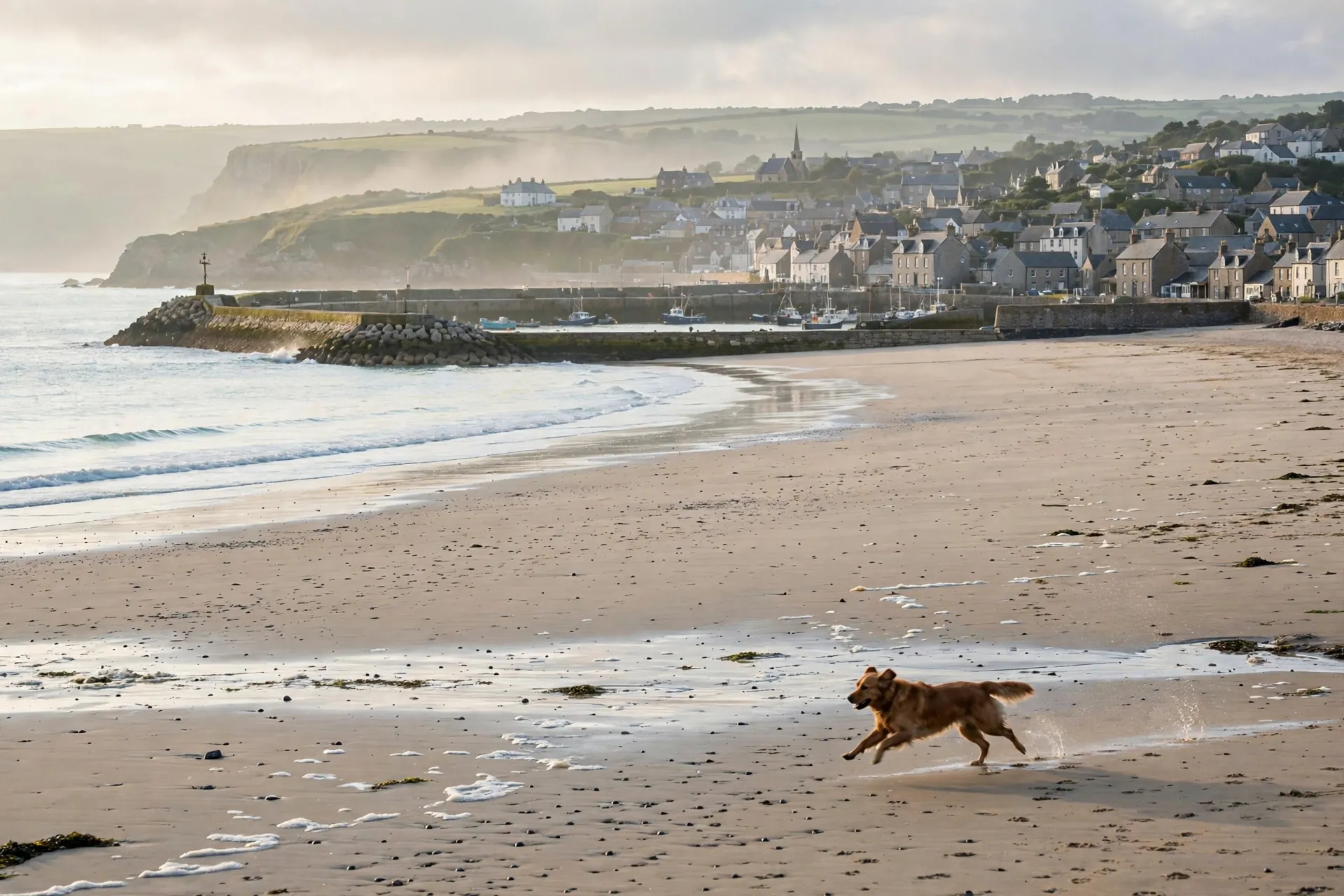
Wildersmouth Beach is the easiest cove to reach from the harbour, a short walk past the theatre and the gardens below Capstone Hill. It is a small sandy cove that welcomes dogs all year round, and it is the place most local dog walkers use for a quick paddle. The beach is covered at high tide, so check the tide times before you set off, and arrive as the water drops to get the widest stretch of sand. The shingle and sand mix is kinder on paws than the harbour stone, and the cove is sheltered enough that a small dog can paddle at the edge without being knocked over by surf.
Harbour Beach, or Strand Beach, is the town's most convenient patch of sand and its most temporary. It appears inside the inner harbour at low tide and disappears again as the water returns, so it is a place for a sit and a paddle rather than a long beach session. Dogs can use it under the council beach rules, but the harbour is a working place: keep the dog away from moored boats, ropes and slipways, and leave well before the tide turns. The charm of the place is its position, right in the middle of the town's working life, with boats on one side and cafes on the other.
Hele Bay, a mile and a half east of the town, is the cove most visitors end up loving best. It is a sheltered mix of sand and shingle below the cliffs, with rock pools and small caves at low tide on either side of the bay, and it is quieter than the town coves because it takes a walk to reach. Dogs are welcome, and the bay is a good place for a longer paddle and a game of fetch away from the harbour crowds. There is a pub at Hele Bay, which makes it a natural end point for a walk rather than a place you rush back from.
Further east, the coast path passes Rapparee Cove and Broadsands, both of which welcome dogs all year round according to local listings, but both of which demand effort to reach. Broadsands is reached down a long flight of steps, about two hundred and forty of them, so it suits a fit dog and an owner with good knees, and it is a poor choice for an older dog or anyone carrying a tired puppy back up. Rapparee Cove is smaller and rockier, and the access is steep. Treat these coves as rewards for a coast-path walk rather than as destinations in their own right, and carry water for the climb back.
On every beach, the same practical habits apply. Check the tide times and the signs before letting a dog off the lead. Keep the dog away from fishing lines, bait and dead fish on the strand line, all of which are tempting and all of which can make a dog ill. Rinse sandy paws before the walk home, because sand between the toes turns into sore paws by the evening. And remember that the sea off Ilfracombe is the Bristol Channel, with a strong tidal range: a beach that looks wide and safe at low tide can narrow fast, so keep an eye on the water while the dog plays.
The coast path east to Hele Bay
The South West Coast Path leaves Ilfracombe in both directions, and the eastern stretch is the gentler place to start. From the harbour, the path climbs over Hillsborough, the grassy headland that shelters the town from the east, and drops down to Hele Bay about a mile and a half away. The climb is steady rather than steep, the views open up quickly, and the reward at the far end is a sheltered cove with a pub. For a dog, it is the best first cliff walk in Ilfracombe: enough height to feel like a proper walk, without the exposed drops that define the western side.
Hillsborough itself is worth slowing down for. The headland is open grassland with views back over the harbour, the town and the coast to the west, and on a clear day you can see a long way along the Bristol Channel. Keep the dog on a lead here, because the grass runs close to the cliff edge in places and the ground falls away sharply on the seaward side. The path is well worn and easy to follow, but after rain the grass is slippery and the chalky soil can be treacherous underfoot, so wear boots with a proper grip and keep the dog close on the downhill sections.
From Hillsborough the path drops to Hele Bay, and the change of mood is immediate. The cove is sheltered, the water is calmer than at the harbour mouth, and the beach is a mix of sand and shingle that suits dogs that like to paddle and dig. At low tide the rock pools on either side of the bay are full of small crabs and shrimps, which will keep a curious dog occupied for longer than you expect. Let the dog paddle, have a drink of fresh water, and rest in the shade of the cliff before the walk back, because the climb out of Hele Bay is the hardest part of the return leg.
Fit dogs can carry on east from Hele Bay towards Watermouth and Combe Martin. The path passes Watermouth Harbour, a small tidal inlet with a castle above it, and continues along the cliffs to Combe Martin, a village with a long main street running down to the sea. This is a full half-day walk rather than a morning stroll, and the ground gets steeper and more uneven as you go. Combe Martin Beach itself bans dogs between 1 May and 30 September, so in summer the village is a place for a drink and a rest rather than a beach stop, and you should check the official guidance before you travel in spring, when the start date of the ban has been disputed between different council notices. In winter, when the ban lifts, the beach is open to dogs again.
The eastern walk is also the better choice in bad weather. The path is lower and more sheltered than the western cliffs, and there are places to turn back at Hillsborough and at Hele Bay if the wind picks up. If the rain arrives halfway, you can cut back to the town along the road from Hele Bay rather than retracing the cliff path in the wet. Carry a drying coat for the dog, because the wind on the headland will chill a wet dog fast, and a lead you can shorten quickly for the stiles and gates along the way.
The coast path west to Lee Bay
West from Ilfracombe, the coast path is wilder, steeper and more exposed, and it is the walk to save for a calm, dry day. The path climbs Capstone Hill, the rocky knoll that rises above the harbour and the theatre, then follows the cliffs past the Torrs towards Lee Bay and on towards Woolacombe. The drops are bigger here, the path is narrower in places, and there are fewer easy places to turn back, so this is a walk for a dog with good recall and an owner who is comfortable with heights.
Capstone Hill is the first test. The climb from the town is short but steep, with steps and rocky ground, and the top is open to the wind from every direction. The reward is the best view in Ilfracombe: the whole harbour below you, the town spread across the hills, and the coast running away to the west. Keep the dog on a lead on Capstone, because the rock is uneven, the edges are unfenced, and a dog chasing a gull can be in trouble in seconds. On a clear morning the hill is busy with walkers, so a nervous dog may prefer the quieter eastern route, but on a weekday out of season you can have the top to yourself.
Beyond Capstone, the path runs along the Torrs, a stretch of rough cliff-top grassland that feels a long way from the town even though it is only a short walk out. The ground here is uneven, with gorse and bracken beside the path and sheep grazing in the fields inland, so the lead stays on. The views west are wide open: the coast falling away towards Lee Bay, the headlands beyond, and on a clear day the long sweep of the Bristol Channel. This is the part of the walk where the wind matters most, because there is no shelter at all, and a wet dog in a strong wind will get cold quickly. Check the forecast before you set off, and turn back at the first sign of the weather closing in.
Lee Bay is a small, quiet cove below the cliffs, reached by a steep path down from the coast path. It is a good place to stop for a paddle and a rest, and it is much quieter than the town beaches, because the walk in puts most people off. The beach is a mix of sand and rock, and at low tide there are pools to explore. The climb back up is the price of the visit, so save water and energy for it, and do not attempt the descent in wet weather, when the path becomes slippery clay.
From Lee Bay, strong walkers can continue west towards Woolacombe, but this is a long and demanding stretch, and it is better done as a planned day walk with transport arranged at the far end than as an out-and-back from Ilfracombe. Woolacombe Beach is three miles of golden sand with a zoned dog system: part of the beach bans dogs in the summer season, part allows dogs on a lead, and part has no restrictions at all, so check the signs at the beach entrance and the official guidance before you travel. If you do walk through to Woolacombe, plan the bus or a lift back, because the return walk over the same cliffs in the afternoon is a hard end to the day for any dog.
The town centre and its lanes
Ilfracombe's town centre climbs uphill from the harbour along the High Street and Fore Street, and the slope is the first thing a dog walker notices. The town is built on steep hills, and every walk out of the centre involves a climb, which is good exercise for a fit dog and hard work for an older one. Plan the day so the uphill comes early, while the dog is fresh, and the downhill comes late, when the legs are tired. The lanes off the main streets are narrow and full of character, with small shops, galleries and cafes tucked into old buildings, and they are worth exploring slowly with a dog on a short lead.
The High Street is the practical heart of the town: supermarkets, a pharmacy, outdoor shops and the usual seaside mix of gift shops and cafes. Dogs are welcome in many of the smaller shops, though the rule varies from door to door, so look for the sign or ask before you walk in with a wet dog. The pavements are narrow in places and busy in summer, so keep the dog on your inside, away from the road, and be ready to step into a doorway to let a pushchair or a delivery trolley past. A dog that is nervous in crowds will be happier on the harbour in the morning and in the lanes in the early evening, when the day visitors have gone.
Above the town centre, the streets climb towards the church and the older houses on the hill, and the views open up with every step. This is the quieter side of Ilfracombe, with less traffic and more gardens, and it makes a good evening walk when the harbour is busy. The climb is steep, so take it slowly and let the dog set the pace. An older dog or a small breed will need rest stops, and a dog with joint problems may be better off sticking to the harbour and the flat parts of the town centre.
One practical point about the town centre is parking. The car parks near the harbour fill early on a summer day, and the walk from the outer car parks to the harbour is uphill on the way back, which matters when you are carrying a tired dog and a bag of wet towels. Arrive early, use the car parks closest to the harbour if you can, and remember where you left the car, because the one-way system and the steep streets make it easy to lose your bearings. If you are staying in the town, walk everywhere and leave the car parked: Ilfracombe is compact enough that the harbour, the tunnels, the town centre and the start of both coast paths are all within walking distance of each other.
The town also has the everyday services a dog owner needs on a longer stay. There are vets in the town and in nearby Barnstaple, pet shops on the High Street, and a good choice of takeaways for an evening when the dog is too tired for a restaurant. Save the vet's number in your phone on arrival, and note the opening hours of the nearest practice, because the nearest emergency vet out of hours may be a drive away. Check the official guidance before you travel if your dog needs regular medication or a specific food, and bring enough of both for the whole stay rather than relying on a local shop to stock them.
Where to eat and drink with a dog
Ilfracombe is one of the easier North Devon towns for eating out with a dog, because so much of the eating happens on the harbour, where the dog is part of the furniture. The quay is lined with cafes, pubs and restaurants, many of which welcome dogs on their terraces and in their bar areas, and the town's pubs have a long tradition of dogs lying under tables while their owners eat. The rule is rarely written on the door, so ask when you arrive, and be ready to sit outside if the inside is full or the dog is restless.
The harbour pubs are the natural choice for a dog-friendly meal. The George and Dragon, an old pub near the harbour, welcomes dogs and makes a good stop after a morning walk, and the pubs along the quay serve food through the day with dogs welcome in the bar and on the terrace. The Pier Brewery Tap and Grill, overlooking the quay, has a beer garden that works well for a dog that likes to lie down and watch the harbour, and the harbour cafes serve breakfast and lunch with dogs welcome outside. In summer, the terraces fill fast, so eat early or late, and bring a mat for the dog to lie on, because the stone floors and the quayside are hard and cold.
At Hele Bay, the pub at the end of the eastern coast walk is the reward for the climb, and it welcomes dogs. A walk to Hele Bay, a drink and a rest, and a slow walk back is one of the best half-days in Ilfracombe, and it works because the pub is used to walkers arriving with muddy boots and tired dogs. Order at the bar, settle the dog under the table or on the terrace, and let the dog recover before the climb back over Hillsborough. The same pattern works in the other direction: a pub stop at Lee Bay or on the way back from the Torrs is a good way to break a long cliff walk into manageable pieces.
A few habits make eating out with a dog work smoothly. Feed the dog before you sit down to eat, so the dog is settled rather than hungry and restless. Bring water and a bowl, because not every terrace has a dog bowl ready, and a dog that has walked the cliffs will be thirsty. Keep the lead short and under the table, and choose a table at the edge of the room rather than in the middle of the traffic, where waiters and other dogs will pass all evening. If the dog barks at other dogs, sit outside or choose a quieter time, because a barking dog in a small pub is hard on everyone, including the dog.
For a quick meal, the harbour takeaways are the easiest option of all. Fish and chips eaten on the harbour wall, with the dog beside you and the boats in front of you, is as good as any restaurant meal in Ilfracombe, and it avoids the whole question of whether the dog is welcome inside. Buy the food, find a quiet stretch of wall away from the gulls, and keep the dog's share to a minimum: chips and batter are not dog food, and a dog that has eaten a stranger's chips will expect the same again tomorrow. Ice cream is a harbour tradition too, but keep it away from the dog, and watch for gulls, which will steal food from an unwatched hand in Ilfracombe as readily as anywhere on the coast.
Where to stay with a dog
Ilfracombe suits a stay rather than a day trip, because the town changes so much with the tide and the weather that one day is never enough to see it properly. The choice of where to stay shapes the trip more than the choice of where to eat, because the town is steep and the dog will be walking the same streets every day. A place near the harbour saves the daily climb, while a place on the hills gives you the views and the quiet, at the price of a steep walk home every evening.
Self-catering cottages and flats are the most common choice for dog owners in Ilfracombe, and the town has a good range of them, from harbour-side flats to houses on the hills above the town. Look for a ground-floor entrance or a place with a small garden or yard, because a dog that needs a late-night toilet trip will be much easier to manage from a ground-floor door than from a third-floor flat. Ask about the garden before you book: a walled yard is worth more than a sea view for a dog that needs a safe place to stretch its legs first thing in the morning. Check the pet fee, the number of dogs allowed, and whether the fee is per dog or per stay, and get the total in writing before you pay.
Hotels and bed and breakfasts in the town also welcome dogs, though the rules vary more. Some take dogs in selected rooms only, some charge a nightly fee, and some welcome dogs in the bar and the garden but not in the dining room. Ask where the dog sleeps, where the dog can be left while you eat, and whether the dog can be left alone in the room at all, because many places prohibit unattended dogs outright. A hotel near the harbour is convenient for the morning walk, but it can be noisy at night in summer, so a light sleeper may prefer a quieter street a little uphill.
Holiday parks on the edge of town offer a different kind of stay, with lodges and caravans set in grounds where the dog has space to move. Mullacott Park, on the road out towards Woolacombe, is one of the better-known parks near Ilfracombe and welcomes dogs, with lodges and facilities that suit families. A park stay works well if you want a base with a garden and a short drive to the harbour, but it means driving into town each day and finding parking, so weigh the space against the convenience. Check the official guidance before you travel for the park's current dog rules, because the number of dogs, the pet fee and the areas where dogs are allowed can all change with the season.
Whatever you book, arrive in daylight and give the dog time to learn the place before the first night. Walk the boundary of the garden, find the nearest toilet spot, and set up the dog's bed in the same place you will use every night. Bring the dog's own bedding, food and bowls, because familiar smells settle a dog faster than any new bed. And keep the first evening quiet: a short harbour walk, a meal, and an early night will do more for the next day's cliff walk than a late evening in a busy pub.
Day trips from Ilfracombe
Ilfracombe makes a good base for North Devon, because the coast runs in both directions and Exmoor is a short drive inland. The best day trips are the ones that give the dog a different kind of walk from the cliffs around the town: a wooded valley, a long sandy beach, or a quiet village where the pace is slower. Plan one day trip for every two days in Ilfracombe, and keep the other days for the harbour and the coast path, because the town itself rewards a slow pace.
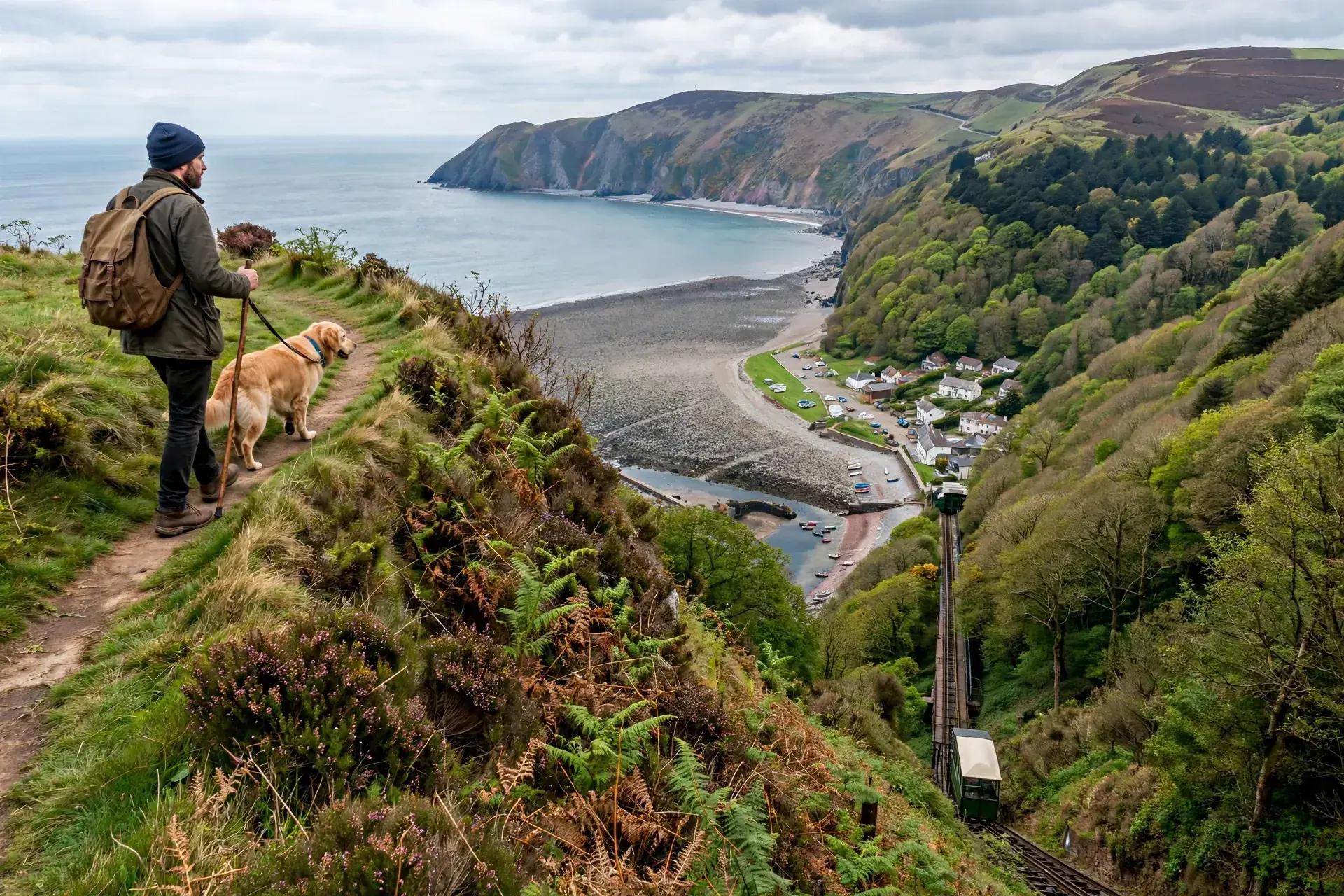
Lynton and Lynmouth, about half an hour's drive east along the coast, are the classic day trip, and they are worth the drive for the change of scenery alone. Lynton sits on the cliff top above Lynmouth, and the two are joined by the cliff railway, a water-powered lift that has been carrying people up and down the hill since the nineteenth century. Dogs can ride the railway, and the walk from Lynmouth up through the Valley of Rocks and along the coast to Watersmeet is one of the finest dog walks in the region, with wooded valleys, waterfalls and open moorland. Our guide to Lynton with a dog covers the railway, the valley walks and the steep paths in detail, including where to keep the dog on a lead and where to find water.
Woolacombe, a short drive west, is the day trip for a dog that loves a long sandy beach. The beach is three miles of golden sand, with a zoned dog system in the summer, and the dunes behind the beach are open to dogs all year round. Arrive early, park near the beach, and walk south towards Putsborough for the quietest stretch of sand. The village has cafes and pubs that welcome dogs, and the coast path from Woolacombe to Mortehoe and back makes a good circular walk for a fit dog. Check the official guidance before you travel for the current beach zones, because the boundaries and the dates change.
Inland, Exmoor is a different world from the coast: open moorland, wooded valleys and quiet lanes, with walks that suit dogs that like to run. The villages on the edge of the moor, such as Parracombe and Challacombe, make good starting points for a moorland walk, and the valley of the East Lyn river is a cool, shaded walk on a hot day. Keep the dog on a lead on the open moor, because there are sheep and wild ponies, and the ground can be boggy after rain. Bring a map, because the moorland paths are less well marked than the coast path, and a dog that runs off on Exmoor can be hard to find.
For a longer day out, Bude in Cornwall is a drive south along the coast, and it offers a different kind of seaside town: two beaches, a canal towpath and a quieter pace than Ilfracombe in summer. Summerleaze and Crooklets beaches have different dog rules through the year, so check them before you go, and the canal walk is a flat, easy stroll for a dog that needs a rest from the cliffs. Our guide to Bude with a dog covers the beaches, the canal and the coast walks in full. Treat Bude as a full-day trip rather than a half-day, because the drive each way is long enough that a rushed visit wastes the journey.
Barnstaple, the market town inland, is the practical day trip: a bigger town with more shops, a pannier market, and the Tarka Trail, a flat cycle and walking path that follows the old railway line along the River Taw. The trail is ideal for a dog that needs a long, flat walk after days of cliff climbing, and it is traffic-free for much of its length. Combine a morning on the trail with lunch in Barnstaple, and you have a rest day that still feels like a proper outing.
Seasons and wet weather
Ilfracombe is a year-round town, but it is a different town in each season, and the dog's experience changes with it. Summer is the busiest and the warmest, with the harbour full, the beaches busy and the coast path crowded. It is also the season when the dog rules tighten: the Tunnels Beaches have their own conditions, Combe Martin Beach bans dogs from May to September, and Woolacombe's beach zones apply through the summer. Walk early in the morning and late in the evening in summer, when the beaches are quieter and the stone is cooler underfoot, and avoid the middle of the day on the exposed cliff paths, where there is no shade and no water.
Autumn is the best season for a dog in Ilfracombe. The crowds thin, the sea is still warm enough for a paddle, the dog restrictions lift on the seasonal beaches, and the coast path is at its best in the low autumn light. September and October are the months to choose if you can, with the added advantage that the pubs and cafes are quieter and more welcoming to a dog that wants to lie under a table. The weather is changeable, so pack a drying coat and a towel, but the walking is as good as it gets all year.
Winter in Ilfracombe is quiet, wild and beautiful, and it suits a dog that likes the wind and the empty beaches. The harbour is working, the town is local, and the coast path can be empty for hours at a time. But winter is also when the weather closes in fastest: a calm morning can turn into a gale by lunchtime, and the cliff paths become slippery and dangerous in rain and high wind. Keep the walks short, stay off the exposed cliff tops in a gale, and use the harbour, the town centre and the sheltered coves on the worst days. Some cafes and attractions close or reduce their hours in winter, so check the official guidance before you travel.
Spring is the season of new growth on the cliffs, with wildflowers on the headlands and lambs in the fields inland. It is also the season when the dog rules change: the summer beach restrictions start to apply from April or May, depending on the beach, so check the signs at each beach entrance rather than relying on last year's dates. The coast path can be muddy in spring after a wet winter, and the lambing season means dogs must be on a lead near livestock, with no exceptions.
Wet weather is a fact of life on the North Devon coast, and Ilfracombe handles it better than many seaside towns, because the town itself is the wet-weather plan. On a rainy day, walk the harbour under the shelter of the buildings, explore the lanes and the shops, visit the tunnels, and eat a long lunch in a dog-friendly pub. The Tunnels Beaches are a good wet-weather choice, because the tunnels themselves are sheltered, and the town's museums and galleries are worth a look, though dogs are not welcome in all of them, so check before you go. Pack two towels, a drying coat and a waterproof lead, and dry the dog properly after every walk, because a wet dog in a cold cottage will be miserable by the evening.
Practical planning for dogs
A good Ilfracombe trip is planned around three things: the tide, the weather and the dog's legs. Check the tide times for Ilfracombe every evening before the next day's walk, because the beaches, the harbour and the tunnels all change with the water. Check the weather forecast for the coast, not just for the town, because the wind on the cliff tops can be twice as strong as the wind in the harbour. And plan the walking around the dog: a fit young dog can manage the coast path in both directions over two days, but an older dog will need shorter walks, more rest and a flat day in between.
Pack for the coast, not for the town. Bring a short lead and a long line, a harness with a handle, a collapsible water bowl and a bottle of fresh water, poo bags and a bag to carry them in, a towel and a drying coat, and a basic first-aid kit with a tick remover and a bandage. The coast path has few places to buy water or food once you leave the town, and the shops in Hele Bay and Lee Bay are limited, so carry everything the dog needs for the whole walk. A dog that drinks sea water will be ill, so offer fresh water often and watch for the signs of salt-water sickness: vomiting, diarrhoea and lethargy after a swim.
Safety on the cliffs is the one rule that matters more than any other. Keep the dog on a lead on the cliff sections, near livestock and at stiles and gates. Never let a dog chase a ball towards a cliff edge, and never throw a ball or a stick near the edge, because a dog that runs after it will not stop in time. If a dog does go over the edge, do not climb down after it: call the coastguard and let the professionals handle the rescue. The coast path is well maintained, but the ground can crumble at the edge, and the drops are high enough that a fall is usually fatal.
Parking and transport deserve a little thought. The car parks near the harbour are the most convenient, but they fill early in summer, and the walk from the outer car parks is uphill on the way back. If you are using public transport, the buses from Barnstaple serve Ilfracombe and the surrounding villages, and dogs are generally welcome on the buses, though the rules vary by operator, so check the official guidance before you travel. The town is compact enough to walk everywhere once you are there, which is one of its best features for a dog owner.
Finally, leave the town better than you found it. Pick up after your dog everywhere, including on the beaches and the coast path, and bin the bag in a proper bin rather than leaving it by a gate or a stile. Keep the dog off the nesting areas on the cliffs in spring, and away from the seals that sometimes haul out on the rocks below the coast path. Ilfracombe welcomes dogs because dog owners, on the whole, look after the place. A little care keeps it that way for the next dog that walks the harbour in the morning.
Practical questions
Before you go
Can dogs go onto the beaches at the Tunnels Beaches?
No. According to North Devon Council, dogs are allowed through the tunnels on a lead but not onto the beaches themselves. The tunnels are still worth walking with a dog on a lead, and the tidal pool and rock pools are best admired from the tunnel mouths and the beach edge. Check the official guidance before you travel, as the private beach operator's rules can change.
Is the harbour beach in Ilfracombe dog friendly?
The small sandy harbour beach, also known as Strand Beach, appears inside the inner harbour at low tide and is covered again as the tide comes in. North Devon Council states that dogs are allowed on all council-owned beaches in Ilfracombe, subject to the district-wide rules on picking up after your dog and putting your dog on a lead when requested. Time your visit for low tide and leave well before the water returns.
Which cliff walk is better with a dog, east or west from Ilfracombe?
East is the gentler introduction: the coast path climbs over Hillsborough to Hele Bay, a sheltered sand-and-shingle cove about a mile and a half away, with a pub at the far end. West is wilder and steeper, over Capstone Hill and the Torrs towards Lee Bay and Woolacombe, with bigger drops and fewer places to turn back. If your dog is older, nervous near edges or new to cliff paths, start east and save the west for a calm, dry day.
Can my dog come on the boat trip to Lundy Island?
No. Dogs are excluded from the Lundy Island voyages, including the Lundy shuttle sailings from Ilfracombe harbour, so a dog cannot travel to the island. Plan Lundy as a humans-only day and arrange care for your dog, or use the sailing time for a long coast-path walk from the harbour instead. Check the official guidance before you travel.
Where can my dog paddle safely around Ilfracombe?
The safest paddling is at low tide on sheltered coves such as Hele Bay and Wildersmouth Beach, where the water is shallow at the edge and you can stay close to shore. Avoid the harbour entrance, the pier end and any fast-moving water around boats, and never let a dog swim near moored craft or in the tidal pool at the Tunnels Beaches. Bring fresh drinking water, because sea water upsets stomachs, and rinse sandy paws before the walk home.
Do dogs need to be on a lead on the coast path around Ilfracombe?
Keep your dog on a lead on the cliff sections, near livestock, and wherever signs ask for it. The South West Coast Path around Ilfracombe runs close to unfenced drops, and the ground can be slippery after rain. A short lead gives you control at stiles and gates and keeps a keen dog from chasing sheep or seabirds. On the open beaches where dogs are allowed off lead, recall still matters, because the tide and the cliffs limit the escape routes.