This guide is independent and contains no paid placement. If affiliate links are added later, they will be clearly marked and will not change our editorial checks.
Ingleton is a small Yorkshire Dales village built around one outstanding dog walk: the 4.5-mile Ingleton Waterfalls Trail. Dogs are welcome on a lead at all times, swimming is not allowed, and the route has many steep, slippery steps, so plan for two and a half to four hours, start early, and keep a gentler village walk in reserve for tired legs.
Why Ingleton works with a dog
Ingleton sits on the western edge of the Yorkshire Dales National Park, in North Yorkshire, where the rivers Twiss and Doe meet to form the River Greta. It is a compact village rather than a town: a main street with shops, cafes and pubs, a community centre car park, an outdoor swimming pool in summer, and walking routes that start almost from the front door. That compactness is the main reason it works so well with a dog. You can park once, walk the famous trail, return to the village for food and water, and then take a short evening loop without driving anywhere.
The second reason is variety in a small area. The Waterfalls Trail is the headline walk, a wooded gorge route past a series of waterfalls, but Ingleton also offers flat village lanes, riverside paths, limestone scenery, open fell and, for fit dogs and owners, the climb to Ingleborough, the second-highest peak in the Yorkshire Dales at 723 metres. A dog that loves water, woodland and viewpoints will find plenty to sniff and look at, while a dog that prefers a steady pavement walk can stay in the village and still have a proper day out.
The third reason is honesty about limits. Ingleton is not a place where every attraction welcomes dogs indoors, and the main trail is not an easy stroll. Some caves do not admit dogs, some sections of the trail are narrow and busy, and the steps are a genuine barrier for older dogs, very small dogs and dogs recovering from injury. A good Ingleton trip is therefore a planned one: choose the right walk for the dog you actually have, check the official guidance before you travel, and build in rest, water and a shorter alternative for the afternoon.
Ingleton also suits a short break better than a rushed day trip. The trail alone takes half a day, and the village deserves an unhurried evening. Staying one or two nights lets you walk the trail early, before the car park fills and the path gets busy, and then use the second day for a fell walk or a drive to a nearby village such as Clapham or Kirkby Lonsdale. If you are comparing longer breaks, our three-day Lake District itinerary with a dog shows how to balance a big walk, a rest day and a swim stop across three days, a pattern that works just as well in the Dales.
Finally, Ingleton rewards walkers who respect the landscape. Much of the route crosses farmland and limestone country, with sheep, dry stone walls, gates and stiles. Keeping a dog on a lead, closing gates, picking up waste and staying on marked paths are not optional extras here; they are the conditions that keep the trail open and the village welcoming to dogs. The sections below turn those general principles into a concrete plan.
Ingleton at a glance
Ingleton is in North Yorkshire, on the A65 between Kirkby Lonsdale and Settle, and on the edge of the Yorkshire Dales National Park. The village is small enough to cross on foot in a few minutes, which makes it easy to combine a walk with a cafe stop, a shop for supplies, or a return to the car for a spare lead, a towel or a water bottle. Mobile signal can be patchy on the fell and in the deeper parts of the gorge, so download maps and save the numbers you might need before you set off.
The headline facts for dog owners are simple. The Ingleton Waterfalls Trail is a circular route of approximately 4.5 miles, or about 7 kilometres, and the operator advises allowing two and a half to four hours. Dogs are welcome but must be kept on a lead at all times, according to the 2026 trail leaflet. Swimming is not permitted in the rivers on the trail. The trail is privately managed by the Ingleton Scenery Company, it is a paid-entry route, and it is open all year except Christmas Day, with seasonal last-entry times. Prices, opening times and trail rules can change, so check the official guidance before you travel.
Ingleton is also the starting point for Ingleborough, one of the Yorkshire Three Peaks, along with Whernside and Pen-y-ghent. The Ingleton route to Ingleborough is about seven miles one way, which makes it a long, serious day for a fit dog and owner, not a casual add-on after the Waterfalls Trail. Shorter fell walks from the village, along Fell Lane and the lower slopes, give a taste of the same limestone landscape without the full summit commitment.
White Scar Cave, described as Britain's longest show cave, is close to the village, and Ingleborough Cave is another nearby show cave. Caves have their own rules, and dogs are not admitted to every cave, so check the official guidance before you travel rather than assuming a dog can go underground. The village also has an outdoor swimming pool, a caving shop and adventure businesses, but these are secondary to the walking for most dog owners.
For food and supplies, the village has a small supermarket, a bakery, cafes and pubs, and a tourist information centre at the community centre. That is enough for a day walk and a short stay, but it is not a large town, so bring any specialist dog food, medication or equipment with you rather than expecting to buy it locally. If you are travelling further into the Dales, Middleham with a dog is a useful comparison: another small Yorkshire town with castle ruins, river walks and dog-friendly pubs, where the same rules about leads, livestock and planning ahead apply.
The Waterfalls Trail, step by step
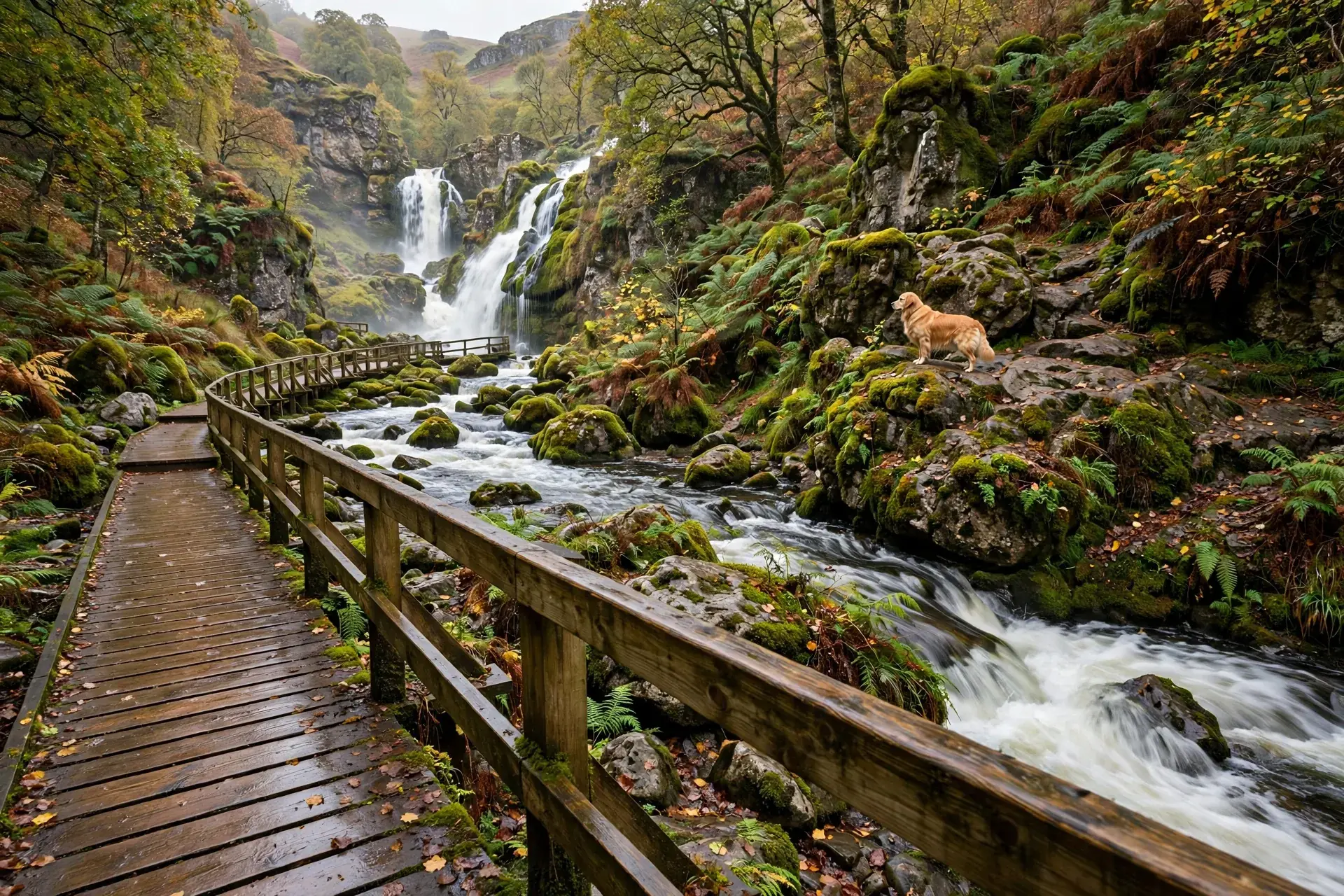
The Ingleton Waterfalls Trail is a circular walk that follows the River Twiss out of the village, crosses open countryside, and returns beside the River Doe. The first section follows the Twiss through woodland and past a series of waterfalls, including Pecca Falls, before the route climbs to open ground with views across the Dales. The return leg follows the Doe through Baxengill Gorge, past Beezley Falls and the Triple Spout, and back towards the village. Thornton Force, the best-known waterfall on the route, is a wide fall on the Twiss, about 14 metres high, and it is the natural viewpoint where most walkers stop longest.
The trail is well marked, with a ticket office at the start where you pay and can pick up a map. The map is worth taking even though the route is clear, because it shows the location of toilets, refreshment points and the main viewpoints, and it helps you judge how far you have left when a dog starts to tire. The path is a mix of woodland track, stone steps, boardwalk, rocky sections and farmland track. Some sections are narrow, with a one-way system in places, and the route can feel busy on weekends and in school holidays, especially around the main falls.
Allow two and a half to four hours for the full circuit. The lower end of that range suits fit walkers with a steady dog on a dry day; the upper end is more realistic if you stop for photographs, queue briefly at narrow sections, rest at viewpoints, or walk after rain when the stone steps need care. Dogs slow the pace in both directions: they need water stops, sniffing time and a pause at the top of the climb, and they cannot be hurried down wet steps. Build that time into your day rather than treating it as lost time.
The climb is the part many people underestimate. The trail rises from the village to open moorland between the two river gorges, and the ascent includes long flights of steps. The views from the top are the reward: open Dales countryside, limestone scars and, on a clear day, the bulk of Ingleborough ahead. Take the climb slowly, keep the dog on a short lead on the steps, and stop in the shade or in a sheltered spot if the dog is panting hard. A dog that is struggling on the way up will struggle more on the way down, when tired legs meet slippery stone.
The return leg beside the Doe is quieter in feel, with the gorge, the falls and the sound of water close by. Beezley Falls and the Triple Spout are the main features here, and the path stays close to the river in places, with barriers and fences at the exposed points. Stay behind the barriers, keep the dog well away from the edge, and do not be tempted to let the dog paddle or drink from fast water. The final stretch brings you back through the village, where a cafe or pub stop is a sensible way to end the walk rather than driving straight away with a wet, tired dog.
One practical point: the trail is a paid-entry, privately managed route, and the ticket office is staffed every day except Christmas Day. There is no advance booking in the usual sense; you pay by card on arrival. That simplicity is helpful, but it also means there is no way to reserve a quiet slot. The only reliable way to walk the trail quietly is to arrive at opening time, on a weekday if you can, and to avoid the middle of a school holiday weekend.
Dogs on the Waterfalls Trail
Dogs are welcome on the Ingleton Waterfalls Trail, and many dogs enjoy it, but the conditions are strict and they matter. The 2026 trail leaflet says to keep your dog on a lead at all times. Other guidance for the route says the same, and the reasons are visible on the ground: narrow paths, steep drops, fast water, livestock on the open section, and other walkers, including children, passing close by. A long line is not a good substitute on the gorge sections, where a dog on a long lead can still reach the edge, tangle around other walkers, or slip on wet stone. Use a short, secure lead, a well-fitting harness or collar, and a lead you can hold firmly with wet hands.
Do not let your dog swim in the rivers on the trail. Swimming is not permitted, and the water is cold, fast and deep in places, especially after rain. Even a strong swimmer can be caught by a current, trapped against rocks, or cut by submerged stone. The rule also protects other wildlife and other walkers, and it protects your dog from water that may carry farm run-off after heavy rain. Offer drinking water from a bottle or a collapsible bowl instead, and keep the dog away from the water's edge at viewpoints.
Think about your dog's fitness before you start. The trail is about 4.5 miles with a climb, many steps and uneven ground. A young, fit collie or spaniel will usually manage it comfortably, with rests. An older dog, a brachycephalic breed, a very small dog, a dog with joint problems, or a dog that has not walked this far before may find it hard. If you are unsure, walk a shorter section and turn back, or choose a village walk instead. There is no shame in a shorter walk that leaves the dog happy; there is a real risk in pushing a tired dog down wet steps.
Watch for the usual Dales hazards. Sheep are present on the open section and on farmland, so keep the dog close and under control even if you have seen no livestock yet. Ticks are a risk in woodland and long grass from spring to autumn, so check your dog after the walk and remove any ticks promptly. Adders are present in parts of the Dales, though encounters are uncommon; keep the dog on the path and away from sunny rock piles and dense bracken in warm weather. After rain, the stone steps and boardwalk can be very slippery, so slow down, use the handrails where they are provided, and let the dog pick its own footing rather than pulling it forward.
Other walkers are part of the trail experience. The path is popular, and you will meet families, photographers, runners and other dog owners. Keep your dog close when passing, step aside at narrow points, and do not let the dog approach other dogs or children without an invitation. A reactive dog can still enjoy Ingleton, but the Waterfalls Trail on a busy Saturday is a hard place to manage reactivity. An early weekday start, or a quieter village walk, is a kinder choice for a dog that finds crowds stressful.
Finally, take waste bags and use them. There are bins in the village and at the trail start, but not along the whole route, so carry a sealed bag until you reach a bin. Do not leave bags on a wall or a fence to collect later. The trail is a managed attraction in a national park, and the standard that keeps it pleasant for everyone is simple: leave no trace, keep the dog on a lead, and stay on the path.
Prices, times and tickets
Prices and times for the Ingleton Waterfalls Trail change from season to season, so treat the figures in this guide as a starting point and check the official guidance before you travel. The 2026 trail leaflet lists an adult ticket at 11 pounds for visitors aged 16 and over, and a child ticket at 5.50 pounds for visitors under 16. A children's activity challenge is also listed at 2 pounds. Card payment is accepted at the ticket office. The trail car park is for ticket holders, on a first-come, first-served basis, with no overnight parking.
Opening times follow a seasonal pattern. The trail opens at 9am throughout the year. Last entry is 2.30pm from January to February and from November to December, 4pm in March and from September to October, and 7pm from April to August. The trail is open all year except Christmas Day, but it can close in severe weather, and the operator may close the route at short notice if conditions become unsafe. If you are travelling in winter, check the official guidance before you travel on the morning of your visit, not the night before.
The practical consequence of last entry is that a late start can cut the walk short. If last entry is 4pm and you arrive at 3.30pm, you will have limited time to complete a 4.5-mile circuit with a dog, and you may feel rushed on the steps. Aim to arrive at or soon after opening, especially in summer when the car park fills early and the path is busiest by late morning. An early start also gives you cooler temperatures for the dog, quieter viewpoints, and time for a proper lunch afterwards.
Budget for the whole day, not just the ticket. The trail ticket is the main cost, but parking in the village, food and drink, and any accommodation add up. If you are staying overnight, ask your accommodation whether the trail ticket is included or whether there is a discount; do not assume it is. If you are visiting as a day trip, factor in fuel or public transport, and remember that the village car parks can fill on busy days, so an early arrival saves both time and stress.
For families, the children's activity challenge is a useful way to keep younger walkers engaged on a long route, but it does not change the physical demands of the trail. Children and dogs both need water, snacks and rest stops, and both are more likely to slip on wet steps if they are tired or rushing. Plan the walk at the pace of the slowest member of the group, human or canine, and treat the stated two and a half to four hours as a minimum, not a target to beat.
Village walks and short loops
Not every Ingleton walk needs to be the full Waterfalls Trail. The village itself offers short, flat options that suit older dogs, puppies, dogs recovering from injury, and anyone arriving late in the day. A simple loop around the village streets, along the riverside and back through the centre, gives a dog a proper sniffing walk without steps or steep climbs. The rivers Twiss and Doe meet in the village to form the Greta, and the riverside paths near the centre are a good place to start, keeping the dog on a lead and away from fast water.
A short out-and-back along the lower part of the Waterfalls Trail, as far as the first falls and back, is another option if you want a taste of the gorge without the full circuit. This only works if you are happy to pay the trail entry and to turn back at a sensible point; it is not a free short cut, and you should not try to join the trail part-way without a ticket. Check the official guidance before you travel if you are unsure how entry works for a partial walk.
Fell Lane, the track that leads from the village towards Ingleborough, offers a longer but still flexible walk. You can walk as far as you like along the track and turn back at any point, which makes it ideal for a dog that needs a steady uphill walk without the commitment of a summit. The track is wide and rocky in places, with dry stone walls, open views and, on a clear day, the limestone scars above the village. Keep the dog on a lead near livestock and on the track, and carry water, because there is little shade on the open section.
For a gentler day, combine a short village walk in the morning with a drive to a nearby village in the afternoon. Clapham, a few miles away, has its own cave, Ingleborough Cave, and a village green and riverside paths that suit a short dog walk. Kirkby Lonsdale, to the north-west, has a market town centre, riverside walks along the Lune, and the famous view from the churchyard, known as Ruskin's View. Both are easy drives from Ingleton, and both reward a slow afternoon rather than a rushed visit.
Whatever short walk you choose, the same rules apply: keep the dog on a lead where signs, livestock or traffic require it, close gates behind you, pick up waste, and stay on marked paths. Short walks are not lesser walks. A forty-minute sniffing loop that leaves a dog relaxed and tired is a better day out than a forced four-hour march that leaves the same dog sore the next morning. If you are planning a longer break and want to compare how different areas handle short walks, our guide to Lake District vs Peak District with a dog compares terrain, lead rules and swimming water across two national parks, and the same questions about gradient, surface and livestock apply in the Dales.
Ingleborough and longer fell walks
Ingleborough, at 723 metres, is the second-highest peak in the Yorkshire Dales and one of the Yorkshire Three Peaks, along with Whernside and Pen-y-ghent. The walk from Ingleton is about seven miles one way, following Fell Lane and then the open fell to the summit plateau, with its distinctive flat top, limestone pavement and trig point. It is a serious mountain walk, not a village stroll, and it needs a full day, proper footwear, a map and compass, food and water for both you and the dog, and a weather check before you set off.
Only take a dog to the summit if the dog is fit, experienced on long fell walks, comfortable on rocky and uneven ground, and reliable on a lead near sheep and other walkers. The route includes steep sections, loose rock, limestone pavement with gaps that can trap a small paw, and exposed ground where wind and rain arrive quickly. A dog that is fine on a four-mile valley walk may not be fine on a fourteen-mile round trip with a 700-metre climb. If you are unsure, walk part of the way up Fell Lane and turn back at a viewpoint, or choose a lower fell walk instead.
Weather is the deciding factor on Ingleborough. The summit can be cold, wet and windy even when the village is warm and sunny, and mist can reduce visibility to a few metres. Check the official guidance before you travel and check a mountain weather forecast on the morning of the walk. If the forecast is poor, do not go. A fell walk that is postponed is not a wasted day; a fell walk in bad weather with a tired dog is a rescue waiting to happen.
Other longer walks from Ingleton include the route to Whernside, the highest peak in the Dales, and the classic Three Peaks route, which is a 24-mile challenge and is not suitable as a dog walk for most dogs. Shorter fell options include the circular walk to White Scar Cave and back, and the walk along the lower slopes of Ingleborough to the limestone scars. These give the sense of height and open country without the full summit effort, and they leave time for a village pub stop afterwards.
If you do walk on the fell, keep the dog under close control at all times. Sheep graze the open fell, and a dog that chases livestock can cause serious harm and can be shot by a farmer in the most serious cases under the law. Keep the dog on a lead where sheep are present, and use a lead on the summit plateau where other walkers, rock gaps and sudden drops make off-lead walking unsafe. Carry a first-aid kit for the dog, including a tick remover, and know where the nearest vet is before you set off.
Caves and other things to do
Ingleton is known for caves as well as waterfalls. White Scar Cave, close to the village, is described as Britain's longest show cave, with a guided tour through passages and chambers including the Battlefield Chamber. Ingleborough Cave, near Clapham, is another show cave, reached by a woodland walk from the village. Caves are a popular wet-weather option, but they are not automatically dog-friendly. Some caves do not admit dogs at all, and others admit dogs only on a lead in certain areas. Check the official guidance before you travel, and do not assume that a dog that is welcome on the trail will be welcome underground.
If a cave does not admit your dog, do not leave the dog in a car while you go inside. A car can overheat quickly even on a mild day, and a dog left alone in a strange place is likely to bark and become distressed. Instead, split your group so one person stays with the dog, or choose a different activity for that day. A riverside walk, a village cafe with a dog-friendly terrace, or a drive to a nearby viewpoint are better uses of the time than a cave tour that leaves the dog behind.
The village outdoor swimming pool is open in summer, but it is not a dog swimming pool, and dogs are not admitted to the pool area. If your dog loves to swim, plan a separate swimming stop at a place where dogs are welcome in the water, and check the official guidance before you travel. Do not let the dog swim in the rivers on the Waterfalls Trail, as explained above, and be cautious about any river or lake after heavy rain, when currents are strong and water quality may be poor.
Other things to do in and around Ingleton include visiting the tourist information centre at the community centre for local maps and advice, browsing the caving and outdoor shops, and driving to nearby attractions such as the Ribblehead Viaduct, Malham Cove and Gordale Scar. Each of these is a walk in its own right, with its own lead rules and livestock, so treat them as separate walks rather than quick photo stops. A dog that has already walked 4.5 miles on the Waterfalls Trail will not thank you for an extra two miles at Malham on the same day.
For rainy days, the best plan is often the simplest: a short village walk in waterproofs, a long lunch in a dog-friendly pub, and a quiet afternoon at your accommodation. Ingleton in the rain is still Ingleton, with the waterfalls at their most dramatic after heavy rain, but the steps are at their most slippery too. If you do walk the trail after rain, allow extra time, wear boots with good grip, and keep the dog on a short lead throughout.
Eating out and staying over
Ingleton has a small but useful range of places to eat and drink, including cafes, pubs and takeaways on and near the main street. Dog policies vary from place to place, and they can change with the season, the time of day and the area of the building. A pub that welcomes dogs in the bar may not welcome them in the restaurant, and a cafe that welcomes dogs on the terrace may not welcome them inside in wet weather. Ask before you sit down, keep the dog on a lead under the table, bring a mat or blanket for the dog to lie on, and order food that does not tempt the dog to beg from other tables.
For a trail day, a cafe breakfast or a packed lunch is often more practical than a long pub lunch. Buy sandwiches, water and snacks in the village before you start the trail, and eat them at a viewpoint or a picnic spot where the dog can rest. After the trail, a pub or cafe stop is a good reward, but check the dog policy first and be ready to sit outside if the inside is not dog-friendly. Take-away food, eaten on a bench or back at your accommodation, is a perfectly good alternative on a busy day.
Staying over in Ingleton means choosing dog-friendly accommodation and reading the dog rules before you book. Options in and around the village include cottages, bed and breakfasts, campsites and holiday parks, but not every property accepts dogs, and those that do may limit the number, size or breed of dog, charge a pet fee, or restrict dogs to certain rooms or units. Ask for the dog rules in writing, including the fee, the maximum number of dogs, whether dogs can be left alone in the room, and where the nearest toilet walk is after dark. A property that is genuinely dog-friendly will answer these questions clearly; a property that is vague about them is a warning sign.
For a one-night stay, a cottage or a dog-friendly bed and breakfast close to the village centre is usually the most convenient, because you can walk to the trail and to food without driving. For a longer stay, a self-catering cottage with a garden or an enclosed outdoor space gives the dog a place to rest and toilet without a lead, which matters after a long walk. Check the garden boundaries before you let the dog off the lead, and do not assume a fence is secure just because a listing describes it as enclosed.
Camping and caravan sites near Ingleton can work well for dogs that are used to camping, but check the site rules about dogs, leads, barking and leaving dogs unattended. A dog that barks at every passer-by will not enjoy a busy campsite, and neither will the neighbours. If you are comparing stays across the Dales and the Lakes, the same questions about fees, boundaries and alone-time rules apply everywhere, and the guide to Middleham with a dog includes a useful checklist for pubs and stays in a similar Yorkshire town.
Getting there and parking
Ingleton is on the A65, about 10 miles from Kirkby Lonsdale and about 19 miles from Settle, and it is reached by car, bus or, for the more adventurous, by a combination of train and bus. By car, the A65 is the main route, with the M6 to the west and the A1(M) to the east. The village is small, so traffic can be slow on summer weekends, and the car parks fill early. Arrive early, especially if you want a space in the trail car park or the community centre car park.
Parking in Ingleton includes the trail car park for ticket holders, the community centre car park, and other village car parks. The trail car park is first come, first served for ticket holders, with no overnight parking. Village car parks may charge, and the rules can change, so check the signs on arrival and do not park on verges, in passing places or across gateways. If the car parks are full, do not park inconsiderately in the village; drive on and return another day, or park in a nearby village and walk in.
By public transport, buses run along the A65 between Lancaster, Kirkby Lonsdale, Ingleton and Settle, but services are infrequent, especially on Sundays and in winter, so check the official guidance before you travel and plan your return journey before you set off. Dogs are usually allowed on buses, but the driver has discretion, and a dog must be kept on a lead and under control. By train, the nearest stations are on the Settle to Carlisle line, including Settle and Ribblehead, with a bus or taxi connection to Ingleton. Check the official guidance before you travel for the latest bus and train times.
If you are travelling with a dog in the car, plan the journey as carefully as the walk. Secure the dog with a harness, a crate or a guard, keep the car cool and ventilated, and stop for water and a toilet break on a long drive. Never leave a dog in a parked car on a warm day, even with the windows open. On arrival, give the dog water and a short toilet walk before you start the trail, and let the dog settle for a few minutes after the drive.
For walkers without a car, Ingleton is a good base because the trail and the village walks start in the village itself. For walkers with a car, the village is also a good base for driving to other Dales walks, but remember that every drive adds time and that the dog will need a break after each journey. A day that combines one good walk with a relaxed village evening is usually better than a day that tries to fit in three walks and two drives.
Seasons, weather and safety
Ingleton is a year-round destination, but the experience changes with the seasons. Spring brings lambs, wildflowers and longer days, but also wet paths and livestock that need extra care. Summer brings the longest opening hours, with last entry at 7pm from April to August, but also the busiest paths, the warmest temperatures and the greatest need for water and shade for the dog. Autumn brings colour in the woodland, quieter paths and shorter days, with last entry at 4pm from September to October. Winter brings short days, with last entry at 2.30pm, cold water, icy steps and the possibility of trail closure in severe weather.
The best time for most dog owners is late spring or early autumn, when the weather is cooler, the paths are quieter and the light is good for photographs. Summer can be excellent too, especially on a weekday, but avoid the hottest part of the day for the trail, carry extra water, and watch for signs of heat stress in the dog, including heavy panting, drooling, lethargy and vomiting. If the dog shows these signs, stop in the shade, offer water, cool the dog gradually and seek veterinary advice if the symptoms do not improve quickly.
After heavy rain, the waterfalls are at their most impressive, but the trail is at its most challenging. The stone steps become slippery, the rivers rise, and the boardwalk can be wet. Allow extra time, wear boots with good grip, and keep the dog on a short lead. Do not attempt the trail in severe weather, and do not cross flooded paths or enter fast water. The operator may close the trail in extreme weather, and the closure is for your safety, not an inconvenience to be worked around.
General safety on the trail is straightforward: stay on the marked path, stay behind barriers, keep the dog on a lead, carry water, wear suitable footwear, and tell someone where you are going and when you expect to be back. Mobile signal is patchy in the gorge and on the fell, so do not rely on a phone for navigation or for calling for help. Carry a paper map or a downloaded offline map, and know the location of the nearest vet and the nearest hospital before you set off. If you or the dog are injured, stay calm, keep the dog close, and seek help from other walkers or from the trail staff.
Finally, respect the Countryside Code. Keep the dog under control, pick up waste, close gates, do not feed livestock, and leave no trace. Ingleton is a working landscape as well as a tourist destination, and the farmers, landowners and residents who keep it open for walkers deserve the same courtesy you would expect at home. A dog owner who follows the code is welcome back; a dog owner who does not is remembered for the wrong reasons.
What to pack for the trail
Packing for the Ingleton Waterfalls Trail is a matter of carrying a little more than you think you need, because there are limited places to buy supplies once you are on the route. Start with the dog: a short lead, a spare lead, a well-fitting harness or collar, a collapsible water bowl and at least a litre of water for the dog, plus extra in hot weather. Add waste bags, a small towel for wet paws, a tick remover, and any medication the dog needs. A dog coat is useful in cold or wet weather, especially for short-coated or older dogs, but it is not a substitute for shelter and rest.
For yourself, wear walking boots with good grip, not trainers, because the stone steps are slippery when wet. Wear layers, including a waterproof jacket, even on a dry day, because the weather can change quickly in the Dales and the gorge can be cool and damp. Carry a map, a phone with offline maps downloaded, a small first-aid kit, sun cream and a hat in summer, and snacks for both you and the dog. A small rucksack is better than a handbag or a carrier bag, because it leaves your hands free to hold the lead and use handrails.
Food for the trail should be simple and easy to eat at a viewpoint: sandwiches, fruit, nuts and a flask of tea or coffee. Avoid food that needs cooking or that creates a lot of litter. For the dog, bring a small amount of the dog's usual food or treats, but do not feed the dog a large meal just before a strenuous walk. Offer small treats and water at rest stops, and save the main meal for after the walk, when the dog has cooled down and rested.
After the walk, you will need a towel for the dog, a change of clothes for yourself if you have been caught in the rain, and a bag for wet or muddy gear. If you are staying overnight, bring a dog bed or blanket that smells of home, the dog's usual food and bowls, and a familiar toy. A dog that has a familiar bed and a routine after a long walk will settle much faster than a dog that is expected to sleep on a strange floor in a strange room.
One item that is often forgotten is a car shade or a sunshade for the journey home. A wet dog in a warm car can overheat, and a dog that has just walked 4.5 miles needs cool air and water, not a stuffy boot. Open the windows, turn on the air conditioning, and stop for a break if the journey is long. The walk does not end when you reach the car park; it ends when the dog is home, dry, fed and asleep.
A two-day Ingleton plan
Day one is the Waterfalls Trail day. Arrive early, park in the trail car park or the community centre car park, and buy your tickets at the ticket office. Walk the full 4.5-mile circuit at a steady pace, allowing two and a half to four hours, with stops at Pecca Falls, Thornton Force and Beezley Falls. Keep the dog on a short lead throughout, offer water at regular intervals, and take photographs at the viewpoints rather than on narrow steps. Finish the trail in the early afternoon, return to the village for lunch, and then take a short, flat evening walk around the village to stretch tired legs before dinner.
Day two is a choice day. If the dog is fit and the weather is good, walk part of the way up Fell Lane towards Ingleborough, turn back at a viewpoint, and enjoy the limestone scenery without the full summit effort. If the dog is tired, or the weather is poor, choose a gentler day: a short village walk in the morning, a drive to Clapham or Kirkby Lonsdale for a riverside walk and a cafe stop, and a quiet afternoon at your accommodation. Either way, do not try to fit the Waterfalls Trail and a fell summit into the same day, unless you are certain the dog can manage both.
If you have a third day, use it for a nearby Dales walk rather than repeating the trail. Malham Cove, Gordale Scar, the Ribblehead Viaduct walk and the walks around Settle are all within an easy drive, and each offers a different landscape for the dog to explore. Check the lead rules and livestock for each walk before you set off, and remember that a dog that has walked hard for two days will need a rest day soon. A three-day break that includes a rest day is more enjoyable than a three-day break that tries to walk every day at full pace.
For a longer break, Ingleton can be combined with other Dales towns. Middleham with a dog is a good second base in Wensleydale, with castle ruins, gallops and river walks, and the three-day Lake District itinerary with a dog shows how to structure a multi-day trip with rest, water and variety. The principle is the same in both areas: one big walk, one gentle day, and one day for exploring a town or village at the dog's pace.
Whatever plan you choose, leave room for change. Weather, tired legs, a busy car park or a dog that simply does not want to walk further are all good reasons to change the plan. Ingleton is a small village with a big walk, and the best trips are the ones that respect the dog's limits, check the official guidance before you travel, and leave time for a quiet evening in the village. The waterfalls will still be there tomorrow, and the dog will enjoy them more if it is rested and ready.
Practical questions
Before you go
Can dogs go on the Ingleton Waterfalls Trail?
Yes. Dogs are welcome on the Ingleton Waterfalls Trail, but the 2026 trail leaflet says to keep your dog on a lead at all times. The route is busy, narrow in places, and crosses farmland with livestock, so a short lead is the practical choice even on quieter stretches. Do not let your dog swim in the rivers.
How long does the Ingleton Waterfalls Trail take with a dog?
Allow two and a half to four hours for the full 4.5-mile circular trail, including stops for water, photographs and rests. Fit dogs that walk steadily may finish sooner, but steps, slippery surfaces, other walkers and viewpoints all slow the pace. Start early, carry water for your dog, and leave enough time to finish well before last entry.
How much does the Ingleton Waterfalls Trail cost?
The 2026 trail leaflet lists an adult ticket at 11 pounds and a child ticket at 5.50 pounds for visitors under 16. Prices can change, so check the official guidance before you travel. Card payment is accepted at the ticket office, and the trail car park is for ticket holders.
Can dogs swim in the rivers at Ingleton?
No. Swimming is not permitted in the rivers on the Ingleton Waterfalls Trail, and the water can be fast, cold and deep after rain. Keep your dog on a lead near the water, stay behind barriers, and offer drinking water from a bottle or bowl instead. If your dog loves to swim, plan a separate stop at a known safe swimming place and check the official guidance before you travel.
Is Ingleton a good base for a longer dog-friendly break in the Yorkshire Dales?
Yes, for walkers who want a small village base with a famous trail on the doorstep and bigger fell walks nearby. Ingleton sits below Ingleborough, close to Clapham, Kirkby Lonsdale and the western Dales, so a two or three night stay can combine the Waterfalls Trail with shorter village walks and a longer fell day. Book dog-friendly accommodation early in school holidays, and check each stay's dog rules in writing.
What should I do if my dog cannot manage steep steps?
Choose a different Ingleton walk. The Waterfalls Trail has many steep and uneven steps, and some sections are slippery when wet, so it is not a good choice for dogs with joint problems, very small dogs, or dogs that struggle with steps. Use the flatter village lanes and riverside paths instead, or drive to a level valley walk nearby, and check the official guidance before you travel.