This guide is independent and contains no paid placement. If affiliate links are added later, they will be clearly marked and will not change our editorial checks.
Innerleithen is a trail town first and a quiet riverside town second, and a dog trip works best when you plan for both. Use the flat River Tweed paths and the old railway line for calm, on-lead walks, keep your dog well clear of the fast downhill mountain bike trails at Glentress and the Golfie, and save the hill routes for early mornings, when the bikes are few and the valley is at its quietest.
The trail-sharing code: dogs, bikes and horses in one valley
Innerleithen sits on a bend of the River Tweed where the Leithen Water joins it, about seven miles east of Peebles on the A72. It is a small town — a high street, a handful of cafes and pubs, a church, a school and a war memorial — but its reputation is far bigger than its size, because the hills on either side of the valley hold some of the best mountain biking in Britain. Glentress Forest lies a few miles to the west, the Innerleithen downhill and enduro trails climb the hills immediately above the town, and the Tweed Valley Railway Path runs along the valley floor between Peebles and Innerleithen. Walkers, runners, horse riders, cyclists and dogs all use the same narrow strip of valley, often on the same paths, and that sharing is what makes Innerleithen both rewarding and demanding for a dog owner.
The first rule of the valley is that a dog on a lead is not a restriction — it is the way the place works. Under the Scottish Outdoor Access Code, dogs must be under close control at all times, and on a lead near livestock, around farm animals and young animals, and wherever signs ask for it. That matters more here than in most Scottish towns, because a single walk can take you from a riverside path shared with cyclists, across a field with sheep, and onto a forest road where a mountain biker can appear silently at speed around a corner. A dog that is reliable off lead on an empty beach is not automatically reliable on a blind bend with a bike coming the other way. Keep the lead on until you can see a long way ahead, the ground is open, and there is nothing to chase.
The second rule is about position. On shared paths, keep your dog on your left, on the inside edge of the path away from the centre, with a short lead — not a long line trailing across the track. Cyclists in the Tweed Valley generally pass on the right and call out, but not every rider does, and a dog that wanders across the path at the wrong moment can cause a crash that injures the rider, the dog and you. Step aside at blind corners, at bridge crossings and at any point where the path narrows between a wall and the river. If you hear a bike bell or a shout behind you, pull the dog in close, stand still, and let the rider pass before you carry on. Horses deserve the same courtesy and more: speak calmly so the rider knows you are there, keep the dog still and on a short lead, and wait until the rider has passed or tells you it is safe to move. A dog that barks or lunges at a horse can spook it badly on a narrow track.
The third rule is about reading the trail before you step onto it. Mountain bike trails in the Tweed Valley are graded in the same way as ski runs: green for easy, blue for moderate, red for difficult and black for severe. The green and blue routes at Glentress are wide, gentle forest roads and purpose-built trails that walkers use too, and they are the right place for a dog walk. The red and black trails, and the dedicated downhill runs above Innerleithen — the ones ridden in enduro races — are not dog-walking routes at all. They are steep, narrow, fast and often one-way downhill, with jumps and drops that a dog cannot read. Walking a dog up a downhill trail is dangerous for everyone, and it is also the fastest way to make yourself unpopular with the local riding community, who built and maintain those trails. If a sign says a trail is for bikes only, believe it.
The fourth rule is about timing. The valley is busiest on Saturday and Sunday mornings, when riders arrive from Edinburgh — about an hour away by car — and on the weekends of organised races and events, when the trails and the car parks fill early. If your dog is nervous around bikes, or young, or reactive, walk early: before 9am on a weekday the forest roads and the riverside path are often nearly empty, and the light in the valley at that hour is at its best. Midweek afternoons are the next quietest window. Avoid the middle of the day at Glentress on a sunny summer Saturday if you can, and check the official guidance before you travel if you want to know whether a race or event is planned for your weekend, because event weekends change the whole character of the town.
The fifth rule is the simplest and the one most often forgotten: clean up, every time, everywhere. The Tweed is a Special Area of Conservation and a famous salmon river, and dog waste left on riverside paths, in fields or in the forest is not just unpleasant — it is a genuine problem for the river, for livestock and for the other people who use the paths. Carry bags, use the bins in the town and at the main car parks, and if there is no bin, carry the bag with you until you find one. The same applies to the car parks and the village streets, where a single missed bag undoes a lot of goodwill.
None of this is meant to put you off. The sharing works, and it works well, because most people in the valley are used to dogs and most dogs in the valley are used to bikes. A well-managed dog that walks calmly on a short lead, steps aside for riders and stays out of the fast trails will have a better time here than in many quieter places, because the valley offers so much variety in such a small area: river, forest, hill and village, all within a short walk of each other. The code above is simply how you get the best of it without spoiling anyone else's day — or your dog's.
The River Tweed: the calm spine of the valley
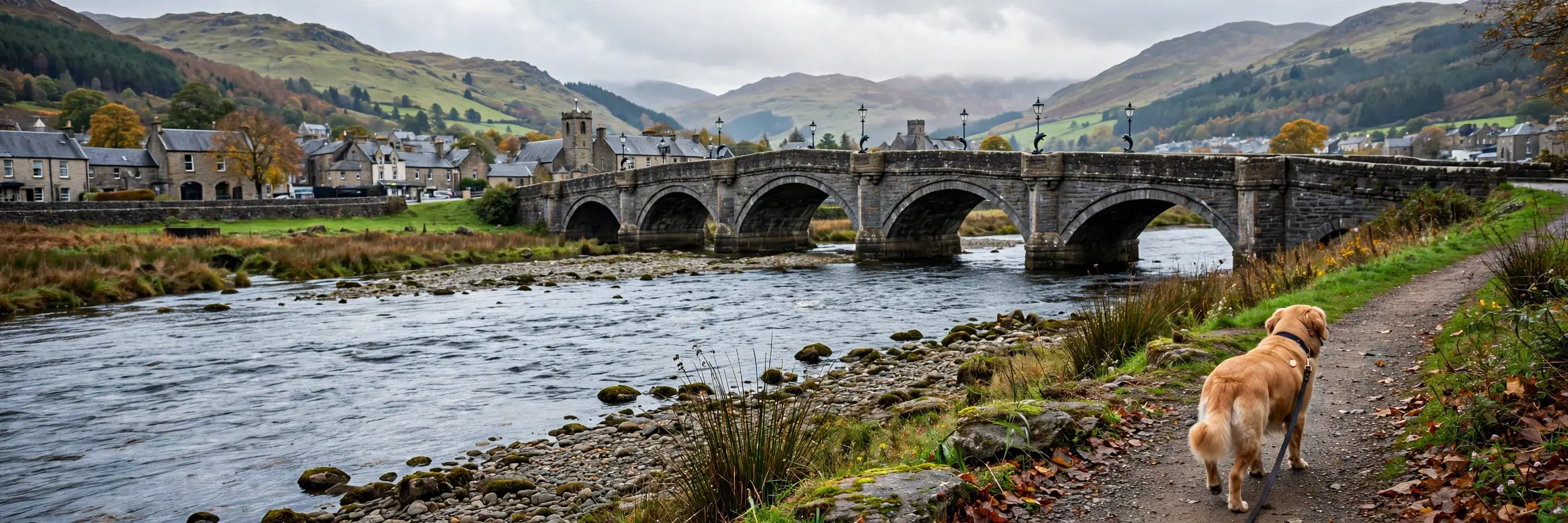
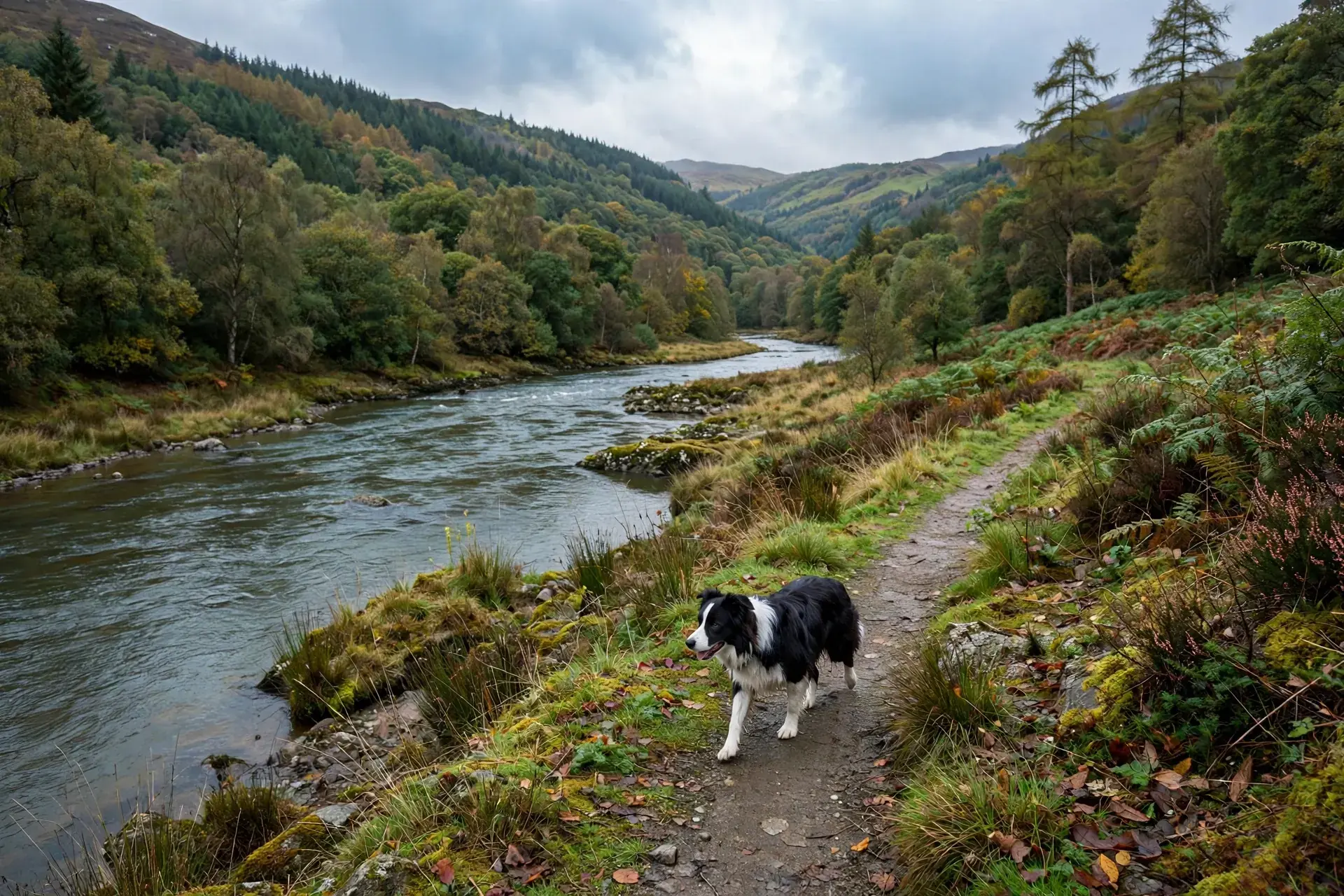
If the forest trails are the valley's busy main road, the River Tweed is its quiet back lane. The Tweed rises in the Lowther Hills and flows for about 100 miles before reaching the sea at Berwick-upon-Tweed, and the stretch through Innerleithen is one of its gentlest: a wide, gravel-bedded river running through open haughland — the flat riverside meadows the Scots call haughs — between wooded hills. For a dog that needs calm, the riverside is where the trip should start, because the walking is flat, the ground is soft underfoot, the views are long, and the only traffic is the occasional angler, cyclist or fellow dog walker.
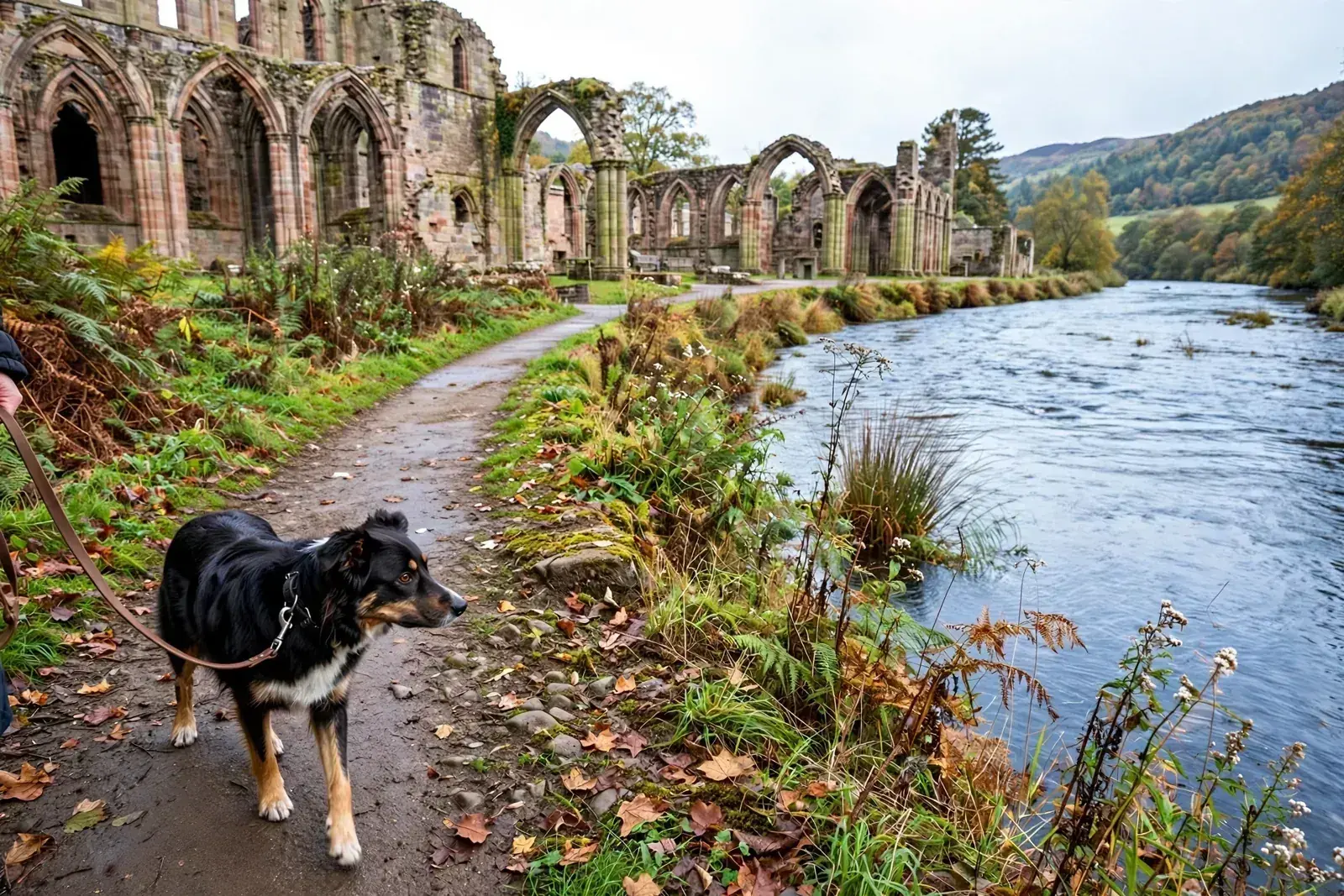
The best short riverside walk starts in the town centre and follows the Tweed downstream towards Walkerburn. The path leaves the town near the bridge, drops to the riverbank and runs along the haughs with the river on one side and fields on the other. It is mostly level, mostly grass and gravel, and easy going for older dogs, puppies and dogs that are still building up their fitness. Allow about an hour for a gentle out-and-back of two to three miles, with plenty of sniffing stops. The river here is wide enough that a dog can paddle at the edges without being swept anywhere, and the gravel banks give easy access to the water for a drink or a splash. Keep the lead on for the first stretch, where the path runs close to the road and to gardens, and only consider letting a reliable dog off where the bank opens out and you can see well ahead.
The same stretch upstream, towards Cardrona and Peebles, is just as calm and a little wilder. The path follows the river past fields and woodland, with herons a common sight standing motionless in the shallows, and kingfishers flashing along the bank in summer. The ground can be soft after rain, and in winter the lower sections of the haugh can flood — the Tweed is a big river and it rises fast after heavy rain in the hills. If the river is brown, fast and carrying branches, keep the dog well back from the edge and skip any paddling. A dog that swims in a spate river is in real danger, and the current near the bank can be far stronger than it looks from a few feet away.
Anglers are part of the riverside picture here, and they deserve particular care. The Tweed is one of the most famous salmon rivers in the world, and the fishing season runs through much of the year, with beats along the river let to anglers who have paid for the privilege of a quiet day on the bank. A dog splashing through a pool where someone is fishing, or barking at an angler from the bank, will not be welcomed. If you see rods, lines or an angler standing in the river, give them a wide berth, keep the dog on a lead, and move past quietly. The same courtesy applies to the river's wildlife: the Tweed's banks are home to otters, dippers, goosanders and, in the right season, salmon leaping the weirs. A dog that chases wildlife into the river is a problem for the wildlife and for itself.
Water safety deserves a paragraph of its own, because river swimming is the most underestimated risk of a dog holiday in the Tweed Valley. The Tweed looks inviting on a warm day, and most dogs love it, but the river has deep pools, strong currents under the surface, and submerged branches and fencing wire that can trap a swimming dog. Let a dog swim only where the water is slow and shallow, where the bank slopes gently so the dog can get out easily, and where you can see the bottom. Never throw a ball or a stick into fast water, and never let a dog jump from a high bank. After a swim, check the dog's paws for cuts from stones and gravel, and dry the ears of dogs prone to ear infections. If you are unsure about water quality or current conditions, check the official guidance before you travel — and if the river is in spate, the answer is always to stay on the bank.
The riverside also makes the best bad-weather walk in the valley. When the hill paths are muddy and the forest tracks are slick with wet leaves, the gravel riverside path usually stays walkable, and the valley floor is sheltered from the worst of the wind. A short riverside loop in the rain, with a drying coat for the dog and a warm cafe at the end, is a far better use of a wet morning than a long slog up a muddy hill. And on a still, cold winter morning, when mist hangs over the river and the hills are white with frost, the Tweed at Innerleithen is one of the most beautiful walks in the Borders — worth the early start on its own.
Tweed Valley Railway Path: Peebles to Innerleithen on foot
The single most useful walk for a dog owner in Innerleithen is the Tweed Valley Railway Path, the traffic-free route that follows the old Peebles Railway trackbed between Peebles and Innerleithen. It is about 9.5 kilometres, or six miles, from end to end, and takes around two hours to walk one way. The surface is mostly compacted gravel and tarmac, the gradients are gentle — it was built for trains, after all — and the route is shared by walkers, cyclists, horse riders and joggers. It is the valley's spine for anyone who wants a long, level walk without touching the A72, and it is the best way to travel between the two towns on foot with a dog.
The path starts at the Peebles end near the old station site and runs east, parallel to the A72 for the first stretch before dipping under the road through a tunnel and hugging the river. It passes Janet's Brae, a wooded climb that walkers use as a shortcut into Glentress Forest, then continues through Eshiels, past the Glentress Forest trails centre, and on through Cardrona, where it crosses the Tweed on an original railway bridge. From Cardrona the path runs on to Innerleithen, ending near the former level crossing on Traquair Road, with the old station building — now a private house — standing just across the road. The whole route is waymarked, and there are access points at Eshiels, Glentress, Cardrona and Innerleithen, so you can walk as much or as little of it as your dog needs.
For a dog, the railway path is a mixed blessing, and it is worth understanding why before you set out. On the plus side, it is wide, flat, well surfaced and free of cars, which makes it ideal for older dogs, dogs recovering from injury, puppies on a first long walk, and owners with a pushchair or a dog in a buggy. The sightlines are long on most sections, so you can see cyclists and horses coming from a good way off, and there are benches and open stretches where a dog can rest. On the minus side, it is popular with cyclists, including families and fast road riders using it as a commuter route, and the tunnel under the A72 and the bridge crossings are pinch points where a dog on a long lead can get in the way. The rule here is the same as everywhere in the valley: short lead, dog on the inside, step aside at the narrow bits.
The practical way to use the path with a dog is to walk it in sections rather than as a single six-mile march. The stretch from Innerleithen to Cardrona is about two miles and makes a good out-and-back of an hour or so, with the Cardrona end offering a cafe stop and a chance to turn around. The stretch from Cardrona to Glentress is shorter and flatter, and it brings you to the forest trails centre, where there are toilets, a cafe and a car park if you need them. The full six miles to Peebles is a serious walk — allow two hours each way, or walk one way and take the bus back along the A72, which runs regularly between the two towns. Buses on this route generally accept dogs at the driver's discretion, but check the official guidance before you travel, because policies vary and a large dog on a busy bus may be refused.
A few details make the walk easier. Carry water for the dog, because there is no reliable drinking water along the path itself and the river is not always accessible from the trackbed. In summer, the open stretches of the path can be hot underfoot for dogs, so walk early or late and check the surface temperature with the back of your hand before you set out. In autumn, the leaf fall from the trees along the path can hide the edges and make the surface slippery, especially on the wooden bridges. In winter, the tunnel and the shaded cuttings can stay icy long after the rest of the path has thawed. And after heavy rain, check the river level before you walk the sections closest to the Tweed — the path itself is raised above the flood plain for most of its length, but the access points at the Innerleithen end can be wet.
The railway path also makes a good base for a longer day. From the Glentress access point you can step off the path and into the forest for a loop on the walking trails, then rejoin the path to walk back to Innerleithen. From Cardrona you can cross the river and explore the village and the golf course edges, keeping the dog on a lead and out of the way of players. And from Peebles you can spend an hour in the town — its riverside, its high street and its cafes — before walking or bussing back. Our guide to Peebles with a dog covers the town end of the route in detail, including the riverside walks, the Glentress access points and the dog-friendly cafes that make a good halfway stop.
Forest and hill routes, graded by bike traffic
The hills around Innerleithen are not one walk but three different kinds of walking, and the difference between them is how many bikes you will meet. Understanding the grading is the difference between a good day and a stressful one, so this section organises the routes by bike traffic, from the quietest to the busiest, rather than by distance or difficulty.
The quietest forest walking is on the waymarked walking trails and forest roads of Glentress Forest. Glentress is part of the 7stanes mountain biking network, and its trails are graded green, blue, red and black, but the forest also has dedicated walking routes that follow forest roads and woodland paths away from the singletrack. The green-graded routes are the gentlest: wide, well-surfaced, with easy gradients, and suitable for most dogs, including older ones. The blue routes are a step up — longer, with more climbing — but still on wide tracks where a bike can be seen coming. The walking trails wind through Sitka spruce and larch, open out onto heather moorland at the top, and give views across the whole Tweed Valley. A typical green-route loop of three to four miles takes an hour to ninety minutes and is the right first forest walk for a dog that has never been in a busy trail centre. Keep the dog on a lead on the shared sections, and be ready to step aside where the walking trail crosses a bike trail — the crossings are signed, but a fast rider can appear with little warning.
The middle tier is the hill walking above Innerleithen itself, on the open moorland and the old drove roads that cross the hills. Routes such as the climb to Lee Pen and the ridge towards Peebles are long, open and exposed, with big views and very few people — and very few bikes, because the ground is rough and the tracks are not built for speed. These are the walks for a fit dog and a fit owner: a hill route of seven to ten miles with several hundred metres of climbing, on grassy tracks and heather, with sheep on the open hill and grouse in the heather. The ground is soft underfoot, which is kind to paws, but the weather changes fast on the tops, and there is no shelter and no water once you leave the valley. Carry water, a map and a lead, and keep the dog on a lead whenever sheep are in sight — lambing season in spring is the time to be most careful, and a dog worrying sheep is a serious matter in Scotland, whatever the dog's intentions. These routes are best on a calm, clear day in late spring or early autumn, when the ground is dry and the visibility is good.
The busiest tier, and the one to avoid with a dog, is the dedicated downhill and enduro singletrack. Above Innerleithen, the hills hold a network of steep, technical downhill trails — the Golfie, in Caberston Forest, is the best known, with tracks that have hosted international enduro racing — and the trails at Glentress include red and black graded singletrack with jumps, drops and berms. These trails are designed for bikes travelling fast downhill, and they are not safe for walkers, let alone dogs. A dog on a downhill trail is a hazard to the rider, who may be travelling at 30 miles an hour and cannot stop in time, and to itself. Do not walk a dog on these trails, even early in the morning, even when they look empty. The risk is not worth it, and the riding community, which maintains the trails voluntarily, will rightly object. If you are unsure whether a trail is a walking route or a bike-only route, check the signs at the trailhead and the official guidance before you travel — and if there is any doubt, choose a different route.
Closer to the town, the shorter woodland walks are the most practical option for a daily dog walk. Pirn Wood, along the Leithen Water, is a short, sheltered walk of about two and a half miles through woodland beside the burn, with the sound of running water all the way and very little bike traffic. St Ronan's Woodland, on the edge of the town, is a two-mile loop through mixed woodland with views back over the town and the river, and it is popular with local dog walkers, which means your dog is likely to meet other dogs — good for a sociable dog, worth avoiding at busy times for a reactive one. Caerlee Hill, above the town, gives a short, steep climb to a viewpoint over the Tweed Valley, and the circular route of about three and a half miles is a good half-day walk. All three are described in the local walking booklet, "Paths Around Innerleithen and Walkerburn", which is worth picking up from a local shop or the visitor information point if you can find a copy, because it gives distances, times and starting points for fourteen routes around the two towns.
A few practical points apply to all the forest and hill routes. Wear boots with grip, because forest tracks are slippery with mud and wet leaves for much of the year, and the hill paths are steep and uneven. Carry a lead and a long line: the long line is useful on open moorland where the dog can range a little without being off lead, but it must be reeled in near bikes, livestock and other walkers. Carry water and a collapsible bowl, because the burns in the forest are not always safe to drink from and the hill tops have no water at all. Check the dog's paws after every forest walk — pine needles, sharp stones and the occasional piece of wire can cause cuts — and check for ticks after walking through bracken and long grass in spring and summer. Ticks are common in the Borders, and a quick check at the end of the walk, with a tick remover in your pocket, is worth more than any amount of worry afterwards.
Finally, remember that the forest is a working forest. Forestry operations — felling, thinning and timber extraction — close sections of trail from time to time, and the closures are signed at the car parks and trailheads. Respect them: a working forest has heavy machinery and falling timber, and a dog off lead in a felling area is in genuine danger. The same applies to the shooting and stalking seasons in the autumn and winter, when parts of the open hill may have signs asking walkers to keep to the paths and keep dogs on leads. Check the official guidance before you travel if you are planning a hill walk in the autumn, and follow the signs on the ground even when they are inconvenient.
Innerleithen village: practical stops and the town centre
Innerleithen's high street is short, and that is part of its charm. Everything a dog owner needs is within a few minutes' walk of the centre: a small supermarket and a couple of convenience shops for supplies, a butcher and a bakery, a pharmacy, a post office, and a handful of cafes and pubs. The town's history is in its mills — Innerleithen grew up around the woollen mills that used the Leithen Water and the Tweed, and the old mill buildings, including Caerlee Mill, still stand along the river — and in Robert Smail's Printing Works, the Victorian print works on the high street that is now preserved as a museum. Dogs are not generally allowed inside the printing works, so plan that visit for a day when one of you can stay outside with the dog, or go in turns.
For a dog owner, the practical centre of the town is the high street and the car park at Leithen Road, which is the natural starting point for the riverside walk and the short woodland loops. Park here, walk the dog along the river first to burn off the journey, and then come back into the town for coffee and supplies. The cafes on the high street vary in their dog policies, and policies change, so always ask before you settle in with a dog — but the town is used to walkers and riders, and several places welcome dogs in the outdoor seating areas and some inside, particularly in the quieter months. The pubs are similarly welcoming in the bar areas, and a muddy dog after a forest walk is a familiar sight in Innerleithen in a way it is not in many towns. If you are staying overnight, ask your accommodation about the nearest dog-friendly pub before you arrive, because a pub that welcomes dogs in the afternoon may have different rules in the evening.
Supplies are worth a thought before you arrive, because Innerleithen is a small town and the shops are not open late. Buy dog food, treats and poo bags in the town or bring them with you, and do not assume you can find a specialist pet shop — the nearest is in Peebles or Galashiels, both a short drive away. The same applies to veterinary care: there is no vet in Innerleithen itself, and the nearest practices are in Peebles and Galashiels. Save the number of the nearest vet and the out-of-hours emergency vet before you arrive, and keep it in your phone. A dog that cuts a paw on a forest track or eats something it should not have on the riverside will need a vet quickly, and the time to find the number is not when you are already worried.
The town also has a useful set of small, practical features that dog owners notice. There are litter bins along the high street and at the main car parks, and a dog waste bin on the riverside path. The public toilets in the town centre are a useful stop on a long walk, though they are not always open in the winter — check before you rely on them. The war memorial and the churchyard at the top of the town are quiet spots for a short, calm walk, but keep the dog on a lead and respect the fact that these are places of remembrance. And if you are staying in the town, ask your host where the nearest practical late-night toilet walk is: the riverside path is dark after sunset, and the streets around the high street are a safer, better-lit option for the last walk of the day.
Innerleithen's annual events are worth knowing about, because they change the town completely for a weekend. The St Ronan's Games, held in the summer, are one of the oldest organised games in Scotland, with running, cycling and traditional sports, and the town fills with visitors. The Common Ridings, the traditional Borders festival, brings horses and crowds through the town in the summer months. And the mountain bike races, including enduro events on the Golfie and at Glentress, bring riders and spectators from across the country. If your dog is nervous around crowds, horses or bikes, check the dates before you book and avoid the event weekends — or, if you are in town during an event, plan your walks for early in the morning, before the crowds arrive, and keep the dog well away from the event itself.
Walkerburn and the valley villages: easy extensions
Innerleithen is not the only dog-friendly stop in the valley, and some of the best walks start in the villages around it. The easiest extension is Walkerburn, the village about two miles downstream on the A72. Walkerburn grew up around the tweed mills in the nineteenth century, when Henry Ballantyne built the mill and the workers' housing, and it still has the feel of a mill village: stone cottages, a church, a village hall, and the river running past the bottom of the village. The walk between Innerleithen and Walkerburn is one of the best short walks in the valley — a circular route of about four and a half miles, or 7.4 kilometres, that follows the Tweed downstream on one bank and returns on the other, with almost no climbing and very little traffic. Allow two hours at a dog's pace, with time for the river.
The Innerleithen to Walkerburn loop is a good test of whether your dog is ready for the longer railway path, because it has the same ingredients — riverside path, open fields, a bridge crossing and a village at each end — in a shorter, gentler form. Start at the Leithen Road car park in Innerleithen, follow the riverside path downstream, and cross the river at Walkerburn to return on the far bank. The path is mostly level and well surfaced, but there are sections where it runs close to the road, and the bridge crossings need a short lead. Walkerburn itself has a small shop and a cafe, and the village green is a good spot for a rest before the walk back. The village is also the starting point for the longer Bier Law circular, an eight-mile hill walk that climbs above the village and gives views across the whole valley — a walk for a fit dog on a clear day, not a first outing.
Further downstream, the valley continues through Cardrona, a village built around the golf course and the old railway station, and on to Peebles, seven miles away. Cardrona is worth a stop on the railway path walk, because the old station building is now a small shop and tea room, and the village has a golf course whose edges the path skirts — keep the dog on a lead and well clear of the fairways. Peebles itself is the valley's market town, with a much wider choice of cafes, pubs, shops and accommodation, and our guide to Peebles with a dog covers the town in detail, including the riverside walks and the Glentress access points that are easier to reach from the Peebles end.
Upstream from Innerleithen, the valley narrows and the road climbs towards the hills, and the villages get smaller and quieter. Traquair, about five miles from Innerleithen, is home to Traquair House, one of the oldest inhabited houses in Scotland, with gardens, a maze and a brewery. Dogs are welcome in the grounds on a lead, but check the official guidance before you travel, because access rules for the house, the gardens and the cafe can change with the seasons and with events. The walk from Innerleithen to Traquair, along the old road and the riverside, is about seven miles one way and makes a good long day out for a fit dog, with the house and its gardens as a reward at the far end. The route is described in the local walking booklet as the Dryhope to Traquair walk, and it is a quieter alternative to the busier railway path, with fewer cyclists and more open farmland.
The wider valley is covered in our guide to dog walks across the Scottish Borders, which puts Innerleithen in context with the abbeys, rivers and border towns around it, including Melrose, Galashiels and the Eildon Hills. If you are staying in Innerleithen for several days, that guide is the best place to plan a day trip — a morning in Melrose, an afternoon on the Tweed at Galashiels, or a longer drive to the coast at Berwick-upon-Tweed, where the river meets the sea. Each of those trips is a day in itself, and each has its own rules for dogs, so read the relevant guide before you set out rather than assuming the rules are the same as in Innerleithen.
Seasons, river levels and livestock
Innerleithen changes with the seasons more than most British towns, because the valley is a working landscape of farms, forests and a big river, and each season brings a different set of conditions for a dog. Understanding them is the difference between a walk that works and a walk that has to be abandoned halfway.
Spring is lambing season, and it is the time to be most careful with livestock. Ewes with lambs are in the fields from March to May, and a dog off lead near lambs is a serious risk — not only to the lambs, but to the dog, because a ewe protecting her lambs can be aggressive, and a farmer is entitled to act against a dog that worries livestock. Keep the dog on a lead in every field in spring, even where there are no sheep visible, because lambs can be hidden in the grass or behind a wall. Spring is also the time when the riverside paths are at their best: the grass is short, the ground is firm, and the wildflowers along the bank — primroses, bluebells in the woods, and later the cow parsley — make the valley look its best. The forest tracks can still be muddy from the winter, so wear boots and carry a towel for the dog.
Summer is the busiest season in the valley, and the one that needs the most planning. The bike trails are at their busiest, the car parks fill early on sunny weekends, and the midges arrive in still, damp woodland, especially in the evenings. Midges are worst in sheltered, humid spots near water and in the forest, and they bother dogs as well as people — a dog with thin fur or a light coat can be bitten badly around the ears and belly. Walk in the morning or in a breeze, avoid the still, damp hollows of the forest in the evening, and consider a dog-safe insect repellent if your dog is sensitive. Summer is also the time to watch the heat: the valley can be warm on a still day, and the open stretches of the railway path and the riverside have little shade. Walk early, carry water, and never leave a dog in a parked car, even for a few minutes — a car in the sun heats up far faster than most people realise, and it can be fatal.
Autumn is, for many dog owners, the best season in Innerleithen. The crowds thin out after the school holidays, the forest turns gold and red, the ground is still firm, and the light in the valley is at its best. The hill walks are at their most rewarding, because the visibility is good and the bracken has died back, making the paths easier to follow. But autumn also brings the shooting season and the stalking season on the open hill, and the deer rut, when stags can be aggressive and unpredictable. Keep the dog on a lead on the open hill in autumn, follow any signs asking walkers to keep to the paths, and check the official guidance before you travel if you are planning a hill walk between September and November. The other autumn hazard is the river: the first heavy rains of the season can bring the Tweed up fast, and a riverside path that was dry in September can be under water in October. Check the river level before you walk the low-lying sections after rain.
Winter in Innerleithen is quiet, cold and beautiful, and it suits a certain kind of dog very well. The trails are empty, the town is calm, and the valley in frost or snow is spectacular. But the practical challenges are real. The forest tracks and the hill paths can be icy, and the shaded cuttings on the railway path can stay frozen long after the rest of the route has thawed. The riverside path can be muddy and, after heavy rain, flooded in places. The days are short — in December the sun sets before 4pm — so plan your walks for the middle of the day and carry a light for the last walk of the day. And the cold is a genuine issue for some dogs: short-coated breeds, older dogs and puppies feel the cold quickly, and a dog that has been in the river or in the rain needs to be dried and warmed up promptly. A drying coat, a warm bed and a draught-free place to sleep are not luxuries in winter — they are part of the kit.
Whatever the season, the river is the thing to watch. The Tweed is a big river with a large catchment, and it can rise several feet in a few hours after heavy rain in the hills, even when it is not raining in Innerleithen itself. The signs are easy to read once you know them: brown, fast water carrying branches and debris; the gravel banks disappearing under the water; the sound of the river changing from a murmur to a roar. If you see those signs, keep the dog on a lead and well back from the edge, and do not let it swim. The river will still be there tomorrow, and a dog that is kept safe today can enjoy it again when the level drops.
Parking, buses and getting here without a car
Innerleithen is easy to reach by car and harder without one, so it is worth planning the journey as carefully as the walks. By car, the town is on the A72, the main road along the Tweed Valley between Peebles and Galashiels, and about an hour's drive from Edinburgh via the A703 and the A72, or via the A7 and Galashiels. The drive from Edinburgh is straightforward, but the A72 is a single-carriageway road with bends and slow traffic, especially in summer, so allow more time than the map suggests. The nearest motorway is the A1 or the M8, both a good hour away, and the nearest train station is at Galashiels, on the Borders Railway from Edinburgh, about seven miles from Innerleithen.
Parking in Innerleithen is straightforward but limited. The main car park is at Leithen Road, near the river and the start of the riverside walk, and it is free — but it is small, and on a busy weekend it fills early with riders' cars and vans. There is on-street parking on the high street and in the side streets, but be careful not to block driveways or the narrow lanes, and do not park on the grass verges, which are easily damaged in wet weather. The Glentress Forest car park, a few miles west towards Peebles, is larger and has toilets and a cafe, but it charges for parking and it is busy on weekends — arrive before 9am if you want a space on a sunny Saturday. The Innerleithen mountain bike trails car park, above the town, is smaller and fills with riders; it is not the best place to start a dog walk, because the trails from it are the fast downhill ones. For a dog walk, the Leithen Road car park or the Cardrona car park on the railway path are better starting points.
By public transport, the practical route is the train to Galashiels and then the bus along the A72 to Innerleithen. The Borders Railway runs from Edinburgh Waverley to Tweedbank, via Galashiels, in about an hour, and the buses from Galashiels to Peebles run along the valley, stopping at Innerleithen, Walkerburn and Cardrona. Buses generally accept dogs at the driver's discretion, but check the official guidance before you travel, because the rules vary between operators and a large dog may be refused on a busy bus. The bus is also the best way to walk the railway path one way: walk from Peebles to Innerleithen, or the other way, and take the bus back. The bus stop in Innerleithen is on the high street, a short walk from the Leithen Road car park and the end of the railway path.
Once you are in the town, you do not need a car. Everything in Innerleithen — the high street, the riverside path, the short woodland walks and the start of the railway path — is within walking distance of the centre, and the valley villages are a walk or a short bus ride away. That is one of the town's strengths as a dog destination: you can base yourself in the town, walk out of the door every morning, and have a different walk every day without driving. If you do need a car for a day trip — to Melrose, to the coast, or to the Eildon Hills — the roads are good and the driving is easy, but the A72 can be slow in summer, so allow extra time.
A final practical note: mobile phone signal in the valley is patchy. The town centre has reasonable coverage, but the forest and the hill tops can have no signal at all, and the railway path has dead spots, especially in the cuttings and the tunnel. Download your maps before you set out, and do not rely on a phone for navigation or for calling for help in the forest. A paper map — the Ordnance Survey Explorer 337, which covers Peebles and Innerleithen — is worth carrying on any hill walk, and a whistle is a useful addition to your pocket if you walk alone with a dog in the hills.
Practical questions
Before you go
Can my dog walk off lead in Innerleithen?
Sometimes, but not by default. Dogs can be off lead on open ground where you have full control and no livestock, bikes or other users are close by, but the Scottish Outdoor Access Code expects dogs under close control at all times, and on a lead near livestock, in fields with young animals, and wherever signs ask for it. In Innerleithen that means keeping the lead on along the riverside path, on shared forest tracks, and anywhere near sheep or horses, and only letting the dog off where you can see well ahead and recall is reliable.
Is the Tweed Valley Railway Path safe for dogs with bikes around?
It is one of the safer shared routes in the valley, because it is wide, mostly flat and has good sightlines, but it is still a shared path used by cyclists, horse riders, joggers and walkers. Keep your dog on a short lead on your left, away from the centre of the path, and step aside at blind corners and bridge crossings. Weekday mornings are quieter than weekend afternoons, and dogs that chase wheels should stay on lead for the whole route.
Where can my dog swim in the River Tweed near Innerleithen?
The safest entry points are the shallow gravel banks and haughland edges downstream of the town, where the water is slow and the bank slopes gently. Avoid fast water, weirs, steep banks and anywhere anglers are fishing. Never let a dog swim after heavy rain, when the Tweed rises fast and carries debris, and check the official guidance before you travel if you are unsure about water quality or current conditions. Dry the dog off afterwards and check paws for cuts from stones.
Are dogs allowed on the Glentress mountain bike trails?
Dogs are welcome in Glentress Forest, including on many of the walking and forest-road routes, but the dedicated mountain bike singletrack is a poor place for a dog. Bikes travel fast on downhill and graded trails, and a dog on the line is a hazard to riders and to itself. Walk the waymarked walking trails and forest roads instead, keep the dog on a lead where bikes cross, and check the official guidance before you travel for current trail designations and any seasonal closures.
What should I do if my dog meets sheep or horses on a trail?
Put the dog on a lead immediately, move to the far side of the path, and keep the dog close and quiet while you pass. If sheep are in the field, stay on the path and do not let the dog approach them; lambing season in spring needs extra care. With horses, speak calmly so the rider knows you are there, keep the dog still and on a short lead, and wait for the rider to pass or tell you it is safe to move on. Never let a dog chase livestock: in Scotland a farmer may take action against a dog worrying livestock, and you could be liable.
When is the best time of year to visit Innerleithen with a dog?
Late spring and early autumn are usually the best balance: the riverside paths are dry, the forest tracks are firm, and the trails are quieter than in the summer holidays. Summer brings warm days and busy bike trails, plus midges in still, damp woodland, especially in the evenings. Winter is quiet and the Tweed looks its best in low light, but paths can be muddy and the river can run high after rain. Avoid the busiest race and event weekends if your dog is nervous around crowds and bikes.