This guide is independent and contains no paid placement. If affiliate links are added later, they will be clearly marked and will not change our editorial checks.
Do the abbey first, while you and the dog are fresh: dogs on leads are welcome in the abbey grounds, the ruins and grass give a dog room to sniff and settle, and the Jed Water loop starts almost from the abbey gate. Then walk the riverside, eat in the Market Place, and save the longer Borders trails for the afternoon. Keep the lead on near livestock, roads and the riverbank.
Start at the abbey: an abbey-first arrival plan
Jedburgh is a small Borders town with one unmistakable landmark, and the sensible way to visit it with a dog is to let that landmark set the shape of the day. Jedburgh Abbey dominates the town from its rise above the Jed Water: a great Augustinian abbey founded in the twelfth century, its ruined nave and choir still standing tall enough to be seen from the approach roads. Everything else in Jedburgh — the Market Place, the Canongate, the riverside paths — sits within a few minutes' walk of it, so an abbey-first plan means you never have to backtrack, and the dog never has to wait in the car while you tick off the main sight.
Arrive and go straight to the abbey grounds. Dogs on leads are generally welcome in the grounds, which is where most of the visit happens anyway: the grassed ruins, the open space around the choir and nave, and the views down over the town and the river. The abbey is managed by Historic Environment Scotland, and opening times, admission charges and any temporary closures change through the year, so check the official guidance before you travel. Plan on the grounds being the dog's part of the visit, and the visitor centre and any indoor exhibition space being the humans' part: dogs are not normally admitted inside, so if you are travelling as a pair, take turns, or accept that the indoor displays are a quick look while one of you stays outside with the dog.
Give the abbey a proper hour, not a ten-minute photo stop. Walk the full perimeter of the ruins first, because that is the circuit that lets a dog sniff, toilet and settle before you ask it to stand still. The grass around the abbey is open and gently sloping, with low stone walls and steps in places, so keep the lead short near drops and stonework. Nervous dogs do better on the wider grass to the south and east of the ruins, away from the entrance and the busiest footfall; confident dogs cope fine anywhere in the grounds as long as they stay on the lead. Bring water, because there is no guarantee of a dog bowl on site, and a chew or a scatter of treats on the grass buys you five quiet minutes while you look up at the nave.
Timing matters more than most visitors expect. Mornings are the calmest time in the abbey grounds, especially outside school holidays, and the light on the red sandstone is at its best before midday. Coach groups and school parties tend to arrive late morning, so if your dog is wary of crowds or children, do the abbey before 11am and leave the town centre for afterwards. In summer the grounds can be busy by early afternoon, and on festival or event days — Jedburgh hosts the annual Jethart Callant's Festival in July, with riding, processions and crowds — the whole town changes character, and a noise-sensitive dog is better off on a quiet riverside stretch than in the middle of the celebrations. Check the official guidance before you travel if your dates fall in early July.
From the abbey, the rest of the day falls into place without a car. The Market Place is a two-minute walk downhill, the Jed Water is a few minutes beyond that, and the longer trails out of town start from the riverbanks. That is the real advantage of the abbey-first plan: by the time you leave the grounds, the dog has had a toilet break, a sniff-heavy wander and a period of calm, and you have seen the town's best sight. Everything after that is a bonus, and if the weather turns or the dog tires, you have already done the thing you came for.
One practical note before you set off: the abbey sits on rising ground, and the paths down to the river and the Market Place are paved but uneven in places, with steps and slopes. Older dogs, dogs recovering from surgery and very small dogs may find the descent awkward, so take it slowly and use the gentler road routes rather than the steepest shortcuts. In wet weather the stone around the ruins and the grassed slopes can be slippery, so keep the lead short and watch the dog's footing. And as with every historic site in Scotland, the rules can change for conservation work or events — check the official guidance before you travel rather than assuming last year's arrangements still apply.
The Jed Water loop: a timed riverside circuit
The Jed Water is the river that gives Jedburgh its setting and its best dog walk. It flows north through the town to join the River Teviot, and the paths along its banks form a natural loop that starts almost at the abbey gate, runs through the town centre and returns without ever needing a car. The full town-centre loop takes about 45 to 60 minutes at a dog-walking pace — roughly 2 miles, or about 3 kilometres — including the abbey grounds and a slow wander through the Market Place. That makes it the ideal second act after the abbey: long enough to tire a medium-energy dog, short enough that an older dog can manage it with a pause or two.
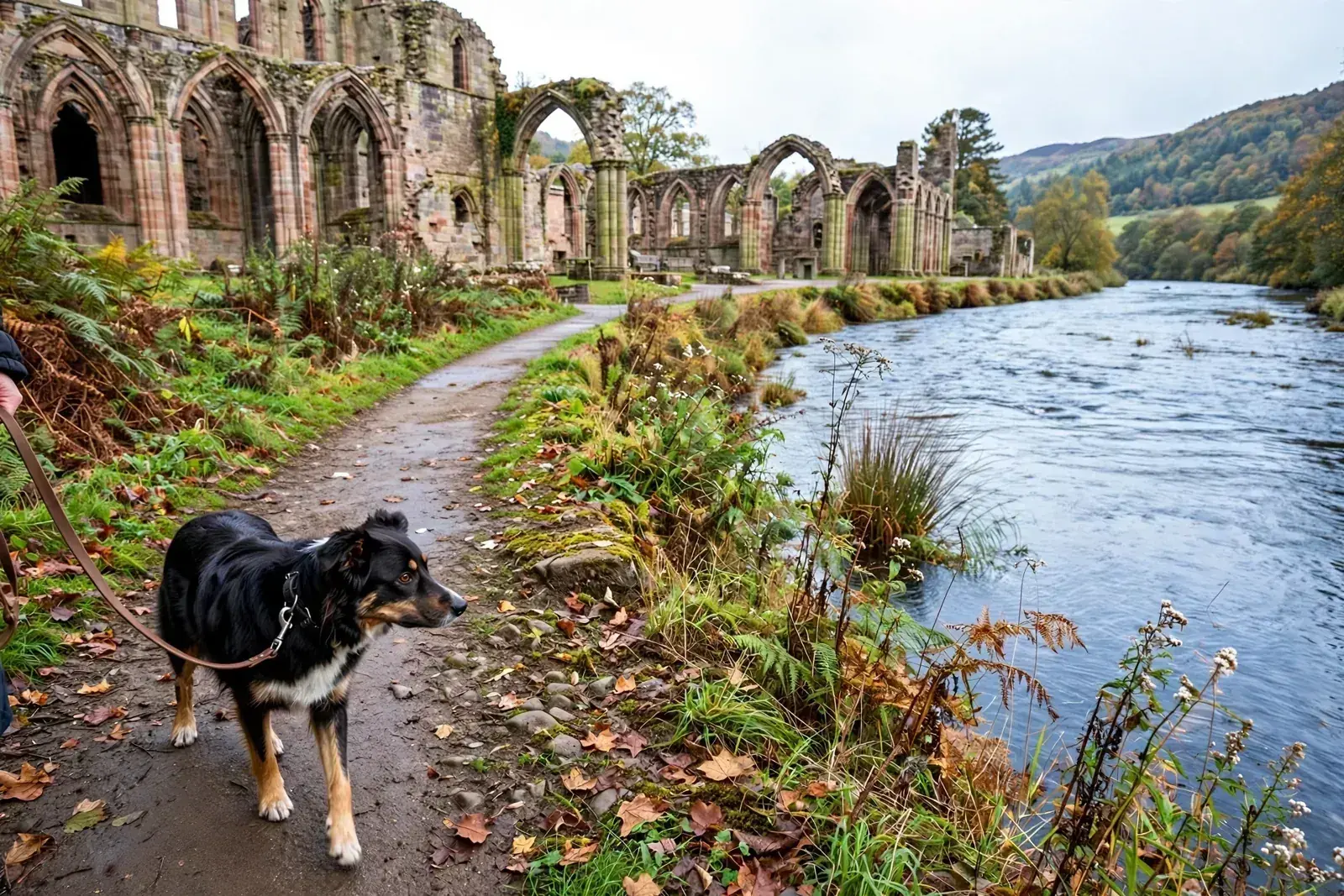
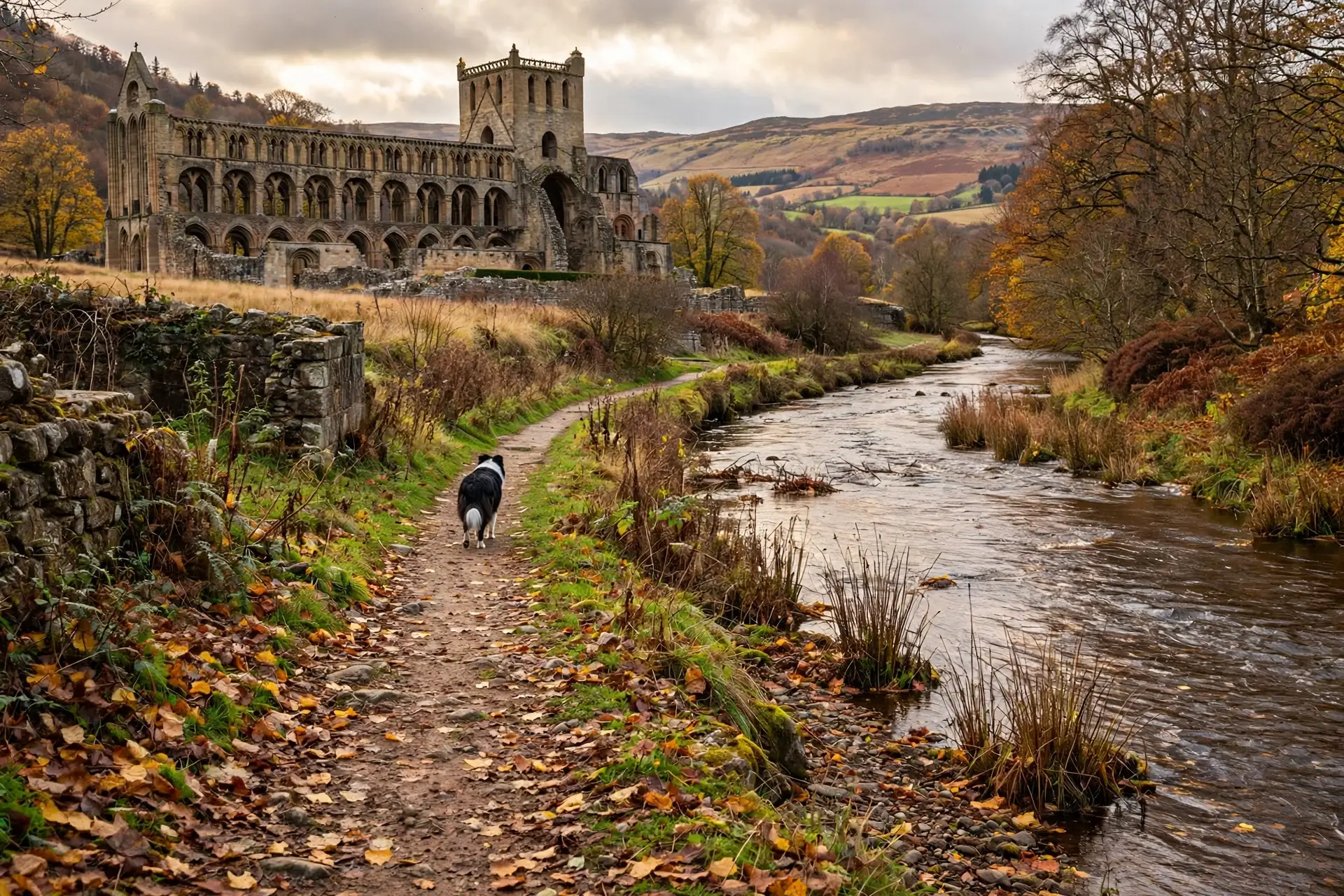
Walk it in this direction. Leave the abbey by its southern side and drop down towards the Canongate, the historic street that runs from the abbey towards the river. Cross towards the Jed Water and pick up the riverside path heading downstream, north through the town. This stretch is the prettiest part of the loop: the river runs fast and clear over stones, trees overhang the bank, and the path is mostly level and well surfaced. Keep the dog on the lead throughout — the bank is unfenced in places, the water is cold and fast after rain, and the path is shared with walkers, runners and cyclists. Dogs that love water will want in; the Jed Water is not a safe paddling river in spate, and after heavy rain it rises quickly, so keep the lead short and the dog on the bank.
Allow about 15 minutes for the first leg, from the abbey down to the northern end of the town-centre path. This is the sniffing leg: the riverbank holds more scent than the abbey grass, and most dogs slow down here. Let them. The point of a riverside walk is not the distance covered but the time spent investigating, and a dog that has had twenty minutes of riverbank sniffing is a calmer dog for the rest of the day. There are benches along the way, and the path passes close to the town centre, so you are never far from a cafe or a shop if you need water, shade or a rest.
The middle leg crosses back through the town. From the northern end of the riverside path, cut back towards the Market Place and the High Street, then head south again along the town's main streets. This is the busiest part of the loop and the least interesting for the dog, so keep it brisk — about 10 minutes of pavement walking, with the dog on a short lead, past parked cars, shop doorways and other pedestrians. If your dog is reactive to other dogs, this is where you are most likely to meet one: Jedburgh is a dog-owning town, and the pavements around the Market Place are the local dogs' daily route. Cross the road early if you see another dog coming, give space at shop fronts, and do not let your dog investigate doorways where food smells spill out.
The final leg, about 20 minutes, takes you back along the southern bank of the Jed Water and up towards the abbey again. This stretch is quieter than the northern bank, with more trees and fewer people, and it is the best part of the loop for a dog that needs to decompress after the town centre. The path undulates gently and the ground can be muddy after rain, so wear proper footwear and expect the dog to come back with wet paws. In autumn the fallen leaves make the path slippery underfoot, and in winter the shaded stretches can hold frost well into the morning — take the dog's footing into account and slow down on the downhill sections.
Shorter and longer versions are easy. For a 15- to 20-minute outing — after a long drive, or for an older dog — walk the northern bank from the Canongate to the top of the town-centre path and back the same way, skipping the town-centre leg entirely. For a longer walk, continue north along the Jed Water beyond the town centre towards Harestanes Countryside Visitor Centre, about 2 miles north of Jedburgh on the A68: the visitor centre has waymarked trails, a cafe and open ground, and the walk out and back adds roughly an hour. Or head south along the river towards Ferniehirst Castle, about a mile and a half from the town centre, for a gentler extension of 30 to 40 minutes. Both extensions cross or run beside farmland, so the lead stays on and the livestock rules in the seasons section apply.
Water safety deserves a paragraph of its own. The Jed Water looks inviting on a hot day, and many dogs will try to get in at the first shallow edge. The riverbed is stony and uneven, the current is stronger than it looks, and after rain the level can rise by a foot or more in an hour. Never let a dog swim in the Jed Water unsupervised, never throw a ball into the river, and keep the lead on near the bank even if your dog is normally reliable off the lead. If your dog does get wet, towel it down before the car journey and check its paws for cuts from sharp stones. In summer, check the official guidance before you travel for any water-quality notices, and in winter, keep the dog out of the water altogether — cold water and a wet coat are a fast route to a chilled, miserable dog.
Market Square and the town centre with a dog
Jedburgh's Market Place is the town's living room: a broad, open square at the heart of the town, ringed by shops, cafes and the tall, slender Mercat Cross, with the Canongate running down to the river and the High Street climbing away to the south. It is the natural place to eat, rest and regroup after the abbey and the riverside loop, and it is also the part of Jedburgh where a dog owner needs the most awareness, because it is where the town's people, traffic and other dogs all converge.
Start with the practicalities. The Market Place is open and mostly traffic-calmed, but it is not pedestrianised, and cars, delivery vans and buses pass through it. Keep the dog on a short lead and on the pavement side of the square, not wandering into the road. The square's surface is a mix of paving and setts, which is hard on paws in hot weather and slippery when wet; in summer, check the ground temperature with the back of your hand before letting a dog stand on it for long. There is little shade in the middle of the square, so on a warm day, sit on the shaded side or under a cafe awning rather than in the open centre.
Cafes and food stops are the question every dog owner asks, and the honest answer is that Jedburgh's offer is small and changes with the seasons. Several cafes and pubs around the Market Place and the High Street welcome dogs, usually in a specific area — a front room, a conservatory or an outdoor terrace — rather than throughout the premises. Policies vary by business and by season, and a cafe that welcomed dogs last year may have changed its rules, so check the official guidance before you travel, and look for a water bowl by the door or a dog sign in the window before you assume. If you are unsure, ask before you sit down: a polite question takes ten seconds and avoids an awkward moment with a dog already settled under the table.
When you do eat out with a dog, choose your spot with the dog in mind. A table at the edge of the room, with the dog on a mat between you and the wall, works far better than a table in the middle of the floor where staff and other customers have to step over a lead. Bring a mat or a blanket so the dog has a defined place to lie, bring a chew to keep it occupied while you eat, and keep the lead short enough that the dog cannot reach the next table's food. Most dogs settle well in a cafe if they have already had a walk; a dog that has just come from the car and has not yet toileted will not settle anywhere, so do the riverside loop before lunch, not after it.
The town centre is also where you stock up. Jedburgh has a small supermarket, a handful of independent shops, a pharmacy and a post office within a few minutes' walk of the Market Place. Dogs are not normally allowed inside food shops, so plan on one person waiting outside with the dog while the other shops, or use the visit to pick up dog supplies — treats, poo bags, a spare lead — from a shop that allows dogs inside. Carry more poo bags than you think you need: the riverside paths and the abbey grounds have bins, but the longer trails out of town do not, and you will be carrying the bag for a while.
Two other town-centre sights are worth knowing about. Mary Queen of Scots' House, on Queen Street just off the Market Place, is a small museum in the house where Mary stayed in 1566; dogs are not normally admitted inside, so treat it as a human-only stop and take turns if you want to go in. Jedburgh Castle Jail and Museum, at the top of the town on Castlegate, is a former prison with a museum and gardens; the grounds are a pleasant short walk from the centre, but again, check the official guidance before you travel for the current dog rules before you plan the visit around the dog. Both are worth a look from the outside with the dog, and neither should be the reason you leave the dog in the car.
Market days and events change the town centre completely. Jedburgh's market is a modest affair, and on market mornings the square fills with stalls, shoppers and dogs, which some dogs love and others find overwhelming. If your dog is crowd-shy, do the town centre early, before the stalls are fully set up, or late, after the crowds thin. The Jethart Callant's Festival in July brings riding, processions, music and large crowds over several days, and the Common Ridings season across the Borders generally runs through the summer — check the official guidance before you travel if your dates fall in June or July, and plan quieter walks for festival days.
Longer walks out of Jedburgh
Jedburgh earns its place as a walking base because the long-distance trails pass through it, not just near it. The Borders Abbey Way is a 109-mile circular route linking the four great Border abbeys — Jedburgh, Kelso, Melrose and Dryburgh — and it runs right through the town, so you can pick up a section of it from the riverbank without driving anywhere. St Cuthbert's Way, the 62-mile route from Melrose to Lindisfarne, passes within a few miles of Jedburgh, and the hills to the south rise towards the Cheviot foothills and the English border. That means a dog owner staying in Jedburgh can walk a different direction every day for a week.
The most rewarding day walk is the Borders Abbey Way section from Jedburgh to Kelso, about 10 miles along the Jed Water and the River Teviot. This is a full-day walk — allow five to six hours including stops — and it is best done as a one-way walk with a bus or a lift back, or as a shorter out-and-back of two to three hours if you prefer a circular route. The path follows the rivers for much of the way, crossing farmland and woodland, and the lead stays on throughout: the route crosses working farms, the fields hold sheep and cattle, and the paths are narrow in places. Take water for the dog, because the rivers are not a reliable drinking source, and take a long line rather than letting the dog off the lead — the open fields look tempting, but livestock can be over the next rise. Our guide to Kelso with a dog covers the other end of this walk in detail, including Abbey Square, Floors Castle gardens and the Tweed riverside paths you will reach at the end of the day.
A shorter, gentler option is the walk north to Harestanes Countryside Visitor Centre, about 2 miles from the town centre along the A68 corridor. The visitor centre sits in woodland with waymarked trails of varying length, a cafe and picnic areas, and it is a popular local dog-walking spot. The trails are mostly surfaced and gently graded, which suits older dogs and families, and the woodland gives shade in summer and shelter in light rain. The route from Jedburgh follows the Jed Water and then a roadside path, so keep the dog on the lead on the road sections, and expect to meet other dogs on the visitor centre trails — a good place for a sociable dog, and a place to keep a reactive dog on a short lead and give space at junctions.
South of the town, the walk to Ferniehirst Castle is a quieter, shorter outing of about 30 to 40 minutes each way. Ferniehirst is a sixteenth-century tower house about a mile and a half south of Jedburgh, set in wooded grounds above the Jed Water, and the walk there follows the river and then climbs gently through trees. The castle itself is not generally open to the public, so treat the walk as the destination rather than the building, and enjoy the woodland and the river views on the way. The path can be muddy and rooty after rain, so wear proper boots, and keep the dog on the lead — the woods hold pheasants and deer, and a dog that chases birds will find plenty to chase here.
For a bigger day, the hills south and east of Jedburgh offer open moorland walking towards the Cheviots and the border ridge. These are exposed, pathless in places and a long way from help, so they suit fit, experienced walkers with fit dogs, and they demand proper preparation: a map and compass or a charged phone with offline mapping, water and food for the dog, a lead and a long line, and a plan for turning back if the weather changes. The Borders weather can turn quickly on the high ground, with wind and rain arriving in minutes, and there is little shelter once you leave the valleys. Check the official guidance before you travel for access and any seasonal restrictions, and do not attempt the high routes with a dog that cannot manage steep, uneven ground or a long day.
Whatever distance you choose, the same planning rules apply. Start early in summer, so the dog is not walking in the heat of the day; carry at least a litre of water for the dog on any walk over an hour, plus a collapsible bowl; pack poo bags and carry them out, because the long-distance paths have few bins; and check the dog's paws at the end of the walk for cuts, thorns and ticks. Ticks are a real consideration on Borders farmland and woodland from spring to autumn, so check the dog after every walk and carry a tick remover. And remember that a long walk for you is a long walk for the dog: build up the distance over the first day or two of a holiday rather than doing the longest walk on the first morning.
Seasons, livestock and ground conditions
Jedburgh changes with the seasons more than a first-time visitor expects, and the dog's experience changes with it. Spring, from March to May, is the season of lambs and new growth: the fields around the town fill with ewes and lambs, the river runs high with snowmelt and rain, and the paths are at their muddiest. Lambing in the Scottish Borders generally runs from late March into May, and during this period the rules are at their strictest — dogs on short leads near all livestock, no exceptions, and if a field holds ewes with lambs, choose another route entirely. The Scottish Outdoor Access Code gives everyone the right of responsible access, and responsible access with a dog near livestock means a short lead, no chasing, and giving the animals a wide berth. Farmers are entitled to protect their livestock, and a dog that worries sheep can be shot in law — a sobering fact that every Borders dog owner knows, and the reason the lead stays on.
Summer, from June to August, brings the best walking weather and the most visitors. The riverside paths are at their driest, the abbey grounds are at their greenest, and the long evenings mean you can walk until nine or ten o'clock. It also brings heat, and heat is the main summer risk for dogs. The Borders are cooler than the south of England, but a sunny July day can still reach the mid-twenties, and a dog walking on hot paving in the Market Place or climbing the abbey slopes in the midday sun can overheat quickly. Walk early in the morning or late in the evening, carry water and a bowl, watch for heavy panting and slowing down, and never leave a dog in a parked car — even on a mild day, a car heats up fast. Midges are a minor nuisance in the Borders compared with the Highlands, but they appear on still, damp evenings near the river, so a light dog coat or a quick retreat indoors is worth having in the kit.
Autumn, from September to November, is arguably the best season for a dog visit to Jedburgh. The crowds thin, the abbey and the riverside are at their most colourful, the air is cool enough for long walks, and the accommodation prices drop. The trade-offs are mud and light: the riverside paths get slippery with fallen leaves, the ground stays wet for days after rain, and the days shorten fast — by late October, it is dark by five o'clock. Carry a torch or a headtorch for evening toilet walks, keep the dog's coat dry with a drying coat or a towel, and check the dog's paws for mud packed between the toes, which can cause soreness on long walks. Autumn is also the season of pheasant shooting on the surrounding estates, so keep the dog on the lead in woodland and farmland, and check the official guidance before you travel for any local notices about shooting days.
Winter, from December to February, is quiet and atmospheric, but it demands the most preparation. The abbey and the riverside paths can be icy, the wind cuts across the open ground around the ruins, and the daylight hours are short — a long walk needs to start by mid-morning at the latest. Some cafes and attractions reduce their hours or close for the winter, so check the official guidance before you travel rather than assuming everything is open. On the plus side, winter is the season for a dog that loves cold weather and empty paths: the riverside loop is yours alone, the abbey grounds are silent, and a dog that has had a good run in the frost will sleep all evening. Dress the dog for the conditions if it is short-coated or elderly — a waterproof coat and a warm bed in the car make the difference between a good winter walk and a miserable one.
Ground conditions deserve a note in every season. The Jed Water paths are mostly surfaced in the town centre, but the stretches beyond it are natural earth and grass, which turn to mud after rain and stay muddy for days. The abbey grounds are grass and stone, which are slippery when wet and frosty when cold. The farmland paths on the longer walks cross fields that can be ploughed, waterlogged or thick with mud in winter, and the woodland paths around Harestanes and Ferniehirst are rooty and uneven. The practical answer is simple: wear proper walking boots in every season, carry a towel and a spare lead, and check the dog's paws after every walk for mud, cuts and stones lodged between the toes.
Parking, buses and getting there
Jedburgh sits on the A68, the main road from Edinburgh to Newcastle, about 49 miles south-east of Edinburgh and about 58 miles north-west of Newcastle. That makes it an easy drive from either city — roughly an hour and a quarter from Edinburgh in normal traffic — and the A68 is a good, fast road for most of its length, with the last few miles into Jedburgh running through rolling Borders countryside. The A698 from Kelso and the A699 from Selkirk and Galashiels provide the other approaches, and all three roads are scenic, single-carriageway routes where a dog in the car needs a proper restraint — a crate, a guard or a harness clipped to a seatbelt anchor — and a stop every couple of hours for water and a toilet break.
Parking in Jedburgh is straightforward, and the car parks around the Market Place and Abbey Place are the best choice for a dog owner: they put you within a few minutes' walk of the abbey, the Jed Water and the town centre, which matters when you are unloading a dog, water, a day bag and a lead. Arrive before late morning in summer and on market days, when the central spaces fill first, and expect the town to be busier during the Jethart Callant's Festival and on summer weekends. Charges and time limits change, so check the official guidance before you travel for the current position, and never leave a dog in a parked car in warm weather, even for a few minutes — the temperature inside a car rises far faster than most people expect, and a dog left in a hot car is a welfare emergency.
Public transport is possible but limited, and it shapes the trip more than a driver expects. Jedburgh has no railway station — the nearest stations are at Tweedbank, near Galashiels, about 20 miles away, and at Berwick-upon-Tweed, about 30 miles away — so a visit by public transport means a bus. Buses run from Edinburgh, Galashiels, Hawick and Kelso, and the services are regular enough for a day trip but not so frequent that you can be casual about times: check the timetable before you travel, and have a plan for the return journey. Dogs are generally allowed on Borders buses at the driver's discretion, usually on a lead and on the floor rather than on a seat, but this is not guaranteed — check the official guidance before you travel, and be ready to wait for the next bus if the driver declines. A well-behaved dog on a short lead, sitting quietly by your feet, is far more likely to be welcomed than a dog that is already barking at the bus stop.
If you are staying overnight, Jedburgh has a small range of dog-friendly accommodation: guest houses, bed and breakfasts and self-catering cottages in and around the town, plus campsites and caravan parks in the wider Borders. Book early for summer weekends and festival dates, and confirm the dog arrangements in writing before you pay: how many dogs are allowed, whether there is a charge, whether the dog can be left alone in the room, and where the nearest toilet walk is. A ground-floor room with a door to the outside is worth asking for, and a place with a garden or a yard beats a place where every toilet trip means a walk through the town. Our overview of Scottish Borders dog walks covers the wider region's places to stay and the abbey towns that pair well with Jedburgh as part of a longer trip.
One last transport note: the Borders roads are narrow and winding once you leave the A68, and the lanes around Jedburgh are shared with tractors, cyclists, horse riders and sheep. Drive slowly on the single-track roads, keep the dog secured in the car, and never let a dog out of the car on a roadside verge — use a car park, a lay-by with a gate, or a proper path. If you are walking from a rural car park, check the dog's lead and collar before you set off: a slipped collar on a country lane is a genuine danger, and a harness is a safer choice than a collar for a dog that pulls.
Where dogs can — and cannot — go
Jedburgh is a welcoming town for dogs, but the rules are not the same everywhere, and knowing them in advance saves awkward moments. The short version is this: dogs on leads are welcome in the abbey grounds, on the riverside paths, in the Market Place and on the long-distance trails, and they are welcome in some cafes and pubs in designated areas; they are not normally allowed inside the abbey visitor centre, the museums, the food shops or the indoor parts of cafes that do not advertise themselves as dog-friendly. The longer version follows, and it is worth reading before you arrive.
In the abbey grounds, dogs on leads are generally welcome, and the open grass and the ruins give a dog room to move without being underfoot. The visitor centre and any indoor exhibition space are the exception: dogs are not normally admitted, so plan on taking turns if you want to see the indoor displays, or skip them and enjoy the ruins themselves, which are the main event. Keep the dog on the lead in the grounds at all times, keep it off the fragile stonework and the planted areas, and pick up after it — the abbey grounds are a historic site and a public space, and a dog fouling complaint is the fastest way to lose the welcome that dogs currently enjoy.
On the riverside paths and the long-distance trails, the lead is the rule, not the exception. The Jed Water paths are shared with walkers, cyclists and children, the banks are unfenced in places, and the fields beyond the town hold livestock for much of the year. The Scottish Outdoor Access Code allows responsible access with dogs, and responsible means a lead near livestock, near other people and near roads, and full control at all times. There is no dedicated enclosed dog field in the town centre, so if your dog needs a proper off-lead run, the honest answer is that Jedburgh's town-centre walks are not the place for it: use a long line on open ground well away from livestock, roads and other dogs, and check the official guidance before you travel for any local dog control orders or seasonal restrictions.
In cafes, pubs and shops, the rule is to ask first and assume nothing. A cafe that welcomed dogs in its conservatory last summer may have changed its policy, a pub that allows dogs in the bar may not allow them in the restaurant, and a shop that allows a small dog to be carried may not allow a large dog on a lead. Look for signs, ask before you sit down, and respect the answer — a business that says no to dogs is not being unfriendly, it is managing its space, and arguing the point helps nobody. If you are travelling with a dog that cannot settle in a cafe, the practical answer is to eat outside: the Market Place and the riverside benches make a perfectly good picnic spot, and a takeaway eaten by the Jed Water is a better lunch than a stressful half-hour in a crowded room.
At the museums and the castle jail, the position is the same as at the abbey: the grounds and the gardens are generally accessible with a dog on a lead, the interiors are not. Mary Queen of Scots' House and Jedburgh Castle Jail and Museum are both small, human-scale museums, and neither is designed for a dog inside. Take turns, or enjoy the outside and move on — the town has plenty to see without going indoors. And in the food shops, the rule is simple: dogs stay outside, one person shops, the other waits with the dog. It is a small inconvenience, and it is also the arrangement that keeps Jedburgh's shops welcoming to the dog owners who come after you.
Finally, a word on the rules that apply everywhere in Scotland. The Control of Dogs (Scotland) Act 2010 means a dog owner is responsible for keeping their dog under control in a public place, and a dog that is out of control — chasing livestock, worrying other dogs, or causing alarm — can lead to a dog control notice and, in serious cases, a court order. The Dangerous Dogs Act 1991 applies across the UK, and certain types of dog are subject to specific conditions. None of this is meant to alarm: it is the legal background that makes the lead, the short lead near livestock, and the habit of asking first the sensible default for every dog owner visiting Jedburgh.
Practical questions
Before you go
Can dogs go into Jedburgh Abbey?
Dogs on leads are generally welcome in the abbey grounds, which is where most of the visit happens: the ruins, the grass and the views of the town. The visitor centre and any indoor exhibition space are a different matter, and dogs are not normally admitted inside. Check the official guidance before you travel, and plan on one person staying outside with the dog if you want to look at the indoor displays.
How long is the Jed Water riverside walk in Jedburgh?
The town-centre riverside loop along the Jed Water takes about 45 to 60 minutes at a dog-walking pace, roughly 2 miles (about 3 kilometres) including the abbey grounds and the Market Place. Shorter out-and-back stretches of 15 to 20 minutes work well for older dogs or a first outing after a long drive, and the route can be extended north towards Harestanes or south towards Ferniehirst for a longer walk.
Are dogs allowed off the lead anywhere in Jedburgh?
Keep your dog on a lead through the abbey grounds, the town centre, the riverside paths and anywhere near roads or livestock. The riverside paths are shared with walkers, cyclists and children, and the fields beyond the town hold sheep for much of the year. There is no dedicated enclosed dog field in the town centre, so if your dog needs a proper off-lead run, use a long line on open ground well away from livestock and roads, and check the official guidance before you travel for any local dog control orders.
Where is the best place to park in Jedburgh with a dog?
The car parks around the Market Place and Abbey Place put you within a few minutes' walk of the abbey, the Jed Water and the town centre, which matters when you are unloading a dog, water and a day bag. Arrive before late morning in summer and on market days, when the central spaces fill first. Check the official guidance before you travel for current charges and time limits, and avoid leaving a dog in a parked car in warm weather.
Is Jedburgh a good base for a longer Borders walking holiday with a dog?
Yes. Jedburgh sits on the Borders Abbey Way and close to St Cuthbert's Way, with Kelso about 10 miles to the north-east, Melrose about 13 miles to the north-west and Hawick about 10 miles to the south-west. That makes it a practical base for day walks and short drives to the other abbey towns, the River Tweed and the Cheviot foothills. Book dog-friendly accommodation early for summer and festival weekends, and plan each day around one long walk rather than two rushed ones.
When is lambing season around Jedburgh, and what should dog owners do?
Lambing in the Scottish Borders generally runs from late March into May, and sheep graze the fields around Jedburgh for much of the year. Keep your dog on a short lead near all livestock at all times, not just in spring, and never let a dog chase or worry sheep. If a field holds ewes with lambs, stick to the marked path or choose another route entirely, and check the official guidance before you travel for current access advice.