This guide is independent and contains no paid placement. If affiliate links are added later, they will be clearly marked and will not change our editorial checks.
Kelso works well as a dog day out because its three best experiences sit close together: Abbey Square for a market morning, the open grounds of Kelso Abbey, and the level riverside paths of the Tweed, with Floors Castle gardens a short walk or drive away. Keep your dog on a lead in the square, the abbey grounds and the castle gardens, check the official guidance before you travel for current access and fishing rules, and plan one calm riverside walk rather than trying to fit everything into a rushed morning.
Market day in Abbey Square
On a market morning, Abbey Square fills before the town has properly woken up. Stallholders unload crates of vegetables, bread and flowers while shopkeepers open their doors, delivery vans thread carefully around the square, and the first dogs of the day arrive with their owners for a slow circuit before the crowds thicken. It is the best possible introduction to Kelso, because the whole town seems to pass through one handsome, cobbled space, and a dog that can settle for a few minutes on a pavement cafe chair or beside a bench gets to watch the town at work. The trick is to arrive early, walk the square once before you stop anywhere, and let your dog sniff the edges, the shopfronts and the quieter corners before the stalls, the music and the smell of hot food pull everyone into the middle.
Kelso calls itself the most attractive town in the Scottish Borders, and Abbey Square is the reason the claim is easy to believe. The square is broad and Georgian in character, with the ruined abbey at one end and a run of independent shops, cafes and pubs around its edges. Market days add stalls, colour and noise, but the square never feels like a theme park: people are doing ordinary shopping, meeting friends, collecting orders and stopping for coffee, and a well-behaved dog fits into that rhythm without fuss. If your dog is nervous in crowds, treat the square as a short visit rather than a base for the morning. Walk through, pause at the quieter side streets, and then head for the river, where the space opens up again and the noise drops away.
Timing matters more than anything else on a market day. The first hour is calm, with room to move, space to park a dog beside a bench, and stallholders who have time to chat. By late morning the square tightens, pushchairs and shopping trolleys compete for the same gaps, and a long lead becomes a trip hazard for everyone. Keep the lead short, keep your dog on the side away from the stalls, and avoid the pinch points where queues form outside bakeries and cafes. If your dog is reactive to other dogs, walk the perimeter rather than cutting across the middle, and use the side streets as escape routes. A reactive dog does not need to be excluded from Kelso, but it does need a handler who reads the square and leaves before the pressure builds.
Use the market as a supply stop as well as a sightseeing stop. Pick up water, snacks and anything your dog might need for the riverside walk, because the shops around the square are easier to use now than they will be after a long walk when everyone is tired. Ask stallholders and shop staff about the day ahead: which riverside paths are muddy, whether the castle gardens are open, and where the quietest cafe table is likely to be at lunchtime. Local advice in a small town is usually specific and current, and it is often more useful than a printed leaflet. Buy what you need, let your dog have a drink, and then move on while the morning is still fresh, because Kelso rewards a slow pace much more than a packed schedule.
Practical market-day habits make the difference between a relaxed morning and a stressful one. Bring a short lead rather than a long line, a water bowl or a bottle your dog will drink from, and a mat or blanket if you plan to sit outside a cafe. Bring bags for waste and use them, because a market square is the worst possible place to leave a mess. Keep your dog out of food stalls and away from produce at nose height, and do not tie a lead to a stall leg or a chair and walk away. If you need to go inside a shop that does not welcome dogs, take turns with your travelling companion, or leave the shopping for later and keep the dog with you. Kelso is a town to explore with a dog, not around a dog, and the square works best when the dog is treated as part of the outing rather than a problem to be parked.
Kelso Abbey with a dog
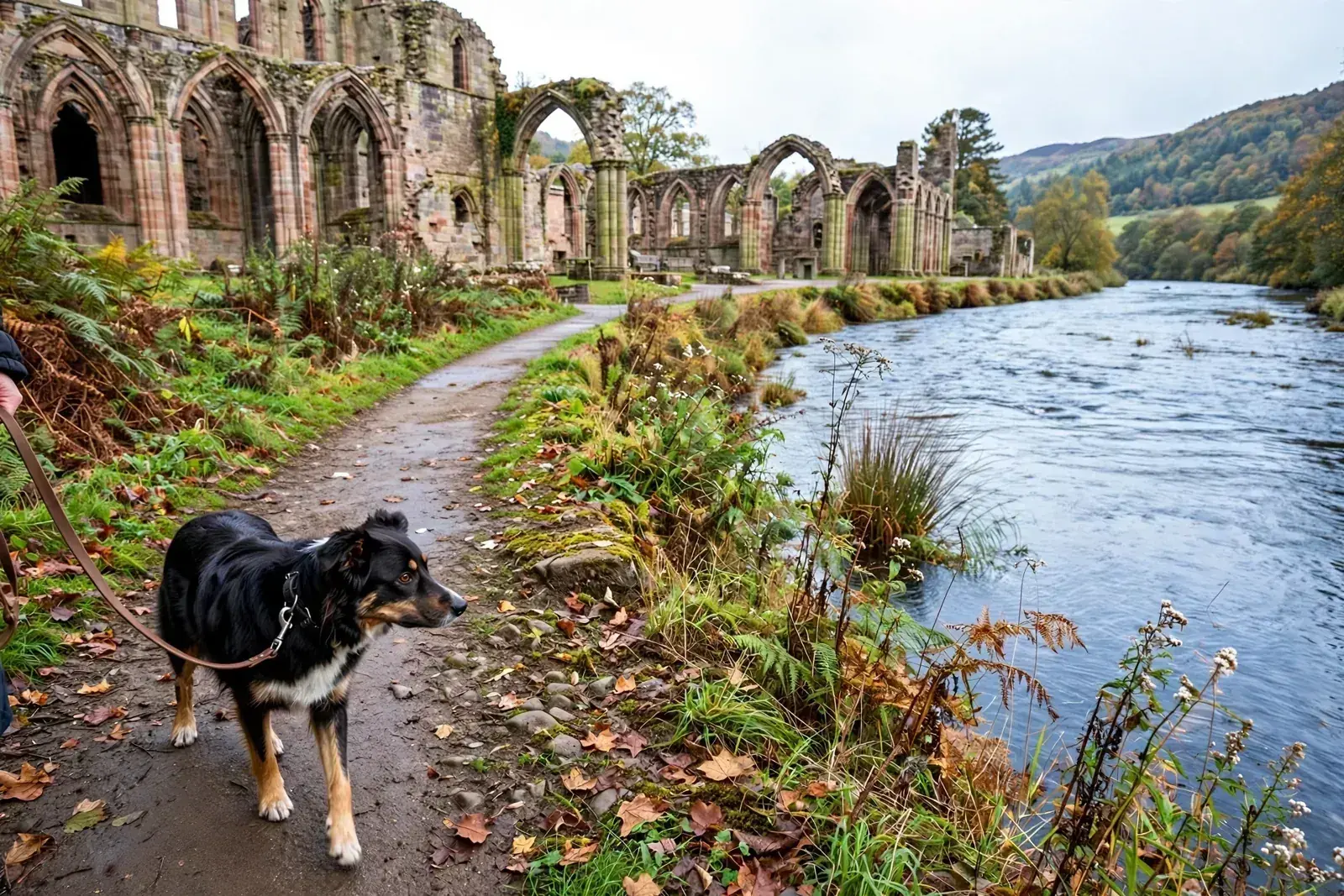
Kelso Abbey stands at the edge of Abbey Square as a great ruined church, its tall arches and broken walls open to the sky. Founded in the twelfth century, it was once one of the richest and most powerful abbeys in Scotland, and its remains still dominate the town in a way that a smaller ruin never could. For a dog walk, the abbey is a short, atmospheric stop rather than a long hike: you walk around the grass, look up at the surviving west front and the great tower, read the information panels, and then carry on towards the river. Dogs are generally welcome in the open-air grounds on a lead, but access rules for any enclosed or staffed area can change, so check the official guidance before you travel and follow the signs on the day.
The abbey grounds suit a calm, on-lead walk because the space is enclosed enough to feel contained and open enough for a dog to move without crowding other visitors. Keep your dog close among the stonework, because the ground is uneven in places, the walls are old and fragile, and climbing on the ruins is not acceptable. Children, photographers and history enthusiasts all share the same small area, so a short lead and a steady pace matter more here than on a riverside path. If your dog pulls towards pigeons, squirrels or other dogs, hold the lead with both hands for the first minute until you know how busy the grounds are, and then settle into a slower circuit once you have the measure of the place.
History helps you get more from a short visit. Kelso Abbey was founded around 1128 and grew into a major Border abbey before suffering repeated damage during the Anglo-Scottish wars of the sixteenth century, when border warfare left much of the building in ruins. What survives is still impressive: the massive west front, the crossing tower and the transepts give a clear sense of the scale of the original church, and the site rewards a visitor who stops and looks up rather than hurrying past. You do not need to know every date to enjoy the abbey, but a little background turns a pile of old stones into a story about monks, border raids and a town that grew up around a great religious house. Read one panel properly rather than skimming them all, and let your dog rest in the shade while you do it.
Combine the abbey with the square and the river rather than treating it as a separate attraction. A natural loop is to start in Abbey Square, walk through the abbey grounds, and then follow the streets down towards the Tweed for the longer riverside walk. That order works because the abbey is the most structured and crowded of the three stops, and the river is the release afterwards, where a dog can stretch its legs and sniff properly. If you arrive at the abbey and find a school group, a tour party or a wedding shoot in progress, do not push through with a nervous dog. Walk the square instead, come back later when the grounds are quieter, or save the abbey for the end of the day when the light is softer and the crowds have gone.
Photographs at the abbey are best taken with the dog as part of the scene rather than as a posed subject in front of the ruins. Sit your dog on the grass at a respectful distance from the stonework, keep the lead loose but short, and take the picture quickly before the dog loses patience. Avoid blocking paths and doorways while you frame a shot, and be ready to move aside for other visitors. The abbey is a historic site, not a dog park, and the dogs that enjoy it most are the ones whose owners treat it with the same quiet respect they would give to any shared public space. For wider context on abbey country and river walks across the region, our guide to Scottish Borders dog walks covers the abbeys, the Tweed and the border towns in more detail.
Floors Castle and its gardens
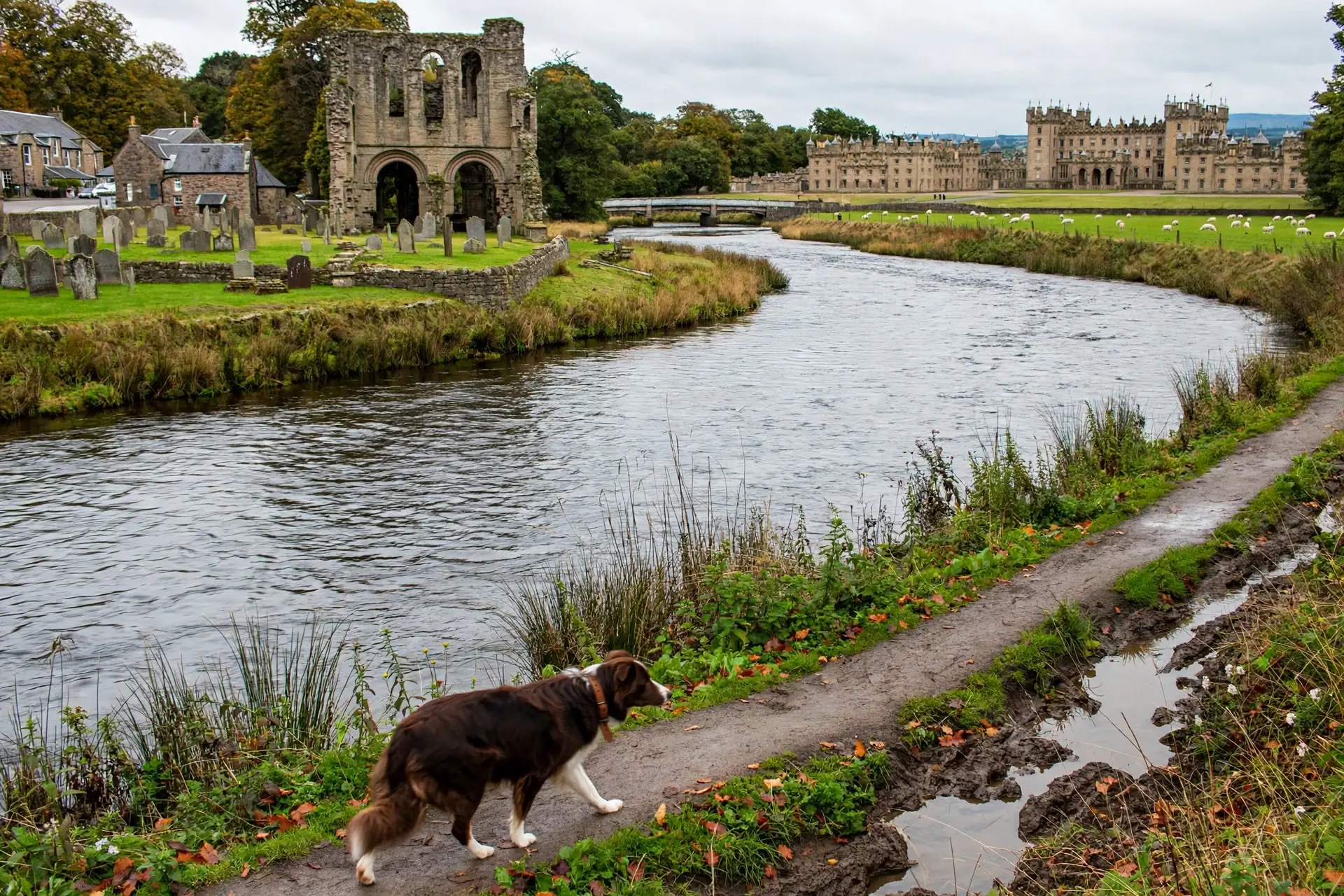
Floors Castle sits just outside Kelso, across the Tweed, as the largest inhabited castle in Scotland and the home of the Duke of Roxburghe. From the town it looks like a fairytale building, all turrets and pinkish stone, but up close it is a working family home with gardens, a cafe, a shop and a calendar of events. For a dog owner, the castle is a gardens-and-grounds visit rather than a house tour: dogs on leads are usually welcome in the grounds and gardens, while the castle interior has separate rules and dogs are not normally admitted inside, so check the official guidance before you travel, because garden access, lead requirements and seasonal opening can change.
The gardens are the part of Floors Castle that repays a slow dog walk. There are formal areas, wooded walks, open lawns and views back across the river to Kelso, and the planting changes through the seasons, from spring bulbs to summer borders and autumn colour. Keep your dog on a short lead and on the paths, and keep them off planted beds and out of formal garden areas where signs ask you to. A dog that stays on the path and does not chase squirrels or dig in borders is welcome in a way that a dog allowed to roam is not, and garden staff notice the difference. Bring water, because the grounds are larger than they look from the gate, and plan for shade on a warm day, especially for older dogs and flat-faced breeds.
Getting to Floors Castle from Kelso is part of the outing. The castle lies across the river, and the walk from the town centre takes you over the bridge and along roads and paths where traffic and other walkers need attention. Keep your dog on a lead for the road sections, use pavements where they exist, and cross carefully at the bridge, where the view is lovely and the traffic is real. If you prefer to drive, use the castle car park and check the official guidance before you travel for current charges and opening times. Either way, arrive with a plan for the dog: a walk in the grounds first, then a rest at the cafe terrace if dogs are welcome there, and then a shorter walk back, rather than a long, hot circuit with no break.
The castle cafe and shop are useful stops, but they need the same care as any venue with a dog. Confirm the current dog policy when you arrive, because policies can differ between the terrace, the indoor cafe and the shop, and they can change with the season or with events. If the terrace is the dog-friendly option, choose a table at the edge where your dog can settle out of the main walkway, bring a mat for the dog to lie on, and order at the counter if that is easier than waiting at the table. Do not leave a dog tied up outside while you go inside, and do not expect staff to watch a dog for you. A calm dog that lies quietly under a table is welcome almost everywhere; a dog that barks at every passing spaniel is not, however friendly the venue claims to be.
Events at Floors Castle can change the visit completely. Garden shows, food festivals, outdoor concerts and seasonal events bring larger crowds, extra parking, different routes through the grounds and sometimes different dog rules. Check the official guidance before you travel if your visit coincides with an event, and decide honestly whether your dog will enjoy a busy event or would be happier on a quiet riverside walk instead. A dog that loves people and noise may thrive at a garden show, while a nervous rescue may find the same event overwhelming. There is no shame in choosing the quieter option, and Kelso has plenty of quiet options within a few minutes of the castle gates.
The River Tweed and salmon fishing
The River Tweed is the thread that ties Kelso together. It flows past the town in a broad, unhurried curve, past the castle, past the abbey and out towards the border country, and its riverside paths are the best dog walks in Kelso for a simple reason: they are level, scenic and easy to adjust to the dog in front of you. A short loop from the town centre gives a tired older dog a proper outing without a climb, while a longer stretch along the river gives a fit dog the distance it needs. The water is always there, changing with the light and the season, and the path is shared with anglers, walkers, cyclists and birdwatchers, so a lead and a little courtesy go a long way.
Salmon fishing is what the Tweed is famous for, and it is also the part of a Kelso visit where the rules matter most. The Tweed is one of the great salmon rivers of Britain, and fishing is organised by beats, each with its own permits, seasons and catch rules. You cannot simply turn up with a rod and fish where you like. Salmon fishing on the Tweed needs the right permit for the beat and the date, and it follows strict seasonal and catch rules, including periods when fishing is closed and rules about what can be kept. Check the official guidance before you travel if you plan to fish, and book through the proper channels rather than relying on a general guide. A dog can walk beside much of the Tweed, but fishing itself is a separate, regulated activity, and the two should not be confused.
If you are walking a dog near anglers, the etiquette is simple and non-negotiable. Keep your dog on a lead near the riverbank, keep well back from anyone casting, and never let a dog run through a pool, splash in the shallows where someone is fishing, or chase after a line. Anglers have paid for a beat and a day, and they have often waited months for a particular date. A dog that disturbs the water or tangles a line can ruin that day, and it can also put itself at risk from hooks, lines and deep water. Walk past quietly, give anglers a wide berth, and use the paths set back from the bank where they exist. If your dog is a keen swimmer, choose a different stretch of river for a paddle, away from the fishing beats, and only where it is safe to do so.
Safety beside the Tweed deserves a paragraph of its own. The river can look gentle in summer and turn fast and deep after rain, and the banks can be slippery, undercut or steep in places. Do not let a dog swim where the current is strong, where the bank is high, or where you cannot see a safe exit point. Keep a long line rather than a free run if your dog is a bold swimmer, and carry a towel and a drying coat for the walk back, because a wet dog in a cold wind cools quickly. In summer, check the water for algae and avoid letting a dog drink from stagnant pools or eat anything washed up on the bank. In winter, the riverside paths can be icy or flooded, so check the official guidance before you travel for path conditions and any temporary closures.
The Tweed is also a wildlife corridor, and a dog walk along the river is a chance to see kingfishers, herons, otters, swans and the salmon themselves in season. Keep your dog on a lead where wildlife is likely, especially in the breeding season, and do not let a dog chase birds or disturb nesting sites. The best wildlife watching is done quietly, from a distance, with a dog lying calmly beside you. If you want a longer river walk, the Borders Abbeys Way and other waymarked routes follow the Tweed and its tributaries between the abbey towns, and our guide to Scottish Borders dog walks explains the longer routes, the lead rules and the livestock seasons that apply across the region.
Other walks from Kelso
Beyond the Tweed, Kelso offers a set of shorter walks that suit different dogs and different days. The lanes towards Roxburgh are quieter than the riverside path and give a good second walk for a dog that has already had its river outing. Roxburgh itself is a small village with a ruined castle site and a sense of border history, and the walk there is a reminder that Kelso sits in a landscape shaped by centuries of raids, farming and river trade. Keep your dog on a lead on the lanes, because traffic can appear suddenly around bends, and watch for farm gates, livestock and field boundaries. Check the official guidance before you travel for path conditions and any temporary closures on the route you choose.
The Borders Abbeys Way is the long-distance route that links Kelso with Melrose, Dryburgh and Jedburgh, and it is worth knowing about even if you only walk a short section of it. The full route is a multi-day walk, but a single stage from Kelso makes a rewarding day out for a fit dog and a prepared owner. Plan the stage carefully: check the distance, the terrain and the transport back to Kelso, carry water and food for both of you, and build in rest stops. A dog that can manage a flat riverside hour may not be ready for a longer, hillier stage, and there is no need to prove anything by walking further than the dog enjoys. Shorter is better than longer if it means the dog comes home happy rather than exhausted.
Woodland and field-edge walks around Kelso need a different kind of attention from riverside paths. In spring and summer, ground-nesting birds, young livestock and growing crops all deserve space, and a dog off lead in the wrong field can cause real damage. In autumn, fallen fruit, mushrooms and farm machinery add their own hazards, and in winter, short days and wet ground shorten the useful walking window. Keep your dog on a lead through farmland unless you are certain the field is safe and the landowner allows dogs off lead, and always close gates behind you. If you are unsure about a route, ask locally or choose a waymarked path rather than improvising across fields, because a clear path is almost always the kinder option for the dog, the farmer and the wildlife.
For dogs that need a shorter, calmer outing, the streets and green spaces of Kelso itself can be enough. A loop from Abbey Square, past the abbey, down to the river and back through the quieter residential streets gives a surprising amount of variety in under an hour, with places to sit, water to drink and interesting smells at every corner. Older dogs, puppies and dogs recovering from injury often prefer this kind of walk to a long country route, because the distance is easy to adjust and the car is never far away. Do not underestimate a town walk: for a dog, the value is in the sniffing, the social contact and the change of scene, not in the mileage.
Whatever walk you choose, pack for the dog as carefully as you pack for yourself. Water, a collapsible bowl, bags for waste, a lead and a spare lead, a towel and a drying coat in wet weather, and a basic first-aid kit for paws are the essentials. A dog that cuts a pad on a stone, picks up a thorn or overheats on a warm day needs help quickly, and Kelso is a small town where a vet may not be open on a Sunday, so check the official guidance before you travel for the nearest vet and its opening hours. Keep your phone charged, tell someone your route if you are walking alone, and build in a margin for the unexpected, because a good dog walk is one that ends with both of you comfortable.
Dog-friendly cafes and pubs
Kelso has several cafes and pubs that welcome dogs, most often in outdoor seating areas and in some indoor spaces, but policies vary by venue and by season, so check the official guidance before you travel and confirm the current dog policy when you arrive. The safest approach is to treat every venue as a fresh question: look for a sign at the door, ask staff before you sit down, and be ready to choose a different table or a different venue if the dog is not welcome in the space you wanted. A venue that welcomes dogs on a quiet Tuesday may have different rules on a busy Saturday, and a pub that welcomes dogs in the bar may not welcome them in the restaurant.
Outdoor seating is the most reliable option in Kelso, especially in the square and along the streets near the river. A pavement table in the sun, a bench in the square or a garden table behind a pub can all work well, provided your dog has shade, water and a place to lie that is out of the main walkway. Bring a mat for your dog to settle on, because pavement and decking can be hot in summer and cold in winter, and a dog that has a defined place to lie is much more likely to settle. Order at the bar or counter if that is easier, and keep your dog on a lead and out of the way of staff carrying trays and other customers carrying hot drinks.
Indoor spaces need more care, because a cafe or pub interior is a shared, enclosed space where a barking or restless dog affects everyone. Choose a table near the door or in a corner, keep the lead short, and settle the dog before you order. If your dog cannot settle after a few minutes, it is kinder to take the food outside or to leave and try a quieter venue than to persist with a dog that is clearly stressed. Bring a chew or a stuffed toy to keep a young dog occupied, but avoid anything noisy or smelly that will disturb other customers. If your dog is reactive to other dogs, ask staff whether other dogs are already inside, and choose a table with a clear line of sight so you can see them coming.
Food and drink for the dog deserve a little planning too. Bring water and a bowl, and offer a drink before you order your own food, because a thirsty dog is a restless dog. Do not feed a dog from the table, and do not let a dog beg from other tables, however cute the face. If you are eating a full meal, consider whether the dog would be happier with a short walk first, so it arrives tired and ready to sleep under the table. Some venues provide water bowls and even dog treats, but do not rely on it, and always ask before giving a dog anything from a kitchen. If you are staying for a longer meal, a short toilet break halfway through is a kindness, not an interruption.
Lunchtime in Kelso is busiest between noon and two o clock, and a dog that arrives at peak time may find every table taken and every corner crowded. An earlier or later lunch is often calmer, and a cafe that is quiet at eleven can be a different place at one. If you are planning a special meal, call ahead and ask about the dog policy, the best table and the quietest time, because a short call can save a long, awkward wait. And if a venue says no to dogs, accept it gracefully and move on: Kelso has enough options that a single refusal should not spoil the day, and a polite response keeps the town welcoming for the next dog owner who asks.
Parking, toilets and practical details
Kelso has town-centre car parks within a short walk of Abbey Square and the riverside, and parking is easiest if you arrive before the late-morning peak on market days. Check the official guidance before you travel for current charges, time limits and any changes to car park layouts. Choose a shaded space in warm weather, never leave a dog in a parked car, and plan a short toilet walk before you head into the square. A dog that has already had a toilet break and a drink is much more likely to settle for a cafe stop or a walk around the abbey, and a few minutes spent on arrival saves a frantic search later.
Public toilets in Kelso are worth locating early, because a long riverside walk with no facilities can be uncomfortable for everyone. Use the facilities in the town centre before you set off, and carry tissues, hand sanitiser and bags for your dog, because rural paths do not have the same provision as a town square. If you are travelling with children, plan the toilet stops into the route rather than hoping to find one on the way. For the dog, the rule is simpler: give it a toilet opportunity before every new stop, and clean up after it every time, without exception. Kelso is a small town, and dog owners who clean up keep it welcoming for everyone.
Vets, pet shops and supplies are part of the practical picture, especially if you are staying for more than a day. Locate the nearest vet before you need it, save the number in your phone, and check the official guidance before you travel for opening hours, because rural practices can close early and may not be open on Sundays. A pet shop in Kelso or a nearby town can supply food, treats and any forgotten essentials, but do not rely on finding a specialist product at short notice. Pack the dog's usual food, medication and a copy of its vaccination record, and keep the lead, collar and identification tag in good order. A dog that is microchipped and wearing a tag with your mobile number is much easier to reunite with its owner if it slips a lead or runs off.
Lead rules in Kelso are a matter of common sense rather than a single town-wide law. Keep your dog on a lead in Abbey Square, the abbey grounds, the castle gardens, near the riverbank where anglers are fishing, on roads and lanes, and anywhere livestock or wildlife are likely. A lead is also the right choice in any crowded or enclosed space, even if the dog is well trained. Off-lead time, if it is appropriate at all, belongs in a safe, open space where you can see the dog, recall it reliably and are certain there are no livestock, no roads and no other hazards nearby. If in doubt, keep the lead on: a dog on a lead can still enjoy a walk, while a dog off lead in the wrong place can cause a problem in seconds.
Weather and clothing are the last practical details, and they matter more in the Borders than in many parts of Britain. The weather can change quickly, with sunshine, wind and rain in a single afternoon, and the riverside can be colder than the square. Dress in layers, bring a waterproof for yourself and a drying coat for the dog, and check the forecast before you leave. In summer, bring shade, water and sun protection for the dog, and avoid walking on hot pavements in the middle of the day. In winter, bring a warm layer for the dog if it is older, small or short-coated, and keep the walk shorter if the wind is biting. A prepared owner and a comfortable dog will enjoy Kelso in any season; an unprepared pair will not.
When to visit Kelso
Spring is one of the best times to visit Kelso with a dog. The days lengthen, the gardens at Floors Castle come alive, the riverside paths dry out after winter, and the town feels fresh without the summer crowds. Spring is also the season when ground-nesting birds and young livestock need the most care, so keep your dog on a lead through farmland and woodland, and watch for lambs in the fields around the town. Check the official guidance before you travel for path conditions after wet weather, because spring paths can still be muddy in shaded stretches, and bring a towel for the inevitable muddy paws.
Summer brings the longest days and the warmest weather, and it is the season when Kelso is at its busiest. Market days are lively, the castle gardens are at their best, and the riverside paths are dry and easy to walk. Summer also brings the risks that every dog owner should plan for: heat, sun, midges and busy paths. Walk early in the morning or late in the evening when it is hot, carry extra water, and avoid the middle of the day on exposed paths. Midges can be a nuisance in the Borders in summer, especially near water and woodland in the evening, so consider a dog-safe repellent and a light covering for yourself. Check the official guidance before you travel for any seasonal dog restrictions that apply in the area you plan to visit.
Autumn is, for many dog owners, the best season in Kelso. The crowds thin, the light softens, the castle gardens turn to autumn colour, and the riverside paths are firm underfoot after the summer. Autumn is also the season of salmon on the Tweed, when anglers are at their busiest and the river is at its most famous, so give them extra space and keep your dog on a lead near the bank. Watch for fallen fruit, conkers and mushrooms on woodland walks, and be ready for shorter days and earlier sunsets. An autumn walk that starts in sunshine can end in dusk, so carry a light and a reflective lead or collar for the dog, and plan to be back in the town before dark.
Winter in Kelso is quiet, cold and often beautiful, with frost on the abbey stones and mist on the river. The town is calmer, parking is easier, and the cafes are warmer and more welcoming, but the days are short and the paths can be icy or flooded. Keep walks shorter, keep the dog warm and dry, and check the official guidance before you travel for path conditions and any closures. Winter is also the season when a dog that is older or arthritic may struggle with cold and damp, so watch for stiffness after a walk and give the dog a warm, dry place to rest afterwards. A winter visit to Kelso is best kept simple: a morning in the square, a short riverside walk, and a long, warm lunch in a dog-friendly pub.
Whatever the season, the best time to visit Kelso is the time that suits your dog. A dog that loves people and bustle will enjoy a summer market day, while a dog that prefers quiet will enjoy a winter weekday. A young, fit dog will enjoy a long Borders Abbeys Way stage, while an older dog will enjoy a short riverside loop and a cafe stop. Match the visit to the dog, not the other way round, and Kelso will reward you with a town that is easy to explore, easy to enjoy and easy to return to. For ideas on combining Kelso with a longer stay, our guide to camping with a dog in the UK covers sites, tent setups and packing for a first camping trip, and the rules that apply when a longer stay follows a town day out.
A half-day and a full-day plan
A half-day in Kelso is enough for the town's three highlights if you keep the pace slow and the plan simple. Arrive early and park in the town centre, then walk to Abbey Square for a coffee and a look at the market stalls. From the square, walk through the abbey grounds, taking time to look up at the arches and read a panel or two while your dog rests in the shade. Then follow the streets down to the Tweed for a riverside walk of forty minutes to an hour, keeping your dog on a lead near anglers and giving them space. Finish with lunch at a dog-friendly cafe or pub, and then drive home while the dog sleeps. That is a complete Kelso day out, and it leaves the castle for a second visit rather than cramming it in.
A full day adds Floors Castle and a longer walk, but it still needs rest built in. Start as above, with the square and the abbey in the morning, then cross to Floors Castle for the gardens and a cafe stop, allowing at least two hours for the castle grounds. After lunch, take a longer riverside walk or a quiet lane walk towards Roxburgh, depending on the dog's energy, and then return to the square for a final coffee before you leave. Build in a rest for the dog after lunch, because a dog that has walked all morning and then walked all afternoon without a break will be tired and less able to settle. A full day in Kelso should feel spacious, not rushed, and the best full days are the ones where you leave feeling you could have done more, rather than feeling you did too much.
For a dog that needs a slower day, the half-day plan can be slowed down even further. Spend longer in the square, sit longer at a cafe, walk a shorter riverside loop, and skip the castle altogether. A slow day is not a failed day, and a dog that has sniffed, rested and watched the town is a dog that has had a good day out. If you are travelling with children, build in extra time for the abbey and the river, because children will want to explore, and a dog that is tired and overstimulated is harder to manage. Take turns with the dog, share the lead, and let everyone have a break.
For a fit dog and an experienced owner, the full-day plan can be extended with a longer Borders Abbeys Way stage or a longer riverside walk, but only if the dog is ready for it. Check the distance and the terrain, carry water and food, and have a plan for getting back to Kelso if the dog tires. A long walk that ends with a tired dog being carried back to the car is not a success, and a shorter walk that ends with a happy dog is. Know your dog, know the route, and be honest about both. Kelso will still be there for a longer walk on another day.
End the day as you began it, with a calm moment rather than a rush. Give your dog a drink, a toilet break and a few minutes to settle in the car before you drive home, and check that you have everything you brought with you. A dog that travels home calmly is a dog that will remember Kelso as a good day, and a dog that remembers a place as good is a dog that will enjoy returning. Kelso is a town that rewards return visits, because the square, the abbey, the castle and the river all change with the seasons, and each visit shows a different side of the same small, handsome border town.
Where to stay with a dog
Kelso makes a good base for a longer stay in the Scottish Borders, because it has accommodation, shops, cafes and walks within a short distance, and the wider region is easy to reach by car. If you are staying overnight, choose accommodation that genuinely welcomes dogs rather than one that merely tolerates them. Ask about the dog policy before you book: how many dogs are allowed, whether there is a pet fee, whether dogs can be left alone in the room, and where the nearest toilet walk is after dark. Get the answers in writing, because a policy that is clear before you arrive is much easier to live with than a policy you discover on arrival.
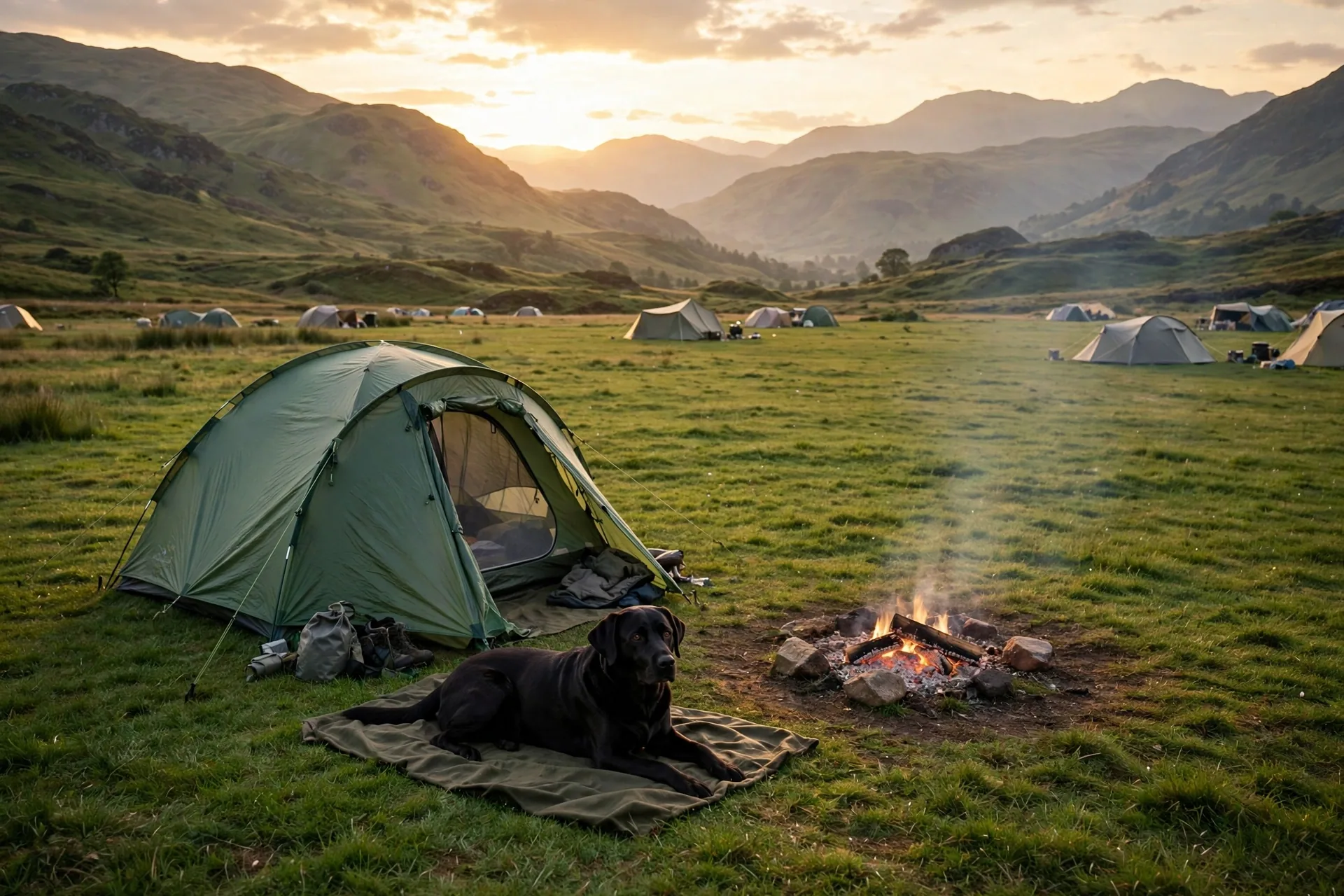
Self-catering cottages, dog-friendly hotels and campsites around Kelso each suit different dogs. A cottage with an enclosed garden suits a dog that needs space to toilet safely, while a hotel with a dog-friendly bar suits a dog that settles well in a busy room. A campsite suits a dog that is used to outdoor living and a tent, but it needs careful packing and a realistic plan for wet weather. Whatever you choose, visit the area first if you can, or at least read recent reviews from other dog owners, because a listing that looks perfect on a website can be less perfect in practice. For a first camping trip from Kelso, our guide to camping with a dog in the UK explains how to choose a site, set up a tent and pack for a relaxed first night.
Staying in Kelso also gives you time to explore the wider Borders without rushing. Melrose, Jedburgh and Dryburgh are all within a short drive, each with its own abbey, river walks and dog-friendly cafes, and the Borders Abbeys Way links them in a longer walking route. A base in Kelso means you can visit one abbey town a day, return to the same bed each night, and let the dog settle into a routine. That routine matters: a dog that knows where it sleeps, where it toilets and where it walks is a dog that relaxes, and a relaxed dog is a better travelling companion. Plan one abbey a day, not three, and let the dog set the pace.
Practical details for an overnight stay are the same as for a day visit, with a few additions. Bring the dog's usual food, bedding, medication and a familiar toy, because a strange bed in a strange place is easier if it smells of home. Bring a drying coat and towels, because Borders weather can turn quickly, and bring a torch for the after-dark toilet walk. Check the accommodation's rules about dogs on furniture, dogs in the bedroom and dogs left alone, and follow them even if they feel strict. A dog that respects the rules is a dog that will be welcome again, and Kelso's accommodation providers remember the dogs that behaved well.
Finally, remember that Kelso is a small town, and small towns work on reputation. A dog owner who cleans up, keeps a lead short in the square, gives anglers space on the river and asks before taking a dog into a cafe or a garden is an owner who helps keep Kelso welcoming for the next dog owner. A dog owner who does the opposite makes it harder for everyone. The best way to enjoy Kelso with a dog is to treat the town as a shared space, to be generous with courtesy, and to leave the square, the abbey, the castle gardens and the riverside exactly as you found them, or a little better.
Two more abbey towns a short drive from Kelso
Kelso pairs naturally with the other abbey towns along the Tweed, and both are covered in the same detail as this guide: Jedburgh with a Dog walks the abbey ruins and the riverside paths below the town, while Selkirk with a Dog covers the hill paths, the river loops and the practicalities of a town that rewards an early start. Either makes an easy second day from a Kelso base.
Practical questions
Before you go
Can dogs go inside Kelso Abbey?
Dogs are generally welcome in the open-air abbey grounds on a lead, but access rules for any enclosed or staffed area can change, so check the official guidance before you travel. Keep your dog close among the stonework, do not let them climb on the ruins, and be ready to step aside for other visitors in the narrower passages.
Are dogs allowed in the gardens at Floors Castle?
Dogs on leads are usually welcome in the castle grounds and gardens, while the castle interior has separate rules and dogs are not normally admitted inside. Check the official guidance before you travel, because garden access, lead requirements and any seasonal restrictions can change. Bring water and a short lead, and keep your dog off planted beds and out of formal garden areas where signs ask you to.
Can I take my dog salmon fishing on the River Tweed?
You can walk a dog beside much of the Tweed, but fishing itself is a separate, regulated activity. Salmon fishing on the Tweed needs the right permit for the beat and the date, and it follows strict seasonal and catch rules. Check the official guidance before you travel, keep your dog on a lead near anglers and riverbanks, and never let a dog disturb fish, tackle or other people fishing.
Where can I park in Kelso with a dog?
Kelso has town-centre car parks within a short walk of Abbey Square and the riverside, and parking is easiest if you arrive before the late-morning peak on market days. Check the official guidance before you travel for current charges and time limits. Choose a shaded space in warm weather, never leave a dog in a parked car, and plan a short toilet walk before you head into the square.
Are there dog-friendly cafes and pubs in Kelso?
Kelso has several cafes and pubs that welcome dogs, most often in outdoor seating areas and in some indoor spaces, but policies vary by venue and by season. Check the official guidance before you travel, and confirm the current dog policy when you arrive. Bring a mat for your dog to settle on, order at the bar or counter if that is easier, and keep your dog on a lead and out of walkways.
What is the best walk from Kelso with a dog?
The riverside path along the Tweed is the best first walk for most dogs, because it is level, scenic and easy to shorten or extend. For a longer outing, the Borders Abbeys Way links Kelso with the wider abbey country, and the quieter lanes towards Roxburgh suit a calmer second walk. Check the official guidance before you travel for path conditions, livestock and any temporary closures.