This guide is independent and contains no paid placement. If affiliate links are added later, they will be clearly marked and will not change our editorial checks.
Keld rewards dog owners who plan like walkers: pick your waterfall walk, carry water and a map, keep the dog on a lead around sheep and near the falls, and treat the moorland weather as the deciding factor. The village itself is tiny, so arrive stocked, park early, and let the trails do the entertaining.
The waterfall chain around Keld
Keld is unusual among Dales villages because the waterfalls are not a day trip away. They are the village's front garden. The River Swale is still a young river here, dropping fast out of the high moor, and within a short walk of the village green it tumbles over a series of falls that change character with every hundred metres of descent. For a dog owner, that concentration matters: you can build a whole day around water without a long drive, and you can shorten it to an hour if the dog is tired or the weather turns.
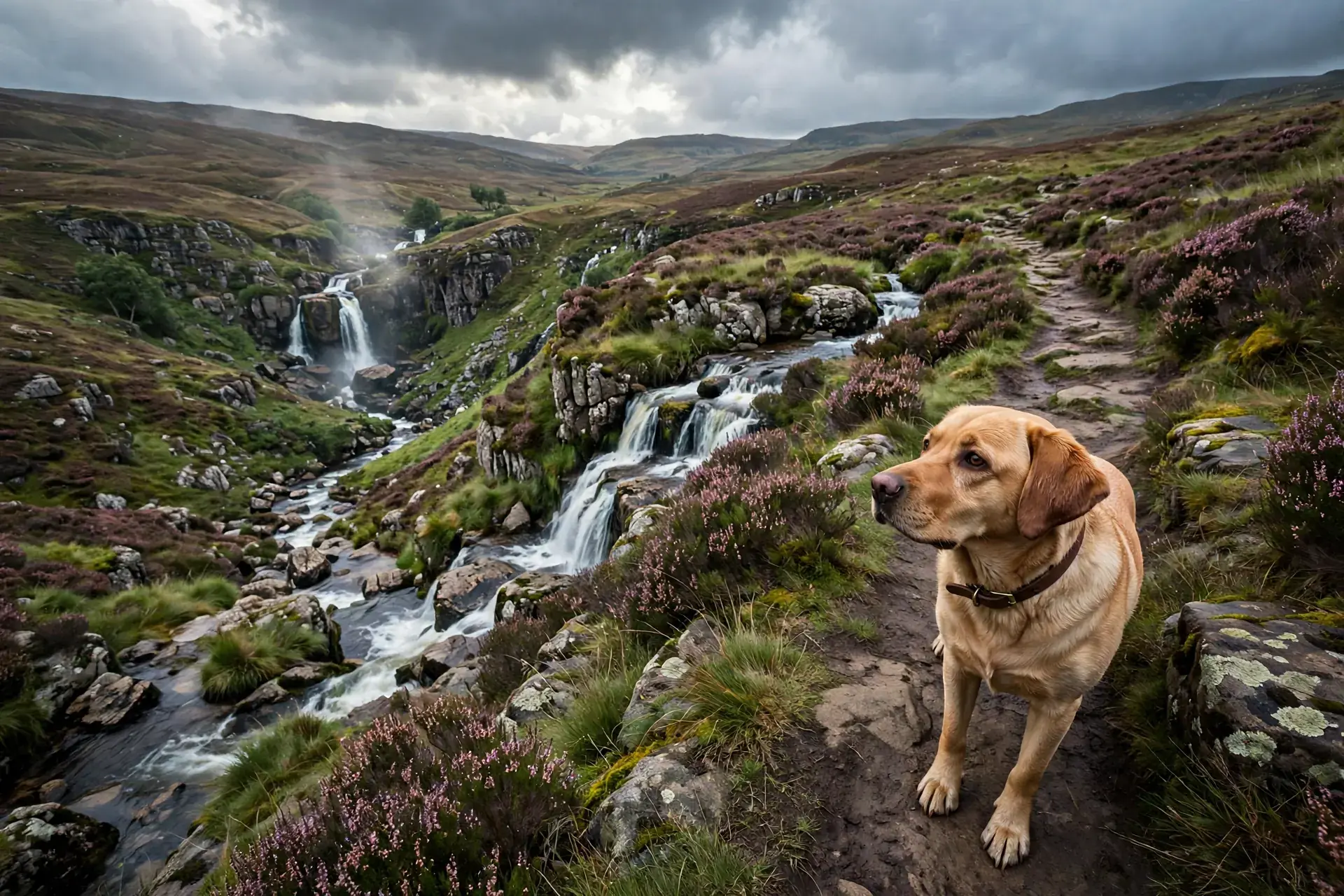
Start with the falls closest to the village. East Gill Force is reached on a short path from Keld along East Gill, a tributary beck that joins the Swale below the village. The walk is gentle by Dales standards, with a narrow path, stone steps and wooden footbridges, and the fall itself drops in a series of steps through a wooded ravine. It is the easiest of Keld's falls to reach with a dog, but the path is narrow and the ground beside the beck is uneven, so keep the dog on a short lead and watch for the slippery stones at the water's edge. Dogs that love to paddle will find shallow stretches above the fall; dogs that charge into water should be held back until you can see the depth and the current.
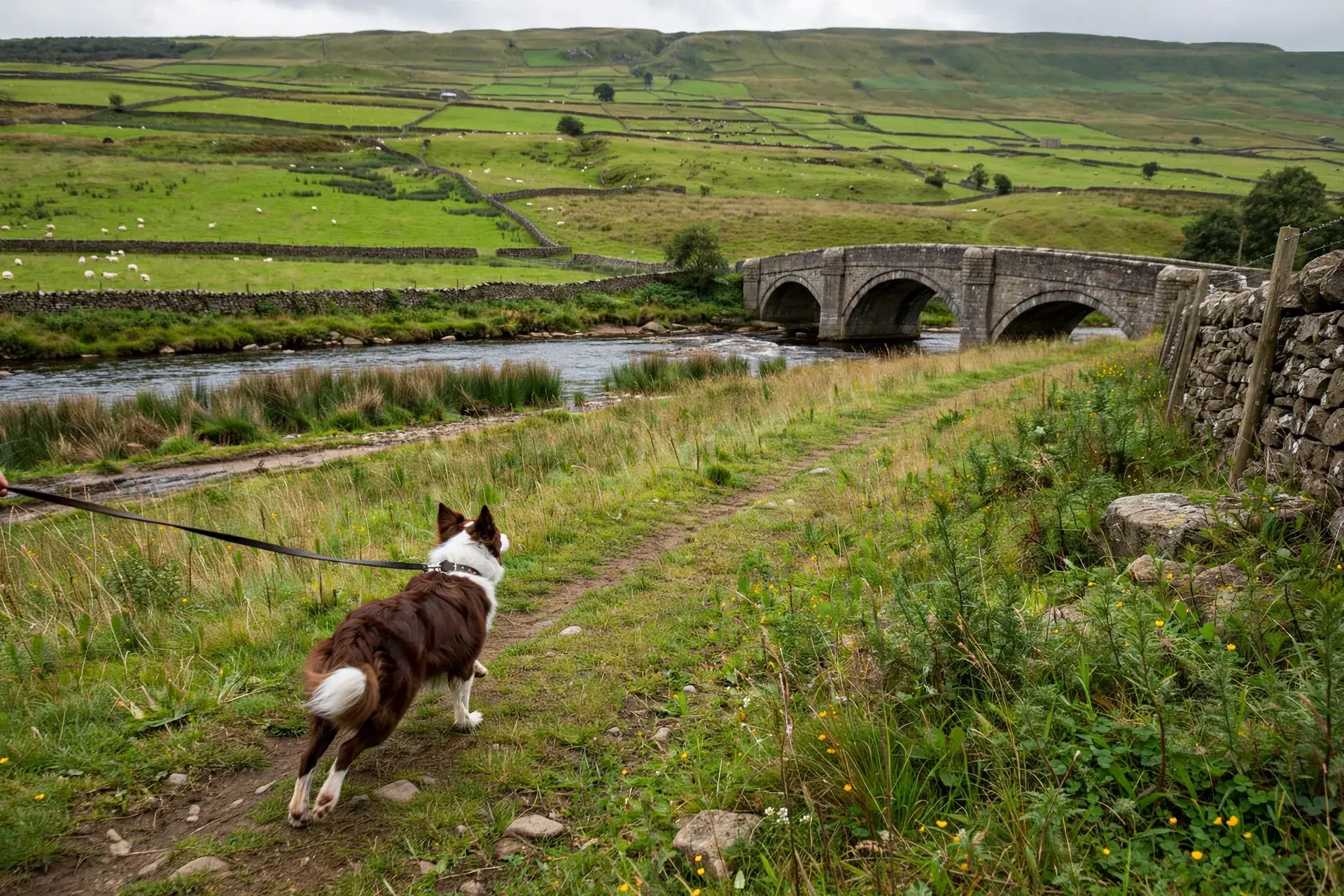
Kisdon Force is the best known of the group and the one most walkers picture when they think of Keld. It sits on the River Swale itself, below Kisdon Hill, where the river squeezes through a narrow, rocky gorge and drops in a powerful cascade. The approach is a valley walk rather than a scramble, following the Swale downstream from Keld through meadows and along a riverside path, but the last stretch to the viewing point is steep and rocky. The noise is considerable after rain, and a nervous dog may find the roar and the spray unsettling, so give them time at a distance before moving closer. Keep a firm grip on the lead: the rocks around the gorge are polished smooth by water, and a dog that slips on the approach could slide a long way before stopping.
Catrake Force, further downstream, is a wider, more open fall where the Swale drops over a broad shelf of rock. It is less enclosed than Kisdon Force, which makes it a better choice for dogs that dislike confined, echoing spaces, and the open ground beside it gives you room to keep a safe distance from the edge. Wain Wath Force, lower still towards Thwaite, is a smaller, gentler fall that suits a tired dog and a slow afternoon. Together the four falls make a natural chain: walk downstream from Keld and you pass from the steep, enclosed gorge to the open valley, with the river getting broader and calmer as you go.
Water levels change everything, and they change fast. The Swale rises quickly after rain on the high moor, and a beck that was a trickle at breakfast can be a brown torrent by lunchtime. Never assume the level you saw on the way out will be the level on the way back, especially if you cross the river on stepping stones or a footbridge low over the water. Check the forecast before you set out, look at the colour and speed of the water at every crossing, and turn back early if the river is rising. A dog that is a confident swimmer in a lake can still be in trouble in a fast, rocky beck, because the danger is not the depth but the current, the rocks and the cold.
Photographing the falls with a dog takes a little choreography. The best light is usually in the morning or late afternoon, when the sun is low enough to light the water without flattening the gorge, and the quietest times are early in the day before the Coast to Coast walkers set out. Put the dog on the side away from the drop, keep the lead short, and let the dog sit on flat ground rather than on a wet rock. A treat pouch in your pocket is worth more than a perfect composition: a dog that has been asked to sit still beside a noisy waterfall deserves a reward, and a rewarded dog is a dog that will sit still again.
Coast to Coast stages from Keld
Keld matters to long-distance walkers because two of Britain's great trails meet here. The Coast to Coast, Alfred Wainwright's 192-mile route from St Bees on the Irish Sea to Robin Hood's Bay on the North Sea, passes through the village, and the Pennine Way crosses it here too. That makes Keld a natural overnight stop, a lunch stop and a decision point all at once. Walkers arrive from the west over the high moor from Kirkby Stephen, and leave to the east down Swaledale towards Reeth. For a dog owner, the practical question is not whether the trails are beautiful — they are — but which stage suits your dog, and what the day will actually demand of them.
The stage east from Keld to Reeth is the classic next step for Coast to Coast walkers, and it is also one of the most dog-friendly long stages in the Dales. The route drops down the valley through Thwaite and Muker, following the Swale for much of the way, with the river as a constant companion and the valley sides rising on both flanks. The walking is mostly on valley paths, farm tracks and riverside meadows, with some road walking through the villages. The distance is roughly ten to eleven miles, which is a long day for most dogs, but the ground is forgiving and there are places to stop, water the dog and rest in the shade. If your dog has never walked that far, consider splitting it: walk from Keld to Muker, rest there, and continue to Reeth on a second day. Our guide to Reeth with a dog covers the village green, the swing bridge and the riverside walks waiting at the far end.
The stage west from Keld to Kirkby Stephen is a different proposition. It climbs out of Swaledale onto the high moor, crosses open, exposed ground with few landmarks, and drops into the Eden Valley on the far side. The distance is similar, but the effort is greater: the climb is long, the ground underfoot is rougher, and the weather on the moor can be several degrees colder and far windier than in the valley. There are long stretches with no water for the dog and no shelter for either of you. This is a stage for a fit, experienced dog and an owner who is comfortable with map and compass. If the forecast is poor, skip it and take a valley walk instead; the moor will still be there on a better day.
Walking a single stage as a day walk, rather than as part of a full crossing, is the sensible way to sample the Coast to Coast with a dog. You can walk out from Keld for two or three hours and return by the same path, or arrange a lift back from the far end. If you are walking the whole route over several days, think about the dog's recovery as carefully as your own. A dog that walks ten miles a day for five days needs rest days, good food, a warm place to sleep and feet checked every evening for soreness, cuts and thorns. Many Coast to Coast walkers with dogs plan a rest day in Keld itself, using the waterfall walks as a gentle recovery day before the next big stage.
Waymarking on the Coast to Coast is generally good through Swaledale, with fingerposts and signposts at junctions, but the route is not waymarked to the standard of a National Trail everywhere, and the moorland sections rely on cairns, fence lines and a map. Carry the relevant Ordnance Survey map — OL30, Yorkshire Dales Northern and Central — and know how to use it. A phone app is a useful backup, not a plan: signal is patchy in the valley and almost non-existent on the high moor, and a dead battery on a wet, windy hill is a problem you do not need. Tell someone your route and your expected return time before you leave, and stick to it.
Stiles are a recurring feature of the Coast to Coast through Swaledale, and they deserve a plan of their own. Some are simple step stiles that a fit dog can manage with a lift; others are ladder stiles or stone squeeze stiles that a large or stiff dog cannot negotiate at all. If your dog cannot be lifted over a stile, you will need to find a gate or a gap, and that can mean a detour. Walk with a lead you can let out and gather in quickly, and never let a dog run ahead through a gate into a field of sheep or onto a road. The Pennine Way section through Keld has similar furniture, so the same advice applies if you follow that trail north or south for a few miles.
Weather at the head of the dale
Keld sits high for a Dales village, at the top end of Swaledale where the valley is narrow and the moor presses in on both sides. That position shapes the weather. Rain that falls as a shower in Reeth can arrive in Keld as a full afternoon of drizzle, and wind that is a breeze in the valley bottom can be a hard, cold blast on the moor above the village. The temperature difference between the valley floor and the moor top is often three to five degrees, and on a wet, windy day the wind chill makes it feel colder still. A dog that is comfortable on a valley walk can be cold and miserable on the moor an hour later, and a short-coated dog will feel it first.
Check the forecast the night before and again in the morning, and look at the mountain forecast rather than a generic town forecast if one is available for the Yorkshire Dales. Pay attention to the wind speed and the wind chill, not just the headline temperature, and look at the rainfall radar as well as the symbol: a day of light rain on the moor is a different walk from a day of heavy showers, because light rain soaks through slowly and heavy rain turns the becks brown and the paths to streams. If the forecast shows strong winds, plan a valley walk instead of a moorland crossing; a dog that is being blown sideways on a ridge is not enjoying itself, and neither are you.
Mist is the weather feature that catches most visitors out. It can roll in from the west in minutes, dropping visibility to a few metres and turning a familiar path into a guessing game. If mist comes down while you are on the moor, stop, get the dog on a lead, and navigate by map and compass back to a handrail you trust. Do not follow the dog, and do not follow another group of walkers unless you are sure they know where they are going. The safest response to mist on open moor is to drop height: head downhill towards the valley, where the mist usually lifts sooner and the paths are clearer. Set a firm turnaround time before you leave the village, and honour it even if the sun is shining when you set out.
Summer brings a different set of problems. Keld is high and exposed, so there is little shade on the moor and the sun reflects off pale limestone and dry grass. Dogs overheat faster than people, and a black-coated dog on a windless, sunny day on the moor can be in trouble within an hour. Walk early in the morning or late in the afternoon, carry more water than you think you need, and watch for the signs of overheating: heavy panting, a bright red tongue, wobbling, or a dog that stops and refuses to move. Cool the dog with water on the belly and paws, get them into shade, and do not push on. The becks are cold even in summer and a quick paddle is a good cooler, but only in shallow, slow water where the dog can stand.
Winter in Keld is serious walking country. Snow can lie on the moor for weeks, ice forms on the paths down to the falls, and the lanes into the village can be impassable after heavy snow. A dog's paws suffer in snow and ice: salt on treated roads, ice balls forming between the toes, and the cold itself. Shorten the walk, keep the dog moving, check the paws regularly, and carry a towel to dry them off. If the dog starts lifting its paws or limping, turn back. The village is quiet in winter, which many dog owners love, but the trade-off is that help is further away, so be conservative about distance and carry a fully charged phone.
Arriving in Keld: parking, pubs and stays
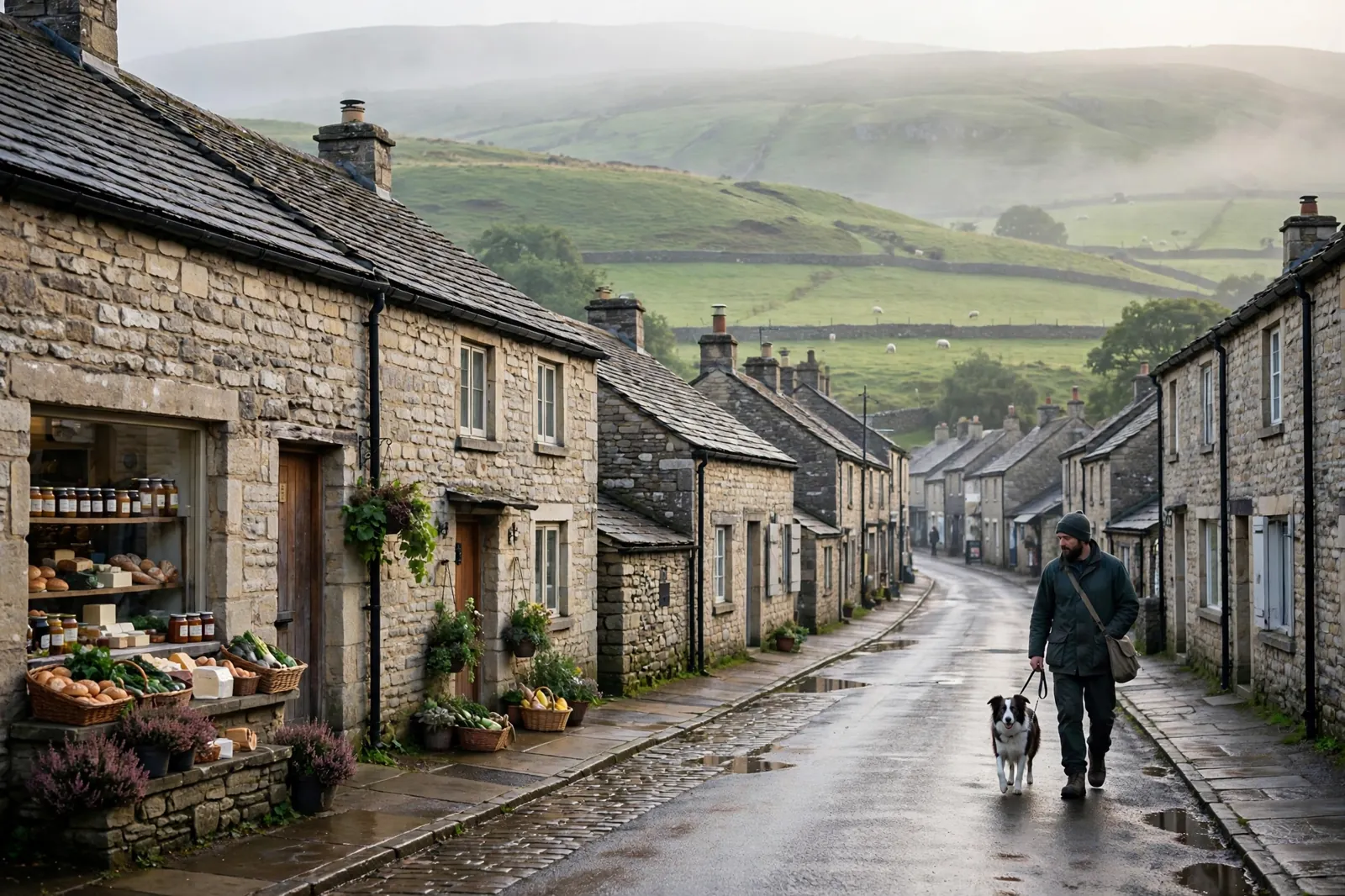
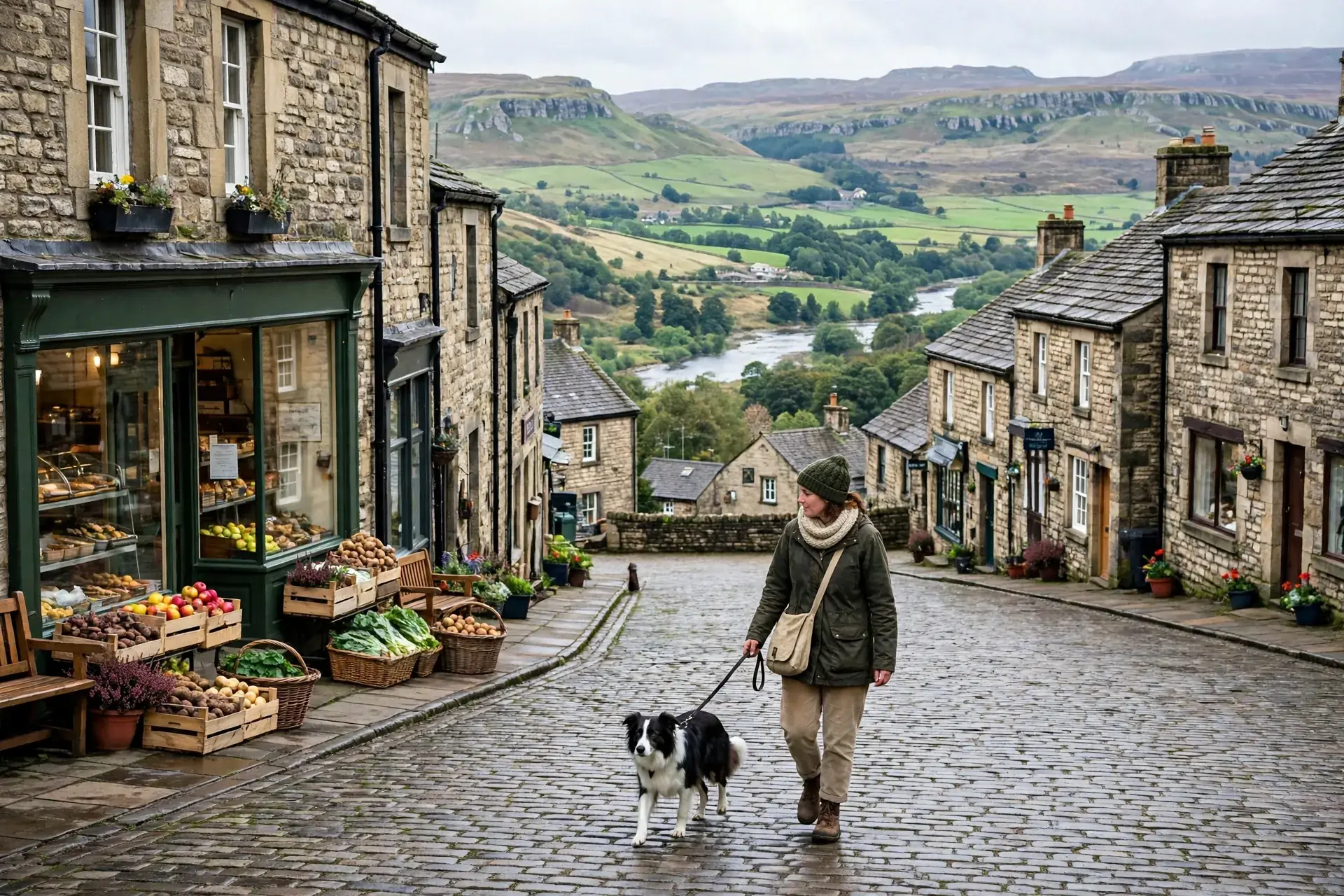
Keld is small. That is the first thing to understand, and it shapes everything else. There is no supermarket, no petrol station and no cash machine, and the handful of buildings — a cluster of stone cottages, a village hall, a bunkhouse and a couple of places to stay — can be walked end to end in a few minutes. The village green is the centre of things, and the lanes that meet there are narrow, with stone walls on both sides and few passing places. Arriving in Keld is not like arriving in a market town: you need to be self-sufficient, and you need to have a plan for where you will park, where you will eat, and where you will sleep.
Parking is the first practical problem. There is a small parking area near the village and a limited amount of roadside space, and on a busy walking weekend both fill early. Arrive before mid-morning if you can, park considerately, and never block a gate, a field entrance, a passing place or a resident's drive. The lanes around Keld are single-track in places, and a badly parked car can block the only route in or out of the village for everyone. Never leave a dog in a parked car, even for a few minutes: the interior of a car heats up fast in sun, and in a remote village there may be nobody around to notice a dog in distress. Check the official guidance before you travel for the current parking arrangements, because they can change with the seasons.
Food and drink in Keld are limited, and the honest advice is to bring your own. The village has had a pub and a cafe at various times, and seasonal or part-time opening is common, so do not rely on finding a meal when you arrive. If somewhere is open and welcomes dogs, the usual rules apply: ask before you sit down, keep the dog on a lead under the table, bring your own water bowl, and do not let the dog wander between tables. A dog that has just come off the moor will be muddy, wet and smelly, so a drying coat and a towel in the car are essential before you go indoors anywhere. For a guaranteed meal, plan to eat in Reeth or Hawes, both a short drive away, and check opening times before you set out. Our guide to Hawes with a dog covers the market town's pubs, cafes and cheese-town walks for exactly this kind of day.
Staying in Keld is the best way to experience it, and the options are small-scale: a bunkhouse, a small number of bed-and-breakfast rooms and self-catering cottages, and a campsite in the village. Book well ahead in the walking season, because the Coast to Coast brings a steady stream of walkers through the village from spring to autumn, and the dog-friendly rooms go first. When you book, ask the specific questions that matter for your dog: is there a secure area for the dog to toilet at night, is there somewhere to dry a wet dog, can the dog be left in the room while you eat, and is there a charge per dog. Get the answers in writing. A bunkhouse may suit a single walker with a dog, while a self-catering cottage suits a family that wants to cook and come and go on its own schedule.
The village hall and the small resource centre are worth knowing about. They hold local information, walking leaflets and, in the walking season, a place to fill a water bottle and ask a question. The people who run them know the paths, the weather and the river levels, and a two-minute conversation can save you a two-hour mistake. Honesty boxes for eggs, cakes and local produce appear in the village and along the lanes in summer; bring coins, and keep the dog from investigating the box too enthusiastically. The church and the old school building are part of the village's history as a lead-mining and farming settlement, and the dry stone walls, field barns and packhorse bridges you see on every walk are reminders that this valley was worked hard long before it was walked for pleasure.
Shorter walks when the big day is too much
Not every day in Keld needs to be a Coast to Coast stage. The village is surrounded by shorter walks that suit a tired dog, a young dog, a wet day or a late start, and they are worth taking seriously rather than treating as a consolation prize. The best of them is the waterfall loop itself: out from the village to East Gill Force and Kisdon Force, and back along the valley path. It is roughly two to three miles depending on the exact route, with the falls as the reward and the river as the companion. Take it slowly, stop at the viewpoints, and let the dog paddle in the safe shallows. It is also the walk to choose on your arrival day, when the dog is stiff from the car and you want to stretch legs without committing to a full day.
The valley walk from Keld to Thwaite is another gentle option. It follows the Swale downstream through meadows, past the falls and over the old stone bridges, and it is mostly level walking on good paths. Thwaite is a tiny hamlet with a pub that has welcomed walkers for years, and it makes a natural turning point: a drink, a rest, and a walk back the way you came, or a longer loop back over the hillside. The path can be muddy after rain and the riverside sections flood in high water, so check the level before you set out and be ready to turn back if the path disappears under water. Our guide to Reeth with a dog covers the longer valley continuation if you decide to keep going.
For a short, steep leg-stretcher, the climb onto Kisdon Hill from Keld gives you the whole of upper Swaledale in one view. The hill sits between Keld and Muker, and the path up is a steady pull rather than a scramble, with the reward of a wide, open summit and views down both valleys. It is exposed to the wind, so it is not a walk for a wild day, and the descent on the far side is steep enough to need care with a dog on a lead. In spring and early summer, keep the dog close: the hill is prime ground-nesting bird country, and a dog quartering the heather can do real damage without meaning to.
A longer short walk — if that is not a contradiction — is the circuit from Keld over the moor to Muker and back down the valley. It is a proper half-day, with a moorland crossing on the way out and a riverside return, and it gives you the two sides of Swaledale in a single walk: the open, empty moor and the green, walled valley. The moorland section needs the navigation skills described above, so do not attempt it in mist or high wind, and carry water for the dog: there is little to drink on the high ground between the becks. Muker has a pub, a tea room and a small shop in the walking season, which makes it a good halfway point for a rest and a refill.
Dogs, livestock and river safety
The rules for dogs around Keld are the rules for the whole of the northern Dales, but the village's position at the top of the valley makes them matter more. Sheep graze the valley meadows, the intake fields and the open moor, and they are present in every season. Lambing runs through the spring, and ewes with lambs are at their most flighty and their most vulnerable then. A dog that chases a sheep can cause a ewe to abort, a lamb to be separated and lost, or a sheep to run onto a road or into the river. The farmer's response is not a matter of temperament but of law: dogs that worry livestock can be shot, and the owner can be prosecuted. Keep the dog on a lead through any field with sheep, and under close control — on a lead or at heel — on the open moor during the nesting and lambing seasons.
Cattle are less common around Keld than sheep, but they are present in the valley meadows in summer, and a field of cows with calves deserves the same respect as a field of sheep. Never walk a dog through a field of cattle with calves, and if cattle approach, let the dog off the lead so it can run clear while you walk steadily to the nearest exit. Do not pick the dog up: a dog in your arms is a target, and a dog on the ground can get out of the way. If a footpath crosses a field of cattle and you are not comfortable, find another route. There is no walk in Swaledale worth a confrontation with a protective cow.
River safety deserves its own paragraph because the Swale is the most dangerous thing a dog will meet around Keld. The river is fast, cold and rocky, and it rises without warning after rain on the moor. Dogs should never be allowed to swim in the river at the top of a waterfall, in a narrow gorge, or anywhere you cannot see the bottom and the far bank. Stepping stones and fords that look easy in the morning can be impassable by the afternoon, and a dog that has crossed a beck on the way out may not be able to cross it on the way back. If the water is above your dog's belly and moving fast, find a bridge. If there is no bridge, turn back. No walk is worth a dog in the river.
Ticks are a real hazard on the moor and in the bracken around Keld from spring through to autumn. Check the dog thoroughly after every walk — ears, armpits, groin, between the toes and around the collar — and remove any tick promptly with a tick hook, twisting gently rather than pulling. A tick remover and a small first-aid kit belong in your day pack on every walk, along with a spare lead, a muzzle if your dog needs one for the vet or for a crowded pub, and the number of the nearest vet. The nearest veterinary practices are in the market towns down the valley, so save the number before you need it, and check the official guidance before you travel for current opening hours.
Finally, think about the dog's feet. The paths around Keld mix sharp limestone, rough moorland tracks, boggy peat and wet riverside stones, and a dog that is used to pavements and park grass will feel it after a long day. Check the pads every evening for cuts, thorns and soreness, and carry a dog boot or a protective balm if your dog has sensitive feet. A dog that starts to limp on a moorland crossing needs to be carried or turned back immediately, not pushed on to the next village. The same goes for overheating, exhaustion and anxiety: the dog cannot tell you it has had enough, so you have to watch for it — the lagging behind, the heavy panting, the refusal to go on — and act on it early.
Planning, packing and seasons
Keld is at its best in late spring and early autumn. May and June bring the heather starting to green, the curlews calling over the moor, and long, light evenings in the valley, with the lambs in the fields and the waterfalls running well after the spring rain. September and October bring the heather in full purple flower, the bracken turning gold, and the walking crowds thinning out, with the added advantage that the summer dog restrictions on beaches elsewhere do not apply here at all. Both seasons can still deliver four seasons in a day, so pack for rain even when the morning is sunny.
Summer is the busiest season, and the village fills with Coast to Coast walkers, day visitors and dogs. The paths are at their driest, the days are long, and the pubs and tea rooms are open, but the heat on the moor is a real consideration for dogs, and the small parking area fills early. If you visit in summer, walk early, carry extra water, and book accommodation well ahead. Winter is the opposite: the village is quiet, the moor is empty, and the waterfalls in spate are spectacular, but the weather is harsh, the days are short, and some accommodation closes. A winter visit suits an experienced walker with a hardy dog and a well-stocked car; it does not suit a first visit with a puppy.
Packing for Keld is packing for a walking holiday in a remote village. Bring more dog food than you need, because there is no pet shop in the village and the nearest shops are a drive away. Bring a towel and a drying coat for every dog, a long line and a short lead, a water bottle and a collapsible bowl, poo bags, a tick hook, a first-aid kit, and a map and compass. Bring a boot liner or an old blanket for the car, because the dog will be muddy and wet at the end of every walk, and bring a torch for the walk back from the pub. If you are staying in a cottage, bring the dog's bed and a familiar blanket: a dog that sleeps in its own bed settles faster in a strange house.
Getting to Keld takes planning too. The village is reached by narrow lanes from the B6270, the road that runs down Swaledale from Kirkby Stephen to Reeth, and the approach from either direction is single-track in places with passing places. Drive slowly, expect sheep and walkers on the road, and be ready to reverse. Public transport is limited: a seasonal bus service runs through the valley in the walking season, but it is infrequent and may not accept dogs, so check the official guidance before you travel and do not rely on it for a tight connection. Most visitors arrive by car, and that is the practical choice with a dog, because it gives you somewhere dry to change, somewhere to leave spare kit, and a way out if the weather closes in.
Put the day together like this. Arrive early, park, and walk the waterfall loop first while the dog is fresh and the light is good. Eat a proper lunch in the village or back at your cottage, rest the dog, and take a short valley walk in the afternoon. Keep the big moorland day for the middle of your stay, when the dog is warmed up and you have had a day to read the weather. Build in a rest day, and use it for a slow walk to Thwaite or Muker rather than a second big crossing. And leave a margin: Keld is the kind of place where the weather, the river or a tired dog can change the plan, and the best trips are the ones that leave room for the change.
Practical questions
Before you go
Can dogs swim in the waterfalls at Keld?
Dogs can paddle in the shallow pools above and below some of the falls, but swimming directly under a waterfall is not safe. The plunge pools are deep, the rocks are slippery, and the River Swale rises fast after rain. Let your dog paddle only in calm, shallow water where you can see the bottom, keep them on a lead near the top of any fall, and check the official guidance before you travel if conditions look high.
Is the Coast to Coast path from Keld suitable for dogs?
Yes, for fit dogs with owners who plan carefully. The stages out of Keld cross open moorland and farmland with stiles, ladder stiles and gates, and long stretches without water or shade. Sheep graze much of the route, so dogs should be on a lead or under close control. Carry water, food and a lead for every section, and check the official guidance before you travel, because path diversions and access conditions can change.
Are dogs allowed in the pubs and cafes in Keld?
Keld is a very small village with limited food and drink options, and policies vary by season and by venue. Some places welcome dogs in a bar area or on an outdoor terrace, while others do not. Always ask before you sit down, keep your dog on a lead and out of walkways, and carry your own water bowl. If you need a guaranteed dog-friendly meal, plan to eat in Reeth or Hawes, and check the official guidance before you travel.
Where can I park in Keld with a dog?
Parking in Keld is limited to a small area near the village and roadside spaces, which fill quickly on busy walking weekends. Arrive early, park considerately without blocking gates, field entrances or passing places, and never leave a dog in a car. The narrow lanes around the village are single-track in places, so reversing into a passing place is part of the routine. Check the official guidance before you travel for current parking arrangements.
What should I do if the weather closes in on the moor above Keld?
Turn back or drop to the valley floor rather than pushing on across open moor. Mist can cut visibility to a few metres, and there is almost no shelter between Keld and the next valley. Keep your dog on a lead so you do not lose sight of them, follow your map and compass rather than a phone signal, and carry a waterproof layer for yourself and a drying coat for the dog. Check the official guidance before you travel and set a firm turnaround time before you leave the village.
Is Keld a good base for a longer walking holiday with a dog?
Yes, if you like quiet villages and long days on the hill. Keld sits where the Coast to Coast and the Pennine Way cross, with waterfall walks, valley routes to Reeth and Muker, and moorland crossings in every direction. The trade-off is a lack of shops and public transport, so you need to arrive well stocked and plan food and rest days in advance. Check the official guidance before you travel, and book accommodation early in the walking season.