This guide is independent and contains no paid placement. If affiliate links are added later, they will be clearly marked and will not change our editorial checks.
The Kennet and Avon Canal runs 87 miles from Bristol to Reading through 105 locks, and the towpath follows it the whole way. Walk it in short sections with your dog: Caen Hill at Devizes is the great set piece, the Bath to Bradford-on-Avon stretch is the easiest family walk, and the Pewsey Vale and Hungerford reaches are the quietest. Keep the dog on a short lead at every lock, bridge and aqueduct, and plan your turn-around before the dog tires, because the towpath rarely offers a shortcut home.
The 87 miles, Bristol to Reading
The Kennet and Avon Canal runs 87 miles from the River Avon at Bristol to the River Thames at Reading, and the towpath runs with it for the whole distance. It is not a single river walk with one character. The western end is the tidal Avon through Bristol and Bath, the middle is the long summit pound across the Wiltshire downs above Devizes, and the eastern end is the River Kennet itself, canalised through Newbury and down to Reading. A dog walking the canal will meet all three kinds of water in a single day if you pick the wrong section, so the first decision is not how far to walk but which kind of canal you want.
The canal climbs from Bristol to its summit near Devizes, then falls again towards Reading. There are 105 locks along the way, and they are not spread evenly. The first locks out of Bath come in a steep staircase at Widcombe, the great flight of 29 locks at Caen Hill lifts boats out of Devizes, and the Crofton flight of nine locks raises the canal to the summit pound. Between those flights there are long, flat pounds where a dog can walk for miles without meeting a lock at all: the stretch from Bradford-on-Avon to Devizes, the summit pound from Crofton to Wootton Rivers, and the Kennet valley from Hungerford to Newbury are all level, easy walking with water always on one side.
Most dog owners walk the canal as a series of out-and-back days rather than a single long-distance hike. A five-mile out-and-back from Bath gives you the aqueduct at Dundas, the tunnels at Bathampton and the village of Bradford-on-Avon. A six-mile loop from Devizes takes in Caen Hill and the Kennet valley below the town. The canal was built for boats moving at three or four miles an hour, and the towpath still sets that pace: it is a slow, flat, water-level walk, which is exactly why it suits older dogs, puppies finding their legs and owners who want a walk without a hill in it. Check the official guidance before you travel if you are planning to walk the full length, because towpath closures for lock repairs, bank works and aqueduct maintenance do happen, and a closure at a lock flight can force a long road detour.
Navigation along the canal is simple in one sense and fiddly in another. The towpath is almost always on the same side of the water, so you cannot get properly lost, but access points are spaced unevenly. In towns the towpath meets bridges and roads every few hundred yards, while on the summit pound there can be a mile or more between a bridge, a stile and a field gate. If your dog needs to get off the towpath in a hurry, know where the next bridge is before you set off. The Canal and River Trust publishes towpath maps, and the mileposts along the bank are worth reading: they tell you how far you are from Bristol or Reading and how far it is to the next lock, which is the information that matters when a dog starts to flag.
Caen Hill: the 29-lock flight
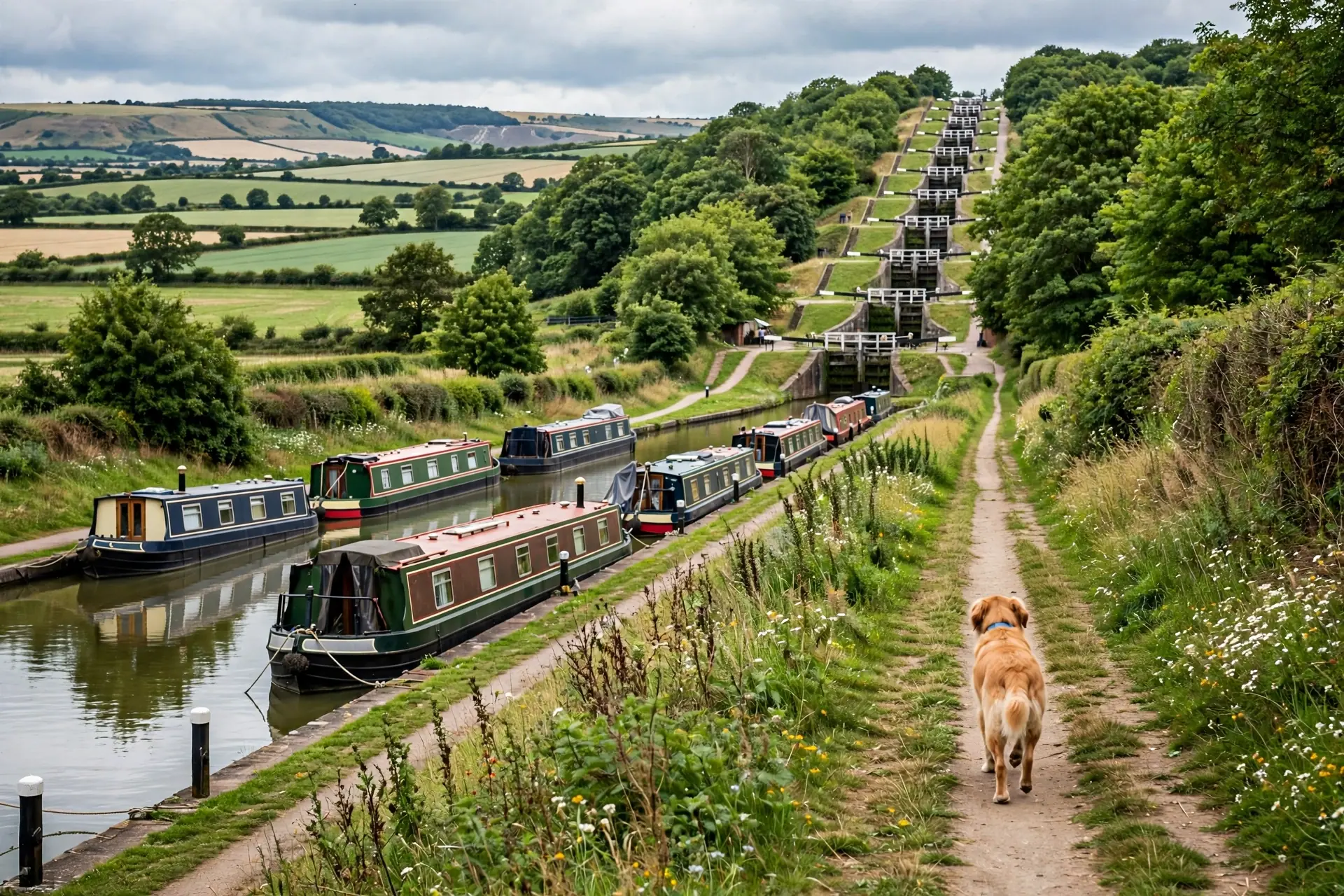
Caen Hill at Devizes is the reason most people come to the Kennet and Avon with a dog, and it is also the stretch that needs the most care. Twenty-nine locks climb 237 feet in just over two miles, sixteen of them in a single straight flight with grassed side pounds between each pair. It is one of the great canal sights in Britain, and it is a working flight: boats pass through all day in summer, lock keepers and volunteers work the gates, and crowds gather on the grassy banks to watch. For a dog, that means noise, moving water, crowds and slippery stone all at once.
Walk Caen Hill with the dog on a short lead, on the towpath side, and keep the dog well back from the lock copings. The stone edges of the locks are worn smooth by two centuries of boots and are treacherous when wet, and the water in a lock chamber drops and rises fast when a ground paddle is wound open. Dogs are drawn to the sound of rushing water at the bottom gates, and a dog that slips in at the top of the flight has a long, fast fall ahead of it. The safest line is the grassy strip between the locks on the offside, away from the towpath edge, and the safest time to visit is early morning, before the volunteer lock keepers arrive and the first boats start up the flight.
The flight is best walked as a one-way descent from the top, starting at the car park by lock 29 at the top of the hill and walking down to the Kennet and Avon Canal Trust cafe at the bottom, or the other way round if your dog prefers to climb. The top of the flight, above lock 29, is the summit pound: flat, quiet water with wide grass banks where a dog can drink and rest before the descent. Halfway down, the side pounds between locks 16 and 22 give the best views back up the flight, and they are also the best place to step aside and let a boat crew through. Do not let the dog drink from the side pounds: they hold still, warm water in summer and are the least clean water on the flight.
Caen Hill is also where the canal meets Devizes itself. The town is a ten-minute walk from the bottom locks along the towpath, and the Market Cross and the Wadworth brewery are the natural end of a Caen Hill walk. Our guide to Devizes with a dog covers the town end of the walk in detail, including where to park at the top and bottom of the flight and which pubs welcome dogs after the climb. If you only walk one stretch of the Kennet and Avon with your dog, make it this one, but walk it early, walk it on a lead, and give the locks the respect they deserve.
Working a lock with a dog
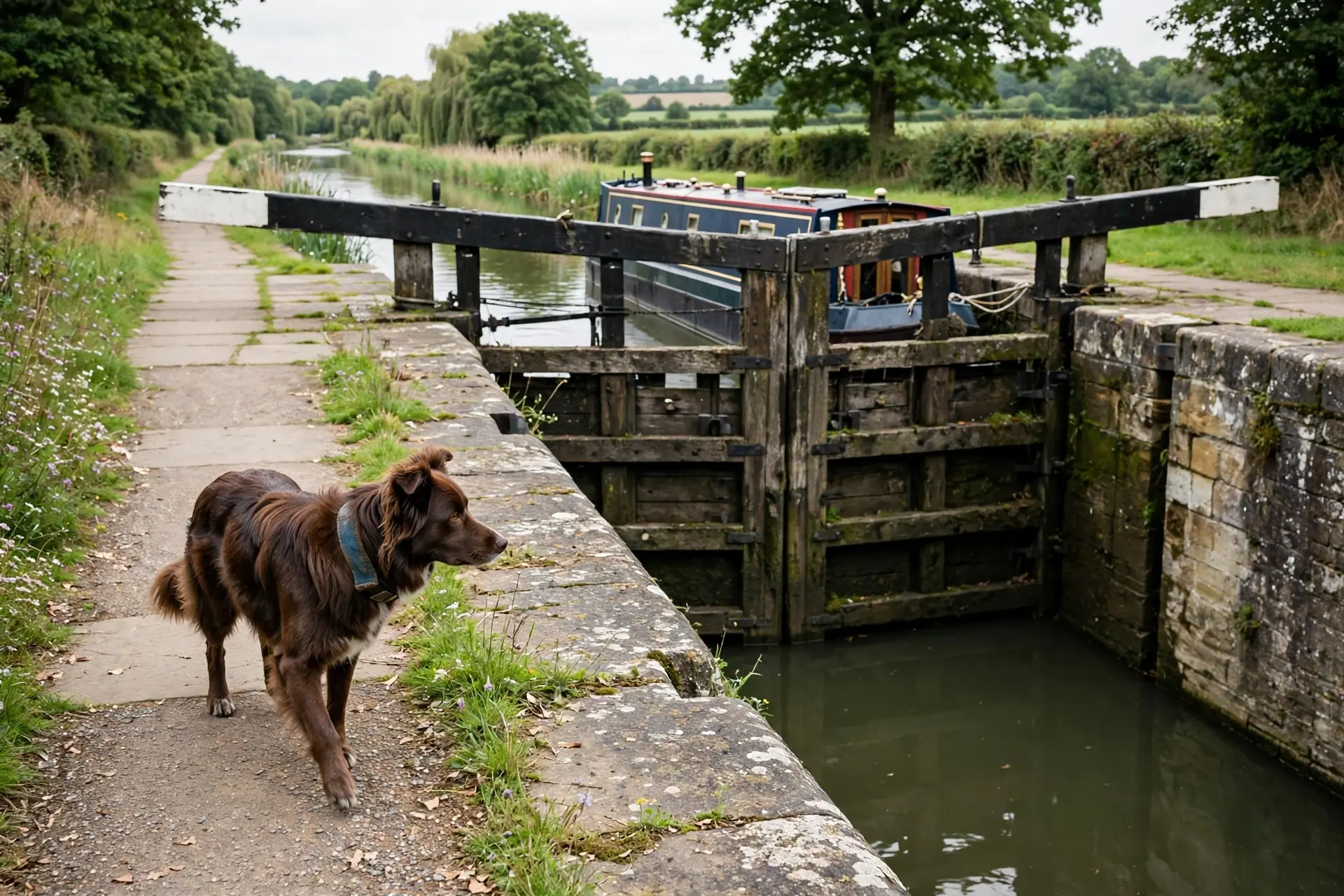
A lock is a machine made of water and heavy timber, and a dog has no place inside the working parts of it. The ground paddles that fill and empty a lock are wound with a windlass, and the water rushes through the culverts under the towpath with enough force to knock a small dog off its feet. The balance beams that open the gates swing in a wide arc at knee height, and a dog standing in the wrong place when a gate swings will be hit. The rule that keeps everyone safe is simple: the dog stays on the towpath, on a lead, held by someone who is not working the lock.
If you are crewing a boat through a lock with a dog aboard, walk the dog past the lock on the towpath while the boat goes through, then bring the dog back aboard at the far end. This is the normal practice on the Kennet and Avon, and lock keepers expect it. A dog that stays on the boat during a lock passage can panic at the sound of the paddles, jump off the roof or the stern, and land in a chamber that is emptying fast. If the dog must stay aboard, keep it below deck with the hatch closed, or held firmly in the well deck by someone who is not handling ropes. Never tie a dog to a balance beam, a bollard or a lock gate: a boat rising or falling in the chamber will pull the rope tight without warning.
On foot, the danger is not the lock itself but the edges around it. The lock ladder is set into the chamber wall and is the only way out if a dog falls in; a dog cannot climb it. The coping stones at the top of the lock are often wet from the last boat, and the ground beside the bottom gates is where the water boils up from the paddles. Teach the dog to sit and wait on the towpath while you look at a lock, and reward the wait, because every lock on the canal is a training opportunity and the dog that waits calmly at Caen Hill will wait calmly at Crofton too.
Moored boats add a second kind of lockside hazard. The towpath beside a moored narrowboat is often narrowed by ropes, fenders, water cans, coal sacks and the boat's own gangplank, and dogs will investigate all of them. Keep the dog on the water side of the towpath or the field side, whichever is clear, and do not let it walk under a boat's mooring ropes or jump onto a boat's roof. Most boat owners are happy to say hello, but a dog that puts its paws on a stranger's paintwork will not be welcomed twice. A short lead and a calm voice carry you past a hundred moored boats without an incident.
Towpath manners: boats, bikes and anglers
The towpath is a shared route, and on the Kennet and Avon it is shared with more kinds of user than most footpaths. Narrowboats move at walking pace and cannot stop quickly, cyclists use the towpath as a commuter route between Bath and Bradford-on-Avon and between Newbury and Reading, anglers sit with rods stretched across the path, and the fields beside the canal hold sheep and cattle for much of the year. A dog that treats the towpath as its own garden will cause trouble within a mile.
When a narrowboat approaches, pull the dog to the field side of the towpath and wait for the boat to pass. The steerer needs the full width of the path to see ahead, and the dog needs to be clear of the bow wave and the propeller wash at the stern. Boats move silently on the water and dogs often do not notice them until they are close, so watch ahead for the white bow of a boat or the plume of smoke from a stove, and call the dog in before the boat reaches you. On the narrowest stretches, between Bathampton and Bradford-on-Avon, the towpath is barely wide enough for two people to pass, and a dog on a long lead will tangle a cyclist in seconds.
Cyclists are the towpath's fastest users and its most frequent source of friction. The Bath to Bradford-on-Avon stretch and the Reading to Newbury stretch are busy with commuter cyclists in the morning and evening, and they move at twenty miles an hour on a path built for horses. Keep the dog on a short lead on these stretches, walk on the field side, and listen for a bell. If your dog chases bikes, the canal towpath is not the place to train that out of it: use a quieter stretch, such as the summit pound above Crofton, where cyclists are rare and the path is wide.
Anglers fish the canal from dawn, and their rods, lines and bait boxes sit on the towpath itself. Give an angler a wide berth, keep the dog away from the rod tip and the keepnet, and never let the dog drink from the swim where the angler is fishing. Livestock is the other towpath hazard: the fields beside the canal between Pewsey and Hungerford are grazed by sheep and cattle, and the fences and stiles that separate field from towpath are not always dog-proof. A dog that slips through a fence into a field of ewes with lambs is in serious trouble, and so is its owner. Keep the dog on a lead wherever livestock is visible, and check the official guidance before you travel if you are unsure whether a stretch is grazed.
Water at the edge: weirs, aqueducts and tunnels
The Kennet and Avon is not a river, and that changes the water hazards. The canal is shallow at the edges and deep in the middle, the banks are often vertical stone or piling with no easy way out, and the water is still enough to hide the depth. A dog that jumps in after a duck at Bradford-on-Avon or Hungerford may find itself against a vertical wall with no bank to climb, and the nearest slipway or lock landing may be a quarter of a mile away. The first rule of canal water safety is to know where the dog can get out before you let it near the water at all.
Weirs are the canal's most dangerous water. Where the canal meets the River Kennet, and at the overflow weirs beside locks such as those at Widcombe and at Newbury, the water drops over a sill and recirculates at the bottom. Dogs are drawn to the noise and the white water, and a dog that goes over a weir can be held under by the recirculation. Keep the dog on a lead at every weir, every overflow and every place where the canal spills into the river. The same applies at the bottom gates of a lock, where the water boils up from the ground paddles: it looks like a play fountain and it is not.
The Dundas Aqueduct, between Bath and Bradford-on-Avon, carries the canal over the River Avon on a stone aqueduct, and the towpath crosses with it. The parapet is high and the water is a long way below, but the towpath narrows at the aqueduct and the dog is close to the edge with boats passing on the inside. Keep the dog on a short lead across the aqueduct, on the field side of the path, and do not stop for photographs in the middle. The Avoncliff Aqueduct, further along the same stretch, is narrower still, with a low parapet and a railway line running beside it, and it deserves the same treatment.
Tunnels are the canal's other pinch point. The Bruce Tunnel, near Crofton on the summit pound, is 502 yards long and has no towpath through it: the towpath climbs over the hill above the tunnel while boats pass underneath. A dog walking the summit pound must take the path over the tunnel, which is steep, muddy and crossed by the tunnel's ventilation shafts, and must be kept on a lead because the path runs beside a road at the top. The shorter tunnels at Bathampton and at Sydney Gardens in Bath do have towpaths, but they are dark, damp and echoing, and dogs that are nervous of the dark will balk at the entrance. Walk through steadily, keep the dog close, and do not let it stop and sniff in the middle of a tunnel where a cyclist may be coming the other way.
Blue-green algae is a summer hazard on the still pounds of the canal, especially on the summit pound and in the wide, slow reaches near Pewsey. The algae forms a green scum on the surface and is toxic to dogs that drink it or swim in it. If the water looks like pea soup, keep the dog out of it and do not let it drink from the canal at all: carry water from a tap or a pub instead. The Canal and River Trust posts warnings when algae is confirmed, so check the official guidance before you travel in a hot summer, and treat any green, soupy water as unsafe until you know otherwise.
The best stretches, mile by mile
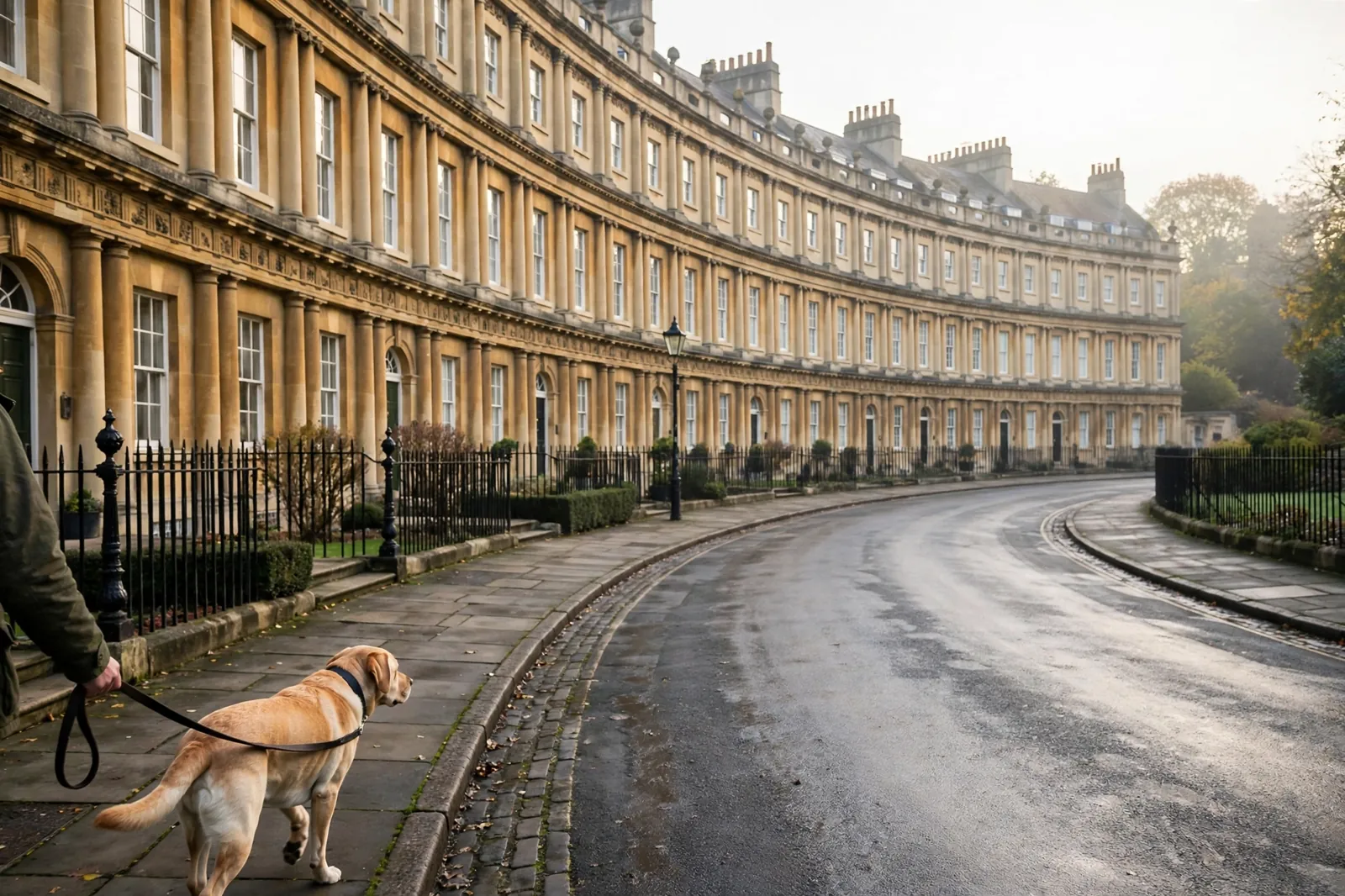
Bath to Bradford-on-Avon is the easiest and busiest stretch, and the best first walk on the canal with a dog. It is about six miles from Bathampton to Bradford-on-Avon, flat all the way, with the Dundas Aqueduct and the Avoncliff Aqueduct as the two set pieces. The towpath is surfaced for much of the way, there are pubs at Bathampton, at Limpley Stoke and in Bradford-on-Avon itself, and the railway line runs beside the canal so you can catch a train back from Bradford-on-Avon to Bath if the dog tires. The price of all that convenience is crowds: on a summer weekend the towpath is full of walkers, cyclists and dogs, and a reactive dog will find it hard work. Walk it early, or on a weekday, and it is a gentle, beautiful introduction. Our guide to Bath with a dog covers the city end of this walk, including the Bathampton meadows and the canal basin at Sydney Gardens.
Bradford-on-Avon to Devizes is the canal at its most peaceful. The water leaves the river valley and climbs gently through the Wiltshire countryside, past the village of Semington and the locks at Seend, to the foot of Caen Hill. The towpath is grass and gravel rather than tarmac, the fields beside it hold sheep and horses, and the pubs at Semington and Seend are proper canal pubs with gardens where dogs are welcome. This is a nine-mile stretch, so most dog owners walk it in two halves: Bradford-on-Avon to Seend, and Seend to Devizes. The Seend locks are a good place to watch boats without the crowds of Caen Hill, and the aqueduct at Semington, where the canal crosses the road on a low bridge, is a good turning point for a shorter walk.
The summit pound, from Crofton to Wootton Rivers, is the quietest water on the canal. The canal runs dead level for miles across the Marlborough Downs, the towpath is wide grass, and the only traffic is the occasional narrowboat and the occasional walker. The Bruce Tunnel is the landmark here, and the Crofton Beam Engines, the steam pumps that once lifted water to the summit, are a short walk from the canal at Crofton. This is the stretch for a dog that needs space: a long lead, a quiet towpath, and water that is still enough to be safe for a paddle at the lock landings. The drawback is the lack of facilities: there are no pubs on the summit pound itself, and the nearest village, Great Bedwyn, is a mile from the canal at the eastern end.
Pewsey to Hungerford is the canal through the Vale of Pewsey, and it is the stretch that feels most like a country walk. The canal winds through water meadows, past the villages of Pewsey, Wilcot and Great Bedwyn, and the towpath is a grassy track with wildflowers in summer and kingfishers on the water. The locks at Wootton Rivers and at Hungerford are small and quiet, the pubs at Pewsey and at Kintbury are dog-friendly, and the railway line that follows the canal gives you an easy way back. This is the stretch to choose if your dog is nervous of crowds or if you want a walk where the dog can be off the lead on the quieter sections, with a good recall and a close eye on the sheep in the fields beside the path.
Hungerford to Newbury, and Newbury to Reading, is the canal as the River Kennet, and it feels different from the western end. The water is wider and faster, the locks are deeper, and the towpath runs through water meadows and past the villages of Kintbury, Aldermaston Wharf and Woolhampton. The stretch from Newbury to Reading is the most urban part of the canal, with the towpath running beside the railway and through the suburbs of Reading, and it is the least attractive for a dog walk. The best of the eastern end is the five miles from Hungerford to Kintbury, where the canal is still rural, the pubs are welcoming, and the walk ends at a station with a train back to Hungerford.
Canal villages and waterside pubs
The Kennet and Avon is a canal of villages, and the villages are what make it a good dog walk rather than a long, flat march. Each village along the canal has its own character, its own pub and its own way of handling dogs, and the walk between them is the point of the canal. The villages below are the ones that work best as the start or the end of a dog walk, because they have parking, a pub that welcomes dogs, and a towpath that is easy to join.
Bradford-on-Avon is the prettiest town on the canal and the best base for a dog walk in the west. The canal runs through the town centre, the towpath is level and surfaced, and the pubs along the canal, including the canalside pubs near the town bridge, welcome dogs in their gardens and often inside as well. The town itself is worth an hour on foot with the dog: the Saxon church, the tithe barn and the narrow streets are all dog-friendly to walk, and the river meadows below the town give the dog a run off the lead. Park at the station car park or the car park by the canal, and walk east towards Bath or west towards Devizes from the town bridge.
Devizes sits at the top of Caen Hill, and the town is the natural reward after the climb. The Market Cross is the centre of the town, and the pubs around it, including the Wadworth pubs that brew in the town, welcome dogs. The canal basin at the top of the flight is a good place to rest the dog after the climb, with wide grass banks and a view back down the flight. If you are walking Caen Hill as a one-way descent, park at the top of the flight, walk down to the bottom locks, and catch a taxi or a bus back to the top: the walk back up the flight with a tired dog is a long one.
Pewsey is the village of the Vale, and the canal runs through the middle of it. The village has a station, a pub that welcomes dogs, and a towpath that is easy to join at the bridge by the village centre. The walk east from Pewsey to Great Bedwyn is the best short walk on the canal, about four miles of flat, quiet towpath through water meadows, with the Bruce Tunnel and the summit pound waiting at the far end. The walk west from Pewsey to Devizes is longer and hillier, with the locks at Wootton Rivers as the halfway point. Pewsey is also the best place to start if your dog is nervous of crowds: the towpath here is quiet even on a summer weekend.
Hungerford and Newbury are the towns of the eastern canal, and they are different in character from the Wiltshire villages. Hungerford is a small market town with a high street that runs down to the canal, and the pubs near the canal bridge welcome dogs. Newbury is larger and busier, and the canal runs through the town centre past the locks at Newbury Wharf, where the water is deep and the towpath is narrow. The best dog walk in the east is not in either town but between them: the five miles from Hungerford to Kintbury, with the canal winding through water meadows and the pub at Kintbury as the turning point. If you want to combine the canal with a town walk, Hungerford is the better choice: it is smaller, quieter and easier to park in with a dog in the car.
Taking the dog aboard a narrowboat
Many dog owners first meet the Kennet and Avon from the deck of a hire boat, and the canal is one of the best places in Britain to try a narrowboat holiday with a dog. The water is slow, the locks are staffed in summer, and the towpath is always there as an escape route if the dog hates the boat. Our guide to canal boat holidays with a dog covers hiring, life jackets and routines in full, and the notes below are the ones that apply specifically to this canal.
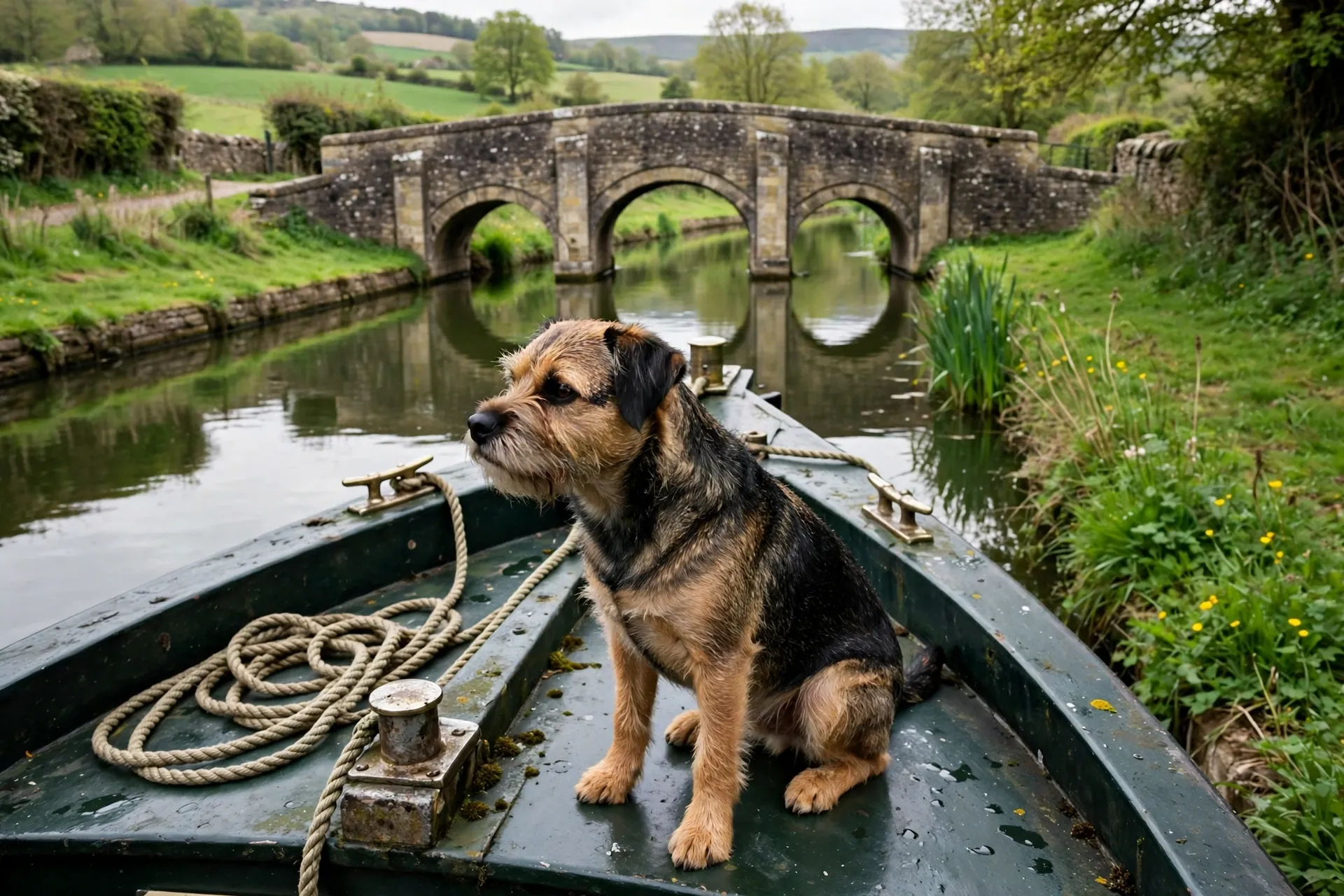
Boarding is the first problem. A narrowboat's stern deck is a small, wet platform with a step down into the cabin, and a dog that cannot manage the step will need to be lifted aboard. The roof of a narrowboat is the dog's favourite place, and also the most dangerous: a dog on the roof can fall into the water at a lock or be hit by a low bridge. The Bruce Tunnel, the tunnels at Bathampton and the aqueducts at Dundas and Avoncliff all have low clearances, and a dog on the roof must be brought down before the boat passes under them. The safest place for a dog on a moving narrowboat is in the well deck at the bow, or below deck with the hatch open, where it can see the water without being able to jump into it.
Mooring on the Kennet and Avon is governed by the Canal and River Trust's rules, and the practical points for a dog owner are the same as anywhere on the network: moor where the bank is low and the dog can get on and off easily, avoid mooring opposite a lock landing where boats will be manoeuvring, and do not moor where the towpath is narrow and the dog will be stepped over by every passer-by. The best moorings for dogs on this canal are the wide grass banks of the summit pound, the moorings at Bradford-on-Avon and the moorings below Caen Hill, where the bank is low and the towpath is wide. The worst are the moorings in Bath and Newbury, where the towpath is busy and the bank is high.
A dog that lives aboard for a week needs a routine that fits the canal's rhythm. The boat moves at three miles an hour, and the dog will spend most of the day watching the bank go past. Plan a towpath walk at every lock flight, because the lock is the natural place to stop, and plan a longer walk at the end of each day, because the dog that has sat on a boat all day needs a proper run. Carry water for the dog from the boat's tank, not from the canal, and keep the dog's bed in the same place every night so it has a settled spot. A dog that settles on a narrowboat is a dog that has learned the boat is home, and the Kennet and Avon, with its slow water and its quiet pounds, is a good canal to learn on.
Seasons and ground underfoot
The towpath changes with the seasons more than most footpaths, because it is a narrow strip of earth and gravel between water and fields, and it takes the weather full in the face. In winter the towpath between Bath and Bradford-on-Avon is surfaced and stays walkable, but the grass towpath on the summit pound and in the Vale of Pewsey turns to deep mud after a week of rain, and the puddles beside the locks at Caen Hill freeze into sheets of ice that a dog will slip on. In summer the same grass towpath bakes hard and dusty, and the shade that matters is the shade of the hedgerow on the field side of the path.
Spring is the best season on the canal, and the hardest for a dog owner who does not plan for it. The towpath is dry, the wildflowers are out, and the lambs are in the fields beside the canal from March onwards. The fields between Pewsey and Hungerford hold ewes with lambs well into May, and the stiles and fences that separate field from towpath are not always dog-proof. Keep the dog on a lead wherever lambs are visible, and do not let it chase the ducks and moorhens that nest in the reeds at the edge of the canal in April and May. The canal is a wildlife corridor, and the dog that leaves the ducklings alone is the dog that will be welcome back.
Summer brings heat and algae together. The towpath has little shade on the long, exposed stretches between Pewsey and Hungerford and on the summit pound, and the canal water is still enough to grow blue-green algae in a hot spell. Walk early in the morning, carry water for the dog, and plan your route around the pubs and villages where the dog can drink and rest in the shade. The locks at Caen Hill are at their busiest in summer, with queues of boats and crowds on the banks, and the best time to walk the flight with a dog is before nine in the morning, when the volunteers have not yet arrived and the towpath is quiet.
Autumn is the canal's quiet season, and the best time to walk it with a dog that does not like crowds. The leaves fall into the canal and the towpath, the pubs light their fires, and the boats thin out. The towpath is damp and the leaves are slippery on the stone copings at the locks, so keep the dog on a short lead at every lock and bridge, and watch for the conkers and acorns that fall onto the towpath from the trees beside the canal: they are toxic to dogs if eaten in quantity. Winter is the canal's hardest season for a dog walk, because the towpath is muddy, the days are short, and the locks are often closed for maintenance. Check the official guidance before you travel in winter, because a lock closure at Caen Hill or Crofton can close the towpath for weeks, and the alternative route is often a busy road with no pavement.
Practical questions
Before you go
Can my dog walk the whole Kennet and Avon Canal towpath?
The towpath runs the full 87 miles from Bristol to Reading, but walking it end to end with a dog is a multi-day undertaking, and some stretches are narrow, muddy or interrupted by road crossings. Most dog owners pick a section of five to eight miles, walk out and back, or arrange a lift at the far end. Check the official guidance before you travel if you are planning a long-distance walk, because towpath closures for lock repairs and bank works do happen.
Is Caen Hill safe for dogs?
Caen Hill is safe if you keep your dog on a short lead and well back from the lock edges. The 29 locks climb steeply, the stone copings are slippery when wet, and water moves fast through the ground paddles. Dogs must never be left on a lockside while a boat is moving through, and they should not be allowed to run loose on the grassy slopes between the locks where boats, cyclists and other walkers are all moving.
Can dogs go through locks on a narrowboat?
Dogs do travel through locks on narrowboats, but the usual practice on the Kennet and Avon is to walk the dog along the towpath past the lock while the boat goes through, then bring the dog back aboard at the far end. This avoids a frightened dog jumping off a boat inside a rising or falling lock chamber. If your dog does stay aboard, keep it below deck or held securely, and check the official guidance before you travel.
Are dogs allowed off the lead on the Kennet and Avon towpath?
There is no single rule for the whole canal. On quiet rural stretches many owners let a well-trained dog off the lead, but the towpath is a shared route with cyclists, anglers, moored boats and livestock in the fields beside it, so a dog that cannot be recalled instantly should stay on a lead. Around locks, bridges, aqueducts and busy town stretches such as Bath and Newbury, keep the dog on a lead.
What is the hardest part of the canal for a dog?
Caen Hill is the hardest part, because 29 locks in two miles means constant water movement, slippery stone and crowds. The Bruce Tunnel and the Dundas Aqueduct are also awkward, because the towpath narrows or leaves the water entirely. Long, exposed stretches between Pewsey and Hungerford can be hard in hot weather, because shade and drinking water are scarce along the bank.
Where can I park to walk the Kennet and Avon with my dog?
Good starting points with parking include Bath, Bradford-on-Avon, Devizes, Pewsey, Hungerford and Newbury, and the car parks at Caen Hill and the Dundas Aqueduct. Smaller villages such as Great Bedwyn, Kintbury and Aldermaston Wharf have limited parking, so arrive early on weekends. Check the official guidance before you travel, because some canal car parks are managed by the Canal and River Trust and have time limits.