This guide is independent and contains no paid placement. Beach rules, parking charges and path conditions can change, so check the signs on the day and check the official guidance before you travel.
Kessingland works best as a straight-line beach walk: park near the village beach access, walk the long open sand, use the dune and cliff-top paths for variety, keep a lead ready for the holiday park edges and the busier entrances, and check wind and tide before any long walk north towards Lowestoft.
The straight beach walk: how to use a long, empty shoreline
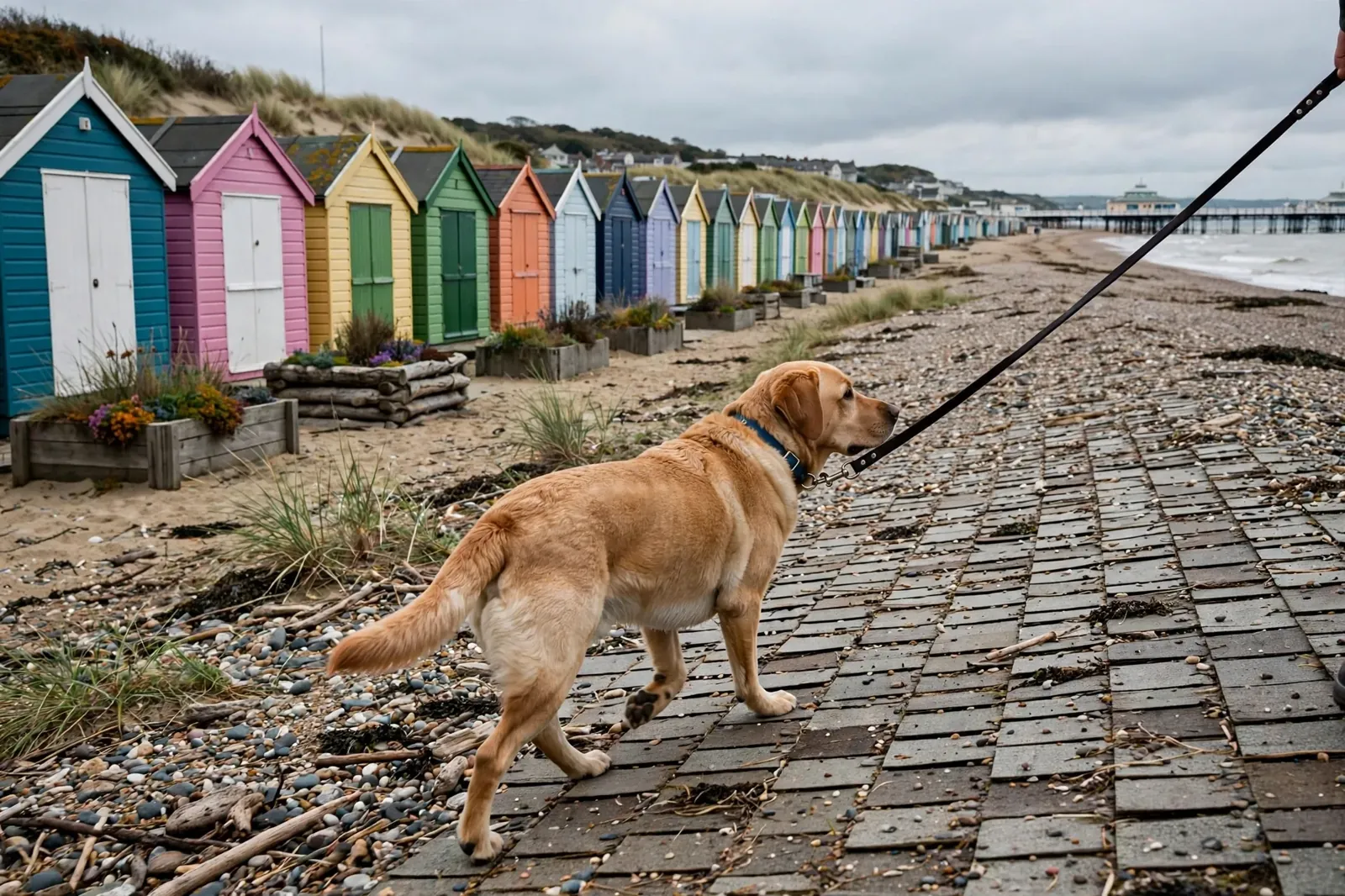
Kessingland beach rewards a simple plan. Instead of hunting for a single viewpoint or a circular loop, start at the village beach access and walk in one direction along the sand, letting the dog set a steady pace on a line that stays open for a long way in both directions. The shoreline here is broad and gently shelving, with firm sand near the waterline when the tide is out and softer, deeper sand higher up the beach, so a dog that charges straight onto the soft sand will tire much faster than one that trots along the firmer strip. On a quiet weekday outside the summer holidays, the beach can feel almost empty, which makes it a good place for recall practice, for a long-line walk with a nervous dog, and for older dogs that need distance without obstacles, steps or stiles. The lack of a promenade means there is nowhere to duck behind for shelter, so the walk is shaped by the weather from the first minute, and that openness is the whole point of coming here rather than to a busier resort beach.
Plan the walk as an out-and-back rather than a loop, and pick your turning point before the dog runs out of energy. A useful rhythm is to walk away from the access point for twenty to thirty minutes, pause for water and a sniffing break, and then turn back while the dog still has something in reserve, because the return leg into a sea wind feels longer than the outward leg with the wind behind you. Dogs that love to swim need watching on this stretch: the water is open North Sea water with no lifeguarded swimming zone in the usual sense, and a dog that paddles at the edge is a different proposition from one that swims out after a ball in a chop. Keep balls and toys close to the shoreline, throw parallel to the water rather than far out to sea, and rinse sandy paws and bellies before the car journey home, since sand works its way into car seats, leads and coat in a way that a short towelling rarely fixes.
The straight shape of the beach also changes how you manage other dogs. On a narrow cliff path, two dogs meet head-on with no room to arc around each other, but on Kessingland sand there is usually space to widen the gap, move towards the waterline or step up towards the dunes while the other dog passes. Use that space deliberately: call your dog in early, move off the direct line, and let the other owner pass before releasing again, rather than waiting until both dogs are already nose to nose. The same openness helps with children, kite flyers and anglers, because you can see them from a long way off and adjust your line early. If your dog is reactive, the long sightlines are an advantage, but only if you use them, so keep scanning ahead instead of walking with your eyes on the sand at your feet.
Dunes and the grass-topped low cliffs
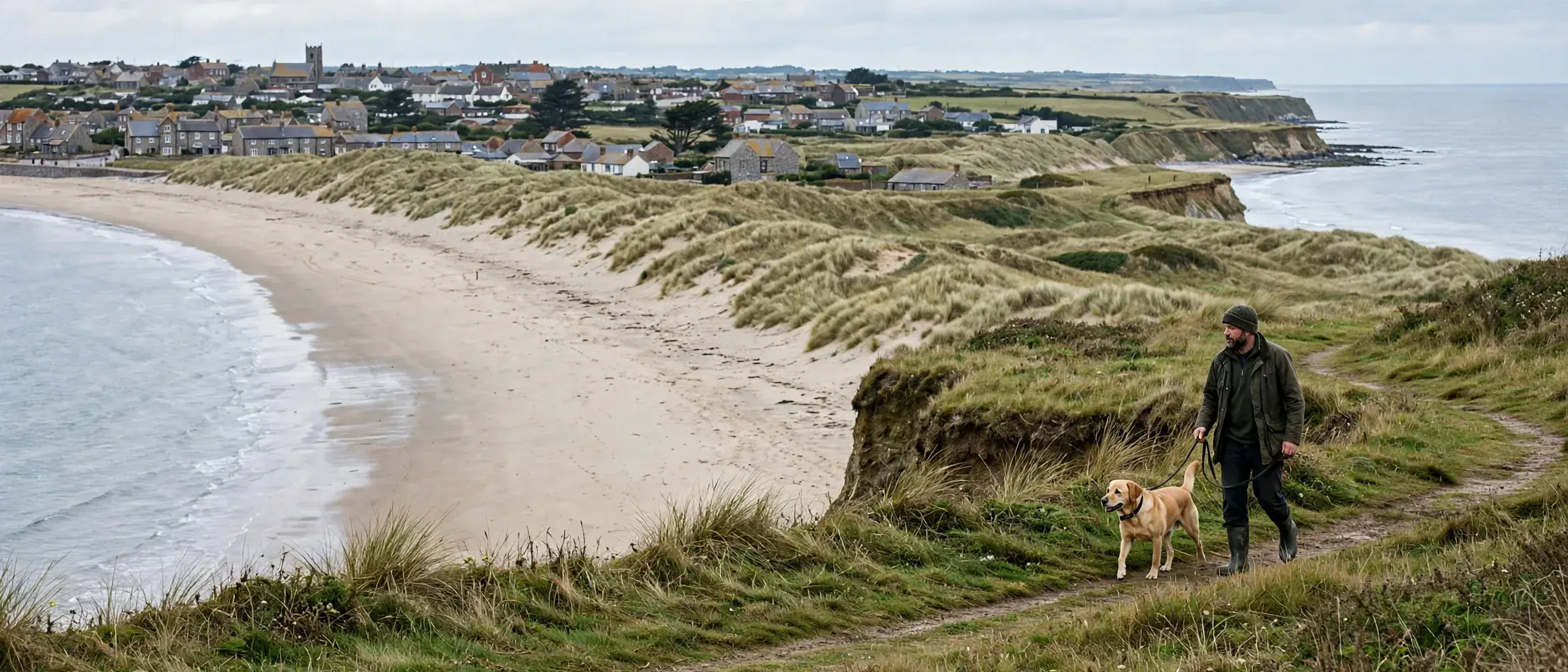
Behind the sand at Kessingland, the ground rises into dunes and then into a low, grass-topped cliff line that runs along the coast, and this strip gives the walk its second character. The dune grass is not decorative: its roots bind loose sand, and the hollows between the ridges shelter birds, insects and small mammals that a dog will scent long before you see them. Stick to the worn paths that already cross the dunes, keep the dog close on the narrow sections where the path dips between banks, and do not let a dog dig a hole in the same spot again and again, because a single afternoon of digging can open a bare patch that wind then widens. Where the path climbs onto the cliff-top grass, the walking becomes easier underfoot but the edge needs respect, especially after heavy rain when the lip can be soft and undercut, so keep dogs back from the very edge and use a lead wherever the path runs close to a drop.
The cliff-top grass also makes a good alternative when the beach itself is less inviting. At high tide, when the sand narrows and the water pushes up against the base of the cliffs, the upper path keeps the walk going without forcing the dog onto a thin strip of shingle between waves and rock. In strong onshore wind, the same path is more exposed than the beach below, so the choice between sand and cliff top is a weather decision as much as a scenery decision: the beach shelters you slightly behind the dune line on a westerly wind, while the cliff top catches the full force of an easterly coming straight off the sea. Older dogs and short-legged breeds often prefer the cliff-top grass because it is level, dry and free of deep sand, but the lack of shade means a summer walk up there needs water carried from the start, since there is no tap or stream along the ridge to top up a bowl.
Wildlife awareness matters more on this strip than on the open sand. Ground-nesting birds use dune grass and cliff-top turf in spring and early summer, and a dog running loose through the grass can disturb a nest without either owner or dog ever knowing it happened. Keep the dog on a lead or under very close control through the dune grass in the breeding season, watch for fencing or temporary signs that mark a sensitive patch, and move on promptly rather than lingering for photographs in one hollow. In autumn the same ground is quieter, with seed heads, blown sand and fewer visitors, which makes it a better season for a longer dune walk, although the paths can be slippery with wet leaves and sand after rain. The rule that covers all seasons is simple: the dune and cliff-top paths are for passing through and looking from, not for cutting new routes across fragile ground.
Holiday park edges: manners and lead sections
Kessingland is closely associated with large holiday parks, and the boundary between park land and public beach is where most of the friction for dog walkers happens. Park roads carry cars, delivery vans and reversing caravans at all hours, and the lanes between accommodation blocks funnel children, cyclists and dogs into the same narrow space, so a dog that is perfectly behaved on open sand can still cause a problem by darting across a park road after another dog or a dropped ice cream. Treat every park road, entrance lane and shared path as a lead section, keep the lead short rather than trailing on a long line, and walk on the side away from the accommodation doors where dogs may be sitting outside their units. If you are staying in the park, learn the exact route from your unit to the beach on the first evening, because a dog that already knows the way to the sand will pull towards it every time you step outside.
Noise and toilet manners matter more around a park than on the open beach. A dog that barks at every passer-by from a caravan deck, or that toilets repeatedly on the same strip of grass outside someone else's unit, will draw complaints quickly, and complaints around holiday accommodation tend to be handled firmly because other guests are paying for quiet. Give the dog a proper toilet walk on the beach or on a designated area before settling outside a unit, carry bags on every outing including the short ones, and pick up even on grass where it feels less visible, since park staff and other guests notice exactly that kind of omission. At night, keep the last walk short, calm and on a lead, and avoid letting the dog run loose around parked cars and bins in the dark, when a startled cat, fox or hedgehog can turn a routine outing into a chase.
If you are not staying in the park, the same courtesy applies in reverse: use the public beach access points rather than cutting through park grounds, do not let the dog drink from decorative water features or toilet on landscaped beds, and respect any signs that mark private land or residents-only paths. The beach itself is the shared space, and the park edges are the approach to it, so the aim is to pass through them quietly and without incident. Dogs that are calm through the park approach tend to be calmer on the beach as well, because they have not already spent their excitement budget on the walk from the car. A few minutes of lead walking and settling at the boundary pays off for the whole outing.
The coast path north towards Lowestoft
From Kessingland, the coast path heading north towards Lowestoft turns a beach outing into a proper linear walk, and it is worth understanding what that commitment involves before you set out. The route follows the shoreline and the cliff-top line, mixing sand, grass and surfaced stretches, and the distance to Lowestoft is long enough that most dogs will be better served by a partial walk with a planned turning point than by an attempt to cover the whole way in one go. A sensible approach is to walk north for forty to sixty minutes, note a landmark such as a distinctive cliff-top bench, a path junction or a change in the surface, and then turn back along the same line, which gives the dog a long walk without the logistics of a one-way journey. Dogs that are fit, accustomed to distance and comfortable on mixed surfaces will enjoy the variety, while puppies, elderly dogs and dogs recovering from injury should stick to the shorter beach section near Kessingland.
Tide and surface conditions decide whether the northern walk works on a given day. If you plan to walk on the sand for any part of the route, check the tide times for Lowestoft and Kessingland before leaving, and start early enough that the tide is falling or low while you are on the beach, because a rising tide can narrow the sand against the cliffs and force an awkward scramble onto the upper path. The cliff-top sections avoid the tide problem but add exposure to wind and, in wet weather, muddy patches where the grass path crosses low ground. Carry water for the dog from the start, since there is no reliable refill point along the open coast, and carry a spare lead, because a long line snagged on dune fencing or gorse is a common reason for a walk to end early. A phone with charge, a basic first-aid item for cut paws, and a towel for the car complete a kit that fits in a small day pack.
If you do want a one-way walk into Lowestoft, arrange the return before you start. Check bus times, taxi availability and whether the service accepts dogs, and confirm the pick-up point in Lowestoft rather than assuming a convenient stop will be near the beach end of the walk. A tired dog that has just walked several miles is a poor companion for an unplanned wait at a roadside, and a wet, sandy dog is not always welcome in a vehicle that was not booked with a dog in mind. For many visitors, the better version of this walk is to drive to Lowestoft another day and explore its own seafront separately, keeping the Kessingland walk as the long, quiet beach day it does best. Either way, the coast path rewards walkers who treat distance as a choice, not a target, and who turn back while the dog is still enjoying the walk.
Sea angling and other beach activities: what they mean for dogs
Kessingland beach is used by sea anglers, and a dog walk that ignores their lines and gear will end badly for everyone involved. Anglers typically fish from the shoreline with rods propped in rests, lines running out into the surf, and bait, hooks and cut tackle scattered near their position, so the safe move is to give each angler a wide berth, keep the dog on a lead or under close control while passing, and never let the dog sniff around rod rests, bait boxes or tackle bags. A hook in a paw or mouth is a veterinary emergency, not a minor inconvenience, and a dog tangled in a line can pull a rod into the sea and ruin an angler's day in seconds. Watch for anglers who are partly hidden behind dune ridges or in hollows, since you may not see them until you are close, and call the dog in as soon as you spot rods rather than waiting until you are alongside them.
Other beach activities shape the dog walk in quieter ways. Kite flyers need a clear run of sand and strong wind, and a dog chasing a low kite or its lines is at risk from the cord as well as from a collision, so steer well clear of anyone actively flying and keep the dog close until you are past. Families with picnics, barbecues and beach games concentrate near the main access points, which means the busiest, most food-scented sand is exactly where a food-motivated dog is hardest to control, so a short lead through the first few hundred metres from the access point is sensible even if the rest of the beach is empty. Swimmers and paddle users in summer add another distraction, and a dog that swims out to join them can alarm parents and exhaust itself, so set the swimming rule before you reach the water: either the dog paddles at the edge on a long line, or it does not go in at all on that visit.
The practical answer is zoning your own walk. Use the quieter stretches away from the access points and the angling spots for off-lead play, recall games and long runs, and use the busier zones as lead sections where the dog walks calmly past other people and their equipment. This keeps the dog's freedom where it is safe and keeps other beach users on your side, which matters on a beach that has room for everyone only if everyone gives each other space. If you find the beach unusually busy, with anglers spaced along the whole shoreline and families spread across the sand, shorten the off-lead portion rather than forcing it, and spend the extra time on the cliff-top path where the dog can still walk and sniff without negotiating lines and picnic blankets. A flexible plan beats a fixed route on a shared beach.
Village facilities, cafes and places to pause
Kessingland village itself is small and practical rather than a resort centre, and dog walkers should plan around that scale. The village has shops and food outlets that serve residents and holiday park visitors, but opening hours can be seasonal, and a cafe that is busy in August may run reduced hours or close on certain weekdays in winter, so check before relying on a particular stop for lunch. If you plan to eat with the dog, look for outdoor seating or a terrace where dogs are welcome, keep the dog on a lead under the table, and bring a portable bowl and a mat so the dog can settle on the ground rather than on chairs or neighbouring tables. A dog that has just come off the beach will be sandy and possibly wet, so a quick brush-down and a towel before sitting down is courtesy to the staff and to the next table, and it also stops sand from working into the dog's coat for the rest of the day.
Water, shade and toilet stops for the dog are the facilities that matter most on a Kessingland day, and they are not always obvious. Carry the dog's water from the car rather than assuming a tap or bowl will be available at the beach entrance, and offer water little and often on warm days instead of waiting until the dog is panting heavily. Shade is scarce on the open beach and on the cliff-top grass, so on a hot day plan the walk for the morning or late afternoon, use the dune hollows for brief shaded pauses, and never leave a dog in a parked car while you go into a shop, even for a few minutes. Public toilets in the village area may be seasonal, so build a comfort stop into the plan before the beach walk, and keep the dog's routine in mind: a dog that needs a toilet break halfway through a long beach walk will be far happier if you have already given it a proper outing near the car park.
For a longer stay, the village is a base for stocking up rather than a destination in itself, and that is part of its appeal for dog owners who prefer quiet evenings to resort nightlife. A local shop for dog food, bags and fresh water, a takeaway or pub meal that can be eaten outdoors, and a calm evening walk on the beach after the day visitors have gone home make a low-key routine that suits many dogs better than a packed itinerary. If your dog is nervous around traffic, note that the village roads are quieter than the main Lowestoft road, but they still carry park traffic at changeover times, so keep the dog on a lead through the village and cross roads at clear points rather than letting the dog lead you across. The village rewards walkers who arrive with realistic expectations: it gives you what you need for a beach day, and the beach itself provides the main event.
Parking and the beach access points
The beach car park near Kessingland village is the most straightforward starting point for a dog walk, because it puts the car, the beach access and the cliff-top path within a short walk of each other. On a warm weekend or in the school holidays, arrive early, because a small coastal car park fills quickly and late arrivals end up walking a longer road route with the dog before they even reach the sand. Before leaving the car, check the payment method, the time limit and any height or overnight restrictions, and take a photograph of the tariff board if the rules are unclear, since a parking fine is an unwelcome end to an otherwise good beach day. Leave the car tidy, with nothing tempting visible, and keep a towel, spare lead and water in the boot so the return to the car is not a scramble for supplies you left at home.
The access points themselves vary in character, and the right one depends on the dog. The main village access is the most direct and the most used, which makes it the best choice for a first visit, for a dog that needs a short route to the sand, and for anyone carrying a lot of kit, but it is also where families, anglers and other dogs concentrate. Smaller gaps through the dunes further along the coast are quieter and give a more gradual start to the walk, yet they may involve soft sand, uneven steps or narrow paths between banks that suit a fit dog better than a stiff or very small one. If your dog struggles with steps or steep sand, use the main access and accept the busier start, then walk away from the entrance until the beach quietens, rather than forcing a difficult dune gap for the sake of solitude. Whichever access you use, note where you came down, because the dune line looks very similar along its length and it is easy to walk past your exit on the way back.
On the return leg, the car park routine matters as much as the arrival. Towel the dog down before it gets into the car, shake out the lead and harness, and check paws for sand, small stones and any cuts picked up on shingle or broken shell, since a dog that limps at home often picked up the problem on the last hundred metres of beach. If the dog has been swimming, a rinse with fresh water from a bottle helps, although it will not remove all the salt, so a proper wash at home is still needed after a sea swim. Keep a spare towel and a waterproof car cover in the boot through the whole trip, not just on the first day, because Kessingland sand is fine and persistent, and it will find its way into every seam of the car if you give it the chance. A calm, unhurried return to the car also helps the dog settle for the drive, which is the last part of the walk that owners tend to rush.
Wind, tides and safety on an exposed beach
Kessingland faces the open North Sea with little shelter, so wind is the weather factor that most changes a dog walk here. An easterly wind comes straight off the water, drives sand across the beach at ankle height, and makes the cliff-top path feel far colder than the temperature suggests, while a westerly wind is softened slightly by the land behind the dunes but can still gust across the open sand. Dogs with short coats, elderly dogs and small breeds feel the wind chill first, so a dog coat is worth packing even on a day that looks mild from the car, and a walk that is pleasant for twenty minutes can become uncomfortable if the wind strengthens while you are a long way from the access point. Check the forecast for wind speed and direction, not just temperature and rain, and be ready to shorten the walk, move from the cliff top down to the beach, or use the dune hollows for shelter if the wind picks up.
Tides deserve the same attention, because the usable beach at Kessingland changes a great deal between high and low water. At low tide there is a broad expanse of firm sand for running and playing, while at high tide the water reaches much further up the beach and the remaining strip can be narrow, soft and close to the base of the cliffs. Walking on a rising tide is the risk to avoid: a dog that is happily playing on a wide beach can find its route back cut off by water against a cliff section, and an owner who has to scramble over rocks or through dunes with a wet dog is in a worse position than one who simply started earlier. Check the tide times for the day, plan the longest beach section for the falling or low tide, and if you are unsure about the tide state, use the cliff-top path for the longer leg and the beach only for a short, supervised section near the access point.
Other safety points are specific to this kind of open beach. Sand can hide broken shell, fishing tackle and sharp stones, so check paws after the walk and watch for a dog that suddenly holds a paw up or starts licking one foot repeatedly. Salt water in quantity can upset a dog's stomach, so discourage drinking from the sea and offer fresh water frequently instead, and watch for a dog that has swallowed a lot of sand while playing with a ball, since sand ingestion can cause discomfort and, in larger amounts, a veterinary problem. Jellyfish and other washed-up sea life should be treated as hands-off for dogs as well as people, and any dog that eats something unknown from the strandline should be watched closely and checked with a vet if it becomes unwell. None of this should put you off the beach, but all of it is easier to manage if you carry water, a lead, a towel and a phone, and if you keep the dog within sight on the open sand.
Combining Kessingland with Southwold and Carlton Marshes
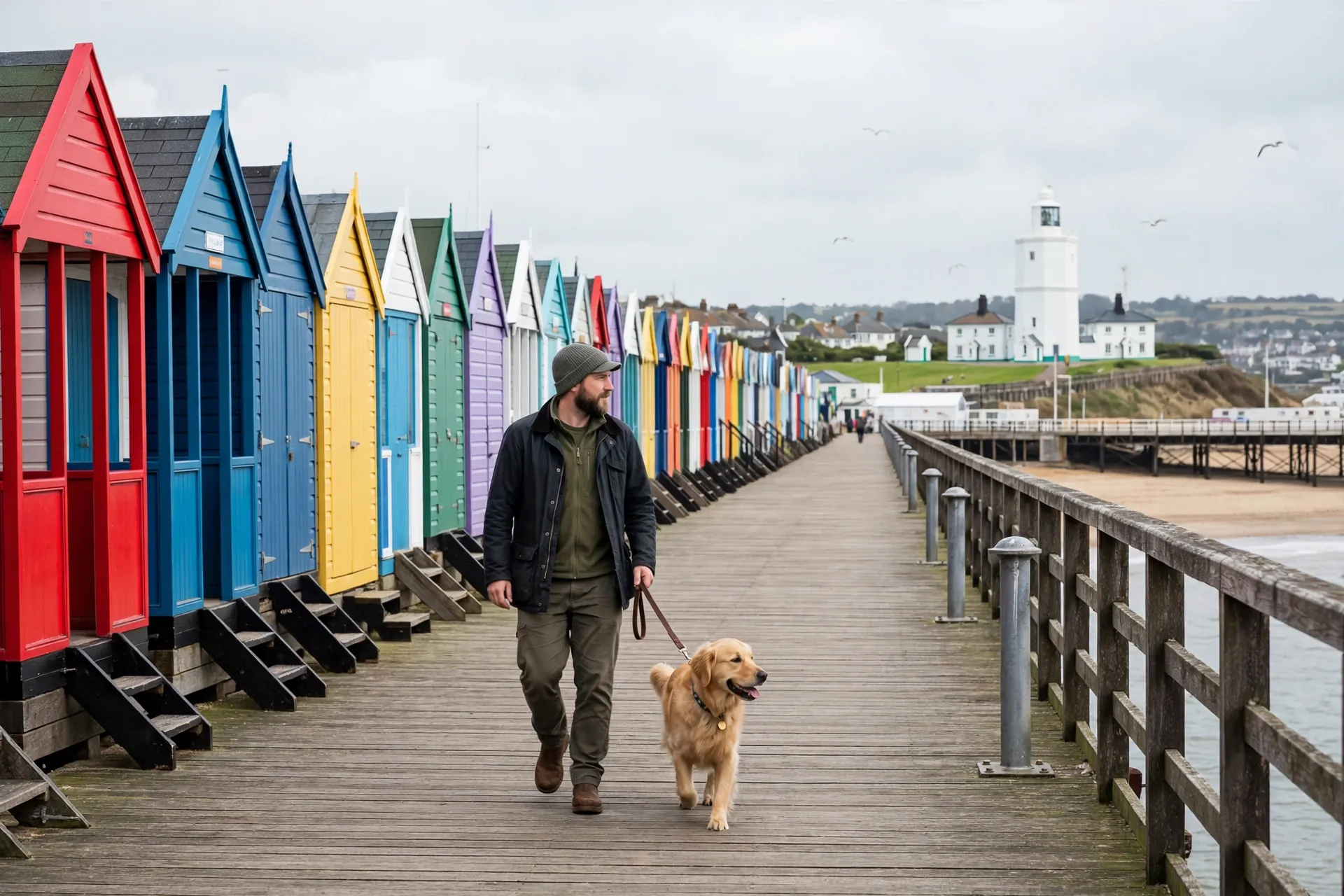
Kessingland sits between two very different Suffolk days out, and pairing it with one of them makes a better short break than trying to do everything in a single day. To the south, Southwold with a dog offers a pier, a lighthouse, colourful beach huts and a town centre with pubs and cafes, which is the busier, more built-up counterpart to Kessingland's open sand. A sensible two-day pattern is to spend one day on the long, quiet Kessingland beach, where the dog can run and sniff without navigating crowds, and the next day in Southwold, where the walk is shorter, the stops are more frequent, and the dog needs to be comfortable on a lead around people, other dogs and street furniture. Dogs that are overwhelmed by Southwold on a summer Saturday will often be perfectly happy at Kessingland on the same weekend, because the space to move away from other visitors changes the whole experience.
Inland from the coast, the Carlton Marshes area offers a completely different landscape of reedbeds, open water and flat paths, and it pairs well with Kessingland because it swaps sand and sea wind for sheltered wetland walking. The marsh paths are generally flat and easy underfoot, which suits older dogs and dogs that tire on soft sand, but the wildlife interest is higher, so a dog that chases birds or is unreliable around water needs a lead and close control through the reserve sections. Check the reserve guidance before you travel, since access rules, seasonal closures and dog restrictions on particular trails can change, and plan the marsh walk as a shorter, calmer outing rather than as a second long beach walk on the same day. A morning on the Kessingland beach followed by a quiet afternoon drive inland is a lot for one dog, so spread the two landscapes across two days if you can, and let the dog rest properly between them.
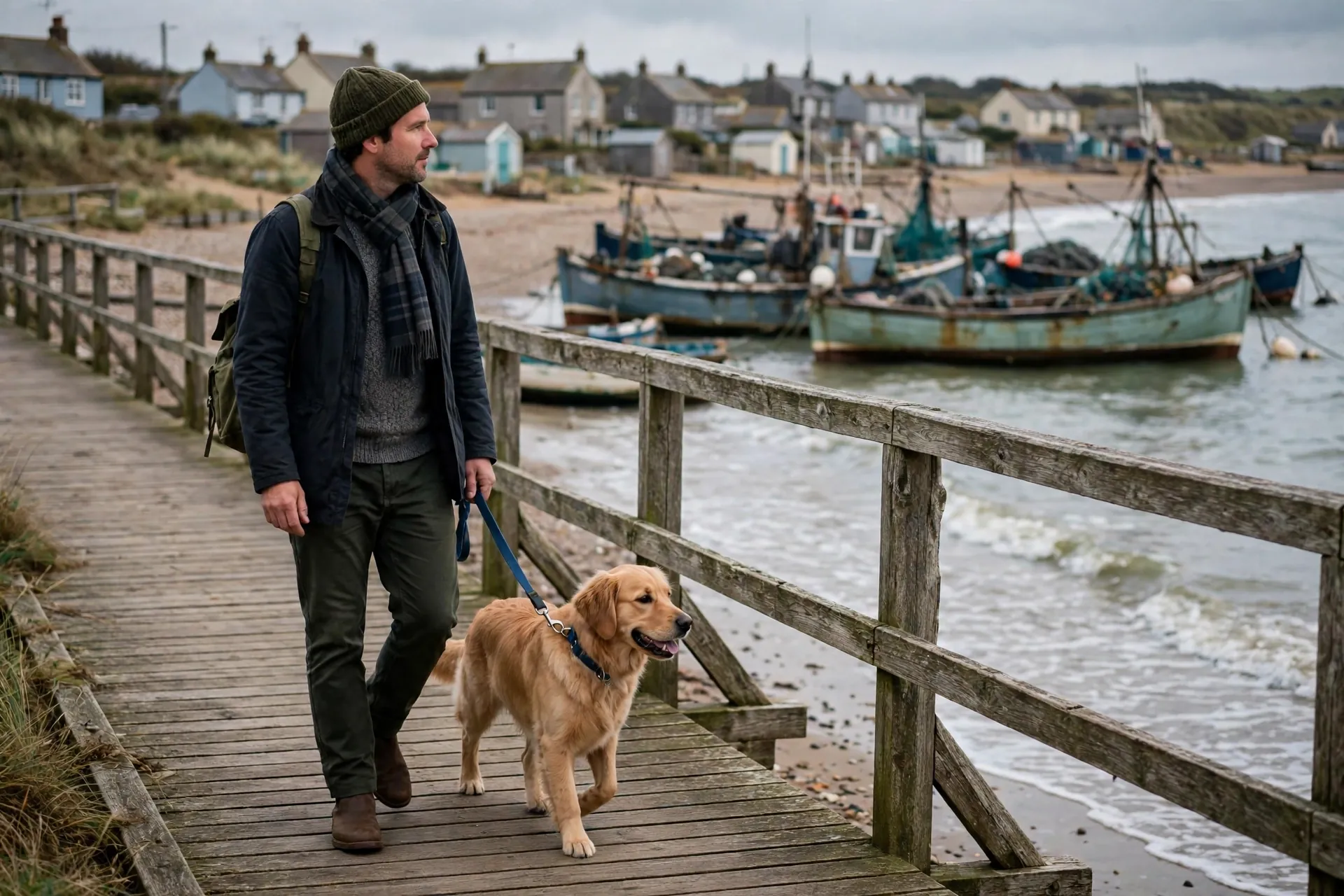
The wider Suffolk coast with a dog picture helps here, because Kessingland is not an isolated beach but one stop on a coastline where each town has a different balance of sand, shingle, promenade and marsh. Aldeburgh, covered in our Aldeburgh with a dog guide, gives a shingle beach, a promenade and fishing boats drawn up on the shore, which is a useful contrast to Kessingland's sandy openness and a good choice for a day when the dog needs a shorter, more structured walk. When you plan a Suffolk coast trip, pick one long-beach day, one town day and, if the dog enjoys it, one marsh or broads day, rather than stacking three beach days in a row, since the variety keeps the dog interested and gives paws, coats and energy levels a change of pace. Kessingland's role in that pattern is clear: it is the long, empty beach day, and it does that job better than almost anywhere else on this stretch of coast.
Seasons at Kessingland: a final reminder
Spring at Kessingland brings longer days, nesting birds in the dunes and cliff-top grass, and a beach that is still quiet outside the Easter holidays, which makes it a good season for dogs that dislike crowds, provided the dune paths are treated with extra care. Keep the dog close through the dune grass in spring, watch for signs about sensitive areas, and expect changeable weather, with bright sun one hour and a cold sea wind the next, so a coat and a towel in the car are still worth packing. Summer is the busiest season, with holiday park visitors, families and anglers sharing the beach, and the dog walk needs to adapt: go early in the morning or late in the afternoon, carry plenty of water, use shade and dune hollows for breaks, and keep the dog on a lead through the busiest access sections. Heat is the main summer risk, and a dog that runs hard on soft sand in midday sun will overheat faster than one walking steadily on the firm waterline, so build rest and water into the walk rather than treating them as afterthoughts.
Autumn is arguably the best season for a Kessingland dog walk, with fewer visitors, cooler air, firm sand after the first rains, and a beach that returns to its quiet, open character. The light is lower, the wind can be stronger, and the cliff-top paths may be muddy after rain, but a fit dog will enjoy the longer walks that summer heat makes difficult, and the dune grass is past its most sensitive period. Winter brings the most exposed conditions: short days, strong easterly winds, high tides that eat into the beach, and a village and park that may be quieter or partly closed, so winter walks need the most planning, with tide times, daylight and a warm, dry car to return to all checked in advance. A winter dog that is comfortable in a coat and on a lead through wind-blown sand will still enjoy Kessingland, but a short, well-timed walk beats a long, cold one every time.
Whatever the season, the same few habits make a Kessingland visit work: check the signs at the access point you use, check the official guidance before you travel if any rule is unclear, carry water, bags, a lead and a towel, and let the dog's energy and the weather set the length of the walk rather than a fixed distance target. Kessingland does not need a complicated itinerary, and it does not reward one: its appeal is a long beach, a dune and cliff line to explore, and a coast path that invites a longer walk when the dog and the day both allow it. Arrive with a simple plan, stay flexible about turning back, and the beach will do the rest, whether you are here for a single morning, a holiday park week, or one stop on a longer Suffolk coast trip with the dog.
Practical questions
Before you go
Are dogs allowed on Kessingland beach all year?
Kessingland beach is generally known as a long, open stretch where dogs can run, but local rules can change by season and by section, so check the signs at the access point you use on the day. Keep your dog under close control around other beach users, anglers and wildlife, and carry bags and water even on a short outing. If a notice asks for dogs on leads in a particular area, follow it for that stretch rather than assuming the whole beach works the same way. When in doubt, check the official guidance before you travel.
What should I do about the dunes and grass-topped cliffs at Kessingland?
Stay on the worn paths through the dunes and along the cliff-top grass, and keep your dog close where the ground is fragile or the edge is soft after rain. Dune grass holds loose sand together, so cutting new tracks through it, or letting a dog dig repeatedly in one spot, does lasting damage out of proportion to a few minutes of play. Keep dogs out of any fenced or signed restoration areas, and call a dog back before it scrambles up a steep, crumbling bank. A lead is the simplest tool on narrow dune paths where you cannot see what is around the next bend.
Do I need to keep my dog on a lead near the holiday park at Kessingland?
Yes, treat the holiday park edges, its access roads and the busier beach entrances as lead territory, even if your dog is reliable off lead on the open sand. Caravans, parked cars, children and other dogs appear suddenly around corners, and a loose dog crossing a park road creates a problem no beach walk is worth. Use a short lead through the park boundary, past the entrance lanes and until you are clear of buildings, bins and play areas. Once you are on the wide, quiet sand with good visibility, you can judge whether a longer lead or off-lead time is sensible.
Can I walk with my dog from Kessingland to Lowestoft along the coast path?
Yes, the coast path north from Kessingland runs towards Lowestoft, and it makes a natural longer walk for a fit dog, but treat it as a committed outing rather than a casual extension. The route mixes beach, cliff-top grass and surfaced sections, so check tide times before setting out, carry water, and plan a turning point instead of assuming you must reach Lowestoft. Some dogs will be happier with a shorter out-and-back from Kessingland than with the full distance in both directions. If you walk one way only, sort the return transport before you start, because the coastal bus and taxi options are not something to improvise with a tired dog.
Where is the easiest place to park for a dog walk at Kessingland?
The beach car park at Kessingland village gives the most direct start, with a short route from the car to the sand and the cliff-top path. Arrive early on warm weekends and in school holidays, because a small coastal car park fills quickly and the overflow walk adds road walking for the dog. Check the payment method and any time limits before you leave the car, and leave nothing tempting visible inside it. If the main car park is full, use a village parking spot that does not block driveways or narrow lanes, and walk to the beach entrance on foot.