This guide is independent and contains no paid placement. If affiliate links are added later, they will be clearly marked and will not change our editorial checks.
Start at Dean Castle Country Park: more than 200 acres of free woodland, parkland and riverside paths where dogs are welcome outdoors on a lead. Add Kay Park for a short town walk, use the coast at Troon or Irvine for a beach day, and treat museums as split visits, since dogs are not generally allowed inside.
Dean Castle Country Park first
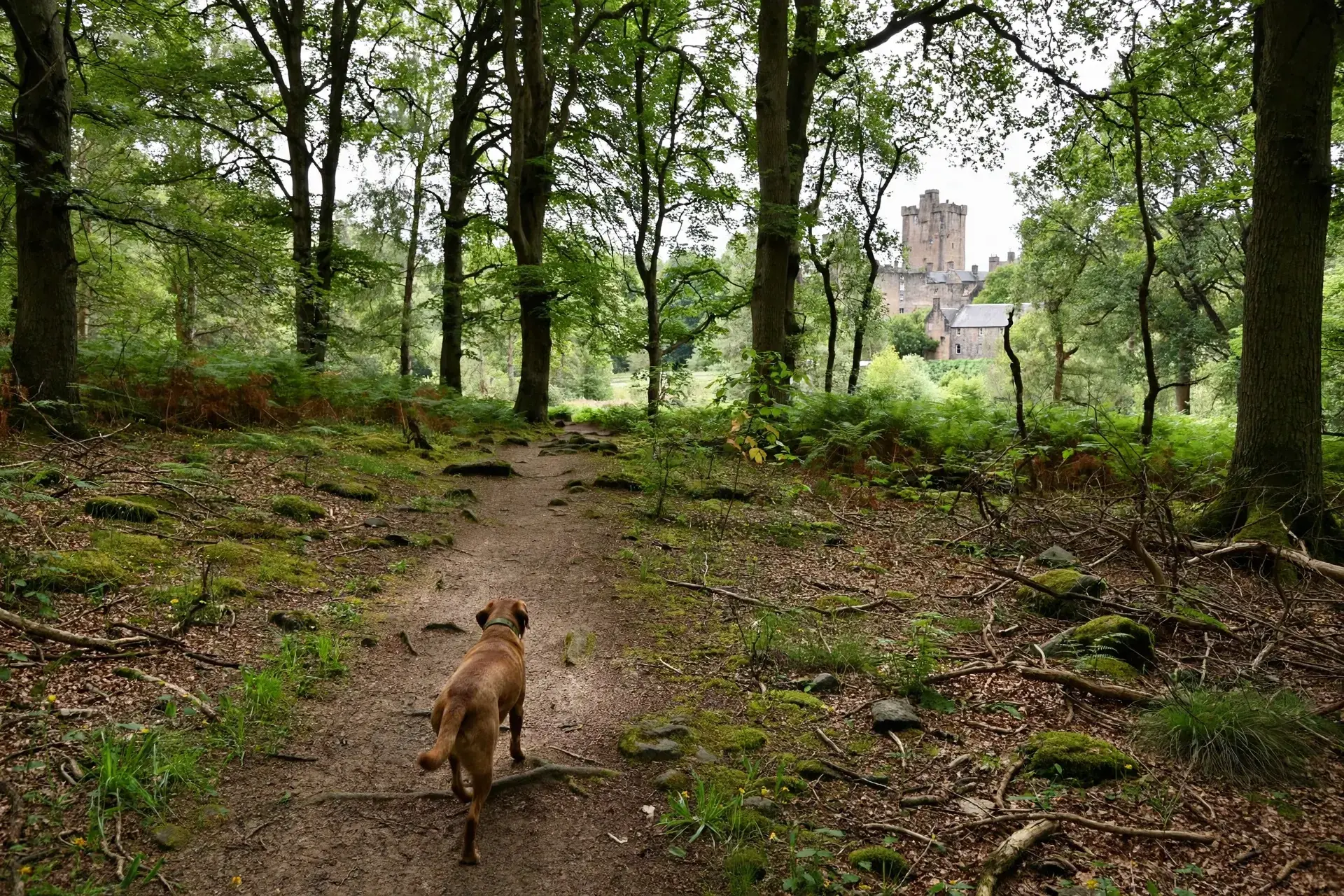
Dean Castle Country Park is the reason most dog owners come to Kilmarnock, and it is also the place to start any visit. The park covers more than 200 acres around a 14th-century castle on the edge of the town, and entry to the park grounds is free. Inside that one boundary you get mature woodland, open grass, a waterside path along Kilmarnock Water, a visitor centre, a cafe, a Rural Life Centre with farm animals, and an adventure playground. Few British towns offer a dog walk of this scale within walking distance of the station, and fewer still offer it for free.
Dogs are welcome in the outdoor areas of the park, and it is one of the most popular dog-walking spots in the whole of East Ayrshire. The rule that matters most is the lead. Keep your dog on a lead, especially near the fallow deer, the farm animals at the Rural Life Centre, and the other wildlife that lives in the woodland. The deer are a genuine draw for dogs, and a dog that chases them can cause real harm to the animals and to itself. A short lead near the animal enclosures and a long line on the open paths is a sensible combination, and it keeps the walk relaxed for everyone else using the park.
The woodland trails are the heart of the walk. They are well signposted, mostly surfaced or firm underfoot in dry weather, and shaded in summer, which makes them a good choice on warm days when open grass is too hot for paws. The routes vary in length, so a visit can be a twenty-minute loop or a proper two-hour walk. The ground rises and falls gently in places, and after rain some of the unsurfaced woodland paths turn muddy, so waterproof boots and a towel for the dog are worth packing. If your dog is older or less mobile, stick to the flatter, surfaced paths near the visitor centre and the castle, and save the steeper woodland loops for another visit.
The waterside path along Kilmarnock Water is the other classic route. It runs through the park in a green corridor of trees and gives dogs the sound and smell of running water without the exposure of an open riverbank walk. Keep a close eye on dogs that like to swim: the water level and current change after rain, and not every stretch has an easy exit. A dog that paddles at the edge is one thing; a dog that launches itself into fast water after heavy rain is a problem worth preventing with a lead.
The castle itself is a separate question from the park. Dean Castle is a 14th-century stronghold with museum collections inside, and dogs are not generally allowed indoors. That does not spoil the visit. Walk the grounds with the dog, admire the castle from outside, and if one person in your party wants to see the interior, take turns: one goes in while the other walks the dog. Check the castle opening times and any booking requirements before you travel, because the museum and the cafe have their own hours and the castle can close for events or maintenance. The same applies to the Treehouse Cafe at the visitor centre, where dogs are welcome in the covered outdoor seating area and, according to current visitor information, while you order at the counter. Outdoor seating is the safe assumption for a meal; check the official guidance before you travel if you are counting on a specific arrangement.
Parking at Dean Castle Country Park is free, and there are car parks near the main entrance and the visitor facilities. On a fine weekend the main car park fills up, so arrive early or be ready for a short walk from an overflow area. If you arrive by public transport, the park is reachable on foot from Kilmarnock town centre, though the walk is uphill in places and takes longer than the drive. For a first visit, drive if you can: it lets you carry towels, water and spare leads without thinking about it, and it gives a tired dog a comfortable ride home.
Finally, treat the park as a place with its own rhythms. Early mornings are quiet and good for reactive dogs, because the paths are emptier and the deer are often visible at a distance. Late mornings and weekend afternoons bring families, school groups and other dogs, which suits a sociable dog and overwhelms a nervous one. If your dog struggles with other dogs, go early, keep to the wider paths, and avoid the pinch points around the visitor centre, the playground and the animal enclosures.
Kay Park and the town centre
Kay Park is Kilmarnock's town park, and it is the right scale for a morning or evening walk rather than a full day out. The park covers about 30 acres and opened in August 1879, funded by a bequest from Alexander Kay. It is a Victorian park in the best sense: formal paths, mature trees, open lawns, a central pond, and monuments that give the walk a sense of place. The Burns Monument Centre sits within the park, along with the Burns Monument itself, stone lions, a Reformer's Monument, and the Edward VII Memorial fountain. It is a park where a dog walk and a little local history happen at the same time.
The walk itself is short and gentle. A loop of the park is roughly 0.6 miles, mostly on tarmac paths that are well maintained, with some gentle slopes towards the Burns Monument Centre and a few steps on some routes that can be avoided. That makes Kay Park a good choice for older dogs, puppies that should not be over-walked, and anyone who wants a level, predictable surface. The paths branch off behind the Burns Monument Centre towards Kilmarnock Water, so a short park loop can be extended into a longer riverside walk when the dog still has energy.
Kay Park is popular with local dog walkers, and that is both its charm and its planning point. Your dog will meet other dogs, often off lead, on the open lawns. If your dog is friendly and sociable, that is a pleasure. If your dog is reactive, keep to the edges of the park, use the quieter paths near the river, and go early or late when the park is emptier. The duck pond is another point to manage: dogs that love water will head straight for it, so keep a lead on until you know how your dog reacts, and do not let a dog drink from or swim in the pond.
The park has a children's play area, a cycle proficiency track and an outdoor gym, which means it is busy with families on fair days. That is good news if you want a lively, social walk, and a reason to choose Dean Castle Country Park instead if your dog is unsettled by children, bicycles or scooters. Toilets are available inside the Burns Monument Centre during its opening hours, and there is a free car park off Kay Park Crescent, near the Townholm side of the park. Kilmarnock bus and train stations are about half a mile away, so Kay Park works well as a first or last walk on a day when you arrive or leave by train.
Howard Park, near the town centre and close to the supermarkets on the edge of the centre, is the third park worth knowing. It is smaller and more neighbourhood in feel, with a play park and open grass for a quick leg-stretch. It suits a short toilet walk or a brief runaround rather than a destination walk, and it is useful precisely because it is close to the shops and the centre. If you are staying in central Kilmarnock, Howard Park is the park you will use most often, while Dean Castle Country Park is the park you will plan a morning around.
Town walks, rivers and quieter routes
Kilmarnock is a town of rivers as much as of parks. Kilmarnock Water runs through the town and through both Dean Castle Country Park and Kay Park, and the riverside paths give a dog walk a natural line to follow. The Irvine, the larger river that gives the neighbouring town its name, runs to the south of Kilmarnock and is reachable on longer walks out of town. Riverside walking in Kilmarnock is pleasant and green, but it needs the same care as any riverside route: keep dogs on a lead near fast water, watch for steep or unfenced banks after rain, and do not assume every stretch has a safe way down to the water and back up again.
For a longer walk, the paths out of Dean Castle Country Park towards the countryside around the town are the natural extension. The park sits on the northern edge of Kilmarnock, and the lanes and field paths beyond it lead into the rolling farmland of East Ayrshire. These are working landscapes, so expect livestock, farm traffic and field boundaries. In Scotland, access rights under the Land Reform (Scotland) Act 2003 allow responsible access to most land, but that right comes with responsibilities: keep dogs under close control around livestock, on a short lead near farm animals, and away from fields with young animals or ground-nesting birds in spring and early summer. If you are unsure whether a field contains livestock, keep the dog on a lead and stay on the path.
Annanhill Golf Course, on the southern edge of the town, is sometimes mentioned as a quieter walking area. Golf courses are private land, and dogs are not automatically welcome on them, so do not walk a dog across a course without checking who manages it and what the rules are. The same caution applies to any path that crosses a golf course or a farm: the right of responsible access is not a right to wander anywhere, and a dog off lead among golfers or livestock is a quick way to lose goodwill. When in doubt, use the public parks and the signed paths, and check the official guidance before you travel.
Street walking in Kilmarnock is straightforward. The town centre is compact, the pavements are generally wide, and the main shopping streets are pedestrian-friendly. That makes a town-centre walk with a dog easy, but it also means traffic, shop doorways, dropped food and other dogs in close quarters. A short lead, a dog that walks calmly at heel, and a habit of crossing the road before a busy junction all help. If your dog is nervous in towns, do the town centre early in the morning when the shops are quiet, and save the parks for the busier part of the day.
For dogs that need space, the trick in Kilmarnock is timing rather than distance. Dean Castle Country Park at 8am on a weekday feels like a different place from the same park at 2pm on a Saturday. Kay Park at dusk in winter is quiet, but the paths are unlit in places, so bring a torch and a reflective lead or collar if you walk after dark. And if your dog is reactive, the wide open lawns of Dean Castle Country Park are more forgiving than the narrow riverside paths, because you can see other dogs coming and give them a wide berth.
Burns, museums and indoor stops
Kilmarnock is a Burns town, and that is worth knowing even on a dog trip, because it shapes what you will see on a walk and what you will need to plan around. Robert Burns lived and worked in the area, and Kilmarnock is where the first edition of his poems was printed in 1786. The Burns Monument Centre in Kay Park, Burns House in the town centre, and the Burns Monument itself are the three places most visitors look for. They are also the places where a dog trip needs a plan, because dogs are not generally allowed inside museums and historic house interiors.
The Burns Monument Centre is the easiest of the three to combine with a dog walk, because it sits inside Kay Park. Walk the dog in the park, look at the monument and the stone lions from outside, and take turns going inside if you want to see the local and family history displays. The centre also houses registration services, so it is a working civic building as much as a visitor attraction, and its opening hours are not the same as the park's. Check the official guidance before you travel if you want to go inside, and do not leave a dog tied up outside a public building: it is stressful for the dog, it blocks the entrance, and in a busy park it invites trouble.
Burns House, on the edge of the town centre, is a small historic house associated with the poet. It is a short visit, and it is best treated as a ten-minute stop on a town-centre walk rather than a destination in its own right. Again, the dog stays outside with one person while the other goes in, or the house is admired from the street. The same split-visit rule applies to the Dick Institute, Kilmarnock's museum, gallery and library on Elmbank Avenue. The Dick Institute is the town's main indoor cultural stop, with exhibitions, local history and a library, but it is not a place to take a dog inside. Plan it for a rainy hour when one person is happy to walk the dog under cover while the other looks around, or skip it and spend the time in the parks instead.
That split-visit approach is the key to enjoying Kilmarnock's indoor attractions with a dog. It is not a compromise so much as a routine: one person and the dog take the park loop while the other does the museum, then you swap notes over a coffee. It works best when the indoor stop is short, the park is close by, and the weather is kind. The Dick Institute and Kay Park are close enough for this to work well, and Dean Castle and its grounds are the same idea on a larger scale. If you are travelling alone with a dog, be realistic: the indoor attractions will mostly be seen from outside, and the parks, the rivers and the coast are where your trip will actually happen. That is not a lesser trip. In Kilmarnock, the outdoors is the point.
One more indoor question comes up often: churches and other historic buildings. The same rule applies. Dogs are not generally welcome inside, and assistance dogs are the exception. Admire the architecture from the churchyard or the street, keep the dog on a lead, and remember that churchyards can contain wildlife and old gravestones that are easily damaged by a digging dog. A short lead and a watchful eye are enough.
Where to eat and stay with a dog
Kilmarnock is a working town rather than a tourist resort, and its dog-friendly eating and staying options reflect that. There are cafes and pubs in the town centre where dogs are welcome, particularly in outdoor seating areas and in the more relaxed, bar-style rooms, but policies vary from place to place and change more often than guidebooks do. The practical rule is to check before you sit down: look for a water bowl by the door, a dog-friendly sign, or a member of staff who welcomes the dog by name. If there is no sign and no bowl, ask. A polite question takes ten seconds and saves an awkward moment with a dog under a table in a place that does not want one there.
The Treehouse Cafe at Dean Castle Country Park is the most reliable cafe stop for a dog walk, because it is part of the park itself. It has covered outdoor seating, and dogs are welcome in the outdoor area and while you order at the counter, according to current visitor information. That makes it a natural end to a park walk: the dog settles on the terrace, you get a coffee and something warm, and nobody has to hurry. On a wet day the covered seating matters, and on a cold day a drying coat for the dog matters more. Check the cafe's opening hours before you travel, because they are seasonal and can change.
In the town centre, the best approach is to treat dog-friendly eating as a search you do on the day rather than a booking you make weeks ahead. Look for cafes with outdoor seating in the warmer months, and pubs with a bar area and a tiled floor in the colder months. A dog that settles under a table is welcome in far more places than a dog that barks, paces or begs, so the dog's behaviour is part of the plan. Bring a blanket for the dog to lie on, a chew to keep it occupied, and water. If the dog cannot settle, take the food away and eat it in the park: Kilmarnock's parks are good picnic spots, and a takeaway eaten on a bench with a dog at your feet is often the better meal.
For staying overnight, Kilmarnock has hotels, guest houses and self-catering options in and around the town, and several accept dogs. The details matter more than the headline. Ask whether dogs are allowed in the room or only in selected rooms, whether there is a pet fee and how much it is, whether the dog can be left alone in the room, and where the nearest practical toilet walk is after dark. A hotel that accepts dogs but has no garden and a busy road outside is a worse stay than a guest house a little further out with a garden and a field nearby. Get the pet policy in writing with the booking confirmation, and confirm it again a few days before arrival, because policies change and reception staff change.
Self-catering is often the easiest option for a dog trip to Kilmarnock. A cottage or flat with a garden, a hard floor and a washing machine solves the three problems that hotels create: mud, wet dogs and laundry. Look for enclosed gardens, ground-floor access, and a location near Dean Castle Country Park or Kay Park so the morning walk does not need a car. Check the cancellation terms, the cleaning fee and any damage deposit, and be honest about the number and size of your dogs at booking. A host who knows the dog is coming is a host who leaves a towel and a spare blanket rather than a host who finds muddy paw prints on a white sofa.
If you are using Kilmarnock as a base for a longer Ayrshire trip, consider the same questions at a larger scale. A base near the coast at Troon or Irvine gives you beach walks on the doorstep but costs more in peak season, while a base in Kilmarnock is cheaper and quieter and puts Glasgow within easy reach by train. Our guide to the Ayrshire coast with a dog covers the coastal towns in more detail, and our Glasgow with a dog guide is useful if you plan a city day from Kilmarnock. The right base depends on your dog: a beach-loving dog belongs near the sand, a park-loving dog is happy in Kilmarnock, and a dog that hates car journeys will thank you for choosing the shorter drive.
Day trips to the Ayrshire coast
The best reason to base a dog trip in Kilmarnock is that the Ayrshire coast is close. Troon, the nearest wide sandy beach, is roughly a 20 to 30 minute drive from the town, depending on traffic and where you start. Irvine Beach is a similar distance in the other direction, and Ayr is a little further south. That puts a proper beach day within easy reach without paying coastal prices for accommodation, and it means a wet morning in Kilmarnock can become a bright afternoon on the sand.
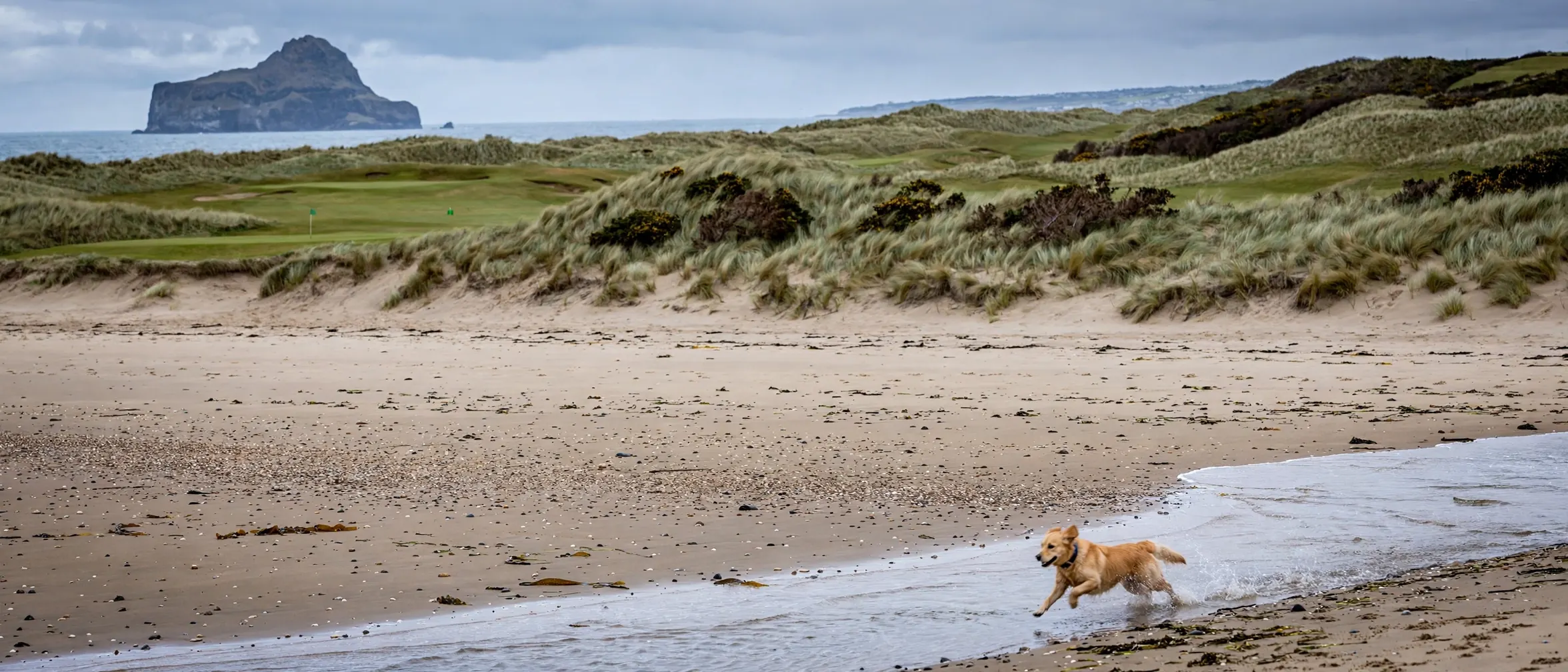
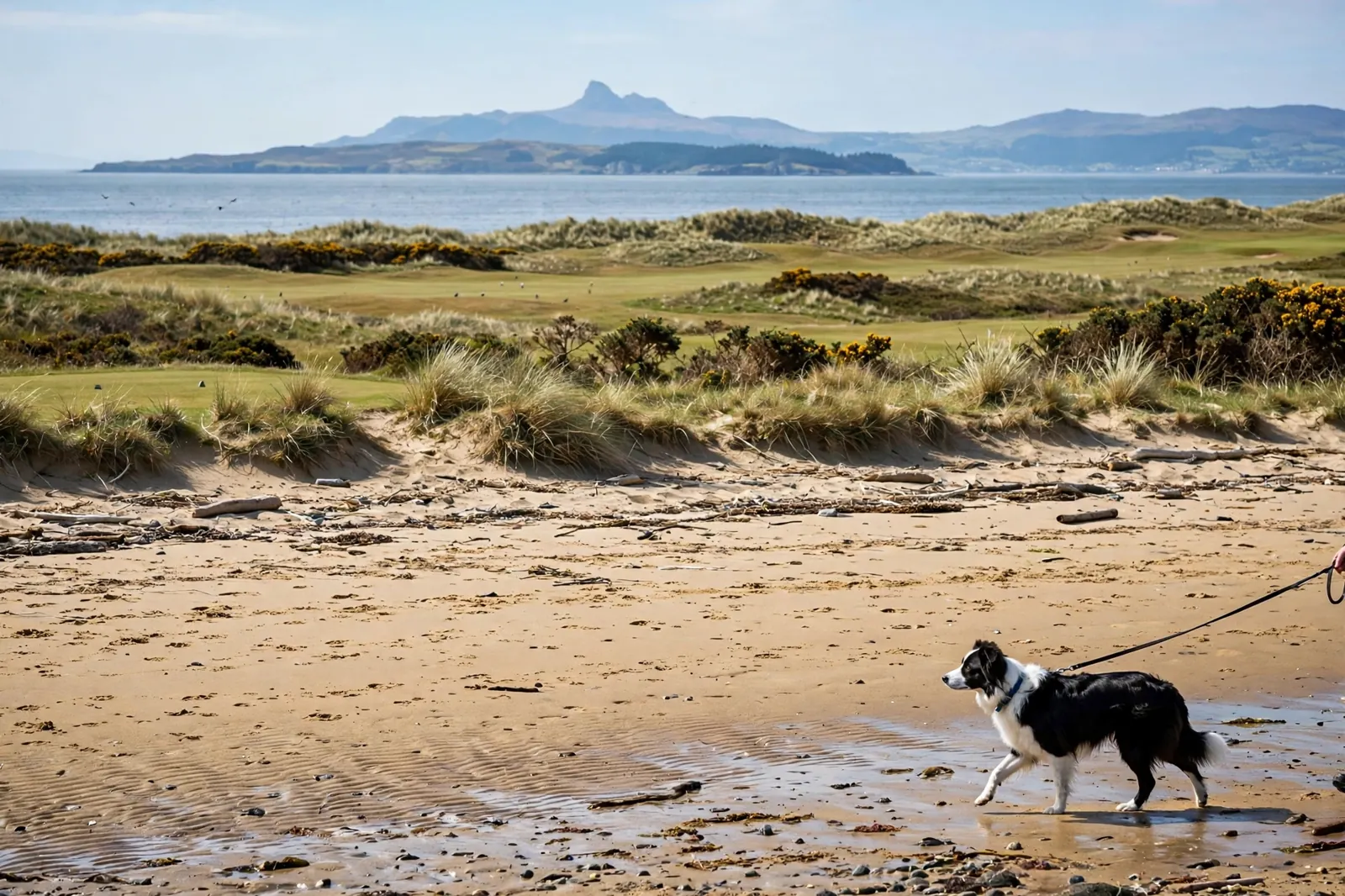
Troon is the obvious first beach trip. Troon South Beach is a wide, flat stretch of golden sand running south from the harbour, with a broad esplanade behind it and views across the Firth of Clyde to the Isle of Arran, Lady Isle and Ailsa Craig. South Ayrshire Council states it has no dog restrictions on its beaches, and dogs are allowed on Troon South Beach all year round, though the council asks owners to keep dogs on a lead when other people, especially children, are around. Some older guides still describe a summer ban, so check the signs on arrival and check the official guidance before you travel. The beach is long enough for a proper run, the sand is firm enough for a good walk at low tide, and there are dog waste bins along the seafront. Our full guide to Troon with a dog covers the beach, the harbour and pier walks, the golf-course paths and the parking in detail.
Irvine Beach is the quieter alternative. Irvine Beach Park has a large sandy beach with dunes behind it, plenty of space, and a reputation among dog owners as a place where dogs can run and swim without the crowds of a town beach. Dogs are allowed all year, and the beach is popular for off-lead walking. The car park is large, the dunes give shelter from the wind, and the walk north along the sand towards the harbour is a satisfying out-and-back. Keep your dog under close control near wildlife in the dunes, and watch the tide: the beach is wide at low tide and much narrower at high tide, and a dog that runs far out on the sand needs a clear route back.
Ayr, further south, adds a town to the beach day. Ayr beach is a long sandy bay with a promenade, and the town has cafes and shops for a proper lunch stop. The Heads of Ayr, south of the town, offer cliff-top walks with big views, though the paths are exposed and not suitable for every dog. Culzean Castle, south of Ayr, is one of Scotland's great coastal castles, and its country park grounds are a wonderful dog walk even though dogs are not allowed inside the castle itself. The Ayrshire coast guide linked above covers Culzean, the Heads of Ayr and the beach rules for the whole coast, and it is the right companion to this guide if you plan more than one coastal day.
A few coastal habits make the beach day work. Check the tide times before you go, because a beach at high tide is a different place from the same beach at low tide, and a dog that loves the water needs room to run. Bring fresh water for the dog, because seawater makes dogs sick and a dog that drinks from the sea will be unwell later. Rinse the dog off after a beach walk if you can, and dry the ears of dogs prone to ear infections. And remember that the Scottish Outdoor Access Code applies on the coast as elsewhere: keep dogs under control, on a short lead near other people and in the bird nesting season, and clean up after them. The beaches near Kilmarnock are generous, and they stay generous because dog owners look after them.
If the weather turns, the coast still works. A grey day on Troon beach with the wind coming off the Clyde is bracing rather than miserable, and a dog that runs on wet sand comes home happy. The car is your shelter and your drying room, so keep a towel and a change of clothes in the boot. And if the rain is truly horizontal, skip the beach and spend the day in Dean Castle Country Park instead: the woodland gives shelter that an open beach cannot, and the cafe gives you somewhere warm to wait it out.
Getting there and getting around
Kilmarnock is well connected for a town of its size, and that is part of its appeal as a dog base. Kilmarnock railway station sits close to the town centre, with services towards Glasgow Central, Ayr, and the coast via Troon. Trains are a practical way to arrive with a dog: dogs travel free on most British trains when they are on a lead or in a carrier, though the exact rules depend on the train operator, so check the official guidance before you travel. The station is about half a mile from Kay Park and a manageable walk from the town centre, though the walk to Dean Castle Country Park is longer and uphill in places.
By car, Kilmarnock is on the A77, the main road south from Glasgow to Ayr, and the M77 motorway brings Glasgow within about a 30 to 40 minute drive. That makes Kilmarnock an easy stop on a longer Scottish trip, and a practical base for anyone driving up from England. The town has several car parks, and parking at Dean Castle Country Park and Kay Park is free, which keeps the cost of a dog day out low. If you are driving, keep a towel, a spare lead, water and a bowl in the car as a matter of routine: Ayrshire weather changes quickly, and a wet dog in a car without a towel is a smell that stays with you.
Bus services link Kilmarnock with Ayr, Troon, Irvine and Glasgow, and dogs are generally allowed on local buses at the driver's discretion. That is a useful fallback, but it is not a plan to rely on for a tight schedule: a bus driver can refuse a dog, and a busy bus with a large dog is hard work for everyone. If you need public transport for a specific journey, check the operator's dog policy in advance and allow extra time. For most visitors, the combination of train to Kilmarnock and car for the coast is the simplest arrangement.
Getting around Kilmarnock itself is easy on foot. The town centre is compact, Kay Park and Howard Park are both within walking distance of the centre, and Dean Castle Country Park is a longer but walkable route for a fit dog and a fit owner. Cycling is another option: there are cycle paths in and around the town, and a dog that runs beside a bike needs training and a safe attachment, not improvisation on a busy road. Whatever mode you choose, plan the first walk of the day before you plan anything else. A dog that has had a good morning walk is a dog that settles in a cafe, sleeps in a car, and tolerates a museum queue without complaint.
Vets and pet supplies are worth locating on arrival, not when you need them. Kilmarnock has veterinary practices in the town, and there are pet supply shops in and around the centre. Save the number of the nearest vet and an out-of-hours emergency vet before your first walk, and note the opening hours of the nearest pet shop in case you run out of food, poo bags or a lead. If your dog is on medication, bring more than you need and keep it in its original packaging with the prescription. A holiday is the wrong time to discover that a pharmacy cannot help with a veterinary prescription.
Seasons, weather and ground conditions
Ayrshire weather is changeable in every season, and Kilmarnock is no exception. The town sits inland from the Firth of Clyde, so it gets the rain and the wind of the west coast without the full force of the sea. A bright morning can turn to rain by lunchtime, and a grey morning can clear to a fine afternoon. The practical response is to dress for rain whatever the forecast says, to keep a waterproof coat and a towel in the car, and to plan walks that have a sheltered option. Dean Castle Country Park's woodland is that sheltered option in summer and in winter alike.
Spring is one of the best times to visit Kilmarnock with a dog. The woodland in Dean Castle Country Park comes alive, the paths dry out, and the park is busy with birdsong. Spring is also the season to be most careful about wildlife: ground-nesting birds, young deer and farm animals with young are all vulnerable, and a dog off lead in the wrong place can do real damage. Keep dogs on a lead in woodland edge and open grassland from March to July, and follow any signs about nesting birds or lambing. The Scottish Outdoor Access Code asks for exactly this, and it is a reasonable ask.
Summer brings the longest days and the warmest weather, but also the most visitors. Dean Castle Country Park and Kay Park are at their busiest on summer weekends, and the coast at Troon and Irvine draws crowds on fine days. Heat is a real consideration for dogs in summer: the woodland paths at Dean Castle are shaded and cooler than open grass, and the riverside path has water nearby, but a car parked in the sun is dangerous for a dog in minutes. Never leave a dog in a parked car on a warm day, even with a window open. Walk early or late, carry water, and watch for signs of overheating, especially in flat-faced breeds, older dogs and overweight dogs.
Autumn is the quiet season, and for many dog owners it is the best. The woodland colours in Dean Castle Country Park are at their finest, the paths are quieter, and the beaches are emptier. The trade-off is mud and shorter days. After rain, the unsurfaced woodland paths and the riverside routes turn soft, and a dog that loves mud will come home filthy. A drying coat, a towel and a washable car seat cover are autumn essentials. Fireworks around early November unsettle noise-sensitive dogs, so check whether events are planned in the parks or nearby, and walk a nervous dog earlier in the evening during fireworks season.
Winter in Kilmarnock is cold, wet and dark early, but it is still a good dog-walking season if you are prepared. The parks are open year round, the paths are quiet, and a crisp, frosty morning in Dean Castle Country Park is a fine walk. The risks are ice on the paths, short daylight, and cold water. Keep to surfaced paths when it is icy, bring a torch for afternoon walks, and do not let a dog swim in cold water: cold-water shock affects dogs as well as people, and a dog that jumps into Kilmarnock Water in January needs to get out quickly. A coat for short-haired or older dogs is sensible in winter, and a warm, dry bed at the end of the day is the reward for a cold walk.
Practical checklist before you go
A Kilmarnock trip does not need much specialist kit, but the right basics make the difference between a smooth day and a scramble. Start with the lead: bring a short lead for town and park entrances, and a long line for the open paths and the beach. Bring more poo bags than you think you need, and a small bag to carry them in until you find a bin. The parks have bins, but the woodland paths do not have one every hundred metres, and carrying a used bag for ten minutes is part of responsible dog ownership.
Water is the next essential. Bring a bottle and a collapsible bowl, and offer water regularly, especially in summer and after a beach walk. The rivers and ponds in Kilmarnock are not a substitute for clean drinking water: river water can carry bacteria after rain, and pond water can be stagnant. A dog that drinks from a pond and is sick later is a dog whose holiday is spoiled, so carry fresh water and use it.
Think about the car as well as the walk. A waterproof seat cover or a crate, a towel, a spare lead and a first-aid kit are the basics. The first-aid kit should include tick removers, because ticks live in woodland and long grass in Ayrshire, especially from spring to autumn. Check your dog for ticks after woodland walks, remove any you find promptly, and ask your vet about tick prevention before the trip if your dog is not already covered. Adders are present in parts of Scotland, though they are uncommon in town parks; the risk is low in Kilmarnock, but a dog that sniffs in long grass and undergrowth in summer is worth watching, and any suspected bite needs a vet immediately.
Dog fouling is a legal and social issue in Scotland, and Kilmarnock is no exception. Pick up after your dog everywhere, including woodland paths and beaches, and use the bins provided. Fixed penalties apply for fouling, and the real penalty is the loss of goodwill that keeps parks and beaches open to dogs. The same applies to barking: a dog that barks persistently in a park, a cafe or a hotel is a dog that makes the next dog owner's visit harder. If your dog barks, move away, give it space, and do not try to train through a problem in the middle of someone else's holiday.
Finally, check the official guidance before you travel for anything that can change: castle and cafe opening hours, beach signs, bus and train dog policies, and accommodation pet rules. Kilmarnock's parks are free and open, and that will not change, but the details around them will. A five-minute check before you leave home is cheaper than a wasted journey, and it is the habit that separates a good dog trip from a frustrating one.
Practical questions
Before you go
Is Dean Castle Country Park dog-friendly?
Yes, dogs are welcome in the outdoor areas of Dean Castle Country Park, and it is one of the most popular dog-walking spots in Kilmarnock. Keep your dog on a lead, especially near the fallow deer, the Rural Life Centre farm animals and other wildlife, and clean up after them. Dogs are not generally allowed inside the castle itself, so plan a split visit if one person wants to go indoors.
Where is the best place to walk a dog in Kilmarnock?
Dean Castle Country Park is the best all-round choice, with more than 200 acres of woodland trails, open parkland and a waterside path along Kilmarnock Water. For a shorter town walk, the 30-acre Kay Park beside the Burns Monument Centre is popular with local dog walkers, and Howard Park suits a quick leg-stretch near the town centre.
Can dogs go on the beach near Kilmarnock?
Yes. The nearest wide sandy beaches are at Troon and Irvine, roughly a 20 to 30 minute drive from Kilmarnock, and South Ayrshire Council states it has no dog restrictions on its beaches. Keep your dog on a lead when other people, especially children, are around, check the signs on arrival, and check the official guidance before you travel, as rules and seasonal advice can change.
Is Kilmarnock a good base for a dog-friendly holiday in Ayrshire?
Yes, particularly if you want a quiet, affordable base rather than a resort town. Kilmarnock has two large parks, a railway station with services towards Glasgow, Ayr and the coast, and easy road access to Troon, Irvine, Ayr and Culzean. Book dog-friendly accommodation well ahead, confirm the pet policy in writing, and check the official guidance before you travel.
Are dogs allowed in the Dick Institute or Burns House in Kilmarnock?
Dogs are not generally allowed inside museums and historic house interiors in Kilmarnock, with the usual exception for assistance dogs. The Dick Institute and Burns House are worth visiting as a split visit: one person goes inside while the other walks the dog in Kay Park or around the town centre. Check the official guidance before you travel, as policies can change.
What should I pack for a dog day out in Kilmarnock?
Pack a lead and a long line, poo bags, water and a bowl, a towel or drying coat for wet woodland paths, and a blanket for cafe stops. Kilmarnock Water and the park ponds attract dogs, so a towel is rarely wasted. In wet weather add a waterproof coat for yourself and check the forecast, because Ayrshire rain can arrive quickly even on a bright morning.