This guide is independent and contains no paid placement. If affiliate links are added later, they will be clearly marked and will not change our editorial checks.
Kinder Scout is the Peak District's highest point at 636 metres, and the classic Edale circuit is about 9 to 10 miles over five to seven hours. Start at Edale, climb by Grindsbrook Clough or Jacob's Ladder, cross the boggy plateau with a map and compass, and come down the same way. Treat it as a mountain day, not a hill walk, and turn back in fog or high wind.
The plateau in numbers
Kinder Scout is the highest point in the Peak District, at 636 metres, but the number misleads: Kinder is not a peak but a broad, flat-topped plateau, roughly four kilometres across, edged with gritstone crags and cut by deep cloughs. The summit itself is a trig point on a wide, peaty top that looks like nowhere in particular, and walkers who expect a dramatic summit are often surprised by how ordinary it feels. The drama is in the edges: the Downfall, the gritstone tors, and the views from the rim across the Edale valley and the Dark Peak.
The classic circuit from Edale is about 9 to 10 miles with roughly 500 metres of ascent, and it takes five to seven hours with a dog, depending on the route and the state of the ground. That is a long time for the mileage, and the reason is the plateau: the walking is slow, the ground is soft, and the navigation takes concentration. A fit walker can do the circuit in four hours in good conditions, but a dog walker should plan for six, because the dog needs water stops, the bog needs care, and the plateau deserves time rather than a forced march.
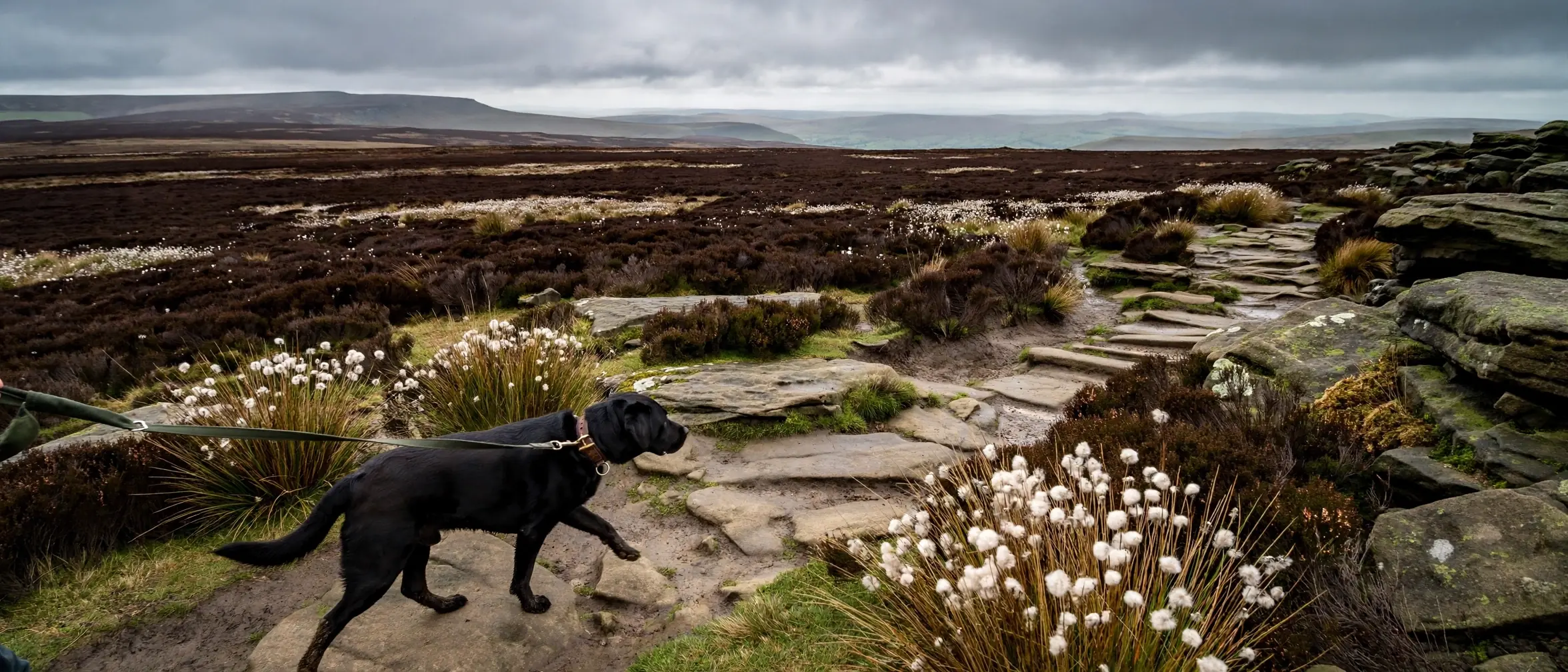
The ground is the walk's defining feature. The plateau is peat, gritstone and cotton grass, and after rain it is wet underfoot for days. The edges are gritstone, with tors and boulders that dogs love to scramble over, and the cloughs that cut the plateau are steep, rocky and often wet. The path is waymarked in places, but on the plateau it fades into the peat, and the route is as much a matter of reading the ground as of following a line on a map. A dog that is happy on rough, wet ground will love Kinder; a dog that hates wet paws will not.
Three ways up: Edale, Hayfield, Snake
Edale is the classic start, and it offers two very different climbs. Grindsbrook Clough is the direct route: a steep, rocky scramble up a boulder-strewn stream bed that dogs love and owners find hard work. The boulders are large, the path is uneven, and small dogs may need a lift over the biggest rocks, but the clough is sheltered and interesting, and it brings the walker onto the plateau near the summit. Jacob's Ladder is the gentler alternative: a broad, stone-paved path that climbs steadily to the plateau's southern edge, with views back down the Edale valley. It is longer but easier, and it suits older dogs and dogs that struggle with scrambling.
Hayfield, on the western side, offers a quieter approach. The route from Hayfield climbs through the Sett Valley and up onto the plateau by William Clough, and it is less crowded than the Edale routes, which makes it a good choice for a reactive dog. The climb is long and steady rather than steep, and the plateau is reached near Kinder Downfall, which is a fine first sight. Hayfield has a car park and a village with pubs and cafes, but no railway station, so the journey there needs a car or a bus.
The Snake Pass approach, from the north, is the least used and the wildest. It climbs from the Snake Pass road onto the plateau's northern edge, and it is a long, lonely walk across open moor before the plateau is reached. It suits experienced walkers who want solitude, but it is not the best first Kinder walk, because the navigation is harder and the bail-out options are fewer. For a first visit with a dog, Edale is the right choice: the railway, the village, and the choice of two climbs make it the most flexible start.
The summit plateau and Kinder Downfall
The plateau itself is the walk, not the summit. Once the climb is done, the walker is on a wide, peaty top with gritstone edges, cotton grass, and a sense of space that is rare in England. The summit trig point is a modest affair, and the real landmarks are the Downfall, the gritstone tors, and the edges. Kinder Downfall is the highest waterfall in the Peak District, and in a strong wind the water blows back up the cliff, which is a sight worth the walk on its own. The Downfall is at its best after rain, when the stream is full, and it is a good place to stop, give the dog water, and take stock of the day.
The plateau's edges need care. The gritstone rim is close to the path in places, and the drops are real, though not sheer. Keep the dog on a lead near the edges, and keep it away from the rim where the wind is strong. The tors are tempting for a dog that likes to climb, but the gritstone is rough and can cut pads, and a dog that scrambles onto a tor may not be able to get down the same way. Let the dog explore the flat ground and keep it off the high rocks unless the descent is obvious.
The plateau is also where the walk's wildlife lives. Red grouse burst from the heather with a noise that startles dogs, and mountain hares run across the open ground in winter. Ground-nesting birds use the moor in spring, and the access rules ask walkers to keep dogs under close control or on a lead in these areas. A dog that chases a grouse across the plateau can be a long way from its owner before it stops, and a dog that flushes a nest can undo a season's breeding, so the lead is the right choice in spring even on the open top.
Bog, gritstone and the plateau underfoot
The plateau's peat is the surface that defines a Kinder day, and it punishes walkers who ignore it. The ground looks firm until it gives way, and a dog that steps into a bog hole can panic and thrash, which only drives it deeper. Read the ground as you go: bright green moss marks the wettest hollows, cotton grass marks ground that is soft but usually passable, and dark bare peat marks the places to walk around. Keep the dog close through the worst of it and let it run free again on the firm ground beyond.
Gritstone is the second surface to respect. It grips well when dry, but it turns slick in the wet, and the boulders scattered across the plateau can graze pads that are already soft from a damp day. Give the feet a proper look at the trig point and again at the bottom of the descent, parting the toes to check for grit and small stones and feeling the pads for warmth and soreness. Boots in the rucksack are cheap insurance, and a little balm rubbed in at night helps the pads recover. A limp is a late warning: by the time a dog is limping up here, the car is a long way away.
The cloughs that cut the plateau are the third kind of ground. Grindsbrook Clough is a boulder scramble, and the rocks are large, uneven and slippery after rain. A small dog may need a hand over the biggest boulders, and an older dog may find the scrambling tiring. Take it slowly, let the dog choose its own line, and do not hurry the way down, which asks more of a dog's legs than the way up. An animal that moves stiffly on the descent has worked hard on the climb, and a shorter route next time would suit it better.
Drinking water on a wet plateau
Kinder is a paradox: the plateau is wet, but drinking water is scarce. The burns that run off the top are generally clean, yet livestock graze the lower slopes, so the water should be treated or filtered where that is possible. The plateau itself has no taps, and in a dry spell the streams can be hard to reach, so carry enough for the dog for the whole day. A litre for the dog on a cool day is a minimum, and more in warm weather, on top of what the walker needs.
A folding bowl weighs nothing and makes it easy for the dog to drink on the move. An animal that has to wait for a puddle will drink from any standing water, and the standing water on the plateau can be stagnant and full of peat, which is not something to rely on. Fill up at every burn on the way up, and carry a filter or purification tablets for the walker as well as the dog, because a dehydrated walker makes worse decisions, and worse decisions on Kinder are the ones that lead to trouble.
After the walk, rinse the coat and paws with fresh water, because peat stains and irritates the skin, and check between the toes for grit. A dog that has crossed the plateau will be wet, muddy and tired, and the journey home should start with a dry dog, not a wet one. Keep a towel and a drying coat in the car, and let the dog cool down before setting off. An animal that has drunk well on the walk will recover faster, and one that has not drunk enough will be stiff the next morning.
The plateau in wind, mist and snow
Weather on Kinder changes fast, and it is the walk's biggest variable. A sunny morning in Edale can become driving rain on the top by lunch, and the gusts up there are strong enough to knock a small dog off its stride. There is no shelter on the plateau, so the waterproofs need to be the real thing, and the dog needs a coat if it is the sort that chills quickly when wet. On a wild day, keep the dog close, stay well back from the rim, and be ready to turn back if the exposure feels wrong.
Mist is the plateau's most dangerous weather, because it takes away the landmarks that navigation depends on. In thick fog the path can be hard to see, and a dog that runs ahead can vanish. Keep the dog on a lead when visibility drops, carry a map and compass, and go back the way you came if the route becomes uncertain. Snow is the other seasonal hazard: Kinder holds snow late into spring, and in winter the plateau is a serious mountain environment, with ice on the edges and deep snow in the cloughs. A winter Kinder walk needs crampons, an ice axe and experience, and it is not a walk for a dog that has never been on snow.
Hot days are the danger nobody expects on a moor. The plateau offers no shade and no water, and a dog in a dark coat can overheat surprisingly quickly. Start before the sun is high, take more water than the morning seems to need, and keep an eye on the dog's breathing: if it stays laboured long after a pause, if the dog keeps stopping, or if the gums feel tacky, that is the moment to act. Get the dog into whatever shade there is, pour water over the belly and the paws, and wait until the breathing is easy again. Miles do not matter when a dog is overheating, and the nearest vet is a long way from the top.
The Mass Trespass and the path's history
Kinder Scout is not just a hill; it is the place where the right to roam in England began. In 1932, hundreds of walkers took part in the Mass Trespass, walking onto the plateau in defiance of the landowners who kept it closed, and the protest became a landmark in the campaign for access to the countryside. The trespassers were arrested, imprisoned, and then celebrated, and their action is remembered every year on the anniversary. Walking Kinder with a dog today is possible because of that protest, and the access that walkers enjoy is a right that was fought for, not given.
The history matters for the dog walker, because it is a reminder that access comes with responsibility. The plateau is open moorland, and the right to walk it depends on walkers behaving well: keeping dogs under control, respecting the grouse moors, and leaving no trace. The grouse moors that cover much of Kinder are working land, and the keepers who manage them are the people who maintain the paths and the access. A dog that chases grouse or disturbs a nest is not just a nuisance but a threat to the relationship that keeps the plateau open.
The Pennine Way, Britain's first National Trail, crosses the plateau, and its waymarks are a useful guide across the top. The trail was opened in 1965, and it runs from Edale to Kirk Yetholm in Scotland, which makes Kinder the starting point of a 268-mile journey. A dog walker who stands on the plateau is standing at the start of that journey, and the thought gives the day a sense of occasion that a lesser hill cannot match. For a mountain walk in Wales that offers a similar sense of a serious day out, our Cader Idris guide compares three paths to a very different summit, and the contrast is a useful reminder of how distinctive Kinder's plateau really is.
When Kinder is the wrong walk
Kinder is a serious day out, and it is not for every dog. A puppy whose joints are still forming should not be doing the full circuit, and a senior dog may be happier on the lower slopes without climbing to the plateau. Flat-faced breeds struggle in warmth and on long climbs, and heavy dogs pay for every mile on soft, uneven ground. A dog that has never spent a full day on rough moorland should build up with shorter hill walks first, so it learns the rhythm of climbing and coming down before it meets Kinder.
A reactive dog needs a plan, because the plateau is popular and the paths are narrow in the cloughs. Walk early, choose a weekday, and take the Jacob's Ladder route, which is broader than Grindsbrook Clough and gives more room to pass other dogs. Keep the dog on a lead in the cloughs and near the edges, and use the wide plateau to give other dogs space. An animal that lunges at others on a narrow, rocky path is a danger to itself and to its owner, so the lead is not optional in the cloughs.
The honest test is the morning after. A dog that is stiff for the first mile the day after Kinder has worked hard, and a shorter route next time would suit it better. A dog that is lame, or that turns away from food, or that lies down on flat ground, is an animal that needs rest, not another hill. Kinder will still be there next year, and a dog that finishes the day happy is a better advertisement for the walk than one that finishes lame. If anything about the dog is worrying, a vet in Edale or Glossop can advise quickly, and asking on the day is always better than wishing you had the next morning.
Edale, Hayfield and the journey home
Edale is the easiest start, because it has a station on the Hope Valley line, with trains from Sheffield and Manchester. Dogs ride free on most trains, though a large animal may need to travel on the floor, and a muzzle is worth carrying for a busy carriage. The station is a short walk from the village, which has a pub, a cafe, a car park, and a choice of dog-friendly places to stay. If you are staying in the area, our Castleton guide covers the village a few miles down the valley, with its caverns, pubs and walks, and it makes a sound base for a Kinder day.
Parking in Edale is limited, and the car park is full early on a fine weekend. Set out before the rush, because the plateau is at its finest in the first hours of daylight, when the sun is low and the crowds are still down in the village, and a morning start means the dog walks while the air is still cool, which matters in summer. A dog that reaches the top at eight has a far better day than one that arrives at midday in a crowd.
Hayfield is the alternative start, with a car park and a village but no station, so the journey there needs a car or a bus. The Snake Pass approach needs a car as well, and the road is sometimes closed in winter, so check the official guidance before you travel. Whichever start you choose, the return is the same: down by the route that was climbed, or by the other Edale route, and back to the village for water, food and rest. Take the finish slowly; a Kinder day deserves a proper wind-down, not a dash to the car.
Practical questions
Before you go
How long is the Kinder Scout walk with a dog?
The classic Edale circuit over Kinder Scout is about 9 to 10 miles and takes five to seven hours with a dog, depending on the route and the ground. The plateau is slow walking, so allow more time than the mileage suggests, and do not plan a Kinder day as a quick morning walk.
Is Kinder Scout safe for dogs in fog?
Mist is the main hazard up there: the ground is featureless, the paths fade into peat, and the edges are close. Keep the dog close in fog, carry a map and compass, and know how to use them. If the mist comes down and the route is uncertain, go back the way you came rather than pushing on.
Can dogs drink from the streams on Kinder Scout?
The burns are generally clean, but livestock graze the lower slopes, so treat or filter the water for walker and dog where that is possible. Carry enough for the dog for the whole day, because the plateau has no taps and the streams can be hard to reach in a dry spell.
Do dogs need to be on a lead on Kinder Scout?
On the open plateau, a dog with reliable recall can walk off lead, but the edges, the bog and the ground-nesting birds in spring all call for a lead. Keep the dog on a lead near the edges, in fog, and anywhere sheep or grouse are close to the path.
What is the best starting point for Kinder Scout with a dog?
Edale is the best start for most walkers: it has a railway station, a car park, a pub and a direct route up Grindsbrook Clough or Jacob's Ladder to the plateau. Hayfield is a good alternative for the western side, and the Snake Pass approach suits walkers who want a quieter start.