This guide is independent and contains no paid placement. If affiliate links are added later, they will be clearly marked and will not change our editorial checks.
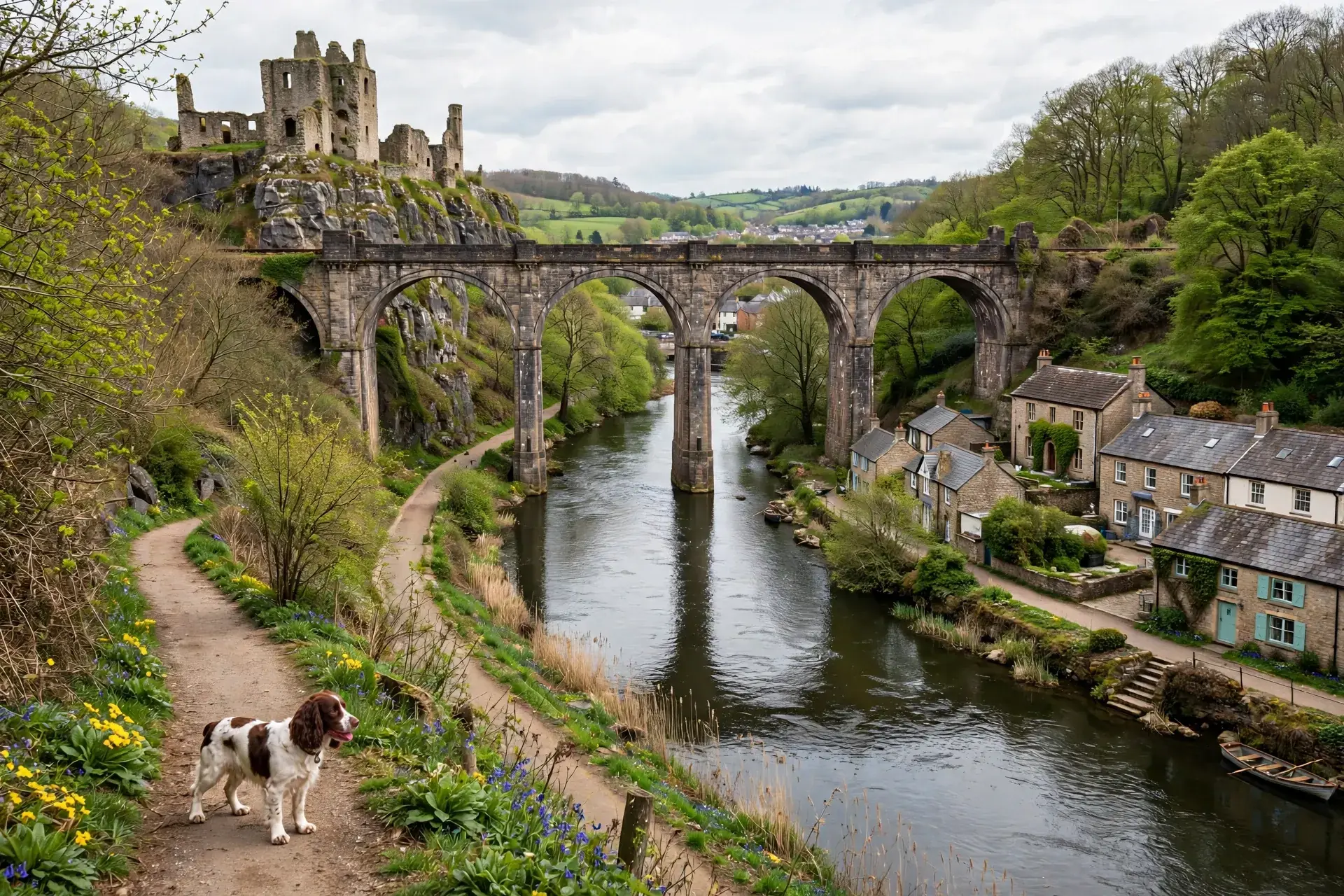
Start at the viaduct viewpoint above the River Nidd: the castle ruins on one side, the river and its boathouses below, and the great stone arches of the railway viaduct in the middle. From there, a short riverside walk leads to Nidd Gorge, Mother Shipton's Cave and the town's dog-friendly pubs — a full day out that works best on a lead, at a gentle pace, with a towel for muddy paws.
The viaduct viewpoint and castle grounds
Stand on the high ground near Knaresborough Castle and the whole town suddenly makes sense. Below you, the River Nidd bends sharply around a wooded bluff. Above the water, the four great arches of the railway viaduct carry the line across the valley, and beyond them the rooftops of the town climb the hill. It is one of the most photographed views in North Yorkshire, and it is also the best place to plan a dog-friendly day, because from this single viewpoint you can see almost everything you will walk to: the castle grounds behind you, the riverside paths below, and the gorge stretching away downstream.
The castle grounds themselves are the natural starting point. Knaresborough Castle is a ruin, with the remains of its keep and curtain walls standing in a grassy public space above the river. Dogs on leads are generally welcome in the grounds, which are managed as an open space, and the lawns give a dog room to sniff and settle before the narrower riverside paths begin. The ground is mostly level near the top, with short grass that stays usable in most weather, though the slopes down toward the river are steep and should be taken slowly with an older or unsteady dog. Keep the dog on a lead throughout the grounds: the site is popular with families, the bowling green is in regular use, and the edges above the river are unfenced in places.
The castle itself and the small museum in the grounds are indoor attractions, and dogs are not usually admitted inside. That is worth planning around rather than discovering at the door. If you want to look inside the keep or the museum, one person can take the dog for a turn around the grounds while the other goes in, then swap. The grounds are compact enough that a split visit works well: a full circuit of the lawns, the walls and the viewpoint takes perhaps twenty minutes at a dog's pace, and there are benches where a waiting person and dog can sit with a view of the river.
From the castle, walk to the viewpoint that looks straight down the viaduct. The best-known vantage point is on the high path above the river, where the arches frame the water and the cottages on the far bank. Trains still cross the viaduct, so a noise-sensitive dog may startle at the sound and vibration; keep a short lead and a little distance from the edge if your dog is nervous of trains. On a quiet weekday morning, though, the viewpoint is calm, and it is a good spot for a photograph with the dog sitting on the path rather than on the wall or the railing.
Allow time to enjoy the grounds rather than rushing through them. A dog that has had a proper sniff around the castle lawns, a drink of water and a few minutes to watch the river will settle far better on the narrower gorge paths that follow. If you arrive by train, the castle is a short uphill walk from the station, and the climb is a useful warm-up; if you arrive by car, the grounds are a short walk from the town-centre car parks. Either way, start high, look at the map of the day in front of you, and then drop down to the river.
The Nidd Gorge riverside walk
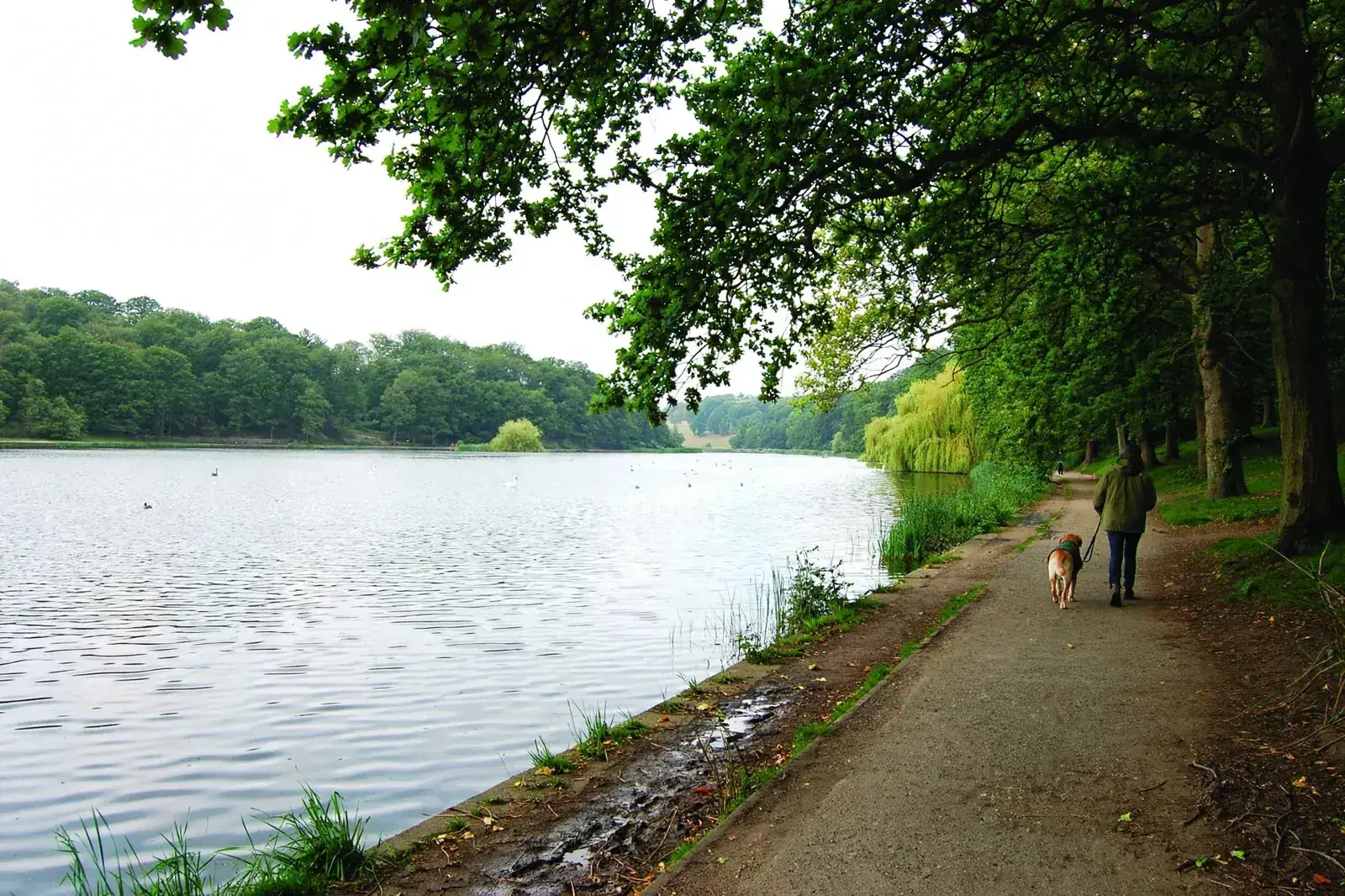
The Nidd Gorge walk is the heart of a dog-friendly day in Knaresborough. The path follows the River Nidd through a steep-sided, wooded gorge just outside the town, with the water on one side and the trees closing in overhead. It is a walk of contrasts: wide, easy riverside stretches where a dog can paddle at the edge, and narrower, root-crossed sections where a lead and good footwear matter. The full gorge route is a there-and-back walk rather than a loop, so you can turn around at any point and still have had a proper walk.
Start from the riverside near the town, where the path is surfaced and the river is wide and slow. This first stretch suits every dog: flat ground, room to pass other walkers, and easy access to the water for a paddle. As you move away from the town, the gorge narrows and the path becomes rougher, with exposed roots, stone steps and muddy patches after rain. The trees give welcome shade on a hot day, and the river keeps the air cool even in summer, but the shade also means the path stays damp long after rain, so expect muddy paws and carry a towel.
Keep your dog on a lead through the gorge. There are unfenced drops above the river in places, and the path is shared with runners, cyclists and families, so a dog darting across the track can cause a collision. The river itself deserves respect: the Nidd looks gentle in places and runs fast over rocks in others, and after heavy rain the water level can rise quickly. A dog that loves to swim should be kept to the slow, shallow edges near the town and kept out of fast water and weirs altogether. If your dog is a strong swimmer, a long line gives them freedom to paddle without the risk of being carried downstream.
The wildlife of the gorge is part of its appeal, and part of its discipline. Kingfishers, herons and dippers work the river, and the woodland holds squirrels and the occasional deer. A dog with a strong chase instinct needs a short lead here, especially in spring when birds are nesting and in autumn when the leaf litter hides small animals. Stick to the marked paths, keep the dog out of the undergrowth, and remember that the gorge is a protected natural space: what you take in, including poo bags, you take out again.
For a shorter outing, walk the riverside from the town to the first wooded stretch and back, which takes about an hour at a relaxed pace with sniffing stops. For a longer walk, continue deeper into the gorge toward the far end, where the path eventually climbs away from the river. Older dogs and puppies do best on the shorter version: the steps and slopes of the full route are demanding on stiff joints, and there is no shortcut back once you are halfway in. Whatever distance you choose, carry water for the dog, because although the river is there, it is not always safe or practical for a dog to drink from, and a collapsible bowl weighs almost nothing.
After the walk, the riverside near the town is the place to let the dog cool off and dry out. There are grassy banks where a dog can lie down, and the flat paths back toward the viaduct are easy on tired legs. A quick towel-down before the car or the train saves the seats and the dog's bedding, and a handful of treats on the bank is a fair reward for a gorge well walked.
Mother Shipton's Cave and the riverside attractions
Mother Shipton's Cave is Knaresborough's most famous attraction, and it sits right on the riverside walk, so it is easy to fold into a dog-friendly day with a little planning. The site is a wooded park beside the River Nidd, with the cave itself, the Petrifying Well, a museum and gardens. Dogs on leads are welcome in the outdoor grounds, including the riverside paths and the area around the Petrifying Well, but they are not admitted inside the cave or the museum building. As with the castle, the practical answer is a split visit: one person explores the cave while the other stays outside with the dog, then swap.
The grounds are worth the visit on their own. The paths wind through mature trees down to the river, and the Petrifying Well is a genuine curiosity: water rich in minerals drips over objects left beneath it and slowly coats them in stone. The riverside here is calmer than the gorge, with flat stretches where a dog can walk comfortably, and there are places to sit and watch the river. The site is a paid attraction, so check the official guidance before you travel for current admission prices, opening times and any seasonal changes to the dog policy.
Beside the cave site, the wider riverside has its own attractions. Rowing boats are a familiar sight on the Nidd in summer, and the boathouses below the castle are part of the town's picture-postcard view. Dogs do not go in the rowing boats, but the riverside paths give a dog a front-row view of the activity without the need to board. The riverside is also home to ducks and swans, so keep a lead on a dog that chases birds, and do not let the dog swim among the boats.
Further along the river, the town's waterside walks connect the cave site back toward the castle and the viaduct, making a pleasant loop for a dog that has already had its main walk. The paths here are wider and flatter than the gorge, which suits older dogs and families with pushchairs, and there are benches at intervals. In summer the riverside can be busy, especially on weekends, so an early start gives a reactive dog a quieter experience; in winter the same paths are often almost empty, and a dog can enjoy the river in peace.
If you are visiting the cave with children as well as a dog, the split-visit plan needs a little more thought. One adult and the dog can explore the riverside paths and the gardens while the other adult takes the children into the cave, then the groups swap. The gardens and the river give the waiting group plenty to do, and the dog will be happier outside in the fresh air than waiting in a car. Never leave a dog in a car while you visit an attraction: even on a mild day, a car heats up quickly, and the riverside car parks are no exception.
The town centre, market and streets
Knaresborough's town centre is small, steep and full of character, and it suits a dog on a lead far better than a big city centre does. The main streets run uphill from the river to the market place, with independent shops, cafes and pubs along the way. The market place itself is the hub: a broad, cobbled space with the market cross and the town's shops around its edges. A regular market is held here, and on market days the square fills with stalls, shoppers and the smell of food, which is exciting for a dog and worth approaching with a plan.
On market days, keep the dog on a short lead and close to your side. The stalls are close together, the ground is uneven cobbles in places, and there are dropped foods, shopping trolleys and children at dog height. A calm dog can enjoy the bustle, but a nervous or reactive dog will be happier on the quieter side streets, or on a market morning when the stalls are still setting up. If your dog is unsettled by crowds, visit the market place early, before the busiest hour, and then head for the riverside, where the space opens up again.
The streets themselves are worth a slow wander. The town has a good range of independent shops, from delicatessens and bakeries to gift shops and bookshops, and many of them are small enough that a dog is best left waiting outside with one person while the other goes in. Some shops do welcome dogs, and a bowl of water by the door is a good sign, but the rule varies from shop to shop, so ask rather than assume. The steepest streets are the ones that drop down to the river: they are picturesque, with stone cottages and glimpses of the viaduct, but they are hard work on the way back up, especially with a dog pulling on the lead. Take the climb slowly, and let an older dog set the pace.
Pavements in the town centre are narrow in places, and traffic uses the same streets, so keep the dog on the inside, away from the road, and shorten the lead at junctions. The town is well signed, and the walk from the market place down to the castle and the river is short, so it is easy to combine a browse of the shops with a proper riverside walk in a single morning. A dog that has had a good walk first will settle better while you browse; a dog that has been waiting in a queue will not.
Toilets, water and shade are the practical details that make a town visit work. Carry a water bottle and a bowl for the dog, because public water points are not always easy to find, and the uphill streets are thirsty work on a warm day. In summer, the shaded side of the market place and the castle grounds give a dog somewhere cool to rest; in winter, the sheltered streets are kinder than the exposed riverside. Poo bins are provided around the town and the riverside, but carry spare bags anyway, and always pick up, especially in the market place and the castle grounds, where families and children play.
Pubs, cafes and food stops
Knaresborough has a good spread of pubs and cafes for a town of its size, and many of them welcome dogs, particularly in bar areas and on outdoor terraces. The riverside pubs are the obvious draw: sitting outside with a dog at your feet, watching the river and the viaduct, is one of the pleasures of a visit. The town-centre pubs are equally useful, especially in bad weather, when a dog-friendly bar with a fire is worth more than any view.
The rules vary from venue to venue, so treat every pub as a fresh question. Some welcome dogs throughout the bar, some allow dogs only in a specific area or on the terrace, and some allow dogs only at quieter times. The safest approach is to ask at the door, or to check the official guidance before you travel, and to have a backup in mind if the first choice is full or has changed its policy. A dog that can settle under a table is welcome almost everywhere; a dog that barks at every passer-by will test even the most dog-friendly landlord.
Make settling easy. Bring a blanket or a mat for the dog to lie on, a chew or a stuffed toy to keep them occupied, and water in your own bowl if the pub does not provide one. Choose a corner table away from the main thoroughfare, keep the lead short enough that the dog cannot wander into the path of staff carrying food, and order promptly so the dog is not waiting hungry while you study the menu. If the dog is wet from the gorge or the river, dry them off before going inside: a wet dog in a warm pub is uncomfortable for everyone, and a towel in your day bag solves the problem in a minute.
Cafes in the town centre are a good option for lunch or a coffee stop, and several have outdoor seating where a dog can sit beside the table. Bakeries and delicatessens are useful for a takeaway picnic, which is often the simplest solution of all: buy sandwiches, cakes and drinks in the town, then eat them on the riverside or in the castle grounds, where the dog has space and nobody minds a few crumbs. A picnic also solves the problem of a dog that will not settle indoors, and it lets you enjoy the view that brought you to Knaresborough in the first place.
For an evening meal, book ahead and confirm the dog policy when you book, not when you arrive. Some restaurants welcome dogs in the bar area but not in the dining room, and some welcome dogs only on certain evenings. If you are staying overnight, ask your accommodation for a recommendation: local hosts and hoteliers usually know which pubs are genuinely relaxed about dogs and which ones tolerate them only on a quiet Tuesday. And if your dog is tired after a long gorge walk, an early supper and an early night is often the kindest plan: a dog that has walked all day will sleep well, and a quiet evening sets up a better second day.
Walks toward Harrogate and the countryside
Knaresborough sits close to Harrogate, and the two towns are linked by road, rail and walking routes, which makes it easy to stretch a day in Knaresborough into a longer break. The walk between the towns is possible for a fit dog and a fit walker, but it is a proper countryside walk rather than a town stroll, with field paths, lanes and stretches beside the road. Check the official guidance before you travel for the current route, and carry a map or a charged phone, because the paths are not always well signed.
For most visitors, the better plan is to take the train between the towns and walk at each end. The railway line links Knaresborough and Harrogate in a few minutes, and dogs are welcome on trains, usually on a lead and under control, though it is worth checking the train operator's rules before you travel. That leaves your energy for the walking that matters: the riverside in Knaresborough, and the parks and woods in Harrogate. Our guide to Harrogate with a dog covers Valley Gardens, the Stray, the Pinewoods and Harlow Carr, and it is a natural companion to this guide if you are staying in the area for more than a day.
Around Knaresborough itself, the countryside opens up quickly once you leave the town. The Nidd valley runs in both directions, with field paths and woodland on either side, and the wider landscape of the Yorkshire Dales is within easy driving distance for a longer day out. Field paths bring their own rules: keep dogs on leads around livestock, especially sheep and cattle, and be ready to shorten the lead when you meet horses or farm machinery. The Countryside Code applies here, and in lambing season, from roughly spring onwards, the need for a lead is at its greatest.
Longer walks need a little more kit than a riverside stroll. Carry water and a bowl, a spare lead, poo bags, a towel and a basic first-aid kit, and wear footwear that can handle mud, because the field paths and gorge paths stay soft after rain. A dog that is used to town pavements may find its first long countryside walk tiring, so build up the distance over the trip rather than attempting the longest route on the first day. A tired dog is a happy dog, but an exhausted dog is a sore dog the next morning.
If you have a second day, consider a trip further afield. York is an easy train ride away and offers a very different day out: a walled city with riverside walks and large parks, where a dog can enjoy the open spaces even if the indoor attractions need a split visit. Our guide to York with a dog covers the Minster split visit, the city walls rules and the riverside routes. Leeds, too, is within reach by train, and its great park at Roundhay and the long canal towpath give a dog a completely different kind of walk; our guide to Leeds with a dog covers both. Knaresborough works as a quiet base for all three, with the advantage of a riverside walk on your doorstep at the end of each day.
Parking, trains and arrival
Knaresborough is a small town, and its car parks are close to everything a dog walker needs, which is part of its charm. The most useful car parks for a dog day are the ones near the town centre and the riverside, from which the castle, the viaduct viewpoint and the riverside paths are all a short walk. On market days and sunny weekends, the popular car parks fill early, so arrive before mid-morning if you can, and have a second car park in mind. Check the official guidance before you travel for current charges, time limits and payment methods, because these change and the signs at the car park are the final word.
Parking with a dog in the car needs a little extra care. Never leave a dog in a parked car on a warm day, even for a few minutes, and in summer, choose a shaded space and leave the windows open only when you are with the dog. On arrival, give the dog a short toilet walk before you set off for the castle or the gorge: the car parks are close to grassy areas, and a dog that has relieved itself before the walk is a happier companion. Keep a towel and a spare lead in the car, because the gorge paths are muddy and a lead can snap or slip at the worst moment.
Arriving by train is straightforward. Knaresborough has its own railway station on the line between Harrogate and York, and the walk from the station into the town centre is short, though uphill. Dogs are welcome on trains in the UK, normally on a lead and under control, and small dogs may travel in a carrier. Check the train operator's rules before you travel, and book tickets in advance where possible, because the line is popular with commuters and day-trippers. The station has limited facilities, so use the toilets and buy water in the town rather than relying on the station.
Buses also serve the town, and the bus station is close to the centre, but dogs on buses are at the driver's discretion in many areas, so check the official guidance before you travel if you plan to rely on a bus. For most visitors, the train or the car is the simpler choice, and once you are in Knaresborough, everything is walkable: the town centre, the castle, the riverside and the gorge are all within a short distance of each other, and a dog that has walked from the station will already have had a good start to the day.
If you are arriving for a longer stay, think about the arrival hour. A mid-afternoon arrival gives you time for a short riverside walk and a pub supper; a late-evening arrival in winter means a dark walk from the car park, so bring a torch and a reflective lead. The town is well lit in the centre, but the riverside paths are dark after sunset, and a dog on a long lead in the dark is a hazard to cyclists and other walkers. Plan your first walk in daylight, and save the gorge for the following morning.
Where to stay
Knaresborough has a range of dog-friendly places to stay, from hotels and bed and breakfasts in the town to cottages and holiday lets in the surrounding villages. The town centre options are the most convenient for a dog: a short walk to the riverside in the morning and to a pub in the evening, with no driving at all. Cottages on the edge of town or in the villages offer more space and often a garden, which suits a dog that needs room to stretch, but they usually need a car for the town and the gorge.
When you book, confirm the dog details in writing rather than relying on a filter. Ask how many dogs are allowed, whether there is a charge per dog per night or per stay, which rooms or units accept dogs, and whether the dog can be left alone in the room. Many hotels allow dogs only in specific rooms, often on the ground floor, and many ask that dogs are not left unattended, so plan your evenings around that rule. A ground-floor room near an exit is worth requesting for night-time toilet trips, and a room with hard flooring is easier to keep clean after a muddy walk than one with thick carpet.
Self-catering cottages are often the best fit for a dog that needs routine. A cottage with an enclosed garden gives a dog a safe place to toilet last thing at night and first thing in the morning, and a kitchen lets you keep the dog's feeding routine exactly as it is at home. Ask about the garden boundary before you book: a low wall or a gap under a gate is no use for a terrier, and a garden shared with other guests is not the same as a private one. Also ask about the cleaning charge and whether the dog is allowed on the furniture, because the answers affect both the price and the way you pack.
Book early for the busiest times. School holidays, bank holiday weekends and the summer months fill the dog-friendly rooms first, and the best cottages with enclosed gardens can be booked months ahead. If your dates are flexible, the shoulder seasons of late spring and early autumn are often the best value, with quieter paths, softer light for photographs and the same riverside walks without the crowds. Winter stays can be good value too, but check the heating, the drying facilities and whether the riverside attractions are open, because some sites reduce their hours outside the main season.
Pack for the accommodation as well as the walk. Bring the dog's own bed or blanket, so the room smells familiar, a spare towel for muddy paws, a food bowl and enough of the dog's usual food for the trip plus a day extra, and any medication in its original packaging. A familiar bed and a familiar routine are the two things that turn a strange room into a place a dog can sleep, and a dog that sleeps well is a dog that walks well the next day.
Vets and practical safety
Before you travel, save the details of the nearest vet to your accommodation, and the number of the nearest out-of-hours emergency vet, in your phone. Knaresborough has veterinary practices in and near the town, and Harrogate, a short drive or train ride away, has several more, including emergency cover. Check the official guidance before you travel for current opening hours, because practices can change their hours and emergency arrangements, and the number you need at midnight is not the one to be searching for in a panic.
River safety deserves a paragraph of its own. The Nidd is a beautiful river and a real hazard: the water is cold even in summer, the current is strong in places, and the banks are steep and slippery after rain. Keep your dog on a lead near fast water, weirs and the edges of the gorge, and do not throw sticks into the river for a dog to fetch, because a dog that chases a stick into fast water can be carried away before you can react. If your dog does fall in, do not jump in after them: call them to the nearest shallow bank and seek help if you cannot reach them safely.
Other hazards are more ordinary but just as real. Ticks are present in the woodland and the long grass around the gorge, especially from spring to autumn, so check your dog after every walk, paying attention to the ears, the armpits and between the toes, and remove any tick promptly with a tick remover. Adder snakes are rare in this part of Yorkshire, but they do occur on sunny banks and in rough grassland, so keep a dog on the path in warm weather and seek veterinary help immediately if you suspect a bite. Blue-green algae can appear in slow-moving water in hot weather: if the river looks green and soupy, keep the dog out of the water entirely.
Heat is a risk even in a riverside town. The gorge paths are shaded, but the castle grounds and the market place are exposed, and a dog can overheat quickly on a warm day, especially a flat-faced breed or an older dog. Walk early in the morning or late in the afternoon in hot weather, carry water, and watch for heavy panting, drooling or reluctance to walk, which are signs to stop, find shade and cool the dog down. In winter, the risk is the opposite: cold water, icy paths and short days, so keep walks shorter, dry the dog thoroughly afterwards, and consider a coat for a short-coated or older dog.
Finally, keep the dog's identification up to date. In the UK, dogs must be microchipped and wear a collar with an identification tag showing the owner's name and address, and a mobile number is a sensible addition. Before you travel, check that the microchip details are current, and that the tag is legible after a muddy walk. A dog that slips a lead in a strange town is found far faster when its tag and chip both point to a phone that is switched on.
Seasonal notes
Knaresborough is a year-round destination, but the experience changes with the seasons, and a dog-friendly plan should change with it. Spring brings the gorge back to life: wild garlic and bluebells in the woodland, birdsong along the river, and paths that are soft underfoot after winter rain. It is a lovely time to walk, but it is also lambing season in the surrounding fields, so leads are essential, and the river can run high after spring rain, so check the water level before letting a dog near the edge.
Summer is the busiest season, and the riverside is at its best: long evenings, rowing boats on the water, and the castle grounds full of picnics. It is also the season that needs the most planning. Start walks early, before the heat and the crowds, carry plenty of water, and use the shade of the gorge for the middle of the day. Market days and weekends can be crowded, so a reactive dog will be happier on a weekday morning, and a dog that struggles with heat will be happier with a short riverside walk and a long rest than with a full day out.
Autumn is, for many dog owners, the best season in Knaresborough. The trees in the gorge turn gold and red, the paths are firm after a dry summer, and the crowds thin out after the school holidays. The light is softer, the photographs are better, and the pubs are quieter. The trade-off is mud: autumn rain returns, the gorge paths get slippery, and the leaves hide roots and holes, so good footwear and a towel matter more than ever. Fireworks season in early November can unsettle noise-sensitive dogs, so check whether local displays are planned and plan a quiet evening indoors if your dog is affected.
Winter has its own quiet charm. The town is calmer, the riverside paths are often empty, and a frosty morning on the castle grounds, with the viaduct in the mist, is a memorable sight. The days are short, though, and the gorge paths can be icy and dark, so walk in the middle of the day, keep the dog on a short lead on icy steps, and carry a torch for the walk back. Some riverside attractions reduce their hours in winter, so check the official guidance before you travel, and confirm that your chosen pub or cafe is open before you set out. A winter visit, planned around daylight and warmth, can be the most peaceful way to see Knaresborough with a dog.
Whatever the season, the shape of a good day stays the same: start high at the viaduct viewpoint, drop down to the river, walk the gorge or the riverside at the dog's pace, and finish with a pub or a picnic where the dog can rest. Knaresborough rewards that simple plan in every season, and a dog that has walked the gorge, sniffed the castle grounds and slept by a pub fire will have had a proper Yorkshire day out.
Practical questions
Before you go
Can dogs go into Knaresborough Castle grounds?
Dogs on leads are generally welcome in the castle grounds, which are managed as a public open space, while the castle itself and the museum are indoor attractions where dogs are not usually admitted. Keep your dog on a lead around the ruins and the bowling green, pick up after them, and check the official guidance before you travel, because access rules and opening arrangements can change.
Is the Nidd Gorge walk suitable for dogs?
Yes, for most dogs, with sensible preparation. The gorge paths are wooded, uneven and steep in places, with steps, muddy stretches after rain and unfenced drops above the river in spots. Keep your dog on a lead near the water and on narrow sections, carry water and a towel, and choose the shorter riverside loop if your dog is older or less steady on slopes.
Can dogs visit Mother Shipton's Cave?
Dogs on leads are welcome in the outdoor grounds at Mother Shipton's Cave, including the riverside paths and the Petrifying Well area, but they are not admitted inside the cave itself or the museum building. One person can wait outside with the dog while the other visits the cave, or you can take turns. Check the official guidance before you travel for current admission rules and any seasonal changes.
Where can I park in Knaresborough with a dog?
The most useful car parks for dog walkers are the ones near the riverside and the town centre, including the car parks off Castle Ings and near the railway station, from which the viaduct viewpoint and the riverside paths are a short walk. Arrive early on market days and sunny weekends, because the town is compact and popular car parks fill quickly. Check the official guidance before you travel for current charges and any time limits.
Are there dog-friendly pubs and cafes in Knaresborough?
Yes. Knaresborough has several pubs and cafes that welcome dogs, particularly in bar areas and on outdoor terraces, and some riverside spots have outside seating where a dog can settle beside the table. Policies vary by venue and by season, so check the official guidance before you travel, or ask at the door, and bring a blanket and a chew so your dog can settle while you eat.
Is Knaresborough a good base for a longer dog-friendly break?
Yes. Knaresborough is a compact market town with a railway station, good riverside walking and easy day trips to Harrogate, York and the Yorkshire Dales, which makes it a practical base for a weekend or a week. Book dog-friendly accommodation early for school holidays and summer weekends, and plan at least one longer walk and one rest day so the trip suits the dog as well as the itinerary.