This guide is independent and contains no paid placement. If affiliate links are added later, they will be clearly marked and will not change our editorial checks.
Lanark works best as a two-part dog day: the Falls of Clyde gorge walk and New Lanark in the morning, then the gentler Lanark Loch and town trails in the afternoon. Keep your dog on a lead in the gorge, near the river and around livestock, check indoor access before you travel, and carry water, towels and a lead you can shorten quickly.
The Falls of Clyde walk
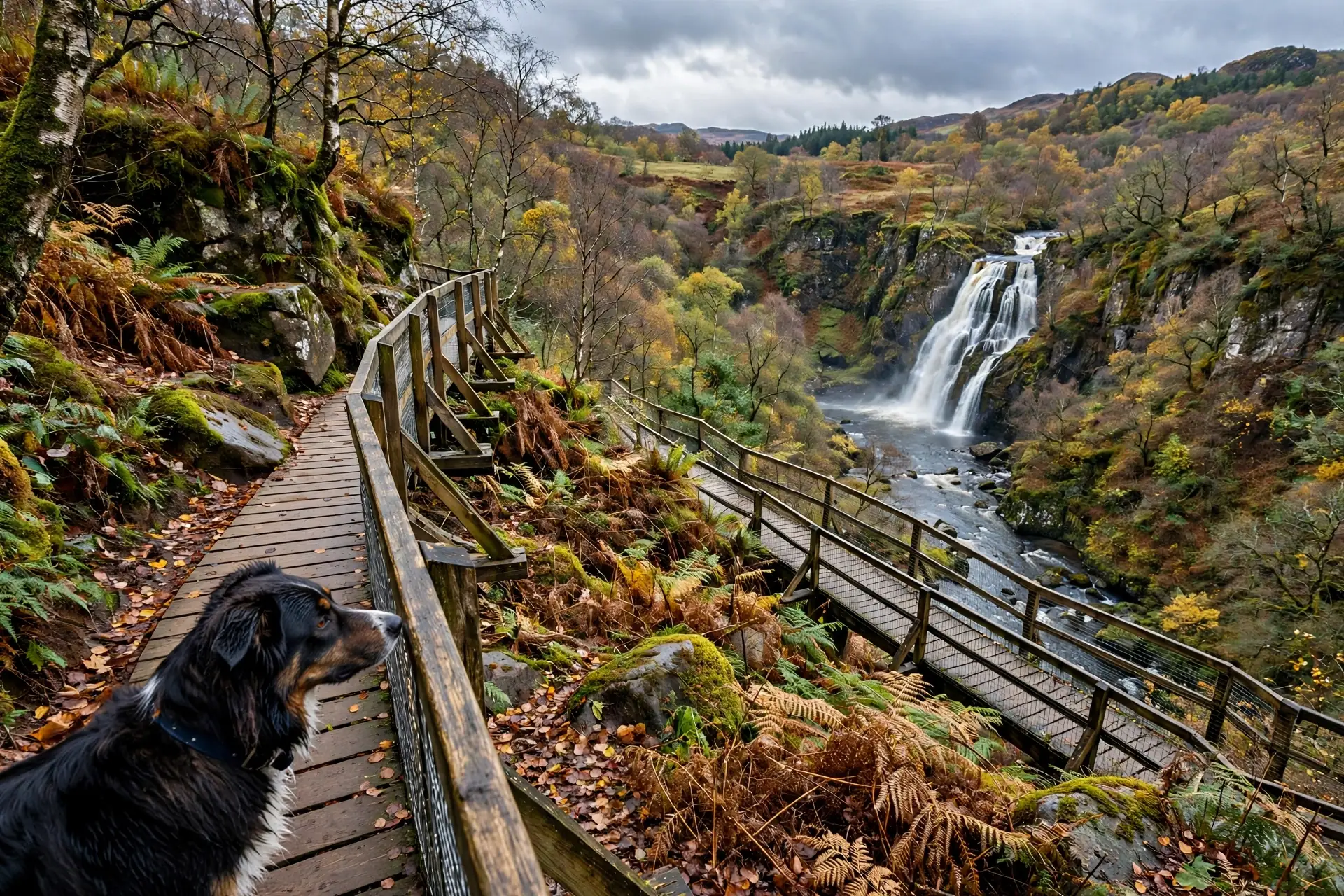
The Falls of Clyde are the centrepiece of a dog trip to Lanark, and they deserve to be treated as a proper walk rather than a quick viewpoint stop. The falls are a series of waterfalls on the River Clyde, where the river drops through a steep, wooded gorge below the town. The best-known route follows the gorge path from New Lanark upstream towards the falls, through mature woodland that feels a world away from the town above. It is one of those walks where the sound arrives before the sight: the river grows louder as the path climbs, the trees close in, and then the water appears through the branches, white and fast over dark rock.
For dogs, the gorge is exciting and demanding in equal measure. The path is mostly a surfaced or well-worn woodland trail, but it narrows in places, climbs and descends in steps, and runs close to steep drops above the river. That combination is exactly why a lead is not optional here. Keep your dog on a short lead for the whole gorge section, even if they are normally reliable off lead, because a squirrel, a sudden noise or another dog appearing around a blind bend can send a dog towards an edge faster than you can react. A lead of about one to two metres gives you control without constantly tangling in undergrowth, and a harness is a better choice than a collar on steep ground, where a sudden pull could jerk a dog off balance.
Distance and difficulty are worth planning honestly. The walk from New Lanark to the main falls and back is a moderate outing for a fit adult dog, with enough climbing to tire a smaller or older dog. Puppies, very elderly dogs and dogs recovering from injury will find the steps and the return climb hard work, so consider a shorter out-and-back section rather than the full route. There is no shame in turning around at the first good viewpoint: the gorge is beautiful from the lower stretches too, and a dog that finishes the walk happy and sound is worth far more than a dog that was pushed to the furthest fall and spent the evening limping.
Footing changes with the weather, and the gorge amplifies every change. After rain the steps and exposed roots become slippery, the path surface turns to mud in the low spots, and the river runs higher and faster, which makes the drops feel more serious. In dry weather the same path is firm and easy, though the gorge stays cool and damp under the trees, so a dog that has been splashing or swimming elsewhere will dry slowly. Wear boots with real grip rather than trainers, and think about your dog's paws: a dog that has been walking on wet rock and muddy ground may need a rinse and a check for small cuts when you get back to the car.
Water safety deserves a direct word. The River Clyde through the gorge is fast, cold and powerful, and it is not a safe swimming river for dogs. Do not let your dog enter the water here, and do not throw sticks or balls towards the river, because a dog that chases a toy into fast water is in serious danger. Carry drinking water for your dog instead, and offer it at the viewpoints and on the return leg, when dogs are most likely to be thirsty. If your dog does get wet, towel them down at the car and keep them warm on the drive home, especially in cooler months.
Other walkers are part of the gorge experience. The Falls of Clyde path is popular, particularly at weekends and in school holidays, and the narrow sections mean you will meet other people and dogs at close quarters. Step aside where the path widens, shorten the lead before a blind bend, and recall or restrain your dog before they greet another dog head-on in a narrow spot. A dog that is friendly on open ground can still feel trapped on a narrow ledge path, so give other dogs space and do not assume every dog wants to say hello. The same courtesy applies to photographers and birdwatchers who stop on the path: pass quietly, keep your dog close, and let them enjoy the view too.
Before you set out, check the official guidance before you travel for current path conditions, closures and access advice. Woodland paths can close after storms, fallen trees can block a section, and high river levels can change which viewpoints are safe to reach. A quick check the day before, and again on the morning of the walk, takes a minute and can save a wasted journey or an awkward turnaround halfway up the gorge.
New Lanark village
New Lanark sits in the valley below Lanark town, beside the River Clyde, and it is one of the most distinctive places you can visit with a dog in Scotland. The village is a former cotton mill settlement, built in the late eighteenth century and later developed under the social reformer Robert Owen, and it is now listed by UNESCO as a World Heritage Site. The mill buildings, workers' housing, school and institute stand in a tight cluster beside the river, with the wooded gorge rising on either side, so a walk through the village feels like stepping into a working piece of industrial history rather than a museum display.
Dogs are generally welcome on leads in the outdoor areas of New Lanark, which is where most of the pleasure lies: the village streets, the riverside paths, the open spaces between the mill buildings and the walk up towards the Falls of Clyde. A dog on a lead can take in the scale of the mills, the sound of the river and the woodland setting without any difficulty, and the flat village streets make a useful warm-up or cool-down after the steeper gorge path. Keep the lead short through the village itself, because the streets are narrow, visitors gather in small groups, and a long lead across a walkway is a trip hazard for everyone.
Indoor access is the part to check carefully. Different buildings in New Lanark have different rules, and a dog that is welcome in a courtyard may not be welcome inside a mill building, an exhibition space or a cafe. Check the official guidance before you travel, and ask at each entrance rather than assuming the same rule applies everywhere. If one person in your group wants to go inside while the other stays outside with the dog, plan that split in advance: agree a meeting point, take it in turns, and do not leave a dog tied up alone outside a building, where they may bark, get tangled or upset other visitors.
The village rewards a slow pace. Allow time to walk the full length of the settlement, look across the river to the woodland on the far bank, and notice the details that make New Lanark different from a modern housing estate: the uniform mill housing, the old school building, the institute and the way the whole village was designed around the mills and the river. Dogs tend to enjoy this kind of slow, sniff-rich walking far more than a brisk march, and the village streets give them plenty of new smells without the steep climbing of the gorge. Bring a water bowl and a small mat if you plan to sit outside for a while, so your dog can settle beside you rather than standing on cold stone.
Busy days need a little extra planning. New Lanark attracts visitors year-round, and on fine weekends and holidays the village, the car park and the gorge path can all be busy. Arrive earlier in the day if you can, especially with a nervous or reactive dog, and avoid the middle of the day when coach groups and families are at their peak. If the village is crowded when you arrive, start with the quieter riverside path rather than the main street, and let your dog settle into the place before you ask them to cope with crowds. A dog that has had a calm first twenty minutes will handle the rest of the visit far better than one that was thrown straight into a busy street.
The Clyde Walkway
The Clyde Walkway is a long-distance walking route that follows the River Clyde, and the section around Lanark is one of its most attractive stretches for dog walkers. The route links Lanark, New Lanark and the Falls of Clyde with the wider Clyde Valley, passing through woodland, riverside meadows and farmland, and it gives you a way to extend a short gorge walk into a longer day without needing a second car or a complicated return. You do not need to walk the whole route to enjoy it: most dog owners pick a single section, walk out for an hour, and return the same way, which keeps the logistics simple and the dog's energy in reserve.
The walking surface varies more than first-time visitors expect. Some stretches are broad, firm tracks through woodland, others are narrow riverside paths with roots and mud, and a few sections climb away from the river through fields and lanes. That variety is part of the appeal, but it also means you should choose your section to match your dog. A fit, confident dog will enjoy the full mix of woodland and open riverside; an older dog, a small dog or a dog with sore joints will be happier on the flatter, firmer stretches near the village, where the ground is even and there are easy places to turn back.
Waymarking is generally good, but do not rely on it alone. Carry a map or a downloaded route on your phone, and check the official guidance before you travel for any diversions or closures, because riverside routes can close after flooding or landslips. Mobile signal can be patchy in the gorge and in the deeper woodland, so download your route before you set out rather than expecting to look it up halfway along. Tell someone where you are walking if you are going out alone, and carry a charged phone, even if the signal comes and goes.
Livestock and wildlife are a regular feature of the Clyde Walkway. The route passes fields that may hold sheep or cattle, and the woodland is home to deer, rabbits, squirrels and a wide range of birds. Keep your dog on a lead through farmland and anywhere you cannot see what is around the next bend, and be ready to shorten the lead the moment you spot livestock. A dog that chases sheep is not just a nuisance: it is a serious legal and welfare problem for the farmer and a danger to the dog. The same applies to ground-nesting birds in spring and summer, when a loose dog running through long grass can disturb nests that are invisible from the path.
For a longer day, the Clyde Walkway also connects Lanark with the wider Clyde Valley, and walkers who enjoy riverside routes often pair it with a trip to Peebles, where the River Tweed offers a gentler riverside walk and a very different market-town atmosphere. The two towns make a natural pair for a short break: Lanark for the gorge and the waterfalls, Peebles for the riverside and the forest trails. If you are staying in the area for a few days, the Scottish Borders guide covers abbeys, rivers and border towns that extend the same kind of walking further south and east.
Lanark Loch
Lanark Loch is the gentler side of Lanark with a dog, and it is the walk to choose when the gorge feels like too much, when the weather turns, or when your dog simply needs an easier outing. The loch sits close to the town, with a level path around the water that suits dogs of almost every age and fitness level. It is a place for a steady, unhurried circuit rather than a challenge: flat ground, open views across the water, and plenty of space for a dog to sniff and mooch without steep climbs or narrow ledges.
Waterfowl are the main feature of the loch, and they set the rules for how you walk here. Ducks, geese and swans use the water year-round, and a dog that charges into the shallows after them will cause real distress and may be met with an aggressive response from a protective swan. Keep your dog under close control around the water's edge, use a lead if your dog has a strong chase instinct or an unreliable recall, and teach or reinforce a solid leave command before you arrive. Even a dog that is normally good off lead can be tempted by a sudden flurry of wings at close range, so stay alert at the spots where birds gather near the path.
The loch is also a social walk. You will meet other dog walkers, families, runners and people feeding the birds, often in the same stretch of path, so it is a good place to practise polite passing. Keep your dog to one side of the path, shorten the lead as you pass, and do not let your dog approach other dogs without checking with the owner first. A calm, controlled greeting on a wide part of the path is fine; a full-speed charge across the grass towards an on-lead dog is not, even if your dog means well. If your dog is reactive, the loch still works, because the open ground lets you see other dogs coming and move aside early, which is much harder in the narrow gorge.
Seasonal changes are easy to read at the loch. In spring the path edges fill with new growth and nesting birds need extra space; in summer the water attracts insects and the open ground can be warm at midday, so walk early or late and carry water; in autumn the trees around the loch turn colour and the path can be slippery with fallen leaves; in winter the ground may be frozen or waterlogged, and the wind across open water feels colder than in the sheltered town. None of this makes the loch difficult, but it does mean the same circuit feels different in each season, and a dog that loved it in May may need a shorter, warmer version in January.
After the loch, the town centre is close enough to walk to, which makes it easy to combine a flat waterside circuit with a coffee stop or a wander through the historic streets. That combination, a gentle walk followed by a town break, suits older dogs and puppies particularly well, because it gives them exercise, new smells and a rest in roughly equal measure. Bring a towel for muddy paws in wet weather, and a spare lead if yours gets soaked, because a wet lead in a cold car is unpleasant for everyone on the drive home.
Castlebank Park
Castlebank Park is Lanark's town park, and it fills the gap between the wild gorge and the flat loch: a green, landscaped space close to the town centre where dogs can stretch their legs without a long drive or a steep climb. The park's lawns, trees and paths make it a natural choice for a morning or evening walk, a toilet break before a longer outing, or a calm wind-down after the excitement of the Falls of Clyde. It is the kind of park that locals use every day, which tells you most of what you need to know about it: it is practical, pleasant and easy to fit into a normal day.
The park's history adds interest to a straightforward walk. Castlebank takes its name from the site of Lanark Castle, and the park sits on ground with deep historic roots, above the town and the Clyde Valley. You do not need to be a historian to enjoy it: the raised position gives views across the town and the valley, the trees give shade in summer, and the paths give a dog a varied, sniff-rich circuit without the hazards of the gorge. Walk the paths slowly, let your dog investigate the trees and the boundaries, and treat the park as a place to decompress rather than a route to rush through.
As with any town park, the rules are about sharing the space well. Keep your dog under control at all times, use a lead in busy areas and near the park entrances, and be ready to recall your dog away from children, picnics and other dogs. Not every park user wants a dog approaching them, and a dog that jumps up at a stranger or steals food from a picnic blanket will not be welcomed back. Pick up after your dog every time, use the bins provided, and carry spare bags, because a park that is clean and well used stays welcoming to dogs, while a park with fouling problems quickly attracts restrictions.
Castlebank works particularly well as part of a two-walk day. Use it for a short morning stretch before the gorge, when your dog needs to loosen up and empty out before a longer walk, or for a gentle evening circuit after the loch, when the day's excitement has faded and a calm walk helps a dog settle for the night. It also works as a wet-weather fallback: the surfaced paths stay usable when the gorge path is muddy, and the shorter circuit means you are never far from the car if the rain turns heavy. Check the official guidance before you travel for any local rules or temporary closures, especially if you are visiting during an event or maintenance work.
Town trails and Wallace history
Lanark town itself is worth a walk with a dog, not just a drive-through on the way to the falls. It is an old market town with a long history, and its streets, lanes and open spaces reward a slow look. The town centre has the feel of a place that has been lived in for centuries: stone buildings, a market cross, narrow closes and a high street that still works as a high street, with shops, cafes and services rather than a museum set. A dog on a lead fits naturally into that kind of town, provided you keep the pace relaxed and the lead short.
The strongest historical association is with William Wallace, who is closely linked to Lanark. Wallace's story is part of the town's identity, and visitors will find references to him in the town centre and in local history. You do not need to follow a formal trail to get a sense of it: walking the older streets, looking at the historic buildings and reading the information boards gives a dog owner a pleasant, low-effort way to add history to a walking day. If you want more detail, check the official guidance before you travel for current information about historic sites, opening arrangements and whether dogs are welcome in any indoor spaces, because access rules for historic buildings change and are not always the same as for outdoor areas.
Street walking with a dog needs a different mindset from country walking. Pavements are narrow in the older parts of town, traffic passes close by, and shop doorways, cafe tables and market stalls all create pinch points. Keep your dog on the inside, away from the road, shorten the lead at crossings and junctions, and do not let a long lead trail across a pavement where it can trip someone. Train or reinforce a reliable wait at kerbs before you travel, because a dog that pulls towards a tempting smell across a busy road is a real hazard in a town centre.
Noise and crowds are the other town factors. Market days, weekends and school holidays bring more people, more noise and more dogs into the centre, which can overwhelm a nervous dog. If your dog is sensitive to crowds, visit the town early in the morning or later in the afternoon, when the streets are quieter, and stick to the wider streets rather than the narrowest closes. A dog that is calm in the gorge may still find a busy high street stressful, because the triggers are different: traffic noise, close passing strangers, shop shutters and sudden sounds from doorways. Watch your dog's body language, and if they start to show stress, move to a quieter street or head back to the park or the loch for a calmer finish.
Toilet stops and water matter in town just as much as on a country walk. Carry bags, use them every time, and do not let your dog foul a pavement, a shop front or a garden wall. Carry water for your dog in warm weather, and offer it before the town walk as well as after, because town pavements radiate heat in summer and dogs can overheat faster on stone and tarmac than on grass. In winter, remember that pavements may be gritted or salted, which can irritate a dog's paws: rinse their feet when you get back to the car and check for cracks or soreness, especially on longer town walks.
Cafes, pubs and stays
Eating and staying with a dog in Lanark is entirely possible, but it works best when you treat every venue as a separate check rather than assuming a general rule. Some cafes and pubs in and around Lanark welcome dogs indoors, some welcome them only in an outdoor seating area, and some do not accept dogs at all. Policies change with new owners, new seasons and new insurance rules, so a venue that welcomed dogs last year may have changed its policy since, and a place that was strict last year may have relaxed its rules. Check ahead with each place before you travel, confirm whether dogs are allowed indoors or only outside, and ask about any size, number or breed conditions that might apply to your dog.
When you contact a venue, ask the questions that actually change your plan. Is there a specific dog-friendly area, and is it inside or outside? Is there a time limit or a requirement that dogs stay on the floor rather than on chairs? Is water provided, or should you bring your own bowl? Is there somewhere to tie a lead safely, or is it better to keep the dog beside your chair? The answers tell you whether the venue is genuinely set up for dogs or merely tolerant of them, and that difference matters: a pub with a dog area, water bowls and staff who are comfortable around dogs will be a relaxing stop, while a place that merely tolerates a dog under a table may be stressful for everyone.
Behaviour at a cafe or pub is a skill worth practising before you travel. Bring a mat or blanket for your dog to settle on, so they have a defined place rather than wandering between tables. Bring a chew or a stuffed toy to keep them occupied while you eat, and order food that does not require you to leave the dog unattended at the table. Do not let your dog beg from other tables, steal food, bark at other dogs or jump up at staff, and be ready to leave early if your dog cannot settle. A short, calm cafe visit that ends well is worth far more than a long lunch that ends with a stressed dog and an embarrassed owner.
Staying overnight with a dog in Lanark follows the same principle: check the specific property, not the general area. Some hotels, guesthouses, bed and breakfasts and self-catering properties in the Clyde Valley welcome dogs, but the details vary widely: some charge a fee per dog per night, some limit dogs to certain rooms, some ask that dogs are not left alone in the room, and some allow dogs only in the grounds rather than inside. Ask for the full dog policy in writing before you book, including the fee, the room type, the alone-time rule and any damage deposit. Check the official guidance before you travel for any property you are considering, and do not assume that a booking site filter for dog-friendly properties tells the whole story, because filters are often out of date.
For overnight stays, think about the practical details that make or break a trip. Is there a garden or an enclosed area where the dog can go out last thing at night and first thing in the morning? Is the room on the ground floor, or will an older dog need to climb stairs? Is there somewhere to dry a wet dog after a gorge walk, and somewhere to store muddy boots and leads? Is the nearest vet easy to reach, and do you have its number saved? Pack your dog's bed, food, bowls and a familiar blanket, because a dog that sleeps in its own bed in a strange room settles far faster than one expected to sleep on unfamiliar bedding. And always have a backup plan: know what you will do if your chosen venue has changed its policy by the time you arrive, so a single closed door does not derail the whole trip.
Leads, livestock and wildlife
Lead rules in and around Lanark are not a single rule but a set of overlapping ones: the gorge, the farmland, the village, the loch and the town each have their own reasons for keeping a dog close. The safest approach is to keep your dog on a lead unless you are in a place where you are certain off-lead walking is allowed, you can see the ground ahead clearly, and your dog's recall is reliable in that exact situation. A dog that recalls perfectly in a quiet park may not recall at all when a deer crosses the path, so judge the situation in front of you rather than your dog's best day.
Livestock is the most serious lead issue in the Clyde Valley. Sheep and cattle graze in fields around Lanark, and the law and the farming reality are both clear: a dog that worries livestock can be shot by the farmer, and the owner can face legal consequences. Keep your dog on a short lead through any field with livestock, even if the animals are at the far end of the field, and do not let your dog approach fences, gates or feeding areas. If you meet cattle on a path, keep your dog on a lead, walk calmly past without stopping, and let go of the lead only if you are directly threatened by cattle and need to protect yourself, which is the standard safety advice for that rare situation. Check the official guidance before you travel for current advice on livestock and access in Scotland, because the rules and the seasons change.
Wildlife adds another layer. The Clyde Valley woodlands are home to deer, badgers, foxes, rabbits and a wide range of birds, including kingfishers along the river and peregrine falcons that nest in the gorge. The Falls of Clyde area is a nature reserve, and the wildlife is one of the reasons the place is special, so give it space. Keep your dog on a lead in the gorge and in woodland during the breeding season, do not let them chase deer or dig at burrows, and keep them out of the river, where disturbance to nesting birds and other wildlife can be significant. A dog that has learned to watch wildlife calmly from a lead is a pleasure to walk with; a dog that charges after every squirrel is a risk to itself and to the animals it chases.
Other dogs are the final piece of the lead picture. Not every dog you meet wants to interact, and some are on lead for good reason: they may be reactive, elderly, in training, recovering from surgery or simply not social. Do not let your dog run up to an on-lead dog, and do not assume that a dog off lead is inviting a greeting. Ask the owner before you let dogs meet, keep the first greeting short and on a loose lead, and move on if either dog shows tension. A lead is not a punishment: it is the tool that lets you keep your dog safe in a place full of cliffs, fast water, livestock and wildlife, and using it well is part of being a responsible dog owner in the Clyde Valley.
Seasons and wet weather
Lanark changes with the seasons more than a first visit suggests, and the best time to come depends on your dog as much as on the weather. Late spring and early autumn are usually the sweet spot: the gorge is green and full of birdsong, the paths are firm, the river is at a pleasant level, and the temperatures suit walking. Summer brings longer days and warmer weather, but the sheltered gorge can feel humid, midges can be a nuisance in the woodland, and dogs can overheat on the climbs if you walk at midday. Winter brings quieter paths and crisp light, but also ice, mud and short days, and the river runs high and fast after rain.
Midges deserve a specific mention, because they catch first-time visitors to Scotland by surprise. These tiny biting insects are most active in still, damp conditions in the summer months, particularly in the early morning and evening and near water and woodland. They do not usually trouble dogs as much as they trouble people, but they can make a riverside stop unpleasant, and a dog that is constantly shaking its head or rubbing its ears may be reacting to midges. Walk in the middle of the day when midges are less active, choose breezy, open stretches over sheltered, still ones, and carry insect repellent for yourself. A light breeze on the loch or the higher town paths is often enough to keep midges away.
Wet weather is a normal part of a Lanark trip, and it should be planned for rather than feared. The gorge path is at its most dramatic after rain, when the falls are full and the river is loud, but it is also at its most slippery, so treat a wet-weather gorge walk as a shorter, slower outing with extra care on the steps. The loch and Castlebank Park are better wet-weather choices, because their paths stay usable and you are never far from the car. Pack a drying coat or a large towel for your dog, a spare lead, waterproofs for yourself, and a waterproof bag for your phone and map, and accept that a wet dog in a car needs a towel down on the seat and a bit of patience.
Heat is the opposite risk, and it matters in the gorge because the climb out is steep and the shade can be deceptive. A dog that is fine on a flat walk can overheat on a steep climb in warm weather, especially if they are brachycephalic, overweight, elderly or heavily coated. Walk early in the morning in summer, carry plenty of water, offer it often, and watch for signs of overheating: heavy panting, drooling, wobbling or a dog that stops and refuses to move. If you see those signs, stop, move to shade, offer water, wet the dog's belly and paws with cool water, and seek veterinary advice if the dog does not recover quickly. Never leave a dog in a parked car, even for a few minutes, because a car heats up fast even on a mild day.
Seasonal access changes are worth checking too. Some paths may close temporarily after storms, flooding or landslips, and wildlife protection measures can restrict access to certain areas during the breeding season. Check the official guidance before you travel, and have a backup walk in mind for every outing: if the gorge is closed, the loch and the town trails still make a good day, and if the loch path is waterlogged, Castlebank Park and a town walk will do. The mark of a good dog trip is not that everything goes to plan, but that you have a plan B that your dog enjoys just as much.
Getting there and parking
Lanark is in South Lanarkshire, in the Clyde Valley, and it is reached by road from Glasgow, Edinburgh and the wider central belt. Most visitors arrive by car, which is also the most practical option with a dog, because it gives you somewhere to store water, towels, spare leads and a dry change of clothes, and a safe place for the dog to rest between walks. Check the official guidance before you travel for current parking arrangements, because car parks, charges and restrictions change, and the most convenient car park for the gorge may not be the most convenient for the town or the loch.
Plan your parking around the walk you are doing first. If the Falls of Clyde and New Lanark are your morning plan, park for the village and the gorge; if the loch and the town are your afternoon plan, move the car to a town car park rather than walking a tired dog along a busy road. Do not leave a dog in a parked car while you walk, and do not leave valuables visible in the car at a rural car park. When you arrive, give your dog a few minutes to stretch, drink and empty out before you set off, and use that time to check the path signs, the weather and your route, rather than rushing straight onto the trail.
Public transport is an option for some visitors, but it needs more planning with a dog. Trains and buses serve Lanark, and the town is walkable from the station, but the gorge and New Lanark are a walk from the town centre, and a tired dog will feel that distance at the end of a long day. If you are travelling without a car, plan a shorter day, use the town walks and the loch as your main outings, and check the official guidance before you travel for current rules about dogs on trains and buses, because policies and peak-time restrictions vary. Whatever your transport, carry water, a bowl, bags and a lead, and keep your dog's identification tag up to date, because a dog that slips a lead in an unfamiliar town is far harder to recover than one that slips it at home.
A practical day plan
A good Lanark dog day is built around energy, not distance: a demanding walk in the morning when you and the dog are fresh, a rest and a town break in the middle, and a gentle walk in the afternoon when the dog is tired. The plan below works for most fit adult dogs in fair weather, and it can be shortened at any point by cutting a section or turning back early. Adjust it to your dog, the weather and the season, and do not feel obliged to do all of it.
Start early at New Lanark. Arrive before the village gets busy, give your dog a short warm-up on the village streets, and then walk the gorge path towards the Falls of Clyde. Take the climb slowly, stop at the viewpoints, offer water, and keep the dog on a short lead throughout. Allow a generous couple of hours for the out-and-back walk, including stops, rather than trying to rush it. When you reach your turning point, whether that is the main falls or an earlier viewpoint, take a few minutes to rest, let the dog sniff and settle, and then walk back down at the same unhurried pace. The return leg is when tired dogs slip on steps, so stay alert all the way back to the village.
After the gorge, return to New Lanark for a rest. Let your dog drink, lie down on a mat in the shade, and recover while you have a drink or a snack outdoors. This rest matters: a dog that has just climbed a gorge needs time to cool down, rehydrate and let its muscles relax before the next outing. Do not jump straight into a second long walk, and do not feed a large meal immediately after hard exercise. A small snack and plenty of water are enough until the dog has rested.
In the afternoon, drive or walk to Lanark Loch for a flat, gentle circuit. This is the recovery walk: level ground, open views, waterfowl to watch from a distance, and plenty of space to move aside from other walkers. Keep the pace slow, keep the dog under control around the birds, and let the dog choose the pace rather than pushing for distance. If the dog is clearly tired, shorten the circuit or simply sit by the water for a while. A dog that has had a good morning walk does not need a long afternoon walk to have had a good day.
Finish with the town. Walk through the historic centre, visit Castlebank Park for a short, calm circuit, and stop at a dog-friendly cafe or pub if you have checked ahead and your dog is settled enough to enjoy it. This is the part of the day where the dog gets to practise town manners, and you get to enjoy Lanark as a place rather than a walking route. End the day with a final toilet walk, a check of paws for mud and small cuts, a towel-down if the dog is damp, and fresh water in the car. A dog that ends the day tired, clean and comfortable is a dog that will sleep well on the drive home, and that is the best measure of a successful day in Lanark.
If you are staying for a second day, use it for the Clyde Walkway rather than repeating the gorge. Pick a different section, walk out for an hour and back, and explore the riverside and farmland that you did not see on the first day. The valley rewards a slower second day, and your dog will benefit from the variety: different smells, different ground, different views, and a gentler climb than the gorge. Pair it with a visit to the town or the loch, and you will leave Lanark feeling that you have seen the place properly, rather than ticking off a single waterfall and driving home.
Practical questions
Before you go
Can dogs walk to the Falls of Clyde?
Yes, dogs can walk the gorge paths from New Lanark towards the Falls of Clyde, but keep them on a lead throughout. The paths are steep in places, with steps, uneven ground and unfenced drops above the river, so a short lead and good footwear matter more than distance. Check the official guidance before you travel, as path conditions and access can change after heavy rain.
Are dogs allowed in New Lanark village?
Dogs are generally welcome on leads in the outdoor areas of New Lanark, including the village streets and riverside paths. Indoor access varies by building, so check the official guidance before you travel and ask at each entrance rather than assuming a dog can go inside.
Is the Clyde Walkway near Lanark suitable for dogs?
Yes, the Clyde Walkway near Lanark suits most dogs that are comfortable on a lead, with woodland and riverside stretches and some steep or muddy sections. Choose a shorter section if your dog is older or less fit, keep the dog on a lead near the river and livestock, and carry water, as there is little to drink safely from the river.
Can dogs go off lead at Lanark Loch?
Lanark Loch is a gentler, flatter walk than the gorge, and many dogs enjoy it, but do not assume off-lead freedom. Keep your dog under close control, recall them away from waterfowl and other walkers, and use a lead if your dog chases birds or cannot be recalled reliably. Check the official guidance before you travel for any local rules.
Where can dogs stay and eat in Lanark?
Some cafes, pubs and places to stay in and around Lanark welcome dogs, but policies change often and vary by venue. Check ahead with each place before you travel, confirm whether dogs are allowed indoors or only outside, ask about any size or number limits, and have a backup plan in case a venue has changed its rules.
When is the best time of year to visit Lanark with a dog?
Late spring and early autumn usually offer the best balance for Lanark with a dog: cooler walking weather, firm paths and fewer midges than high summer. Summer can be warm in the sheltered gorge, winter paths can be icy and muddy, and the river runs high after rain, so check the official guidance before you travel and plan shorter walks in poor conditions.