This guide is independent and contains no paid placement. If affiliate links are added later, they will be clearly marked and will not change our editorial checks.
Lancaster works best with a dog when you treat the castle as a view rather than a visit: dogs are not allowed inside it. The real dog day is the River Lune, the canal towpath, Williamson Park's 54 acres and a short trip to Morecambe — and in summer, only the beach at Bare stays open to dogs all year.
Start with the river, not the castle
Lancaster is a small northern city with a very large castle, and that mismatch shapes every dog trip here. The castle dominates the skyline, the photographs and the guidebooks, yet it is the one place in the city where a dog cannot go. Start your planning from that fact rather than fighting it, and the city opens up: a river that runs the length of the place, a canal that threads through it on the flat, a hilltop park with views to the sea, and a seaside town ten minutes away by train.
The shape of Lancaster helps. The historic centre is compact enough to cross on foot in twenty minutes, and it sits on a hill above the River Lune, which bends around the city in a wide loop. Below the hill, the riverside paths and the canal towpath are flat, which matters more than it sounds: the climb to the castle is steep and cobbled, so it is worth doing once, slowly, and then letting the dog do the rest of the day on level ground. Think of the trip as three layers. The top layer is the castle hill and the old streets, good for half an hour of looking and sniffing. The middle layer is the park and the canal, good for a long, easy walk. The bottom layer is the river itself, where the best dog walking in the area actually happens.
That layering also decides the order of your day. Arrive early and walk the river or the park first, while the dog is fresh and the paths are quiet. Come into the centre late morning, when the cafes and pubs are open and the dog has already had the run it needs. Save the castle hill for the golden hour, when the stone glows and the views over the Lune and towards Morecambe Bay are at their best, and when a tired dog is happy to sit beside you and watch the city instead of pulling at every smell. A dog that has already walked five miles behaves very differently on a crowded cobbled street from one that has been in the car all morning.
Lancaster is also a university city, which gives it a useful character for dog owners: plenty of independent cafes, a market, and a centre that stays lively without feeling like a theme park. Students, locals and visitors share the same pavements, and dogs are a normal sight rather than a novelty. That does not mean every doorway welcomes them — it means the city has enough genuinely dog-friendly places that you can plan a whole day without improvising at every stop. The sections below work in the order a real visit tends to follow: the hill, the park, the river, the canal, food and drink, the coast, then the practical questions of staying, arriving and packing.
One warning before the detail. Lancaster's weather is Lancashire weather: four seasons in an afternoon, wind off the bay, and rain that arrives sideways. The city rewards the owner who packs a drying coat and a towel and keeps going, and punishes the one who plans a single outdoor activity with no wet-weather fallback. Every route in this guide has a shorter version and a dry alternative, because the difference between a good Lancaster day and a miserable one is rarely the destination — it is the backup plan.
The castle hill and the old city
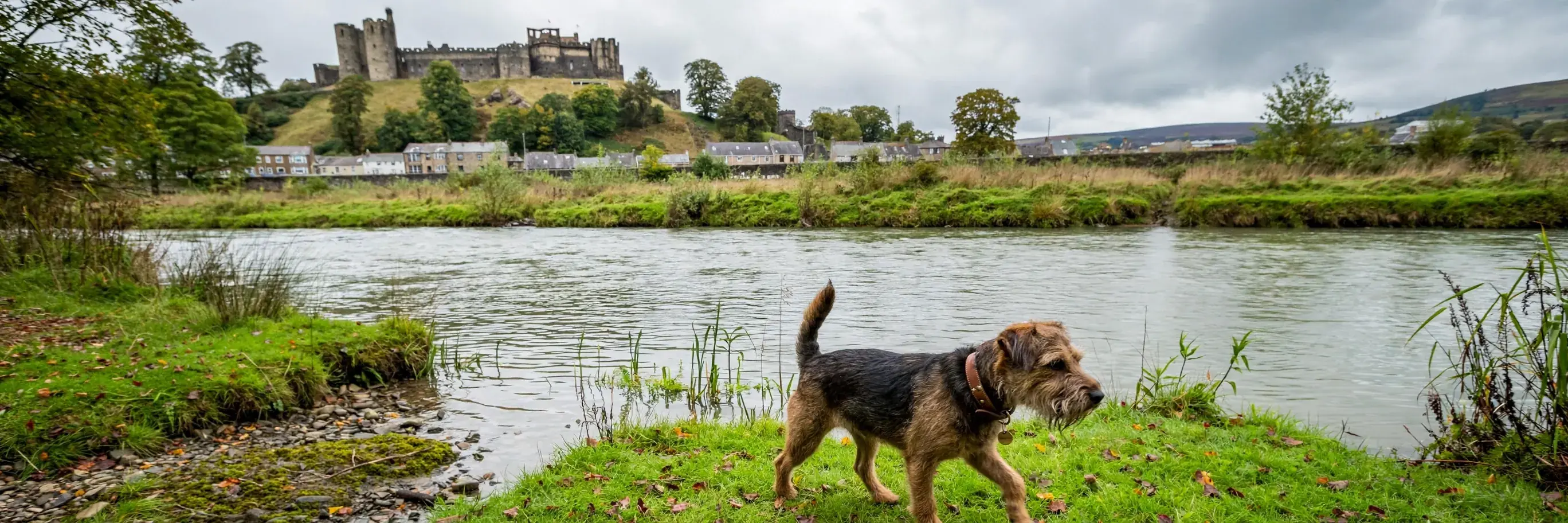
Lancaster Castle stands on the site of a Roman fort, rebuilt in stone from the 11th century onwards, and it has spent much of its life as a prison and a court rather than a palace. That history is exactly why it is worth seeing — and why it is awkward with a dog. The castle is open daily, with the courtyards open from 9.30am to 5pm, but access to the interiors is by guided tour only, and dogs are not allowed inside the castle, in the courtyards or on the tours. Assistance dogs are the only exception. So the honest plan is to enjoy the castle from the outside, which is free, and to let anyone in the party who wants the tour take it while someone else stays with the dog.
What the outside gives you is still considerable. The castle sits on Castle Hill at the top of the city, and the approach up Castle Park and Church Street is one of the most atmospheric short walks in the north-west: Georgian townhouses, the Priory church beside the castle, and the great stone gatehouse opening onto views across the rooftops to the Lune and the fells. Dogs on leads are fine on the public streets and pavements around the hill, and the grassy slopes below the castle walls are a good place for a photo and a pause. The ground is the problem, not the rules: the hill is steep, the old streets are cobbled and uneven, and the tour route itself is not suitable for wheelchairs or pushchairs. Older dogs, small dogs and anyone with sore knees should take the gentler approach from the lower end of Church Street rather than the direct climb, and should allow extra time.
Beside the castle stands Lancaster Priory, the parish church, with its churchyard and its own views over the river. The churchyard is a quiet, green pause after the climb, and a good place to let a dog settle for a few minutes before heading back down. Keep the dog on a lead here and on the streets: the castle hill is busy with visitors, and the narrow pavements leave little room for a dog to wander. If you are visiting with children as well as a dog, the hill is the part of the day that needs the most supervision — the traffic is light but the drops from the terrace edges are real, and an excited dog on a long line can tangle a whole family in seconds.
Down the hill, the old city repays a slow wander. The pedestrianised streets around Market Square, the covered market and the independent shops of the centre are easy walking on the flat, and the city rewards the owner who lets the dog set the pace for a while: there are smells here that no park can offer, from the market to the bakeries. The Judges' Lodgings, the City Museum in the old town hall, and the Maritime Museum down by the river are all worth knowing about, but check the official guidance before you travel if you plan to take a dog inside any of them — museums in historic buildings usually allow assistance dogs only, and their rules change with exhibitions. Treat the city centre as a place to walk through and eat in, not as a string of indoor attractions, and you will enjoy it far more with a dog at your side.
The practical way to handle the castle tour question is to decide it before you arrive. If one person wants the tour, book a time, agree a meeting point, and give the dog walker a proper walk to do in the meantime — the riverside path below the hill or the canal towpath both work. Tours last around an hour, which is a long time to stand outside a gatehouse with a bored dog. If nobody in the party is determined to go inside, skip the tour entirely: the exterior, the Priory and the views are the parts of the castle that cost nothing and welcome a dog, and they are the parts most visitors remember.
Williamson Park and the Ashton Memorial
If the castle is the view, Williamson Park is the walk. The park covers 54 acres of woodland, lawns and gardens on the hill south of the city centre, and it is home to the Ashton Memorial, the great domed Edwardian monument built by the industrialist Lord Ashton in memory of his wife Jessy and opened in 1909. Entry to the park grounds and the memorial is free, and the park is open all year round except Christmas Day, Boxing Day and New Year's Day. Dogs are welcome in the grounds, and the council publishes a Park Dog Code for owners — read the signs at the entrances and follow them, because the park is shared with children, picnics and the Saturday parkrun.
The park is a hill, and it does not pretend otherwise. The main loop trail is about two miles, generally considered easy, and takes around 45 minutes, with about 50 metres of climbing. The paths are largely surfaced, but there are rocky and uneven woodland sections, and the ground can be slippery after rain. For a fit dog this is a perfect morning circuit: woodland smells, open lawns with views to Morecambe Bay and the Lakeland fells, and enough other dogs to make it sociable without ever feeling crowded. For an older dog or a puppy, the same loop can be cut short at several points — the park has multiple entrances from Quernmore Road, Wyresdale Road and Fenham Carr Lane — and the flatter lawns near the cafe are a gentler alternative to the full circuit.
The Ashton Memorial itself is the landmark. Climb to its terrace for the view, which on a clear day runs from the city and the Lune out to the bay and the fells, and on a grey day still shows the whole shape of Lancaster below. The ground floor is reached by stairs or a lift, but the higher floors are stairs only, and the viewing gallery involves around 70 steps — leave the dog with a companion at the bottom if you go up. Dogs are not allowed inside the Butterfly House or the Mini Zoo, which sit in the park and charge a small entry fee; if the rest of the party wants to go in, take turns staying outside with the dog. The cafe is dog friendly and a natural rest stop, with water usually available — ask at the counter rather than assuming.
Williamson Park is also where Lancaster's dog community gathers. Saturday mornings bring the Lancaster parkrun, a free 5k around the park, where dogs are welcome on a short, handheld, non-extendable lead, one dog per runner, within reach at all times. If your dog is reactive, avoid Saturday at 9am and come later in the day, when the park settles back into dog walkers and families. The park hosts outdoor theatre in summer — the Dukes theatre company performs in the park — and seasonal events through the year, so check the official guidance before you travel if you are visiting on an event day, because the busiest lawns and some paths may be fenced off.
Parking is straightforward and worth knowing in advance. There are two pay-and-display car parks inside the park: the Quernmore Road entrance has about 15 spaces including disabled parking, and the Wyresdale Road entrance has about 100. Both fill up on sunny weekends, so arrive before 10am if you can, and have change or a card ready for the machine. The walk from the city centre to the park takes about 20 minutes uphill, which is a good warm-up for the dog but a real climb for anyone with limited mobility — in that case, drive to the Wyresdale Road car park and start from the top of the hill instead.
River Lune walks: Crook O' Lune and beyond
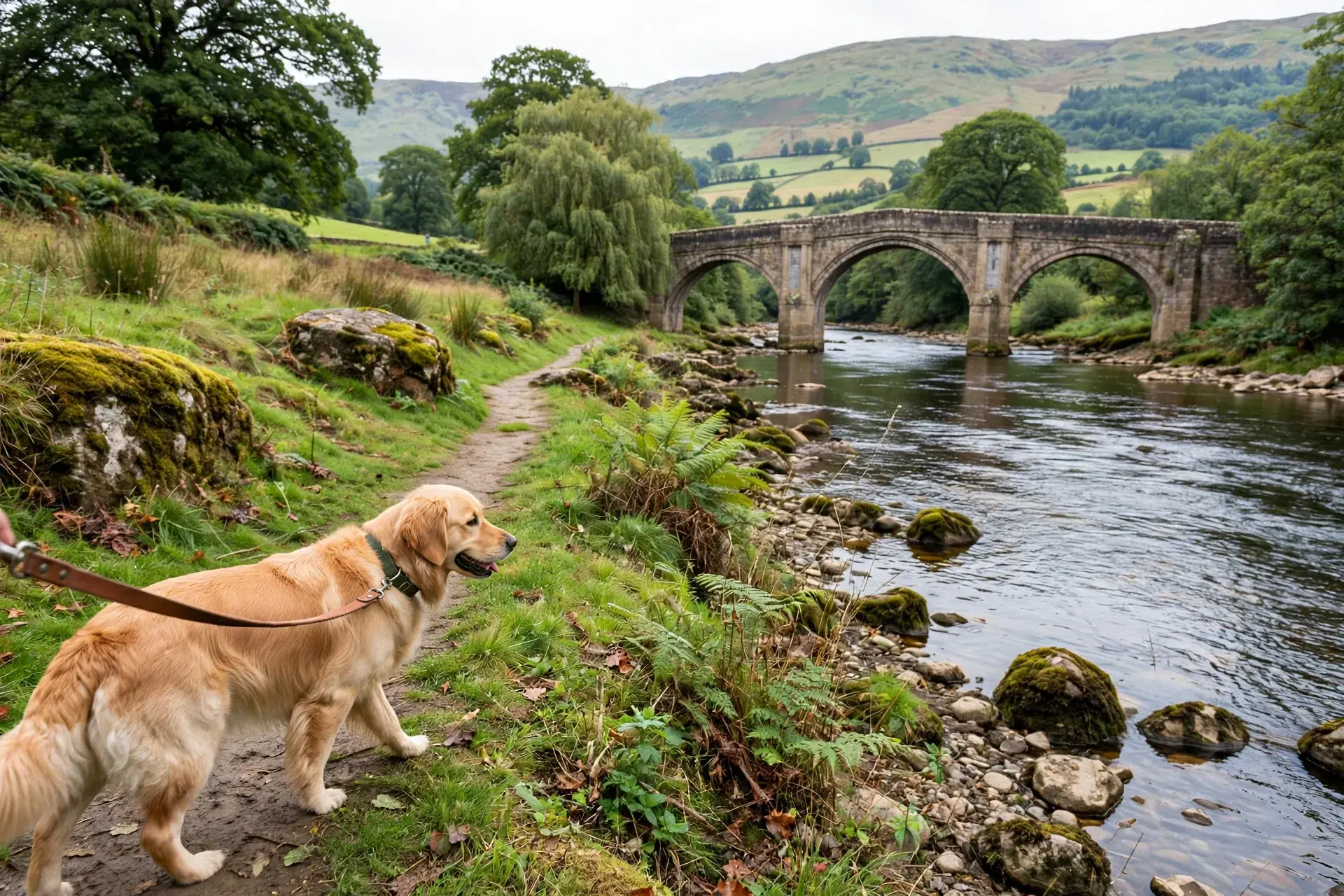
The River Lune is the best dog walking in the Lancaster area, and the best of it starts a few miles upstream at Crook O' Lune, a broad bend in the river between Caton and Halton. The circular walk here is about three miles on mostly flat paths, suitable for most abilities, and it is the route local dog owners return to week after week. There is a car park at the picnic site with toilets, a picnic area and a cafe, and from there the waymarked Lune Valley Ramble follows the river north-east through riverside meadow and pockets of woodland. The river is wide and slow here, the banks are grassy, and the shallow edges are where dogs paddle on warm days.
The short circular is the one to learn first. From the Crook O' Lune picnic site, follow the river to the Thirlmere Aqueduct, cross, and return along the opposite bank — a loop of about 2.5 miles that takes most walkers under an hour. The longer versions add Halton and Caton: a 4.3-kilometre circular via Halton Bridge and the old station, an 8.4-kilometre circuit that takes about two hours, and a 10.3-kilometre loop through Caton for the days when the dog still has energy to burn. All of them share the same character: flat riverside path, field edges, disused railway line, and views back towards the city. The Station Hotel in Halton, an 18th-century coaching inn, is dog friendly and makes a natural halfway stop on the longer routes — check the official guidance before you travel, because opening hours and dog areas change with the seasons.
The river demands respect, and the advice here is not decoration. The Lune is a working river whose level and current change fast after rain in the fells, and the banks can be boggy and slippery for days afterwards. Keep your dog on a lead or a long line near the water until you know the spot, and never let a dog swim near weirs, bridges or the aqueduct, where the current is deceptive. Some fields along the route hold livestock, so leads are essential there even if your dog is normally reliable off lead. After flooding, sections of the riverside path can be under water or deep in mud — proper footwear is not a suggestion, it is the difference between a good walk and a miserable trudge, and a dog that has to be carried through a flooded section will not thank you for it.
Closer to the city, the Lune Riverside Path runs along the river below the castle and out towards the Lune Aqueduct, the great stone structure built in 1797 to carry the Lancaster Canal over the river. The city loop that links the castle, the river and the canal is about 2.1 miles with some climbing, and it is a useful shape for a visit: start at the Moor Mills car park, walk through the historic centre, drop down to the river, then follow the canal back. The steps down to the paths beneath the aqueduct can be slippery when wet, so take them slowly and keep the dog close. The riverside path is public and free, with no tickets, and it is at its best early in the morning, when the mist sits on the water and the only other users are dog walkers and the occasional rower.
What makes the Lune special for dogs is variety within a single walk: open meadow for running, woodland for sniffing, shallow water for paddling, and a cafe or pub at the end of most routes. It is also a walk that scales. A puppy or an older dog can do the flat mile from the Crook O' Lune car park to the aqueduct and back; a young spaniel can do the full ten kilometres to Caton and still want more. Bring water in summer, because the river is not a safe drinking source in low water, and bring a towel all year round, because a dog that has paddled in the Lune will want to dry off in the car. And remember the fields: the Lune Valley is farmland, and a dog that chases sheep is a dog that should be on a lead for the whole route, whatever the weather.
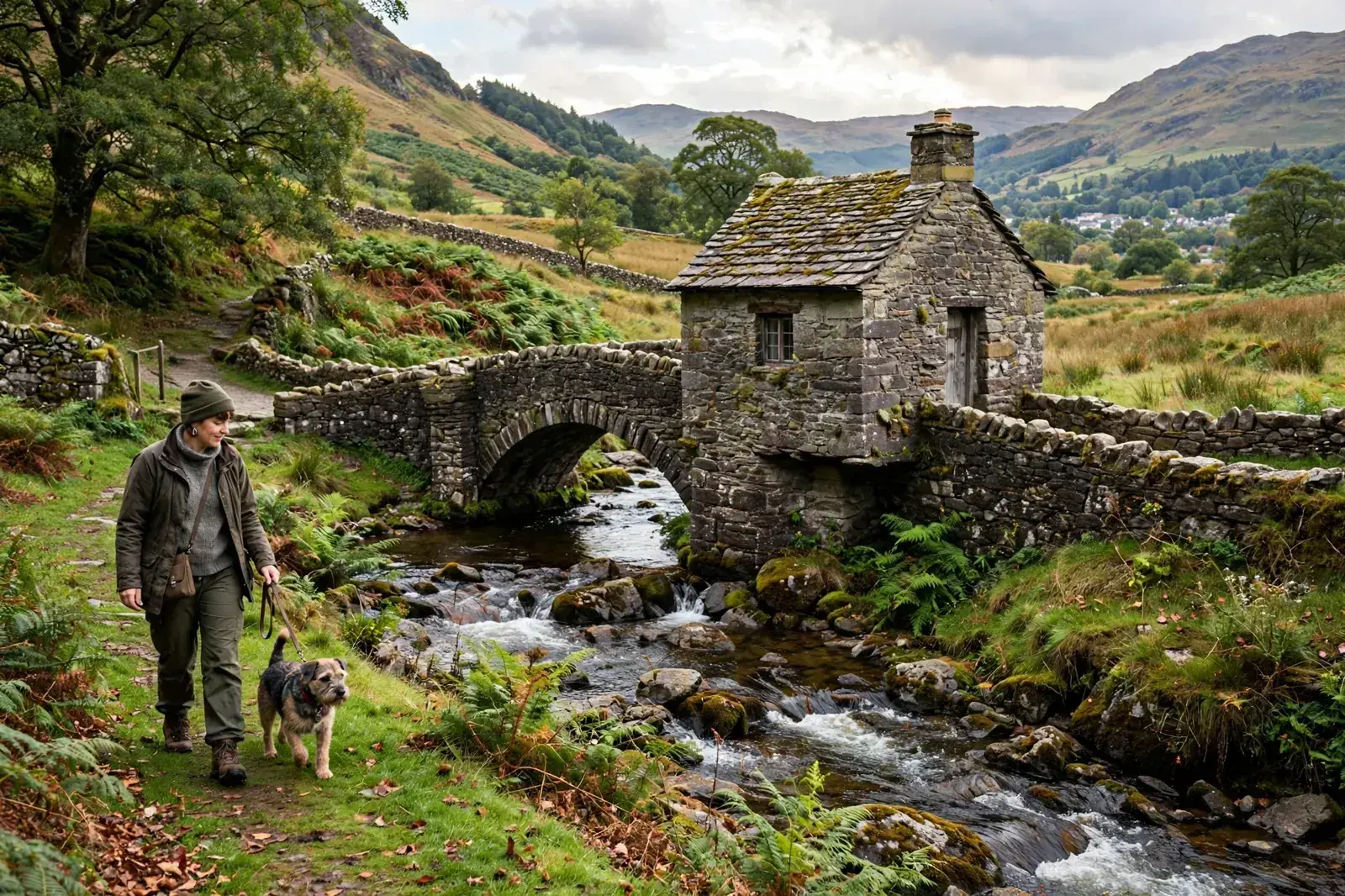
For a longer stay, the Lune Valley Ramble continues upstream beyond Caton towards Kirkby Lonsdale, and the same river that runs through Lancaster threads the whole valley together. Our guide to Kirkby Lonsdale with a dog covers the Lune Valley walks further upstream, including Devil's Bridge and the gentler routes for older dogs — worth reading if you are planning a second day on the river rather than a second day in the city.
The Lancaster Canal towpath
The Lancaster Canal runs through the city on the flat, and its towpath is the most forgiving walk Lancaster offers. The canal was built to carry coal and limestone, and the stretch through Lancaster is now a quiet, tree-lined corridor where the main sounds are ducks, cyclists and the occasional narrowboat. For a dog, it is a long, straight, level walk with water on one side and hedges on the other — simple, safe and easy to shorten, because you can turn back at any bridge.
The practical way to use the towpath is as a connector rather than a destination. From the city centre, join the canal near the bus station or the southern edge of the centre and walk north towards the Lune Aqueduct, where the canal crosses the river on John Rennie's five-arched structure from 1797. The aqueduct is the highlight: standing on it with the river below and the city behind is one of those moments that makes a plain walk feel like a proper outing, and dogs on leads are fine on the towpath throughout. Walk south instead and the canal runs out through the suburbs towards Galgate and beyond, getting quieter with every bridge until it feels like countryside.
Towpath etiquette matters, because the path is narrow and shared. Keep your dog on a short lead when cyclists approach, and step to the side rather than expecting the cyclist to swerve around a dog on a long line. The water is the obvious hazard: the canal edge is unguarded for long stretches, and a dog that falls in needs a way out. Small dogs and puppies should stay on a lead near the water, and every dog should be watched at locks and bridges, where the stonework is slippery. In summer the towpath is shaded and cool, which makes it a better choice than the open riverside on a hot day; in winter it can be icy underfoot, and the shaded sections freeze first.
The canal also connects to the city's dog-friendly eating and drinking, which is the real reason it earns a section of its own. The Water Witch, the canal-side pub at the southern end of the centre, welcomes dogs and sits right on the towpath, so a canal walk can end with a drink and a rest without any extra walking. Treat the towpath as your plan B as well as your plan A: when the riverside paths are flooded after rain, the canal towpath is usually still walkable, because it sits higher and drains better. That single fact makes it the most reliable walk in Lancaster in wet weather, and wet weather is when you will need a reliable walk most.
Eating and drinking in the city centre
Lancaster eats well with a dog, provided you choose the right kind of place. The city has a strong independent cafe and pub scene, and dogs are welcome inside a surprising number of them — one local listing counted 24 pubs and 11 cafes in the city where dogs are welcome inside, plus dozens of dog-friendly things to do within 25 miles. That count will have changed by the time you read this, so treat it as a sign of the city's character rather than a promise about any single venue, and check the official guidance before you travel if a particular place matters to your day.
Start with coffee. Atkinsons, the Lancaster coffee roaster, has a shop in the city centre, and the attached Hall welcomes dogs inside — a useful combination on a wet morning, when you can drink good coffee while the dog dries off at your feet. The Gallico Lounge runs a "Muttley Crew" with a canine menu, water and natural chews, and the Bier and Twist bar welcomes dogs in its bar area. The Water Witch, on the canal, is the pub to aim for after a towpath walk: stone walls, a water bowl by the door, and a garden in summer. The Greaves Park, a country pub on the edge of the city, welcomes dogs in designated indoor areas and is a good finish after a riverside walk. None of these places should be taken for granted on a busy Saturday: dog-friendly areas are often one room rather than the whole pub, and a large group with a large dog may need to book or to sit in the bar rather than the restaurant.
The rules of thumb for eating out with a dog in Lancaster are the same as anywhere, but they are worth stating because the city makes them easy to forget. Ask before you sit down, not after: a place that welcomes dogs in the bar may not welcome them in the restaurant, and a place that welcomed dogs last year may have changed its policy. Bring a mat or a blanket for the dog to lie on, because pub floors are cold and hard, and a settled dog on a mat is a dog that gets invited back. Order at the bar if the dog is restless, and keep the lead short and under your chair rather than stretched across a walkway. And always carry water and a bowl of your own: many places offer water, but not all of them do, and a dog that has walked the Lune in summer needs a drink more than you do.
For a longer lunch, the pubs and cafes around Market Square and the canal are the practical choice, because they put you within a few minutes of a toilet walk — the canal towpath or the riverside — if the dog needs a break between courses. The Animal Care Tea Room, a short drive from the centre, welcomes dogs and even has a doggy menu, and it doubles as a charity cafe, which makes it a popular stop for visitors who like their cake with a clear conscience. Whatever you choose, plan the meal around the dog's needs rather than the other way round: a dog that has had a long walk, a drink and a mat will sleep through lunch, while a dog that has been waiting in the car will not.
One more practical point: Lancaster's centre is small enough that you can eat, walk and eat again without ever getting in the car, which is the ideal shape for a dog day. Use that. Park once, walk everywhere, and let the dog's energy decide the pace. The city is at its best on foot, and the dog is the perfect excuse to slow down and notice the details — the market, the Georgian streets, the canal boats — that a driver would miss entirely.
Morecambe Bay: beach rules and tides
Morecambe is four miles from Lancaster, ten minutes by train or a short drive, and it changes the whole trip: a seaside town with a long promenade, a wide sandy bay, and the best sunsets on this coast. Dogs are welcome on Morecambe's beaches, but the rules are specific and the penalties are real, so this is the section to read carefully rather than skim.
The two main bathing beaches, Morecambe North Beach and Morecambe South Beach, ban dogs from 1 May to 30 September each year, to meet the conditions of the resort's Seaside Award and to protect water quality in the busiest months. Breaching the restriction can bring a fixed penalty notice of 100 pounds. Dogs are allowed on both beaches again from 1 October to 30 April. The exception that saves a summer visit is Morecambe Beach at Bare, east of the Green Street breakwater, where dogs are allowed all year round. Half Moon Bay at Heysham, a short drive along the coast, also allows dogs all year. Dogs must be kept on a lead on the promenade, in the gardens beside it and on Sunny Slopes, all year round — the lead rule is separate from the beach ban and applies even in winter.
The tides are the serious part. Morecambe Bay is famous for fast-moving tides and for quicksand in places, and the bay's channels shift with every tide. Never let a dog run far out onto the sands, never follow the tide out, and never assume that the firm sand under your feet will still be firm in half an hour. Keep dogs close to the promenade end of the beach, keep them on a lead if they are inclined to chase the water, and check the tide times before you go — the official guidance before you travel is not a formality here, it is the difference between a safe walk and a rescue. If you are unsure, walk the promenade instead of the sand: the views are the same, the ice cream is closer, and the dog is safe.
Morecambe itself is worth an afternoon even without a beach run. The promenade is flat, wide and easy for older dogs, the Eric Morecambe statue is the obvious photograph, and the Midland Hotel's art-deco frontage is worth a look from the outside. The town has dog-friendly cafes along the front, and the walk from the station to the Stone Jetty is a gentle twenty minutes with the bay on one side the whole way. In winter, when the bathing beaches reopen to dogs, Morecambe is at its best for dog owners: empty sand, long light, and a town that is quiet enough to feel like it belongs to the people walking their dogs.
If you have a car and a second day, the coast road south from Morecambe to Heysham and the coast road north towards Arnside and Silverdale both offer quieter shoreline walks, and the Lune estuary at the edge of the city gives a wilder, muddier alternative to the resort beach. Whichever stretch you choose, the rule is the same: check the signs on the day, because beach rules are set by the council and the landowner and they can change, and the signs on the beach are the final word.
Where to stay with a dog
Lancaster has no single obvious dog-friendly base, which is actually good news: the city is small, the surrounding countryside is full of options, and the right choice depends on the dog rather than on the brand. The three shapes that work are a city-centre hotel or guesthouse, a self-catering cottage in the Lune Valley, and a rural pub or farm stay a short drive out. Each suits a different kind of dog, and the wrong one can spoil a trip that the walking would otherwise have made.
City-centre stays suit confident, settled dogs that are happy with short toilet walks and a busy street outside the door. Ask before booking whether dogs are allowed in the room or only in selected rooms, whether there is a pet fee and how much it is, whether the dog can be left alone in the room and for how long, and where the nearest patch of grass is at 11pm. A hotel that welcomes dogs in the bar but not in the bedroom is no use to anyone. The centre's advantage is that everything in this guide is walkable from the door, and the disadvantage is noise: student streets, delivery vans and late-night voices are all louder in a small city centre than they look on a booking page.
Self-catering cottages in the Lune Valley suit dogs that need space and quiet. A cottage near Caton, Halton or Hornby puts you on the riverside walks from the front door, and a fenced garden changes the whole stay for a dog that likes to mooch outside on its own. Check the garden properly: a low wall, a gap in a hedge or a gate that a terrier can slip under is not a secure garden, whatever the listing says. Ask about the flooring — stone flags and tile are easier to clean than carpet after a muddy Lune walk — and about the dog rules: some cottages charge per dog per stay, some cap the number of dogs at two, and some allow dogs only in the kitchen and living room. Get the pet fee and the rules in writing with the booking confirmation, and photograph any existing damage on arrival, exactly as you would in a holiday park.
Rural pubs and farm stays suit the owner who wants to eat and sleep in the same place. The Lune Valley and the Forest of Bowland, which starts a short drive east of Lancaster, have pubs with rooms and farmhouses that welcome dogs, and the advantage is the evening: a dog that has walked all day can sleep by the fire while you eat, instead of being left alone in a strange room. The trade-off is the drive: a rural base means driving to the city for the castle and the park, and driving back in the dark after dinner, which is fine if you have a car and less fine if you came by train.
Whatever you book, the questions are the same. How many dogs are allowed, and is there a size or breed condition? What is the total pet charge, and is there a damage deposit? Can the dog be left alone, and what happens if it barks? Where is the nearest vet, and is there an out-of-hours number? And what is the cancellation policy if the dog is ill? A property that answers those questions clearly, in writing, is a property that has thought about dogs properly. One that answers with a vague reassurance has not, and the time to discover that is before you pay, not at 10pm on the first night.
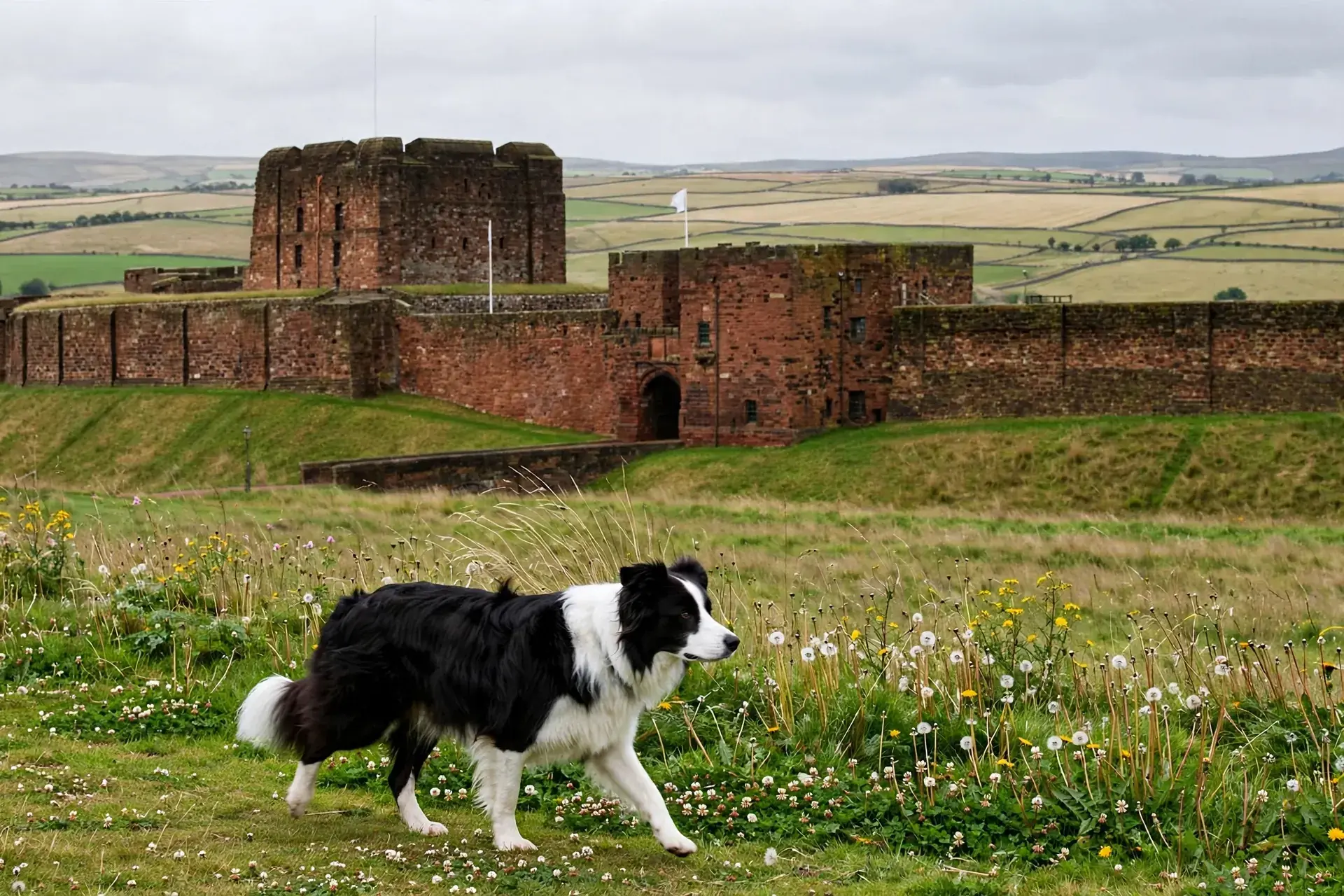
If you are extending the trip, the obvious next bases are north and south along the same coast and valley. Carlisle with a dog covers the border city an hour north, with castle grounds, the cathedral green, River Eden walks and Hadrian's Wall paths — a natural second stop if you are driving up the M6. Closer to home, the Lune Valley guide to Kirkby Lonsdale is the one to read before you choose a rural cottage, because it tells you which valley walks are genuinely easy and which ones only look easy on a map.
Getting there and parking
Lancaster is easy to reach, which is part of its appeal as a dog break. By car, the city sits just off the M6 at junctions 33 and 34, about an hour north of Manchester and an hour south of the Lake District. From the south, junction 33 and the A6 is the straightforward approach; from the north, junction 34 drops you onto the road into the city from the east. Both routes are well signposted, and the drive from the motorway to the centre takes about fifteen minutes in normal traffic. Allow more on a Friday afternoon or a bank holiday, when the M6 around Lancaster slows to a crawl and a dog in a hot car becomes a problem rather than a passenger.
By train, Lancaster station sits on the West Coast Main Line with direct services from London Euston, Birmingham, Manchester, Glasgow and Edinburgh, and a short branch line runs to Morecambe and Heysham. Dogs normally travel free on British trains when kept on a lead or in a carrier and off the seats, but the exact conditions are set by each operator, so check the official guidance before you travel. The station is a short walk from the city centre, and the walk is flat until the castle hill — which is the point at which the dog, and you, will notice the climb. If you arrive by train with luggage and a dog, take a taxi to your accommodation rather than attempting the hill with bags, a lead and a tired dog all at once.
Parking in the city centre is the usual mix of council car parks and on-street bays, and the practical choice is to park once and walk. For a day built around the park, use the Williamson Park car parks described above. For a day built around the river, the Moor Mills car park near the start of the castle-river-canal loop is a useful base. For the city centre itself, the larger car parks south of the river and around the bus station put you on flat ground near the canal towpath. Charges and opening hours change, so check the official guidance before you travel rather than relying on a figure in a guide. On sunny weekends and in school holidays, arrive before 10am: Lancaster's car parks fill early, and a dog waiting in a car while you circle for a space is a dog that is already having a bad day.
One warning that applies to every car journey in this area: never leave a dog in a parked car in warm weather, even with the windows open and even for a few minutes. A car in direct sun heats up far faster than most owners expect, and the RSPCA and the police both treat it seriously. In Lancaster the risk is highest on the coastal car parks at Morecambe, where the sun reflects off the bay and the wind makes the outside feel cooler than the inside of the car. If you cannot take the dog with you, do not bring the dog — or choose a destination where the dog can come in.
Seasons, weather and busy days
Lancaster is a four-season city, and the best season for a dog trip depends on what your dog likes rather than on the calendar. Spring is the kindest: the Lune Valley is green, the riverside paths are firm, the beaches are open to dogs until the end of April, and the city is busy enough to be lively without being crowded. Autumn is nearly as good, with the added advantage that the summer beach bans have lifted and the whole of Morecambe's sand is open again from 1 October. The light in October is low and golden, and the Lune in autumn, with the fells behind it, is the prettiest it gets all year.
Summer is the season that needs the most planning. The beach bans run from 1 May to 30 September on the two main Morecambe beaches, the city centre is at its busiest, and the riverside paths are at their most crowded with families and picnics. On the other hand, summer is when the canal towpath is at its shadiest, Williamson Park hosts its outdoor theatre, and the long evenings make a late walk along the Lune genuinely lovely. The heat is the real constraint: a dog walking on hot tarmac in the city centre needs water, shade and regular stops, and the cobbles on the castle hill hold the heat long after the sun has gone. Walk early, rest at midday, and walk again in the evening — the Mediterranean pattern suits a Lancashire summer better than a single long midday march.
Winter is the quiet season, and for many dogs it is the best. The beaches are open, the park is empty, the pubs have fires, and the city feels like it belongs to the people who live there. The costs are mud and short days: the Lune Valley paths can be boggy for weeks after rain, the canal towpath ices over in the shaded stretches, and the light goes by four o'clock. Pack a drying coat, a towel and a head torch for the last walk of the day, and plan your indoor stops — the Hall at Atkinsons, a pub by the fire — as carefully as your outdoor ones. Fireworks around early November unsettle noise-sensitive dogs, so check whether the park or nearby venues are hosting displays before you book a stay that week.
The busiest days are predictable and worth avoiding if you can: bank holiday weekends, the university's graduation weeks, the start of term, and any weekend when the weather forecast promises sunshine after a run of rain. On those days the park car parks fill by mid-morning, the riverside paths are crowded with dogs that are not all under control, and the dog-friendly pubs run out of dog-friendly tables. A weekday visit, or a Sunday morning before the crowds arrive, gives you the same city with half the friction. If you must come on a busy day, arrive early, walk the river first, and save the city centre for the late afternoon, when the day-trippers are leaving and the pubs have tables again.
What to pack for a Lancaster day
The Lancaster packing list is short, but every item on it earns its place. A lead and a long line: the lead for the city, the canal and the promenade, the long line for the riverside meadows where a dog can run without being truly off lead near livestock or water. A harness that fits properly, because a dog that pulls on the castle hill in a collar will hurt its neck, and a dog that slips a loose harness on a crowded pavement is a dog in traffic. Water and a collapsible bowl, because the Lune is not a safe drinking source in low water and the city's cafes do not all offer water. Poo bags, more than you think you need, and a sealed bag to carry them in, because the riverside bins are spaced further apart than the city-centre ones.
A towel and a drying coat are the two items that separate a comfortable Lancaster day from a damp and miserable one. The Lune, the canal and the bay all produce wet dogs, and a wet dog in a car or a pub is a problem that a towel solves in two minutes. The drying coat does the longer job: put it on after the walk and the dog dries while you drive or eat, instead of shaking water over the upholstery. Add a mat or a blanket for pub floors and cafe visits, a spare lead in case the first one gets soaked or chewed, and a small first-aid kit with a tick remover, antiseptic wipes and a bandage — the Lune Valley has ticks in the long grass from spring to autumn, and a tick found early is a tick dealt with easily.
For the dog's comfort, pack what the dog already knows: its own bed or blanket for the accommodation, its usual food measured out for the trip, and a familiar chew or toy for settling in a strange room. A new bed in a new place is a double change; the old blanket in a new place is a single one, and dogs settle faster with a single change. For the owner's comfort, pack layers and waterproofs, because the wind off Morecambe Bay cuts through a single jacket and the rain arrives without warning. Sturdy, waterproof footwear is not optional on the riverside paths after rain: the mud on the Lune Valley is deep, sticky and famous, and trainers will not survive it.
Finally, pack the information. Save the address and phone number of the nearest vet before you leave home, and save an out-of-hours number as well — rural practices around Lancaster can be twenty minutes away and close early. Keep a note of your accommodation's dog rules and pet fee, the tide times if you are going to Morecambe, and the train times if you are going by rail. None of this takes more than ten minutes at home, and all of it is much harder to sort out on a wet hillside with a dog on the lead and a phone battery at ten per cent.
Practical questions
Before you go
Can dogs go inside Lancaster Castle?
No. Dogs are not allowed inside the castle, in the courtyards or on guided tours; assistance dogs are the only exception. The castle hill, the streets around it and the views over the city and the River Lune are still open to dogs on leads, so plan the castle as an outside visit and let the rest of the party take the tour if they want to go in.
Is Williamson Park dog friendly?
Yes, the park grounds welcome dogs, and the council publishes a Park Dog Code for owners to follow. Entry to the grounds and the Ashton Memorial is free. Dogs are not allowed inside the Butterfly House or the Mini Zoo, so one person should stay outside with the dog if the rest of the party goes in. Keep dogs on a lead around the play areas and the cafe terrace.
Where can my dog paddle or swim near Lancaster?
The shallow edges of the River Lune at Crook O' Lune are the usual local choice, but the river is a working river with currents that change after rain, so keep your dog on a long line until you know the spot and never let a dog swim near weirs or the aqueduct. Morecambe Bay is not a safe paddling alternative: tides move fast and there is quicksand in places, so keep dogs on the sand near the promenade and check the official guidance before you travel.
Can dogs go on Morecambe beach in summer?
Not on the two main bathing beaches. Dogs are excluded from Morecambe North Beach and Morecambe South Beach from 1 May to 30 September, and breaching the restriction can bring a fixed penalty notice of 100 pounds. Morecambe Beach at Bare, east of the Green Street breakwater, allows dogs all year round, and dogs are allowed on the main beaches again from 1 October to 30 April. Keep dogs on a lead on the promenade all year.
How do I get to Lancaster with a dog by train?
Lancaster station sits on the West Coast Main Line with direct services from London, Birmingham, Manchester, Glasgow and Edinburgh, and a short branch line runs to Morecambe. Dogs normally travel free on British trains when kept on a lead or in a carrier and off the seats, but the exact conditions are set by each operator, so check the official guidance before you travel. The station is a short walk from the city centre, though the climb to the castle is steep.
Where should I park in Lancaster with a dog?
For a walk, use the pay-and-display car parks inside Williamson Park: the Wyresdale Road entrance has about 100 spaces and the Quernmore Road entrance about 15. For the city centre, the larger car parks south of the river and around the bus station put you on flat ground near the canal towpath. Arrive early on weekends and in school holidays, and check the official guidance before you travel, because charges and opening hours change.