This guide is independent and contains no paid placement. River levels, path conditions and access can change, so check local signs on the day.
Plan Kirkby Lonsdale as a valley walk with a gradient, not a flat town stroll. Descend by a route your dog can also climb back up, keep the dog on a lead near roads, bridges and livestock, respect river currents after rain, and build in level town rests for older dogs.
Start with the valley, not the viewpoint
Visitors often arrive in Kirkby Lonsdale with a viewpoint in mind, and the Lune Valley certainly rewards that instinct. The river, the stone bridges and the wooded slopes create a landscape that looks made for photographs. For a dog, however, the valley is first a physical experience: gradients, surfaces, smells, water and other walkers, all encountered in sequence. Starting with the valley itself, rather than a single viewpoint, leads to better decisions. Ask first how far the dog can comfortably walk, how steep a descent it can manage, and how much energy it will need for the return climb, and only then choose a viewpoint that fits those answers.
The town sits above the river, so almost every riverside walk involves a descent and a later ascent. That is not a reason to avoid the valley, but it is a reason to treat distance with caution. A walk that looks short on a map can feel long when half of it is uphill on the way back, especially for older dogs, small breeds and dogs carrying extra weight. Break the walk into stages, with a riverside rest before the climb, and do not commit to a long riverside extension if the dog is already tired. Turning back at a pleasant riverside spot is a complete walk, not a failed one.
Time of day also shapes the valley walk. Early mornings are usually quieter, with fewer walkers, cyclists and dogs on narrow riverside paths, and softer light for photographs. Midday weekends bring more people, more dogs and more congestion at bridges and viewpoints, where space to pass is limited. Late afternoons can be beautiful but bring lower light on wooded paths and a colder climb back to town. Choose the time that suits your dog's temperament and fitness, not just the time that suits a photograph.
Town to river: gradients that matter
Gradients are the defining practical feature of Kirkby Lonsdale dog walks. Some paths descend steeply, with steps, uneven surfaces and loose gravel, while road and lane routes may be longer but gentler. For a fit, young dog, a steep direct path may be enjoyable, provided the surface is safe and the dog is under control. For an older dog, a dog with arthritis, a dog recovering from injury, or a small dog that must be lifted over obstacles, that same path can be painful or risky. The right route is therefore a dog-specific choice, not a universal recommendation.
Assess a descent before committing to it. Look at the surface, the width, the presence of steps or handrails, and whether there is room to step aside for other walkers. Wet stone, fallen leaves and mud make steep paths slippery, and a dog that pulls on a descent can unbalance its owner. Keep the lead short on steep sections, walk slowly, and pause on flat sections to let the dog rest and to check that it is not lagging, panting excessively or showing stiffness. On the climb back, the same care applies: a dog that bounded down happily may climb slowly, and that slowing is information, not stubbornness.
Plan an alternative route in advance, even if you hope not to need it. A gentler road or lane route back to town, a shorter riverside loop, or a town-only walk can all serve as fallbacks if the steep path proves too much, if weather changes, or if the dog becomes tired. Knowing the fallback before you descend removes the pressure to continue, and it makes the whole day calmer. For dogs that struggle with steps generally, our wider guidance on access and steps is useful background, and local signs will confirm which paths are currently in good condition.
Devil's Bridge and viewpoints
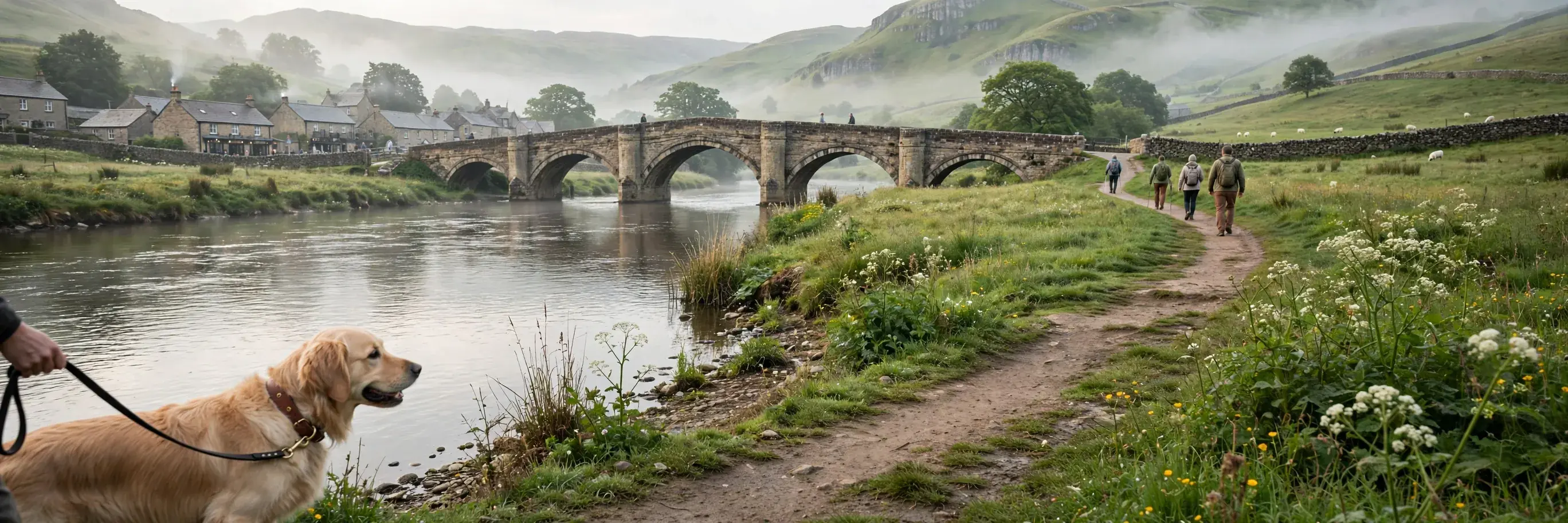
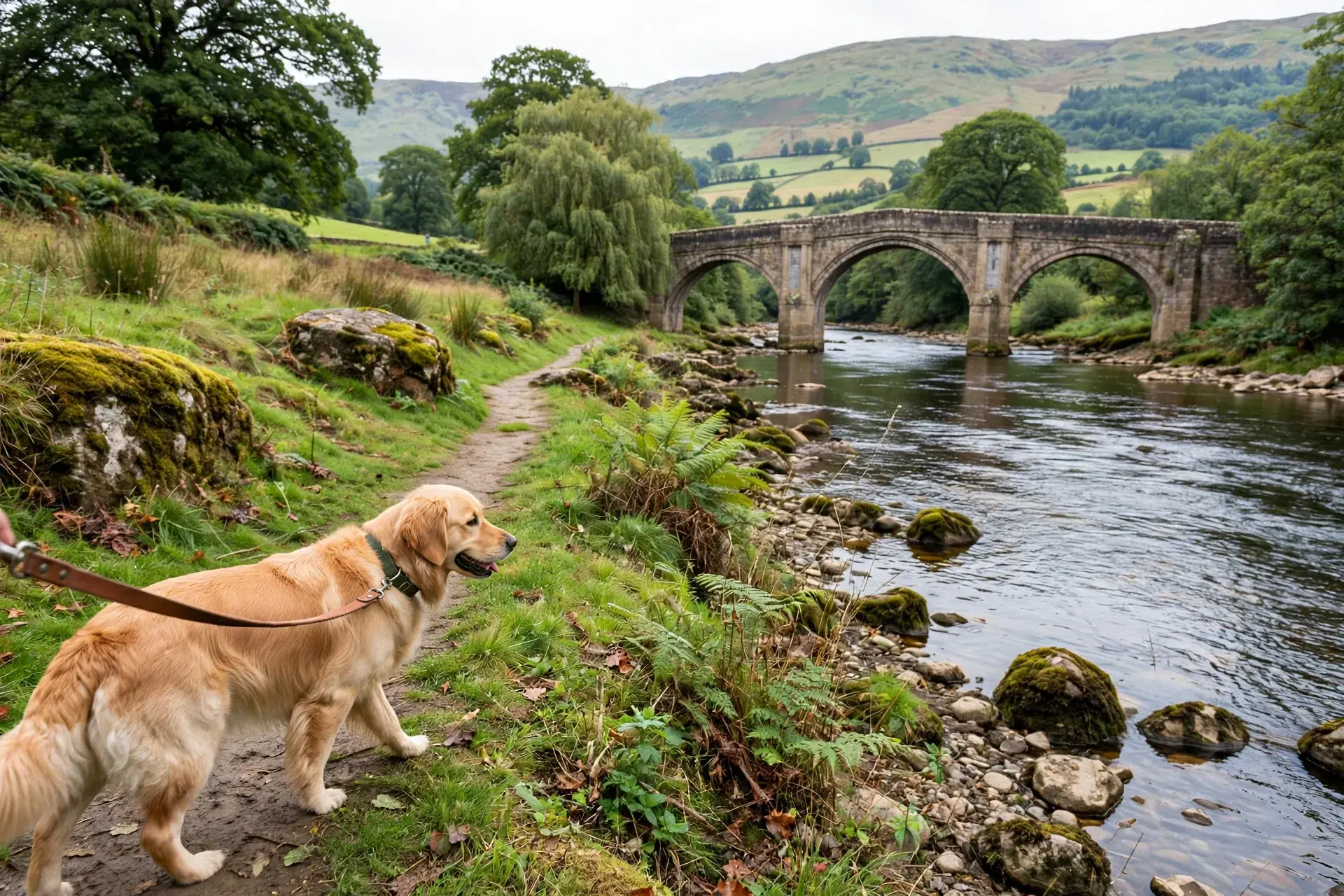
Devil's Bridge is Kirkby Lonsdale's best-known landmark, a historic stone bridge over the Lune that draws walkers, photographers and, on some days, motorcyclists and other visitors. For dog owners, the bridge is best enjoyed as a viewpoint with a plan, not as a place to linger in traffic. It is a road bridge, so dogs should be on a short lead, owners should stay on the pavement or verge, and photographs should be taken from a safe stopping point away from the carriageway. A dog that is calm on a quiet lane may still be startled by vehicles, horns and groups gathering on a bridge, so keep the visit brief and controlled.
Viewpoints around the bridge and the valley offer a chance to pause, offer water, and let the dog rest before the next stage. Choose a viewpoint with space to step aside, rather than the narrowest, busiest spot, and keep the dog close while other visitors pass. If the viewpoint is crowded, move on to a quieter riverside stretch: the valley's beauty is not confined to one famous spot, and a calm riverside bank with room to sniff is often more enjoyable for a dog than a crowded bridge parapet. Respect any signs about access, erosion or private land near viewpoints, and check the official guidance before you travel if you are unsure about a particular path.
Photographs are part of many valley visits, but they should not dominate the dog's walk. A quick photograph from a safe spot, with the dog on a lead and away from the road edge, is fine. A long photography session that keeps a dog standing on a busy bridge, in wind or rain, while the owner adjusts settings, is not. Take the photograph, reward the dog, and move on to a walk the dog can enjoy on its own terms.
Riverside paths and river safety
Riverside paths below Kirkby Lonsdale offer level walking, water smells, shade and open space, all of which many dogs love. They also bring hazards that town streets do not: fast water, deep pools, slippery banks, fishing lines, and other dogs off lead. Keep the dog on a lead where paths are narrow, where livestock may be present, or where the bank drops steeply to the water. Even a dog with good recall can be tempted by water, wildlife or another dog, and a riverside path leaves little margin for error if the dog bolts towards the river.
River swimming should never be assumed safe. The Lune's current, depth and water quality vary with recent rain, season and upstream conditions, and a river that looks calm at the edge can be fast and deep a few metres out. After heavy rain, keep dogs out of the water entirely: currents strengthen, banks become slippery, and debris in the water can injure paws and legs. Watch for local warnings about algae, pollution or strong currents, and if in doubt, allow only a brief paddle in shallow, slow water under close supervision, or no paddling at all. A dog that swims in a river also needs a plan for drying, warming and checking paws afterwards, especially in cold weather.
Other riverside users deserve consideration too. Anglers, walkers, cyclists and families with children all share narrow paths, and a dog that runs up to an angler's equipment or a child's picnic creates friction that affects all dog owners. Keep the dog close on shared paths, give way at narrow points, and clean up promptly. For general river and water safety, our guide to dog swimming safety is worth reading before a valley visit; the principle remains the same: slow, shallow and supervised, or not at all. Check local signs for any specific riverside rules on the day.
Finally, respect the riverbank itself. Erosion, nesting birds and fragile vegetation mean that some banks are best left undisturbed, and dogs should not be allowed to scramble up steep banks or disturb wildlife. Stay on marked paths where they exist, keep the dog out of reed beds and nesting areas, and leave the riverside as you found it. A careful riverside walk protects both the dog and the valley for future visitors.
Gentler routes for older dogs
Older dogs can enjoy Kirkby Lonsdale very much, provided the walk is designed around their needs. Level town streets, short flat riverside stretches, frequent bench stops and a prompt return to the car or a cafe are the ingredients of a good older-dog visit. Avoid long, steep descents and climbs, avoid routes with many steps, and avoid surfaces that are slippery when wet. A walk of twenty or thirty minutes on level ground, with time to sniff and rest, is often more satisfying for an older dog than an hour-long valley circuit that leaves it stiff and exhausted.
Watch for the signs that an older dog needs to shorten the walk: slowing pace, lagging behind, reluctance to climb, stiffness after resting, heavy panting, or a change in gait. These signs are not complaints; they are the dog communicating its limits. Respond by shortening the route, finding a bench, offering water, and heading back by the gentlest available route. A portable mat for cafe stops, a coat for cold or wet weather, and a towel for drying all help older dogs recover quickly after a walk.
For older dogs that cannot manage the valley descent at all, a town-only visit is still worthwhile. Kirkby Lonsdale's streets, shops and cafes, combined with a short, level walk and a rest, can make a complete day out without any steep gradient. Do not feel that a visit has failed because the river was not reached: the dog's comfort is the measure of success, and a calm town walk that ends with a settled dog is a better outcome than a valley walk that ends with a limping companion.
Town streets, cafes and rests
After a valley walk, Kirkby Lonsdale's town streets offer a natural place to rest, eat and recover before the drive home. Choose a cafe with outdoor seating or a dog-welcome indoor area, settle the dog on a mat, offer water, and allow time for the dog to dry and relax. A rushed cafe stop, where the dog is still wet, panting and overstimulated, is less restful than a longer, calmer stop after a riverside rest. Our guide to dog friendly cafes explains how to check policies and settle a dog indoors, and those tips apply directly here.
Town streets themselves are part of the walk, not just a route to a cafe. They are generally level, with shops, benches and quieter side streets that suit a post-valley stroll. Keep the dog on a lead, watch for traffic at junctions, and avoid narrow pavements where the dog could be squeezed between shop fronts and passing vehicles. If the dog is tired after the valley, keep the town walk short: a brief circuit and a cafe rest are enough, and the car should not feel like a long march away.
Shopping with a dog in town needs the same care as in any market town. Check door signs, ask staff, and do not leave a dog tied outside a shop or in a car while you browse. If a shop cannot welcome the dog, plan who stays with the dog, or enjoy the street and window displays instead. Small courtesies, such as prompt clean-up and keeping the dog out of walkways, keep Kirkby Lonsdale welcoming for dogs, because traders notice them.
Seasons and river levels
Spring and summer bring longer days, more walkers and fuller riverside paths, but also higher river levels after rain and more insects near water. Autumn often offers the calmest valley walks, with cooler air, fewer crowds and beautiful woodland colour, although fallen leaves can hide uneven surfaces and muddy banks. Winter brings quieter paths, colder water and shorter days, so valley walks should be shorter, earlier and better planned, with a torch or light for late-afternoon returns and a warm, dry place to recover afterwards.
River levels deserve attention in every season, but especially after sustained rain. A river that was safe for paddling one week can be fast and dangerous the next, and riverside paths can flood or become slippery. Check recent weather, look at the river before allowing any paddling, and be prepared to change plans if the water is high, fast or discoloured. When in doubt, stay on town streets and high paths, and save the riverside walk for a drier day. That caution is not overcaution; it is the difference between a pleasant valley visit and a dangerous one.
Finally, remember that Kirkby Lonsdale rewards patience. A valley walk that is planned around gradients, river safety and the dog's energy will feel spacious and enjoyable, while a walk that ignores those factors can feel rushed and stressful. Plan the descent, enjoy the river, save energy for the climb, and end with a calm town rest. That rhythm, repeated on future visits, will make the Lune Valley a place your dog associates with calm, interesting walks rather than exhausting climbs.
Which dogs suit the valley best
Fit, confident dogs that enjoy water, varied terrain and longer walks will thrive on Kirkby Lonsdale's valley routes, provided they are kept on a lead near roads, bridges and livestock and kept out of dangerous water. Young, excitable dogs need shorter valley loops, careful management around other dogs on narrow paths, and frequent rests, because their enthusiasm can outrun their fitness on steep gradients. Puppies should have very short valley exposure, with level paths and plenty of rest, because steep descents and riverbanks are not suitable for developing joints.
Nervous dogs may find busy bridges and viewpoints difficult, but quiet riverside stretches early in the morning can suit them well, provided distances from other dogs are generous and exits are clear. Reactive dogs need wide paths, early starts and a plan to avoid narrow pinch points where close passes are unavoidable. If a reactive dog becomes overwhelmed on a valley path, retreat to a wider, quieter stretch or return to town, rather than pushing through a crowded section.
Older and less mobile dogs, as described above, suit gentler town and short riverside routes best. Their Kirkby Lonsdale visit should be measured in calm minutes and bench stops, not in miles or viewpoints reached. A visit that ends with a settled, comfortable dog, whether or not the river was reached, is a successful visit, and it leaves the dog willing to return to this beautiful valley again.
A sample valley day, step by step
A well-planned Kirkby Lonsdale day begins in town, not at the river. Park, give the dog a toilet and water stop, and walk a short, level town circuit so the dog can adjust to the place before any descent. Check the weather, look at the river level from a safe viewpoint if possible, and choose a descent route that the dog can also climb back up. That early decision, made while everyone is fresh, prevents most valley problems, because it avoids committing a tired dog to a steep climb later in the day.
The descent itself should be slow and controlled, with the dog on a short lead, pauses on flat sections, and attention to surface and footing. At the river, allow time to sniff, rest and enjoy the valley, but keep the dog away from fast or deep water and keep the visit to a length that leaves energy for the return. A riverside bench, a shaded bank and a drink of water are all part of the walk, not delays to it. When the dog begins to slow, or when the planned time is up, start the climb back while the dog still has energy in reserve, rather than waiting until it is exhausted.
Back in town, a cafe rest completes the day. Dry the dog if it has paddled or walked through wet grass, offer water, settle it on a mat, and allow a proper rest before the drive home. A final short town stroll and a toilet stop near the car leave the dog settled and comfortable. This step-by-step rhythm, town, descent, river, climb, rest, is what makes Kirkby Lonsdale enjoyable for dogs, because it respects the valley's gradients instead of fighting them.
Practical questions
Before you go
Is the walk from Kirkby Lonsdale to the River Lune steep?
Some routes descend quite steeply from the town to the river, while others are gentler. Choose a route to suit your dog, allow extra time for the climb back, and use a gentler road or lane route for older or less mobile dogs.
Can dogs walk across Devil's Bridge in Kirkby Lonsdale?
Devil's Bridge is a road bridge, so keep dogs on a short lead, stay on the pavement or verge, and watch for traffic. Enjoy the view from a safe stopping point rather than lingering in the road, and check the official guidance before you travel if access arrangements change.
Is it safe for dogs to swim in the River Lune?
River swimming depends on current, depth, recent rain and water quality, so do not assume it is safe. Keep dogs out after heavy rain, avoid fast or deep water, and check for local warnings about algae or pollution before allowing any paddling.
Where can older dogs walk in Kirkby Lonsdale?
Older dogs usually do best on level town streets, gentle riverside stretches and short, flat loops with frequent bench stops. Avoid steep descents and long climbs, and plan a shorter route that ends near the car or a cafe.
Where should I park in Kirkby Lonsdale with a dog?
Use a town car park, note its location, and give the dog a toilet and water stop before the river walk. On busy weekends central parking fills early, so arrive early or accept a slightly longer, flatter walk from a quieter car park.