This guide is independent and contains no paid placement. If affiliate links are added later, they will be clearly marked and will not change our editorial checks.
Lavenham suits a slow visit: walk the leaning timber-framed streets first, add a short field loop when your dog still has energy, then finish in a pub garden or tea room. Keep your dog on a lead in the village, check the official guidance before you travel for indoor access and path closures, and plan around mud and livestock on the field paths.
Start where the houses lean
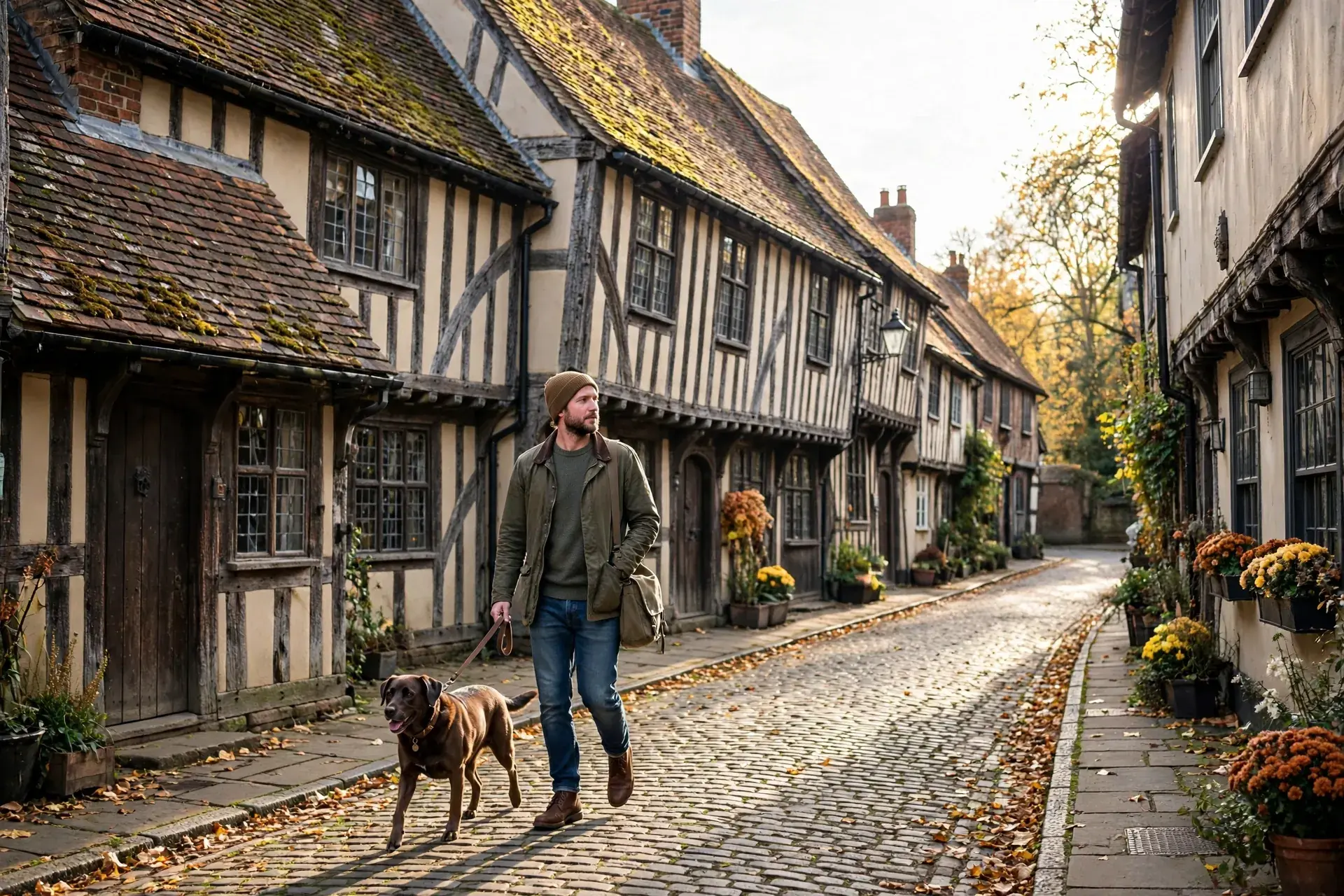
The first thing you notice in Lavenham is not a single attraction but a whole street that seems to have settled at a slight angle. The timber-framed houses along the High Street and around the Market Place lean, bow and sag in ways that would worry a surveyor anywhere else, and here they are simply the village. They are the visible legacy of a wealthy wool town: in the fifteenth and sixteenth centuries Lavenham grew rich on cloth, and merchants built tall, decorated timber houses that have survived, warped timbers and all, into the present day. For a dog walk, that history is unusually convenient, because the best of it is outdoors and free to enjoy at whatever pace your dog sets.
Walk slowly on purpose. Dogs read a village through smells, and Lavenham gives them a dense sequence of them: bakery doorways, shop thresholds, churchyard grass, garden walls and the occasional cat watching from a window. A brisk march past the prettiest houses misses the point and winds a dog up; a slow wander with regular sniffing stops leaves most dogs calmer by the time you reach the church. If your dog pulls towards every doorway, keep the lead short through the narrowest stretches and reward a loose lead whenever the pavement widens. The pavements here are old and sometimes narrow, so step into a doorway or a wider patch to let other walkers pass rather than squeezing past on a tight lead.
Look up as you walk, because the upper storeys tell the story. Overhanging jettied floors, pargeted plasterwork and twisted chimney stacks crowd above the street, and the effect changes with the light: morning sun picks out the plaster patterns, while late afternoon throws the leaning fronts into long shadow. Autumn is a particularly good season for this walk, when low sun warms the pink and cream plaster and the trees in the churchyard turn. Take photographs from across the street where the pavement allows, and keep your dog close while you do it, since the same narrow pavements that make the village charming also leave little room for a long lead and a camera at the same time.
The Market Place is the natural pause in the middle of the walk. It is small enough to feel like a village square rather than a tourist stage, and it gives a dog a chance to sit, drink and watch the world before the second half of the day. Sit on a bench or a low wall, offer water, and let your dog settle for ten minutes. A settled dog copes far better with the busier stretches that follow than a dog that has been marched from the car park to the church without a break. If you are travelling with children, this is also the moment to agree the plan: village first, fields second, pub last, with no rushing between them.
One practical warning belongs at the start rather than the end. Lavenham's charm is also its hazard for dogs: narrow pavements beside a road that still carries traffic, low walls that tempt jumping, and shop doorways at nose height full of interesting smells and occasionally food. Keep food out of reach, keep the lead short near the road, and do not let your dog drink from puddles near the road after rain, when run-off can carry grit and oil. None of this should stop the walk; it simply means the village rewards the same slow, attentive style that makes the rest of the day work.
The village loop, step by step
A good village loop takes about an hour at a dog's pace, including sniffing stops, and needs no map beyond the street pattern itself. Begin at the village car park and walk into the centre on foot, which immediately sets the right rhythm: you arrive as a walker, not as a driver hunting for a space in a narrow street. Head for the High Street first, where the timber-framed fronts are at their most theatrical, then drift towards the Market Place and the Guildhall, the grand timber building that anchors the village centre. You do not need to go inside anything to enjoy this loop; the architecture is the attraction, and it is all visible from the street.
From the Market Place, continue towards the church of St Peter and St Paul, whose tall tower dominates the village skyline and gives the walk a natural destination. The churchyard is a welcome change of surface after pavement: grass, trees and space to breathe, and a good place for a longer sniffing break. Keep your dog on a lead in the churchyard out of respect for the setting and for other visitors, and check the official guidance before you travel if you hope to go inside, since access arrangements for historic churches vary with services, events and restoration work. Even from outside, the church is worth the walk: its scale says more about Lavenham's wool wealth than any single house, and the tower is a useful landmark if you lose your bearings in the smaller lanes.
Loop back through the quieter side streets rather than retracing the High Street. These lanes are where Lavenham feels most like a lived-in village: smaller cottages, garden gates, washing lines and far fewer visitors. Dogs often relax noticeably here because the footfall drops and the smells become domestic rather than commercial. Watch for cats, which are a feature of these lanes, and for narrow corners where a dog can appear suddenly in front of a cyclist or another walker. A short lead and a habit of pausing at corners keeps these encounters friendly.
Finish the village loop where you started, or at a tea room if the timing suits. This matters more than it sounds: dogs that know the route is circular, with a rest at the end, settle better than dogs dragged onwards indefinitely. If your dog is still full of energy, that is the signal to head for the field loop below rather than adding another circuit of the same streets. If your dog is flagging, skip the fields without guilt and go straight to the pub garden section of the day. Lavenham is a village that rewards doing less, well, and a short happy visit beats a long tired one every time.
For visitors combining Lavenham with a longer Suffolk trip, the village pairs naturally with the county's coast. Our guide to the Suffolk coast with a dog covers beaches, seasonal restrictions and quieter stretches, which helps if you want a seaside second day after a village first day. The contrast is the point: one day of leaning streets and hedgerow lanes, one day of open sand and sea air, with the same packing list and the same unhurried pace.
The field loop beyond the village
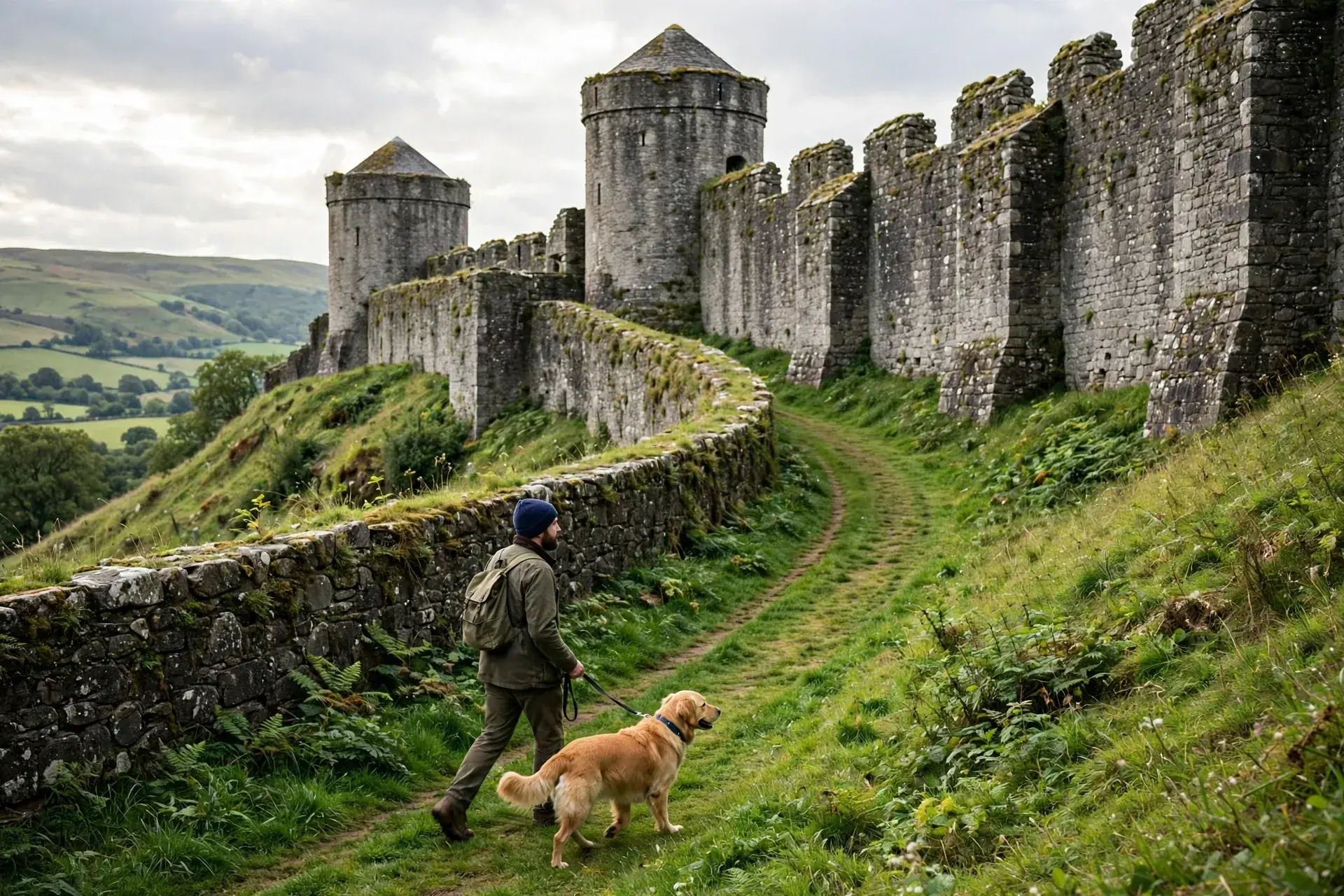
The field loop is what turns a pretty village stroll into a proper dog walk. Signed public footpaths lead out of Lavenham into the rolling Suffolk countryside, through hedgerows, across open arable fields and along quiet lanes, and a circular route of two to four miles suits most dogs. You do not need to plan an expedition: choose a loop that returns to the village by a different lane, keep the total distance honest about your dog's fitness, and leave plenty of time for sniffing, because a field walk is a dog's newspaper and rushing it defeats the purpose.
Expect the practical realities of a working landscape. Footpaths cross farmland, which means stiles, gates, uneven ground and, at some times of year, livestock. Keep your dog on a lead near sheep and cattle, and on a short lead wherever the path runs beside a road or through a farmyard. Lambing season, roughly spring, deserves extra care: ewes with lambs are easily stressed, and a loose dog in a lambing field can cause real harm even without chasing. If a path is closed or diverted, follow the diversion rather than improvising a shortcut across a crop, and check the official guidance before you travel for any longer-term closures or access changes.
Underfoot conditions decide how enjoyable the loop feels. Suffolk field paths are often heavy clay, which is firm and pleasant in a dry spell and gloriously muddy after rain. In wet weeks, expect sticky sections that coat paws and lower legs, and plan the return accordingly: a towel in the car, a drying coat for the dog, and shoes you do not mind cleaning. In dry summer weeks the same paths are dusty and the hedgerows offer the only shade, so carry water even for a short loop and watch for overheating in thick-coated or older dogs. After harvest, stubble fields can be sharp underfoot, so a quick paw check at each stile is a sensible habit all year round.
Navigation deserves a sentence of its own. Village footpaths are usually waymarked, but markers can be faded, overgrown or knocked askew, and a phone map with the route downloaded before you leave is worth more than a signal-dependent app in a field with patchy reception. Tell someone your rough route if you are walking alone, carry a charged phone, and remember that the village tower is a visible landmark for much of the surrounding countryside. If you are unsure at a junction, retracing to the last confident marker is always better than pressing on into an unknown field.
The reward for the effort is a different Lavenham. From the fields, the village appears as a cluster of roofs and a church tower in a green bowl, and the contrast with the close-up timber streets is striking. Dogs, too, behave differently out here: the open air, the long sightlines and the freedom to sniff a hedgerow properly often settle a dog that was fizzing in the village. A long line gives a good compromise on open sections, offering freedom without losing control near livestock or roads. Finish the loop by a quiet lane back into the village, slow the pace for the last ten minutes, and let the dog arrive at the pub or tea room already calm rather than still buzzing from the fields.
Where dogs can and cannot go
The honest answer for Lavenham, as for most historic villages, is that the outdoors is reliably dog-friendly and the indoors varies. Streets, lanes, the churchyard on a lead and the field footpaths are all open to dogs, and that already covers the best of the visit. Indoor access is a patchwork: some shops welcome dogs, others prefer them to wait outside; some historic buildings allow dogs in certain areas only; and policies can change with the season, an exhibition or a private event. Treat every indoor hope as something to confirm on the day, and you will never be disappointed.
The Guildhall deserves a specific note because it is the building most visitors ask about. It is a magnificent timber-framed guildhall at the heart of the village, and its status as a historic property means access rules are set by its managing organisation rather than by the village. Dog policies at such properties change with exhibitions, conservation work and the time of year, so check the official guidance before you travel rather than relying on a general statement in any guide, including this one. Plan the day so that the Guildhall exterior, the Market Place and the streets carry the visit, and any indoor access is a welcome extra.
Shops and galleries are generally worth asking about individually. Many independent village shops are happy to welcome a well-behaved dog, particularly outside peak hours, while food shops and smaller galleries may reasonably ask dogs to wait outside. A quick question at the door, a short lead and a dog that can wait calmly for two minutes will open more doors than any policy list. If one person in your party wants to browse a shop that does not admit dogs, take turns outside with the dog rather than leaving the dog tied up alone, which is stressful for the dog and unfair on passers-by.
Churches follow their own rhythm. A church open for quiet visiting may welcome a calm dog on a lead, while the same church during a service, wedding or concert will not be the right place for one. The churchyard is the safer default: it is beautiful, peaceful and dog-appropriate on a lead, and it gives you the tower, the trees and the village view without any uncertainty. If you do step inside with permission, keep the visit short, the lead short and the dog close, and leave promptly if the dog cannot settle.
Finally, remember that assistance dogs have legal access rights that pet dogs do not, and that distinction is respected throughout this guide. Everything here about checking policies and asking at the door applies to pet dogs; if you travel with an assistance dog, the relevant access law applies and staff will advise on any practical arrangements. When in doubt about any venue, a polite question and the official guidance for that venue will always give you a better answer than a guess.
Pubs, tea rooms and good manners
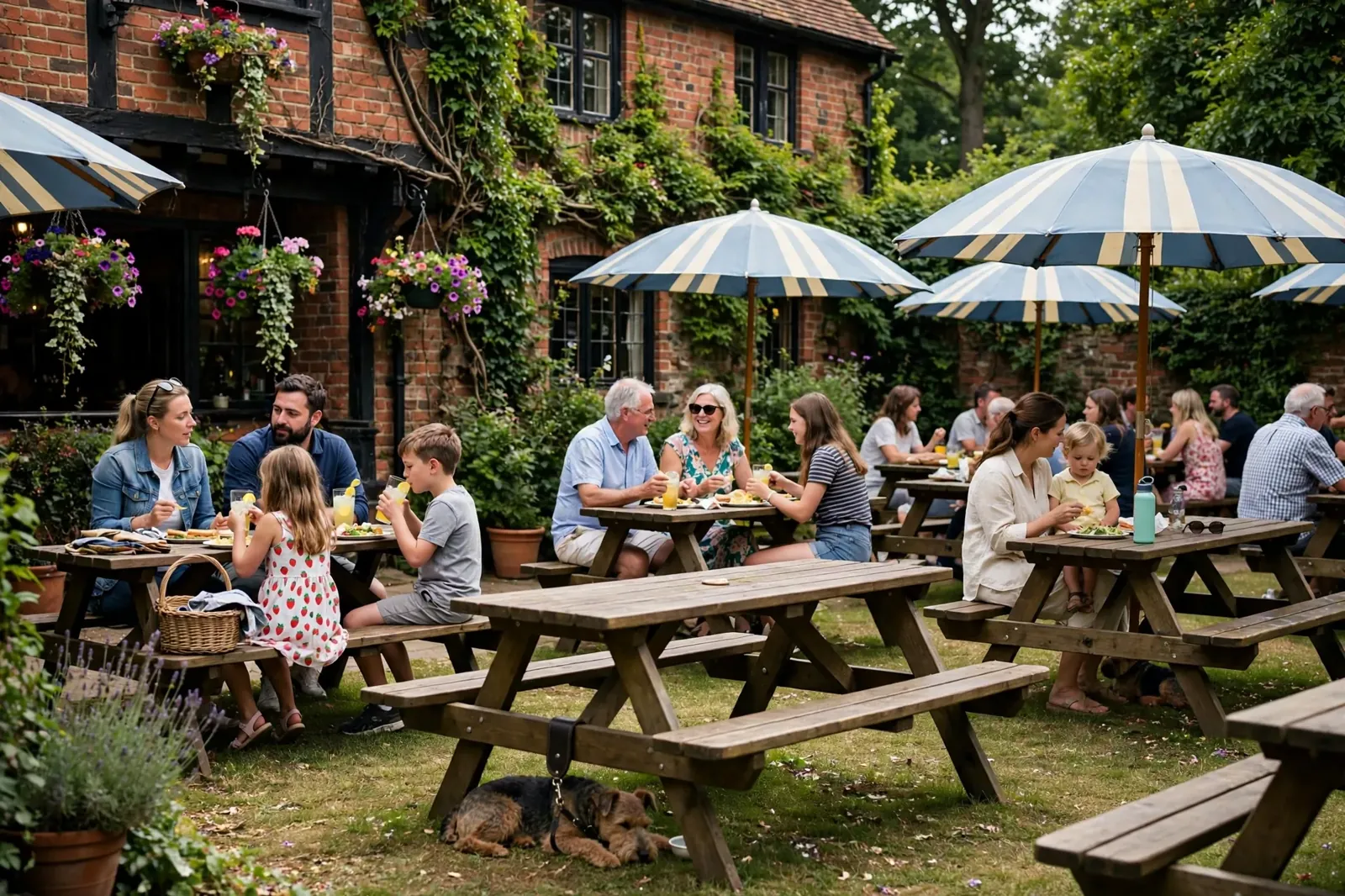
Lavenham's pubs and tea rooms are a genuine part of the day, not an afterthought, and most dogs will tell you so by steering towards the first open door that smells of food. Many village pubs welcome dogs in at least part of the building, often the bar or the garden, while restaurant rooms may be dog-free; tea rooms vary similarly. The pattern to expect is a patchwork rather than a blanket rule, so ask at the door, accept the answer gracefully, and choose the room you are offered rather than negotiating for another. Our guide to dogs in pub gardens covers the details of leads, tables and other dogs, and it is worth a read before a village pub day.
A few manners make the difference between a welcome dog and a tolerated one. Keep your dog on a short lead under the table, not stretched across a walkway where staff carry hot food. Bring a mat or blanket so the dog has a defined place to settle, and a water bowl so you are not borrowing crockery. Order promptly and settle the dog before food arrives, because a dog that has already relaxed is far less interested in neighbouring plates. If your dog barks at other dogs, choose a quiet corner or the garden edge, and be ready to step outside for a calming minute rather than letting a barking match develop indoors.
Tea rooms call for the same approach with one addition: they are often smaller and quieter than pubs, so a large or excitable dog can dominate the room without meaning to. A small table near the door, a short visit and a dog that can lie quietly will be remembered fondly by the staff, while a long, restless visit in a tiny room will not. If the tea room is busy, consider a takeaway and a bench in the Market Place instead; eating outside with a dog is often more relaxing for everyone, and Lavenham's square is a pleasant place to do it.
For a longer trip, it helps to know how to spot genuinely welcoming cafes elsewhere in Britain, not just in one village. Our guide to dog friendly cafes in the UK explains how to check indoor access before you go and what indoor etiquette actually looks like in practice. The skill transfers directly: a phone call or a quick check before arrival, a mat and water bowl in your bag, and a willingness to sit where dogs are welcome rather than where you first fancied sitting.
One last practical point: never leave a dog alone in a car while you eat, in any season. A car parked in autumn sun can still warm quickly, and a dog left alone in an unfamiliar village is a worried dog. If your party cannot all eat together with the dog, take turns, eat outside, or choose a takeaway. Lavenham is compact enough that this is easy to arrange, and it keeps the day's slow, kind rhythm intact.
Parking and arrival
Arrive like a walker, not like a driver looking for a doorstep space. Lavenham's streets are narrow and historic, and circling them in a car while a dog waits in the back is a poor start to a slow day. Use the signed village car park, park once, and walk into the centre from there. The walk in is part of the visit: it gives the dog a first stretch, a first sniff of the village, and a calm transition from car to street.
Timing matters more than route. Weekday mornings are the calmest arrival, with space in the car park and quiet streets. Weekend late mornings are the busiest, when day visitors, wedding parties and coach groups can coincide; if you must arrive at a busy time, an early start and a field loop first, village second, can dodge the worst of the crowds. School holidays, bank holidays and the run-up to Christmas, when the village is famously decorated, are the peak periods, so a dog that dislikes crowds will do better on an ordinary weekday.
Before you set off, sort the small things that make arrival smooth. Note where the public toilets are, since village facilities are not always obvious from the car park. Carry water for the dog from the start rather than assuming a shop will be open, and keep poo bags in a pocket rather than in the car. If you are staying overnight, confirm your accommodation's dog arrangements before arrival: where the dog sleeps, whether the dog can be left briefly, and where the last outing of the evening will be. A calm first hour at a new place sets the tone for the whole stay.
Satellite navigation deserves a caution. Postcodes for historic villages can drop you at a broad area rather than a precise entrance, and narrow lanes do not forgive a wrong turn gracefully. Use the car park as your destination rather than a street address, and check the official guidance before you travel for current parking charges, time limits and any seasonal changes. Arriving ten minutes later but unstressed is a better trade than arriving on time after three loops of the one-way system.
Seasons in Lavenham
Spring brings the first real field-walking season. Hedges green up, lambs appear in the surrounding fields, and the village shakes off winter quiet. This is the season for the strictest livestock manners: keep dogs on leads near sheep, give ewes and lambs a wide berth, and remember that a dog that has never seen a lamb can still cause harm by excitement alone. Spring showers also mean the first mud of the year, so the towel habit starts early and stays all year.
Summer is the busiest and brightest season, and the one that needs the most planning for dogs. The streets fill, tea rooms queue, and the sun heats the plaster fronts and the pavements alike. Walk early or late, carry water, and watch for hot pavement on a dog's paws in a heatwave; grass and shade are kinder surfaces than sun-baked stone. Summer is also the season when the field loop needs shade planning: hedgerow shade helps, but open arable stretches offer none, so a short loop with water stops beats a long exposed one.
Autumn is, for many dog walkers, Lavenham's best season. The crowds thin after the summer holidays, the light turns low and golden, and the hedgerows and churchyard trees colour up. The village's pink and cream plaster looks its best in autumn sun, and the field paths, while muddier, are quieter and full of smells that keep dogs happily occupied. This is the season for the slow day this guide describes: village streets in the morning, a field loop in the afternoon, a pub garden while the light lasts.
Winter has its own quiet charm and its own cautions. The village is at its calmest, the timber frames look stark and graphic against a grey sky, and a crisp frosty walk followed by a pub fire is hard to beat. Short days mean planning the field loop for daylight, and wet winter mud is at its deepest, so boots, towels and a drying coat are essential rather than optional. Around Christmas the village draws visitors for its decorations, and that period can be as busy as summer, so check the official guidance before you travel if you are planning a festive visit with a dog that dislikes crowds.
For nervous, older or reactive dogs
Lavenham can work beautifully for a nervous or reactive dog, provided the day is built around that dog rather than around a sightseeing list. The key is control of exposure: choose a weekday, arrive early, walk the quieter side streets first, and keep encounters short and at a distance. A dog that can watch the world from a bench in the Market Place for ten calm minutes is learning that the village is safe; a dog dragged through the busiest stretch at midday is learning the opposite.
Older dogs need a different kind of planning. Shorten the village loop, skip the stiles on the field loop or choose a lane-based circuit instead, and build in rest stops with water and a comfortable surface. Cobbled or uneven pavements can be hard on arthritic paws and stiff joints, so watch your dog's gait and cut the walk short at the first sign of tiredness rather than pushing on to a planned destination. A dog pushchair or a car-based plan, with short walks from a parked car, is a perfectly respectable way to enjoy Lavenham with a very old dog.
Reactive dogs benefit from the field loop more than the village streets, because open space gives you the distance that narrow pavements cannot. Use a long line on open sections, keep the dog on a short lead near gates and stiles where other dogs appear suddenly, and practise a simple turn-away routine before the trip so you have a plan for surprise encounters. If the village centre feels too much, there is no shame in enjoying Lavenham from its edges: the lanes, the churchyard at a quiet hour and the field paths are all Lavenham too.
For all three groups, the pub or tea room needs care. Choose a quiet table, visit outside peak hours, and keep the stay short the first time. A dog that can settle for twenty minutes in a calm pub garden has had a successful outing, and a second, longer visit can build on it. Bringing a familiar mat, a chew or a long-lasting treat gives the dog a job while you eat, and leaving before the dog becomes restless preserves the good experience for next time.
A slow half-day and full-day plan
The half-day plan is the heart of this guide and suits most visitors. Arrive mid-morning and park once. Spend an hour on the village loop: High Street, Market Place, churchyard and a drift back through the side lanes. Pause for water and a rest in the Market Place. Then either take a short field loop of about an hour, or go straight to a pub garden or tea room for lunch, depending on your dog's energy. Finish with a slow wander back to the car, with a final toilet stop and a towel if the fields were muddy. Total time: three to four hours, with no rushing at any point.
The full-day plan adds a second act without adding hurry. Follow the half-day plan in the morning, then after lunch take a longer field loop, aiming for two to three miles at a leisurely pace with plenty of sniffing stops. Return to the village for a second rest, perhaps a different tea room or a quiet bench, and finish with a final slow circuit of the prettiest street in evening light. The full day works best when the middle is genuinely restful: a dog that naps in the car or at your feet between walks will enjoy the afternoon loop far more than a dog that has been on the go since morning.
If you are staying overnight, the evening walk is a pleasure worth protecting. Lavenham after the day visitors leave is quiet, the light is soft, and a short evening loop around the lanes gives the dog a final outing without any crowds. Keep the evening walk short and on familiar streets, carry a torch or a light for the dog's collar on unlit lanes, and finish with the same calm routine you use at home. Dogs settle better in a new place when the last walk of the day is predictable.
Whatever length of visit you choose, keep one rule: the dog's energy is the itinerary. A plan that flexes around a tired, nervous or overexcited dog will always beat a plan that marches on regardless. Lavenham rewards that flexibility more than most places, because its pleasures are all close together and none of them requires a timetable. Slow down, follow the leaning streets, and let the village set the pace.
What to pack
Packing for Lavenham is simple, and getting it right removes most of the day's friction. Start with the lead system: a short lead for the village streets, and a long line for the open field sections. Add a harness that fits well and does not rub on a long walk, a water bottle and a collapsible bowl, and more poo bags than you think you need, since village bins and field bins are not always where you expect them.
Mud gear is the second category. A towel in the car, a second towel in your bag for emergencies, and a drying coat for the dog will handle everything from a damp churchyard to a properly muddy field loop. For you, shoes with grip matter more than smart shoes: wet clay, uneven pavements and grassy churchyards are all unforgiving in smooth soles. In summer, add sun protection for yourself and shade planning for the dog; in winter, add a dog coat for short-coated or older dogs and a torch for the walk back to the car.
The third category is comfort: a mat or blanket for pub and tea room floors, a chew or quiet toy for settling, any medication your dog needs, and a basic first-aid kit including a tick remover in the warmer months. Ticks are a reality of hedgerow and long-grass walking, so check your dog after the field loop and remove any tick promptly. Finally, carry your phone charged with an offline map of the area, the car park location saved, and the number of a local vet noted before you need it. None of this is heavy, all of it fits in a small day pack, and together it turns a good village day into an easy one.
Practical questions
Before you go
Can dogs go inside the Guildhall in Lavenham?
Policies at historic houses can change with the season and the exhibition, so check the official guidance before you travel. As a rule, plan your visit around the outside of the building and the village streets, and treat any indoor access as a bonus to confirm on the day rather than a promise.
Are dogs allowed in Lavenham pubs and tea rooms?
Many village pubs and tea rooms welcome dogs, but the rule varies from room to room within the same building: a bar or garden may welcome dogs while a restaurant room does not. Ask at the door, keep your dog on a short lead under the table, and bring a mat and water bowl so the visit stays easy for staff and other guests.
Is there a good circular walk from Lavenham for dogs?
Yes. A gentle village loop followed by a field loop works well: start on the timber-framed streets, then take a signed footpath out past hedgerows and open fields and return by a quiet lane. Expect stiles, possible livestock and muddy sections after rain, so keep your dog on a lead near farm animals and check the official guidance before you travel for any temporary path closures.
Where can I park in Lavenham with a dog?
Use the signed village car park and walk into the centre from there, rather than circling the narrow streets looking for a space. Arriving early on a weekend gives you a calmer start, and leaving the car in one place for the whole visit keeps the day slow and simple. Check the official guidance before you travel for current charges and any time limits.
When is the quietest time to visit Lavenham with a dog?
Weekday mornings outside school holidays are usually the calmest, when the streets are quiet and tea rooms have space. Autumn weekdays are a particular pleasure: low light, fewer visitors and hedgerows full of colour. Summer Saturdays and bank holidays are the busiest, so if your dog dislikes crowds, plan an early start and a field loop before the village fills.
What should I pack for a muddy field walk around Lavenham?
Pack a short lead and a long line, a water bottle and bowl, poo bags, a towel and a drying coat for the car journey home. After rain, Suffolk field paths can be heavy clay mud, so boots with grip for you and a quick paw check for your dog at every stile are worth the effort. A spare towel in the boot turns a muddy return into a minor event rather than a disaster.