This guide is independent and contains no paid placement. If affiliate links are added later, they will be clearly marked and will not change our editorial checks.
Lewes rewards dogs that like hills and sniffing. The castle itself admits only assistance dogs, but the streets around it, the River Ouse towpath, the Railway Land Nature Reserve, Southover Grange Gardens and the climb onto the Downs are all open to dogs on leads, and the High Street is one of the most dog-welcoming in Sussex. The one day to avoid entirely is 5 November: Bonfire Night is not suitable for dogs, and visitors are asked not to travel to the town at all.
A county town with a castle
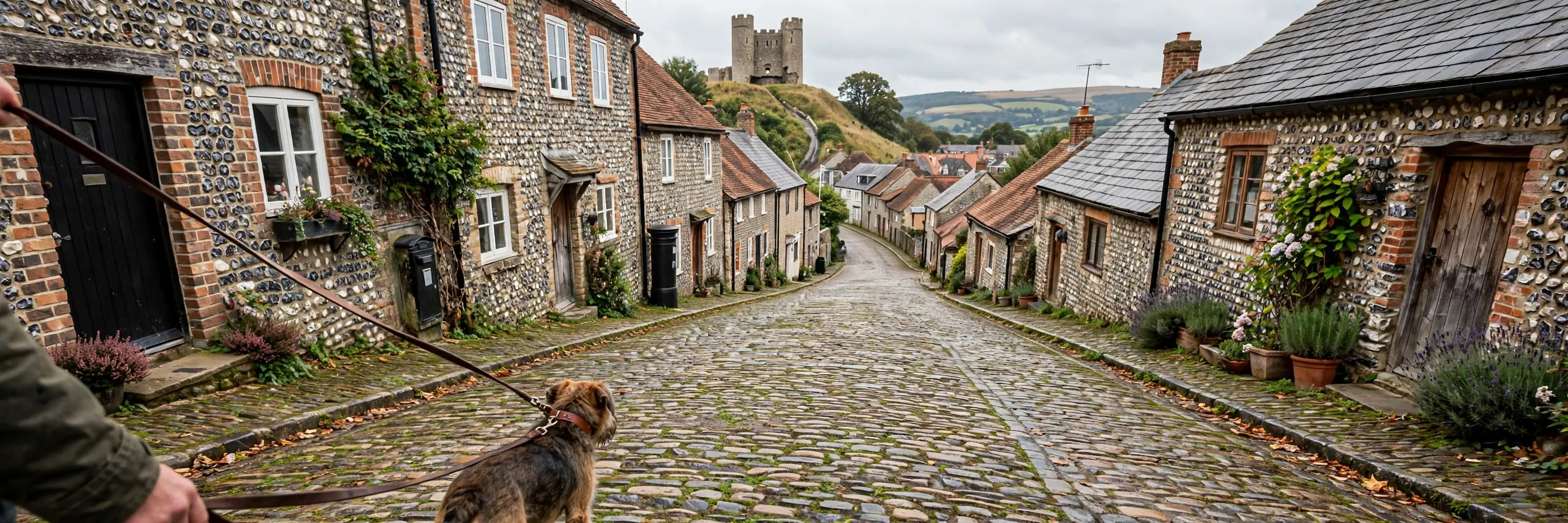
Lewes is the county town of East Sussex, and it wears the title in stone. The town sits in the gap where the River Ouse cuts through the South Downs, about seven miles inland from the sea, and its streets climb steeply from the river at Cliffe up to the castle on its chalk mound. Flint is everywhere: in the walls of the cottages, in the garden boundaries, in the church towers, in the very pavements. The local building stone is knapped flint set in lime mortar, often with brick dressings, and once you have walked one Lewes lane you will recognise the pattern in every other one. For a dog, the town is a sequence of smells and gradients — malt from the Harvey's brewery at the bottom of Cliffe High Street, baking from the High Street, river mud at the Ouse, chalk dust on the Downs — and the gradients are real. Some of the lanes, known locally as twittens, are steep enough that an older dog will want to take them slowly, and the cobbles of Keere Street and Castle Ditch Lane can be hard on paws in wet weather, when the flint turns slick.
The town's shape is the first thing to understand, because it decides how you plan a walk. Lewes is not a flat grid. The High Street runs along the ridge from the castle at the top down towards the war memorial and the station, while Cliffe High Street runs parallel to the river at the bottom, and Southover sits across the other side of the Ouse, reached by the bridge at the end of Southover Road. Between the ridge and the river, narrow twittens drop down the slope: Keere Street from the castle to the High Street, Church Twitten beside St Anne's church, and the steep steps of Castle Ditch Lane. A sensible loop with a dog starts at the station, climbs gently through the gardens at Southover Grange, crosses into the town centre, works up the High Street to the castle, and comes back down by a different twitten so the dog gets new smells instead of retracing its steps. That loop is roughly two miles and takes most dogs between an hour and ninety minutes with sniffing stops, which makes it a good half-day outing rather than a full day's march.
History is unavoidable here, and it is worth knowing a little of it before you arrive, because it explains the street names and the buildings you will keep stopping to look at. Lewes was founded as a Saxon burh, taken over after the Norman Conquest by William de Warenne, who built the castle and the great Cluniac priory at Southover. The Battle of Lewes was fought just outside the town in 1264, when Simon de Montfort defeated Henry III on the slopes of Mount Harry. In the sixteenth century, seventeen Protestant martyrs were burned in the town during the reign of Mary I, and their memory is carried every year by the bonfire societies. In the nineteenth century the town became a brewing centre — Harvey's of Lewes still brews at the Bridge Wharf brewery beside the river — and in the twentieth it became a byword for independent shops, second-hand bookshops and political argument. None of this is scenery for its own sake: the priory ruins, the castle, the brewery and the bonfire societies are the landmarks your walk will keep passing, and knowing what they are turns a pleasant stroll into a proper day out.
Getting there is straightforward, and the train is the easiest option for most dog owners. Lewes station is served by Southern trains from London Victoria via Gatwick and Haywards Heath, from Brighton, from Eastbourne and Hastings, and from Seaford. Dogs travel free on these services, on a lead and under control, and the station sits at the foot of the town, a few minutes from the High Street and the river. Drivers should note that the town centre is compact and parking is limited; the station car park, the Eastgate Street car park near the river, and the long-stay car park at North Street are the most useful, and all of them leave you a short walk from the centre. The A27 runs past the town, linking Brighton to Eastbourne, and the A26 comes down from Tunbridge Wells through the Weald. Check the official guidance before you travel if you are driving on a Saturday, when the farmers' market and the antique shops pull in extra traffic, and on 5 November, when the town effectively closes to visitors.
The best time to bring a dog is a weekday morning in spring or autumn, when the town is quiet, the light on the flint is at its best, and the Downs are not crowded. Summer weekends bring coach parties to the castle and the High Street, and the narrow pavements can feel cramped with a large dog on a lead. Winter has its own appeal: the town is at its most itself, the pubs are warm, and the low sun picks out the chalk cliffs at the edge of Cliffe. Whatever the season, bring water for the dog, because the climb from the river to the castle is a genuine workout, and there are few public drinking fountains on the way up. A short lead is more useful than a long line in the town centre, where the pavements are narrow and the twittens are barely wide enough for two people to pass.
Lewes Castle and the Barbican
Lewes Castle is the town's centrepiece and the reason the skyline looks the way it does. It is a Norman motte-and-bailey castle, built soon after the Conquest by William de Warenne, and it is unusual in having two mottes — the great mound carrying the keep, and a smaller mound known as the Brack Mount, joined by a curtain wall. The castle is run by the Sussex Archaeological Society, and a ticket covers both the castle and Barbican House Museum across the street. Adult tickets cost £12 at the time of writing, with concessions and family tickets available, and the site is generally open Tuesday to Sunday from 10am to 5pm, with last admission half an hour before closing. Check the official guidance before you travel, as hours shorten in winter and the castle closes on some Mondays.
The important fact for dog owners is simple: only assistance dogs are allowed inside the castle and the museum. Pet dogs cannot go through the barbican gate, cannot climb the keep, and cannot wait inside the museum shop. This is not a policy worth arguing about at the gate; the site has steep slopes, uneven paths and a great many steps, and the keep climb is a narrow spiral staircase that would be miserable for most dogs anyway. The practical answer is to split the visit. One person takes the castle ticket and the climb — the view from the top of the keep, across the Ouse valley and out to the Downs, is the best in the district — while the other walks the dog around the castle's outer circuit. Castle Precincts, the grassy area below the keep, and the streets that ring the castle mound all give fine views of the flint walls, and the dog gets a proper sniffing walk while the castle visitor gets the panorama.
The walk around the outside is worth doing in its own right. Start at the Barbican, the stone gateway at 169 High Street, where the museum sits in a late sixteenth-century timber-framed house. The Barbican itself is a handsome piece of medieval defensive architecture, with a portcullis groove still visible, and the street in front of it is one of the prettiest in Lewes, with Keere Street dropping away to the left and the flint cottages of Castle Ditch Lane to the right. From the Barbican, follow Castle Ditch Lane down and around the base of the mound, where the curtain wall runs above you and the gardens of the houses below are full of the kind of planting that dogs find endlessly interesting. Turn up Southover Road and you come to the Priory ruins, which are the subject of the next part of this walk, and then circle back up the High Street. The whole circuit is under a mile, but it is steep in places, and the cobbles need care in the rain.
Barbican House Museum, across the street from the castle gate, holds the Museum of Sussex Archaeology, with finds from the Stone Age to the medieval period and a model of Lewes as it was in the 1880s. Like the castle, it admits only assistance dogs, so the same split-visit logic applies. The museum's garden, however, is a pleasant place to sit with a dog while the other half of the party looks at the exhibits, and the benches there are a good spot for a sandwich and a water break. The combined ticket also covers Anne of Cleves House, a fifteenth-century timber-framed house on Southover High Street that was once part of the queen's divorce settlement from Henry VIII; it too admits only assistance dogs, but the street outside it, with its flint cottages and the church of St John the Baptist, is one of the most atmospheric corners of the town for a dog walk.
A word about the keep climb for the human half of the party: it is steep, the steps are worn and uneven, and the viewing platform at the top is exposed to the wind. Allow forty-five minutes to an hour and a half for the castle and museum together, and wear shoes with grip, because the chalk and flint underfoot are slippery when wet. If your dog is nervous of crowds, avoid the castle area on summer Saturdays and on the first Saturday of the month, when the farmers' market fills the High Street. The castle precincts are at their quietest on weekday mornings, and that is also when the light on the flint walls is at its warmest, which is why photographers favour the early hours.
The River Ouse walk
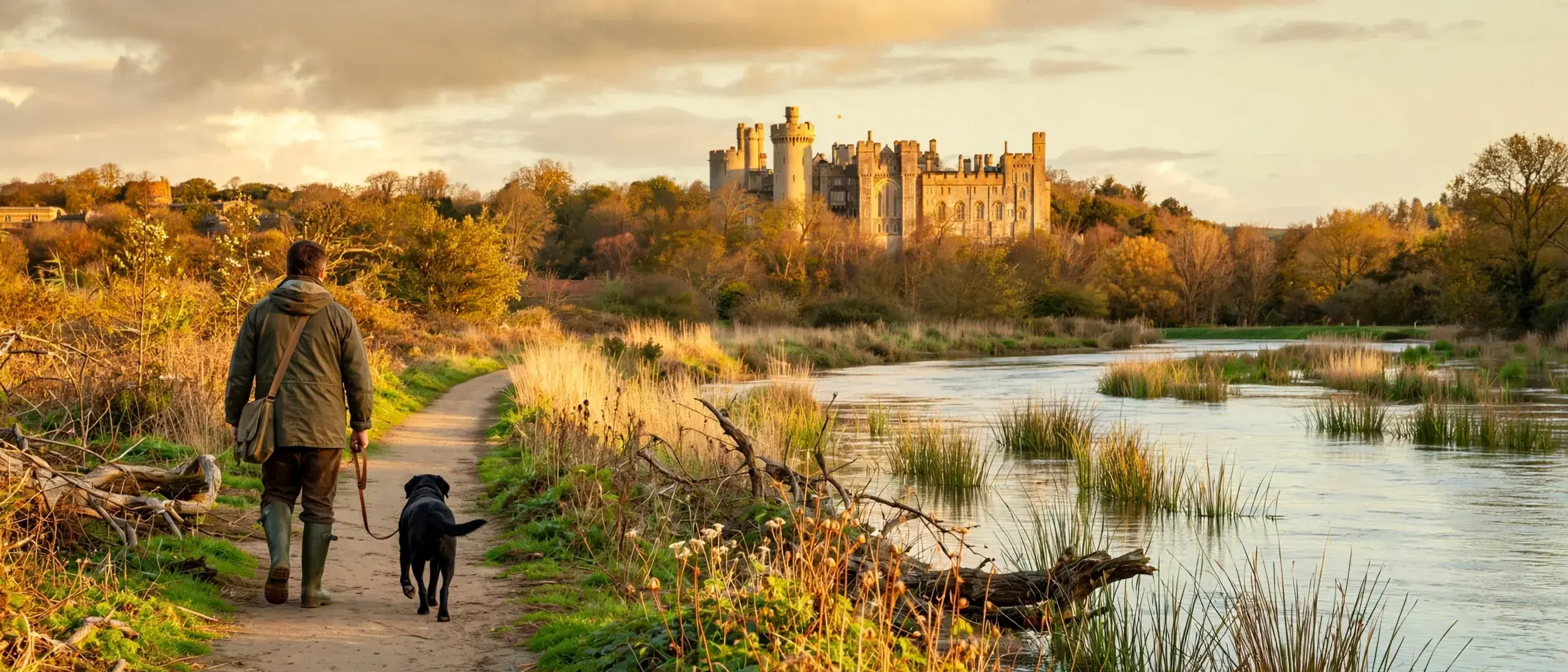
The River Ouse is the other half of Lewes, and for most dogs it is the better half. The river rises in the Weald, flows south through the gap in the Downs at Lewes, and reaches the sea at Newhaven, and it is tidal as far as the town — the water level at the bridge by Harvey's brewery rises and falls with the tide, and at low water the mud banks are exposed and full of wading birds. The walk along the river is flat, which comes as a relief after the castle climb, and it is the place to let a tired dog amble, sniff and cool off. The classic riverside loop starts at the station, follows the footpath along the west bank of the Ouse past the Railway Land Nature Reserve, and returns along the east bank through Southover, with the bridge at the bottom of Southover Road joining the two sides.
The Railway Land Nature Reserve is the first stop, and it deserves an unhurried visit. It sits on the old railway sidings beside the river, just south of the station, and it is now a mosaic of grassland, wet willow woodland, floodplain meadow, reeds and drainage ditches, managed by the Railway Land Wildlife Trust. The paths are mostly level and many are wheelchair accessible, which also makes them kind to older dogs and to puppies that are still building up their stamina. Dogs are welcome and many owners let steady dogs off the lead on the open grassland, but keep the lead on near the ditches and the riverbank, where the water is deep and the banks are undercut, and around the grazing areas, where cattle and sheep are sometimes present. The reserve is a Site of Special Scientific Interest, so the usual countryside rules apply: keep dogs out of the reed beds in the breeding season, pick up after them, and stay on the marked paths where the signs ask for it. In spring the meadows are full of wildflowers, in summer the willows give shade, and in winter the floodplain does what floodplains do — it floods, and the paths can be under water after heavy rain, so check the official guidance before you travel in wet weather.
From the reserve, the footpath continues south along the river towards the A27 and the open Ouse valley, and this is where the walk opens out. To the east the Downs rise in a long chalk ridge, to the west the river meanders through water meadows, and the path is a proper towpath, wide enough for walkers, cyclists and dogs to pass each other without fuss. Herons stand in the shallows, little egrets stalk the ditches, and in winter the valley fills with wigeon and teal. The path is part of the longer Ouse valley route that runs from Lewes down to Newhaven, about nine miles, and if you have a fit dog and a full day, the walk to Southease and back is a rewarding half-day, with the church at Southease and the YHA at the old station as landmarks. Most visitors, though, will turn back at the first bridge or after an hour, and that is enough: the river walk is about the rhythm of the water and the width of the sky, not about the distance covered.
The return leg through Southover is the quieter half of the loop. Cross the river at the bridge by Harvey's brewery — the brewery itself is a Lewes landmark, a red-brick tower brewhouse that has been brewing on the site since the eighteenth century, and the smell of malt hangs over Cliffe on brewing days — and walk up Southover High Street, past Anne of Cleves House and the church of St John the Baptist, to the Priory ruins. The Priory of St Pancras was the first Cluniac priory in England, founded by William de Warenne and his wife Gundrada in the years after the Conquest, and its remains are now a quiet, grassy site where dogs on leads are welcome to wander among the walls. The priory was largely demolished after the Dissolution, and its stone was reused all over the town — Southover Grange, the subject of the next section, was built from priory stone — so the walk from the priory to the Grange is a short lesson in how Lewes recycled itself. Allow an hour for the full riverside loop, longer if the dog insists on investigating every ditch, and carry water in summer, because there is little shade on the towpath once you leave the reserve.
Two practical notes. First, the river is tidal and the mud is real: a dog that goes in at low tide will come out coated in grey Ouse mud, which is why the riverside car park at Eastgate Street is a good place to finish, with a towel in the car. Second, the towpath is shared with cyclists, some of them fast, so keep the dog on a short lead on the narrow sections and teach a reliable recall before letting them off on the open grassland. If you want a longer day, the Ouse walk connects with the South Downs Way, and our guide to walking the South Downs Way with a dog covers the chalk ridge routes that climb out of the valley above Lewes.
Southover Grange and the gardens
Southover Grange Gardens are the town's green sitting room, and they are the best place in central Lewes to give a dog a calm break between the castle climb and the High Street. The gardens surround Southover Grange, a Grade II* listed house built in 1572 from stone taken from the dissolved Lewes Priory, and they sit just south of the station, between Southover Road and the Priory ruins. The house itself is now used as council offices and a wedding venue, so the dog's business is with the gardens rather than the building, and the gardens are generous: lawns, mature trees, herbaceous borders, a rose garden, and a walled area that catches the sun on a cold morning. Dogs on leads are welcome throughout, and the flat paths make the gardens a good choice for older dogs that have had enough of the town's hills.
The gardens are at their best in late spring and early summer, when the borders are in full flower and the scent carries across the lawns, but they are worth visiting in any season. In autumn the trees turn — the copper beech near the Grange is a local landmark — and in winter the bare branches open up views across to the castle and the Downs that the summer leaves hide. The lawns are a popular spot for picnics, and the benches under the trees are the natural place to sit with a sandwich while the dog rests in the shade. There is a small cafe in the gardens in the summer months, and the kiosk serves drinks and ice cream, but its hours vary with the season, so check the official guidance before you travel if you are counting on it. The gardens are also the venue for community events through the year, including open-air theatre in the summer and the occasional farmers' market stall, and on event days the lawns fill up, so a nervous dog may prefer a quieter hour.
From the gardens, the Priory ruins are a two-minute walk, and the two sites belong together. The ruins of the Priory of St Pancras cover a substantial area of grass and low walls, with the outlines of the great church, the chapter house and the cloister still readable in the ground plan. Gundrada's tombstone, one of the most famous pieces of Norman sculpture in England, was found here. Dogs on leads can wander the site freely, and the open grass is a good place for a game of fetch if the dog is steady and the site is quiet, though it is a historic monument rather than a dog park, so keep the lead on when other visitors are around. The priory site is managed by the Sussex Archaeological Society, and the same care that applies at the castle applies here: no digging, no climbing on the walls, and no letting the dog chase the rabbits that live in the banks.
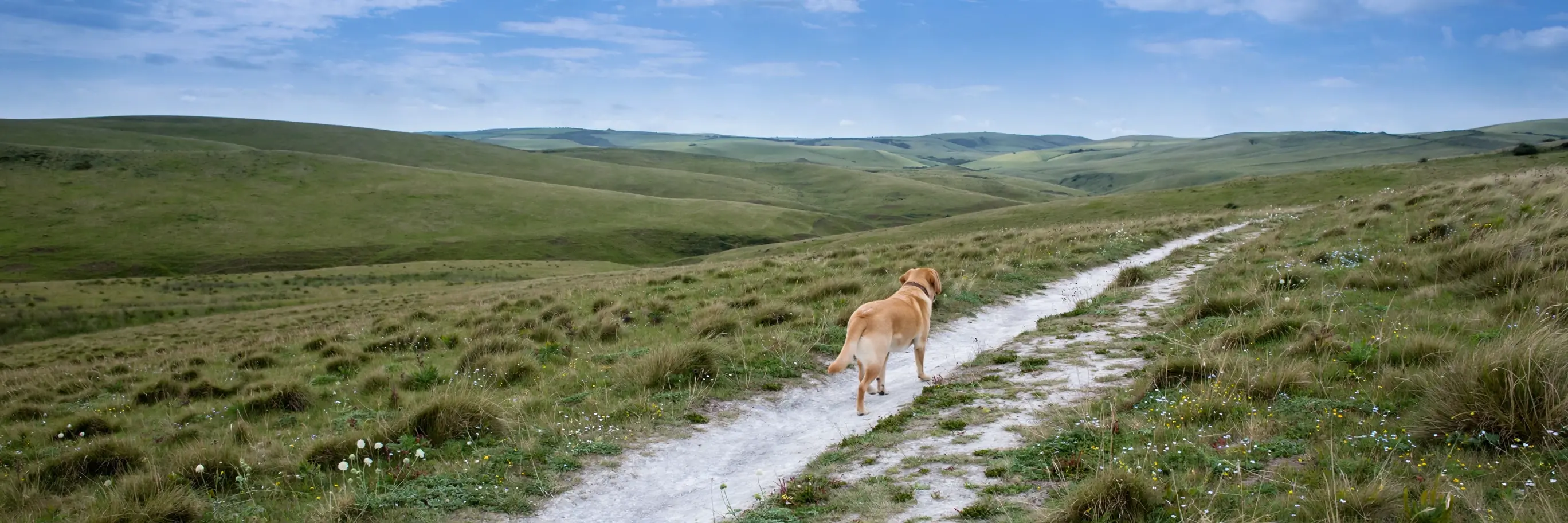
South of the gardens, the land rises towards the Downs, and the walk up to Mount Caburn starts from the edge of Southover. Mount Caburn is an Iron Age hillfort, a distinctive rounded hill that dominates the view east of Lewes, and the climb from the town to its summit is about a mile and a half of steady uphill walking on chalk grassland. The views from the top are superb — across Lewes, the Ouse valley, Glynde and the Weald — and the hillfort's ramparts make a fine place for a dog to explore on a lead. The chalk grassland is flower-rich in summer, with orchids and butterflies, and the path can be slippery after rain, so wear boots with grip and keep the dog close on the steeper sections. Mount Caburn is a good half-day extension to the gardens visit, and it is the natural next step for a dog that has finished the town walk and still has energy to burn. Our guide to the South Downs Way covers the longer chalk routes that pass over Caburn's shoulder.
One more garden deserves a mention, because it is easy to miss. The garden of the Grange is public, but the small garden at St John the Baptist church in Southover, with its yew trees and its view of the priory, is a quieter spot, and the churchyard at St Anne's on the High Street is another. Neither is a destination in itself, but both are the kind of place where a dog walker ends up sitting for ten minutes on a sunny afternoon, and that is often the best part of a Lewes day.
The High Street: shops and cafes
The High Street is the spine of Lewes, and it is where the town's reputation for independence is most visible. The street runs from the castle at the top down to the war memorial and the station, and it is lined with a mix that is hard to find anywhere else in Sussex: second-hand bookshops, a famous cheese shop, a wholefood store, a brewery shop, a violin maker, a shop selling nothing but buttons, and a series of cafes and pubs that have been serving the town for generations. The pavements are narrow and the street is busy on Saturdays, so a dog on a short lead is the practical choice, and the best approach is to walk the street slowly, letting the dog sniff the shop fronts while you browse, rather than trying to cover it at marching pace.
The shops that matter most to dog owners are the ones that welcome dogs inside. Harvey's Brewery Shop, at the bottom of Cliffe High Street by the brewery, sells the brewery's beers and merchandise and is used to dogs, as is the case with most of the town's independent shops — Lewes is a town where a dog in a shop is normal rather than exceptional, and many shopkeepers keep a jar of treats behind the counter. The bookshops are a particular pleasure: the town has several, and the best of them have dogs of their own asleep in the aisles, which is a reliable sign. The cheese shop, the wholefood store and the delicatessens are generally happy to have a well-behaved dog on a lead, though food hygiene rules mean some food shops ask you to leave the dog at the door, so check the sign or ask before you walk in with a large dog. The antique shops on the upper High Street are worth a look, but they are full of fragile things at tail height, so keep the lead short and the dog close.
Cafes and pubs are where Lewes really earns its dog-friendly reputation. The town has an unusual number of pubs for its size — a legacy of its brewing history and its bonfire societies — and many of them welcome dogs, often with water bowls, treats and a fire in winter. The Dorset Arms on Cliffe High Street is the headquarters of Cliffe Bonfire Society and has been for around 160 years, and it is a proper old pub with a dog-friendly bar. The Snowdrop Inn, at the edge of town under the chalk cliffs, has two sunny gardens and a welcome aimed squarely at walkers and dogs, and it is the natural finishing point after a walk on the Downs. The John Harvey Tavern, the brewery tap, sits beside the river and is a good place for a drink and a plate of food after the Ouse walk. On the High Street itself, the cafes range from the long-established to the new, and most of them have outdoor seating in the summer where a dog is welcome without question. Policies change by venue and by season, and some places allow dogs in the bar but not in the dining room, so check the official guidance before you travel or ask at the door before settling in — and if you are planning a meal, it is worth ringing ahead, because the most popular places fill up on Saturdays.
Two shopping notes are worth remembering. First, the farmers' market, held on the first Saturday of the month in Cliffe, is a delight and a crush: the stalls sell local cheese, bread, meat and vegetables, and the crowds are dense, so a nervous dog is better left out of the thickest part of it, or visited early before the crowds build. Second, the town's charity shops are unusually good, and the bookshops' bargain bins are a Lewes institution, but both are best enjoyed with a dog that will settle at your feet while you browse. If the dog is restless, the better plan is to walk the river first, tire the dog out, and then do the High Street at a leisurely pace with a tired dog, which is a much more civilised way to shop.
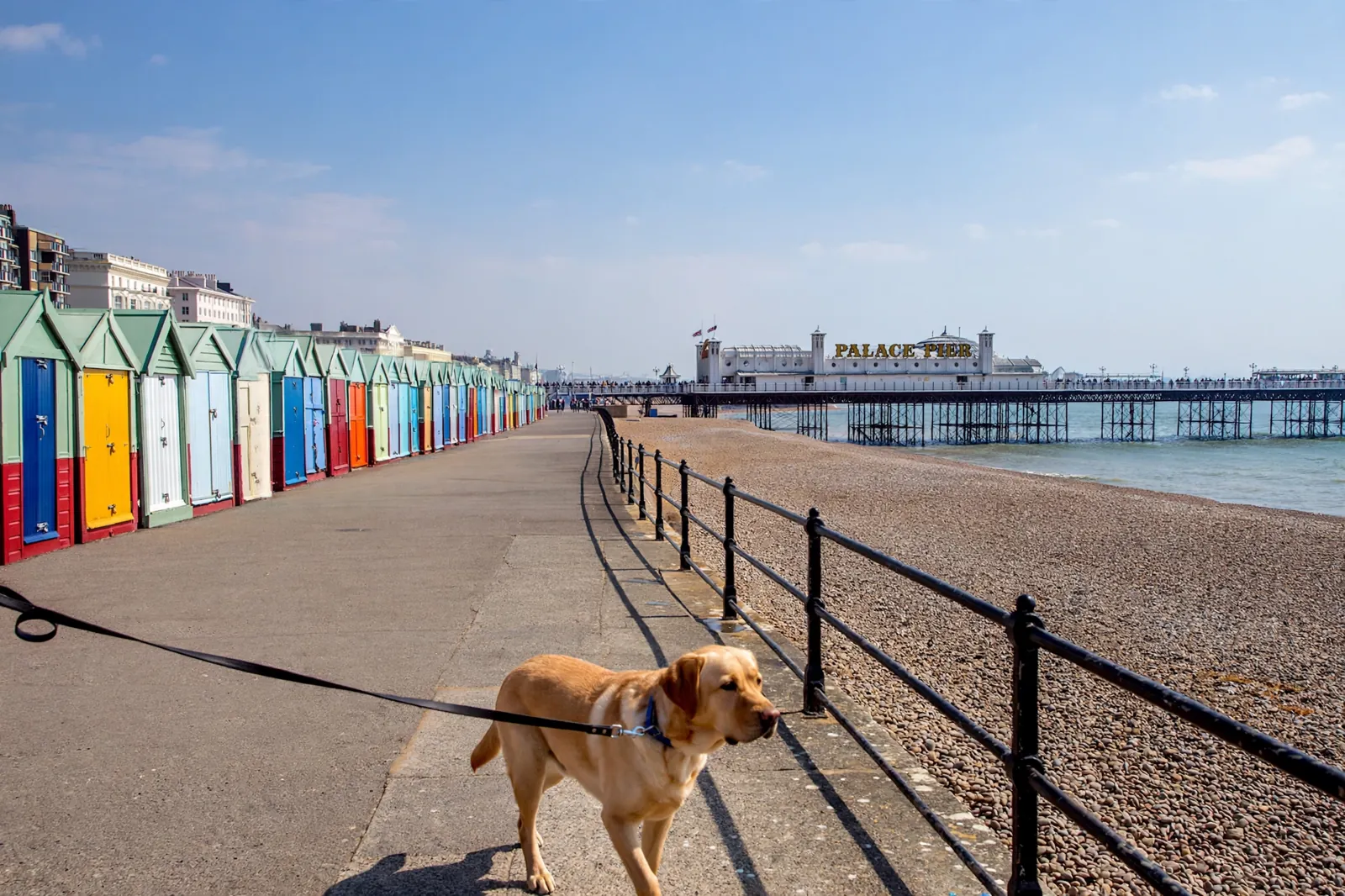
For a longer break, Lewes makes a good base for the Sussex coast and the Downs, and the town's accommodation includes several dog-friendly options, from bed and breakfasts in the old town to self-catering cottages on the edge of the Downs. The town is also an easy train ride from the coast: Brighton is about twenty minutes by train, and our guide to Brighton with a dog covers the seasonal beach rules and the promenade, while Arundel with a dog makes a good pairing for a second day, with its castle, river walks and riverside town centre. Lewes rewards a slow pace, and the best High Street days are the ones where the dog sets the tempo and the shopping fits around it.
Bonfire and the town's dog rules
No guide to Lewes with a dog is complete without a serious word about Bonfire Night, because it is the one day of the year when the town that welcomes dogs most warmly asks you, plainly, to stay away. Lewes Bonfire Night, on 5 November, is the most famous bonfire celebration in Britain. Six bonfire societies — Cliffe, Southover, Commercial Square, Waterloo, Borough and Nevill Juvenile — hold their own torchlit processions through the narrow streets, with burning crosses, flaming tar barrels, drums and fireworks, commemorating the seventeen Protestant martyrs burned in the town under Mary I and the Gunpowder Plot of 1605. The first organised societies date from 1853, and the tradition has grown into an event that draws tens of thousands of people into a town built for a few thousand. The streets are narrow, the crowds are dense, the noise is extreme, and the smoke hangs in the valley.
Every year, East Sussex Fire and Rescue Service and Sussex Police publish the same advice, and it is worth quoting in full because it is unambiguous: the event is not suitable for young children or dogs, and non-residents are asked not to travel to Lewes on 5 November at all. The fire service's statement for the most recent celebration said there "remain serious concerns about overcrowding in the narrow streets of Lewes", and Lewes District Council's own guidance says the same of children, young families and vulnerable adults. The practical measures are extensive. Six roads close at 4.45pm — the A27 junction with the A277 at Ashcombe roundabout, the A275 Offham Road with the B2116 Plumpton Road, the C7 Kingston Road with the C324 Wellgreen Lane, the A26 with the A2029 Malling Street, the A26 Church Lane with Mayhew Way, and The Drove from Hamsey Lane to the A275. Parking restrictions start at noon, parking is not permitted at Brooks Industrial Estate on the day, and visitors are told not to bring a vehicle into town at all. Trains do not call at Lewes, Falmer, Cooksbridge, Glynde or Southease from 5pm until the start of service the next morning. Residents are told to get their cars home before 4pm. The message is consistent across every authority: if you do not live in Lewes, go to a display nearer home.
For a dog owner who lives in or near Lewes, the advice is equally clear. Keep the dog indoors for the whole evening, with the curtains drawn, the television or radio on to mask the bangs, and a safe den — a crate with a blanket over it, or a room away from the street — ready before the processions begin. Walk the dog well before the evening, in daylight, and do not take them out again until the morning. If the dog is noise-sensitive, speak to a vet in advance about calming measures; do not wait until the day itself. The bonfire societies themselves are not the enemy here — they are a community tradition, and many society members own dogs — but the event is a participant celebration, not a visitor spectacle, and a dog in the middle of a torchlit procession in a narrow street is in genuine danger. The week after Bonfire Night is also worth care: the streets are littered with firework debris, spent sparklers and broken glass, so keep the dog on a lead and watch what they pick up until the clean-up is done.
Away from Bonfire Night, the town's everyday dog rules are the ordinary English ones, but they are worth stating because Lewes has its own quirks. Dogs must be kept on a lead on the High Street and in the town centre, and on the towpath where it is narrow and shared with cyclists. The Railway Land Nature Reserve and the open Downs allow off-lead walking for steady dogs, but grazing animals are present on parts of the Downs, and the law requires dogs to be under close control around livestock — a dog that chases sheep can be shot by the farmer, and that is not a figure of speech. The town's parks and gardens, including Southover Grange Gardens, require dogs on leads. Fouling must be picked up everywhere in the town, and the bins are frequent enough that there is no excuse. The riverside is a particular case: the Ouse is tidal, the mud is deep in places, and a dog that goes in at low tide can get stuck, so keep the lead on near the bank unless you know the spot well.
Finally, a note on the town's other great tradition, which is less dramatic than Bonfire but just as Lewesian. Lewes is a town of societies, clubs and arguments, and its pubs are the headquarters of bonfire societies, its shops are cooperatives, and its noticeboards are full of meetings. A dog walker who comes back to Lewes more than once will start to recognise the same faces on the river path, the same dogs in the same pubs, and the same shopkeepers with the same treats. That is the real reward of bringing a dog to Lewes: the town is small enough to learn, steep enough to tire a dog out properly, and welcoming enough that the dog is treated as a guest rather than a problem. Come on a quiet weekday, climb to the castle, walk the river, sit in the Grange gardens, and finish in a pub garden with a tired dog at your feet. Avoid 5 November. Check the official guidance before you travel for the details that change — castle hours, cafe policies, road closures — and the town will do the rest.
Practical questions
Before you go
Can my dog go inside Lewes Castle?
Only assistance dogs are allowed inside Lewes Castle and Barbican House Museum. Pet dogs cannot go through the barbican or up the keep, so plan for one person to stay outside with the dog, or admire the castle from Castle Precincts and the streets below, where the flint walls and the keep make a fine walk in themselves.
Where can my dog run off the lead near Lewes?
The Railway Land Nature Reserve beside the River Ouse has open grassland where many owners let steady dogs off the lead, and the lower slopes of the South Downs above Lewes offer long off-lead stretches once you are clear of the town. Keep dogs on a lead near the riverbank, around grazing animals, and on any path shared with cyclists, and check the official guidance before you travel, as seasonal restrictions can change.
Is Lewes Bonfire Night suitable for dogs?
No. East Sussex Fire and Rescue Service and Sussex Police state plainly that Lewes Bonfire Night is not suitable for dogs, because of the crowds, the narrow streets, the noise and the smoke. Non-residents are asked not to travel to Lewes on 5 November at all, and trains do not stop at Lewes from 5pm. If you live in or near Lewes, keep your dog indoors with the curtains drawn and the television or radio on, and walk them well before the evening begins.
Can I take my dog on the train to Lewes?
Yes. Dogs travel free on Southern services to Lewes, on a lead and under control, and Lewes station sits at the foot of the town, a short walk from the High Street and the river. The one exception is Bonfire Night, 5 November, when trains do not call at Lewes, Falmer, Cooksbridge, Glynde or Southease from 5pm until the start of service the next morning.
Where can I park in Lewes with a dog?
The most useful car parks for dog walkers are the station car park at the bottom of the town, the car park on Eastgate Street near the river, and the long-stay car park at North Street, all within a few minutes' walk of the High Street. On 5 November parking restrictions start at noon and visitors are told not to bring a vehicle into town at all, so check the official guidance before you travel on that date.
Are dogs welcome in Lewes cafes and pubs?
Lewes is one of the more dog-welcoming towns in Sussex, and many cafes and pubs on the High Street and in Cliffe welcome dogs, often with water bowls and treats. Policies change by venue and by season, and some places allow dogs in the bar but not in the dining room, so check the official guidance before you travel or ask at the door before settling in.