This guide is independent and contains no paid placement. If affiliate links are added later, they will be clearly marked and will not change our editorial checks.
Walk the 2.3-mile loch loop first, keep your dog on a lead in the palace grounds (dogs are not allowed in roofed areas), then use the flat Union Canal towpath for a second, quieter stretch. Everything sits within a short walk of the High Street, so plan one base, one lead and two waterside walks.
Start at the loch, not the palace
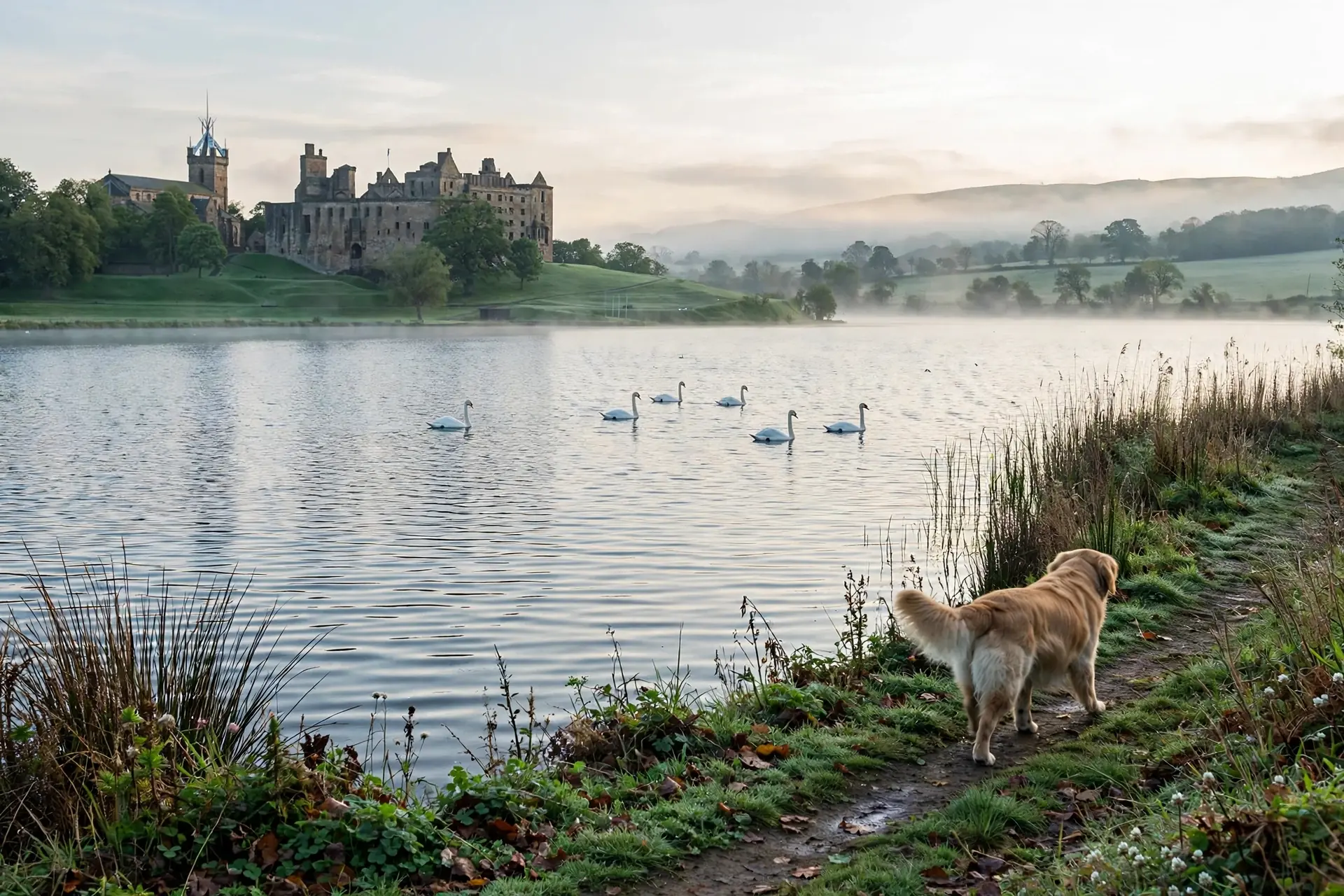
Most visitors arrive in Linlithgow with the palace in mind, and most dogs would rather start at the water. The loch is the better first move for both of you. Linlithgow Loch sits directly below the palace on the north side of town, and the circular path around it is 2.3 miles of mostly compacted gravel, largely flat, with benches and picnic tables on the Peel — the broad grassed parkland that wraps around the palace. A steady walker covers the loop in about an hour; a dog that stops to read every scent, watch the swans and investigate the reed beds will want ninety minutes, and that slower pace is the point.
Direction matters less than timing, but the loop rewards a clockwise start from the palace end if you arrive in the morning. The early light comes across the water towards the palace ruins, the swans are usually at their most active near the western shore, and the path is quieter before the midday crowd arrives from the High Street. Walk the north shore first and the palace stays in view across the water for much of the circuit, which makes the return leg feel like a different walk rather than a retread. The south shore, by contrast, runs closer to the town and the road, so dogs that are unsettled by traffic do better on the water side, where the only sounds are birds, anglers and the occasional sailing dinghy.
The surface is one of the loop's genuine strengths. Compacted gravel holds up after rain far better than the muddy field-edge paths that surround many Scottish lochs, and there are no stiles to lift a dog over. Older dogs, dogs recovering from a strain and owners pushing a buggy all manage the circuit, although the ground can still be soft at the field edges after a wet week, and the path is unlit, so a winter afternoon walk needs a torch and a reflective lead. There are places to sit at intervals along the Peel, which matters more than it sounds: a dog that can settle beside a bench for ten minutes while you watch great crested grebes, coots, moorhens, tufted duck and mallard is a dog that arrives at the High Street calm rather than wired.
Wildlife is the loch's main event, and it sets the rules for the walk. Mute swans patrol the open water and the reed margins, and they are famously confident — confident enough to follow walkers along the bank in the hope of food. Do not feed them bread, and do not let your dog approach them: a swan defending a nest or cygnets can injure a dog, and a dog that lunges at a swan creates a scene nobody enjoys. Keep the lead short through the reed beds, where moorhens and coots nest low, and give anglers a wide berth. Linlithgow Loch is a working trout fishery as well as a wildlife site, so a dog crashing through a swim where someone has been sitting quietly for two hours is the fastest way to sour the morning. The sailing club uses the water too, which means sudden movement, flapping sails and voices carrying across the loch — worth knowing if your dog is sound-sensitive.
Water safety deserves a paragraph of its own, because the loch looks inviting and is not a swimming spot. Like many lowland lochs, it can be affected by blue-green algae in warm weather, and the algae can be dangerous to dogs even in small amounts. Keep your dog out of the water, carry drinking water of your own rather than letting the dog drink from the loch, and check the official guidance before you travel for current water-quality advice. After wet weather, the margins can also be slippery underfoot, so a dog that pulls towards the water needs a short lead and a harness rather than a long line. If your dog does get in, rinse them off as soon as you can and watch for vomiting or lethargy — and if either appears, contact a vet promptly.
One practical detail that catches people out: the loch loop is a shared path, not a dog exercise field. Cyclists, runners, families with small children and other dog walkers all use the same compacted gravel, and the busiest stretch is the section nearest the palace and the car parks. A recall that works in an empty field may not hold when a swan takes off ten metres away, so keep the lead on for the whole circuit and save off-lead time for a secure field elsewhere. The loop's real gift is that it tires a dog out without tiring the owner — flat ground, constant interest, fresh air — and that is exactly what a day in a historic town needs as its foundation.
The palace from the outside, with a dog
Linlithgow Palace is the ruin on the low hill above the loch, built by the Stewart kings and famous as the birthplace of Mary, Queen of Scots, who was born here in December 1542. For a dog owner, the important fact is not the date but the boundary: the palace is managed by Historic Environment Scotland, and the dog rules are clear and specific. Visitors' dogs are allowed in the palace grounds, but they are not permitted in roofed areas. Dogs must be kept on a lead at all times and must not be left unattended at any time. Assistance dogs are permitted throughout, including in roofed areas. Those four sentences shape the whole visit, so plan around them rather than testing them.
What that means in practice is a split visit, and Linlithgow is well set up for one. One person can go inside the palace while the other walks the dog around the Peel and the loch, then you swap. The grounds themselves are generous — the Peel is a large grassed park with a circular path, benches and picnic tables — so the dog's half of the bargain is not a punishment. Walk the palace from the outside first: the courtyard fountain, the great hall's empty window frames and the sheer scale of the walls are all visible from the grounds, and the view back across the loch from the palace terrace is one of the best in West Lothian. If you are travelling alone with a dog, do not expect to leave the dog tied outside while you go in; the rule against leaving dogs unattended is explicit, and a tied dog outside a busy historic site is a welfare and theft risk as well as a breach of the rules.
Access arrangements change while conservation work is under way — the palace has had periods when the interior was closed and only the grounds were open — so check the official guidance before you travel rather than assuming the interior will be open on your date. Opening hours are seasonal, tickets are usually booked or bought on site, and the site can be busy on summer weekends and during school holidays. Arriving early is the simplest fix: the grounds are calmer, the dog settles faster, and the light on the loch is better. If the interior is closed, the day loses nothing for a dog owner, because the palace from the outside, the Peel and the loch loop are the parts of the visit that work best with a dog anyway.
Beside the palace stands St Michael's Church, with its distinctive crown spire, reached through Kirkgate off the High Street. Dogs are not generally expected inside the church, so treat it as another outside-looking-in stop: the kirkyard, the spire against the sky and the view down towards the loch are the parts that cost nothing and need no ticket. The church, the palace and the loch form a single historic cluster within a few hundred metres, which is why Linlithgow works so well as a dog day out — the history is concentrated, the walking is flat, and nothing requires a car once you have parked.
A word on the ground itself. The Peel is grassed parkland, which means it can be soft and muddy after rain, especially on the slopes below the palace walls. The compacted gravel of the loch path is the reliable surface; the grass is the place for a sniff and a settle, not a sprint. After a wet week, keep the dog on the path through the worst of the mud, and carry a towel in the car for paws before the drive home. The palace grounds also have no fencing between the grass and the loch edge in places, so a dog with a strong chase drive needs the same short-lead discipline here as on the loop itself.
The Union Canal towpath: a flat second walk
If the loch is Linlithgow's postcard, the Union Canal is its working walk. The canal runs for 31 miles from Edinburgh to Falkirk, where it joins the Forth and Clyde Canal, and it passes along the southern edge of Linlithgow. It opened in 1822 as a route for coal and other goods into the capital, closed in 1965, and was reopened in 2001 as part of the Millennium Link project, with the Falkirk Wheel reconnecting it to the Forth and Clyde Canal in 2002. Because it was built as a contour canal, following the 73-metre contour along its whole length, it has no locks on the Linlithgow stretch — which is why the towpath is flat, and why it suits dogs that have already done the loch loop and still have energy to burn.
The practical starting point is the Linlithgow Canal Centre at the canal basin, a short walk south of the town centre. The basin is where narrowboats moor, where the canal society is based, and where the towpath is at its widest and easiest. From here you can walk east towards Edinburgh or west towards Falkirk, and the choice changes the character of the walk completely. East takes you towards Philpstoun and Winchburgh on a quiet, green stretch where the canal runs through open countryside and the towpath narrows to a gravel track. West takes you towards the Avon Aqueduct, the great 810-foot structure that carries the canal 80 feet above the River Avon — the second-longest aqueduct in the United Kingdom — and on towards Muiravonside and the Falkirk Wheel in the far distance. Neither direction is a there-and-back you need to complete; both work as an out-and-back of whatever length your dog's legs allow.
The towpath surface varies, and that is worth knowing before you set off. Near the basin and through the town it is surfaced and wide enough for a dog, a walker and a cyclist to pass comfortably. Further out it becomes a narrower gravel track, and the stretch over the Avon Aqueduct itself is cobbled and very narrow, with a low parapet and a long drop to the river below. That is the one place on the whole canal walk where a lead is not optional: keep your dog on a short lead, keep to the inside, and do not stop for photographs in the middle of the aqueduct if other people are trying to pass. The same applies in the short tunnel sections and under the stone bridges, where the towpath narrows suddenly and cyclists appear with little warning.
Cyclists are the main thing to manage on the towpath. The canal is a popular commuter and leisure cycling route, and bikes approach quietly from behind. Train your dog to walk on the side away from the water, step onto the grass verge when you hear a bell, and never let a long line trail across the path. The canal edge itself is an unfenced drop into deep water in places, so a dog that is inclined to jump in after a duck needs to be on a lead for the whole walk, not just near the aqueduct. The water is also slow-moving and can carry the same algae risks as the loch in warm weather, so the same rule applies: carry your own drinking water and keep the dog out of the canal.
For a dog that needs a longer, flatter walk than the loch loop, the canal is the answer. A two-mile out-and-back from the basin — an hour at a sniffing pace — gives you water, wildlife, narrowboats and bridges without a single hill. Moorhens and herons work the reed margins, kingfishers are seen on the quieter stretches, and the canal society's boats add a slow-moving interest that most dogs watch with fascination. In winter the towpath can be icy in shaded cuttings, and after heavy rain the gravel sections puddle, so waterproof boots for the owner and a drying coat for the dog are sensible from October to March. Check the official guidance before you travel for any towpath closures, because maintenance works and aqueduct repairs can close short sections without much notice.
Stretching the day: Beecraigs, Cockleroy and the Avon
Linlithgow's third kind of walking starts where the town ends. Beecraigs Country Park lies a short drive south of the town, on the ridge above the Union Canal, and it is the place to go when the loch loop and the towpath have not been enough. The park covers woodland, open hillside and a small loch of its own, with waymarked trails of different lengths, a visitor centre and picnic areas. Dogs are welcome on leads through the park, and the mix of woodland paths and open ground suits dogs that like to sniff through trees as much as they like open water. The trails climb gently rather than steeply, but they are not as flat as the loch, so an older dog will feel the difference — plan a shorter circuit and build in a rest at the top.
Cockleroy, the rounded hill that rises above Beecraigs, is the natural extension for a fit dog. The climb from the park to the summit is short but steady, and the reward is a wide view across West Lothian towards the Forth, the Pentlands and, on a clear day, the hills beyond. The summit is exposed, so on a windy day the wind chill is real and a thin-coated dog will feel it; bring a coat and do not linger. The descent is on the same path, which means meeting other walkers and dogs head-on — a good reason to keep the lead on and the dog close through the narrow sections.
The River Avon offers a different kind of longer walk, west of the town. The River Avon Heritage Trail runs from the Avon Aqueduct towards Muiravonside Country Park, following the river through woodland and riverside meadow. It is a wilder, muddier walk than the loch or the canal, and after rain the riverside sections can be slippery and the path can flood in places. That is part of its charm for a dog that likes water and woodland, and part of its risk: the river is fast in places, the banks are steep, and a dog that swims in the Avon needs a reliable recall and a safe exit point. Treat it as a walk for a confident, fit dog in dry conditions, and save it for a second visit if the ground is wet.
The long-distance option is the Linlithgow to Bo'ness circular, a roughly nine-mile route that runs from the loch across farmland to the Bo'ness foreshore, along the heritage railway line and back through Kinneil Woods and the John Muir Way. That is a full-day walk for a fit dog and an experienced owner, not a casual add-on, and it crosses farmland where livestock may be present. If you attempt any part of it, keep the dog on a lead through fields, check the official guidance before you travel for the current route conditions, and carry more water than you think you need — there are few reliable water stops between Linlithgow and Bo'ness. For most visitors, the honest answer is simpler: the loch loop plus a canal out-and-back is a full day, and Beecraigs is the next-day walk, not the same-day one.
High Street, the Cross and a dog-friendly pause
Linlithgow's High Street runs east to west through the town, and it is one of the best-preserved historic high streets in Scotland — wide, mostly stone-built, and lined with independent shops, cafes and pubs. For a dog owner, its virtue is practical: it is flat, it is a short walk from both the loch and the canal, and it has enough stopping points that a tired dog can rest while you eat. The Cross, at the eastern end of the High Street near the Vennel, is the natural meeting point, marked by the Cross Well, originally built in 1628 and replaced by a replica in 1807. It is also where the town's market and events gather, so on a market day the Cross is busy, noisy and full of food smells — exciting for a dog, overwhelming for a nervous one. If your dog struggles with crowds, walk the High Street early, before the shops fill, and save the Cross for a quiet moment.
Cafes and pubs are where the dog rules need checking rather than assuming. The Lochside Cafe, beside the loch near the palace, is a natural post-loop stop and is known as dog-friendly, but policies change with management and season, so check the official guidance before you travel rather than arriving with a wet dog and an expectation. Platform 3, the pub by the station on Station Road, is a useful landmark on the walking routes through town and a practical stop for a drink with a dog. The Black Bitch, named for the town's famous black bitch legend — the story of a black greyhound that supposedly swam across the loch to bring food to her imprisoned master — is the town's best-known pub name, and the Four Marys, named for the four companions of Mary, Queen of Scots, is another historic stop on the High Street. Whether any particular pub welcomes dogs inside, on a terrace only, or not at all can change, so ask before you sit down, and always have a takeaway plan if the answer is no.
The Burgh Halls, at the Cross end of the High Street, are worth a look from the outside for their gardens and the rose garden behind them, and the halls sometimes host exhibitions and events where the dog question is better asked in advance. The practical point for a dog owner is simpler: the High Street has public toilets in the Burgh Halls area and a supermarket on the edge of the centre, so water, food and a comfort break are all within a few minutes of the loch. That matters on a hot day, when a dog needs water and shade, and on a wet day, when you need somewhere to dry off before the drive home.
Shopping with a dog in Linlithgow is mostly a matter of manners. The independent shops along the High Street vary in their dog policies, and the polite move is to ask at the door rather than assume. A wet, muddy dog in a small bookshop is a different proposition from the same dog on the pavement outside, and a quick question saves everyone embarrassment. The town's compact size means you can leave the dog with a companion outside for two minutes, or tie up briefly in a visible spot — but never leave a dog unattended for longer than a moment, and never outside the palace grounds, where the rules are explicit. Linlithgow rewards the slow approach: one cafe, one pub, one shop at a time, with the dog settled at your feet, rather than a forced march from one end of the High Street to the other.
Getting there and parking without a scramble
Linlithgow is one of the easiest Scottish towns to reach with a dog, because it sits on the main railway line between Edinburgh and Glasgow and just off the M9. By train, Linlithgow station is on the Edinburgh to Glasgow via Falkirk line, with frequent services in both directions; trains to Edinburgh Waverley and to Glasgow Queen Street typically take under half an hour, which is why the town works as a base for city day trips as well as a destination in its own right. Dogs travel free on ScotRail services, but they must be kept on a lead and under control, and they should not occupy a seat. The station is about a ten-minute walk from the loch, downhill from the High Street, and the walk from the station to the palace takes you past Platform 3 and up Station Road — a useful orientation walk on arrival. Check the official guidance before you travel for current timetables, because engineering works can replace trains with buses, and a rail-replacement bus is a much harder proposition with a large dog.
By car, Linlithgow is reached from the M9, with the town a short drive from the motorway junctions serving the area. The drive from Edinburgh takes roughly half an hour in normal traffic, and from Glasgow a little longer, which makes the town a realistic day trip from either city — and a useful comparison with our guides to Edinburgh with a dog and Glasgow with a dog, where the same walks come with city crowds and city parking. The last approach into town is through residential streets, so slow down: the roads around the loch and the Peel are used by families, cyclists and dog walkers, and a dog can step off a pavement without warning.
Parking is straightforward if you arrive early and know where to aim. The Vennel car park, beside the Cross at the eastern end of the High Street, puts you a short walk from the palace, the loch and the shops, and it is free — although that is the kind of detail that can change, so check the signs on arrival. There is also parking around the Peel and near the canal basin, and on-street parking on the wider streets south of the High Street. On a sunny weekend the lochside spaces fill first, and the streets around the palace can be busy with visitors, so an arrival before ten in the morning is the simplest way to park without circling. Charges, time limits and disabled bays all vary by car park, so read the signs rather than relying on memory or on this guide.
By bus, services connect Linlithgow with Edinburgh, Falkirk and the surrounding villages, and dogs are generally allowed on local buses at the driver's discretion. That discretion is the point: a small, calm dog in a carrier or on a short lead is usually fine, while a large, excitable dog on a crowded bus may be refused. If you are relying on a bus to get home, have a backup plan — a taxi number, or a friend with a car — because a refused boarding at the end of a long walk is a miserable way to finish the day. Cycling is also practical: the canal towpath and the quieter roads around the town suit a bike, but a dog should not be expected to run alongside a bike on the towpath, where the surface is narrow and the canal edge is unfenced.
Staying over: what to ask in a Linlithgow base
Linlithgow is small enough that most stays are in the town itself or in the villages around it — guest houses, bed and breakfasts and self-catering cottages rather than large hotels. That is good news for a dog owner, because a small stay means a real conversation with the host, and a real conversation is where the useful answers live. The questions to ask are specific to Linlithgow, not generic: is there a secure garden or yard, and how high is the fence? Is the garden shared with other guests or with the host's own dogs? How far is the nearest evening toilet walk — the loch path is unlit, so a dark walk to the Peel at eleven at night is a different matter from a lit pavement around the block. Can the dog be left alone in the room for a short time, and if so, under what conditions? A host who answers those questions precisely is a host who has thought about dogs; a host who answers "we love dogs" and nothing else has not.
Location within the town matters more than the listing photographs suggest. A stay near the loch and the Peel gives you a level, traffic-free first and last walk of the day, which is ideal for an older dog or a puppy that needs frequent outings. A stay on the High Street gives you cafes and shops on the doorstep but more traffic noise and more passers-by past the window, which can unsettle a watchful dog. A stay south of the town, towards the canal, gives you the towpath as your morning walk but a longer walk into the centre for food. None of these is wrong; the mistake is booking the prettiest listing without asking which of the three it is. Ask for the exact walking distance to the loch path and to the canal basin, and ask whether the route involves a busy road crossing — the answer will tell you more than the star rating.
Linlithgow also works as a base for a longer West Lothian and Central Scotland break, which is where its railway position pays off. From one base you can day-trip to Edinburgh, to Glasgow, to the Falkirk Wheel and to the Forth bridges, and the practical guide to Perth with a dog shows how the same base-camp logic works further north, with the River Tay and the Highlands in reach. If you are planning that kind of trip, book the Linlithgow nights first and build the day trips around them, because the town's accommodation is limited and the dog-friendly rooms go first. Confirm the dog rules in writing — the number of dogs, the fee, whether the fee is per night or per stay, and whether there is a damage deposit — and keep that confirmation with your booking. A verbal "dogs welcome" is not enough when you arrive at nine at night with a tired dog and a host who has changed their mind.
For a longer stay, think about the practicalities that a single night hides. Is there a washing machine or a drying area for wet towels and muddy leads? Is there a freezer for raw food, or a fridge shelf you can use? Where is the nearest vet — Linlithgow has veterinary practices in town, but opening hours and emergency cover vary, so save the number before you need it, and check the official guidance before you travel for the nearest out-of-hours service. Where is the nearest pet shop for a forgotten bag of food? The High Street and the supermarket on the edge of town cover most needs, but a specialist item — a particular food, a medication, a replacement lead — may need a trip to Falkirk or Edinburgh. None of this is a reason not to stay; it is a reason to arrive prepared, with a packed dog bag and a plan, rather than assuming the town will provide everything.
Linlithgow through the seasons
Linlithgow changes more through the year than its compact size suggests, and the best season depends on the dog you have. Spring is the gentlest introduction: the loch loop dries out, the swans are nesting and protective — keep the lead short and the distance generous — and the canal towpath comes back into use after the winter. The Peel's grass is at its best in late spring, and the High Street's gardens and the Burgh Halls rose garden are worth a slow look. Spring is also the season when the loch's birdlife is at its most active, which means the most temptation for a dog that chases birds; a long line on the open grass is a better choice than an off-lead run near the reed beds.
Summer is the busiest and the most demanding season. The loch loop, the palace grounds and the High Street all fill up on sunny weekends, the car parks fill early, and the water in the loch and the canal warms up — which is when the blue-green algae risk is highest and the swimming rule matters most. A summer visit needs shade and water: carry a collapsible bowl and more water than you think the dog needs, walk the loch loop early in the morning before the heat builds, and use the canal towpath's shaded cuttings for the afternoon walk. The palace grounds offer little shade on a hot day, so a dog that overheats will do better on the tree-lined stretches of the canal or in the woods at Beecraigs. Summer is also the season for the town's events, including the Linlithgow Marches in June, when the town marks its historic boundaries with a procession — a wonderful spectacle and a very poor day for a nervous dog, so check the dates and plan around them.
Autumn is, for many dog owners, the best season in Linlithgow. The crowds thin, the light across the loch turns gold, the canal towpath is lined with turning leaves, and the walking is cool enough for a long day. The trade-offs are mud and early darkness: the Peel's grass softens, the riverside paths by the Avon become slippery, and the loch loop is unlit, so a walk that started at three in the afternoon can end in darkness. Carry a head torch, a reflective lead and a drying coat from October onwards, and plan the canal walk for the morning and the loch loop for the middle of the day. Autumn is also the season when the swans are at their most visible on the open water, and when the migrating wildfowl arrive — another reason to keep the dog on a lead and the binoculars, if you carry them, to hand.
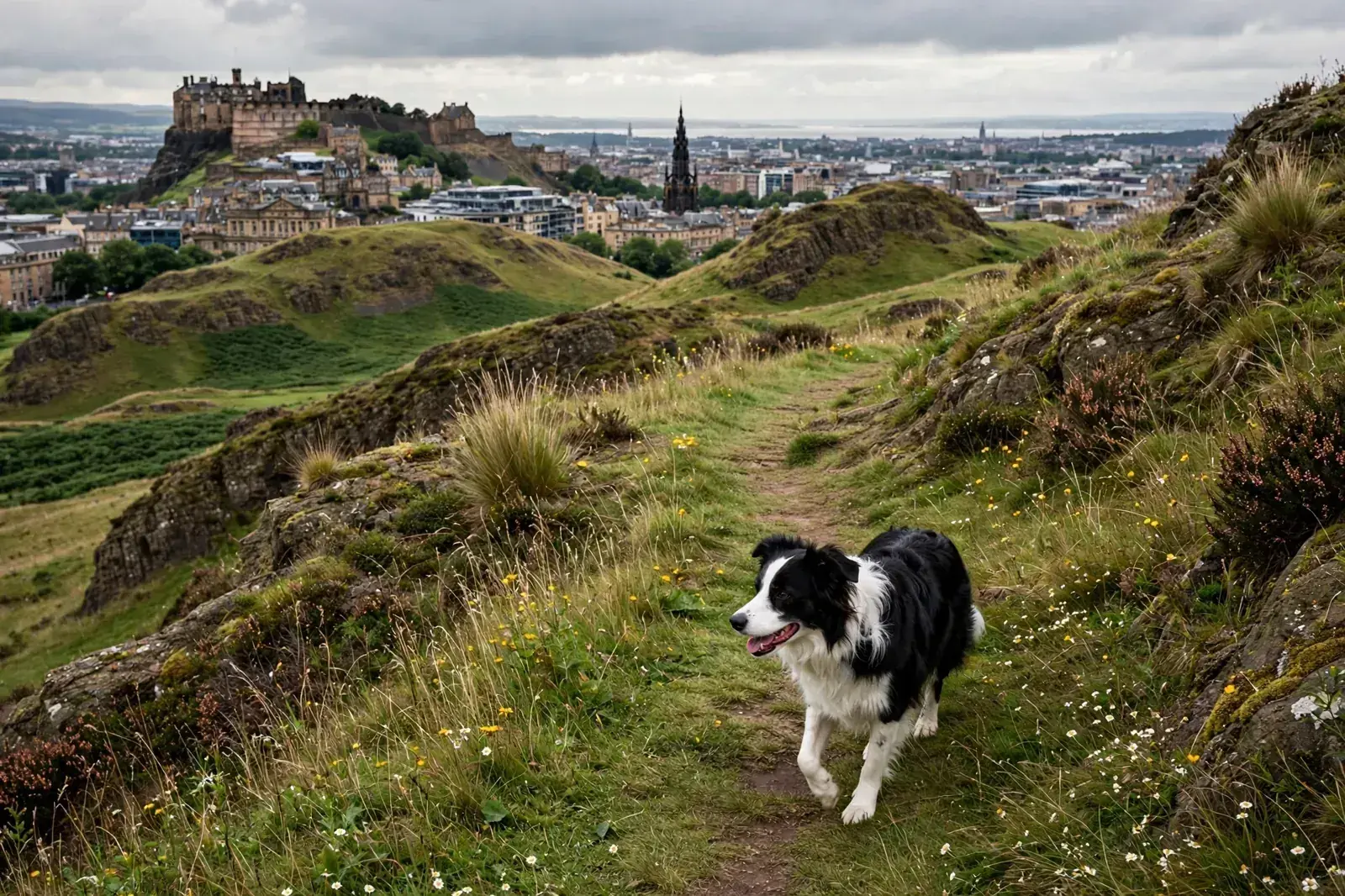
Winter in Linlithgow is quiet, cold and, on a clear morning, beautiful. The palace ruins against a frosty loch, the swans on still water and the empty towpath are the town at its most atmospheric, and a dog that likes cold weather will love it. The practicalities are the same as anywhere in Scotland in winter: short days, icy towpath sections in shaded cuttings, and the need for a warm coat for a thin-coated or older dog. The palace interior may have reduced winter hours, so check the official guidance before you travel, and do not assume the cafes and pubs keep summer hours either. Winter is the season when Linlithgow feels most like a local town rather than a visitor destination, which is exactly why some dog owners prefer it — the walks are empty, the High Street is calm, and the dog gets the loch almost to itself.
A one-day plan that actually fits a dog
A good Linlithgow day is built around two walks and one long rest, not three walks and a forced march. Start at nine with the loch loop, clockwise from the palace end, at a sniffing pace. Allow ninety minutes, including a ten-minute settle on a bench on the Peel. By half past ten the dog has had water, wildlife and exercise, and is ready for the first rest of the day. That rest is not wasted time: a dog that has walked and settled will sleep in the car or in a cafe corner, while a dog that has been dragged from one sight to the next will be restless all afternoon.
From the loch, walk up Kirkgate to the palace grounds and the church, then down to the High Street for a late-morning pause. This is the moment for a cafe stop — the Lochside Cafe if you are still by the water, or a High Street cafe if you have already come into town — and for a look at the Cross and the Cross Well. Keep the stop short and the dog settled: a dog that has just walked for ninety minutes does not need another hour of pavement. If you are doing the split palace visit, this is the window for it, with one person inside and one person with the dog on the Peel.
After lunch, drive or walk to the canal basin for the second walk. A two-mile out-and-back on the towpath, east towards Philpstoun for quiet countryside or west towards the Avon Aqueduct for the engineering, takes about an hour and gives the dog a different kind of interest — narrowboats, bridges, kingfishers — without another hill. Return to the basin, give the dog water, and then decide whether the day is done or whether there is energy for a short High Street wander. For most dogs, the honest answer is that the day is done: two walks, a palace, a canal and a town is a full day, and the drive home is better with a sleeping dog than with a dog that has been pushed too far.
If you are staying overnight, the second day writes itself: Beecraigs in the morning, when the dog is fresh and the hill is manageable, then a slow afternoon on the loch loop in the opposite direction, which feels like a different walk. If you are day-tripping from Edinburgh or Glasgow, the same plan works in reverse — arrive by train, walk from the station to the loch, and let the railway timetable set the end of the day. Either way, build in a buffer: Linlithgow's walks are short, but the town rewards the visitor who stops, sits and watches the swans, and a dog that has had time to settle is a dog that will want to come back.
Lochside etiquette: swans, anglers and other dogs
The rules that make Linlithgow work for dogs are mostly unwritten, and they are mostly about other people. The loch loop is shared with anglers who have paid for a swim and sat quietly for hours, with sailing club members launching boats, with families feeding the ducks and with other dog walkers who may have a reactive dog on a lead. Your dog's freedom ends where their day begins, and the lead is the tool that keeps the peace. Keep it short near the reed beds, near anglers and near the sailing club, and give other dogs space rather than assuming a greeting is welcome. A dog that is friendly with your dog may not be friendly with theirs, and the narrow sections of the loch path leave no room for a misunderstanding.
Swans deserve a final word, because they are the animal most visitors underestimate. A mute swan can weigh more than ten kilograms, can strike with its wings, and will defend a nest or cygnets without hesitation. The swans on Linlithgow Loch are used to people, which makes them bolder, not safer. Never let your dog approach a swan on the water or on the bank, never let a child chase one, and never feed them from your hand with a dog at your side. If a swan approaches your dog, move calmly away along the path rather than standing your ground, and keep the dog behind you. The same caution applies to the geese that visit the loch in winter, which can be noisy and territorial in a group.
Picking up after your dog is not optional on the Peel or the loch path, and it is not optional on the canal towpath either. The Peel is a picnic site as well as a dog walk, and the towpath is used by families with small children, so a missed bag is noticed and remembered. Carry more bags than you need, use the bins provided, and if there is no bin, carry the bag until there is one — do not leave it by the path to collect later, because later rarely comes. The same applies to the High Street and the canal basin, where a bag left on a wall is a small thing that does a lot of damage to the reputation of dog owners in the town.
Finally, remember that Linlithgow is a living town, not a theme park. People live on the streets around the loch, work in the shops on the High Street and fish the loch at dawn. A dog that barks at every passer-by outside a house, or that worries livestock on the farmland walks beyond the town, is a problem for the people who live there every day, not just for the afternoon of your visit. The Scottish Outdoor Access Code gives you the right to walk responsibly on most land, and with that right comes the responsibility to keep your dog under control, to respect livestock and wildlife, and to leave the place as you found it. Do that, and Linlithgow will still be welcoming the next time you come back with a dog.
Practical questions
Before you go
Can my dog go inside Linlithgow Palace?
No. Visitors' dogs are allowed in the palace grounds, but they are not permitted in roofed areas. Dogs must be kept on a lead at all times and must not be left unattended. Assistance dogs are permitted throughout. Check the official guidance before you travel, because access arrangements can change while conservation work is under way.
How long is the walk around Linlithgow Loch?
The circular path around the loch is 2.3 miles long, on a mostly compacted gravel surface, and most walkers complete it in about an hour without long stops. With a dog that stops to sniff, watches the swans and pauses at the benches on the Peel, allow ninety minutes. The route is largely flat and there are no stiles.
Is the Union Canal towpath at Linlithgow suitable for dogs?
Yes, it is one of the easiest walks in the area: flat, mostly surfaced and traffic-free. Keep your dog on a lead or under close control near the water's edge, move aside for cyclists, and take extra care on the narrow, cobbled stretch over the Avon Aqueduct west of town. Check the official guidance before you travel for any towpath closures.
Can dogs swim in Linlithgow Loch?
It is best not to let them. The loch is used by anglers and by a sailing club, and like many lowland lochs it can be affected by blue-green algae in warm weather, which is dangerous for dogs. Keep your dog out of the water, carry drinking water of your own, and check the official guidance before you travel for current water-quality advice.
Where is the best place to park in Linlithgow with a dog?
The Vennel car park beside the Cross puts you a short walk from the High Street, the palace and the loch. There is also parking around the Peel and near the canal basin. Charges and time limits change, so check the signs on arrival and the official guidance before you travel, and arrive early on sunny weekends when the lochside spaces fill first.
Is Linlithgow a good base for a longer dog-friendly break?
Yes. It sits on the railway between Edinburgh and Glasgow, with trains to both cities in under half an hour, and the Union Canal, Beecraigs Country Park and the River Avon trails all start within a few miles. That makes it a calm overnight base with city day trips on the doorstep, provided you confirm each stay's dog rules in writing before booking.