This guide is independent and contains no paid placement. If affiliate links are added later, they will be clearly marked and will not change our editorial checks.
Linton is a small Wharfedale village built for a slow dog day: a level village green to arrive on, a short riverside stroll to Linton Falls, and a flat two-mile walk to Grassington. Keep your dog on a lead by the water and on the green, arrive early for parking, and let the river set the pace.
Begin on the village green
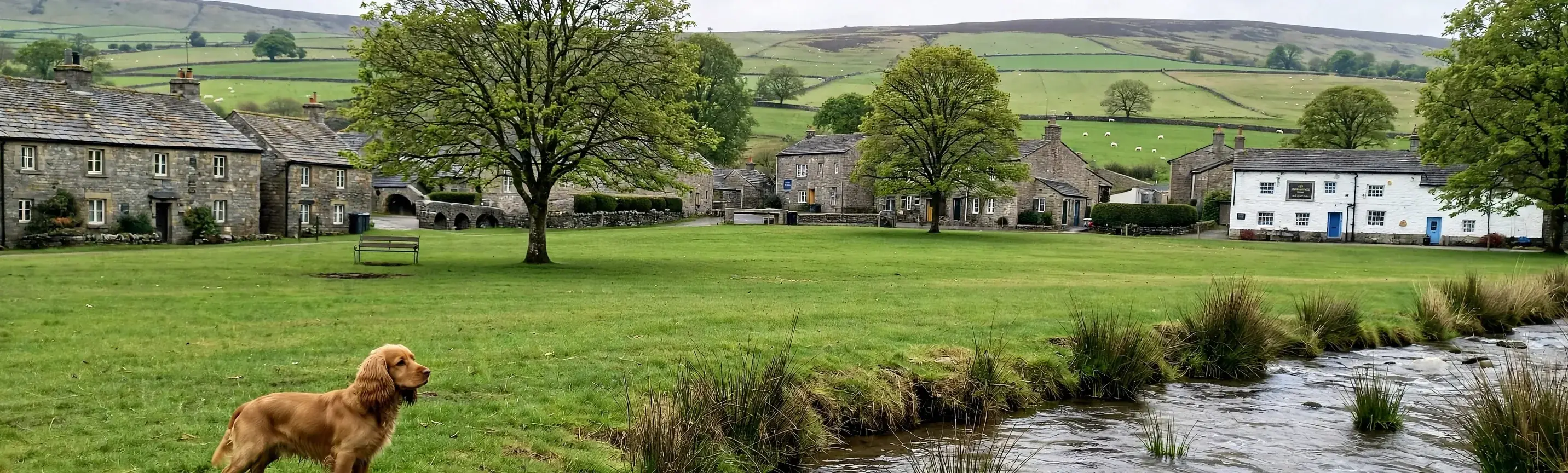
Most Wharfedale walks begin with a car park, a map board and a decision. Linton begins differently. The village green is the first thing a dog notices: a broad, level stretch of grass in the middle of the village, edged by stone cottages, with the church of St Michael and All Angels close by and the River Wharfe a short stroll away. For a dog that has just spent an hour in the car, the green is the perfect decompression zone. There is room to stretch, grass to sniff, and nothing steep or urgent to negotiate. Owners who arrive with a plan to march straight to the falls often find that ten unhurried minutes on the green makes the rest of the day easier, because a dog that has emptied its bladder, shaken off the journey and read the local smells is a calmer walking companion.
The green is also the best place to take stock. Stand still for a moment and work out which kind of day your dog needs. A young spaniel may be ready for the full walk to Grassington and back, with energy to spare for the fields beyond. An older dog, a puppy, or a rescue on its first Dales outing may be happier with the green, a gentle loop to the falls, and a long sit outside the pub. Neither choice is a lesser day. Linton rewards the slower version just as much as the longer one, because the village is compact enough that the river, the falls and the green are all within a few minutes of each other. You do not have to choose between a scenic walk and a restful one; the same short circuit can be both, depending on how many times you stop.
Treat the green as a shared village space, not as a dog park. Houses face directly onto it, walkers cross it on their way to the church and the river, and children play there in fine weather. That means a lead, even for a dog with good recall, and a pocket full of bags. Picking up promptly matters more in a village this small than it does on an open fell, because the same patch of grass is used by everyone who lives here. It also matters for the next dog that arrives: a clean green is what keeps a village welcoming to visitors with dogs. If your dog is reactive, the green is still useful, because it is open enough to see other dogs coming from a distance and to move to a quieter corner before an encounter becomes a problem. Arrive early, use the space when it is quiet, and leave before the midday crowds if your dog finds busy greens stressful.
From the green, the village itself is worth a slow look. Linton is a classic Wharfedale stone village, with cottages built from local limestone and gritstone, dry stone walls, and narrow lanes that were never designed for fast traffic. The pace of the village is part of its appeal for dog owners: cars move slowly, people stop to talk, and a dog on a lead is an ordinary sight rather than an exception. Walk the lanes once, let your dog sniff the wall bases and gateposts, and you will have a sense of the place before you have gone near the river. That slow start is also practical. It lets you check paws, leads and water bottles while you are still close to the car, rather than discovering a problem half a mile along a riverside path. A dog that pulls on the lead will pull less after a few minutes of sniffing on the green than it will if it is taken straight from the car to a narrow path with ducks and other dogs ahead.
One more reason to start on the green is orientation. The river lies to one side of the village, the road to Grassington runs in the other direction, and the falls sit between the two. Once you have stood on the green and looked around, the geography clicks into place: green first, river second, falls third, and Grassington beyond. That simple order is the backbone of every route in this guide. It also makes it easy to shorten the day at any point. If the weather turns, if a dog gets tired, or if a child in the group runs out of patience, you are never more than a few minutes from the green and the car. Few Dales villages offer that kind of easy retreat, and it is one reason Linton suits first-time visitors, older dogs and families with young children as well as seasoned walkers.
Linton Falls, step by step
Linton Falls is the natural centrepiece of a visit, and it is close enough to the green that even a short outing can include it. The River Wharfe drops over a series of limestone shelves here, spreading wide across the rock in low water and running fast and brown after rain. The sound of the water carries up the lane before you see it, which is often the first sign for a dog that something interesting is ahead. Many dogs quicken their pace at that point, so shorten the lead before the path narrows and keep a firm grip as the ground changes from lane to riverside track.
The approach is short but it deserves care. The path to the falls crosses uneven ground, and the limestone near the water is smooth and slippery even when it looks dry. Wet rock, algae and loose gravel are a combination that catches out confident dogs as easily as cautious ones. Keep your dog on a short lead through the whole viewing area, and do not let them scramble down the bank to the water's edge. The best view is from the path and the bridge area, where you can watch the river without standing on the rock shelves themselves. If you want a photograph, take it from the path with the dog sitting beside you, rather than trying to pose a dog on wet stone above fast water. The picture will be better, and the dog will be safer.
Water levels change the falls completely, and they change fast. After a dry week, the river runs clear and low, the shelves are exposed, and the falls look like a wide staircase of pale rock with thin sheets of water. After heavy rain, the same place is loud, fast and brown, with the shelves hidden under a single powerful flow. Both versions are worth seeing, but they demand different behaviour from a dog owner. In low water, the temptation is to let a dog paddle at the edges; in high water, the temptation is to stand too close for a better look. In both cases, the rule is the same: the dog stays on the lead, and nobody goes into the water above the falls. Below the falls, deep pools form where the river slows, and the current near the lip is stronger than it looks from the bank. Check the official guidance before you travel if you are unsure about conditions, and if the river is running high after rain, enjoy the falls from the path and save paddling for a calmer day.
Time your visit to the falls with the rest of the day in mind. Early morning is quiet, with soft light on the water and few other walkers, which suits nervous dogs and owners who want a calm start. Midday on a fine weekend brings families, picnics and other dogs, which can be enjoyable for a sociable dog but overwhelming for a reactive one. Late afternoon, as day visitors leave, the falls quieten again and the light turns golden on the stone. If you are walking on to Grassington, the falls make a natural halfway pause: stop, let the dog drink from your bottle rather than the river, check paws for grit, and decide whether to continue or turn back. A dog that is tired at the falls will be much more tired by Grassington, so treat the falls as a decision point, not just a photo stop.
Dogs react to falling water in different ways. Some are fascinated and want to stare; some are unsettled by the noise and want to move on; a few try to chase the white water. None of these reactions is a problem if you are prepared for it. A dog that stares can be rewarded for settling beside you. A dog that is unsettled can be walked past the noisiest section at a steady pace without stopping. A dog that lunges can be held on a short lead and redirected with a treat. What does not work is standing still in the noisiest spot while a dog gets more and more aroused. Keep moving, keep the lead short, and keep the visit to the falls to the length your dog enjoys rather than the length a guidebook suggests. Five happy minutes at the falls beat twenty stressed minutes every time.
The River Wharfe at Linton
The River Wharfe is the thread that ties Linton together. It rises on the fells above the Dales, runs through Kettlewell, Burnsall and Grassington, and passes Linton on its way to Bolton Abbey and Ilkley. At Linton it is a mature river: wide enough to feel substantial, shallow enough in places to see the riverbed, and bordered by meadows, trees and dry stone walls. For a dog, the river is a constant presence of sound, smell and movement. Ducks, dippers, herons and kingfishers all use this stretch, and the smell of the water changes with the season, from fresh and cold in spring to warm and weedy in late summer. A dog that walks the riverside path is walking through a corridor of scent that is far richer than any park.
The riverside path from Linton is mostly level, which is one of its great strengths. There are no long climbs, no steep descents and no scrambling, so it suits older dogs, puppies building up their stamina, and owners who prefer a walk that is gentle on knees. The surface varies: firm tracks, grassy field paths, and short sections of stone and gravel near the falls. After rain, the grassy sections become muddy and the low-lying meadows can hold water, so waterproof boots and a towel in the car are sensible even on a dry-looking morning. In summer, the same paths are firm and dusty, and the shade of riverside trees matters more than the mud. Either way, the walking itself is straightforward, which leaves attention free for the dog rather than the terrain.
Where can a dog actually get to the water? The honest answer is that it depends on the day. There are shallow edges near the village where a dog can paddle, and there are stretches where the bank is steep, fenced or overgrown. Do not assume that every gap in the vegetation leads to a safe entry point. Look for a gentle slope, clear water, and a bank you can reach yourself without climbing. If you cannot reach the water easily, your dog should not be in it either, because you need to be able to help if they slip or get into difficulty. A long line is useful here: it lets a dog paddle while you stay on the bank with control, and it prevents a strong swimmer from being carried downstream. Never let a dog swim above the falls or in fast water, and never throw a ball into the river for a dog to fetch. A ball in moving water is an invitation to a dog to follow it into a current, and the Wharfe can be deceptively strong even when it looks calm on the surface.
Wildlife deserves a mention, because the Wharfe at Linton is rich in it. Ducks and moorhens nest in the reeds, swans pass through in winter, and the river is known for trout and grayling. A dog with a strong chase instinct needs a lead along the whole riverside, not just at the falls. Ground-nesting birds use the meadows in spring and early summer, and sheep graze the fields beside the river, so the lead stays on through the fields as well as on the path. The Countryside Code applies here in full: keep dogs under control, pick up after them, and leave gates as you find them. Farmers in Wharfedale are generally welcoming to walkers with dogs, and that welcome lasts only as long as walkers respect livestock and crops. A single loose dog chasing sheep can close a path for everyone, so the responsibility is real.
For many owners, the river is also the reason to slow down. Linton is not a place for ticking off miles. It is a place for sitting on a bank while a dog sniffs the air, for watching a dipper bob on a stone, and for letting a walk take twice as long as the map suggests. Build that slowness into the plan. Bring a flask, bring a mat to sit on, and give the dog time to lie down in the grass and watch the river. A dog that is allowed to rest by the water will walk better afterwards than a dog that is marched from one landmark to the next. The river rewards patience, and so does the dog.
Walking on to Grassington
The walk from Linton to Grassington is one of the easiest and most rewarding riverside walks in the Dales, and it is the natural extension of a Linton day. The route follows the River Wharfe downstream, staying close to the water for much of the way, and arrives in Grassington from the riverside rather than from the main road. It is roughly two miles each way, mostly level, and usually takes about 45 to 60 minutes of walking in each direction, plus stopping time. For a fit adult dog, that is a comfortable half-day outing. For an older dog, a puppy, or a dog that is new to longer walks, it is better treated as a there-and-back with a long rest in Grassington in the middle, or as a one-way walk with a lift back if someone in the group can collect you.
The route itself is straightforward to follow, but it is worth describing in stages so that you can judge it for your dog. From the village green, head towards the river and the falls, then pick up the riverside path heading downstream. The first section is the most scenic, with the falls behind you and the river widening into calm pools. The middle section crosses riverside meadows, where the path is grassy and the views open up across the valley to the fells. The final approach to Grassington brings you past riverside trees and into the edge of the village, where the cobbled square and the shops are a short walk away. There are stiles and gates along the way, so a dog that cannot be lifted over a stile needs a route that avoids them, and you should check the official guidance before you travel for the latest access information, because field paths and stiles can change with the seasons and with farming work.
Grassington is a different kind of village from Linton, and the contrast is part of the pleasure of the walk. Where Linton is quiet and green-centred, Grassington is busier, with a cobbled market square, independent shops, cafes and pubs, and a steady stream of visitors. For a dog, that means more people, more dogs, more smells and more noise. A sociable dog will enjoy the square, the shop fronts and the chance to sit outside a cafe. A nervous dog may find the square overwhelming after the quiet of Linton, and may prefer a short loop around the quieter streets or a rest on a bench away from the main crowds. Our guide to Grassington with a dog covers the square, the pubs, the parking and the lead rules in detail, and it is worth reading before you set off so that you know what to expect at the far end of the walk.
Plan the Grassington stop as carefully as the walk. Dogs are welcome outside many cafes and pubs, but indoor access varies, and a dog that has just walked two miles in warm weather needs shade and water before it needs a menu. Find a quiet spot, offer water, and let the dog settle for at least twenty minutes before you move on. If you plan to eat, check in advance whether dogs are welcome where you want to sit, and have a backup in mind. A dog that is tired and hot will not enjoy being dragged from one busy cafe to another, so pick one place, settle in, and let the dog rest. The return walk to Linton is the same distance, so do not spend so long in Grassington that the dog has stiffened up. A short, gentle warm-up walk around the square before you set off back helps more than a sudden start after a long sit.
There are other ways to use the Linton to Grassington route. Some walkers do it as a one-way walk, leaving a car in Grassington and walking back to Linton, or vice versa. Others combine it with a longer circuit that takes in the fields above the river, though that adds climbing and is a different kind of day. The simplest version, out and back along the river, is the one this guide recommends for most dogs, because it is easy to shorten: if the dog tires halfway, you simply turn around and retrace your steps. There is no shame in a short version of a famous walk. A dog that walks one happy mile and comes home content has had a better day than a dog that is pushed to the full distance and comes home lame or exhausted. Let the dog set the distance, and let the river set the pace.
Three loops from the green
Not every visit needs to reach Grassington. Three shorter loops from the village green cover most dogs, most weathers and most energy levels, and they all start and finish in the same place, which makes them easy to remember and easy to cut short.
The first loop is the green and falls loop, and it is the one to choose for a first visit, a puppy, an older dog, or a wet day. From the green, walk to the river, spend a few minutes at the falls, and return to the green by the same path or by the lane. The whole loop is well under a mile, mostly level, and takes about thirty to forty minutes at a dog's pace, including stops. It gives a dog the river, the falls and the green in one short outing, without any of the distance or the stiles of the longer walk. It is also the best loop for a dog that is reactive or nervous, because you can do it early in the morning when the village is quiet, and you are never far from the car.
The second loop is the riverside out-and-back, and it suits a fit adult dog that wants a proper walk without a town at the end. From the green, follow the river downstream for about a mile, past the falls and into the meadows, then turn around and walk back. The total distance is about two miles, and the time is about an hour to an hour and a half, depending on how often the dog stops to sniff. This loop has the advantage of being entirely riverside, so the dog gets water, shade and open grass for the whole walk, and there is no busy village square to negotiate. It is a good choice for a hot day, because the river keeps the air cooler and there are shaded spots to rest, and for a dog that prefers fields to streets.
The third loop is the full Linton to Grassington and back, described in the previous section, and it is the one to choose for a fit dog on a fine day when you have at least three hours to spare. It adds the bustle of Grassington, the shops and cafes, and the satisfaction of a proper point-to-point walk, but it also adds distance, people and stiles. Do not attempt it as a first walk with a new dog, and do not attempt it in heavy rain or high water, when the riverside path can become muddy and the meadows can flood. Choose the loop that fits the dog you have today, not the dog you wish you had, and remember that you can always do a longer loop next time. Linton is not going anywhere, and neither is the river.
Whichever loop you choose, build in the same habits. Start on the green, let the dog settle, and check leads, water and bags before you leave the village. Walk out at a steady pace, stop often, and offer water at every rest. Turn around before the dog is tired, not after, because the return leg always feels longer. Finish on the green, let the dog have a final sniff and a drink, and towel off muddy paws before the dog gets back in the car. Those small habits turn a good walk into a good day, and they are what make a dog look forward to the next visit to Linton.
Lead rules, livestock and other dogs
Linton is a lead-on village for most of the day, and that is not a restriction to resent but a practical response to the geography. The green is shared with houses and a church, the lanes are narrow, the river is fast, and the fields hold sheep. A dog off lead in any of those places can cause a problem in seconds, whether it is chasing a duck, running into a road, or worrying livestock. The lead is what lets a dog enjoy Linton safely, and it is what keeps the village welcoming to the next dog that arrives.
The practical rule is simple: lead on in the village, on the green, at the falls, and through any field with livestock or with a footpath running through it. Use a short lead, about one to two metres, in the village and at the falls, where control matters more than freedom. Use a longer lead or a long line on the open riverside stretches, where a dog can sniff and explore without being able to reach the water or another dog. Off-lead time, if you choose it at all, belongs on a safe, open stretch away from the river, away from livestock, and away from other walkers, and only where you are confident it is permitted and your dog's recall is reliable in the presence of distractions. If you are unsure, keep the lead on. A dog on a long line is still having a good walk, and a dog that is under control is a dog that gets invited back.
Livestock deserves particular care in Wharfedale. Sheep graze the riverside fields around Linton, and they are often close to the footpath, especially in spring when lambs are present. A dog that has never seen sheep before may be fascinated, frightened or predatory, and none of those reactions is safe off lead. Keep the dog on a short lead through any field with sheep, walk steadily past without stopping to stare, and do not let the dog approach fences or walls where sheep are grazing on the other side. If sheep are on the path itself, give them a wide berth and wait for them to move on rather than pushing through. Farmers have the right to protect their livestock, and a dog that worries sheep can be shot, so this is not a minor rule. It is the most serious responsibility a dog owner carries in the Dales.
Other dogs are the other regular encounter on the Linton paths. The riverside walk is popular, and you will meet other dogs, often off lead, often friendly, and often running ahead of their owners. Not every dog wants to say hello, and not every owner wants their dog to be greeted. If your dog is on a lead and another dog approaches, do not assume the encounter will be friendly. Move to the side of the path, shorten the lead, and let the other owner recall their dog. If your dog is reactive, step off the path into a field gateway, turn the dog away, and reward calm behaviour. If your dog is friendly, still ask before letting it greet another dog, because the other dog may be old, injured, in training, or simply not in the mood. The riverside is wide enough for everyone if owners keep their dogs under control and respect each other's space.
Finally, remember that the lead rules change with the season. In spring, ground-nesting birds and lambs make the fields more sensitive, and dogs should be kept on leads and on the path. In summer, the river draws more visitors, and the paths are busier, so a lead helps a dog navigate crowds. In autumn, the fields are quieter but the ground is wetter, and a dog on a lead is less likely to slip into a ditch or a flooded meadow. In winter, the paths can be icy and the river high, and a lead is essential near the water. The lead is not a punishment. It is the tool that makes Linton work for every dog, in every season.
Parking and arrival
Linton is a small village, and parking is its main practical constraint. There is no large car park in the village itself, and most visitors park on the roadside, in the lanes, or in the small areas near the green. On a fine weekend or a school holiday, those spaces fill early, and by late morning the village can feel full. Arrive before ten in the morning if you can, or after three in the afternoon when day visitors are leaving. If you arrive at midday on a sunny Saturday, expect to drive around the village more than once, and be prepared to change your plan.
Park considerately, because inconsiderate parking is what turns a village against visitors. Keep access to houses clear, do not block farm gates, field entrances or the church, and do not park on grass verges or on the green itself. Leave room for farm vehicles and emergency vehicles to pass, and do not block passing places on the narrow lanes. If you cannot park without blocking something, do not park there. Drive on to Grassington, where there is a larger car park, and walk to Linton from there instead. That walk is part of the pleasure of the area, and it is a better use of time than circling a small village looking for a space that does not exist.
Arriving by public transport is possible but requires planning. Buses serve Grassington and the surrounding villages, and the walk from Grassington to Linton is the same riverside route described in this guide. Check bus times in advance, because services in the Dales are infrequent, especially on Sundays and in winter, and a missed bus can mean a long wait. If you are travelling by bus with a dog, check the operator's rules on dogs in advance, and bring a lead, water and a mat for the dog to lie on. Taxis from Skipton or Grassington are another option, but book in advance and confirm that the driver accepts dogs, because not all do. Our guide to Skipton with a dog covers the market town that most visitors pass through on their way to Wharfedale, including parking, the canal towpath and the walk to the Dales.
Once you have parked, take a moment to get the dog ready before you leave the car. Offer water, check paws and leads, and put on a harness if your dog wears one. Let the dog out on the lead, not loose, because a dog that jumps out of a car in a village lane can run into the road before you have closed the door. Walk to the green first, let the dog settle, and only then set off for the river. That order, car to green to river, is the safest and calmest way to start a Linton day, and it is worth repeating every time you visit, even when you know the village well.
Pubs, picnics and a drink
Linton has a village pub, the Fountaine Inn, which sits close to the green and is a natural end to a walk. Pubs in the Dales change their dog policies from time to time, so check the official guidance before you travel, and do not assume that a dog that was welcome last year is welcome in the same part of the pub this year. As a general rule, dogs are more often welcome in the bar area and outside than in the restaurant, and a well-behaved dog on a lead, lying quietly under a table, is welcome in more places than a dog that barks, begs or wanders. Bring a mat for the dog to lie on, offer water, and order at the bar rather than leaving the dog alone at the table.
If the pub is busy or the dog is tired, a picnic is often the better choice. The green is a pleasant place for a sandwich, and the riverside meadows offer quiet spots to sit with a flask and a view of the water. Bring a picnic blanket, a bowl for the dog, and bags for rubbish, and leave the spot cleaner than you found it. Do not feed the dog from the picnic if it has a sensitive stomach, and do not leave food unattended where other dogs or crows can reach it. A picnic also has the advantage of flexibility: you can eat when the dog is ready to rest, rather than when a pub table becomes free, and you can move to shade if the sun comes out or to shelter if the rain arrives.
Grassington, at the end of the riverside walk, offers more choice, with cafes, tea rooms and pubs that cater to walkers. That is one reason to do the full walk to Grassington rather than staying in Linton: the reward at the far end is a proper lunch and a choice of places to sit. If you walk to Grassington, plan the food stop in advance, check which places welcome dogs, and have a backup in case your first choice is full. A dog that has walked two miles needs water and shade before it needs a menu, so find a table, settle the dog, and then think about food. Our guide to Harrogate with a dog covers a larger town to the south-east, with more cafes and gardens, if you want to combine a Wharfedale walk with a town day on the same trip.
Water is the most important refreshment of all, and it is worth carrying more than you think you need. The river is not a reliable drinking source for a dog, because it can carry bacteria, algae and agricultural run-off, especially after rain. Carry a bottle and a collapsible bowl, and offer water at every rest, even if the dog does not seem thirsty. In warm weather, offer water every twenty minutes, and watch for signs of overheating: heavy panting, drooling, lethargy or a reluctance to walk. If a dog overheats, move it to shade, offer small amounts of cool water, wet its paws and belly, and seek veterinary advice if it does not recover quickly. Prevention is better than treatment, so walk early in the morning on hot days, avoid the midday sun, and cut the walk short if the dog is struggling.
Staying overnight near Linton
Linton itself has limited accommodation, and most visitors who stay overnight in the area base themselves in Grassington, Burnsall, Kettlewell or Skipton, and visit Linton as a day trip. That arrangement works well, because Linton is a village to visit rather than a town to stay in, and the surrounding villages offer more choice of cottages, inns and bed and breakfasts that accept dogs. When you book, check the dog rules carefully: how many dogs are accepted, whether there is a charge, whether the dog can be left alone in the room, and whether there is a secure garden or a nearby toilet area for last thing at night.
Self-catering cottages are often the best choice for a dog stay in Wharfedale, because they offer a kitchen, a garden and a routine that is closer to home. Look for a cottage with a secure garden, a hard floor that is easy to clean, and a location that is close to a walk that does not require a car. Ask about the garden fence: a low wall or a hedge is not a secure boundary for a determined terrier, and a cottage that describes itself as dog-friendly may still have a garden that is not enclosed. Check whether the cottage provides a dog bed, bowls and towels, or whether you need to bring your own. Bring the dog's own bed and blanket in any case, because a familiar smell helps a dog settle in a new place.
Inns and bed and breakfasts can also work well, especially for a short stay, but they require more planning. A dog that is used to sleeping in a bedroom at home may settle in a hotel room, but a dog that is used to a crate may need the crate brought along. Ask whether the dog can be left in the room while you eat, and what happens if the dog barks. Some inns welcome dogs in the bar but not in the dining room, which means you may need to eat in shifts or choose a place where you can eat together. Book directly with the property rather than through a third party if you can, because it is easier to ask detailed questions and to get a clear answer about dog rules when you speak to the owner.
Whatever you book, plan the evenings as carefully as the days. A dog that has walked all day needs a quiet evening, a familiar bed, and a last toilet walk in a place it knows. Walk the last route in daylight on the first evening, so that you and the dog both know it in the dark. Pack a torch, because village lanes and riverside paths are unlit, and a dog on a lead in the dark needs a light to be seen by cars. Keep the evening routine close to home: same feeding time, same bed, same last outing. A dog that settles well on the first night will walk better on the second day, and a stay that starts well is a stay that ends well.
Linton through the seasons
Spring is the season when Linton wakes up. The meadows turn green, the river runs clear and cold, and the first walkers return to the riverside paths. It is a beautiful time to visit, but it is also the most sensitive time for wildlife. Ground-nesting birds use the meadows, lambs are in the fields, and the river can run high after spring rain. Keep the dog on a lead, stay on the paths, and be prepared for mud. Spring is also the time when ticks become active, so check the dog after every walk, especially around the ears, neck and belly, and remove any ticks promptly. A tick hook and a bottle of water are as important as a lead in spring.
Summer is the busiest season, and the one that needs the most planning. The green is busy, the falls are busy, and the walk to Grassington is busy. Arrive early, walk early, and rest in the shade during the middle of the day. The river is at its lowest and clearest, and the shallow edges are inviting for a paddle, but the water can also be warm and slow, which increases the risk of algae. Do not let a dog drink from stagnant pools or from water with a green scum on it. Summer is also the season for midges and flies, especially in the evening by the river, so bring insect repellent that is safe for dogs, and check the dog's ears and belly for bites after the walk.
Autumn is, for many regular visitors, the best season in Linton. The crowds thin, the light turns golden, and the river runs fuller after the first rains. The trees along the Wharfe turn yellow and orange, and the village green is covered in fallen leaves that dogs love to sniff through. The paths become muddier, so waterproof boots and a drying coat for the dog are sensible, and the days become shorter, so start earlier and carry a torch. Autumn is also the season when the river can rise quickly after rain, so check the weather forecast and the river level before you set off, and be prepared to shorten the walk if the water is high.
Winter in Linton is quiet and stark. The village is almost empty, the river runs cold and fast, and the fells are often capped with snow. It is a beautiful time for a short, crisp walk, but it is not a time for a long riverside outing with a dog that feels the cold. Keep walks short, keep the dog on a lead near the water, and watch for ice on the paths and on the limestone near the falls. A dog coat helps a short-coated dog, and a towel in the car helps every dog. Winter is also the time when daylight is shortest, so plan to be back at the car well before dark, and do not start a walk to Grassington late in the afternoon. A winter visit to Linton is best treated as a short, bright interlude rather than a full day out.
Water, weather and tired dogs
Water safety is the most important safety topic in Linton, because the river is always present and always attractive to dogs. The rules are simple, but they need to be repeated: never let a dog swim above the falls, never throw a ball into the river, never let a dog enter fast water, and never assume that a calm surface means a safe current. The Wharfe has undercurrents, deep pools and slippery shelves that are not visible from the bank. A dog that is a strong swimmer in a lake can still get into difficulty in a river, and a dog that is a weak swimmer should not be in the river at all. If a dog does get into difficulty, do not enter the water yourself. Call for help, throw a rope or a branch if you can do so safely, and seek advice from the emergency services. Your safety matters as much as the dog's.
Weather in the Dales changes quickly, and Linton is no exception. A fine morning can turn to rain by lunchtime, and a riverside path that was firm in the morning can be muddy by the afternoon. Check the forecast before you set off, carry a waterproof jacket and a waterproof for the dog if it wears one, and be prepared to turn back. Rain is not a reason to cancel a walk, but it is a reason to shorten it, to stay on the firm paths, and to keep the dog on a lead near the river. Wind matters too, especially on the open meadows, where a strong wind can chill a wet dog quickly. If the dog is shivering, cut the walk short, dry the dog, and get it into a warm car.
Tired dogs are the third safety topic, and the easiest to overlook. A dog that is tired will walk more slowly, stumble more often, and be less able to cope with stiles, slippery ground and other dogs. The signs of tiredness are not always obvious: a dog that is lagging behind, a dog that is lying down on the path, a dog that is refusing treats, or a dog that is panting heavily long after a rest. If you see those signs, stop, rest, and turn back. Do not push a tired dog to finish a walk because the map says you are halfway. The map does not know your dog, and the dog does not care about the map. A short walk that ends with a happy dog is a successful walk.
Finally, know where the nearest vet is before you need one. The nearest veterinary practices are in Grassington, Skipton and Harrogate, and they may not be open on Sundays or in the evening. Save the number in your phone before you set off, and know how to get there from Linton. Bring a basic first aid kit for the dog: a bandage, antiseptic wipes, tweezers for ticks, and a towel. Most walks in Linton pass without incident, but a cut paw, a tick, or a stomach upset from drinking river water can happen on any walk, and being prepared turns a crisis into an inconvenience. Check the official guidance before you travel for current veterinary opening times and emergency cover, because practices change their hours and their out-of-hours arrangements from time to time.
Linton is a village that rewards a careful, unhurried approach. Start on the green, walk to the falls, follow the river to Grassington if the dog is ready, and come back the same way. Keep the lead on by the water, respect the livestock, pick up after the dog, and leave the village as clean as you found it. Do that, and Linton will be there for the next visit, and the next, with the same green, the same falls and the same river, waiting for the next dog to arrive.
Practical questions
Before you go
Can my dog swim or paddle in the River Wharfe at Linton?
Some dogs paddle at the shallow edges near the village and below Linton Falls, but the river is not a supervised swimming spot. Water levels and currents change quickly after rain, the limestone shelves can be slippery, and deep pools form below the falls. Keep your dog on a lead near fast water, let a confident swimmer paddle only in calm, shallow water you can reach easily, and check the official guidance before you travel if conditions are uncertain.
Is Linton village green suitable for a dog's first toilet stop?
Yes, for most dogs it is one of the easiest first stops in Wharfedale. The green is open, level and close to parking, so a dog can stretch, sniff and settle after the drive without a long walk first. Keep your dog on a lead on the green, pick up after them, and remember that the green is a shared village space with houses, a church and other walkers nearby, so it is a pause rather than an off-lead exercise field.
How long is the walk from Linton to Grassington with a dog?
The riverside route from Linton to Grassington is roughly two miles each way and usually takes about 45 to 60 minutes of walking, plus time for sniffing, photos and a rest at Linton Falls. It is mostly level riverside walking on field paths and tracks. Allow at least two and a half hours for the return trip with a relaxed dog, and check the official guidance before you travel after heavy rain, when riverside ground can be muddy and slippery.
Do I need to keep my dog on a lead around Linton Falls?
Yes, a lead is the sensible choice at the falls. The viewing area is close to fast water, wet limestone and uneven ground, and the river drops over shelves that are easy to misjudge. A short lead keeps a curious dog from scrambling down to the water's edge or slipping on wet rock. Save off-lead time for a safe, open stretch away from the falls, and only where you are confident it is permitted and your dog's recall is reliable.
Where can I park in Linton with a dog?
Linton is a small village with limited roadside parking rather than a large car park, so arrive early on fine weekends and school holidays. Park considerately, keep access to houses, farm gates and the church clear, and do not block passing places on the narrow village lanes. If the village is full, consider parking in nearby Grassington and walking to Linton instead, and check the official guidance before you travel for current parking arrangements.
Is Linton a good base for a longer dog-friendly stay in Wharfedale?
Linton works well as a quiet base for walkers who prefer a small village to a busy town, because Grassington, Burnsall and Bolton Abbey are all within easy reach by car or on foot. It suits dogs that settle quickly and owners who plan their days around riverside walks and village pubs. Check that any cottage or inn accepts dogs, confirm the rules on leaving a dog alone, and check the official guidance before you travel for opening times and access.