This guide is independent and contains no paid placement. If affiliate links are added later, they will be clearly marked and will not change our editorial checks.
Start at Lagan Valley Island and walk the flat Lagan Towpath as far as your dog wants, then cross into Castle Gardens — dogs on leads — for a short, calm finish. Wallace Park, a 26-acre Victorian park with a duck pond, is the best backup when the towpath is muddy. Lisburn station is about 25 minutes from Belfast Grand Central, so the town also works as a car-free day trip.
Why Lisburn works with a dog
Lisburn is Northern Ireland's third-largest city, with a population of just over 51,000 at the 2021 census, yet it feels like a market town with a river running through it. The River Lagan forms the historic boundary between County Antrim and County Down here, and the town grew up around linen mills, the river and the canal that once carried barges between Belfast and Lough Neagh. That industrial past is the reason the town is so good for dogs today: the old towpath survives as a level, traffic-free walking route, and the grounds of the lost 17th-century castle survive as a public garden in the middle of town.
The practical shape of a dog day in Lisburn is unusually simple. Three green spaces — the towpath, Castle Gardens and Wallace Park — sit close enough together that you can link them on foot without driving between them, and each one does a different job. The towpath is the long, steady walk. Castle Gardens is the short, formal, on-lead wander with history built into the walls and terraces. Wallace Park is the open-grass, off-lead-friendly space where a dog can actually run, play and sniff without a cyclist coming up behind it. If one of the three does not suit your dog on the day, another one probably will, and none of them charges admission.
Lisburn also sits at a useful distance from Belfast. The train from Belfast Grand Central Station takes about 25 minutes to Lisburn, and the town centre is roughly a ten-minute walk from the station to Castle Gardens. That makes Lisburn a realistic car-free day trip from Belfast, and a calmer base than the capital for anyone who wants to walk the Lagan Valley without city-centre crowds. Drivers get the same benefit in reverse: the M1 motorway passes the town, and the towpath car parks at Lagan Valley Island and Drum Bridge put you straight onto the river without a town-centre drive.
Before planning the detail, it helps to be honest about what Lisburn is not. It is not a beach town, and it is not a wild moorland base. There is no long off-lead beach within the town, and the most famous garden nearby — Hillsborough Castle and Gardens, about five miles south — does not admit dogs other than registered assistance dogs. What Lisburn offers instead is a compact, flat, mostly shaded set of walks that suit older dogs, puppies building up distance, reactive dogs that need space and predictable surfaces, and owners who want a proper walk without a long drive or a steep climb. If that matches your dog, the town will probably surprise you.
The Lagan Towpath in sections
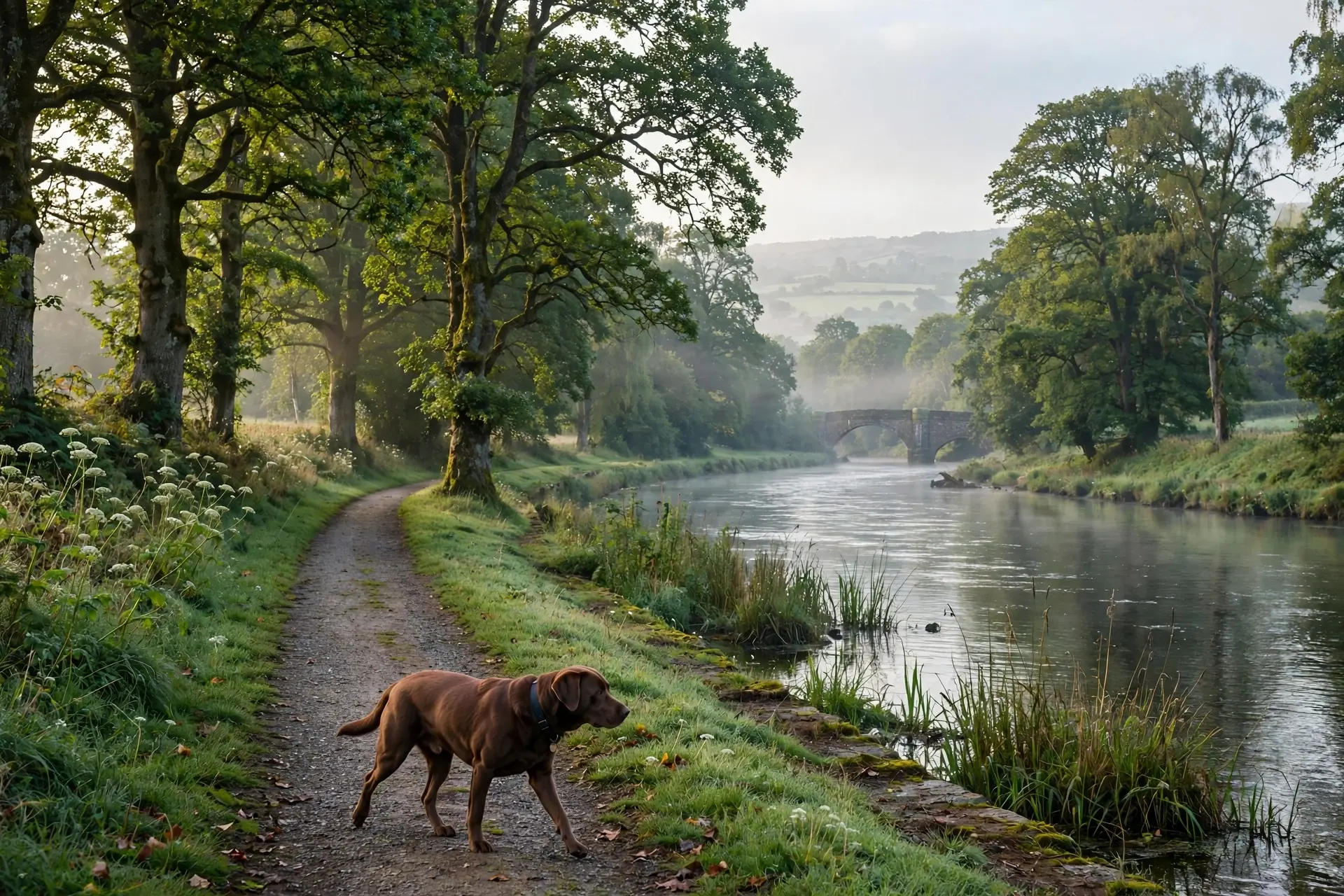
The Lagan Towpath is the spine of Lagan Valley Regional Park, which was established in 1967 as Northern Ireland's first regional park and now covers roughly 4,200 to 5,200 acres along the river between Belfast and Lisburn. The towpath itself runs about 11 miles (around 17 to 18 kilometres) from Stranmillis, on the southern edge of Belfast, to the Union Locks at Lisburn, following the River Lagan and the surviving cuts of the Lagan Navigation. Horses once pulled barges along this path; today it is a shared-use route for walkers, runners and cyclists, surfaced in tarmac and gravel and almost entirely flat, with no hills to speak of across the full 11 miles.
Do not try to walk the whole thing with a dog unless you know your dog can comfortably manage four to five hours on a lead. The useful way to use the towpath is in sections, and the official park maps divide it into five: Lock Keeper's to Stranmillis, Lock Keeper's to Shaw's Bridge, Shaw's Bridge to Drumbridge, Drumbridge to Lisburn, and Lisburn to Union Locks. From Lisburn itself, only the last two sections matter for a normal day out, plus the Drumbridge stretch if you want a longer walk towards Belfast. Each section has a different character, and choosing the right one matters more than covering distance.
The Lisburn to Union Locks section is the shortest and the most useful for a first visit. It runs south-west from the town, past the restored Lock 12 near the Civic Centre at Lagan Valley Island, towards the four Union Locks and the point where the canal route once continued towards Moira and Lough Neagh. The surface here is good, the river is close, and the walk feels semi-rural within minutes of leaving the town centre. Allow about 45 minutes to an hour out and back at a dog's pace, with stops for sniffing and water, and treat it as the warm-up rather than the main event.
The Drumbridge to Lisburn section is the classic Lisburn towpath walk and the one most local dog walkers use every week. Heading north-east from Lagan Valley Island, the path passes Hilden and Lambeg, with the derelict Hilden Mill buildings standing on the river bank as a reminder of the linen industry that built the town. The locks along this stretch — Lambeg Lock, Hilden Lock, Scott's Lock and Hanna's Lock among them — give the walk a rhythm: a short stretch of river, a lock chamber, a bridge, then open meadow again. This is also the stretch where the path is busiest with cyclists, so keep your dog on a short lead, keep to one side, and expect to step aside regularly on a dry weekend afternoon.
Beyond Drumbridge, the towpath continues through Edenderry and Minnowburn towards Shaw's Bridge and Belfast. This is where the walk changes character: the meadows open out, the villages thin out, and the path feels more like countryside than town park. Anglers favour this stretch because salmon and trout still run in this part of the river, so keep a dog that likes to splash well away from fishing lines and do not let it charge into the water near someone casting. The Giant's Ring, a Neolithic henge monument, sits a short detour from the path near Minnowburn, but the land around it is farmed and grazing livestock are sometimes present, so keep dogs on a lead there and follow the signs at each field entrance.
Three practical points apply to every section. First, the towpath is shared, and cyclists can approach quickly and quietly from behind, especially on the long straight stretches between locks. A long line is a hazard here; use a short lead, walk on the same side consistently, and teach or remind your dog to move to the edge when you hear a bell. Second, there are no dedicated dog bins along the towpath, according to the park's own visitor information, so carry bags and take them home or to a bin at a car park or park entrance. Third, low-lying riverside sections can flood or turn muddy after heavy rain, particularly in winter, so check the official guidance before you travel if there has been a wet week, and have a dry-park backup — Wallace Park, described below — ready before you set off.
Castle Gardens, on the lead
Castle Gardens, on Castle Street in the centre of Lisburn (BT27 4XE), is the most historically significant open space in the town. It stands on the site of Lisburn Castle, a 17th-century fortified manor house built by the Conway family, the landlords of Lisburn. The castle itself was destroyed in the Great Fire of 1707, but the grounds survived and were later laid out as public gardens, with terraces, a bandstand, a war memorial and a sandstone gateway dated 1677. The gardens are free to enter and open year-round from dawn to dusk, and public toilets are available on site.
Dogs are welcome in Castle Gardens but must remain on leads at all times, and that rule shapes how to use the place. This is not a run-around park; it is a slow, on-lead wander through terraced gardens, past monuments and flower beds, with the dog at your side rather than ranging ahead. For a reactive dog, that is actually an advantage: the paths are wide, sightlines are open, and you can see other dogs coming from a long way off. For a dog that needs to burn energy, it is the wrong tool — do the towpath or Wallace Park first, and use the gardens as the calm finish.
Walk the gardens in a loose loop rather than trying to cover every terrace in one pass. Enter from Castle Street, follow the main paths up through the terraces, pause at the 1677 gateway and the bandstand, and come back down by a different path so the dog gets new smells on the return leg. The war memorial area is the quietest corner and the best place to stand still for a few minutes if your dog needs to settle before you head back into town. Keep the dog off the flower beds and out of any planted areas, and keep the lead short around the memorial and the bandstand, where other visitors stop to read plaques and take photographs.
The gardens connect naturally to the rest of a Lisburn day. From Castle Street it is about a ten-minute walk through the town centre to the river and the towpath, and the Irish Linen Centre & Museum, on Market Square, sits between the two. The museum building itself is the old linen market house, and the visitor information centre is inside it — a useful stop for a map, a question about current towpath closures, or a check on whether any event is using Lagan Valley Island that day. Dogs are not generally admitted inside museums, so plan for one person to wait outside with the dog if you want to go in; check the official guidance before you travel rather than assuming.
One more detail worth knowing: Castle Gardens is a popular lunchtime spot for workers from the town centre, so it is busiest on weekday middays in good weather and quietest early in the morning and in the evening. If your dog struggles with crowds, go early, do the towpath first while the gardens are still quiet, and save the gardens for a short late-afternoon loop when the lunch crowd has gone.
Wallace Park and the short loops
Wallace Park is the park most Lisburn dog walkers actually use day to day, and it is the best answer to the question of where a dog can properly run. The 26-acre Victorian park was gifted to the town by Sir Richard Wallace in 1884, and its duck pond dates back to the 17th century, when it served as the town's reservoir. A major refurbishment completed in 2012 restored the bandstand and the pond and added children's play areas, sports facilities and accessible paths. The park sits in the heart of Lisburn, a short walk from Castle Gardens, and the council lists its main loop at about 1.2 kilometres.
The dog rules in Wallace Park are specific and worth learning before you go, because they change with the season. Dogs are welcome off the lead in the park, but not on the football pitches from 1 September to 30 April, when the pitches are in use. The children's play park is for children only, so keep your dog safely tied up outside while children play. Only club members can use the Lisburn Cricket Club ground inside the park, and dogs are not permitted in that area. The council also reminds owners that the fine for failing to clean up after a dog is £100, and that dogs must be kept under control and prevented from approaching other people and their dogs, cyclists, livestock and wildlife.
Walk the park as a perimeter loop first. The paths around the outside of the park, past the duck pond and around the cricket ground, give a dog a full circuit of smells and a clear view of who else is in the park, without cutting across the pitches or the play area. The duck pond is the feature every dog notices first, and it is also the place to be most careful: keep a dog that likes water on a lead near the pond until you know how it reacts, because ducks, children and a wet dog in a small pond are a combination that goes wrong quickly. The bandstand, which hosts live bands on many Sunday afternoons in summer, is the noisiest corner of the park; if your dog is sound-sensitive, give it a wide berth on a Sunday and use the far side of the park instead.
Wallace Park also works as a weather backup. When the towpath is waterlogged after rain, the park's tarmac paths and open grass stay usable, and the loop is short enough to repeat twice for a dog that still needs distance. Public toilets are available in the park, and there is a small car park plus on-street parking beside it. In summer the park fills with families, sports teams and children on bikes, especially on Saturday mornings when the football pitches are busy, so go early or late if your dog prefers space. In winter, when the council parks open from 9am to 5pm rather than 9am to 9pm, plan the park walk for the middle of the day and save the towpath — which is open access — for the early morning or late afternoon light.
Two smaller green spaces are worth knowing about for a second day or a short evening walk. Duncan's Dam, next to Thiepval Army Barracks, is a small suburban park around a dam that supplied Lisburn's water until the 1940s, and it is a known spot for dog walkers and anglers, with ducks as its main residents. Moat Park, at about 2.5 kilometres of paths, is another local option, but dogs are not allowed in its play park or multi-use games area, so keep your dog tied up if you use those facilities. Neither replaces the towpath or Wallace Park, but both are useful when you want a different ten-minute loop without driving anywhere.
Market Square, Bow Street and the town centre
Lisburn's town centre is largely car-free in its central streets, and that makes it a pleasant place to walk a dog between the green spaces. The natural route runs from Castle Gardens down Castle Street to Market Square, then along Bow Street, the main shopping street, and back towards the river. Market Square is the historic heart of the town, home to the Irish Linen Centre & Museum and the visitor information centre, and it is also where the town's market and events gather. The square is open, paved and easy to cross with a dog, but it is also where you will meet the most people, pushchairs and other dogs in the shortest distance, so keep the lead short and the pace steady.
Bow Street runs south from Market Square towards the station, and it is the street to use if you need supplies. Pet food, leads, poo bags and a spare towel are all easier to buy here than on the towpath, and the street has the usual mix of high-street shops, banks and cafes. Treat Bow Street as a transit route rather than a destination for the dog: the pavements are narrower than Market Square, shop doorways open directly onto the pavement, and a dog that stops to sniff every doorway will block the footway. Walk it once, get what you need, and head back to the river.
The town centre also has a practical role in a dog day that is easy to overlook: it is where the shade, water and toilets are. On a hot day, the walk from the towpath into the centre, through the shaded side streets and into the gardens, is cooler than staying on the exposed stretches of the river path. Carry water for the dog on the towpath in any case — there are water points at Lagan Valley Island, but not along every section — and refill at the island or in the town centre before the return leg. If you are travelling by train, the town centre is also the link between the station and the river: Lisburn station sits at the southern end of the centre, about a ten-minute walk from Castle Gardens, and the walk between the two is mostly flat and paved.
One caution applies to the town centre in the evening. Lisburn is a working town rather than a tourist resort, and the centre quiets down early in the evening outside the pubs and restaurants on the main streets. That is good for a calm dog walk, but it also means that cafes and shops close earlier than a visitor might expect, so do not plan a late supper in the centre without checking opening times first. If you want an evening meal with the dog, the safer plan is to eat earlier in the day at a place with outdoor seating, or to take food back to your accommodation and walk the dog on the towpath at dusk instead.
Getting there, parking and the train
By car, Lisburn is reached from Belfast on the M1 motorway, and from the south on the A1. The two car parks that matter for dog walkers are Lagan Valley Island and Drum Bridge. Lagan Valley Island is the town-centre start: it sits on an island in the River Lagan, reached by bridge from the town, and it holds the council's civic centre, a theatre and the river frontage where the towpath begins. It is central, well used and the obvious place to start, which is also its drawback — on a dry Sunday afternoon it can feel busy with prams, other dogs and events spilling out of the civic centre. Arrive before 10am or after 4pm to get the calm version of it.
Drum Bridge car park is the calmer alternative. It sits on the towpath between Lisburn and Edenderry, and it puts you straight onto the quieter, more rural stretch heading towards Belfast, without the town-centre traffic. It fills up quickly on a nice evening, and overflow parking on the verges is not something to rely on, so treat it as a morning start rather than a late-afternoon one. Hilden is the third option and the quietest of the three: parking there is smaller and less obvious, which keeps numbers down, and you step straight onto a short, flat stretch of towpath beside the old mill buildings. Use Hilden when you only have twenty minutes and want a quick river walk without driving into the centre at all.
By train, Lisburn station is on the Belfast to Portadown line, and the journey from Belfast Grand Central Station takes about 25 minutes, with Lisburn the ninth stop out from the city. Trains run frequently through the day, and the Dublin to Belfast Enterprise service also stops at Lisburn. The station has two platforms and step-free access, and the walk from the station to Castle Gardens takes about ten minutes through the town centre. Dogs can travel on Translink trains, but check the official guidance before you travel for the current rules on leads, carriers and peak-time restrictions, and keep the dog on a short lead on the platform — the gap between the platform edge and a passing train is not a place for a long line.
By bus, Ulsterbus routes serve Lisburn from Belfast and from the surrounding towns, including the 38 service that connects Lisburn with Hillsborough village. Bus rules for dogs vary by operator and by driver, so check the official guidance before you travel rather than assuming a dog can board. If you are relying on public transport for the whole day, the train is the more predictable option, and the walk from the station covers the town centre, Castle Gardens and the towpath without any further transport at all.
Whichever way you arrive, build in a settling stop before the main walk. Dogs that have just come off a train or out of a car need ten minutes to toilet, drink and sniff the new place before they are asked to walk two miles on a lead beside cyclists. Lagan Valley Island is the best place for that stop if you arrive by car, and the small green area outside Lisburn station serves the same purpose if you arrive by train. A dog that has settled first walks better, pulls less and is less likely to react to the first cyclist it meets on the towpath.
Where to stay with a dog
Lisburn works best as a day trip from Belfast or as a one- or two-night base for the Lagan Valley, and the way you book a stay should reflect that. The town has a small number of hotels and guesthouses in and around the centre, and a wider choice of self-catering and bed-and-breakfast options in the surrounding villages, but dog policies vary from property to property and from room to room, so do not assume that a hotel that accepts dogs in one room type accepts them in all of them. Ask three questions before you pay: does this specific room accept dogs, is there a pet charge and how much is it, and where is the nearest practical toilet area after dark.
The questions matter more in Lisburn than in a resort town, because the town's accommodation is mostly designed for business and family visitors rather than for dog owners. A room on an upper floor with no lift, a room facing a busy road, or a room a long way from the exit can all turn a simple overnight stay into a difficult one with a dog that needs to go out at night. Ask for a ground-floor room near an exit if one is available, confirm whether the dog can be left alone in the room and under what conditions, and find out whether the hotel has a garden or grass area where the dog can toilet without crossing a car park. Get the answers in writing with your booking confirmation, and keep the email until you are home.
Self-catering is often the easier option in this part of County Antrim, because it gives the dog a door to a garden and a kitchen for its food, and it removes the question of whether the dog can be left in a hotel room while you eat. If you book a cottage or apartment, check the garden boundary before you arrive: a low wall, a gap under a gate or a shared garden with another property can all matter more than the size of the garden itself. Ask for photographs of the boundary and the gate, confirm the number of dogs allowed, and check whether there is a secure area where the dog can be left for a short time. Our guide to dog-friendly holiday parks covers the same boundary and fee questions in detail, and the same checklist works for a cottage near Lisburn.
Staying in Belfast and visiting Lisburn by train is a sound alternative, especially for a first trip. Belfast has a wider choice of dog-friendly hotels, and the 25-minute train journey means you can walk the towpath in the morning and be back in the city for the evening without driving. If you take that option, book a hotel near Grand Central Station so the walk to the platform is short, and plan the Lisburn day around the train times rather than the other way round — a missed train with a tired dog is a much longer wait than a missed train on your own. For a longer stay, the same logic works in reverse: base yourself in Lisburn, walk the towpath in the morning, and take the train into Belfast for an afternoon when you want a change of scene.
Whatever you book, pack for a riverside town rather than a city break. The towpath is flat but exposed in places, and the river makes the air damp even on a dry day, so bring a drying coat or two towels, a waterproof mat for the dog's bed, and a spare lead. If your accommodation has hard floors, a non-slip mat by the door will save an older dog from slipping after a wet walk, and a lidded box for muddy leads keeps the room clean. These are small items, but they are the difference between a stay that feels easy and one that feels like a negotiation with mud.
Eating and drinking with a dog
Eating out with a dog in Lisburn is a matter of terraces, timing and asking first, rather than a list of places that never changes. The town centre has cafes and pubs around Market Square and Bow Street, and several of them have outdoor seating where a well-behaved dog on a lead is welcome, but policies change with the season, the manager and the weather, so a place that welcomed dogs on its terrace last summer may have different rules this year. The reliable approach is to look for outdoor seating, ask before you sit down, and have a backup in mind if the answer is no.
Time your meal around the walk, not the other way round. A dog that has just walked two miles on the towpath will settle under a table far more easily than a dog that has been waiting in the car while you walk, and a cafe stop works best as a reward at the end of the walk rather than as a break in the middle of it. Order, sit the dog on a mat or blanket you have brought with you, and give it something to chew or lick while you eat. A dog that has a job — a filled chew, a lick mat, a familiar blanket — is a dog that is not watching every plate that passes.
Lagan Valley Island deserves a mention here because it is the most useful refreshment stop on the towpath itself. The island holds the civic centre and a theatre, and there are toilets and water points on site, which makes it the natural place to pause, refill the dog's water and decide whether to walk further or turn back. Cafes and kiosks in the area vary by season and by event, so check what is open on the day rather than planning a meal around a single venue. If you are walking the longer Drumbridge stretch, carry your own water and a snack for the dog, because there is no cafe on the towpath itself between Lisburn and Drumbridge.
For a longer lunch, the Lock Keeper's Cottage near the Belfast end of the towpath is the best-known refreshment stop in the whole park: a cafe set in the restored lock keeper's cottage near Lockview Road, which welcomes well-behaved dogs in its outdoor seating. It is too far to walk to from Lisburn with most dogs — the full towpath is 11 miles — but it is a useful target if you drive to the Belfast end for a second day, or if you walk the Shaw's Bridge section and want a proper stop. Check its opening times before you go, because they vary by day of the week and by season, and the outdoor seating is the dog-friendly part, not the inside of the cottage.
If you cannot find a place that suits the dog, the fallback is simple and often better: buy food in the town centre, take it to Castle Gardens or Wallace Park, and eat it on a bench with the dog beside you. Both parks are free, both have benches and open grass, and a picnic eaten slowly in a park is often calmer for a dog than a meal in a busy cafe. Bring a bag for your rubbish, take it home with you, and do not feed the dog from your plate — the ducks in Wallace Park and the gulls along the river will already be watching for dropped food.
Longer days: Hillsborough, Moira and Drum Bridge
Lisburn is a good base for three longer days, and each one uses a different part of the Lagan Valley. The first is Hillsborough Forest, about five miles south of Lisburn in the village of Hillsborough. The forest covers a substantial area of mixed woodland with a lake, waymarked trails and a sculpture trail, and the council lists its main dog walk at about four kilometres. Dogs are welcome off the lead in the forest, but they should not be allowed to disturb wildlife at any time of year, so keep the dog in sight and call it back from the lake edge and from any deer or waterfowl. The forest is the right answer when the towpath feels too linear and the dog needs woodland smells and a change of surface.
Hillsborough Castle and Gardens sits beside the forest, but it is a separate visit with separate rules, and it is important not to confuse the two. The castle is a working royal residence and the official home of the Secretary of State for Northern Ireland, and its 100 acres of gardens include lakes, orchards and a children's play trail. Dogs are not permitted in Hillsborough Castle and Gardens unless they are registered assistance dogs, and assistance dogs in training are also welcome. That means a visit to the castle needs a plan for the dog: either one person stays with the dog and walks the forest while the other visits the castle, or the castle is left for a dog-free day. Do not arrive at the castle with a dog and expect to be admitted; check the official guidance before you travel and plan the split visit in advance.
The second longer day is Moira, a village about eight minutes by train from Lisburn on the Portadown line, or a short drive along the A3. Moira Demesne, the village park, has a listed dog walk of about 1.5 kilometres, and the council asks owners not to exercise dogs on the football pitches from 1 September to 30 April. The demesne is a small, calm park with mature trees and a pond, and it works well as a quiet alternative to Wallace Park when Lisburn itself is busy. Combine it with a walk around Moira village, which has cafes and a slower pace than Lisburn town centre, and treat it as a half-day rather than a full day — the demesne is a park, not a hiking destination.
The third longer day is the one that uses the towpath properly: a full walk from Lisburn to Drumbridge and beyond, towards Edenderry and Minnowburn, with a car left at one end or a bus or lift back. The council lists the Lagan Valley Regional Park walk at 12.55 kilometres, and the towpath from Lisburn to Lady Dixon Park in Belfast is listed by walking sites at 11.9 miles out and back, taking three to four and a half hours. That is a long day for most dogs, so build it up rather than attempting it on a first visit: walk Lisburn to Drumbridge first, then Drumbridge to Edenderry, and only then consider the full stretch. Carry water for the dog, plan a turn-back point before you set off, and agree in advance who will collect the car if the dog tires before the planned end.
For a second day with a dog that still has energy, the Belfast end of the towpath offers a different landscape: Sir Thomas and Lady Dixon Park, with its meadows and rose garden, and Barnett Demesne, with Malone House and its cafe, both sit on or near the towpath between Shaw's Bridge and the city. Malone House is a late-Georgian mansion about two and a half miles south of Belfast city centre, and its cafe serves pastries, sandwiches and hot drinks. Dogs are welcome on the towpath throughout, but should be kept on a lead across the Minnowburn and Giant's Ring sections, where the land is farmed. If you want a coastal contrast after two days on the river, our guide to dog-friendly beaches and their rules explains how seasonal restrictions work, and our Edinburgh guide shows how a bigger city can be planned around a dog in the same way.
River, weather and towpath safety
The River Lagan is the reason the towpath exists and the main hazard on it, so it deserves a section of its own. The river is deep in places, the current is stronger than it looks after rain, and the banks are steep and slippery in several stretches, particularly where the path runs close to the water near locks and bridges. Do not let a dog swim in the river unless you know the entry and exit points, the current and the water quality, and never let a dog jump in from a lock wall or a bridge. If your dog falls in or jumps in and cannot get out, do not go in after it unless you are certain you can get out safely yourself; call for help and keep the dog in sight. Blue-green algae can affect rivers and ponds in warm weather, so keep dogs out of stagnant or discoloured water in summer and check the official guidance before you travel if there has been a warning.
Weather changes the towpath more than it changes the parks. In summer, the exposed stretches between the locks have little shade, and the tarmac can be hot underfoot for a dog's paws in the middle of the day. Walk early or late, test the surface with the back of your hand, and carry water — the river is not a safe substitute for a water bottle. In autumn, fallen leaves hide mud, tree roots and uneven surfaces, and the path can be slippery after rain. In winter, low-lying sections flood, and the council parks in Lisburn open shorter hours, from 9am to 5pm between October and March, compared with 9am to 9pm in summer. Check the official guidance before you travel in winter, and have Wallace Park as a backup if the towpath is closed or flooded.
Livestock and wildlife need a mention because the towpath passes farmland as well as parkland. The council's own advice for its parks and open spaces is to keep dogs under control, prevent them from approaching other people and their dogs, cyclists, livestock and wildlife, never let a dog worry or attack farm animals, and give wildlife a wide berth. That is not generic advice on this route: sheep and cattle graze in fields beside the towpath, particularly around Minnowburn and the Giant's Ring, and a dog that chases livestock can cause serious harm and legal trouble. Keep the dog on a lead near any field with animals in it, leave gates as you found them, and do not let the dog through a gap in a hedge into a field you cannot see into.
Other dogs are the most common source of friction on a busy towpath, and the narrowness of the path makes it worse. The towpath is not wide enough for two dogs on long leads to pass each other comfortably, and a dog that lunges at another dog on a narrow bridge or beside a lock has nowhere to go. Keep the lead short on bridges and at locks, step off the path into a wider area when you see another dog approaching, and do not let your dog approach another dog without asking the owner first. If your dog is reactive, walk the quieter sections — Hilden to Lisburn early in the morning, or Lisburn to Union Locks — rather than the busy Drumbridge stretch on a Sunday afternoon.
Finally, know where help is. The nearest vet to the towpath is in Lisburn town centre, with Vets for Pets on Longstone Street among the practices in the town, and the Lagan Valley Regional Park ranger service patrols more than 38 kilometres of paths and trails in the park. Save the number of a vet and the park office before you set off, and carry a phone with charge. If your dog is injured on the towpath, the flat surface is an advantage: you can carry a small dog back to a car park, and a larger dog can usually walk slowly to the nearest access point, but a dog that cannot walk at all will need a vehicle, so note the nearest car park — Lagan Valley Island, Drum Bridge or Hilden — before you start each section.
A workable half-day plan
Put the pieces together and a Lisburn half-day with a dog looks like this. Arrive at Lagan Valley Island before 10am, give the dog ten minutes to toilet and settle, and walk the towpath north-east towards Hilden and Drumbridge for 45 minutes, turning back at the point where the dog starts to slow or the path starts to fill with cyclists. Return to the island, refill the dog's water, and walk through the town centre to Castle Gardens for a slow, on-lead loop of the terraces and the 1677 gateway. That is about two hours of walking in total, with a proper break in the middle, and it gives the dog river, woodland, town and garden in a single morning.
For the afternoon, choose one of two options based on the dog. If the dog still has energy, drive or walk to Wallace Park for a perimeter loop and some off-lead time on the grass, away from the football pitches in season and away from the cricket ground. If the dog is tired, skip the park, find a cafe with outdoor seating around Market Square, and let the dog settle under the table while you eat. Either way, finish with a short, calm walk — a lap of Castle Gardens or a slow stretch of the towpath near the island — rather than a final burst of exercise, so the dog travels home settled rather than wired.
A full day adds one longer element and one rest. Walk the towpath to Drumbridge and back in the morning, rest the dog in the middle of the day — in the car in the shade with ventilation, in your accommodation, or on a blanket in a park — and use the afternoon for Wallace Park or a train ride to Moira Demesne. A two-day stay adds Hillsborough Forest on the second morning, with the castle left for a dog-free visit or a split visit as described above. The pattern is the same at every scale: one long walk, one short walk, one rest, and no more than one new place per half-day. Dogs learn a place by returning to it, and Lisburn rewards a second visit to the same stretch of towpath far more than a rushed tour of every park in the district.
Pack for the day as if the weather will change, because on the Lagan it often does. Bring water and a bowl, poo bags, a short lead and a spare, a drying coat or two towels, a mat for the dog to lie on in a cafe or park, and a snack or chew for the settling stops. Bring a phone with the train times saved, the number of a vet, and a note of the car park you started from. And bring patience for the cyclists: the towpath is shared, the locks are narrow, and the best walks on the Lagan are the ones where nobody is in a hurry.
Practical questions
Before you go
Are dogs allowed in Castle Gardens in Lisburn?
Yes. Dogs are welcome in Castle Gardens but must stay on a lead at all times. The gardens are free to enter and open from dawn to dusk, so they work well as a short, calm walk either before or after a longer stretch on the Lagan Towpath.
How long is the Lagan Towpath from Lisburn to Belfast?
The towpath runs about 11 miles (around 17 to 18 kilometres) between Lisburn and Stranmillis in Belfast, following the River Lagan through Lagan Valley Regional Park. Most visitors walk one section rather than the whole route, which takes roughly four to five hours end to end.
Can my dog go off the lead in Wallace Park?
Dogs are welcome off the lead in Wallace Park except on the football pitches from 1 September to 30 April, and dogs are not allowed on the cricket ground, which is for club members only. Keep your dog tied up outside the children's play park, and keep it under control around the duck pond.
Can I take my dog to Hillsborough Castle and Gardens from Lisburn?
No, apart from registered assistance dogs. Dogs are not permitted in Hillsborough Castle and Gardens. Plan it as a dog-free visit with one person staying with the dog, or walk Hillsborough Forest instead, where dogs are welcome off the lead provided they do not disturb wildlife.
Where is the best place to park for a dog walk in Lisburn?
Lagan Valley Island is the most convenient start for the town-centre end of the towpath, with the river, toilets and water on site. Drum Bridge car park is a calmer alternative for the towpath heading towards Belfast, and Hilden is the quietest start for a short walk, though parking there is smaller.
Can I take a dog on the train to Lisburn?
Lisburn station is on the Belfast to Portadown line, about 25 minutes from Belfast Grand Central Station. Dogs can travel on Translink trains, but check the official guidance before you travel for the current rules on leads, carriers and peak-time restrictions.