This guide is independent and contains no paid placement. If affiliate links are added later, they will be clearly marked and will not change our editorial checks.
Llangollen is one of the easiest Welsh towns to enjoy with a dog: a flat canal towpath runs straight out of town, the Pontcysyllte Aqueduct is a short walk or drive away, the steam railway welcomes dogs on many services, and the River Dee gives the whole day a natural centre. Keep the dog on a lead at the aqueduct and near the river, and the rest of the day takes care of itself.
Why Llangollen suits a dog day out
Llangollen works for dogs because almost everything worth doing is outdoors and close together. The town sits in a steep-sided valley where the River Dee runs through the middle, the canal runs along one side, and the hills rise sharply on both banks. That geography means a dog can go from a riverside stroll to a canal towpath to a hill climb in the space of a single afternoon, without a car in between. Few Welsh towns pack that much variety into such a small area, and fewer still do it with a town centre that is genuinely pleasant to walk through on a lead.
The other reason Llangollen suits dogs is the pace. This is not a town built around a single attraction with a queue at the door. The canal, the river and the valley are the attraction, and they are free, open all day and best enjoyed slowly. A dog that would be miserable standing in line at a castle will be perfectly happy here, because the day is made of walking, sniffing, watching narrowboats and sitting outside a cafe while the world goes by. If your dog is the sort that settles best after a long sniffy walk rather than a short march, Llangollen is built for them.
It helps to understand the layout before you arrive. The town centre clusters around the bridge over the Dee, with the main street running roughly parallel to the river. The canal runs above the town on the valley side, reached by a short climb from the centre, and the railway station sits near the river at the eastern end of town. The Horseshoe Falls, where the canal draws its water from the Dee, lie a couple of miles upstream to the west. Once you have that picture in mind — river below, canal above, falls upstream, hills on both sides — you can plan a day that flows naturally instead of doubling back on itself.
Dogs of most kinds cope well here, but the town does ask a few specific things of them. The aqueduct crossing is narrow and exposed, the canal is unfenced, the river is fast, and the hill paths cross sheep country. None of that is a reason to stay away; it is a reason to bring a short lead, a long line for the quieter stretches, water, a towel and a plan for where the dog will rest. This guide covers each of those points in turn, so you can match the day to the dog you actually have rather than the dog you wish you had.
The Pontcysyllte Aqueduct walk
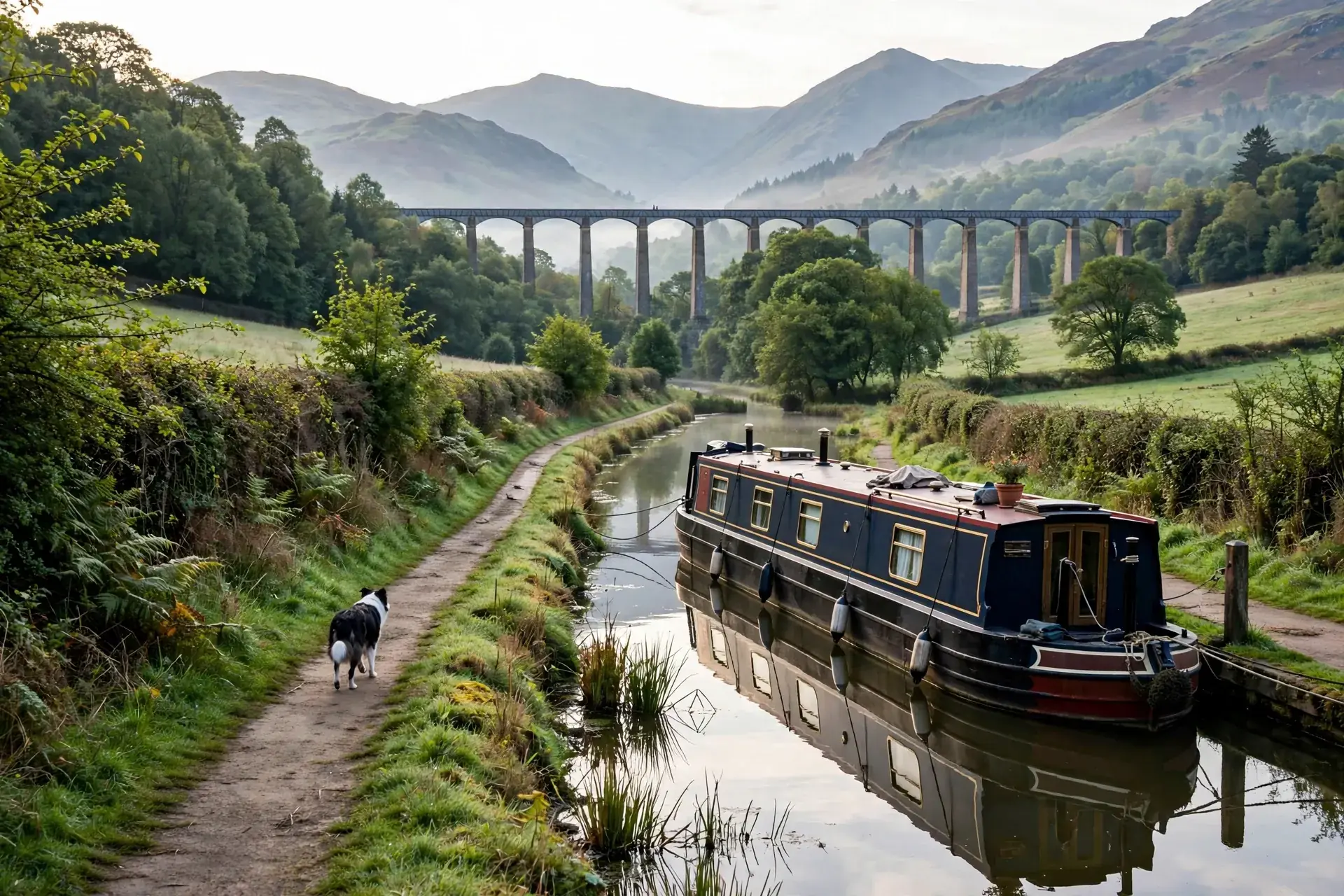
The Pontcysyllte Aqueduct is the single most famous thing in the Dee Valley, and it deserves its reputation. Completed in 1805 to designs by Thomas Telford, it carries the Llangollen Canal across the River Dee on a slender iron trough, about 307 metres long and roughly 38 metres above the river. It is a UNESCO World Heritage Site, and the view from the middle — the valley falling away on both sides, the Dee far below, the hills rolling off toward the Berwyns — is one of the great sights in Wales. It is also, for a dog owner, a crossing that needs to be taken seriously rather than casually.
The towpath runs along one side of the aqueduct, next to the water channel, with a low wall on the canal side and, on the far side, nothing but the edge of the trough and a long drop to the river. Dogs cross on the towpath every day without incident, but the rules are simple: short lead, dog close to your side, no long line, no off-lead, and no stopping in the middle to take photographs while other people are trying to pass. The path is narrow enough that two people passing need to coordinate, and a dog weaving across the path is a genuine hazard to cyclists and other walkers. If your dog is nervous of heights, exposed edges or busy narrow paths, consider whether the crossing is right for them at all; the view from the valley floor below is almost as good and a great deal calmer.
Getting there is straightforward. From Llangollen, the canal towpath runs east out of town toward the aqueduct, a walk of roughly two miles that follows the canal the whole way and stays flat throughout. That makes it an excellent out-and-back for a fit dog, and the towpath itself is part of the pleasure: narrowboats, bridges, hedgerows and glimpses down into the valley. Alternatively, drive to the aqueduct and park nearby, then walk the crossing and a short stretch of towpath in either direction. The aqueduct is busy on summer weekends, so an early start changes the experience completely — arrive before ten in the morning and you will often have the towpath largely to yourself.
A few practical points are worth knowing. There is no fence or barrier at the far end of the crossing to keep a dog from wandering, so keep hold of the lead until you are well clear of the structure. The iron trough can be slippery when wet, and the towpath surface gets muddy after rain. Anglers and cyclists use the same path, so give way politely and keep the dog on the canal side of the path where possible. And remember that the aqueduct is a working piece of canal infrastructure, not a viewing platform: narrowboats cross it slowly, and their crews need room to work the tiller. Stand aside, let them pass, and enjoy watching a boat float across a valley on a ribbon of water — it is a strange and wonderful sight, and dogs usually find the boats at least as interesting as the view.
If you cross with a dog that copes well with the height and the crowds, the far side rewards you. The towpath continues toward Chirk and the English border, and the walking gets quieter the further you go from the aqueduct. Even a short continuation of twenty minutes takes you past the worst of the crowds and into proper canal country, with hedges, fields and the occasional heron. Turn back when the dog tells you to, not when the map tells you to; the aqueduct is the destination, and everything beyond it is a bonus.
Canal towpath walks from the town
The canal is the spine of a Llangollen dog day, and the towpath is the easiest walking in the valley. The Llangollen Canal runs for around 46 miles from Hurleston, near Nantwich in Cheshire, to its terminus at Llangollen, and the final stretch into town is the prettiest part of the whole waterway. From the town basin the towpath heads west toward the Horseshoe Falls and east toward the aqueduct, so you can walk in either direction straight from the centre without driving anywhere. Both directions are flat, well surfaced for much of their length, and lined with enough to look at that a slow dog will never be bored.
The westward walk to the Horseshoe Falls is the better choice for most dogs. It is about two miles each way, following the canal as it leaves the town and winds through woods and fields toward the falls, where the Dee is diverted to feed the canal. The falls themselves are a low curved weir rather than a dramatic cascade, but the setting is lovely: a stone bridge, a riverside meadow, and the canal beginning its journey back toward town. The path is quieter than the aqueduct direction, the water is close enough for a dog to watch the ducks, and there are places to sit and let the dog rest. In summer the towpath here is shaded for long stretches, which matters on a hot day when the valley floor can feel surprisingly warm.
The eastward walk toward the aqueduct is busier but more spectacular, and it suits a dog that is comfortable around people, bikes and boats. The towpath passes under bridges, alongside gardens and allotments, and then out into open valley with views across to the far hillside. You do not need to walk the whole two miles to the aqueduct to enjoy it; even the first mile gives you the canal at its best, and you can turn back at any of the bridges. If you do continue, the path stays flat all the way, and the reward is the aqueduct crossing described above.
Water safety deserves a clear word. The canal is not fenced, and the towpath edge drops straight into water that is deep enough to be dangerous for a small or nervous dog. Most dogs walk the towpath happily on a lead for years without incident, but a dog that lunges at ducks, chases moorhens or simply cannot resist jumping in needs to stay on a short lead near the water, especially at bridges and locks where the edge is closest to the path. Bring a towel and a drying coat: even a dog that only paddles at the edge will come back wet, and canal water is not the sort you want drying on the car seats. If your dog does go in, stay calm, call them to the nearest shallow edge or a lock landing, and never jump in after them yourself.
Shared-path manners make the towpath work for everyone. Cyclists travel faster than walkers and cannot always be heard coming, so keep the dog on the side away from the centre of the path and shorten the lead when you hear a bell or a voice behind you. Anglers sit quietly by the water with rods out; give them a wide berth and do not let the dog investigate their tackle. Narrowboat crews need the towpath clear when they are working a bridge or a lock, so step aside and wait. These are small courtesies, but on a narrow path they are the difference between a good day and a grumpy one.
Llangollen Railway: steam trains and dogs
The Llangollen Railway is the heritage steam line that runs from the town eastward along the Dee Valley toward Corwen, and for many visitors it is the highlight of the day. The line follows the river through wooded valley scenery, crossing the Dee on bridges and passing through cuttings and small halts, and the journey feels like a proper railway adventure rather than a short tourist loop. The full run to Corwen is around ten miles each way, and the round trip makes a satisfying half day when combined with a walk at one end and lunch at the other.
Dogs and heritage railways generally get on well, and the Llangollen Railway is no exception, but the details matter and they change. Dog policies on heritage lines can vary between ordinary services, dining trains, gala days and peak holiday services, and a dog that is welcome on a quiet Tuesday may not be welcome on a crowded Santa special. Check the official guidance before you travel, and if the railway's own website does not answer the question, ask them directly before you book. It is a short question and it saves a wasted journey.
On the day itself, a few preparations make the train ride easy. Bring a blanket or mat for the dog to lie on, because heritage carriage floors are hard and the dog will be happier with something familiar under them. Choose a seat where the dog can lie out of the aisle, and keep the lead short so nobody trips over it when the train sways. Arrive in good time so the dog can settle before departure rather than being bundled aboard at the last minute, and give them a toilet walk before boarding — there are no toilet stops on a moving train. If your dog is noise-sensitive, sit away from the locomotive end and consider ear protection in the form of a calm, familiar routine rather than any gadget; the whistle and the steam are part of the experience, and a dog that is frightened by sudden loud noises may be happier on the towpath that day.
The railway is also a useful piece of the day's logistics. You can ride one way and walk back along the valley, or ride both ways and use the time at the far end for a riverside walk and a pub lunch. The station at Llangollen is close to the town centre and the river, so it slots naturally into a day that starts on the canal and ends in town. And if the weather turns, a steam train is one of the few dog-friendly activities in the valley that is properly under cover — worth remembering on a wet Welsh afternoon when the towpath has turned to mud.
One more thing to note: the railway is run largely by volunteers, and the people who work on it are usually delighted to see a well-behaved dog. A calm dog that settles under a seat and ignores the other passengers is the best advertisement for dog-friendly travel there is. If your dog is the sort that barks at strangers, lunges at other dogs or cannot settle in a confined space, be honest about it and choose the towpath instead. There is no shame in picking the walk over the train; the valley is the same either way.
The River Dee: paths, bridges and water safety
The River Dee is the reason Llangollen exists where it does, and it gives the town its energy. The river runs fast and clear through the town, crossed by a handsome road bridge and several footbridges, and the riverside paths are the natural place for a dog to stretch its legs after the car journey. The most useful stretch runs along the river through the town itself, from the railway station end to the meadows upstream, and it is an easy, level walk that suits dogs of all ages. Benches, grassy banks and shade make it a good place to stop and let the dog watch the water.
But the Dee is not a paddling river, and this is the point to take seriously. The current through Llangollen is strong, the riverbed is rocky, and the water is used by kayaks, canoes and white-water rafts, particularly around the town bridge and the weirs. A dog that jumps into moving water can be swept downstream faster than you can run along the bank, and a ball thrown into the current will be gone before the dog reaches it. Let the dog paddle only at quiet, shallow edges well away from weirs and boat traffic, keep them on a long line if you are at all unsure, and never throw anything into moving water. If your dog is a keen swimmer, save the swimming for a still lake or a calm beach another day.
The bridges are part of the experience. The main road bridge in the town centre is busy with traffic, so cross it briskly on a short lead and keep the dog on the inside of the pavement. The footbridges are quieter and give better views, and the Chain Bridge — a restored pedestrian suspension bridge a short walk upstream — is a lovely detour with a dog that is comfortable on a narrow, slightly springy deck. Some dogs dislike the movement and the see-through gaps of a suspension bridge, so watch your dog's body language and be ready to turn back rather than coaxing them across. The riverside meadow on the far bank is a good place for a calmer walk once you are over.
Wildlife is part of the Dee's charm and part of its discipline. Dippers, grey wagtails and herons work the river, and the banks are home to ducks and the occasional otter. Keep the dog under control near nesting birds in spring and summer, and do not let them crash through the reeds where birds may be nesting. In autumn, fallen leaves hide the bank edge, and after heavy rain the river can rise quickly and the paths can flood; if the water is brown and fast, keep the dog well back from the edge and choose the canal instead. The Dee in spate is a magnificent sight from a bridge, and a dangerous one from the bank.
The town itself: streets, shops and cafes
Llangollen town centre is small, walkable and full of independent shops, which makes it a pleasure to explore on foot with a dog. The main street runs from the bridge up through the town, lined with bookshops, outdoor shops, cafes, bakeries and craft shops, and the pace is unhurried even on a busy Saturday. Most shops are small enough that you can see inside from the door, so if you are unsure whether dogs are welcome, a quick look and a polite question costs nothing. Many independent shops in the town welcome well-behaved dogs, but policies vary from shop to shop, so ask rather than assuming.
Plas Newydd, the historic house on the edge of town that was home to the Ladies of Llangollen in the late eighteenth century, is worth a look from the outside even if you do not go in. The house and gardens sit in a wooded setting above the town, and the walk up to it is a pleasant short climb with views back over the valley. Check the official guidance before you travel for current dog rules in the gardens, as historic house gardens sometimes restrict dogs to certain areas or require leads throughout. Even if the gardens are not open to dogs, the walk to the gates and the surrounding lanes make a good short outing.
The town's famous Eisteddfod, the international music festival held each July, changes the character of Llangollen completely for a week. The town fills with visitors, the pavilion hosts concerts and competitions, and the streets are busier than at any other time of year. If you are visiting during the Eisteddfod with a dog, expect crowds, noise and limited space in cafes, and plan your walks for early morning or late evening. Outside festival week, the town is quiet enough that a reactive dog can manage the main street with a little care and a route that avoids the busiest pinch points.
Street-level practicalities are straightforward. The pavements are generally wide enough for a dog on a short lead, though the bridge and a few narrow stretches need care. There are bins for dog waste around the town and along the main paths, but carry your own bags anyway, because bins fill up on busy days. Water is easy to find: most cafes will fill a bowl if you ask, and the river and canal are always nearby, though canal and river water are not ideal drinking water for dogs. If your dog is small, remember that the town sits in a valley and the walk back up to the canal from the river is a proper climb — fine for most dogs, but worth knowing if you are carrying a puppy or an older dog in your arms.
Longer walks: Dinas Bran and the valley sides
For dogs that need a proper hill, the climb to Castell Dinas Bran is the walk to do. The ruined castle crowns the hill directly above the town, and the path climbs steeply from the town centre through woods and open hillside to the summit, where the views stretch along the whole Dee Valley. It is a short walk in distance — under two miles return — but a serious one in effort, with a steep gradient that will tire a fit dog and test an older one. Take water, take your time, and do not attempt it in high wind or heavy rain, when the exposed summit is no place for a small dog.
The reward at the top is worth the climb. The castle ruins are a shell of stone walls with grass inside, and the panorama takes in the town below, the river winding east, the aqueduct in the distance and the Berwyn mountains rising to the south. Keep the dog on a lead around the ruins: the walls are uneven, the drops are real, and the site is popular with other walkers. The descent is harder on a dog's joints than the climb, so take the gentler path down if one is available and give an older dog time on the way back. If your dog is very young, very old or has joint problems, skip the summit and walk the lower paths instead — the valley views from halfway up are nearly as good.
The Horseshoe Pass is the other great valley-side outing, though it needs a car. The A542 climbs out of Llangollen in a series of sweeping bends to the pass, where there is parking and access to open moorland walks. The road itself is busy and not a place to walk a dog, but the moorland tracks beyond the car park offer wide, open walking with big skies and far fewer people than the town paths. Keep the dog on a lead here: the moor is sheep country, the ground is uneven, and the weather can change in minutes. The pass is also one of the best places in the valley for a sunset, if you are staying overnight and the evening is clear.
For a longer day, the Dee Valley Way and the Offa's Dyke Path both pass through or near Llangollen, and they offer waymarked long-distance walking without the need to navigate. The Dee Valley Way follows the river and the valley sides, while Offa's Dyke runs along the ridge to the east. You do not need to walk either path end to end; pick a section, walk it out and back, and you will have a proper day in the hills. Both paths cross farmland and sheep country, so a lead is essential for much of the way, and both are best walked with a map and a charged phone. If you are planning a longer trip around North Wales, our dog-friendly North Wales road trip guide sets out a driving loop that pairs Llangollen with the Conwy coast and the Llyn Peninsula, and our Snowdonia dog guide covers the mountain walks further west for dogs that are ready for bigger hills.
Where to eat and drink with your dog
Llangollen is well supplied with dog-friendly places to eat and drink, and the town's cafe culture is one of its strengths. The pattern is familiar from other Welsh towns: many cafes welcome dogs inside or on a terrace, pubs are generally more dog-friendly than restaurants, and the best approach is to look for a water bowl by the door — it is the clearest sign a place expects dogs. Policies change with seasons and ownership, so treat any specific recommendation as a starting point and check the official guidance before you travel, or simply ask at the door.
For lunch, the town centre cafes are the easiest option. A dog that can settle under a table will be welcome in many of them, and a terrace table on a fine day is the simplest arrangement of all. Bring a mat or blanket for the dog to lie on, because cafe floors are usually hard and cold, and order something the dog can ignore rather than something that fills the table with smells they cannot have. If your dog barks at strangers or begs from neighbouring tables, choose a table at the edge of the room and keep the lead short. A tired dog after a canal walk is a much better cafe companion than a fresh one, so plan lunch for after the morning walk rather than before it.
Pubs are the backbone of the Llangollen dog scene, and several of the town's pubs welcome dogs in the bar area, with some also allowing them in the dining room. The riverside and canal-side pubs are particularly good on a fine evening, when the dog can lie on the terrace and watch the boats and the river. Evening meals need a little more planning: book ahead where you can, mention the dog when you book, and ask where dogs are allowed to sit. A pub that welcomes dogs in the bar may not welcome them in the restaurant, and discovering that at the door with a hungry dog is nobody's idea of a good evening.
A few eating practicalities round out the picture. Takeaway food is a useful fallback: buy sandwiches or pasties from a bakery and eat them on a bench by the river, where the dog can sit beside you without any rules at all. If you are staying overnight in self-catering accommodation, the town has a small supermarket and several independent food shops for supplies. And remember the basics: never leave a dog in a car while you eat, even for a short lunch, and never feed a dog from the table in a place that has welcomed them — a dog that learns to beg in one cafe will try it in every cafe after that.
Parking, toilets and practical arrival planning
Arrival is the part of the day that most often goes wrong, and Llangollen rewards an early start. The town's car parks fill up on summer weekends, bank holidays and Eisteddfod week, and the closest spaces to the canal and the river go first. Arrive before ten in the morning and you will usually park easily and have the towpath to yourself for an hour; arrive at midday on a sunny Saturday and you may be circling the town or parking on the outskirts and walking in. Check the official guidance before you travel for current charges, time limits and any height restrictions, and keep coins or a payment app ready, as machines vary.
Once parked, give the dog a proper toilet walk before you do anything else. The riverside paths and the canal towpath both have grassy edges that work for a first stop, and there are waste bins around the town, though you should carry your own bags regardless. Public toilets in the town centre are the practical option for people, and cafes are the usual fallback. If you are travelling with a puppy or a dog that needs frequent stops, plan your route around the known toilet spots rather than discovering the lack of them halfway up Dinas Bran.
Packing for Llangollen is packing for a Welsh valley: layers, waterproofs and a towel, whatever the forecast says. The valley can be warm and still in the town while the hilltops are windy and cold, and rain can arrive from the west with very little warning. For the dog, the essentials are water and a bowl, a lead and a long line, a drying coat, a towel, waste bags and a mat for cafes and trains. A first-aid kit with tick tweezers is worth carrying from spring to autumn, as the valley's woods and long grass are tick country. Check the dog for ticks after woodland and moorland walks, and know where the nearest vet is before you need one — the nearest practices are in the surrounding towns, so save the number in your phone on arrival.
Mobile signal in the valley is generally usable in the town, but it can drop on the hill paths and in the deeper parts of the valley. Download your maps before you set off, and do not rely on live navigation on the moorland tracks. If you are walking with children as well as a dog, the canal towpath is the safest route for the whole group: flat, traffic-free and easy to follow, with plenty of places to stop. And if something goes wrong — a lame paw, a cut pad, a dog that has had enough — the town is never far away on the valley floor, which is one of the great comforts of Llangollen as a dog destination.
Staying overnight with a dog
Llangollen makes a good overnight base as well as a day trip, and staying over changes the day completely. The town has hotels, bed and breakfasts, self-catering cottages and campsites in the surrounding valley, and many of them welcome dogs, though rarely all of them and rarely without conditions. The usual pattern applies: ask about the pet fee, the number of dogs allowed, whether dogs can be left alone in the room, and where the nearest toilet walk is after dark. Get the answers in writing with the booking, and do not assume that a place that welcomed dogs last year still does.
Self-catering cottages are often the best fit for a dog stay, because they give you a kitchen, a garden or yard, and the freedom to come and go without negotiating a dining room. Look for a genuinely enclosed garden rather than a shared one, and check the boundary before you let the dog off the lead — a cottage garden that looks secure from the photographs may have a gap under the gate that a terrier will find in minutes. Campsites in the Dee Valley offer a different kind of stay, with space for the dog to be outside and easy access to the valley walks, but check whether dogs are allowed on the whole site or only in certain areas, and whether there are quiet pitches away from the main footpaths.
Staying overnight also opens up the valley in the evening and early morning, which are the best times to be here. The towpath at dawn, before the day visitors arrive, is a different place from the towpath at noon: mist on the canal, the valley still quiet, and the dog free to sniff without interruption. The evening is equally good, with the light on the hills and the pubs filling up. If you can only do one thing with an overnight stay, make it an early-morning canal walk before breakfast — it is the Llangollen experience at its best, and it costs nothing.
If Llangollen is one stop on a longer Welsh trip, it pairs naturally with the coast and the mountains. A night or two here, then west into Eryri for the bigger walks, or east toward the border for quieter countryside, makes a satisfying week. The town is an easy drive from Chester and Shrewsbury, which makes it a natural first or last stop on a Welsh tour, and the road connections are good enough that you are never far from the next valley. Plan the driving in short stages, with a proper walk at each stop, and the dog will arrive at each new base in a better state than if you had driven straight through.
Seasons, weather and when to go
Llangollen is a year-round destination, but the valley changes with the seasons and the best time to visit depends on the dog. Spring is the classic choice: the canal banks are green, the woods are full of birdsong, and the paths are quiet before the summer crowds. Lambing season runs through spring on the surrounding farms, so dogs must be on leads near livestock and extra care is needed on the hill paths. Bluebells and wild garlic fill the valley woods in April and May, and the towpath is at its prettiest — though the same woods are also at their muddiest after a wet winter, so bring the drying coat.
Summer brings the crowds and the heat, and both need managing. The aqueduct, the towpath and the town centre are at their busiest from late June to early September, and the Eisteddfod week in July is the busiest of all. On hot days, walk early and late, use the shaded stretches of the canal, and carry more water than you think you need — the valley floor can feel hot even when the hills are cool. Never leave a dog in a parked car, even in the shade and even for a few minutes. The river looks tempting on a hot day, but the current is as strong in summer as in winter, and the water safety advice in this guide applies all year round.
Autumn is, for many dog owners, the best season in the Dee Valley. The crowds thin, the light turns golden, the woods change colour, and the towpath is quiet enough for a reactive dog to enjoy. The canal is at its most atmospheric in October mist, and the hill walks are at their clearest. The trade-off is weather: autumn rain can make the towpath muddy and the hill paths slippery, and the days shorten quickly, so plan to be off the hills well before dark. The autumn colours on the valley sides are worth a dedicated trip, and a dog that loves leaves will be in heaven.
Winter in Llangollen is quiet, cold and beautiful. The town is at its calmest, the pubs are at their cosiest, and the steam railway runs special services that are worth checking. Frost on the canal and snow on the Berwyns transform the valley, but the paths can be icy, the towpath can be treacherous underfoot, and short winter days mean a walk that starts late can end in darkness. Dress for the cold, keep the dog's walk shorter and warmer, and remember that a wet dog in winter needs drying quickly. Check the official guidance before you travel in winter, as some attractions and cafes reduce their hours and the railway timetable changes with the season.
A one-day plan that actually works
Here is a day that uses the valley properly, built around the dog rather than around a checklist. Arrive before ten and park near the town centre. Start with a toilet walk along the river, then climb to the canal and walk west toward the Horseshoe Falls, letting the dog sniff and settle for an hour or so. Turn back at the falls, walk the towpath back into town, and have lunch at a dog-friendly cafe, with the dog resting under the table on their mat.
After lunch, drive or walk to the aqueduct. Cross it if the dog is comfortable with the height and the crowds, and walk a short stretch of towpath on the far side before turning back. If the dog is not comfortable, enjoy the view from below instead and walk the valley floor path. Late afternoon is the time for the river: a gentle stroll along the banks, a paddle at a safe edge if the dog wants one, and a slow wander through the town centre before the drive home. If you have the energy, the climb to Dinas Bran at golden hour is a fine way to end the day, but only if the dog still has the legs for it — a tired dog is better off resting in the car with the windows down and a bowl of water while you stretch your own legs.
The plan works because it alternates effort and rest, and because it keeps the busiest places — the aqueduct and the town centre — for the times of day when the dog is already tired and settled. It also leaves room to change your mind: if the dog is flagging after the morning walk, skip the aqueduct and spend the afternoon on the quiet westward towpath instead. The valley does not mind, and neither will the dog. A good day in Llangollen is not measured in miles or attractions ticked off; it is measured in a dog that comes home tired, content and ready to sleep.
Before you set off, run through a short checklist: water and bowl, lead and long line, towel and drying coat, waste bags, a mat for cafes, the vet's number saved in your phone, and a check of the official guidance before you travel for the railway, the aqueduct and any attraction you plan to visit. Tell someone your route if you are walking the hills alone, and carry a charged phone. None of this is complicated, and all of it is the difference between a day that runs smoothly and a day that does not.
Practical questions
Before you go
Can dogs walk across the Pontcysyllte Aqueduct?
Yes, dogs can cross on the towpath, which runs along one side of the aqueduct, but the route is narrow and exposed, so keep your dog on a short lead and close to you at all times. The drop on the river side is around 38 metres, the towpath is busy with walkers and cyclists, and there is no fence between the path and the edge on the far side of the water channel, so it is not a place for a long line or an off-lead dog. Cross early in the morning for a quieter experience, and check the official guidance before you travel in case access rules have changed.
Are dogs allowed on the Llangollen Railway steam trains?
The Llangollen Railway is a heritage line and its dog policy can change between seasons and special events, so check the official guidance before you travel. In general, well-behaved dogs on leads are welcomed on many heritage railways in Wales, but some services, such as dining trains and peak event days, may restrict dogs. Book ahead where possible, bring a blanket for the seat area, and be ready to sit in a carriage section where the dog will not block the aisle.
Is the Llangollen Canal towpath suitable for all dogs?
The towpath is mostly flat and easy underfoot, which suits older dogs and puppies, but it is not fenced from the water, so a dog that loves to jump in needs a lead near the canal. The path is shared with walkers, cyclists and anglers, and narrowboats pass close by, so a short lead and good recall around bikes matter more than fitness. In wet weather the surface can get muddy and slippery, especially near bridges and locks, so bring a towel and a drying coat.
Can dogs swim in the River Dee at Llangollen?
The River Dee at Llangollen is fast-flowing and used by kayaks, canoes and rafts, so it is not a safe swimming spot for most dogs. The current is strong even where the water looks calm, and there are weirs and rocky sections downstream of the town. Let your dog paddle only at quiet, shallow edges well away from weirs and boat traffic, keep them on a long line if you are unsure, and never throw a ball into moving water. Check the official guidance before you travel for any local restrictions.
Where can I park in Llangollen with a dog?
Llangollen has several public car parks within a short walk of the canal and the river, and the main car parks are signposted as you enter the town. Arrive before mid-morning on weekends and in school holidays, because the town fills quickly and the closest spaces go first. Check the official guidance before you travel for current charges and any height or time limits, and leave the car in the shade with water available if you are stopping for lunch.
What is the best walk in Llangollen for a dog that needs space?
The canal towpath beyond the Horseshoe Falls is quieter than the town stretch, and the valley-side paths above the town give your dog room to move away from other walkers. For a dog that needs real space, head for the wider tracks on the Berwyn side of the valley or the quieter stretches of the Dee Valley Way, and keep the dog on a lead wherever sheep or livestock graze. Avoid the aqueduct and the town centre at the busiest times of day, and plan your return route before you set off so you are not forced back through a crowd.