This guide is independent and contains no paid placement. If affiliate links are added later, they will be clearly marked and will not change our editorial checks.
Llanrwst works best as a slow, on-lead day: cross the Pont Fawr bridge, walk the riverbanks, spend an hour or two in the Gwydir Castle gardens and woodland, then eat and browse in a compact market town where dogs are welcome in several cafes and pubs. Keep the lead short on the bridge and near sheep, and check the official guidance before you travel for Gwydir opening times and dog rules.
The bridge that sets the day
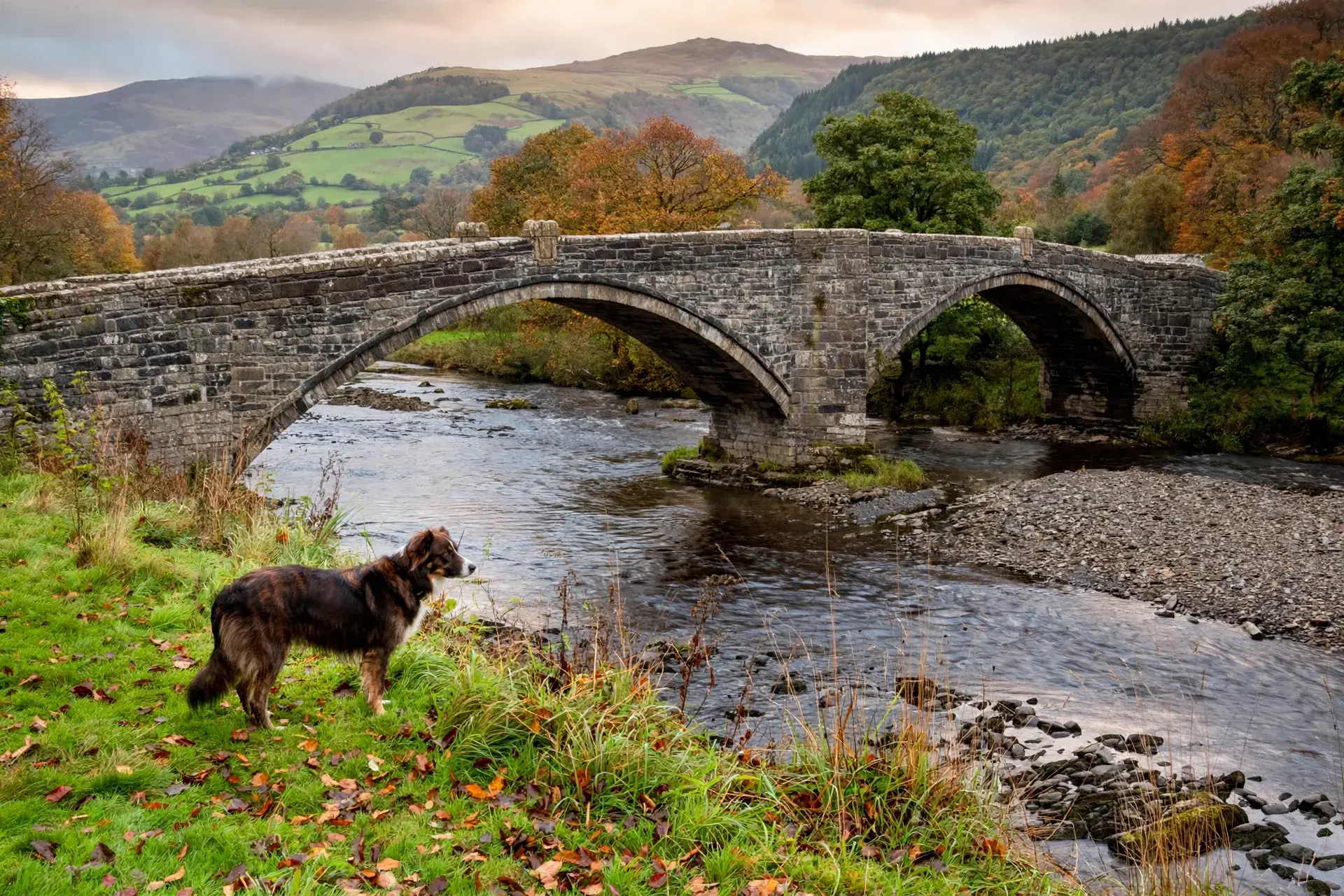
Most towns announce themselves with a high street or a car park. Llanrwst announces itself with a bridge. Pont Fawr, the Great Bridge, carries the road across the River Conwy on three stone arches, and it has been doing so since the 1630s, when it was built to replace a crossing that the river kept washing away. The design is traditionally attributed to Inigo Jones, and whether or not the attribution holds up in every detail, the structure itself tells the story plainly: wide, low arches, solid stone parapets, and a gentle hump that lifts you just high enough above the water to see the river properly. Stand in the middle with your dog and you can read the whole valley in one look — the river running down from the south, the green slopes closing in on both sides, and the town gathered on the bank behind you.
That single view is the reason to plan a dog day around the bridge rather than around a list of attractions. Llanrwst is not a town of big-ticket stops. It is a market town in the Conwy Valley, halfway between the mountains of Eryri and the coast at Conwy, and its pleasure is in the sequence: bridge, riverbank, garden, woodland, high street, pub. A dog that is happy with that rhythm — a proper sniff along the water, a steady walk through trees, a long settle under a cafe table — will have a better day here than a dog that needs constant novelty. If your dog is the kind that treats every new smell as an event, the riverside alone will keep them occupied for an hour.
Arrive with the bridge in mind and the rest of the day falls into place. The river is the town's compass: the valley runs roughly north to south, the bridge sits at the town's southern edge, and the walks worth doing follow the water or climb gently away from it. The A470 runs through the town and carries through-traffic between Betws-y-Coed and Conwy, so the streets near the bridge can be busier than the town's size suggests, especially on summer weekends. That is the one practical fact that shapes everything else in this guide: keep the lead short where the road is narrow, give the dog the open ground by the river, and save the off-lead hopes for the quieter stretches of valley path where the conditions genuinely allow it.
Llanrwst also rewards visitors who slow down enough to notice that it is a working town, not a stage set. The high street has butchers, bakers, a bookshop, a hardware shop and the sort of independent businesses that have served the valley for generations, alongside the cafes and galleries that visitors expect. Farmers come in for market business, walkers pass through on their way to the hills, and the river keeps its own timetable regardless of any of them. A dog fits naturally into that picture. Nobody here will be surprised to see a wet spaniel shaking off by the riverbank or a collie waiting patiently outside a shop, and the town's dog-friendly reputation is built on that everyday acceptance rather than on a single famous dog attraction.
Before you set off, a word on timing. Llanrwst is at its best in the quieter months and the quieter hours. A weekday morning in spring or autumn gives you the bridge almost to yourself, the river at a comfortable level, and the cafes with tables to spare. Summer weekends bring more traffic, more visitors and more dogs, which is fine for a sociable dog but harder work for a reactive one. Winter can be beautiful here — low light across the valley, mist on the water — but the riverside ground gets muddy and the daylight is short, so plan a shorter loop and bring a drying coat. Whatever the season, check the official guidance before you travel for Gwydir Castle opening times, river conditions after heavy rain, and any temporary closures on the valley paths.
Pont Fawr and the riverside
Crossing Pont Fawr with a dog is a short walk with a long memory. The bridge is a public road bridge, and its pavements are narrow, so this is not the place for a long lead, a sniffing stop or a photograph that takes five minutes to arrange. Keep your dog on a short lead, on the side away from the traffic, and walk steadily across. The reward is the view from the middle: upstream, the river bends away between wooded banks; downstream, it widens toward the valley floor. In autumn the trees on the far bank turn in patches of gold and rust, and after rain the river runs fast and brown under the arches, loud enough to drown out the road entirely.
On the far side of the bridge, the little thatched tearoom building known as Tu Hwnt i'r Bont sits right at the bridge end, and it is one of the most photographed buildings in Wales. It is a working tearoom, and it draws a crowd on fine days, so treat the area around it as a busy pinch point rather than a place to let the dog wander. If you want a photograph of the bridge itself, the best vantage points are from the riverbanks a little way up or downstream, where the whole span fits into the frame and the dog can stand on grass instead of tarmac. Cross back over the bridge at a calm moment and let the dog settle on the bank before you decide which direction to walk.
The riverside ground on the town side of the bridge is where the real dog walk begins. Short, informal paths run along the bank, and the ground is a mix of grass, gravel and worn earth that changes with the weather. After a dry spell it is firm and easy; after rain it can be soft and slippery, especially on the slopes down to the water's edge. Keep the dog out of the fastest water. The Conwy is a proper river, not a stream, and its current is stronger than it looks from the bank, particularly after heavy rain in the hills. A dog that loves to paddle should be kept to the shallow edges and only where the bank is gentle and you can reach them easily. Never let a dog swim near the bridge arches, where the current funnels and the stonework creates hidden hazards.
A sensible riverside loop from the bridge takes about forty minutes to an hour at a dog's pace, and it is worth doing slowly rather than treating it as a warm-up for something bigger. Let the dog work the bank: the smells of otter and waterbird, the driftwood, the places where other dogs have stopped before. Watch for the birds, too — the Conwy valley is good for dippers and grey wagtails along the river, and kingfishers are seen here, so a dog that fixates on birds will need a steady hand and a short lead. Bring poo bags and use the bins in town rather than leaving bags on the bank; the riverside is well used by anglers and other walkers, and the path is narrow enough that a forgotten bag is everyone's problem.
If your dog is reactive, the bridge and the tearoom end are the two spots to manage carefully. Both are narrow, both funnel people and dogs into the same small space, and both can catch a nervous dog by surprise around a blind corner of stonework. Cross early, before the day's visitors arrive, and give the dog space by stepping onto the wider ground beside the bridge rather than holding your position in the flow. A dog that is fine on open paths but struggles in tight spaces will be much happier once you are on the riverside proper, where there is room to arc around other walkers. And if the bridge is busy when you arrive, there is no shame in driving to a quieter starting point and coming back to the bridge on foot later in the day, when the crowds have thinned.
One more practical point: the river level changes quickly after rain in the hills, and the riverside paths can flood or become impassable after a wet spell. If the water is high and brown and the bank is under water in places, turn back and take the higher ground through the town instead. The valley will still be there tomorrow, and a dog that has had a good walk on dry ground is better off than a dog that has been dragged through a flooded path for the sake of a route on a map.
Gwydir Castle gardens and woodland
A short distance from the town centre, Gwydir Castle is the other anchor of a Llanrwst dog day, and it is a very different kind of place from the bridge. Where Pont Fawr is public, open and free, Gwydir is a private Tudor house set in gardens and woodland, and visiting it means accepting its rules rather than making your own. The house itself dates largely from the sixteenth century, with later additions, and the gardens and grounds around it have been restored over many years into a series of distinct spaces: formal gardens, a Dutch garden, wooded slopes, and a knot garden that rewards a slow wander. For a dog, the interest is in the grounds rather than the house — the house is not a dog visit — and that distinction is worth getting clear before you arrive, so nobody is disappointed at the gate.
Dogs on leads are generally welcome in the gardens and on the woodland walks at Gwydir, and the grounds are big enough that a visit can comfortably fill an hour or two. The garden paths are a mix of gravel and grass, with steps and slopes in places, so a dog that struggles with uneven ground will need a slower pace and a hand on the lead at the steeper spots. The woodland is the quieter half of the visit: mature trees, dappled shade, and paths that wind up through the trees with glimpses back down to the house and the valley. It is the kind of ground where a dog can settle into a steady walking rhythm, and where the smell of leaf litter and damp earth will occupy a keen nose for far longer than the formal garden will.
Because Gwydir is a privately run historic property, the details that matter most to a dog owner — whether dogs are allowed on a given day, which parts of the grounds are open, what the admission charge is, and whether an event changes the rules — can change with the season and with the events calendar. Check the official guidance before you travel, and confirm the current dog policy, opening times and admission before you set off. Do not assume that what applied on a quiet weekday in spring still applies on a wedding weekend in summer. The same caution applies to the house tours: even if the house is open, it is not a place for dogs, so plan for one person to stay with the dog in the gardens if the rest of the party wants to look inside.
Inside the grounds, the rules are the usual ones for a historic garden, and they are worth taking seriously because the gardeners' work is the reason the place is worth visiting. Keep the dog on the lead and on the paths, keep them out of the flower beds and the knot garden, and do not let them dig or mark the planting. The woodland is more forgiving, but the same lead discipline applies: there is wildlife in the trees, other visitors on the paths, and garden staff working in places you cannot see. A dog that can walk calmly on a lead through a garden is a dog that will be welcome back; a dog that has to be hauled out of a herbaceous border is a dog that will not.
Plan the Gwydir visit as a separate, unhurried block in your day rather than a quick add-on after the bridge. Arrive with water and a bowl, give the dog a drink before you go in, and take a break on a bench in the woodland if the dog starts to flag. The grounds are sloping, and a dog that has already walked the riverside will feel the climb more than you expect. If you are visiting in summer, the woodland shade is a genuine relief on a warm day, but the formal garden can be hot and exposed, so keep the garden part short in the heat and spend the longer stretch under the trees. In autumn, the woodland is at its best, with the leaf colour and the low light making the paths feel like a different place entirely.
For visitors who want to pair Gwydir with the wider valley, the castle sits conveniently between Llanrwst and the road south toward Betws-y-Coed, which makes it an easy stop on a longer Conwy Valley day. Our guide to Betws-y-Coed with a dog covers the village, the falls and the forest walks a short drive south, and the two places together make a natural full day: bridge and gardens in the morning, forest and falls in the afternoon, with a pub stop in between. Just remember that a dog that has had a full morning at Gwydir will not want a second full afternoon of walking, so keep the second half of the day gentle.
Conwy Valley trails: riverside, woodland and farmland
Beyond the town and the castle gardens, the Conwy Valley opens out into the walking country that makes this part of Wales worth a dog's time. The valley floor is a patchwork of riverside meadow, woodland and farmland, with the river running through the middle and the hills rising steeply on both sides. The walking here is not about a single famous route; it is about a network of public footpaths, farm tracks and forestry roads that can be joined into loops of almost any length. That flexibility is a gift for dog owners, because it means you can choose a walk that fits your dog's legs and temperament rather than forcing the dog to fit a route somebody else designed.
The riverside paths are the easiest place to start. They follow the Conwy and its tributaries along flat or gently undulating ground, and they suit almost every dog: older dogs, puppies on their first proper valley walk, and dogs that are still building up their fitness. The ground underfoot varies from firm riverside grass to softer meadow and, after rain, to mud that will test your boots and your dog's patience in equal measure. Keep the dog on a lead where the path runs beside the road or through a farmyard, and watch for the places where the path crosses a field with livestock. The valley is working farmland, and sheep are a constant presence, not a seasonal surprise.
Sheep are the single most important safety issue on the valley walks, and they deserve more than a passing mention. The Conwy Valley is sheep country, and a dog that chases sheep is a dog that can cause real harm and real trouble, including legal trouble for the owner. The law in England and Wales allows a farmer to shoot a dog that is worrying livestock, and that is not a theoretical risk — it is a real one, and it applies even to a dog that is "only playing". Keep your dog on a lead anywhere sheep are visible, anywhere sheep might be over the next hedge, and anywhere the path crosses open grazing land. A long line is a reasonable compromise on open ground where you have a clear view and your dog has reliable recall, but a long line is not a substitute for a short lead in a field with sheep in it. If your dog has a high prey drive or has chased livestock before, keep the lead short for the whole walk and choose routes that stay on the riverside and the woodland rather than crossing open fields.
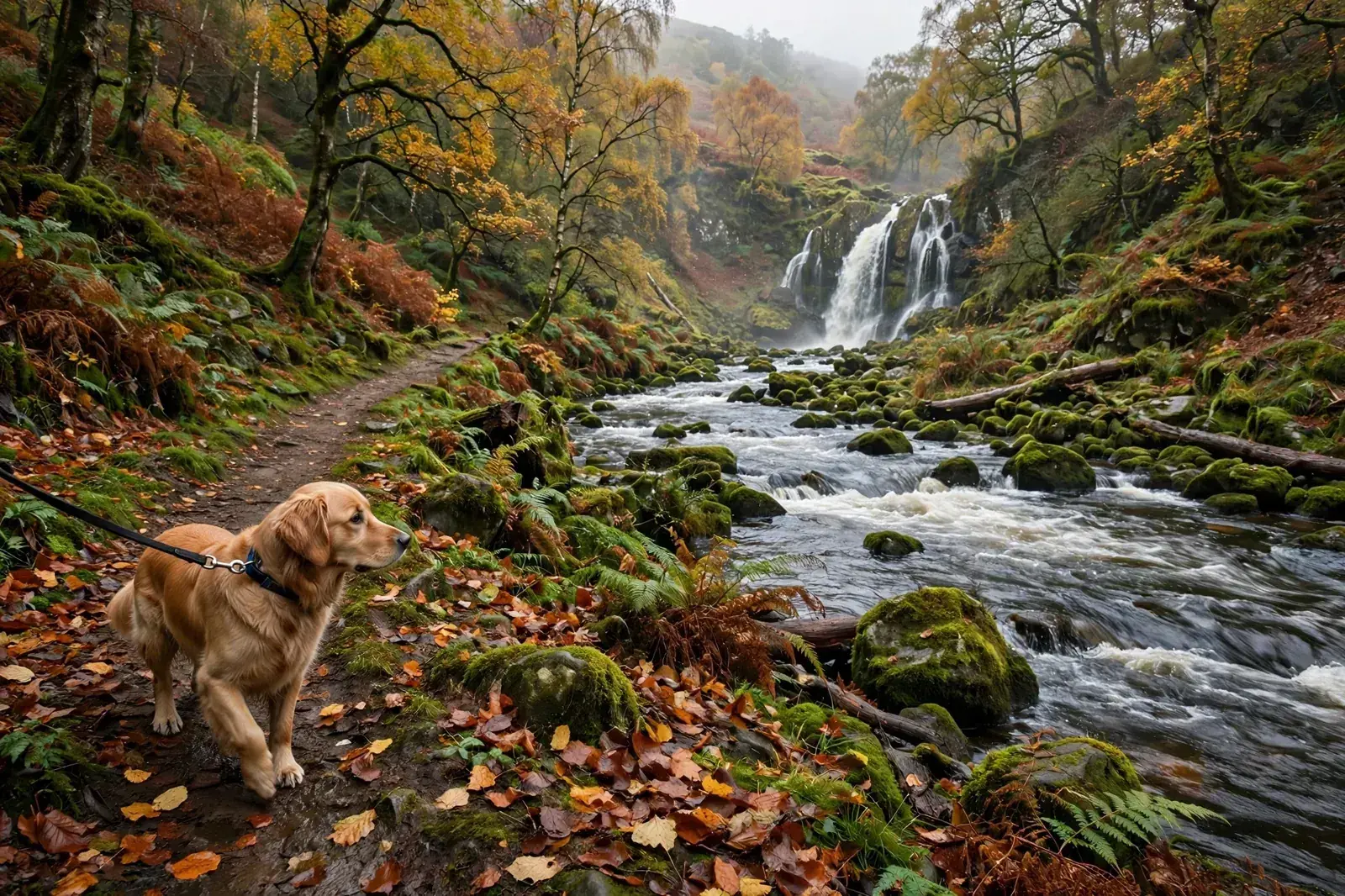
The woodland paths are the valley's other great resource for dogs. Gwydir Forest, the large forestry block south of Llanrwst toward Betws-y-Coed, offers miles of forest roads and waymarked trails under conifer and broadleaf canopy, and it is one of the best places in the area for a long, steady, on-lead walk with a dog. The forest floor is soft, the gradients are manageable on the main tracks, and the shade makes it a good choice on a warm day. The forest is also a working forest, so expect forestry vehicles on the main tracks, occasional felling operations with signed diversions, and mountain bikers on the shared trails. Keep the dog close on the wider tracks, and do not let them disappear into the trees after a squirrel — a dog that vanishes into a working forest is a dog you may not see again for an anxious twenty minutes.
Farmland paths need a different mindset again. A public footpath across a field is a right of way, not an invitation to treat the field as a dog park, and the etiquette matters. Stick to the line of the path, keep the dog close and on a lead, close every gate behind you, and do not let the dog drink from troughs or disturb feeding livestock. If the path crosses a field with cattle, keep the dog on a short lead and walk calmly and directly through, without stopping to let the dog investigate. Cattle with calves can be protective, and a dog is exactly the thing that makes them nervous. If cattle are blocking the path and you do not feel safe, turn back and take another route rather than pushing through — the valley has enough paths that no single blocked field should ruin a day.
For a half-day loop, a good starting point is the riverside path south from the bridge, joining the quieter lanes and field paths that loop back through the valley floor toward the town. Allow two to three hours for a proper valley walk, including stops, and carry water for the dog even on a cool day — there are few reliable places to fill a bowl on the field paths, and the river is not always safe or accessible for drinking. A map is worth carrying, not just a phone: the valley paths are not always well signed, mobile signal can be patchy between the hills, and a paper map or a downloaded offline map will save a long detour when the path you expected turns out to be a farm track that ends at a locked gate. The Ordnance Survey Explorer map for the area covers the valley in the detail a dog walker needs, and it is worth the small investment if you plan to come back.
Seasons change the valley walks more than they change the town. Spring brings lambs, which means extra lead discipline and extra care around the fields where ewes and lambs are grazing. Summer brings long days and warm ground, which means early starts, shade, and water. Autumn is the valley at its best for dogs: cool air, firm ground, leaf colour in the woodland, and fewer visitors on the paths. Winter brings short days, mud, and rivers that can rise quickly, which means shorter loops, a drying coat, and a willingness to turn back when the ground tells you to. Whatever the season, the rule that never changes is the same: lead on near livestock, lead on near roads, and a dog that is under control is a dog that is welcome everywhere the valley allows.
If you want a bigger day out after the valley, the coast is a short drive north, and the contrast is worth it: river and woodland in the morning, sea air in the afternoon. Our guide to Conwy with a dog covers the castle town, the quay, the town walls and the beach at Morfa, and it pairs naturally with a Llanrwst morning. Just remember to check the tide and the beach rules before you set off, and to give the dog a rest in the car or at a cafe between the two halves of the day.
Shops, cafes and pubs: the high street with a dog
Llanrwst's high street is short enough to walk in ten minutes and interesting enough to take an hour over, and that is exactly the scale that suits a dog day. The town's independent shops are its backbone: a butcher, a baker, a bookshop, a hardware shop, and the specialist food and craft shops that have grown up alongside them. Most of them are small, and small shops mean a decision at the door: does the dog come in, wait outside, or stay with one person while the other browses? The honest answer is that it depends on the shop, the dog and the moment. A calm dog on a short lead is welcome in many of them; a large, wet or excitable dog is better off waiting outside with a companion while you pop in. Ask at the door, keep the lead short, and do not let the dog browse the shelves — a wagging tail at shelf height in a bookshop is a small disaster waiting to happen.
The cafes and tearooms are where Llanrwst's dog-friendliness is most visible. Several of the town's cafes welcome dogs in at least part of the premises, often in a specific area or on an outdoor terrace, and the town's pub or pubs are generally dog-friendly in the bar area, which is the pattern across much of rural Wales. The practical approach is to treat every cafe and pub as a fresh question rather than a guarantee: policies change, a busy lunchtime is different from a quiet mid-afternoon, and a dog that is welcome on the terrace in June may not be welcome inside in January. Walk in, ask politely, and settle the dog under the table with water before you order. A dog that can lie quietly for twenty minutes while you eat is a dog that will be remembered fondly; a dog that barks at every passing tray is a dog that will shorten your lunch.
Pack a small cafe kit and the whole high street becomes easier. A portable water bowl and a bottle of water, a mat or blanket for the dog to lie on, a chew or a stuffed Kong for the settling period, and a spare lead in case the first one gets tangled under a table. The mat matters more than people expect: a dog that has its own defined spot is much more likely to settle than a dog that is simply told to lie down on a cold, noisy floor. Bring the same mat you use at home, and the dog will read it as a cue to relax, even in a room full of strangers and the smell of other people's food.
The food itself is worth planning around. Llanrwst is a good place for a proper Welsh lunch — a hearty soup, a sandwich made with local bread, a slice of bara brith with a pot of tea — and the cafes here tend toward the homemade rather than the chain. If you are visiting with a dog, favour the places with outdoor seating in good weather and the places with a quiet corner inside when it is wet or cold. Avoid the busiest hour if your dog is reactive, and remember that a dog that has had a good walk and a drink is far more likely to settle than a dog that is still full of energy and has not had a proper toilet stop. The riverside walk before lunch is not just a pleasure; it is the thing that makes lunch possible.
For provisions, the town's shops cover the essentials for a dog owner: a supermarket or convenience store for the basics, a butcher for a treat, and a bakery whose smell alone will test your dog's lead manners. If you are staying in a self-catering cottage in the valley, stock up here rather than assuming you will find everything at a smaller village shop later. Buy the dog's dinner, a spare bag of treats, and anything you forgot to pack — the town is the valley's service centre, and the shops here are used to walkers and dog owners stocking up before heading out to the hills.
One more high-street habit worth building: leave the dog's needs until last when you plan the route. Do the shops first, the cafe second, and the pub last, so the dog's patience is spent on the things that matter most to you and the dog's reward — a long sniff on the riverside, a rest in the car, a treat at the pub — comes at the end. A dog that has waited patiently through three shops and a cafe deserves a proper walk afterwards, and the riverside is right there waiting. And if the day is going well and the dog is settled, the high street will still be there tomorrow; there is no need to see everything in a single visit.
Staying over and parking: the practical half of the day
Llanrwst works well as a day trip, but it works even better as a base, and the town and the valley around it have a good range of dog-friendly places to stay. Self-catering cottages are the most common choice in the valley, and they suit dogs well: a private door, a garden or yard, and no shared corridors to negotiate with a nervous dog. When you book, ask the specific questions that matter for your dog rather than relying on a "dog-friendly" tick box: is there a secure garden, and how high is the fence? Is there a surfaced area for a wet dog to be dried before coming inside? How many dogs are allowed, and is there an extra charge? Is the cottage near a road, a farmyard or a field with sheep? The answers will tell you more about the stay than the photographs will.
Bed and breakfasts and small hotels in and around Llanrwst can also work well, particularly for a one-night stop on a longer tour of North Wales, but they need a different set of questions. Ask whether the dog can be left in the room while you eat breakfast, whether there is a ground-floor room, and where the nearest late-night toilet walk is. A B&B with a garden and a host who keeps dogs themselves is a very different stay from a B&B that tolerates dogs but has no outdoor space of its own. Book early in the summer and at bank holidays: the valley's dog-friendly accommodation is limited, and the best cottages and rooms are booked months ahead for the peak weeks.
If you are staying in the valley for several days, Llanrwst makes a practical hub. Betws-y-Coed is a short drive south, Conwy and the coast are a short drive north, and the forest and the mountains are on the doorstep. That centrality is the town's real strength as a base: you can do a different kind of walk every day — river one day, forest the next, coast the day after — without ever driving for more than half an hour. Our guide to Colwyn Bay with a dog covers the promenade, the beach and the coastal walks to the north, and it makes a good contrast to a valley day: wide open sand and sea air after a morning among the trees.
Parking in Llanrwst is straightforward if you use the public car parks rather than trying to stop on the narrow streets by the bridge. The main car parks put you within a short walk of the river, the high street and the start of the valley walks, and they are the right place to leave the car while you explore on foot. Check the signs for charges and time limits when you arrive, because arrangements can change, and do not assume that a car park that was free last year is still free. If you are staying in the valley, ask your accommodation about parking before you arrive — some cottages have a dedicated space and some rely on the public car parks, and the difference matters when you are unloading a dog, a crate and a week's luggage in the rain.
The car itself deserves a little planning on a Llanrwst day. Leave shade and water in the car for the return journey, and never leave a dog in a parked car on a warm day, even for a few minutes — the valley can be deceptively warm in summer, and a car heats up fast even with the windows cracked. In winter, the reverse problem applies: a wet dog in a cold car after a muddy walk is a miserable end to a good day, so bring a drying coat and a towel, and warm the car up before the dog gets in. A portable crate or a boot guard makes the journey safer and the car cleaner, and it gives the dog a familiar den to rest in between walks.
Finally, a word on getting there. Llanrwst sits on the A470, the main road through the Conwy Valley, and it is an easy drive from the A55 coastal expressway and from the south via Betws-y-Coed. The town also has a railway station on the Conwy Valley line, which runs between Llandudno Junction and Blaenau Ffestiniog, and the line itself is one of the prettiest railway journeys in Wales. If you are travelling by train with a dog, check the operator's current dog policy before you travel, keep the dog on a lead on the platform, and remember that the station is a short walk from the bridge and the riverside. Whichever way you arrive, the first thing to do is the same: walk to the bridge, look at the river, and let the dog take in the valley. The rest of the day will follow from there.
Before you leave, take a moment to check the practical details that catch people out. Mobile signal can be patchy in the valley, so download your maps before you arrive. Cash is useful for the smaller shops and car parks, even though most places take cards. And if you need a vet, find the nearest practice before you need it rather than after — the valley's practices are a short drive away, but they are not on every street corner, and a saved phone number in your phone is worth more than a search in a hurry. A little preparation is what turns a good dog day in Llanrwst into a day you will want to repeat.
Practical questions
Before you go
Can dogs cross Pont Fawr bridge in Llanrwst?
Yes. Pont Fawr is a public road bridge with narrow pavements, so keep your dog on a short lead and close to the wall, away from passing traffic. Cross at a calm moment, keep moving, and use the wider riverside ground on either bank for sniffing and settling rather than stopping on the bridge itself.
Are dogs allowed at Gwydir Castle gardens?
Dogs on leads are generally welcome in the gardens and woodland walks at Gwydir Castle, while the house itself is not a dog visit. Rules can change with events and the seasons, so check the official guidance before you travel and confirm the current dog policy, opening times and admission before you set off.
Where can dogs walk off lead near Llanrwst?
There is no single signed off-lead area in the town centre, so plan for mostly on-lead walking. The best off-lead chances are on quieter riverside stretches and open valley ground away from roads, livestock and other walkers, and only where your dog has reliable recall. Keep the lead on near sheep, on narrow paths, on the bridge and anywhere livestock could be over a hedge.
Are there dog-friendly cafes and pubs in Llanrwst?
Llanrwst has a small cluster of independent cafes, tearooms and pubs, and several welcome dogs in at least part of the premises, often the bar area or an outdoor terrace. Policies vary by business and by season, so ask at the door, keep your dog settled under the table, and check the official guidance before you travel if a specific stop matters to your day.
Where should I park in Llanrwst with a dog?
Use the public car parks in and around the town centre rather than stopping on the narrow streets by the bridge. The main car parks put you within a short walk of the river, the high street and the start of the valley walks. Check the signs for charges and time limits on arrival, and leave shade and water in the car for the return journey.