This guide is independent and contains no paid placement. If affiliate links are added later, they will be clearly marked and will not change our editorial checks.
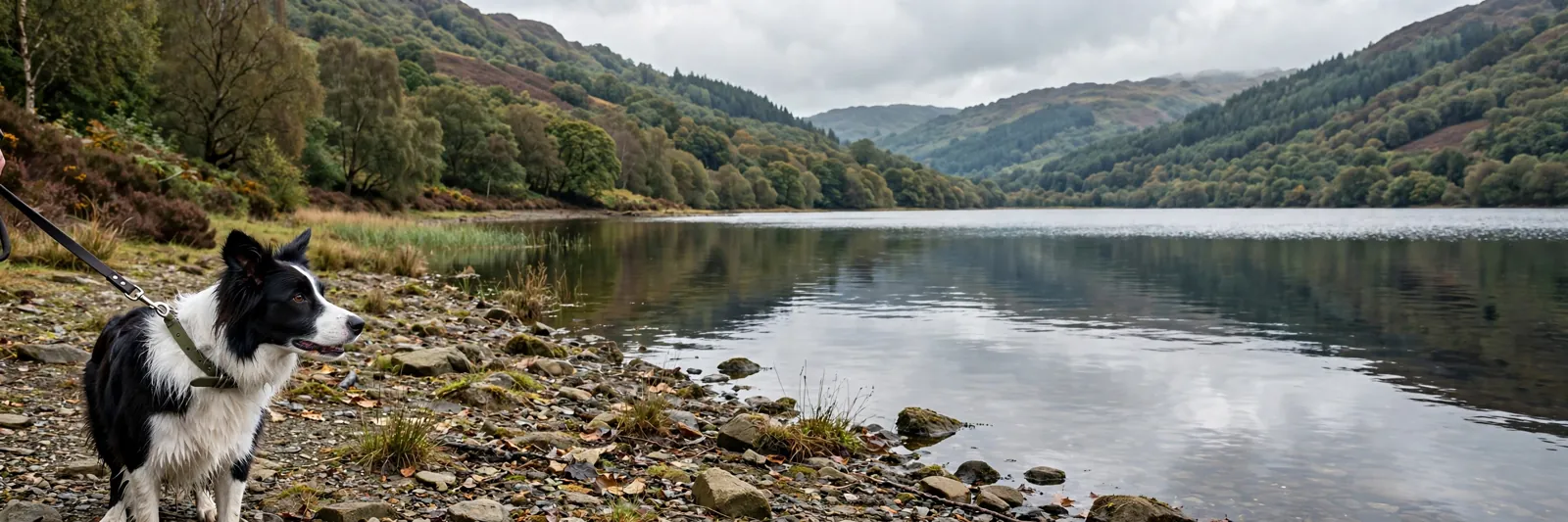
Loch Tay with a dog works best when you pick one end as a base and explore outwards. Kenmore in the east gives gentle loch shore, woodland around Taymouth and the River Tay leaving the loch. Killin in the west gives the Falls of Dochart, the Rob Roy Way and a gateway towards the Trossachs. Keep dogs on short leads at the falls, around livestock and on Ben Lawers lower slopes, treat loch swimming as a cold-water decision rather than a default, and verify the current dog rules for the Scottish Crannog Centre before you set off.
Kenmore or Killin: choose your end of the loch first
Most British lochs ask you to choose a shore. Loch Tay asks a different question: which end? The loch stretches for roughly fifteen miles through Highland Perthshire, and its two bookend villages could hardly feel more different. Kenmore sits at the eastern end, where the water narrows and slips away as the River Tay, Scotland's longest river, beginning its journey towards Perth and the sea. Killin sits at the western end, where the River Dochart tumbles through the village in a famous series of rapids before reaching the loch, and where the hills crowd closer. Driving the length of the loch on the north-shore road is possible, but it is not a hop: allow real time, expect single stretches of concentration, and do not plan a holiday that commutes daily between the two.
Kenmore suits a dog holiday built around steadiness. The village is small and handsome, the shore near the village offers easier access to the water's edge, and the grounds and woodland paths associated with Taymouth give shaded walking when the open shore feels exposed. Aberfeldy, a larger town a short drive east, supplies supermarkets, cafés, a vet and rainy-day options, which matters on a week-long stay with a dog that still needs its routine. If your dog is older, nervous in busy places, or happiest with two moderate walks and a long sleep between them, the eastern end usually fits better.
Killin suits a dog holiday built around features. The Falls of Dochart run through the middle of the village rather than hiding in a glen, the Rob Roy Way passes through, and routes west lead towards Loch Lomond and the Trossachs National Park, within which the western end of Loch Tay sits. The village can be lively around the falls on fine days, with visitors gathered on the bridge, so a dog that dislikes crowds and close passing on pavements will need timing: early mornings and evenings restore Killin to its residents and its river. If your dog is fit, sociable and bored by repetition, the western end gives you more variety within walking distance.
Neither choice is wrong, and a longer trip can split the week, three or four nights at each end, moving once rather than driving daily. What matters is deciding deliberately, because almost everything else in this guide — which walks are your locals, which stay you book, which end you save for a single day trip — follows from that first decision. Check the latest official guidance before you travel for roadworks, parking arrangements and any local access updates at either end.
Falls of Dochart with a dog: look, do not scramble
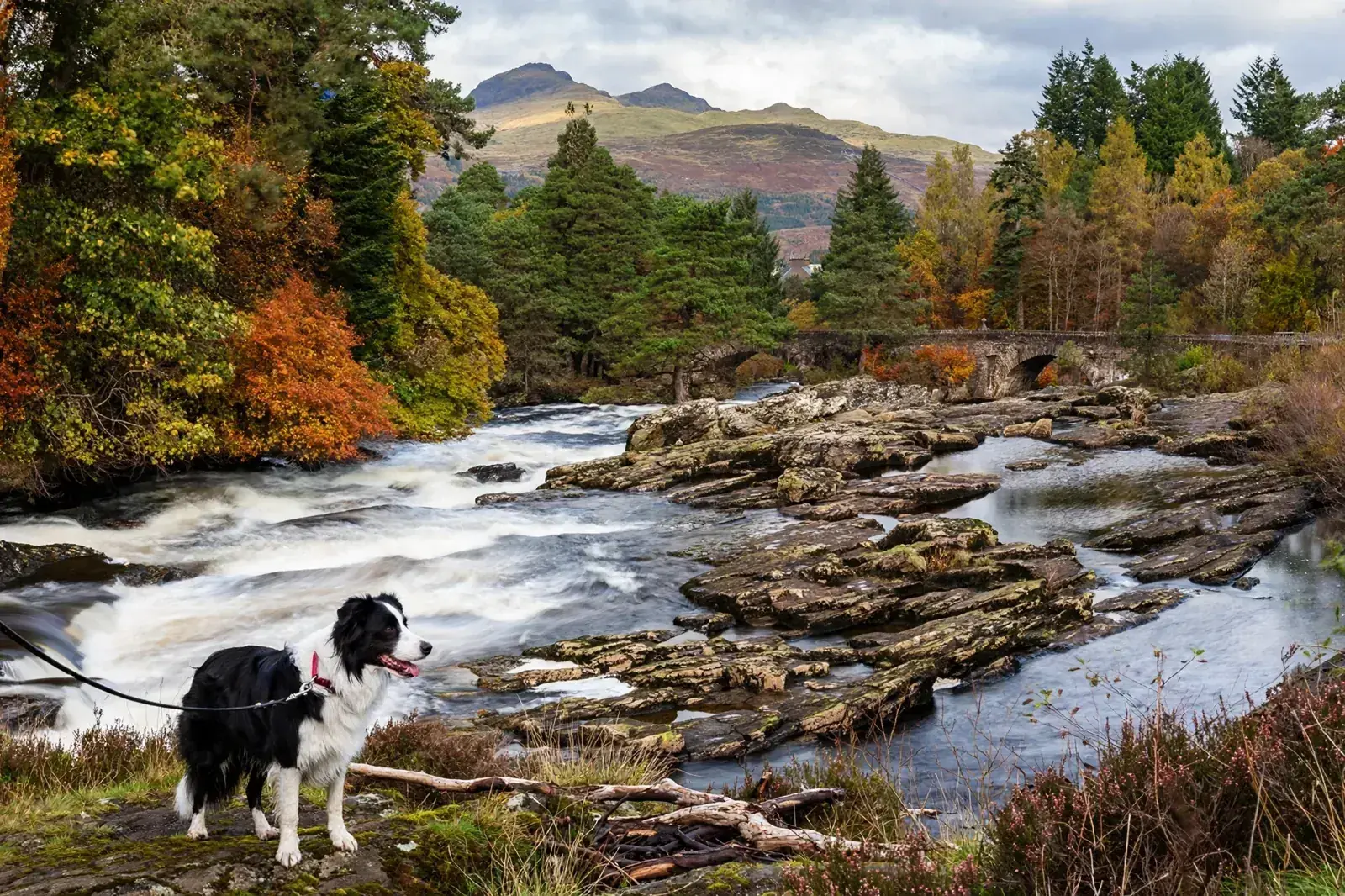
The Falls of Dochart are not a waterfall in the single-drop sense. They are a long, muscular stretch of rapids where the River Dochart gathers itself among dark rocks, splits around the island of Inchbuie with its old burial ground, and pours under the stone bridge that carries the main road through Killin. In spate after Highland rain the whole village seems to vibrate slightly, spray hangs over the bridge parapet, and the water turns the colour of strong tea. In a dry summer spell the rapids shrink to threads between exposed boulders, which tempts people — and would tempt dogs — out onto the rock. Resist both versions of that temptation.
For a dog, the falls are a viewing experience. Walk the bridge on a short lead on the side away from traffic, pause where the pavement allows without blocking other people, and use the viewing areas at the village end where the dog can stand on solid ground and watch water do something dramatic. Keep a firm hold if your dog lunges at birds or reacts to the noise; the roar that humans find thrilling can unsettle a sound-sensitive dog, and a first visit at a quieter hour, standing back near the village green end, is a kinder introduction than the bridge at peak spate and peak crowd.
The rocks are the real hazard. They are polished by water, slick with algae and spray even when they look dry, and they slope towards fast water with no forgiving shallows below. A dog that slips from the rocks at the falls is in a powerful current among boulders, and a person who follows is in the same current. So the rule is absolute and simple: no scrambling, no posing a dog on wet rock for a photograph, no paddling at the falls themselves, and extra care after rain when levels rise quickly and edges crumble into foam. Photograph from the bridge and the bank paths instead — the classic view needs no risk to compose.
Practical details shape a good visit. Parking in Killin fills around the middle of fine days, so arrive early or later and walk in from a stay if you can. Keep leads short on the bridge because traffic, cyclists and other dogs compress into a narrow space. If you cross towards Inchbuie or explore the riverside paths beyond the bridge, follow any signs on the day about access and ground conditions, keep the dog away from anglers' lines and back-casts, and leave the burial ground itself to quiet human respect rather than dog exercise. Seen this way — briefly, safely, on a lead — the falls deliver their drama without demanding anything from your dog except tolerance.
Lochside walks: shores, woods and village loops
Beyond its famous ends, Loch Tay rewards the unglamorous middle: short shore accesses, woodland climbs above the water, and village loops that give a dog a proper walk without a mountain attached. The pattern to understand is that continuous lochside walking is limited. Much of the shore is farmland, private ground or roadside without a pavement, so think in episodes — a shore here, a wood there, a glen path inland — connected by short drives, rather than imagining a single trail hugging the water for fifteen miles. Scotland's access rights help responsible walkers, but they come with responsibilities around houses, gardens, fields with young animals and conservation ground, and a dog under close control is the price of admission everywhere.
At the Kenmore end, combine the shore near the village with paths into the Taymouth grounds and the wooded slopes above, where Drummond Hill rises behind the village with forestry tracks and wide views back over the loch for those who climb. The mix suits a flexible day: an hour in the woods in the morning, a shore stroll when the light softens, and the village as a punctuation mark between them. Watch for golfers and estate activity where paths cross managed ground, follow local signage, and keep dogs out of any watercourses used by anglers, who pay heavily for Tay salmon fishing and reasonably expect an undisturbed cast.
At the Killin end, the riverside and the old railway and path networks west of the village give gentler mileage, while the slopes above the village open towards Glen Lochay and the long, quiet interior that most visitors never see. Around both ends, and all along the loch, working ground rules apply: sheep on inbye fields, cattle that may be protective with calves, deer moving at dawn and dusk, and game birds in season. A recall that works in a home park may not survive a red deer crossing a Highland path at forty metres, so use a lead or a long line whenever livestock or wildlife could appear, which on Loch Tay means almost everywhere outside a village street.
Build each day around one longer episode and several short ones, and let weather arbitrate. A shore that is delightful in a light breeze can be bleak when wind drives straight down fifteen miles of open water, while the woods above Kenmore stay sheltered in the same conditions. Carry a map that works offline, because signal along the loch is patchy, and tell your stay where the dog is headed if you are walking alone. For a wider Scottish loch comparison, our Loch Lomond with a dog guide covers a busier, more regulated loch to the south-west, and the contrast helps you appreciate how comparatively unhurried Tay still feels.
Ben Lawers: mountain access, livestock and reserve rules
Ben Lawers dominates the north shore, rising to 1,214 metres as the highest mountain in the southern Highlands and one of Britain's highest Munros. It is also a National Nature Reserve, protected for an exceptional collection of arctic-alpine plants that survive on its high, lime-rich slopes, and managed with a visitor centre area and waymarked lower routes as well as the mountain paths. That double identity — big mountain, delicate reserve — is exactly how a dog walker should approach it: ambitious about the weather and fitness judgement, conservative about where the dog walks and what it is allowed to disturb.
Access starts from the car park on the mountain road above the loch, reached by a steep minor road from the A827. From there, a well-made path climbs towards the summit, often combined with neighbouring Beinn Ghlas, while a shorter nature trail near the start introduces the reserve's plants and geology without committing anyone to the top. Do not underestimate the main route because the path is clear. The summit ridge is exposed, weather arrives faster and colder than the loch shore suggests, and a dog that was cheerful at the car park can be miserable, disoriented by wind and at risk on icy or rocky ground near the top. Fit, experienced hill dogs with owners who would turn back without regret are the right team; puppies, elderly dogs and any dog in poor condition should enjoy the lower trail and the view instead.
Livestock occupy the lower mountain and surrounding ground, including sheep and at times cattle, and the reserve asks walkers to keep disturbance to a minimum for ground-nesting birds and fragile vegetation. Keep your dog on a lead around livestock without exception, under close control elsewhere on the reserve, and on the path where the ground beside it carries rare plants that a shortcutting paw can damage. If cattle block the path, give them a wide berth or wait; forcing a passage with a dog between you and a protective cow is a familiar recipe for a mountain rescue call that nobody wanted.
Kit and timing complete the picture. Carry water for the dog — high burns can run low in dry spells and should not be relied on — plus a spare lead, waste bags to carry everything out, and an extra layer for enforced stops. Start early, set a turnaround time based on daylight rather than summit fever, and check mountain weather forecasts and the latest official guidance before you travel, not the loch-level forecast alone. A clear morning at Kenmore or Killin guarantees nothing at 1,200 metres, and the mountain will still be there on your next visit.
Swimming in Loch Tay: cold water, algae and common sense
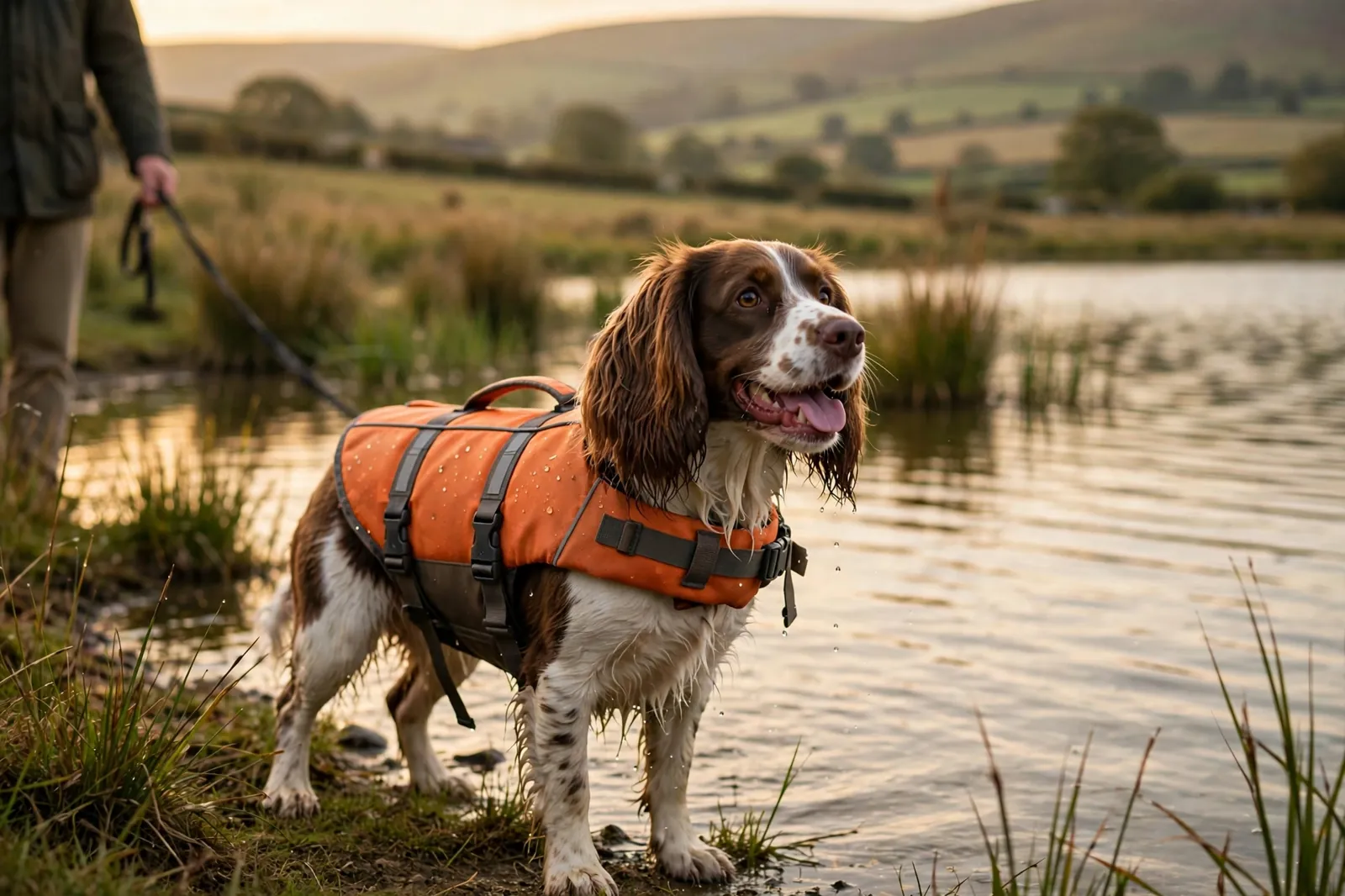
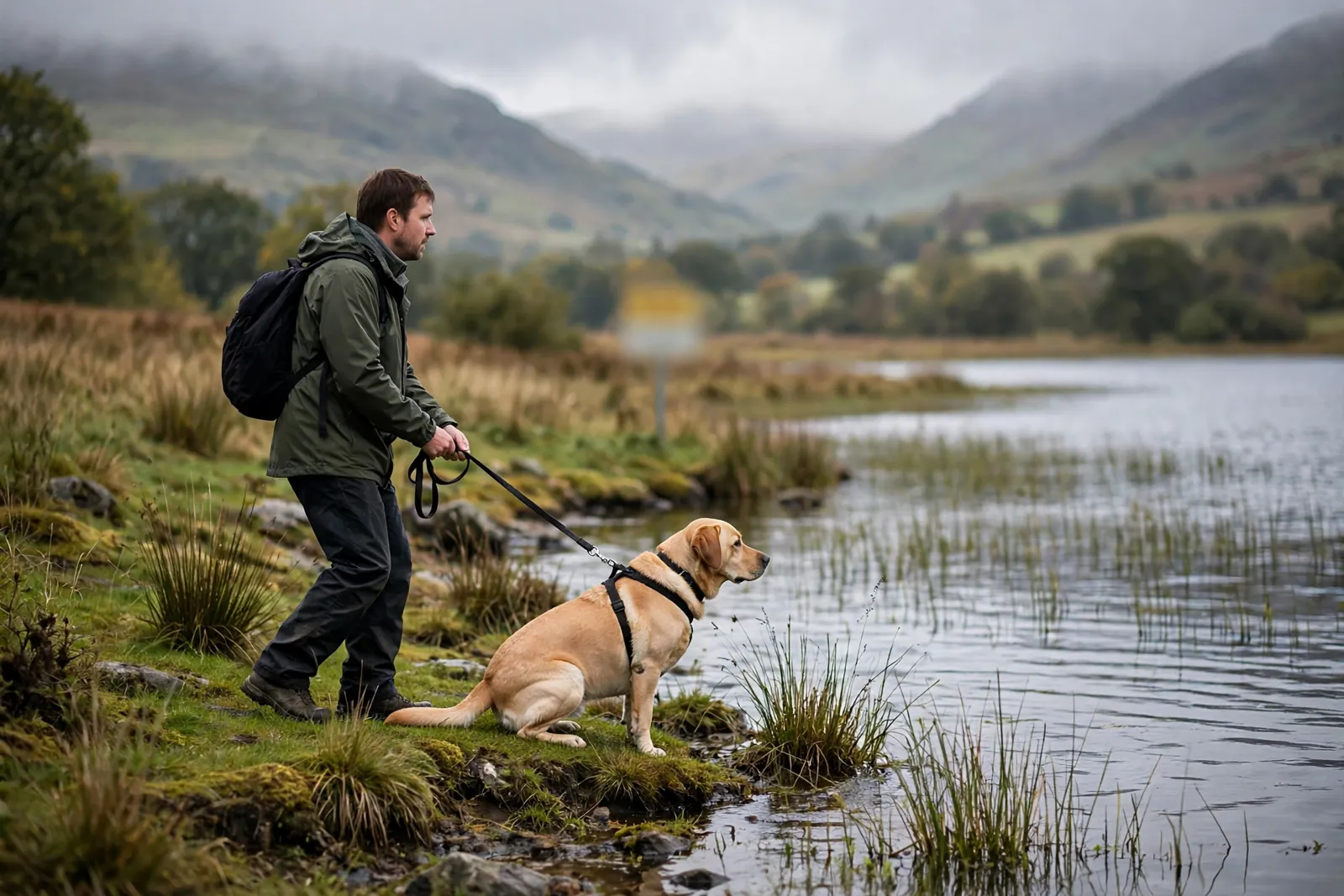
Loch Tay looks inviting on a still summer morning, all reflections and soft shore sounds, and many dogs will vote to swim with enthusiasm. Your job is to be the cautious second opinion. This is a deep Highland loch — over a hundred metres down in its deepest trench — and deep water stays cold. Even in August, surface warmth can give way to a sharp chill a short distance out, and a dog that swims far, tires, or panics in cold water is in trouble quickly. Choose gently shelving shore entries where your dog can walk in and out under its own power, keep swims short and close, and end the session while the dog is still keen rather than exhausted.
Entry and exit points matter more than enthusiasm. Avoid steep banks, slippery rock shelves, harbour and mooring areas, anywhere with boat traffic, and spots where anglers are fishing. A dog shaking water over a salmon fisherman's kit will not improve anyone's holiday. Look for quiet shore with a gradual slope, check the bottom for sudden drop-offs by staying in the shallows yourself first if you paddle, and never throw sticks or balls far out to manufacture a long swim. Retrieve games should arc along the shore, not away from it, so a tired dog is always swimming towards safety rather than away from it. Our dog swimming safety guide sets out the wider UK picture on currents, cold water and life jackets, and is worth reading before any loch holiday.
Algae deserves specific attention at Loch Tay because the risk hides in exactly the places dogs prefer. Blue-green algae — cyanobacteria — can bloom in warm, settled weather, gathering as green scum or paint-like streaks in sheltered bays, around shore edges and in still corners where a dog would choose to lap and splash. Some blooms produce toxins that can make dogs seriously ill very quickly. If the water looks discoloured, scummy, or unusually green, or if official warnings are posted, keep your dog out and away from the edge entirely, including drinking. Our blue-green algae and dogs guide explains what to look for and what to do in an emergency; the short version at the shore is that no swim is worth gambling on doubtful water.
Aftercare finishes a safe swim. Rinse the dog with clean water you carry if there was any doubt about quality, dry ears thoroughly, watch for shivering that does not settle, unusual tiredness, vomiting or wobbliness afterwards, and contact a vet promptly if anything seems wrong, mentioning freshwater exposure. Know where the nearest vet practices are — Aberfeldy and the Crieff and Callander directions are the practical horizons from different ends of the loch — and save numbers offline before you need them. Swimming can absolutely be part of a Loch Tay dog holiday; it just has to be a chosen, checked, short and supervised part, not an accident that happened while you were looking at the view.
The Scottish Crannog Centre: check the dog rules first
Crannogs are among Scotland's most evocative ancient sites: artificial islands built in lochs from the Iron Age onwards, part house, part fortress, part statement in timber and stone. Loch Tay held many of them, their remains now mostly submerged humps of stone, and the Scottish Crannog Centre has spent decades bringing that world to life through reconstruction, experiment and display, based on the loch's eastern shore near Kenmore. Its reconstructed crannog, museum exhibits and hands-on demonstrations of ancient crafts and cooking have made it one of Highland Perthshire's signature visits — and also a visit whose dog practicalities need checking rather than assuming.
The reason for caution is change. The centre's original reconstructed crannog was destroyed by fire in 2021, and the organisation has since been developing its site and experience at its Loch Tay location in phases, with buildings, tours and arrangements evolving as that work continues. Older listings, blog posts and leaflets describing dog access may therefore describe a version of the visit that no longer exists in that form. A policy that once welcomed dogs in certain areas, or provided a waiting arrangement, may have been adjusted while structures and routes around the site are reorganised.
So treat this section as a method rather than a verdict. Before you travel, check the centre's own current visitor information and, if the dog position is not stated plainly, contact the centre directly and ask three precise questions. First, can a dog come onto the site at all, and if so, is access limited to outdoor areas? Second, what happens during any guided or indoor elements — must one person wait outside with the dog, and is there shade and water where they wait? Third, are there times, events or demonstrations — fire-making, animals, school groups — when dogs are not admitted even outdoors? Record the answer with a date, and plan the day so the dog is never an afterthought discovered at the entrance.
If dogs cannot join the visit on your date, Loch Tay makes the compromise easy. Split the party if you are travelling as a group, so one person enjoys the crannog while another takes the shore and woodland walks near Kenmore, then swap. If you are travelling solo with a dog, weigh a shorter visit format if one is offered, or save the centre for a future trip without the dog rather than leaving it unattended in a car — which is never an acceptable plan in warm weather and is a poor one in any weather in an unfamiliar place. Ancient islands waited two thousand years; they can wait for the visit you can do properly.
Rob Roy Way sections for dog walkers
The Rob Roy Way is a long-distance route of around eighty miles between Drymen, near Loch Lomond, and Pitlochry, named for Rob Roy MacGregor, the outlaw and folk figure whose life played out across this Highland edge country in the late seventeenth and early eighteenth centuries. On its way it passes through Killin and follows the Loch Tay area before turning towards Aberfeldy and the Tay valley, which makes it a gift for dog walkers based at the western end: a waymarked, purposeful trail you can sample in sections without committing to the full week of walking it end to end.
The Killin sections are the natural starting point. Walking out of the village on the Way gives you the falls as a farewell, then quieter ground as the route climbs away from the road and finds its rhythm among farms, woodland and open hillside above the loch's western end. In the other direction, the route heads west towards Strathyre and the Trossachs, trading loch views for glen and forest. Either way, expect the mixture that defines the Way throughout: good stretches of track and path interrupted by road sections where leads go on and stay on, farm gates where stock may be waiting on the other side, and distances between settlements that demand you carry everything the dog needs.
Plan sections by turnaround, not by ambition. A two-hour out-and-back from Killin on the Way is a complete and satisfying dog walk; a one-way section with a pre-arranged lift back is better still, because linear routes show you new ground with every mile. Taxis and accommodation providers in walking country are often used to one-way walkers with dogs, but confirm the dog is welcome in the vehicle when you book, carry a towel and a mat for muddy paws, and do not assume a return bus will accept a large wet dog at the driver's discretion. In hunting and shooting seasons, follow any local signage about diversions or activity on estates the route crosses.
Dogs walking sections day after day need the same pacing as dogs thru-hiking. Build in a lighter day, check paws each evening for the small cuts that gritty tracks produce, feed a little extra if your vet's usual advice supports it for sustained work, and keep water discipline strict on dry upper sections where burns may not coincide with thirst. The Way rewards this steadiness with a sense of travel that circular walks rarely give: your dog will learn the smell of a route that is going somewhere, and Killin will feel earned when you walk back into it with the river loud below the bridge.
Stays, seasons and practicalities at both ends
Accommodation around Loch Tay ranges from village hotels and guest houses to self-catering cottages, lodges, holiday parks and estates, spread between Kenmore, Killin, the north and south shores, and the useful nearby towns of Aberfeldy and beyond. Dog-friendly is a phrase that stretches to cover everything from a genuinely welcoming house with an enclosed garden and a hose for muddy legs to a grudging permission with a long list of exclusions, so interrogate every booking with the same questions. How many dogs, of what size, at what charge? Are dogs allowed in bedrooms, in eating areas, and left alone in the room at all? Is there enclosed outdoor space, a safe after-dark walk that does not involve the main road, and hard flooring where a wet Highland dog will actually spend its time?
Season changes the loch's character and its logistics together. Spring brings lambing on the farms around the shore — the strictest lead discipline of the year — along with lengthening days and the first anglers. Summer offers the fullest choice of places to eat and visit, the warmest, though never warm, swimming decisions, and the busiest bridge at Killin. Autumn is arguably the connoisseur's choice: Perthshire's woodlands colour famously, the midges fade, the roads quieten and a dog that loves cool air and leaf litter is in its element. Winter demands respect for short daylight, icy minor roads to places like the Ben Lawers car park, and stays with real heating and drying space, but repays it with empty shores and storm drama at the falls viewed safely from the bridge.
Practical supplies cluster at the ends and beyond them. Aberfeldy serves the east with shops, fuel, cafés and services; Killin has village shops and places to eat for the west, with larger provision in Callander or Crieff further afield. Stock up on dog food rather than relying on a single village shop stocking your brand, carry cash as well as cards for honesty-box parking and small purchases in patchy signal country, and download maps, stay details and vet numbers offline. Mobile coverage along the loch cannot be assumed at the exact moment a plan changes.
Finish every Loch Tay day with the small rituals that keep a dog holiday smooth: a paw and belly check for ticks, seeds and scrapes after woodland and shore alike; a proper dry, especially ears after any swim; waste from every walk carried back to a bin rather than left in a verge bag; and a note of which shore, wood or section of the Way worked best, because Loch Tay is a loch people return to at the other end next time. Choose Kenmore, choose Killin, or choose both in turn — what the dog will remember is not the geography but the steady, water-scented, well-led days built around it.
Practical questions
Before you go
Can dogs swim in Loch Tay?
Yes, at suitable shore spots away from boats, anglers and road edges, but treat the loch as cold, deep water all year. Choose a gently shelving entry, keep sessions short, watch for blue-green algae warnings in sheltered bays in warm weather, and rinse and dry your dog afterwards. Never let a dog chase birds or swim out after thrown sticks into deep water.
Is the Falls of Dochart safe for dogs?
The viewing areas and bridge at Killin are fine for a dog on a short lead, but the rocks beside the falls are slippery and the current is powerful, especially after rain. Keep dogs off wet rock, away from the water edge and out of the river at the falls themselves. Safer paddling, if conditions allow, is on calm shore elsewhere, away from white water.
Can dogs go up Ben Lawers?
Dogs can accompany walkers on Ben Lawers routes, but it is a serious mountain and a protected nature reserve with livestock on the lower ground. Keep your dog on a lead around sheep and cattle, under close control near ground-nesting birds and rare alpine plants, and only attempt the summit with a fit dog in suitable weather and daylight. Check the latest official guidance before you travel.
Are dogs allowed at the Scottish Crannog Centre?
Dog arrangements at the Scottish Crannog Centre have changed as the site has developed at its Loch Tay location, so verify the current rules directly before you visit. Ask whether dogs are welcome in outdoor areas only or anywhere inside, where they must wait during tours, and what lead and water arrangements apply. Do not assume entry based on older listings.
Which end of Loch Tay is better for a dog holiday, Kenmore or Killin?
Kenmore at the east end suits loch shore walks, Taymouth grounds and a quieter village feel, while Killin at the west end suits the Falls of Dochart, the Rob Roy Way and routes towards Loch Lomond and the Trossachs. Both work well; choose by the walks you want most, then confirm any stay welcomes your dog in writing.