This guide is independent and contains no paid placement. If affiliate links are added later, they will be clearly marked and will not change our editorial checks.
Lockerbie is a small, easy-going Dumfriesshire market town that works well as a quiet base for a dog break: the Annandale Way runs through it, Eskrigg Nature Reserve is a short drive away, and Dumfries, the Solway coast and Carlisle are all within easy reach. Bring a lead you trust around sheep and cattle, a towel for muddy lanes, and a plan for wet weather.
Getting to Lockerbie and parking
Lockerbie sits in southern Scotland, in the county of Dumfries and Galloway, roughly halfway between Carlisle and Dumfries. That position is the main reason it works as a dog-holiday base: you can reach it without a long drive from the border, and from it you can reach the Solway coast, the Galloway hills and the Scottish Borders without packing up every morning. The town is just off the M74 motorway at junction 17, and the A709 runs through it towards Dumfries. Coming from England, the drive from Carlisle takes around half an hour in normal traffic; from Glasgow or Edinburgh, allow roughly an hour and a half to two hours depending on the route and the time of day.
Trains are a genuine option here, which is not true of every small Scottish town. Lockerbie station is on the West Coast Main Line, with services linking Carlisle, Dumfries and Galloway to Glasgow and the south. Dogs travel free on most UK trains when they are kept on a lead and do not take a seat, but check the official guidance before you travel, because rules on larger dogs and on busy services can change, and a crowded Friday-evening train is a poor first journey for a nervous dog. If you travel by rail, bring a blanket or mat so your dog has a defined place to settle, and arrive early enough to find a quieter carriage rather than squeezing into the first open door.
By car, the practical question is parking. Lockerbie has town-centre car parks within a short walk of the High Street, along with on-street parking on the quieter residential streets. The car parks near the centre are the sensible choice for a dog: you can unload, water the dog and set off on foot without crossing busy roads. On market days and during local events the centre fills up, so arriving before mid-morning is the simplest way to get a space close to where you want to walk. Charges and time limits change, so check the official guidance before you travel rather than relying on a sign you remember from a previous visit.
Plan the arrival as a dog-first task, not a driving task. If the journey is long, stop once on the way for a proper leg stretch rather than a hurried lay-by pause — a service area with a grassy edge is better than a petrol forecourt. When you reach Lockerbie, give the dog a short walk before you check in or start sightseeing. Ten minutes of sniffing around a quiet street or a field edge does more to settle a dog after a car journey than an hour of sitting in a cafe while it fidgets under the table. In warm weather, choose a shaded parking spot and never leave a dog in a parked car, even for a few minutes; the inside of a car heats far faster than most people expect, and a dog cannot open a window to cool down.
Lockerbie at a glance
Lockerbie is a market town of around twelve thousand people, built around a broad High Street with the town hall at its heart. It is not a tourist honeypot, and that is part of its appeal for dog owners. There are no crowds to thread through, no queues outside attractions, and most of what a visitor needs — food shops, cafes, pubs, a pharmacy and a handful of independent shops — is within a short walk of the centre. The pace is unhurried, the streets are wide enough for a dog on a lead, and the countryside starts almost as soon as the houses end.
The town is best known for a sad reason. On 21 December 1988, Pan Am Flight 103 was destroyed above Lockerbie, and 270 people lost their lives. The memorial at Dryfesdale Cemetery and the garden of remembrance in the town are quiet, respectful places. Visitors with dogs should treat them as they would any place of remembrance: keep dogs on a short lead, keep voices low, and do not let a dog run across the memorial areas. It is a short, sobering stop, and many visitors find it the most memorable part of a visit to the town. There is no need to plan a long visit there; a few quiet minutes are enough.
Away from the centre, Lockerbie has a few features that shape a dog break. The town has an ice rink that draws visitors in winter, and there are sports fields and open green spaces on the edges of town that work for a morning leg stretch. The Dryfe Water, a small river, runs close to the town and gives the surrounding lanes their green, enclosed character. Dry-stone walls, hawthorn hedges and grazing fields are the landscape here, and they set the rules for walking: most routes leave the town on lanes or field paths, and livestock is a normal part of the scenery rather than an exception.
What Lockerbie does not have matters too. There is no beach in the town, no large park with a fenced dog area, and no long traffic-free promenade. Dogs that need an enclosed space to run off the lead will need a car journey to a suitable spot, and owners should plan for that rather than hoping the town provides one. The trade-off is that the town is genuinely quiet, the walks from the door are real country walks rather than laps of a housing estate, and the wider region — Dumfries, the Solway shore, the Galloway Forest and Carlisle — is close enough for easy day trips.
Easy walks in and around the town
The simplest walk in Lockerbie is a loop of the town itself. Start at the High Street, walk past the town hall, and take the quieter side streets towards the edge of town, where the houses give way to fields and the lanes narrow. A loop of forty minutes to an hour is easy to build without any map, and it gives a new dog a chance to learn the smells and sounds of the place before you ask it to settle in a cafe or a holiday cottage. Keep the dog on a lead throughout: pavements are narrow in places, and the town has its share of delivery vans and farm vehicles.
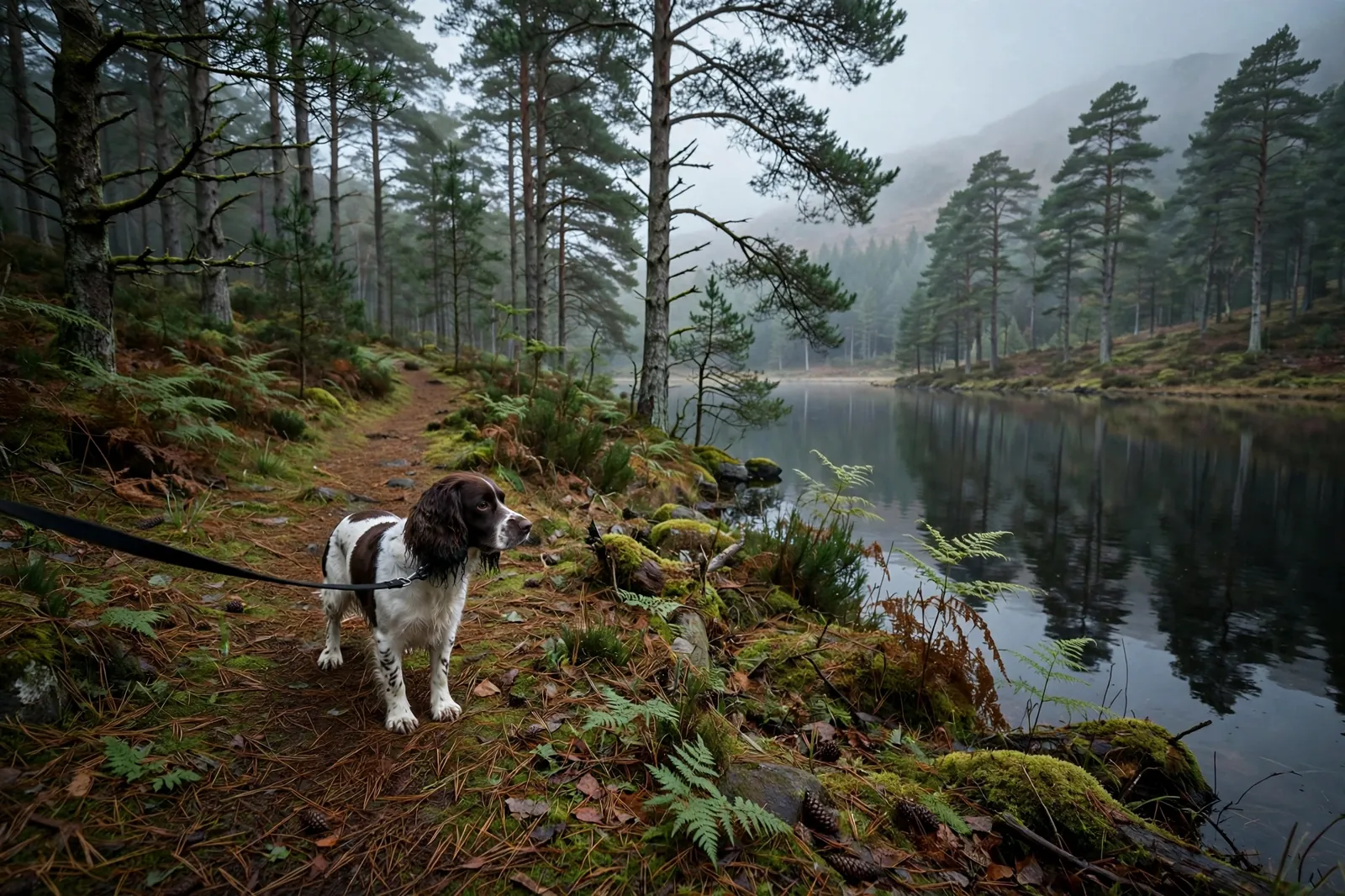
For a greener walk, head for Eskrigg Nature Reserve, a small woodland site on the edge of town managed by Lockerbie Wildlife Trust. The reserve is known for red squirrels, woodland birds and a quiet pond, and its paths are short, level and easy to follow. Dogs are welcome on a lead, and the lead matters here: red squirrels are easily disturbed, and a dog crashing through the undergrowth defeats the purpose of the visit. Go early in the morning for the best chance of seeing a squirrel, keep the dog close on the paths, and do not let it enter the pond. The reserve is compact — an hour is plenty — but it is the kind of place that repays a second visit at a different time of day, when the light and the birdsong have changed.
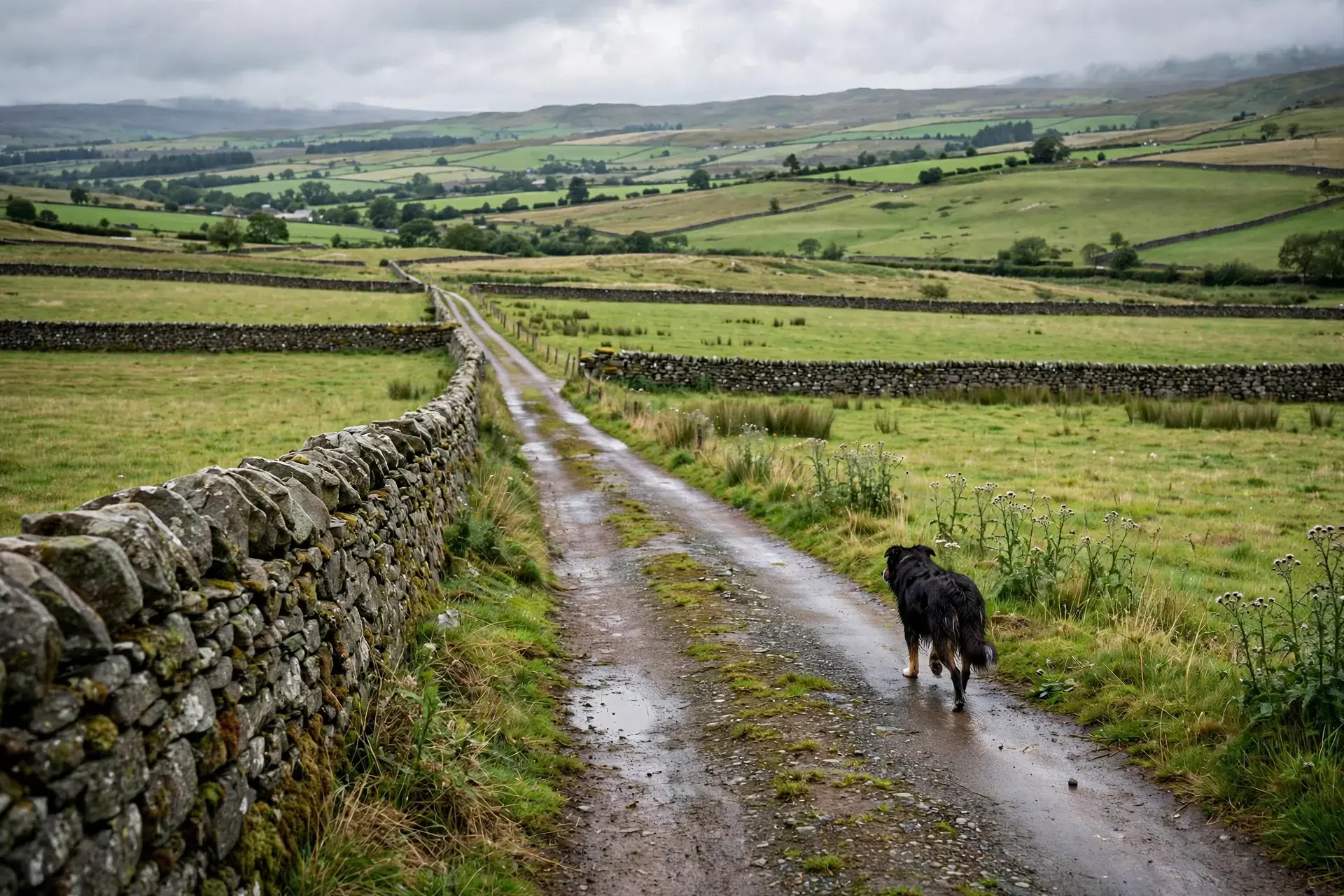
Field-edge lanes around the town offer longer, still easy walking. The lanes that run out towards the Dryfe Water and the surrounding farms are mostly quiet, with grass verges a dog can sniff along, but they are working lanes: tractors, livestock lorries and the occasional fast car all use them, so walk facing the traffic where there is no pavement, keep the dog on the inside, and use a short lead rather than a long line. After rain, the lanes and field paths get muddy quickly — Lockerbie sits on low, damp ground — so a towel in the car and a drying coat for the dog are worth packing even on a dry-looking morning.
Short, practical walks matter more than grand ones on a town break. A dog that has had a good morning walk will settle happily while you eat lunch or drive to a day-trip destination; a dog that has only had a pavement circuit will not. Build the day around one proper walk in the morning, a shorter toilet walk at lunchtime, and a relaxed evening loop. That rhythm suits most dogs better than a single long hike followed by hours of sitting around, and it leaves room for the town itself — a coffee, a browse of the shops, a slow wander — without the dog becoming restless.
The Annandale Way and longer routes
The best-known long walk through Lockerbie is the Annandale Way, a waymarked trail of about 53 miles that runs from Moffat in the north to Annan on the Solway coast in the south, following the River Annan for much of its length. Lockerbie sits roughly in the middle of the route, which makes it a natural place to sample a section rather than walk the whole thing. The stretch south from Lockerbie towards Annan and the stretch north towards Moffat are both workable as day walks, though they are very different in character: the southern sections are gentler, following the river valley, while the northern sections climb a little more as the valley narrows.
Walking a section of the Annandale Way with a dog needs the same planning as any farmland walk. The route crosses fields, farm tracks and quiet lanes, and livestock is common along it — sheep on the open ground, cattle in the riverside meadows. Keep the dog on a lead through farmland, and use a long line only on open stretches where you can see well ahead and there is no stock nearby. Carry water for the dog as well as for yourself: the route has few shops between villages, and a river is not a reliable water source for a dog in dry weather or after rain, when the water can be fast and muddy.
Do not try to walk the whole Annandale Way in a weekend with a dog unless the dog is already fit for long days on mixed ground. A realistic approach is to pick one section of five to eight miles, walk it out and back or arrange a lift at the far end, and treat the rest of the day as rest. Dogs that are used to an hour a day will struggle with four hours of walking, however enthusiastic they look at the start. Watch for tiredness in the second half — lagging behind, lying down at stiles, or a reluctance to jump — and shorten the route rather than pushing on.
Stiles and gates deserve a mention. The Annandale Way, like most Scottish lowland routes, has kissing gates, field gates and the occasional stile. Most are dog-friendly enough for a medium or large dog to pass with a little help, but small dogs and older dogs may need lifting over a stile, and a dog that panics at a narrow gate can hold up a whole group. Practise lifting and carrying your dog at home before the trip, and carry a lead that clips short so you can manage the dog with one hand while you open a gate with the other. Check the official guidance before you travel for the latest route information, diversions and access conditions, because waymarked routes do change when landowners alter a field boundary or a path is closed for work.
Day trips from Lockerbie
Lockerbie earns its keep as a base because the day trips are short. Dumfries, the largest town in the region, is about fifteen miles to the south-west — a straightforward drive along the A709 and the A75. Dumfries has a riverside setting on the River Nith, a castle, the Robert Burns Centre and a good range of cafes and shops, and it makes a useful wet-weather day out when the country lanes are at their muddiest. Our regional guide to Dumfries and Galloway with a dog covers the forests, dark skies and Solway shore that surround the town, and it is worth reading before you plan a longer stay in the region.
Lochmaben, a few miles north-west of Lockerbie, is a smaller and quieter stop. Its castle ruins stand beside a loch, and the lochs around the village are good for a short, level walk with a dog on a lead. The village itself is small — a pub, a shop, a church — and that is the point: it is a half-day outing rather than a full day, best combined with a longer walk or a drive through the surrounding countryside. Check access and opening details before you go, because small historic sites in the region can have seasonal hours.
South towards the Solway Firth, the coast is about fifteen miles away. The Solway shore is tidal, wide and often windy, with big skies and long views across to England. Dogs usually love it, but the tide needs respect: the Solway has fast-moving tides and large areas of mud, and a dog that runs out onto the mudflats can get into difficulty. Walk on the firmer sand near the shore, keep the dog in sight, and check tide times before you set out. The coast here is also a good place for a winter walk, when the light is low and the beaches are empty — just dress for wind, and bring a towel, because a Solway dog comes home sandy and wet.
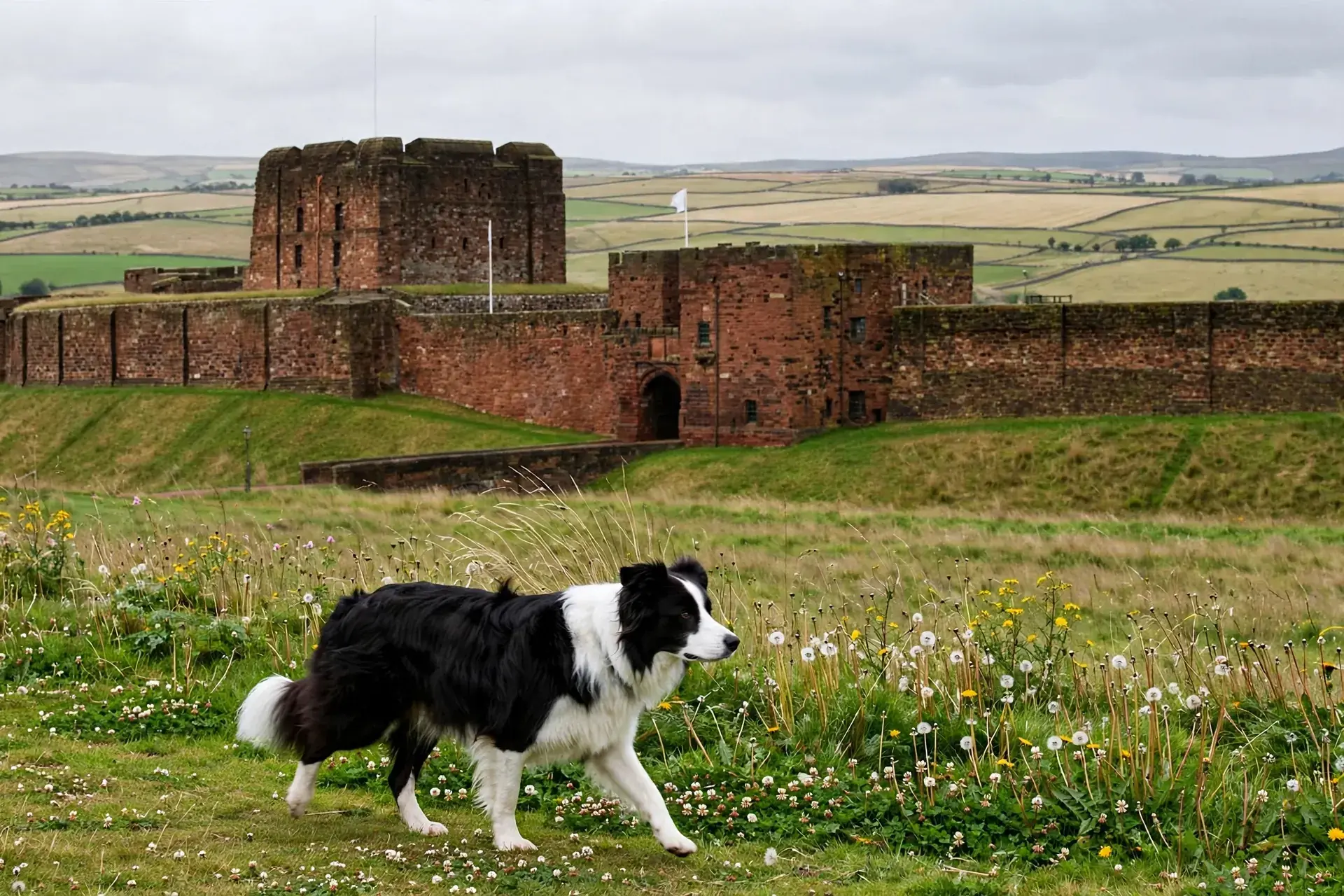
Carlisle, about twenty miles to the south-east, is the nearest city and the best option for a day with more to see. The castle grounds, the cathedral green and the River Eden walks give a dog plenty of open space, and the city has a good range of dog-friendly pubs and cafes. Our guide to Carlisle with a dog covers the castle, the cathedral and the Hadrian's Wall paths in detail, including where to park and where to eat with a dog in tow.
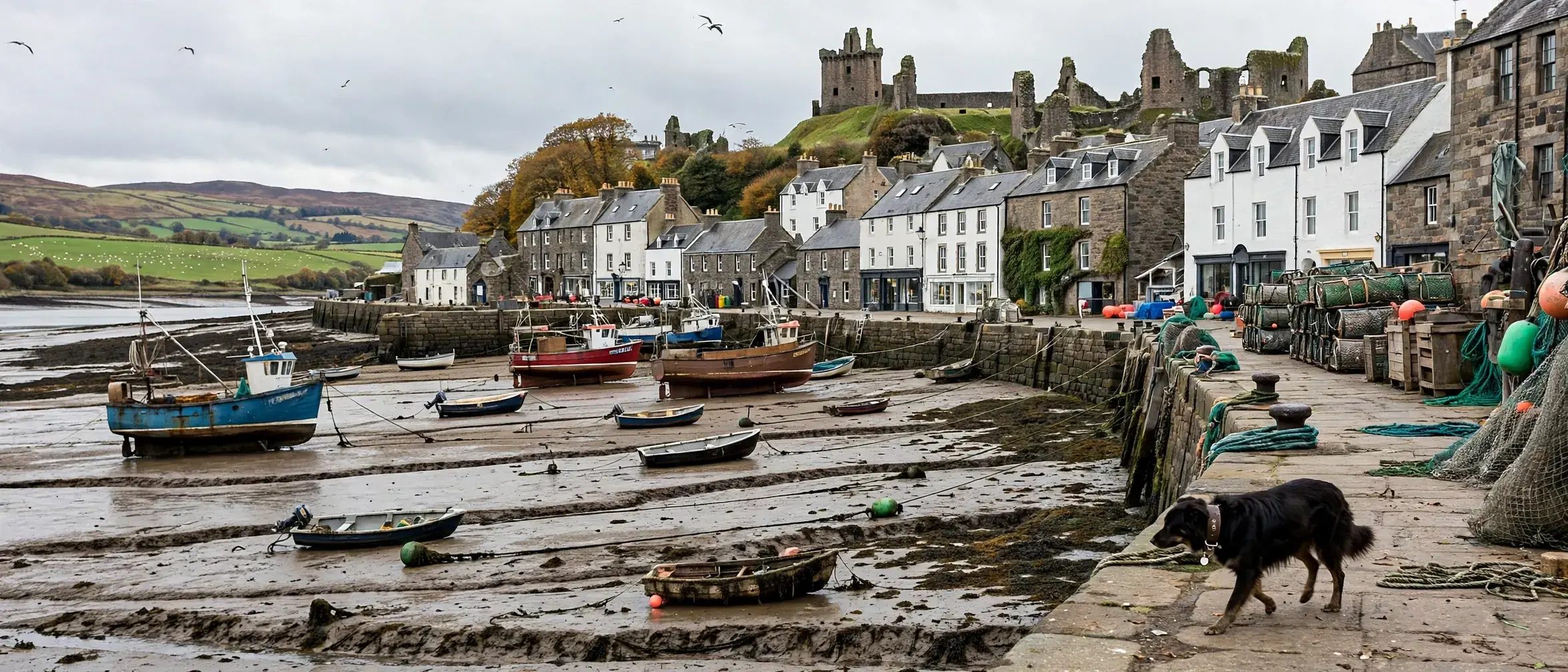
Further west, the Galloway coast and the artists' town of Kirkcudbright make a longer but rewarding day trip — about an hour's drive each way. Kirkcudbright has a working harbour, pastel-painted streets and a relaxed, dog-welcoming atmosphere, and the coastal paths around it are gentler than the wilder Galloway shore further west. Our guide to Kirkcudbright with a dog covers the harbour walks, the galleries and the cafes. If you go, allow a full day: the drive is easy, but the town deserves an unhurried afternoon rather than a rushed hour.
Eating and drinking with a dog
Lockerbie has a handful of pubs and cafes, and several of them welcome dogs — usually in the bar area, in a garden, or on outdoor seating. The pattern is the familiar one for small Scottish towns: the welcome is genuine, but it is not always advertised, and it can depend on the time of day, the weather and how busy the place is. The safest approach is to ask before you sit down, rather than assuming, and to have a fallback in mind. A pub that welcomes a quiet dog at three in the afternoon may not want one at eight on a Friday night.
Make it easy for a business to say yes. Bring a mat or blanket so the dog has a place to lie, keep the lead short and the dog under the table or beside your chair, and order at the bar rather than asking staff to come to a dog that is blocking the aisle. If your dog is a barker, a beggar or a dog that needs constant attention, eat outside or take food away rather than testing a pub's patience. One bad visit can change a pub's policy for every dog owner who comes after you, and small towns remember.
For a sit-down meal, lunchtime is usually the best bet. Pubs are quieter, staff have more time, and a dog that has had a morning walk will settle far more easily than a dog that has been in the car all morning. If you are staying in self-catering accommodation, the simplest routine is often to eat out at lunch and cook in the evening, when the dog is tired and the cottage is warm. Takeaway food is a good fallback in bad weather: eat it back at your accommodation with the dog settled beside you, rather than trying to make a wet, muddy dog comfortable in a busy dining room.
Supplies are easy to find. Lockerbie has supermarkets and a butcher, so buying dog food, treats and a spare lead is straightforward — you do not need to bring a week's worth of food from home unless your dog is on a specialist diet. If your dog does need a particular food, bring it with you and check the official guidance before you travel about local stock, because small-town supermarkets do not carry the full range of specialist brands. A small bag of high-value treats is worth packing for pub visits and for rewarding calm behaviour around livestock.
Where to stay with a dog
Most visitors to Lockerbie stay in self-catering cottages, farm stays or small bed and breakfasts in the town and the surrounding villages. Self-catering is usually the easiest option with a dog: you control the routine, there is normally a garden or a yard, and nobody minds if you come back muddy from a walk. When you book, ask the specific questions that matter for your dog rather than relying on a "dog-friendly" label. Is the garden genuinely enclosed, and how high is the fence? How many dogs are allowed, and is there an extra charge per dog? Is there a hard floor the dog can dry on, and somewhere to wash muddy paws?
Bed and breakfasts and small hotels in and around Lockerbie can work well too, but they vary more. Some welcome dogs in selected rooms only, some charge a per-night fee, and some ask that dogs are not left alone in the room. If you plan to eat out in the evening, ask whether the dog can come to the bar or the garden, because a dog that cannot be left alone and cannot come to dinner leaves you with a problem. Get the answers in writing with the booking confirmation, so there is no confusion on arrival.
Location matters as much as the property itself. A cottage on the edge of town with a field path from the gate is worth more than a smarter place in the centre that needs a drive for every toilet walk. Ask where the nearest practical walk is, and whether it can be reached on foot. For a reactive dog, a cottage at the end of a lane beats one on a busy road; for an older dog, a single-storey property with no steps beats a pretty cottage with a steep staircase. If you are travelling in winter, check the heating: a stone cottage with a dog that sleeps on a cold floor needs a warm room and a good bed, not just a good view.
Book early for the times when Lockerbie is busiest. The town is quiet for much of the year, but school holidays, summer weekends and the period around local events can fill the best dog-friendly places. If you are planning a summer stay, book several months ahead; for a winter break, you will usually find a choice at shorter notice, and some owners offer longer lets at lower rates. Whatever the season, read the cancellation terms before you pay a deposit, and keep the confirmation email until you are home — if a problem arises on arrival, the written booking is what you will rely on.
Livestock, leads and the countryside code
The single most important skill for a dog break around Lockerbie is managing livestock. The fields around the town hold sheep and cattle for much of the year, and many of the best walks cross grazing land. The Scottish Outdoor Access Code gives everyone a right of responsible access to most land, but that right comes with responsibilities, and the first of them is to keep dogs under close control around farm animals. In practice, that means a short lead whenever you are near stock, not just when you can see it — sheep can be hidden behind a hedge or a dip in the ground, and a dog that spots them before you do is already a problem.
Learn to read a field before you enter it. If there are sheep or cattle in the field, walk around the edge, keep the dog on a short lead, and move calmly and steadily. Do not walk between a cow and its calf, and do not let the dog approach or chase any animal. If cattle start to move towards you, the advice in the Scottish Outdoor Access Code is to let the dog off the lead if it is safe to do so, so the dog can run clear and the cattle follow the dog rather than you — but only do this if you are confident you can call the dog back, and only in open ground where the dog has somewhere safe to go. Check the official guidance before you travel for the current advice, because guidance on livestock and access is updated from time to time.
Lambing season, roughly from late winter into spring, is the time for extra care. Ewes with young lambs are easily stressed, and a dog running loose in a lambing field can cause real harm even if it never touches a lamb. During lambing, keep the dog on a lead on all farmland, stick to paths, and avoid fields with ewes and lambs altogether if there is an alternative route. Farmers in the area are generally welcoming to walkers who behave responsibly, and they are understandably sharp with those who do not — a loose dog in a lambing field is the fastest way to lose access to a route for everyone.
Beyond livestock, the usual countryside courtesies apply. Close gates behind you, even if they were open when you arrived. Pick up after your dog on paths, lanes and verges, and take the bag with you — there are few bins on country lanes, so carry a bag holder and a spare. Do not let the dog drink from troughs or disturb ground-nesting birds in spring and early summer. And remember that the access code applies to you as much as to the dog: leave the land as you found it, and the next walker — and the next dog — will find the same welcome.
Vets, shops, weather and packing
Before you travel, save the details of a vet in Lockerbie and a second one in Dumfries or Carlisle. The local practice is the one you would call in an emergency, but out-of-hours cover in a rural area can be provided from a neighbouring town, and knowing that in advance saves a panicked search at ten at night. Save the numbers in your phone, along with your own vet's number, and keep your dog's vaccination record and any medication in an accessible bag rather than buried in the boot. If your dog is on regular medication, bring a few days' extra supply in case your stay runs longer than planned.
Shops in Lockerbie cover the basics well. There are supermarkets for food and household supplies, a pharmacy, and a handful of independent shops. What the town does not have is a large pet shop, so bring specialist food, a spare lead, poo bags and any particular treats your dog needs. A first-aid kit for the dog is worth packing too: tick remover, antiseptic wipes, a bandage, and tweezers for thorns. The lanes and woods around Lockerbie have brambles and hawthorn, and a dog that picks up a thorn in a paw will need it dealt with before the next walk.
The weather in Dumfriesshire is changeable in every season. Rain can arrive quickly even on a promising morning, and the wind off the Solway can make a mild day feel cold. Pack a waterproof coat for yourself and a drying coat for the dog, and accept that mud is part of the trip: the ground around Lockerbie is low and damp, and field paths stay soft for days after rain. In summer, the risk is different — warm, still days can bring midges in the evening, particularly near water and woodland, so pack insect repellent and plan the evening walk for before dusk. Check the forecast the night before and the morning of each walk, and have a wet-weather fallback ready: a shorter town loop, a drive to Dumfries, or a quiet afternoon in a dog-friendly pub.
A short packing list for a Lockerbie dog break: a short lead and a long line, a harness that fits well, poo bags and a bag holder, a water bottle and a collapsible bowl, a towel and a drying coat, a blanket or mat for pubs and cafes, the dog's usual food and a few days' extra, any medication, a tick remover and a small first-aid kit, and a torch for evening walks — the lanes around the town are unlit, and a dog on a dark lane needs to be visible. Add a spare lead if your dog is a chewer, and a car seat cover or a blanket for the boot, because a Lockerbie dog comes home muddy more often than not.
A relaxed two-day plan
Day one is for settling in. Arrive in the morning, park near the centre, and take a gentle loop of the town so the dog learns the area. Stop for a coffee at a dog-friendly cafe if the dog is settled, then drive out to Eskrigg Nature Reserve for a short woodland walk — an hour at most, on a lead, with time to watch for red squirrels. Back in town, have a late lunch at a pub, then check in to your accommodation and let the dog rest. In the evening, take a short loop around the quieter streets or the lanes on the edge of town, and keep the evening simple: an early night sets up a better second day than a late one.
Day two is for a longer walk. Pick a section of the Annandale Way — the stretch south towards Annan is a good choice for a first attempt — and walk for two to three hours, with a break in the middle for water and a rest. Keep the dog on a lead through farmland, and turn back at a sensible point rather than pushing on to a distant village. After the walk, drive to Lochmaben for a short loch-side wander and a late lunch, or head to Dumfries for a riverside walk and a browse of the shops. Finish with an easy evening: a short toilet walk, a warm room, and a tired dog.
If you have a third day, use it for the coast or for Carlisle. The Solway shore is best on a calm, dry day, when the sand is firm and the light is good; Carlisle is the better choice in wet weather, when the castle grounds and the city centre give you somewhere to walk without wading through mud. Either way, keep the last day shorter than the middle one — a dog that has walked hard for two days will enjoy a gentle final morning more than another long hike, and the drive home is easier with a settled dog in the back.
The plan is deliberately unambitious, and that is the point. Lockerbie rewards a slow pace: a town that is easy to walk, a nature reserve that rewards patience, a long-distance path that can be sampled in sections, and a region that opens up in short drives. A dog that has had a good morning walk, a decent lunch stop and a quiet evening will remember the break far more fondly than one that has been dragged through a packed itinerary. Build in slack, watch the dog rather than the clock, and let the town set the pace.
Practical questions
Before you go
Is Lockerbie a good base for a dog holiday in Scotland?
Yes, for a slow-paced break. Lockerbie sits on the West Coast Main Line and just off the M74, with the Annandale Way passing through town, Eskrigg Nature Reserve nearby, and easy day trips to Dumfries, the Solway coast and Carlisle. It suits dogs that enjoy country lanes, woodland and quiet town streets more than dogs that need a beach or a busy city.
Can dogs walk the Annandale Way from Lockerbie?
Yes. The Annandale Way runs from Moffat to Annan and passes through Lockerbie, so you can walk a short section in either direction as a day walk. The route crosses farmland, so keep dogs on a lead near livestock, carry water, and check the official guidance before you travel for the latest route and access information.
Are dogs allowed at Eskrigg Nature Reserve?
Dogs are welcome at Eskrigg Nature Reserve on a lead. The reserve is a small woodland site managed by Lockerbie Wildlife Trust, known for red squirrels and woodland birds. Keep dogs on the paths, on a lead at all times, and do not let them disturb wildlife or enter the pond area.
Where can I park in Lockerbie with a dog?
Lockerbie has town-centre car parks within a short walk of the High Street, plus on-street parking on quieter streets. Arrive early on market or event days, and check the official guidance before you travel for current charges and time limits. Choose a shaded spot in warm weather and never leave a dog in a parked car.
Are there dog-friendly pubs and cafes in Lockerbie?
Several pubs and cafes in Lockerbie welcome dogs, usually in bar areas, gardens or on outdoor seating. Policies change, so check before you go, ask on arrival, and bring a mat so your dog can settle. In bad weather, takeaway food eaten back at your accommodation is a reliable fallback.
What should I do if my dog meets livestock near Lockerbie?
Keep your dog on a short lead, move calmly and steadily past the animals, and give them a wide berth. If cattle approach, let the dog off the lead only if it is safe to do so and you can call the dog back, as the Scottish Outdoor Access Code advises. Never walk between a cow and its calf, and check the official guidance before you travel.