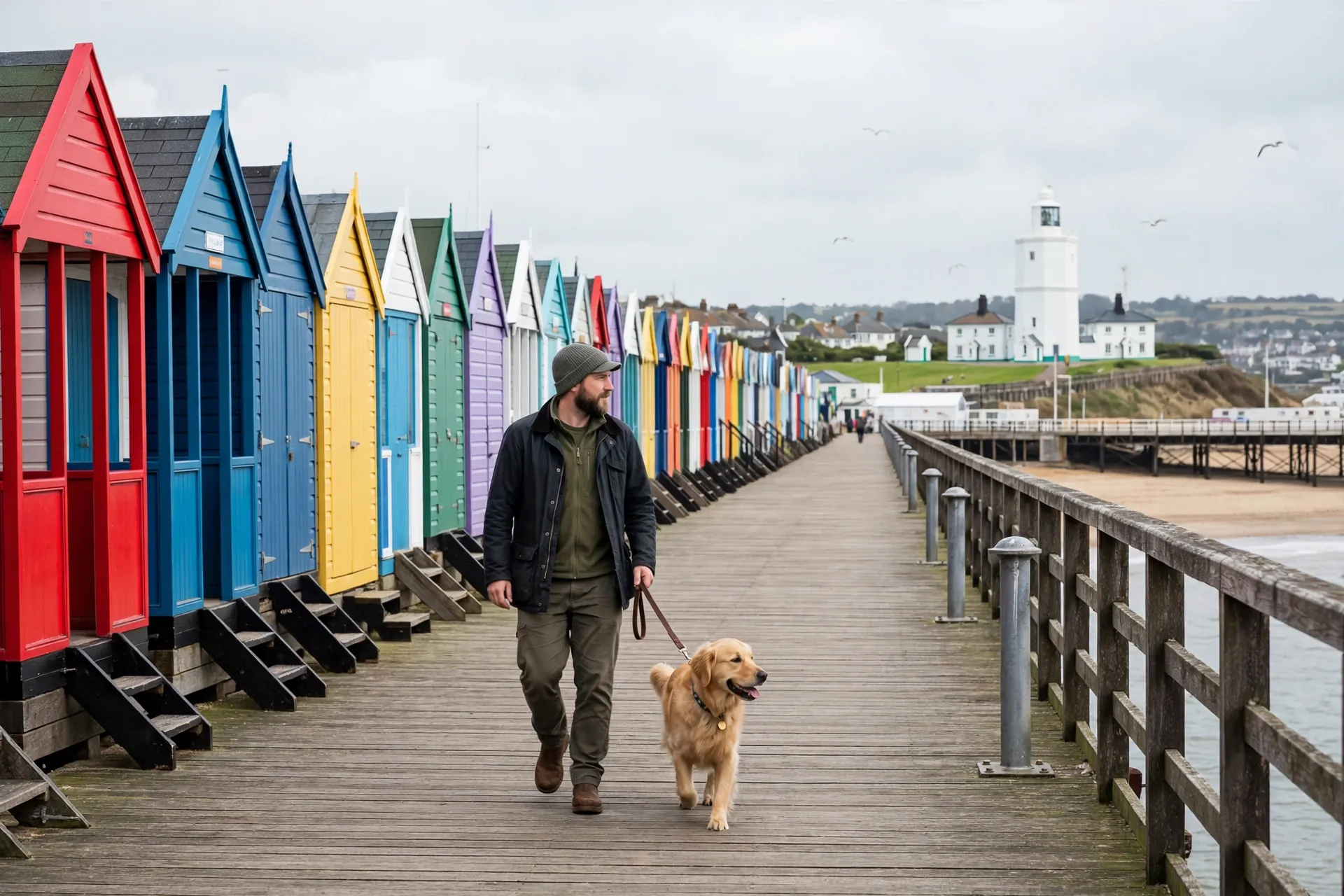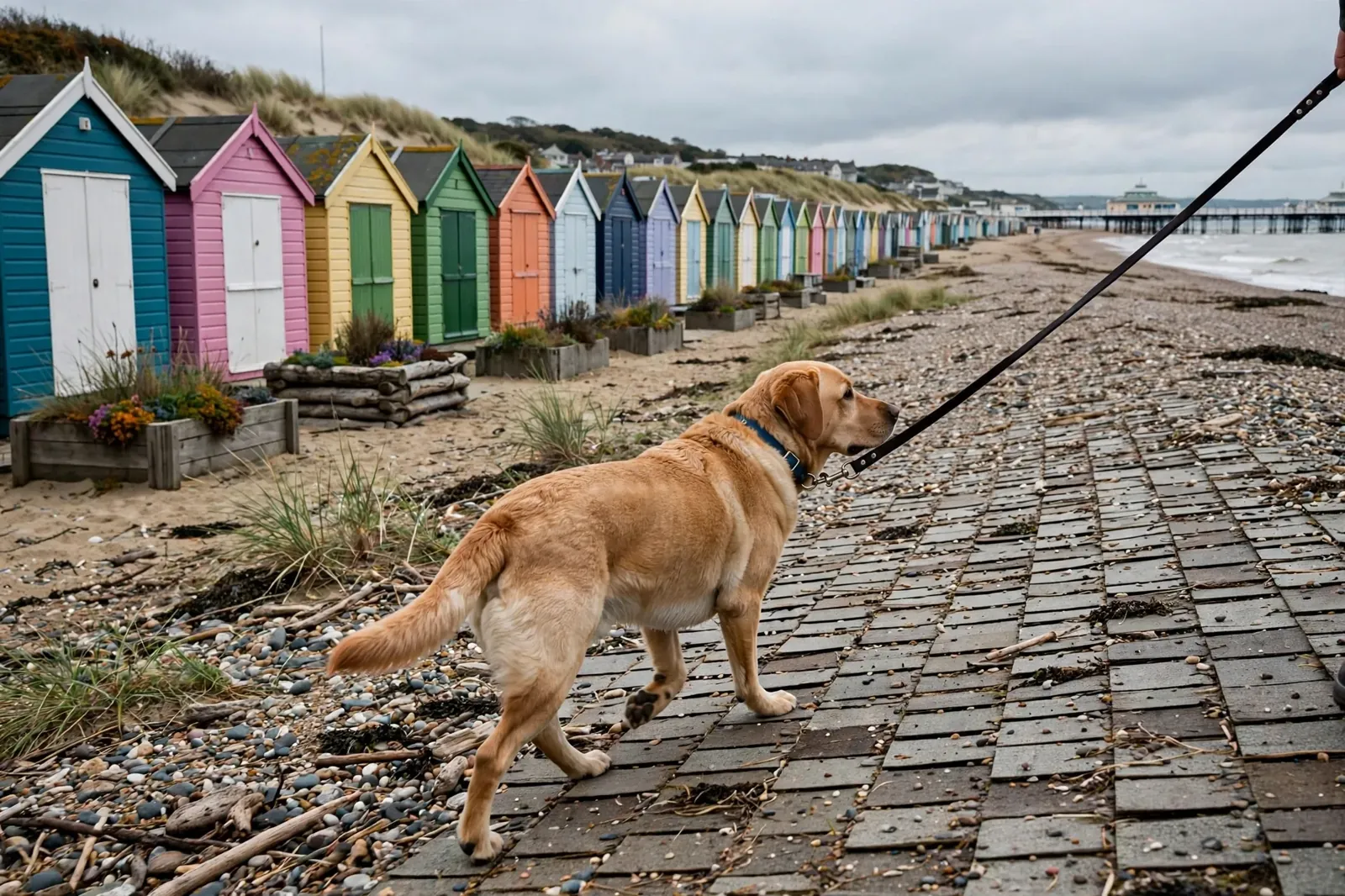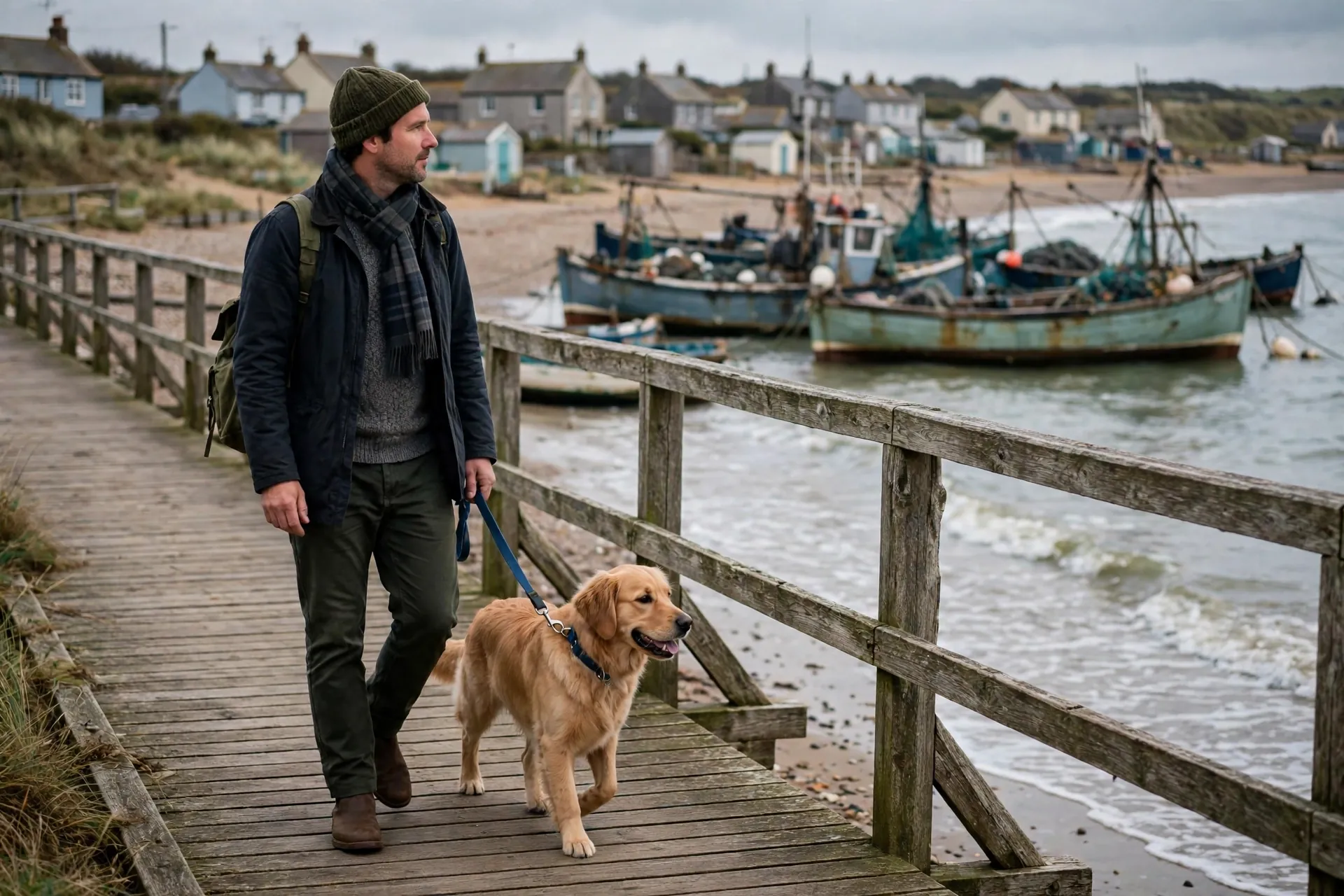
This guide is independent and contains no paid placement. If affiliate links are added later, they will be clearly marked and will not change our editorial checks.
Lowestoft rewards an early start and a flexible plan. Watch the sunrise at Ness Point, choose your beach by the season and the signs at the access point, keep harbour walks on a lead, take the Scores slowly, and leave Gunton for the quieter part of the day.
Begin at the easternmost sunrise
Lowestoft has a claim no other British town can match, and it shapes the whole trip: this is the easternmost town in Britain, so on a clear morning the sun reaches here before anywhere else in the country. That single fact gives a dog walk a natural structure. Instead of drifting into the day, you have a reason to be out early, when the seafront is quiet, the light is low and golden, and a dog that has spent the night in a new place can stretch its legs before the town wakes up. An early walk is not about chasing a spectacle for its own sake. It is about giving the dog the calmest version of the busiest landscape, and giving yourself a simple way to learn the shape of the town before cars, crowds and working harbour traffic fill it in.
Ness Point, the marked easternmost point, is the obvious place to begin, but it works best as an orientation stop rather than as a destination that has to carry the whole morning. Stand there, look north along the long beach and south towards the harbour entrance, and notice how different the two directions feel. To the north, the beach runs on in a wide, open sweep. To the south, the harbour, piers and town centre create a busier, more enclosed scene. A dog will read that difference too: open sand invites running and sniffing, while a quayside invites close control and watching. Letting the dog take in both in a short first outing makes later decisions easier, because you will already know which kind of walk suits the dog that morning.
Early light also changes practical things. Shadows are long, so a dog that is nervous about strangers has more warning of people approaching. The sand is cool, which matters on a warm day when a midday beach can be hard on paws. Sea birds are active, so recall needs to be honest rather than hopeful: if your dog cannot reliably come back past gulls, keep a long line on for that first walk and enjoy the sunrise without a chase. Bring water even for a short outing, because a dog that has just woken up, travelled, or slept in a warm room will drink more than you expect. And remember that sunrise itself is a moving target through the year. In summer it arrives very early, in winter it arrives at a far more civilised hour, so plan the walk around the season you are actually visiting, not around a photograph of someone else's summer.
One more reason to start early is that it sets the tone for the rest of the visit. A dog that has had a proper sniff, a drink and a toilet break before breakfast is a different animal from one that has been kept waiting while humans sort out parking and plans. The easternmost sunrise is therefore less a sightseeing checkbox and more a piece of dog management: it gets the essential walk done while the town is at its quietest, and it leaves the rest of the day free for slower, more deliberate exploring. If the weather does not cooperate, the same logic still holds. A grey dawn walk at Ness Point, short and purposeful, still gives the dog its morning outing and still lets you learn the seafront before deciding what to do next, and you should check the official guidance before you travel for any access or restriction changes that might affect that first route.
The north beach and Ness Point
The beach to the north of the harbour is Lowestoft's great open space: a long, wide stretch of sand and shingle that runs towards Gunton and beyond, with room to spread out even when the town is busy. For a dog, that width matters. A wide beach means you can keep distance from other dogs, from children playing near the water, and from anglers or walkers who would rather not be approached. It also means you can choose your surface. Some dogs prefer firm, damp sand near the waterline, where walking is easy and the smells are strongest. Others prefer the drier, looser sand higher up, where they can dig and roll. Watching which surface your dog chooses tells you a lot about their energy and their paws, and on a long beach you have the space to follow their preference instead of forcing them along a narrow strip.
Ness Point itself sits at the northern end of this picture, and it is worth understanding its position before you plan a route. It is not a beach in itself so much as a headland marker and a viewpoint, a place to pause and look out over the North Sea. The walk to and from it can be combined with the beach in either direction, and the combination is what makes it useful: a short pause at the point, then a longer walk along the sand, or a beach walk first with the point as a turning marker. Either way, keep the dog under close control at the point itself, because it is a shared public space where people stop, take photographs and look out to sea, and a dog running through a group of strangers is the fastest way to spoil a quiet morning. A lead or a long line at the point, followed by more freedom on the open beach where the rules allow, is a sensible compromise.
The north beach also teaches an important lesson about Lowestoft as a whole: the town's beaches are not one uniform place with one uniform rule. Different stretches have different characters, different neighbouring uses, and potentially different seasonal restrictions. That is why this guide keeps repeating the same advice, and why it matters more here than in a small resort with a single cove. You should check the official guidance before you travel, and then check the signs at the access point you actually use, because a rule that applies to one stretch may not apply to the next. If you are unsure whether dogs are welcome off the lead on the particular section in front of you, keep the lead on until you have seen a sign that says otherwise. It costs you nothing and it avoids the awkward moment of being asked to leave a stretch you assumed was open.
For a longer north-beach walk, think in terms of out-and-back rather than a loop. The beach is linear, so a loop usually means coming back along the promenade or through the streets, which is a different kind of walk altogether. An out-and-back route has real advantages with a dog: you can turn around at the first sign of tiredness, you already know the ground underfoot, and you can judge the tide by watching how the waterline has moved since you passed. It also makes water management simple. Carry water, offer it often, and do not rely on the sea. Salt water is not drinking water, and a dog that drinks a lot of it on a long walk can end up unwell. The same applies to beach finds: fishing line, hooks, broken shells and discarded food are all more likely on a long, well-used beach, so a quick scan of the ground ahead, and a reliable leave command, are worth more than any gadget.
The south beach and its seasonal rules
South of the harbour, Lowestoft's seafront takes on a different character. This is the more traditional resort side of the town, closer to the town centre, the promenade, gardens and the places where visitors gather. That closeness is both its appeal and its complication for dog owners. On the one hand, it is convenient: a short walk from parking or accommodation, with facilities nearby and a promenade to fall back on when the sand is too hot, too crowded or too windy. On the other hand, it is precisely the kind of beach where seasonal dog restrictions are most likely to apply, because it is the stretch where families, dogs and resort activity all compete for the same sand. The south beach therefore needs a different mindset from the north beach. Here, the question is not just whether you can walk, but when, on which section, and under what conditions.
Seasonal rules on British beaches commonly work by dividing the beach into zones and the year into periods, with dogs excluded from, or restricted to leads on, certain sections during the busiest months, and welcomed more freely outside them. Lowestoft's long seafront means those zones matter: a restriction on one section does not necessarily close the whole beach, and a dog-friendly stretch may be a short walk away from a restricted one. The practical skill is to find the boundary and respect it, rather than to assume the whole seafront follows one rule. Look for signs at every access point, note the dates and the exact stretch described, and if the sign is damaged, unclear or missing, choose the more cautious option and check the official guidance before you travel. This approach also helps you plan across the seasons. A visit in late autumn or winter can feel like a different town from a visit in high summer, with more beach open to dogs and fewer people to navigate, while a summer visit rewards an early start, a careful choice of section, and a willingness to move to the quieter north beach when the south beach fills up.
The promenade alongside the south beach deserves attention in its own right, because it is the fallback that makes a seasonal restriction manageable. If the sand section you wanted is restricted, a promenade walk still gives the dog exercise, smells and socialisation, without breaking the rules. It also gives older dogs and puppies a firmer, flatter surface than loose sand, and it keeps paws away from the hottest sand on a summer day. The trade-off is proximity: promenades concentrate people, pushchairs, cyclists and other dogs into a narrower corridor, so a lead is essential and distance management becomes your job. Step aside, let faster walkers pass, and give other dogs space at corners and access points where paths narrow. A promenade walk done well is a calm, sociable outing. A promenade walk done at the dog's pace, with no regard for anyone else, is stressful for everyone, including the dog.
It is worth comparing Lowestoft's seasonal pattern with neighbouring stretches of the Suffolk coast, because the contrast helps you plan a longer trip. Our guide to Southwold with a dog explains how another Suffolk resort divides its beaches by season and section, and our broader Suffolk coast dog guide sets Lowestoft in the context of year-round and seasonal beaches further south. Reading those two guides before you travel helps you see Lowestoft not as an isolated case but as part of a coastline where every town balances resort use and dog access slightly differently. If Lowestoft's south beach is restricted on your dates, the wider coast may offer an alternative for a particular day, and if Lowestoft is open, you may still want a day further south for variety. Either way, the same discipline applies everywhere: check the signs, check the dates, and check the official guidance before you travel.
The working harbour and fishing quarter
Lowestoft is a working port, not a harbour-themed backdrop, and that distinction should shape every walk you take around the water. Fishing boats, commercial vessels, cranes, warehouses and quayside traffic are part of daily life here, and they bring hazards that a purely leisure harbour does not. A dog on a lead, kept close and kept out of working areas, is safe and welcome on the public routes around the harbour. A dog off the lead, investigating mooring lines, nets, crates and puddles of harbour water, is at risk and in the way. The pleasure of the harbour walk is in watching the work, not in joining it, and the best harbour walks are the ones where the dog learns that quaysides are for walking calmly, not for exploring freely.
Start by separating the public walkway from the working zone in your mind, even when there is no dramatic fence between them. Public routes around a harbour often run alongside areas where vehicles reverse, loads are lifted, and surfaces are wet, oily or uneven. Barriers, painted lines and signs are there for a reason, and they are worth respecting even when the area looks quiet. A quiet moment in a working port can change quickly when a boat comes in or a vehicle moves, and a dog that has wandered into a working area during a lull may be in the wrong place when activity resumes. Keep the dog on the landward side of barriers, do not let them duck under chains or gates, and do not encourage them to investigate ropes, cables or equipment. If a route is blocked or diverted for harbour work, take the diversion without argument; it is usually there because something heavy or hazardous is happening just out of sight.
The fishing quarter adds its own specific hazards, and they are worth naming because they are easy to overlook. Discarded fishing line is a serious danger: it can tangle legs, cut paws and, if swallowed, cause internal injury. Hooks, bait and fish remains attract dogs and can cause illness or injury in minutes. Harbour water itself is not drinking water, and puddles on a quayside may contain fuel, cleaning chemicals or fish waste. A dog that drinks from a puddle or scavenges fish remains is not being naughty; it is being a dog in an environment full of strong smells. Your job is to manage that environment: keep the lead short near fishing activity, carry water so the dog is not thirsty enough to drink from puddles, and practise a leave command before the trip so that it works when the temptation is real. After a harbour walk, check paws, mouth and coat for line, hooks or debris, and rinse salt and grit off paws before the dog settles indoors.
There is also a quieter pleasure to harbour walking that is easy to miss if you focus only on hazards. Watching boats come and go, seeing the catch landed, and hearing gulls over working water gives a dog a rich sensory walk without needing to run. Many dogs settle surprisingly well on a harbour walk because there is so much to watch and smell from a stationary position. Use that to your advantage. Pause at a safe viewpoint, let the dog watch the water, and let the walk be slow. A harbour walk does not need to be long to be satisfying, and a short, calm harbour walk pairs well with a longer, freer beach walk later in the day. The two together give the dog both excitement and release, which is a better balance than either on its own, and you should check the official guidance before you travel for any harbour access changes, temporary closures or events that might affect your route.
The Scores: steep lanes, slow walking
The Scores are one of Lowestoft's most distinctive features, and they are also the part of the town where a little preparation pays off most. These are steep, narrow lanes that run between the upper town and the seafront, cutting through the cliff in a series of steps, slopes and passages. Historically they linked the town to the beach and the fishing quarter, and today they offer a direct, characterful route down to the sea that feels completely different from the main roads. For a visitor with a dog, the Scores are best treated as an experience in themselves, not just as a shortcut. Walked slowly, with pauses to look at the views and let the dog sniff, they are memorable. Walked hurriedly, with a dog pulling on a lead down steep steps, they are stressful and potentially unsafe.
The key is to choose your Score, and your direction, with the dog in mind. Not all Scores are equally steep, equally stepped, or equally busy, and the right choice depends on the dog's age, fitness and confidence on steps. An older dog, a puppy, or a dog with joint problems will cope far better with a gentler, more gradual route than with the steepest, most stepped lane, even if the gentler route takes a few minutes longer. Going up is often harder than going down, especially for dogs with sore hips or short legs, because climbing puts sustained strain on joints and because there is no easy way to pause on a narrow, steep lane without blocking other walkers. If in doubt, walk down one Score and come back up by a gentler road route, or simply treat the Score as a one-way descent and plan the return differently. There is no prize for completing the steepest lane in both directions, and a dog that is tired or sore at the top of a steep lane is a dog that still has to get down safely.
Surfaces and footing deserve attention too. Scores can be a mixture of steps, slopes, worn stone and tarmac, and they can be slippery when wet, icy in winter, or covered in leaves in autumn. A dog's paws need grip, and a lead needs to be managed so that it does not tangle around legs on steps. Keep the lead short but not tight, walk on the side that gives the dog the most room, and pause at landings or wider spots to let other people pass rather than squeezing past on a narrow step. If your dog is nervous on steps, do not force the issue. Let them approach, sniff, and take one step at a time, and be ready to abandon the Score and use a road route instead. Confidence built slowly lasts; confidence forced on a steep lane can be lost in a single frightening moment. For dogs that love steps and slopes, the Scores are a delight, but even a confident dog should be kept on a lead here, because a lane that narrows suddenly can bring you face to face with another dog, a cyclist or a pedestrian with no room to manoeuvre.
The reward for taking the Scores slowly is a sense of the town's history that you cannot get from the promenade alone. These lanes were working routes, used by fishermen and townspeople for generations, and walking them gives you a feel for how Lowestoft grew up around its cliff and its sea. Look for the views that open up as you descend, the glimpses of the harbour between buildings, and the way the sounds of the town change as you move from street to lane to seafront. Let the dog share in that slow discovery: pauses for sniffing are not wasted time, they are how a dog reads a new place. A Score walked at a dog's pace, with time to look and sniff, is a richer walk than the same lane rushed through, and it leaves both of you in a better mood for the beach at the bottom. Check the official guidance before you travel if you plan to rely on a particular Score as a route, because maintenance, closures or diversions can change which lanes are open.
Gunton and the quieter northern edge
If the south beach is Lowestoft at its most resort-like, Gunton is Lowestoft at its quietest. This northern area, beyond the main town beaches, offers a calmer, more open stretch of coast where the pressure of resort activity fades and the landscape takes over. For many dogs, Gunton is the best part of a Lowestoft trip, precisely because it is less busy. There is more space to walk, fewer distractions, and a sense of being on the open coast rather than in a town that happens to have a beach. It is the natural place to go when the main beaches are crowded, when your dog needs a longer, less interrupted walk, or when you simply want a quieter end to the day.
Gunton's quietness brings its own planning needs. A quieter beach is not necessarily a more serviced beach. Facilities, parking and access points may be further apart than in the town centre, and the walk to the beach may be longer or less obvious. That matters for a dog walk: you need to know where you will park, how far the dog will have to walk to reach the sand, and where you will find water and shade. It also matters for safety. A quiet beach can feel remote, and a dog that runs off on a wide, open stretch can cover a surprising distance before you realise. Keep recall honest here too. If your dog's recall is reliable on a busy beach with lots of distractions, it may still fail on an open beach with rabbits, birds and new smells, so a long line is a sensible precaution until you know how the dog behaves in this particular landscape. The same applies to the tide: on a long, open beach, the tide can cut off sections or change the available walking area faster than you expect, so check tide times and the official guidance before you travel.
The character of the Gunton coast also makes it a good place to think about the wider Suffolk and Norfolk coastline. Lowestoft sits near the border between the two counties, and a trip that starts here can naturally extend north towards Norfolk or south towards the rest of Suffolk. Our guide to Suffolk coast dog walks is useful background for the southern direction, and the quieter northern edge at Gunton is a reminder that the coast does not stop at the town boundary. If you are staying for several days, consider using Gunton as a base for a slower day: a morning walk here, a rest in the middle of the day, and a short evening walk back in town. That rhythm suits many dogs better than a day packed with three different beaches, because it gives the dog time to settle between outings and gives you time to notice what the dog actually enjoys.
Gunton also rewards a different kind of attention from the town beaches. Where the south beach invites you to notice facilities and rules, Gunton invites you to notice weather, light and ground. Wind is stronger on an open coast, and a dog that is comfortable in a sheltered town may be unsettled by wind on an exposed beach. Sand and shingle change underfoot, and a dog with sensitive paws may prefer one surface to another. Sea birds nest and feed along open coasts, and disturbing them is both inconsiderate and, in nesting season, potentially harmful, so keep dogs under control near bird colonies and follow any local signs. The pleasure of Gunton is in its openness, but openness needs management: space to run is only a pleasure when the dog can be recalled from it, and a long walk is only a good walk when the dog returns home tired in a good way, not exhausted, footsore or overstimulated.
Practical planning: parking, water and toilets
Practical planning for Lowestoft with a dog starts with a simple principle: sort out the basics before the dog needs them. Parking, water, toilet stops and shade are not glamorous topics, but they decide whether a day feels easy or fraught. A dog that has to wait in a car while you search for parking, or that has no water on a warm beach walk, or that has no suitable toilet spot after a long drive, starts the day at a disadvantage. A little advance thought removes most of those problems. Before you set out, think about where you will park in relation to the beach or harbour you plan to visit, how far the dog will have to walk from the car to the first toilet opportunity, and where you will refill water during the day. If you are staying overnight, think about the same questions for the morning walk, because the first walk of the day is the one that most often goes wrong when the basics are not sorted.
Parking in a coastal town is seasonal and situational. In summer and on sunny weekends, the car parks closest to the beach fill early, and the walk from a further car park to the beach can be longer than you planned. In winter, parking is easier but daylight is shorter, so the timing of the walk matters more. Rather than relying on a single car park, have a fallback in mind: a second car park, a street where parking is permitted, or a plan to arrive early and walk from further away. The walk from the car is part of the dog's day, not just a transfer, so make it a good one: a pavement walk with interesting smells is fine, but a long walk along a busy road with no pavement is not a good start for a nervous dog. If the dog is older, has mobility problems, or is travelling in a crate, the distance from car to beach matters even more, and it is worth choosing a beach access point that minimises that distance, even if it means a slightly busier beach.
Water is the single most important thing to carry, in every season. Dogs lose water through panting, exercise and heat, and a beach walk in wind can be deceptive: the dog may be working hard without looking hot, because the wind cools the surface while the body still loses moisture. Carry more water than you think you need, offer it little and often, and carry a bowl the dog will actually drink from. Some dogs refuse unfamiliar bowls, so practise at home before the trip. Do not rely on beach cafes, harbour taps or the sea as a water source. Cafes may not be open, taps may not be suitable for drinking, and sea water, as noted earlier, is not a substitute. The same logic applies to toilet stops. A dog needs a chance to toilet before a long walk, during a long walk, and after a car journey. Grass verges, beach edges and designated areas all serve, but the key is to build toilet stops into the plan rather than hoping they happen. Carry bags, dispose of them properly, and remember that fouling on a beach or promenade is both unpleasant for others and, in many areas, an offence. Good toilet planning is part of being welcome as a dog owner in a resort town.
Shade and shelter are the other practical essentials, and they are easy to overlook on a cool, bright day. A dog on a beach has little shade unless you provide it, and a dog in a car has none at all. Never leave a dog alone in a car on a warm day, even for a short errand, because a car heats up far faster than most people expect. On the beach, a windbreak, a parasol or a shaded spot near a wall can make a long stay comfortable, while a dog left in full sun on hot sand will overheat and damage its paws. In winter, shelter means something different: protection from wind and rain, a dry place to sit, and a warm layer for a short-coated or older dog. Pack for the season you are visiting, check the forecast, and check the official guidance before you travel for any changes to parking, access or facilities that might affect your plan. A practical plan is not a rigid plan; it is a plan with enough slack that a closed car park, a sudden shower or a tired dog does not derail the whole day.
Rainy days and drying routines
Rain is a normal part of a British coastal trip, and Lowestoft is no exception. A rainy day with a dog is not a failed day; it is a different kind of day, and it works well if you adjust expectations and routines. The mistake is to try to force a sunny-day plan into rain: a long beach walk in driving rain, with a dog that hates wet sand and an owner who hates wet clothes, helps no one. A better rainy-day plan is shorter, more sheltered, and more focused on the dog's needs than on covering distance. A brief walk in a break in the rain, a sheltered promenade walk, or a short beach walk followed by a proper drying session can be more satisfying than a long, miserable outing, because the dog still gets exercise and smells, and you still get to see the coast, without either of you becoming cold and fed up.
Drying is the skill that makes rainy days work. A wet dog in a car or in accommodation is uncomfortable, smelly and potentially chilled, especially if the dog is small, short-coated, older or very young. A good drying routine starts on the walk: a drying coat, if your dog will wear one, keeps the worst of the rain off and makes the post-walk dry much faster. After the walk, towel the dog thoroughly, paying attention to paws, belly, ears and the area under the collar and harness, where dampness lingers and can irritate skin. If you are staying overnight, a second towel, a spare bed or blanket, and a place to hang wet leads and coats will make the evening far more pleasant. In a car, a towel on the seat, a waterproof cover, and a spare towel for the return journey are essential, and the car should be ventilated on the way home so that damp air does not fog the windows and chill the dog.
Paws need particular attention in wet and salty conditions. Salt, sand and grit can dry out paw pads, cause cracking, and lodge between toes, causing limping and soreness. After a beach walk in any weather, check paws, rinse them with fresh water if possible, and dry them carefully. If your dog has hairy feet, trim the hair between the toes before the trip so that sand and salt do not mat there. If your dog is prone to sore paws, a paw balm applied before the walk can help, but it is not a substitute for checking paws afterwards. The same care applies to ears, especially for dogs with floppy ears or a history of ear problems: damp ears after swimming or rain should be dried gently, and any sign of discomfort, head shaking or smell should be checked by a vet rather than ignored. These small routines take minutes, but they prevent the minor irritations that can spoil a trip.
Indoor options on a rainy day depend on what is open and what welcomes dogs, and both can change, so check the official guidance before you travel and check with individual venues before you rely on them. As a general approach, look for places where dogs are welcome in a defined area, such as a cafe with a dog-friendly section, a covered market, or a sheltered walkway, rather than assuming every indoor space welcomes dogs. If you cannot find a suitable indoor stop, a short, sheltered outdoor walk followed by a rest in your accommodation is a perfectly good rainy-day plan. Dogs do not need constant entertainment; they need exercise, toilet opportunities, food, water, rest and company. A rainy day that provides those basics, with a little novelty in the form of a new walk or a new smell, is a successful dog day, even if you never see the sun. Pack a book, pack extra towels, and let the rain set the pace.
Older dogs, puppies and short legs
Lowestoft's variety is an advantage for dogs at different life stages, but only if you match the walk to the dog. An older dog, a puppy and a fit adult spaniel do not need the same Lowestoft, even though they are visiting the same town. An older dog may love the harbour walk, the promenade and a short, flat beach walk, but struggle with the Scores, with deep sand, or with a long out-and-back beach walk that has no easy turning point. A puppy may love the novelty of the seafront, the harbour smells and the Scores, but need frequent rests, toilet breaks and socialisation in small doses, rather than a long, overstimulating day. A short-legged dog may cope well with flat promenades and firm sand, but tire quickly in deep, loose sand or on steep steps. The art of a good Lowestoft trip is to notice which dog you have and plan accordingly, rather than to follow a generic itinerary that assumes every dog is the same.
For older dogs, the key considerations are joints, stamina, temperature regulation and confidence. Joints suffer on steep steps, on deep sand, and on long walks with no rest, so favour flat, firm surfaces, short walks with frequent pauses, and routes with easy exit points. Stamina fades faster than enthusiasm in many older dogs: they may set off eagerly and tire suddenly, so plan a route where you can turn back or cut short without a long return walk. Temperature regulation is also harder for older dogs, in both heat and cold, so a warm day needs shade, water and a shorter walk, while a cold, windy day needs a coat and a sheltered route. Confidence matters too: an older dog that has become nervous about other dogs, children or traffic will enjoy a quiet Gunton walk far more than a busy south beach promenade, and forcing a nervous older dog into a crowded situation for the sake of sightseeing is unfair and counterproductive. Let the older dog set the pace, and let a short, happy walk count as a successful day.
For puppies, the key considerations are socialisation, toilet training, vaccination and overstimulation. A puppy visiting Lowestoft for the first time is learning about the world: new surfaces, new sounds, new people, new dogs, the sea, the harbour, the wind. That learning is valuable, but it needs to be dosed. Short, positive experiences are better than long, overwhelming ones. A ten-minute beach walk with time to sniff, watch the sea and meet one calm dog is better than an hour on a busy beach with dozens of dogs, children and cyclists. Toilet training means frequent stops and a tolerance for accidents, especially after excitement, travel or a change of routine. Vaccination status matters for where a puppy can safely walk and which dogs it should meet, so check with your vet before the trip and follow their advice on public areas. Overstimulation shows as hyperactivity, inability to settle, excessive mouthing or sudden tiredness, and the remedy is rest, not more stimulation. A puppy that naps in the car or in accommodation after a short walk has had a good day, even if you have not covered much ground.
Short legs, small size and brachycephalic breeds bring their own considerations, and Lowestoft's variety helps here too. Small dogs can struggle in deep sand, on steep steps and in wind, but they often do well on firm promenades, short beach walks and harbour viewpoints where they can be carried for part of the route if needed. A carrier or sling is not cheating; it is a sensible tool that lets a small dog enjoy a longer outing without exhaustion. Brachycephalic dogs, such as pugs and bulldogs, are more vulnerable to heat and to overexertion, so they need shorter walks, more water, more shade and a careful eye on breathing, especially on warm days. For all these dogs, the same principle applies: choose the walk that fits the dog, not the walk that looks best in a photograph, and check the official guidance before you travel for any access information that might affect a dog with mobility or health needs. A trip planned around the dog you actually have is a trip the dog will enjoy, and a dog that enjoys the trip is a dog you will enjoy travelling with.
Tides, water and seafront hazards
Seafront safety with a dog is mostly about respecting water, and Lowestoft's long, open coast makes that respect essential. Tides on the east coast can move quickly, and a beach that is wide and inviting at low tide can narrow dramatically as the tide comes in, cutting off sections and forcing walkers towards cliffs, harbour walls or groynes. Before a beach walk, check tide times for the day, note whether the tide is coming in or going out, and plan your turning point accordingly. A good rule is to turn back while you still have plenty of beach, not when the water is already at your feet. If you are walking with the tide coming in behind you, you are walking into a trap, however pleasant the walk feels at the start. If in doubt, ask locally, check the official guidance before you travel, and choose a promenade or harbour walk instead of a beach walk when the tide is unfavourable.
Water safety for dogs goes beyond tides. Dogs that love swimming can get into difficulty in currents, waves and cold water, and a dog that swims confidently in a lake or river may struggle in the sea. Keep swimming to calm, shallow water where you can see the bottom and where the dog can easily get out, and never encourage a dog to swim near harbour entrances, piers, groynes or areas with boat traffic. Cold water is a particular risk in spring and autumn, when the air feels warm but the sea is still cold, and a dog that swims for too long in cold water can become chilled and disorientated. After swimming, dry the dog, offer fresh water, and watch for shivering, lethargy or vomiting, which can indicate salt-water ingestion or cold. A dog that has swallowed a lot of sea water should be monitored and, if unwell, seen by a vet. Prevention is simpler than cure: short swims, close supervision, fresh water available, and a willingness to call the dog out of the water even when it wants to stay in.
Other seafront hazards are less dramatic but more common. Groynes, rocks and sea defences can be slippery, sharp or barnacle-covered, and a dog running over them can cut paws or slip. Fishing line and hooks, already mentioned for the harbour, are also found on beaches, especially near angling spots. Broken glass, sharp shells and discarded food are common on resort beaches, and a dog that scavenges is at risk of cuts, stomach upsets or worse. Jellyfish, seaweed and dead sea creatures can also attract dogs and cause illness if eaten or touched. The remedy is the same in all cases: keep the dog under control in areas where hazards are likely, scan the ground ahead, practise a leave command, and check paws and mouth after the walk. A beach walk is not a free-for-all; it is a managed exploration, and the management is what keeps it safe and enjoyable.
Weather hazards complete the picture. Sun, wind, rain and cold all affect dogs on the coast, sometimes in combination. Sun can overheat a dog, burn exposed skin, and heat sand to a level that burns paws. Test sand with your own hand: if it is too hot for your hand, it is too hot for paws. Wind can chill a wet dog, blow sand into eyes, and make recall harder by carrying sound and scent away. Rain can make surfaces slippery and chill a small or short-coated dog quickly. Cold can affect older dogs, puppies and lean, short-coated breeds most. The solution is not to avoid the coast in imperfect weather, but to adapt: shorter walks, more water, shade or shelter, a coat for a dog that needs one, and a willingness to cut a walk short when conditions change. A dog walk that ends early because the weather turned is not a failed walk; it is a well-judged one, and it leaves the dog ready for a better walk later in the day.
A calm two-day shape
A two-day visit to Lowestoft with a dog works best when it has a shape, not a schedule. A schedule tries to fit too much into fixed times and leaves no room for a tired dog, a sudden shower or a beach that turns out to be restricted. A shape, by contrast, gives each day a theme and a rhythm, and lets you adjust the details as you go. The shape suggested here is deliberately calm: a sunrise and seafront day, followed by a harbour, lanes and quiet-coast day. It is not the only shape that works, and it should be adapted to your dog, your accommodation and the season, but it shows how Lowestoft's different parts can fit together without rushing.
On the first day, start early at Ness Point, as described at the beginning of this guide, and follow it with a beach walk on the stretch that suits the season and the signs you find. Let the morning be the main walk, with time for sniffing, paddling and playing, and let the afternoon be slower: a promenade walk, a rest, and a short evening walk to settle the dog before bed. This rhythm mirrors a dog's natural pattern of activity and rest, and it avoids the common mistake of packing two long walks into one day and then having an exhausted, overstimulated dog in the evening. If the south beach is your morning choice, check its seasonal rules first; if the north beach is your choice, use the open space to let the dog run and explore. Either way, end the day with a proper drying and paw-check routine, so that the second day starts with a clean, comfortable dog.
On the second day, shift the focus to the harbour, the Scores and Gunton. Start with a calm harbour walk on a lead, watching boats and working water, then take a Score down to the seafront at a slow pace, pausing for views and sniffs. This is a good day for a shorter, more varied set of walks rather than one long beach walk, because the variety itself is stimulating for the dog: harbour smells, lane views, beach sand and open coast in a single day, each in a manageable dose. Finish with Gunton, where the quieter coast gives the dog a longer, less interrupted walk to end the trip on a high note. If the dog is tired by the afternoon, shorten the Gunton walk or replace it with a promenade walk; the shape still works, because the harbour and Scores have already given the day its character. For ideas for extending the trip, our Aldeburgh with a dog guide shows how a neighbouring Suffolk resort handles its promenade and fishing-boat shore, and it pairs naturally with a Lowestoft base for a longer Suffolk coast stay.
Across both days, keep a few habits constant. Offer water little and often, build in toilet stops, check paws after beach and harbour walks, and keep a rest period in the middle of the day when the dog can sleep undisturbed. Dogs that rest well between walks enjoy the next walk more, and they are less likely to become overstimulated, reactive or exhausted. Keep a note of which walks your dog enjoyed most, which surfaces they preferred, and which routes were too steep, too busy or too long. That note is the most useful souvenir of a Lowestoft trip, because it tells you what to repeat next time and what to change. Lowestoft rewards return visits: the sunrise is different every morning, the harbour changes with the boats, and the beaches change with the seasons. A first trip that is calm, well-planned and dog-centred is the best preparation for a second trip that can be a little more adventurous, and you should check the official guidance before you travel on that return visit too, because beach rules, harbour access and facilities can all change between trips.
Practical questions
Before you go
Can dogs go on Lowestoft beaches all year?
Not on every stretch, and not under the same conditions all year. Lowestoft has long north and south beaches, and seasonal restrictions can apply to particular sections, so check the official guidance before you travel and look for the signs at each beach access point before you let your dog off the lead.
Is Ness Point a good first stop with a dog?
Yes, as a short, orienting stop rather than a long walk. Ness Point marks the easternmost point of Britain, it is an easy place to get your bearings, watch the light over the sea and settle into the town, and it pairs naturally with a longer beach walk afterwards. Keep dogs under control around other visitors, and check the official guidance before you travel if you plan a longer route from there.
What should I watch for around Lowestoft harbour with a dog?
Working harbour traffic, mooring lines, fishing gear, wet and slippery surfaces, and sudden gaps between quayside structures. Keep your dog on a lead, stay behind barriers and away from working areas, and do not let your dog drink harbour water or pick up discarded bait, line or hooks. If anything looks like a working zone rather than a public walkway, treat it as out of bounds.
Are the Scores lanes suitable for older dogs or puppies?
They can be, if you choose a short, gentle section and go at the dog's pace. The Scores are steep, narrow lanes running between the town and the seafront, so they suit a slow wander with pauses better than a forced climb. For an older dog, a puppy, or a dog with sore joints, pick the flattest approach, avoid the steepest lanes, and check the official guidance before you travel.
What is the best wet-weather plan in Lowestoft with a dog?
Keep the plan short, sheltered and flexible: a brief beach or promenade walk in a break in the rain, a dry indoor stop where dogs are welcome, and a proper drying routine back at your accommodation. Pack a drying coat and towels, protect paws from salt and grit, and check the official guidance before you travel, because dog policies at indoor venues can change.