This guide is independent and contains no paid placement. If affiliate links are added later, they will be clearly marked and will not change our editorial checks.
Three of Lyme Regis's four beaches welcome dogs all year: Monmouth Beach, Church Cliff Beach and East Cliff Beach. Only Front Beach, the sandy beach in the middle of town, bans dogs from 1 May to 30 September. Dogs stay on a lead through the town, the harbour and the Cobb, and every beach walk here is ruled by the tide, so check tide times and the official guidance before you travel.
The four beaches, in one table
Most visitors to Lyme Regis make the same mistake on their first morning: they walk straight to the sandy beach in the middle of town, because it is the one they can see from the promenade, and then discover that it is the one beach their dog cannot use in summer. Lyme Regis has four beaches, and they behave like four different places. Learn the four names before you arrive and the whole trip gets simpler, because the beach you want depends on the season, the tide and how far your dog is happy to walk over pebbles.
Front Beach, also called Town Beach or Sandy Beach, is the sheltered sandy stretch between the Cobb and the town centre. It is the family beach, with the promenade, the amusements and the cafes a few steps away, and it is the beach with the seasonal rule: no dogs from 1 May to 30 September, and dogs allowed on a lead from 1 October to 30 April. Out of season it is a genuinely good dog beach, because it is the only one with real sand underfoot, easy level access and somewhere to sit with a coffee while the dog sniffs the tideline. In summer, walk past it without arguing with the sign; the year-round beaches are better for dogs anyway.
Monmouth Beach runs west from the Cobb for about a mile, and it is the beach most dog owners end up using most. It is pebbles and rock ledges rather than sand, it welcomes dogs all year round off the lead once you are on the beach itself, and it is long enough that even in August you can walk far enough to find quiet space. The far western end is where the famous Ammonite Pavement sits: a limestone ledge packed with large fossil ammonites, exposed only at low tide. Monmouth Beach shelves steeply in places and there can be strong currents, so swimming needs care, and the pebbles get hot in strong sun. The car parks at Monmouth Beach and Cobb Gate are the closest to the water and fill early in summer, which is the practical reason to arrive before the middle of the morning.
Church Cliff Beach is the small, quieter beach east of the town, in front of the rock armour that protects Gun Cliff Walk. It is pebble and sand in places, with an extensive rock ledge revealed at low tide and the River Lym flowing into the bay at its eastern end. Dogs are welcome all year round, off the lead on the beach, but they must be on a lead on the sea wall and walkway above it. The sand here vanishes fast as the tide comes in, so this is a beach to visit on a falling tide and leave with time to spare, not a place to settle in for the afternoon without checking the tide table first.
East Cliff Beach, known locally as Back Beach, is the furthest east, stretching towards Charmouth beneath the cliffs called the Spittles. It is usually the emptiest of the four, it welcomes dogs all year round, and it is one of the best fossil-hunting beaches on this coast. That combination comes with the strongest warnings: the cliffs here are very unstable, with extensive mudflows, so stay well away from their base, and the beach can be cut off at high tide. Access is by Church Cliff Walk, roughly ten minutes from Front Beach, with steps, and from the seawall you can reach Charmouth Road car park by 114 steps up the hill. A dog that is happy with steps and pebbles will love it; a dog that struggles with either will be happier on Monmouth Beach.
Put together, the pattern is simple enough to remember. In winter, all four beaches are open to dogs, and Front Beach is the easiest. In summer, use Monmouth Beach for a long walk, Church Cliff Beach for a quiet hour, and East Cliff Beach for fossils and space. The lead rule is the same everywhere in town: dogs must be on a lead on Marine Parade, Cart Road, Bell Cliff, the harbour, the slipways and sea walls, the Cobb, Gunn Cliff Walk, the Church Cliff walkway and the steps to Charmouth Road car park. In the Dorset Council area, where a lead is required it must be no longer than two metres, and the fixed penalty for taking a dog onto a restricted beach in season, failing to pick up, or ignoring a lead requirement can be £100, reduced to £75 if paid within 14 days. Check the official guidance before you travel, because the dog order that sets these rules runs to the end of 2026 and the next order may adjust the details.
Plan around the tide, not the clock
Lyme Regis is a town where the tide is the timetable. The beaches that make it special, the Ammonite Pavement at the far end of Monmouth Beach and the fossil ledges at Church Cliff and East Cliff, are only properly walkable at low tide, and the same beaches can be cut off as the water comes in. People walking east towards Charmouth do get cut off every year, and the town council and the museum both repeat the same advice: check the tide times before you set out, and turn back with plenty of time. A dog does not understand a rising tide, and a dog that is happily sniffing rock pools at the far end of a beach will not volunteer to leave early. That decision is yours, and it has to be made before the water does it for you.
The practical way to plan is to build the day backwards from low tide. Look up the low tide time the night before, then plan to arrive at the beach about an hour before it, so the water is still falling and the ledges are opening up as you walk. Give yourself a hard turn-back time, written down or set as a phone alarm, and stick to it even if the fossil hunting is going well. A good rule for a first visit is to be off the far ledges at least an hour before the tide turns, and to be back on the seawall or the main beach well before high tide. If you are walking the shore from Lyme Regis towards Charmouth, remember that the walk is about three miles along the beach, the cliffs behind you are unstable, and there is no easy escape route up them if the tide cuts you off. The coast path above the cliffs is the safe alternative for that direction, and it is a walk in its own right rather than a fallback.
Tides also change what each beach feels like. At low tide, Monmouth Beach opens out into rock ledges and pools where a dog can paddle and sniff for a long time; at high tide, the same beach is a narrower strip of pebbles with the water close to the sea wall. Church Cliff Beach is covered at high tide, and East Cliff Beach is cut off, so neither is a place to arrive at without checking first. Front Beach is the most forgiving, because the promenade and the town are right behind it, but even there a rising tide changes the space quickly. If you are staying for several days, the tide times shift by roughly an hour each day, so the best beach hour moves with them, and a morning that worked on Tuesday may be a midday low tide on Thursday. Keep the tide table on your phone and check it each morning alongside the weather, the way you would check a train time.
Storms and spring tides deserve their own note. After heavy rain or a storm, the cliffs shed more material, the beaches change shape, and debris can wash up, including old material from a former landfill site above East Cliff Beach that was closed in the early 1970s and is now subject to coastal erosion. Keep dogs away from anything that looks like old rubbish or sharp debris, and do not let them drink seawater, which can make them unwell. In severe weather the Cobb and the seafront can close, and waves can break over the harbour wall, so a stormy day is a day for watching the sea from a safe distance, not for walking the dog along the front. Check the official guidance before you travel if a storm is forecast during your stay.
The Cobb, the harbour and the town on a lead
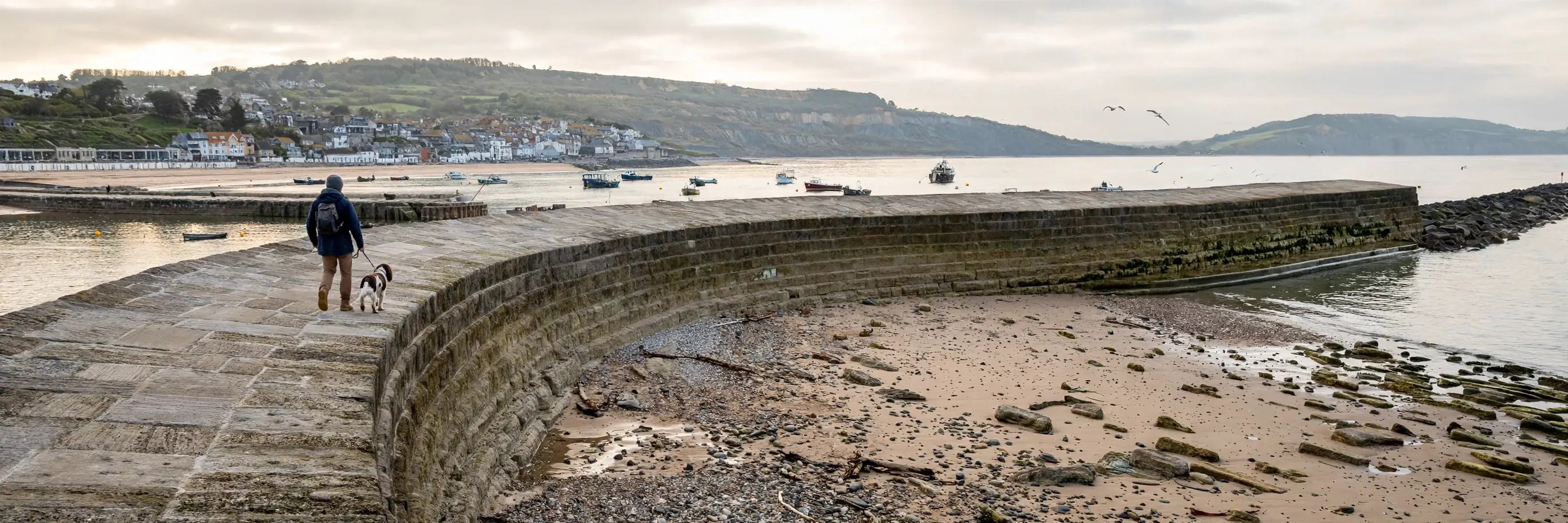
The Cobb is the curved stone harbour wall that has sheltered Lyme Regis for centuries, and it is the town's most photographed place. It is also, for a dog owner, a place to walk carefully rather than casually. The Cobb is a Grade I listed structure with no railings on its upper walkway, a sheer drop to the harbour on one side and the open sea on the other, and it is an on-lead area for dogs, along with the harbour and Marine Parade. Keep the lead short, keep your dog on the harbour side of the wall, and do not walk it in high winds or when waves are breaking over the top. A sudden lurch towards the edge, after a gull or a fishing boat, is the main risk, and it is entirely preventable with a short lead and a steady pace.
The walk itself is worth doing slowly. The lower Cobb is the sheltered walkway on the harbour side, with the boats, the sailing club buildings and the Marine Aquarium, while the upper Cobb gives the wide view back across the bay towards the town and the cliffs. Granny's Teeth, the stepped section at the end of the Cobb, and the steps made famous by the film of Jane Austen's Persuasion are the details people stop to photograph, and they are also the places where a dog on a long lead can get tangled or step into someone's path. Shorten the lead before the steps, let other people pass, and remember that the Cobb is a working harbour wall as well as a promenade: fishing boats, ropes, lobster pots and wet stone are all part of the surface underfoot.
Parts of the Cobb close from time to time for repairs and in bad weather, and the wall itself is under pressure from the sea. In October 2025 the town council reported that a void had been found at the base of the wall and needed urgent repair before the storm season, so closures and scaffolding are a normal part of the Cobb's life rather than a surprise. Obey any barrier or sign, do not climb over it for a photograph, and check the official guidance before you travel if you are planning a visit around a particular walk. The harbour area below the Cobb, with its slipways, boat park and fish stalls, is also on-lead, and it is a place where a dog needs to be close to you rather than exploring, because of moving vehicles, boat trailers and wet, slippery surfaces.
The town behind the harbour is steep, narrow and busy in summer, and the lead rule applies there too. Broad Street climbs up from the seafront through the main shopping street, and the lanes off it are narrow enough that a dog on a long lead can block the pavement. Keep the lead short, keep the dog on the inside away from the road, and be ready for crowds, pushchairs, other dogs and the smell of fish and chips, which is a serious distraction for most dogs. The town rewards a slow walk, though: independent shops, the museum, the theatre and the gardens are all within a short distance, and a dog that can settle outside a cafe while you have a coffee will have a much better day than one dragged from shop to shop. Plan the town in short bursts, with a beach walk before and after, rather than as one long march.
Fossil hunting with a dog
Lyme Regis is famous for fossils because of Mary Anning, the fossil collector who found the first complete ichthyosaur skeleton here as a young woman in the early nineteenth century, and whose work changed how scientists understood prehistoric life. The Jurassic Coast, the 95-mile stretch of coastline that runs from East Devon through Dorset, is a UNESCO World Heritage Site because of the rocks exposed in its cliffs, and Lyme Regis sits in the middle of it. The fossils here are not a museum exhibit behind glass; they are in the pebbles under your dog's paws, in the limestone ledges at low tide, and in the loose material that falls from the cliffs after rain. That is what makes a fossil walk with a dog so absorbing, and it is also why the rules matter.
The first rule is the simplest: only collect fossils that are already loose on the beach. Never hammer or dig into the cliffs, and never hammer the bedrock ledges such as the Ammonite Pavement. The pavement itself, a limestone bed packed with large ammonites at the far western end of Monmouth Beach, is there to be looked at, photographed and walked across carefully at low tide, not chipped at. The second rule is to stay well away from the base of the cliffs. The cliffs around Lyme Regis are actively eroding, with mudflows and rockfalls, and the Spittles cliffs above East Cliff Beach are described by the town council as very unstable. A fossil that has just fallen is not worth standing under a cliff for, and a dog that is sniffing at the cliff base is in exactly the wrong place. Admire Black Ven and the cliffs from a distance, and let the tide and the weather bring the fossils to you.
The third rule is practical and dog-specific. A fossil walk is a slow walk, with a lot of standing still, bending down and looking at the ground, which is a different rhythm from a normal beach walk. Some dogs settle into it happily, sniffing each new rock, while others get bored and start pulling towards the next interesting smell. Keep the dog on a lead on the access paths and slipways, and once you are on the beach itself, use a long line rather than letting a dog run free among fossil hunters who are crouched over the pebbles. A dog that runs across a ledge can damage a fossil someone is examining, and a dog that picks up a fossil and runs off with it is a familiar local story. Teach a reliable leave-it before you come, and bring a pocket or a small bag for your own finds so the dog does not carry them.
What you are likely to find, on a good low tide, is ammonites of many sizes, belemnites that look like small stone bullets, crinoid stems, and fragments of marine reptiles in the loose shingle. The best finds often come after winter storms, when fresh material has fallen and been washed clean, and after rain, when the wet rock shows the fossil patterns more clearly. The Lyme Regis Museum organises fossil-hunting walks, and joining one is the best way to learn what to look for, because a guide can show you the difference between a promising nodule and an ordinary pebble in a few minutes. Check the official guidance before you travel for walk times and whether dogs can join; even if the dog cannot come on a guided walk, the museum itself is worth a visit on a wet afternoon, and the walk you do afterwards will be better for it.
For the dog, the hazards of a fossil beach are the same as any rocky shore, with a few extras. Sharp rock edges can cut paws, so check paws after a walk on the ledges and consider dog boots if your dog has soft pads. Loose pebbles shift underfoot, and a dog that scrambles over a boulder field can slip, so keep older or arthritic dogs on the flatter shingle and let the agile dogs do the ledges. Fossils themselves are not poisonous, but the beach can hold old debris, and a dog that eats stones or seaweed can become unwell, so watch what goes in the mouth and bring fresh water so the dog is not tempted to drink seawater. After the walk, rinse the dog's paws and belly, check for cuts, and dry them properly, because salt water and wet pebbles left on the coat will chill a dog fast on a windy day.
Cliff walks: Charmouth, Golden Cap and inland
The South West Coast Path runs through Lyme Regis in both directions, and it is the backbone of every longer walk from the town. Eastwards, the path climbs from the town towards Charmouth, about two to three miles along the coast, with wide views back over Lyme Bay and the town below. Westwards, it climbs towards Golden Cap, at 191 metres the highest point on the south coast of England, with views across the Jurassic Coast that repay the climb. Both directions are clifftop paths with steep drops, uneven ground and, in places, narrow sections, so they are on-lead walks for dogs, and they are walks to do in good weather and good light rather than in wind, rain or fading light.
The walk to Charmouth is the easier of the two for most dogs, and it pairs naturally with the beach walk back. The coast path above the cliffs is the safe route between the two towns, while the beach below is the fossil route that can be cut off by the tide, so choose one or the other before you set out and do not try to switch between them halfway. Charmouth itself has its own fossil beach, with East Beach welcoming dogs all year and West Beach closed to dogs in summer, and a large car park by the river. If you walk to Charmouth and take the bus or a taxi back, check the timetable first, because a dog that has walked three miles along the cliffs will not enjoy a long wait at a bus stop. Our guide to Seaton with a dog covers the next town west along this coast, and the cliff walks between the two, if you want to extend the trip along the Jurassic Coast.
Golden Cap is the more demanding walk, and the one to save for a fit dog and a clear day. The climb from Lyme Regis is steady and exposed, the path can be muddy after rain, and the descent on the far side is steep, so allow plenty of time, carry water for the dog, and do not attempt it in high winds. The reward is the view from the top, across the whole sweep of the coast, and the quieter paths beyond, where the crowds thin out quickly. For a shorter version, drive or take the bus to the Golden Cap car park and walk the shorter loop from there, which gives you the summit without the long climb from Lyme Regis. Either way, keep the dog on a lead on the clifftop, because the drops are sheer and the path runs close to the edge in places.
If the cliffs are not the right walk for your dog on a given day, the inland routes are the answer. The River Lym runs through the town and up into the wooded valley behind it, and the paths along it offer shade, water and a gentler gradient than the coast path. The lanes north of the town, towards Uplyme and the Devon border, are quiet, with hedgerows, fields and small streams, and they make a good wet-weather alternative when the coast path is too windy. A circular walk that goes up the valley and back along a lane is often a better day for an older dog than a clifftop out-and-back, because it avoids the steep descent that hurts arthritic joints. Ask at the visitor information point or the museum for a route that matches your dog's fitness, and check the official guidance before you travel for any path closures, because landslips close sections of the coast path from time to time.
Whatever route you choose, the basics of a cliff walk with a dog are the same. Carry more water than you think you need, because there is no reliable drinking water on the clifftop, and a dog working hard on a warm day will drink far more than at home. Keep the dog on a lead near the edge, near livestock and near other walkers, and use a harness rather than a collar if your dog pulls, because a sudden lunge near a cliff edge is dangerous on a collar. Watch for adders in warm weather on sunny banks and for ticks in long grass, especially from spring to autumn, and check the dog afterwards. And build in a rest: a dog that has climbed to Golden Cap and back needs a quiet afternoon, not another long walk, and a dog that has walked to Charmouth and back will sleep well if you let it.
A fossil-town day that is not all beach
Lyme Regis is a small town, and a good day with a dog does not have to be all beach. The museum, built on the site of Mary Anning's home, tells the story of the fossils and the town, and it is the best place to start if you want to understand what you are looking at on the shore. Dogs cannot go inside the museum itself, so plan it as a turn-taking visit or a short stop while one person waits outside with the dog, and then use what you have learned on the beach afterwards. The fossil walks the museum organises are the practical version of the same idea, and they are worth booking in advance in the busier months.
Langmoor and Lister Gardens, the gardens above the seafront, are the town's green breathing space, with lawns, flower beds and views across the bay. They are a good place for a calm walk and a sit-down after the beach, and they are on-lead, as the town's parks and gardens are. The gardens are also a useful test of how your dog copes with a busier, more formal space: a dog that can walk calmly past other dogs, children and picnics here will cope well anywhere in the town, while a dog that struggles is better off on the quieter beach. The Marine Theatre, the town's small theatre on the seafront, and the seafront amusements are part of the town's character, but they are not dog stops, so treat them as background rather than destinations.
The streets themselves are worth a slow walk. Broad Street, the main street climbing from the seafront, is lined with independent shops, galleries and cafes, and the lanes off it, with their cottages and small gardens, give the town its character. A dog that is comfortable in a busy street will enjoy the smells and the attention, but a nervous dog will find the crowds, the narrow pavements and the other dogs stressful, especially in summer. If your dog is nervous, walk the town early in the morning or in the evening, when the streets are quieter, and save the middle of the day for the beach. The town's bookshops, fossil shops and galleries are worth a look, but most do not allow dogs inside, so plan for one person to wait outside with the dog, or for a quick look while the dog settles in the shade.
A useful shape for a day is to start with a beach walk at low tide, come back into town for a late breakfast or an early lunch, spend the middle of the day in the gardens or on a short inland walk, and return to the beach in the late afternoon when the light is softer and the crowds have thinned. That rhythm gives the dog two good walks, a rest in the middle, and a town visit that does not ask too much of them. It also fits the tide, because the low tide moves by about an hour each day, so the best beach hour is different every morning. A dog that has had a good morning walk will settle better in a cafe or a garden, and a dog that has had a rest will enjoy the evening walk more than one that has been marched around all day.
Eating, drinking and drying off
Lyme Regis has plenty of places to eat and drink, and a fair number of them welcome dogs, but the pattern is the same as in most British seaside towns: dogs are usually welcome outside, on a terrace or in a garden, and only sometimes inside. Check before you sit down, ask where the dog is welcome, and do not assume that a place that welcomed dogs last year still does, because policies change. A dog that can settle under a table outside will have a much better lunch than one that is left tied up outside a restaurant, and a pub with a dog-friendly bar is worth more than a restaurant with a view if your dog is tired and wet.
The practicalities matter more than the names. After a beach walk, a wet dog needs to be dried before it goes into a cafe or a pub, so carry a towel and a drying coat, and use the outdoor tap or the beach shower if there is one before you go in. A dog that shakes salt water over a cafe floor will not be welcomed back, and a dog that is cold and wet will not settle. Bring a small mat or a blanket for the dog to lie on, because a cold stone floor is uncomfortable and a dog that cannot settle will fidget and bark. Bring water and a small chew or a stuffed toy to keep the dog occupied while you eat, and order something that does not take long to arrive if your dog is restless. A short, successful cafe stop is better than a long one that ends with the dog barking.
Takeaway food is often the simplest answer in Lyme Regis. Fish and chips, a pasty or a sandwich eaten on a bench above the beach, with the dog beside you, is a proper seaside lunch, and it avoids the whole question of whether the dog is welcome inside. Just keep the food out of the dog's reach, because a dog that steals a chip will want the whole portion, and a dog that eats a fish bone or a wrapper can become unwell. Dispose of the packaging properly, because gulls will steal it if you leave it, and a gull stealing food near a dog is a recipe for a chase. If you do eat inside, choose a place with a hard floor rather than a carpet, sit near the door so you can step outside quickly, and keep the lead short and under the table.
Drinking water is the detail people forget. A dog that has been walking on pebbles and in salt water needs fresh water regularly, and the town's cafes and pubs will usually fill a bowl if you ask, but it is better to carry your own bottle and bowl so you are not relying on it. In summer, carry enough for the whole walk, because the beach has no drinking water, and a dog that drinks seawater because it is thirsty can become unwell. In winter, the same bottle matters, because a dog that is cold and wet still needs to drink. A collapsible bowl weighs nothing, fits in a pocket, and is the single most useful thing you can carry on a Lyme Regis day.
Where to stay: what to ask first
Lyme Regis has a good range of places to stay with a dog, from cottages and flats in the town to caravan and chalet sites above Monmouth Beach and hotels and bed and breakfasts on the seafront. The choice matters more here than in a flat inland town, because the town is steep, the streets are narrow, and the walk from your accommodation to the beach can be the difference between a good holiday and a tiring one. A cottage at the top of the town may have a wonderful view, but it also means a steep walk down to the beach and back up again, several times a day, with a dog on a lead. A flat near the seafront may be noisier, but it puts the beach, the harbour and the cafes within a few minutes' walk.
Before you book, ask the questions that the listing does not answer. Is the garden or outside space enclosed, and how high is the fence, because a dog that can escape into a steep lane is a problem. Are there steps to the front door, and how many, because a caravan or a cottage with steep steps is hard for an older dog. Where is the nearest practical place for a last toilet walk at night, and is it lit, because a dark, steep lane at eleven o'clock is not a good last walk. Is there somewhere to dry a wet dog and wash off sand and salt, because a dog that comes back from Monmouth Beach covered in pebble dust and salt water needs more than a towel. And is there parking beside the property or in a nearby car park, because unloading a dog, luggage and shopping in a narrow street is stressful.
Ask about the dog rules in writing, and get the answer with the booking confirmation. How many dogs are allowed, what is the pet charge, and is there a deep-clean charge or a damage deposit on top of it? Are dogs allowed in every room or only in selected ones, and are they allowed on the furniture or only on the floor? Can the dog be left alone in the property, and for how long, because a dog that cannot be left alone changes what you can do in the evenings. And what happens if the dog barks, because a cottage in a quiet residential street has different neighbours from a caravan on a holiday park. The answers to these questions are the difference between a stay that works and one that ends early.
For a longer stay, think about the week as a whole rather than the first day. A base in Lyme Regis puts you within easy reach of Charmouth, Seaton and Sidmouth, and our wider guide to Dorset with a dog covers the Jurassic Coast beaches and walks further east, from Lulworth to Studland, if you want to plan day trips. A base here also means you can plan around the tide, because the best beach hour moves each day, and you can choose a different beach each morning. A dog that has a garden to settle in, a beach to walk on and a routine that repeats each day will be happier than one that is moved from place to place, so favour a stay that lets you settle rather than one that asks you to pack up every morning.
Arrival, parking and the steep town
Lyme Regis is a small town with narrow streets, and parking is the practical problem every dog owner meets first. The car parks near Monmouth Beach and Cobb Gate are the closest to the year-round dog beaches, and they are the ones to aim for on a beach day, but they fill early in summer and on sunny weekends. Charmouth Road car park, at the top of the town, is larger and the base for the park-and-ride in the busier months, but the walk down from it is steep, and the walk back up at the end of the day, with a tired dog and wet towels, is a proper climb. Holmbush car park and the other town car parks are useful fallbacks, but they are further from the beach and involve the same steep streets.
The best arrival plan is to arrive early, before ten o'clock in summer, and to have a second car park in mind before you set off. If your first choice is full, do not circle the narrow streets hoping for a space, because the streets are one-way in places, the pavements are narrow, and a dog in a hot car while you circle is a welfare problem. Park in the first sensible space, walk to the beach, and accept a slightly longer walk rather than a stressful search. In winter, parking is much easier, and the park-and-ride may not be running, so check the official guidance before you travel for current charges, opening times and park-and-ride dates, because they change by season.
The steepness of the town deserves its own warning, because it catches people out. Lyme Regis is built on a hillside, and the streets from the seafront climb steeply to the top of the town. A fit dog will manage it happily, but an older dog, a small dog, a dog with arthritis or a dog recovering from an injury will find it hard, especially after a long beach walk. Plan the day so the steep walk happens once, not several times: park near the beach in the morning, walk the beach, have lunch near the seafront, and only climb to the top of the town once, if at all. If your accommodation is at the top of the town, consider driving down to the beach car park in the morning rather than walking down and back up with the dog. And remember that the 114 steps from East Cliff Beach up to Charmouth Road car park are a climb in their own right, not a shortcut.
Arriving by public transport is possible but needs planning. The nearest railway stations are at Axminster, about five miles away, and the bus from Axminster to Lyme Regis is the usual connection. Dogs are generally welcome on buses, but the rules vary by operator, and a large dog on a busy summer bus can be a squeeze, so check the official guidance before you travel and travel outside the busiest hours if you can. Our guide to Axminster with a dog covers the town and the River Axe walks if you have time before your bus, and it is a useful stop on the way in or out. If you are driving, the approach roads are narrow and winding, with single-track sections and passing places in the lanes, so allow more time than the map suggests and do not rely on a satnav to take you through the narrowest streets.
Seasons, weather and the winter advantage
Summer in Lyme Regis is busy, bright and full of life, and it is also the hardest season for a dog owner. The town is crowded, the car parks fill early, the pebbles on Monmouth Beach get hot enough to be uncomfortable for paws, and Front Beach is closed to dogs. The year-round beaches still work well in summer, because Monmouth Beach is long enough to find quiet space, but you need to arrive early, carry water, and plan for shade, because there is very little natural shade on a pebble beach. A dog that is happy to paddle and sniff in the morning will be happier than one that is walked at midday in strong sun, and a dog that can rest in the shade in the afternoon will enjoy the evening walk more.
Autumn is, for many dog owners, the best season in Lyme Regis. The crowds thin after the school holidays, the light softens, the sea is still warm enough for a paddle, and on 1 October Front Beach opens to dogs again, which gives you the sandy beach as well as the three year-round ones. Fossil hunting is often at its best after the autumn storms, when fresh material has fallen from the cliffs and been washed clean, and the coast path is quieter. The weather is changeable, though, and a calm morning can turn into a windy afternoon, so carry a waterproof and a drying coat, and be ready to change plans if the wind picks up.
Winter is the quiet season, and it has its own rewards. The town is calm, parking is easy, the beaches are empty, and Front Beach is open to dogs, so a winter dog walk on the sand, with the cafes a few steps away, is one of the simplest pleasures in Lyme Regis. Winter storms are spectacular from a safe distance, with waves breaking over the Cobb and the cliffs, but they are also the time when the Cobb and the seafront can close, the coast path can be muddy and slippery, and the cliffs shed more material. Check the forecast and the official guidance before you travel, and do not walk the dog on the Cobb or the seafront in severe weather. A winter visit also needs a warm, dry place to stay, because a wet dog in a cold cottage is miserable, so check the heating and the drying facilities before you book.
Spring brings the town back to life, with the gardens in flower, the coast path drying out, and the beaches quiet before the summer crowds. It is a good season for the longer walks, to Charmouth and Golden Cap, because the days are longer and the ground is firmer than in winter, but the cliffs are still shedding winter material, so the advice to stay away from their base applies all year. The seasonal dog ban on Front Beach starts on 1 May, so a spring visit that straddles the end of April and the start of May needs to be planned with that date in mind. Whatever the season, the rule that does not change is the tide: check it every morning, plan the beach walk around it, and do not let a beautiful day tempt you onto a beach that will be cut off by the time you want to leave.
Packing for pebbles, mud and fossils
A Lyme Regis packing list is different from a normal beach list, because the beaches are pebbles and rock ledges rather than soft sand, the cliffs are muddy after rain, and the fossils are the point of the trip. Start with the dog's feet: check paws before you come, trim the nails, and consider dog boots if your dog has soft pads or has cut its paws on rocks before. Bring a paw wash or a bottle of fresh water and a cloth for rinsing paws after a walk on the ledges, and check for cuts and for salt and sand between the toes. A drying coat is more useful here than an extra towel, because it keeps working while the dog dries, and two towels are better than one, because the first will be wet and sandy within minutes.
For the beach itself, bring a long line as well as a short lead, because the long line gives the dog freedom on the beach while keeping control near other fossil hunters and near the cliff base. Bring a collapsible water bowl and a bottle of fresh water, because there is no drinking water on the beach and a dog that has been walking on pebbles in the sun will need to drink. Bring poo bags, and more than you think you need, because there are bins in the town and the car parks but not on the far end of the beach, so you will be carrying them back. Bring a small bag or a pocket for your own fossil finds, and a separate bag for anything the dog finds that you do not want it to keep, because a dog that carries a fossil home is charming until it drops it on a car seat.
For the cliffs and the coast path, bring a harness if your dog pulls, a waterproof coat for the dog if it is a breed that gets cold when wet, and a first-aid kit with a tick remover, antiseptic wipes, a bandage and any medication your dog needs. Bring a phone charger, because the tide table, the weather forecast and the map are all on your phone, and a flat battery on a cliff walk is a problem. Bring a paper map or a downloaded map as a backup, because the signal can be patchy on the coast path. And bring a dry change of clothes for yourself, because a dog that shakes after a paddle will soak you, and a wet owner is a cold owner by the time you walk back to the car.
For the accommodation, bring the dog's own bed or blanket, because a familiar smell helps a dog settle in a new place, and bring the dog's normal food, because a change of food on holiday is a common cause of an upset stomach. Bring a chew or a stuffed toy for the evenings, and a night light or a familiar routine for the last walk, because a dog that knows what happens next will settle faster. If your dog is on medication, bring more than you need, and bring the vet's number and the details of the nearest vet, which you should look up before you travel rather than in an emergency. And if you are staying in a cottage, bring a stair gate or a travel crate if that is what your dog uses at home, because a dog that is used to a crate will settle in one, while a dog that is left to roam a new cottage may chew or bark.
Safety, vets and if something goes wrong
The main safety rule in Lyme Regis is the cliff rule, and it is worth repeating because it is the one that saves lives. Stay away from the base of the cliffs, do not climb them, do not dig into them, and do not let your dog run along their base. The cliffs are actively eroding, with mudflows and rockfalls, and the town council warns visitors to stay away from the Spittles cliffs above East Cliff Beach in particular. A rockfall can happen without warning, and it can happen on a calm, sunny day as well as after rain. If you hear a cracking sound or see fresh material on the beach, move away from the cliffs and towards the sea, and do not stop to look back. Keep your dog on a lead on the clifftop paths, because the drops are sheer and a dog that chases a rabbit or a gull can go over the edge.
The second safety rule is the tide rule. Check the tide times before every beach walk, plan to be off the far ledges well before the tide turns, and do not walk east towards Charmouth on the beach if the tide is coming in. If you do get cut off, do not try to climb the cliffs, do not try to wade through deep water, and call for help. The coastguard and the RNLI cover this coast, and the lifeboat station in Lyme Regis is a reminder that the sea here is a working sea, not a swimming pool. Swimming from the beaches needs care, because Monmouth Beach shelves steeply and there can be strong undercurrents, and the water is cold even in summer. Let the dog paddle in the shallows rather than swim far out, and keep a close eye on any dog that is a keen swimmer, because a strong current can carry a dog away from the shore faster than you can follow.
Other hazards are smaller but worth knowing. Adders live on sunny banks and in long grass from spring to autumn, and a dog that is bitten needs a vet quickly, so keep dogs on the path in adder country and check for ticks after every walk. The beaches can hold sharp rocks, old debris and, after storms, material washed up from the cliffs, so check paws after every walk and watch what the dog picks up. Seawater can make a dog unwell if it drinks too much, and seaweed and dead fish on the tideline can cause an upset stomach, so bring fresh water and discourage scavenging. In summer, hot pebbles can burn paws, so test the ground with your own hand and walk in the morning or the evening rather than at midday.
Before you travel, look up the nearest vet and save the number in your phone, along with the number for an out-of-hours vet, because a rural practice may close early and the nearest emergency vet may be some distance away. If your dog is injured or unwell, keep it calm, keep it warm, and call the vet before you set off, because they can tell you what to do on the way. If your dog is lost, check the beaches and the car parks first, because a lost dog in Lyme Regis will usually head for the beach or for the smell of food, and tell the town council, the local vets and the local social media groups, because a lost dog is usually found quickly in a small town. And if you find a dog that is lost, keep it safe, check for a tag, and call the local vet or the dog warden, because the owner will be looking for it. Check the official guidance before you travel for the current vet and emergency numbers, because they can change.
Lyme Regis is a town that rewards a careful dog owner. The beaches are beautiful, the fossils are extraordinary, the Cobb is one of the great walks in Britain, and the town itself is small enough to feel like a village and lively enough to feel like a holiday. The dog rules are clear once you know them, the tide is the timetable, and the cliffs demand respect. Plan around those three facts, and the dog will have a holiday as good as yours.
Practical questions
Before you go
Can dogs go on the beach at Lyme Regis in summer?
Yes, on three of the four beaches. Monmouth Beach, Church Cliff Beach and East Cliff Beach welcome dogs all year round, off the lead once you are on the beach itself. Front Beach, the sandy beach in the middle of town, does not allow dogs from 1 May to 30 September, but welcomes them, on a lead, from 1 October to 30 April. Check the official guidance before you travel, as seasonal orders can change.
Can dogs walk on the Cobb at Lyme Regis?
Yes, on a lead. The Cobb, the harbour, Marine Parade and the sea walls are all on-lead areas. The upper Cobb has no railings and a sheer drop to the harbour on one side, so keep the lead short, keep your dog on the harbour side of the wall, and do not walk it in high winds or when waves are breaking over the top.
Can my dog come fossil hunting at Lyme Regis?
Yes, and Lyme Regis is one of the best places in Britain for it, but the rules matter. Only collect fossils that are already loose on the beach, never hammer or dig into the cliffs, and stay well away from the base of unstable cliffs, especially at East Cliff and Black Ven. Keep your dog on a lead on the access paths and check the tide times first, because several beaches are cut off at high tide.
Is Lyme Regis safe for dogs near the cliffs?
It is safe if you treat the cliffs with respect. The cliffs around Lyme Regis are actively eroding, with mudflows and rockfalls, and the town council warns visitors to stay away from their base. Walk the beaches at low tide, keep dogs on a lead on clifftop paths, and turn back well before the tide comes in. If in doubt, ask at the museum or visitor information point before you set out.
Where is the best place to park in Lyme Regis with a dog?
For a beach day, the car parks near Monmouth Beach and Cobb Gate are closest to the year-round dog beaches, but they fill early in summer. Charmouth Road car park, at the top of the town, is a good fallback and the base for the park-and-ride in the busier months, though the walk down involves steep streets and, from East Cliff Beach, 114 steps. Arrive early, and check the official guidance before you travel for current charges and park-and-ride dates.
What is the best time of year to visit Lyme Regis with a dog?
October to April is the easiest season for dog owners: Front Beach opens to dogs, the town is quieter, and parking is simpler. Summer still works well because Monmouth, Church Cliff and East Cliff beaches welcome dogs all year, but expect crowds, hot pebbles, and busy car parks. Winter storms are spectacular from a safe distance, but check the official guidance before you travel, as the Cobb and seafront can close in severe weather.