This guide is independent and contains no paid placement. If affiliate links are added later, they will be clearly marked and will not change our editorial checks.
Seaton suits dogs that like variety: flat wetland paths in the morning, a tram ride to Colyton in the middle of the day, and a pebble beach or clifftop walk in the evening. Keep your dog on a lead in the wetlands and near cliff edges, check the seasonal beach rules before you travel, and carry water — there is little shade on the marsh or the clifftop.
Seaton at a glance
Seaton sits where the River Axe meets the sea on the East Devon coast, between Sidmouth to the west and Lyme Regis to the east, and it is one of the few Jurassic Coast towns where the walking is not all up and down. The town itself is low, flat and compact: a seafront esplanade, a pebble beach, a small harbour at Axmouth, and a high street a short walk inland. Behind the beach, the Axe estuary spreads into Seaton Wetlands, a nature reserve of reedbeds, grazing marsh and shallow pools that runs inland towards Colyford. Above the town to the east and west, the red sandstone and white chalk cliffs of the Jurassic Coast rise steeply, and the South West Coast Path threads along their tops.
That combination is what makes Seaton work for dogs. A morning can be a level, easy walk through the wetlands, watching herons and egrets while your dog sniffs along a flat path. The middle of the day can be a ride on the Seaton Tramway, the narrow-gauge line that runs beside the estuary to the village of Colyton, with the dog riding along. The evening can be the beach at low tide, when the pebbles give way to sand and rockpools near the harbour wall, or a short stretch of clifftop if your dog is fit and steady. Few other towns on this coast offer a flat nature walk, a heritage railway and a cliff walk within a mile of each other.
The town is small enough to explore on foot with a dog, and that matters more than it sounds. Parking is concentrated near the seafront and the wetlands, the esplanade is level, and most of the practical things a dog owner needs — a vet, a pet shop, fresh water, a bin for waste — are within a short walk of the beach. Seaton is also a quieter base than Sidmouth or Lyme Regis, which means fewer crowds on the pavements and less competition for a table outside a cafe, although the esplanade and the tramway both get busy on summer weekends and school holidays.
Before planning anything in detail, it helps to understand the three landscapes that shape every walk here. The estuary and the wetlands are flat, wet and full of birds, so dogs stay on leads and out of the water. The beach is pebbles, not sand, and it shelves steeply into the sea, so swimming is a different proposition from a sandy Cornish beach. The cliffs are high, crumbling and unfenced in places, so the coast path demands a lead and a dog that will not lunge at the edge. Get those three facts right and the rest of the trip falls into place.
Seaton also works as a base for the wider East Devon coast. Beer is a cliff walk away to the east, Axminster is a short drive inland up the Axe valley, and Sidmouth is a drive or a long coast-path walk to the west. If you are staying for several days, plan one Seaton day, one day walking east towards Beer and Branscombe, and one day inland along the river, and your dog will have a different walk every day without a long drive.
Getting there and parking
Most visitors arrive by car. Seaton is reached from the A35, the main road along the south coast, by turning south at Axminster and following the A3052 and then the Axe valley road into town. The drive from Axminster takes about fifteen minutes, and the road is a single carriageway that gets slow behind tractors and caravans in summer, so allow extra time on a Saturday changeover day. There is no railway station in Seaton itself; the nearest mainline station is Axminster, on the line between Exeter and London Waterloo, and from there a bus runs down the Axe valley to Seaton. If you are travelling by train with a dog, check the bus operator's rules for dogs before you travel, and allow a generous connection time at Axminster, because the bus stop and the station are not beside each other.
Parking in Seaton is straightforward but worth planning around the dog. The main seafront car parks sit just behind the esplanade, a minute from the beach, and they are the obvious choice if your first job is a beach walk. The wetlands car park, off the Colyford road at the inland end of the reserve, is the better start for a wetland walk, because it puts you straight onto the flat paths without a walk through town. In summer both fill up by late morning, and on a hot day the seafront car parks are the ones to avoid leaving a dog in — a car parked in full sun beside the esplanade heats up fast, and the walk from the car to the shade is short but the wait is not. If you arrive after midday in July or August, park at the wetlands end and walk in along the estuary instead.
Pay attention to where you park relative to the walk you actually want. Seaton is flat, but the walk from the seafront to the wetlands is longer than it looks on a map, and a dog that has already walked half a mile through town on a hot pavement has less energy left for the reserve. Match the car park to the walk: seafront for the beach and the cliff path east, wetlands for the reserve, and the tramway station car park if you are riding the tram first and walking later. Keep a lead, a water bottle and a bowl in the car rather than in your luggage, because you will want them at every stop, and remember that the esplanade has very little shade in the middle of the day.
Arriving on foot or by bus is easier than it looks. The esplanade is level from one end of the beach to the other, the pavements through the town centre are wide enough for a dog on a short lead, and the walk from the town centre to the wetlands follows a surfaced path beside the estuary. If you are staying in Seaton without a car, you can still reach the wetlands, the tramway and both directions of the coast path on foot, which is more than can be said for most Jurassic Coast towns. The bus to Axminster also opens up the inland walks, although dogs on buses are at the driver's discretion in many cases, so check the official guidance before you travel rather than assuming a seat.
Seaton Wetlands: the flat walk
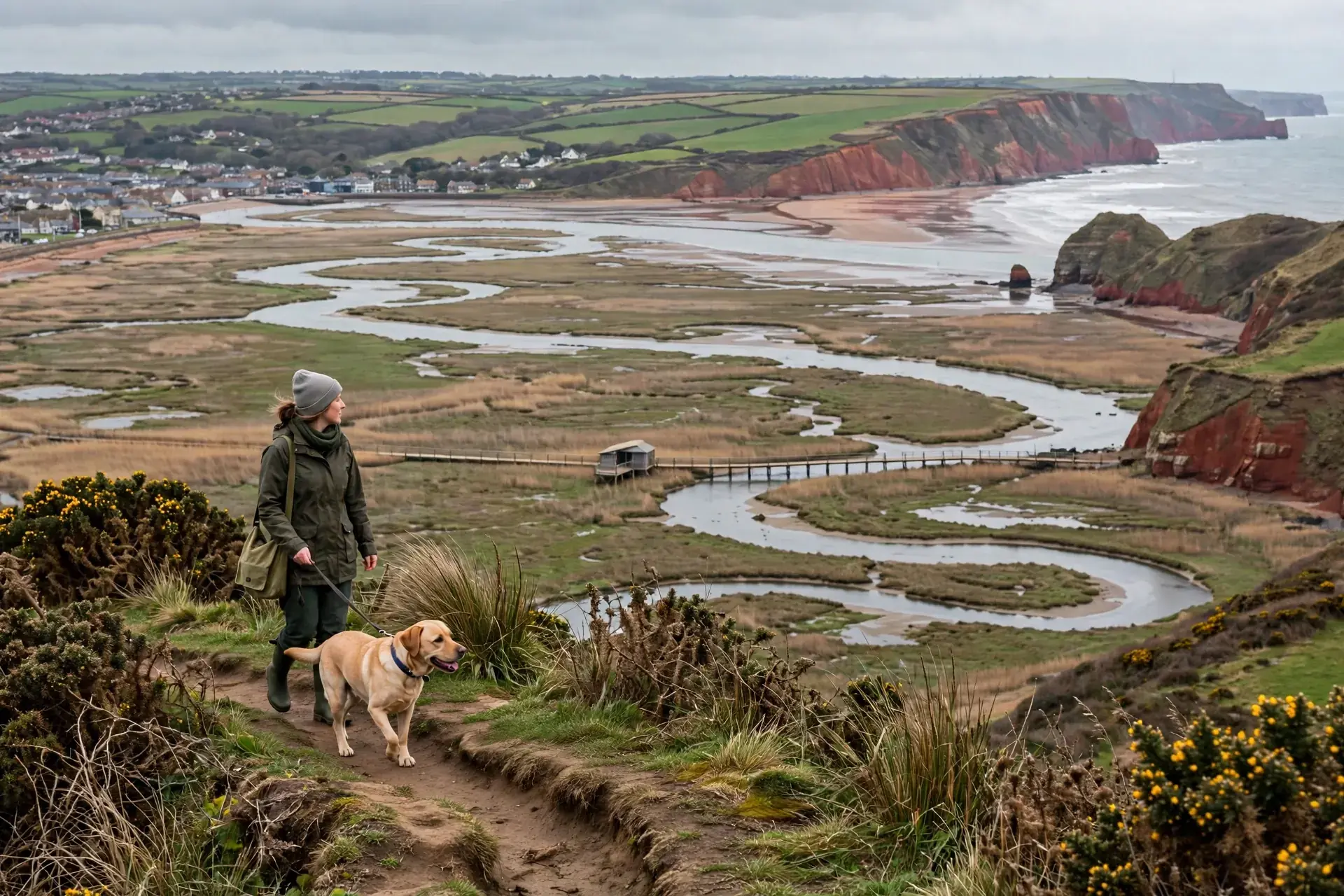
Seaton Wetlands is the walk to do first, especially if your dog is older, recovering from an injury, or simply not a hill dog. The reserve runs along the River Axe between Seaton and Colyford, and its paths are flat, mostly surfaced, and easy underfoot. The landscape is reedbeds, grazing marsh, ditches and shallow pools known as scrapes, with bird hides dotted along the route and boardwalks crossing the wettest ground. In spring and summer the reedbeds are full of warblers, and on the open water you can expect herons, little egrets, ducks and waders; in winter the estuary brings in wildfowl in large numbers. It is a birdwatcher's reserve first and a dog walk second, and that order of priorities shapes the rules.
Dogs must stay on a lead throughout the reserve, and the reason is practical rather than bureaucratic. The scrapes and ditches hold ground-nesting birds in the breeding season, and water voles live in the banks; a dog running through the reeds can do real damage in seconds, and a dog in the water disturbs birds across the whole pool. Keep your dog on a short lead near the hides, where a barking dog will clear the birds before anyone has seen them, and keep your dog out of the ditches, which look shallow but have steep, muddy sides that are hard for a dog to climb out of. If your dog is a keen swimmer, the wetlands are not the place to let them practise — the estuary and the beach are the water for that, under the rules that apply there.
The main circuit starts at the wetlands car park and runs out along the estuary, past the first hides and boardwalks, and back along a parallel path. The full loop is a comfortable hour at a dog-walking pace, but the honest advice is to treat it as an out-and-back walk rather than a circuit you must complete. Walk for twenty minutes, turn at the second hide, and you have had the best of the reserve without tiring a stiff dog. There are benches at intervals, and the hides themselves are worth stopping at even if you are not a birder: they give you a roof, a seat and a view across the marsh, which is the closest thing to a rest stop the reserve offers.
What to bring matters more here than on a beach walk. There is almost no shade on the open marsh, so on a warm day bring water for the dog and a bowl, and walk early or late rather than at midday. The paths are surfaced but the edges are muddy after rain, so a dog that likes to explore the margins will come back with wet feet and legs; pack a towel in the car. In summer, check for ticks after a walk through the longer grass at the edges of the reserve, and in winter bring a drying coat if your dog gets cold standing still at the hides. The reserve is at its best in the first two hours after dawn, when the birds are active and the paths are quiet, and at that hour you will often have the place almost to yourself.
The wetlands also connect to the wider Axe valley. From the inland end of the reserve you can follow the river path towards Colyford, a small village with a pub and a level walk back along the estuary, and the tramway runs parallel to the reserve for much of its length, so a wetland walk and a tram ride combine naturally into one outing. If your dog is reactive to other dogs, go early: the paths are narrow in places, and the boardwalks give you nowhere to step aside, so a quiet morning is much easier than a busy afternoon. The reserve is managed for wildlife, and the signs at the entrances spell out the current rules — read them rather than relying on memory, because seasonal restrictions around nesting birds can change the advice from year to year.
Seaton Tramway with a dog
The Seaton Tramway is a narrow-gauge heritage tramway that runs for about three miles from Seaton seafront, along the estuary and through the wetlands, to the village of Colyton. The trams are open-sided in summer, which makes them a good way to see the estuary without walking it, and the ride takes about twenty-five minutes each way, passing reedbeds, grazing marsh and the river itself. For a dog owner, the tram solves a real problem: it lets a tired dog, an older dog or a dog that has already had a long morning see the estuary from a seat instead of on foot.
Dogs are generally welcome on the tramway, but the rules and any fare for a dog can change, so check the official guidance before you travel. Keep your dog on a short lead on the platform and in the carriage, and settle them on the floor between your feet rather than on a seat, especially on a busy service. Open-sided trams are breezy, which most dogs enjoy, but a small or nervous dog may prefer a seat further inside, away from the edge and the wind. If your dog barks at other dogs, choose a quieter departure — the first tram of the day and the last tram back are usually calmer than the midday services, and the staff can often advise on which departure is likely to be quietest.
Colyton, at the far end of the line, is a small village with a church, a handful of shops and places to eat, and a riverside walk that suits a short leg-stretch before the return tram. The station at Colyton has a cafe and a garden, and the walk from the station into the village is short and level. Plan the timing carefully: the tram runs to a timetable, and the last tram back to Seaton leaves earlier than many visitors expect, so check the departure board at Seaton station before you set off, and do not plan a long lunch in Colyton without knowing when the next tram leaves. If you miss the last tram, the walk back along the estuary path is flat but long for a tired dog, and there is no shortcut.
Practical details make the difference. Bring water for the dog, because the wait on the platform at Seaton can be hot in summer and there is little shade. Keep the lead short and the dog close while the tram is moving, and do not let the dog put its head out of the open side of the tram — passing vegetation and other trams make that a genuine risk. If your dog is large, the floor space in a carriage is limited, so travel outside peak hours when you can spread out. And if your dog is nervous about noise, remember that the tram bell and the sound of the tram on the track are part of the experience; a first ride is best done on a quiet day, with a familiar blanket or mat on the floor to settle on.
Seaton beach and the estuary
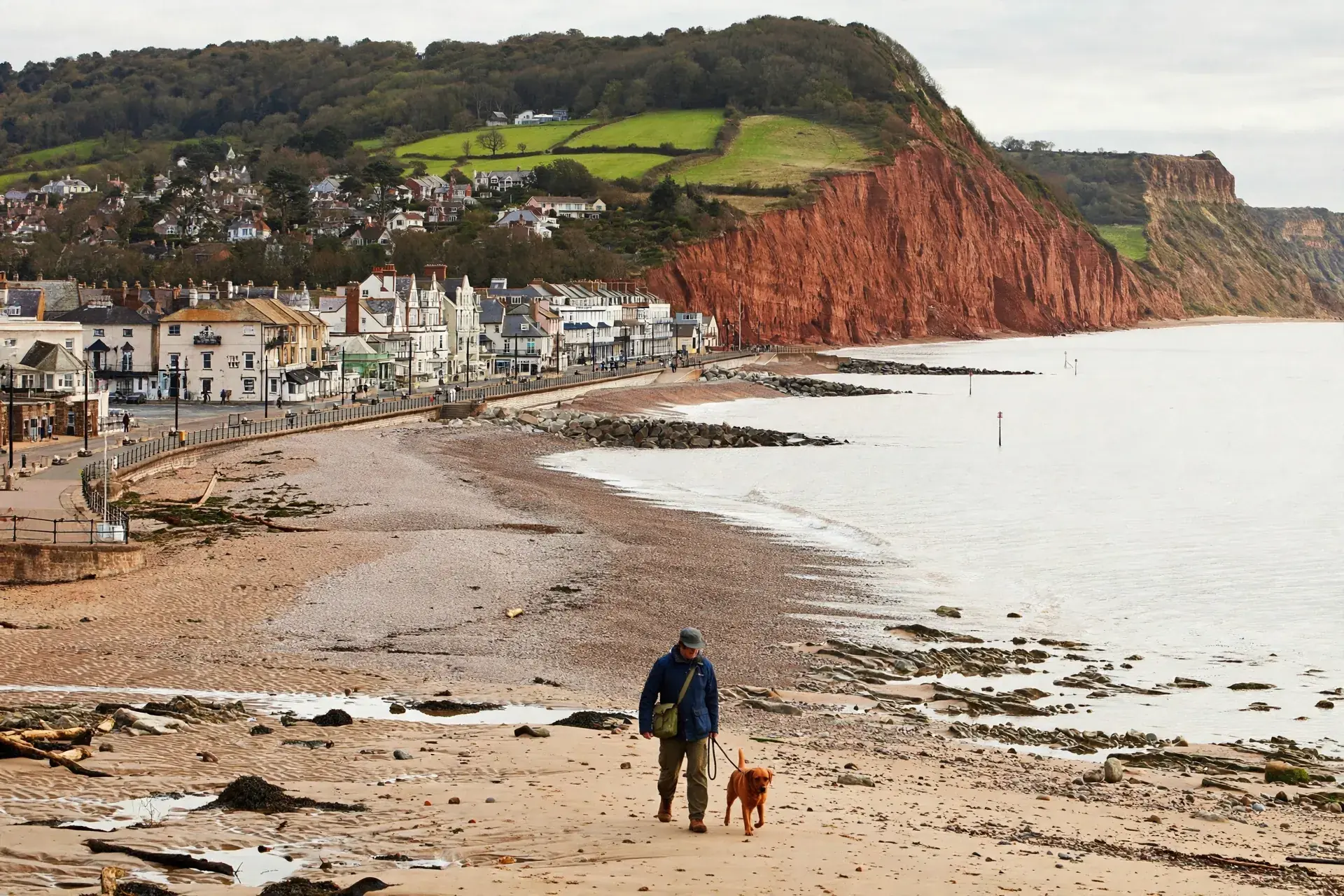
Seaton beach is a pebble beach, a long curve of shingle that runs from the harbour at Axmouth in the west to Seaton Hole in the east, backed by the esplanade and the town. It is not a sandy beach, and that changes the dog experience. Pebbles are hard on paws over a long walk, especially for a dog that is used to grass, and the beach shelves steeply into the sea, so the water deepens fast and the undertow can be strong. Dogs that love to charge into the sea need a lead and a watchful eye here, and dogs that swim should be kept close to the shore and away from the harbour entrance, where boats come and go.
Seasonal dog restrictions apply to parts of the beach during the summer months, and the restricted area and the dates change from year to year, so check the official guidance before you travel and read the signs at every beach entrance. In general, the rules are tightest on the main beach in front of the esplanade during the summer season, and looser at the quieter ends of the beach and outside the season. When in doubt, walk to the far end of the beach, keep the dog on a lead near other beach users, and pick up after your dog — the bins on the esplanade are emptied regularly in summer, but on a busy day they fill up fast, so carry a spare bag.
The best time for the beach with a dog is at low tide, when the sea draws back to reveal sand and rockpools near the harbour wall and at the eastern end by Seaton Hole. Low tide is also when the beach is widest, giving a nervous dog room to move away from other dogs and from children playing near the water. Check the tide times before you go, because the beach narrows quickly as the tide comes in, and at high tide there is very little dry beach at all in places. The estuary side of the beach, near the mouth of the Axe, is a different world from the open sea: calmer water, muddy edges and wading birds, and a place where a dog should stay on a lead to avoid disturbing the birds and getting stuck in the mud.
Rockpools and pebbles bring their own hazards. Sharp shells and broken glass hide among the stones, so check your dog's paws after a beach walk, and watch for fishing hooks and discarded line near the harbour, where anglers fish from the wall. In summer, the pebbles themselves get hot in the sun, and a dog that will happily walk on grass may refuse to cross a hot stretch of shingle — test the surface with your own hand before asking the dog to walk on it. Salt water is the other issue: a dog that drinks from the sea will be sick, so bring fresh water and a bowl, and rinse a dog that has been swimming before the drive home if you can.
The esplanade is the social side of the beach. It is level, wide and popular with walkers, runners and cyclists, so keep your dog on a short lead and to one side, and be ready for scooters and bikes coming up behind you. The esplanade is also where you will find the cafes and kiosks, and on a summer evening it is the natural place for a slow walk with the dog after the beach has emptied. If your dog is reactive, the esplanade is harder than the beach itself — the pavement is narrow, the dogs are close together, and there is nowhere to step aside — so walk on the beach at low tide instead, where space is free.
Cliff walks: Beer and the Undercliff
The South West Coast Path runs through Seaton in both directions, and the two directions could hardly be more different. East, towards Beer, the path climbs from the beach at Seaton Hole up onto the clifftop, with red sandstone cliffs below and the white chalk of Beer Head ahead. West, towards Lyme Regis, the path drops into the Undercliff, a landslipped wilderness of woodland and tumbled ground that is one of the wildest stretches of coast in southern England. Both are serious walks, and both need a lead, water and a realistic sense of your dog's fitness.
The walk east to Beer is the one most visitors choose, and for good reason. From Seaton Hole the path climbs steadily to the clifftop, then runs along the top with the sea on one side and fields on the other, passing above the beach huts and the chalk cliffs before dropping down into Beer. The distance is about two miles each way, and at a dog-walking pace with stops for the view, allow an hour and a half each way. The cliffs here are high and the path runs close to the edge in places, with no fence, so keep your dog on a lead for the whole clifftop section, and do not let a dog run ahead around a blind bend. In wet weather the chalk and clay underfoot become slippery, and in strong wind the clifftop is exposed, so check the forecast and the official guidance before you travel, and turn back if the path looks unsafe.
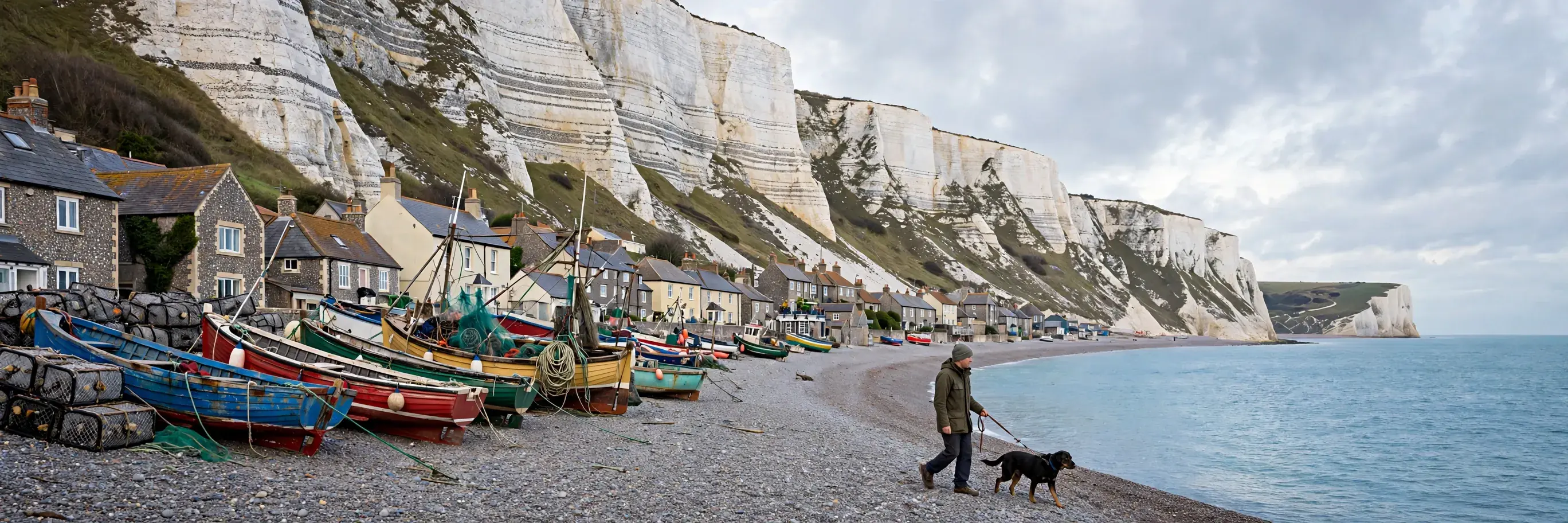
Beer itself is a fishing village with a pebble beach, a steep main street and a cliff-top car park, and it makes a natural turning point. There are places to eat and drink in the village, and the beach at Beer is a good place for a rest before the walk back, although the same seasonal dog rules that apply at Seaton apply here too, so check the signs. The walk back to Seaton is the same path in reverse, and it is worth remembering that the climb out of Beer is steeper than the climb out of Seaton, so a dog that was fresh on the way out may be tired on the way back. If that is a worry, walk to Beer, take the bus back to Seaton, and check the bus rules for dogs before you travel.
The walk west to Lyme Regis is a different proposition and should not be attempted lightly. The Undercliff National Nature Reserve is a landslipped landscape of dense woodland, fallen trees and uneven ground, and the path through it is rough, muddy and hard to follow in places. It is beautiful and it is wild, and it is also the wrong walk for an older dog, a small dog, or a dog that needs a clear path. The full walk to Lyme Regis is about seven miles and takes most of a day, with no easy exit point in the middle. If you want a taste of the Undercliff without committing to the full walk, walk out from Seaton for an hour and turn back at the first viewpoint, which gives you the woodland and the sense of wilderness without the long return.
On either coast path, the same rules apply. Carry more water than you think you need, because there is no fresh water on the clifftop and no shop between Seaton and Beer. Keep your dog on a lead near livestock, which graze the clifftop fields, and near the cliff edge at all times. Watch for adders on warm, sunny days on the clifftop grass, and keep your dog on the path rather than letting them nose through the bracken at the edge. And check the tide times if your route drops to the beach at either end, because the beach below the cliffs disappears at high tide and there is no safe way along the base of the cliffs.
Eating and drinking in town
Seaton's places to eat and drink are concentrated along the esplanade, the high street and the road to the tramway station, and the honest picture is that dog-friendliness varies from place to place and from season to season. The pattern that holds most often is that dogs are welcome on outdoor terraces and in the gardens, and welcome inside only in a few places and only by arrangement. That is not a criticism of Seaton — it is the pattern across most small seaside towns — but it means you should plan around the terrace rather than assuming you can take the dog inside.
The esplanade cafes and kiosks are the easiest option. They are set up for beach trade, with outdoor tables, a takeaway counter and a view of the sea, and a dog on a lead under the table is part of the normal scene. Order at the counter, take your food outside, and keep the dog on a short lead so it is not tripping up the staff carrying trays. On a busy summer day the terraces fill up fast, so go early for breakfast or late for a cream tea, when there is space to settle a dog without blocking the pavement. Bring a mat for the dog to lie on, because the paving is hot in summer and the dog will settle better on its own mat than on bare stone.
Pubs in Seaton and the surrounding villages are worth asking about rather than assuming. The usual arrangement is dogs welcome in the bar area and the garden, and not in the restaurant, with water bowls by the door and a biscuit behind the bar. Call ahead or check the pub's own website before you set off, because policies change with the season and with the landlord, and a pub that welcomed dogs last summer may have changed its rules. If you are walking the coast path to Beer or the valley to Colyford, the same advice applies: the pub at the end of the walk is the reward, but it is worth knowing before you arrive whether the dog can come in or will be waiting in the garden.
Takeaway food is the fallback that makes Seaton easy with a dog. Fish and chips, sandwiches and ice cream are all available to take away along the esplanade, and a takeaway eaten on a bench above the beach, with the dog beside you, is often a better meal than a formal lunch indoors. If you are staying in self-catering accommodation, the shops in the town centre cover the basics, and a picnic from the town is a good plan for a wetland or clifftop walk. Whatever you choose, keep food away from the dog's nose on a crowded terrace, and remember that a dropped chip on a busy esplanade is an invitation for a dog to lunge across a pavement full of people.
Where to stay with a dog
Seaton has the usual seaside mix of self-catering cottages, holiday flats, small hotels and caravan and camping sites, and the dog rules differ more between properties than between types of accommodation. The single most useful question to ask before booking is whether the specific room, flat or cottage you are booking accepts dogs, because a property that is described as dog-friendly may only accept dogs in some of its units. Get the answer in writing, with the pet fee itemised, and confirm the number of dogs allowed, because a two-dog household can find that only one dog is welcome.
Location matters as much as the rules. A flat on the esplanade is convenient for the beach but noisy in summer, and a dog that barks at passers-by will struggle with the foot traffic outside the window. A cottage inland, towards Colyford or the Axe valley, is quieter and closer to the wetland paths, but further from the beach. A site on the edge of town, towards Beer or towards Axmouth, gives you a quiet garden and a short walk to the coast path, but you will drive for shops. Match the location to the dog: a nervous dog wants quiet and a garden, a sociable dog wants the esplanade, and an older dog wants level ground and a short walk to a toilet spot.
Ask about the practical details that booking sites rarely mention. Is there a secure garden or a fenced area where the dog can be off the lead? Where is the nearest place for a last walk at night, and is it lit? Is there a hose or an outdoor tap for washing sandy paws, and is there somewhere to dry a wet dog without using the bath? Are dogs allowed to be left alone in the property, and if so, for how long and under what conditions? A property that answers these questions clearly has thought about dogs; a property that answers with a single line about a pet fee has not, and the difference will show on the first evening.
If you are staying for a week, consider the rhythm of the place. Seaton is quiet on weekdays outside the school holidays, and the beach and the wetlands are at their best then. A Saturday changeover brings traffic and crowds, and the esplanade on a summer Saturday is a different town from the esplanade on a Tuesday in September. If you can choose, arrive on a weekday, walk the wetlands on your first morning while the dog is fresh, and save the tramway and the cliff walk for the middle of the stay, when you know how the dog is coping with the heat and the hills.
Practical dog care in Seaton
The practical side of a Seaton trip is mostly about water, paws and the weather. Bring more fresh water than you think you need, because the wetlands, the clifftop and the beach all have little shade and no reliable drinking water for dogs. A collapsible bowl weighs nothing and fits in a pocket, and a litre of water per dog per walk is a sensible minimum on a warm day. On the beach, rinse salt water off the dog's coat and paws before the drive home if you can, and check the paws for cuts from sharp pebbles and shells after every beach walk.
Seaton has a veterinary practice in the town, and the nearest out-of-hours cover is in the surrounding towns, so save the number of the local vet in your phone before you set off, and know where the nearest twenty-four-hour emergency vet is. That matters more on the coast path than in the town: a dog that cuts a paw on the chalk path between Seaton and Beer is a long way from help, and a dog that eats something on the beach needs a vet quickly. Keep the dog's vaccination and insurance details in your phone, and carry a basic first-aid kit with tweezers for ticks, a bandage and a muzzle for a dog in pain.
Ticks are the most common health issue on the East Devon coast. They live in the long grass at the edges of the wetlands, in the bracken on the clifftop and in the woodland of the Undercliff, and they are active from spring to autumn. Check your dog after every walk, paying attention to the ears, the armpits and the groin, and remove any tick promptly with a tick hook. Adders are present on the clifftop grass and in the Undercliff, and they are most often seen basking on warm, sunny days; keep your dog on the path and do not let them nose through dense bracken, and if a dog is bitten, keep it still and get to a vet immediately rather than trying to treat the bite yourself.
The weather on this coast changes fast, and the wind is the factor most visitors underestimate. A calm morning in Seaton can become a windy afternoon on the clifftop, and the wind chill on an exposed cliff in October is a different matter from the sheltered esplanade below. Pack a coat for a short-haired or older dog, and a drying coat for the drive home after a wet walk. In summer, the risk is the opposite: the sun on the pebbles, the lack of shade on the marsh, and the heat in a parked car. Never leave a dog in a car on a warm day, even for a few minutes, and walk early or late rather than at midday when the sun is strongest.
A one-day plan that works
A good Seaton day with a dog starts early and follows the light. Begin at the wetlands, arriving as the reserve opens to the day, and walk the flat paths for an hour while the birds are active and the paths are quiet. Take the short loop rather than the full circuit, stop at a hide, and let the dog sniff along the estuary edge. By the time you are back at the car, the town is waking up, and the esplanade cafes are opening for breakfast — a good moment for a coffee outside with the dog settled on its mat.
Mid-morning is the time for the tramway. Catch a tram from Seaton station, ride along the estuary to Colyton, and walk the short level loop around the village before the return tram. The ride is the restful part of the day for the dog, and the change of scene — river, village, garden — keeps the day interesting without adding miles to the dog's legs. If the dog is tired after the tram, skip the cliff walk and spend the afternoon on the beach instead; there is no rule that says a day must include a hill.
The afternoon belongs to the beach or the cliffs, depending on the tide and the dog. At low tide, walk the beach from the esplanade towards Seaton Hole, letting the dog paddle at the water's edge and explore the rockpools, and then walk back along the esplanade. If the tide is high and the dog is fit, take the clifftop path towards Beer for an hour and turn back at the first viewpoint, which gives you the cliff-top views without committing to the full walk to Beer. Either way, finish with a slow walk along the esplanade as the beach empties, and a takeaway supper eaten on a bench above the sea.
That plan works because it respects the dog's energy across the day. The flat walk comes first, when the dog is fresh and the birds are out. The tram ride comes in the middle, when the dog needs a rest and the sun is strongest. The beach or the cliff comes last, when the light is best and the crowds have thinned. If the weather turns, the plan bends rather than breaks: a wet morning is a good time for the tram, a windy afternoon is a good time for the wetlands, and a hot day is a good time to do the beach early and spend the middle of the day in the shade. Seaton's variety is the point — when one walk does not suit the day, another one will.
For a longer stay, repeat the pattern with a different walk each day. Day two can be the full coast-path walk to Beer and back, or a bus ride to Beer and a walk back along the cliff. Day three can be inland, following the Axe valley towards Axminster with a dog, where the river walks and the market town give a different kind of day. Day four can be the Undercliff, walked out and back for an hour rather than all the way to Lyme Regis. And if the weather closes in, the tramway and the cafes of Seaton are a perfectly good wet-weather day on their own — the dog does not need a mountain to have a good holiday.
Seaton rewards the dog owner who plans around the dog in front of them rather than the postcard. The wetlands suit the old dog, the tram suits the tired dog, the beach suits the swimmer, and the cliffs suit the fit dog that still has energy at the end of the day. Pick the walk that fits the dog you have, check the seasonal rules before you travel, and let the town's small scale do the rest — everything is close, everything is walkable, and the next good walk is never far away.
Practical questions
Before you go
Can dogs go on the Seaton Tramway?
Dogs are generally welcome on the Seaton Tramway, but the rules and any fare for a dog can change, so check the official guidance before you travel. Keep your dog on a short lead on the platform and in the carriage, choose a quieter departure if your dog is nervous around crowds, and bring water for the wait at Colyton.
Are dogs allowed on Seaton beach all year?
Seaton beach is a pebble beach on the River Axe estuary, and seasonal dog restrictions apply to parts of it during the summer months. The restricted area and the dates change from year to year, so check the official guidance before you travel, look for the signs at the beach entrances, and keep your dog on a lead near the esplanade and the harbour.
Is the Seaton Wetlands walk suitable for older dogs?
Yes, much of Seaton Wetlands is flat, with level paths, boardwalks and bird hides that suit older dogs and dogs that tire quickly. Choose the short loop from the main car park, walk out and back rather than completing the full circuit, and carry water, because there is little shade on the open marsh. Avoid the site in very hot weather and after heavy rain, when the paths can be muddy.
Where can I walk from Seaton to Beer with a dog?
The South West Coast Path runs east from Seaton along the clifftop to Beer, passing Seaton Hole and Beer Head. It is a steady climb with exposed cliff edges, so keep your dog on a lead, carry water, and allow about an hour and a half each way at a dog-walking pace. In wet or windy weather the chalk and clay underfoot becomes slippery, so check the official guidance before you travel and turn back if the path looks unsafe.
Do I need to keep my dog on a lead at Seaton Wetlands?
Yes, keep your dog on a lead throughout Seaton Wetlands. The reserve protects ground-nesting birds, water voles and grazing livestock, and dogs off the lead can disturb wildlife and damage the reedbeds. Use a short lead near the hides and the boardwalks, and keep your dog out of the ditches and scrapes, which are shallow but steep-sided.
If the cliff walk to Beer has whetted your appetite for that village, our guide to Beer with a dog covers the pebble beach, the quarry caves and the chalk cliffs in detail, including where to eat and where to park.