This guide is independent and contains no paid placement. If affiliate links are added later, they will be clearly marked and will not change our editorial checks.
Lynmouth works best for dogs that enjoy short, varied walks rather than long open runs. Base yourself at the harbour, use the cliff railway instead of the steep climb, walk the river valleys on a lead, and keep your dog out of fast water after rain. Bring a towel, a lead you can shorten quickly, and a plan for wet weather.
Where two rivers meet the sea
Lynmouth is a village shaped by water. The East Lyn and the West Lyn both run down from Exmoor, through steep wooded valleys, and meet at the harbour before flowing out into the Bristol Channel. Stand on the harbour wall with your dog and you can watch the two rivers join in front of you: the East Lyn arriving from the wide valley to the east, the West Lyn dropping down the narrower gorge to the west, and the tide pushing back against both of them. It is a small place, and that is the point. Everything a dog owner needs — the harbour, the car park, the pubs, the start of the valley walks — sits within a few minutes of each other, so you can plan a day in short loops rather than one long march.
The rivers explain almost everything about walking here. The valley floors are shaded, damp and cool even on a warm day, which suits dogs that overheat, but the ground stays muddy long after rain and the paths are narrow, with tree roots, stone steps and the occasional low bridge. The water itself is the main hazard and the main attraction at the same time. On a dry summer day the East Lyn runs clear and shallow over flat rocks, and dogs love to paddle at the edges. After heavy rain on the moor the same river can turn brown, fast and loud within hours, and the crossing points that looked harmless in the morning can be dangerous by the afternoon. That is why this guide keeps coming back to the same rule: look at the river before you let your dog near it, and if it is running high, keep your dog on a lead and well back from the bank.
Lynmouth also carries a serious piece of history that is worth knowing before you walk the valleys. In August 1952, after days of heavy rain, a flood swept through the village, destroying buildings and taking lives. The rivers were re-channelled afterwards, and the flood memorials around the village are a reminder of how quickly Exmoor water can rise. You do not need to dwell on it, but it is a useful reason to take river levels seriously and to check the official guidance before you travel if there has been heavy rain. The village has rebuilt itself around the harbour, and the flood story is part of why the riverside paths, bridges and walls are built the way they are.
For a dog, the geography creates three very different kinds of walk in one small area. Down at the harbour the ground is flat, paved and busy, with boats, ropes, lobster pots and people coming and going. Up the valleys the walking is shaded and riverside, with water to paddle in and woodland smells at every step. And above the village, on the moor and the coast path, the walking opens out into wind, heather and long views. A good Lynmouth day uses all three, in that order: a gentle harbour loop to settle the dog, a river walk while the light is good, and a higher walk only if the dog still has energy and the weather is kind.
The harbour and the village on foot
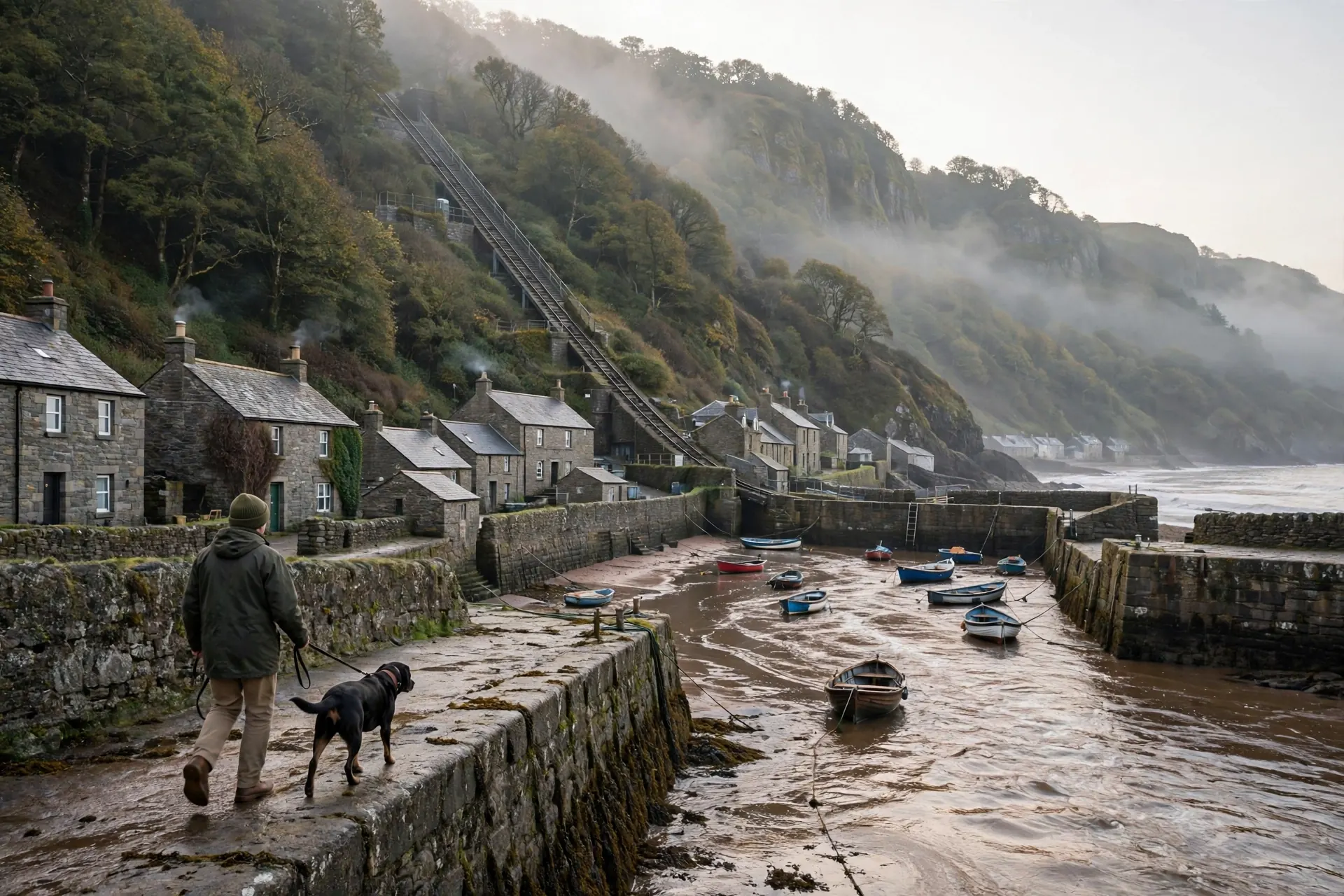
The harbour is the natural starting point for any walk, and it is also the place where a lead earns its keep. Lynmouth harbour is small and working: fishing boats, trip boats, mooring ropes, stacked pots and a stone quay with no railings in places. Dogs should be on a lead here, not because anyone will object to a well-behaved off-lead dog, but because the edge of the quay drops straight into the harbour, the ropes and chains are trip hazards, and a dog that jumps in after a gull will find a steep stone wall and cold water. Walk the harbour wall slowly, let your dog sniff the ropes and the boats, and keep a short lead when other dogs pass, because the quay is narrow and there is nowhere to step aside.
From the harbour, the village spreads out in two directions. The main street runs back from the quay past the pubs, cafes and small shops, and it is a pleasant ten-minute wander rather than a shopping trip. The pavements are narrow in places and the road carries traffic down to the harbour, so keep your dog on the pavement side and watch for cars turning into the car park. The other direction is along the rivers: the East Lyn heads east past the car park and the playing field, and the West Lyn heads west towards the gorge and the road up to Lynton. Both riverbanks have short, flat stretches that work well as a first walk of the day or a last walk before bed, when you want somewhere easy and close to the car.
The village is compact enough that you can build a routine around it. Many dog owners use the same pattern: a harbour loop first thing, breakfast, a longer valley walk, then a late-afternoon wander back to the quay to watch the boats and the tide. The playing field by the East Lyn is a useful open space for a ball game or a recall practice, but it is not fenced, it sits close to the road and the river, and it is shared with families and picnics, so use a long line rather than letting a dog run free. If your dog is reactive, the harbour is busiest around late morning and mid-afternoon, when the cliff railway is running and day visitors arrive; early morning and early evening are noticeably quieter, and the light is better then too.
One more harbour detail matters for dogs: the ground. The quay and the village streets are stone and tarmac, which is fine for a short walk but hard on paws over a long day, especially for older dogs. The valley paths are softer underfoot but muddier. If your dog has sore paws or is recovering from a cut, alternate the two surfaces and rinse their paws after a muddy walk. There is no dedicated dog wash in the village that we can rely on, so bring your own towel and a bottle of clean water, and check the official guidance before you travel if you need a specific facility such as a tap or a dog shower at your accommodation.
The cliff railway and the climb to Lynton
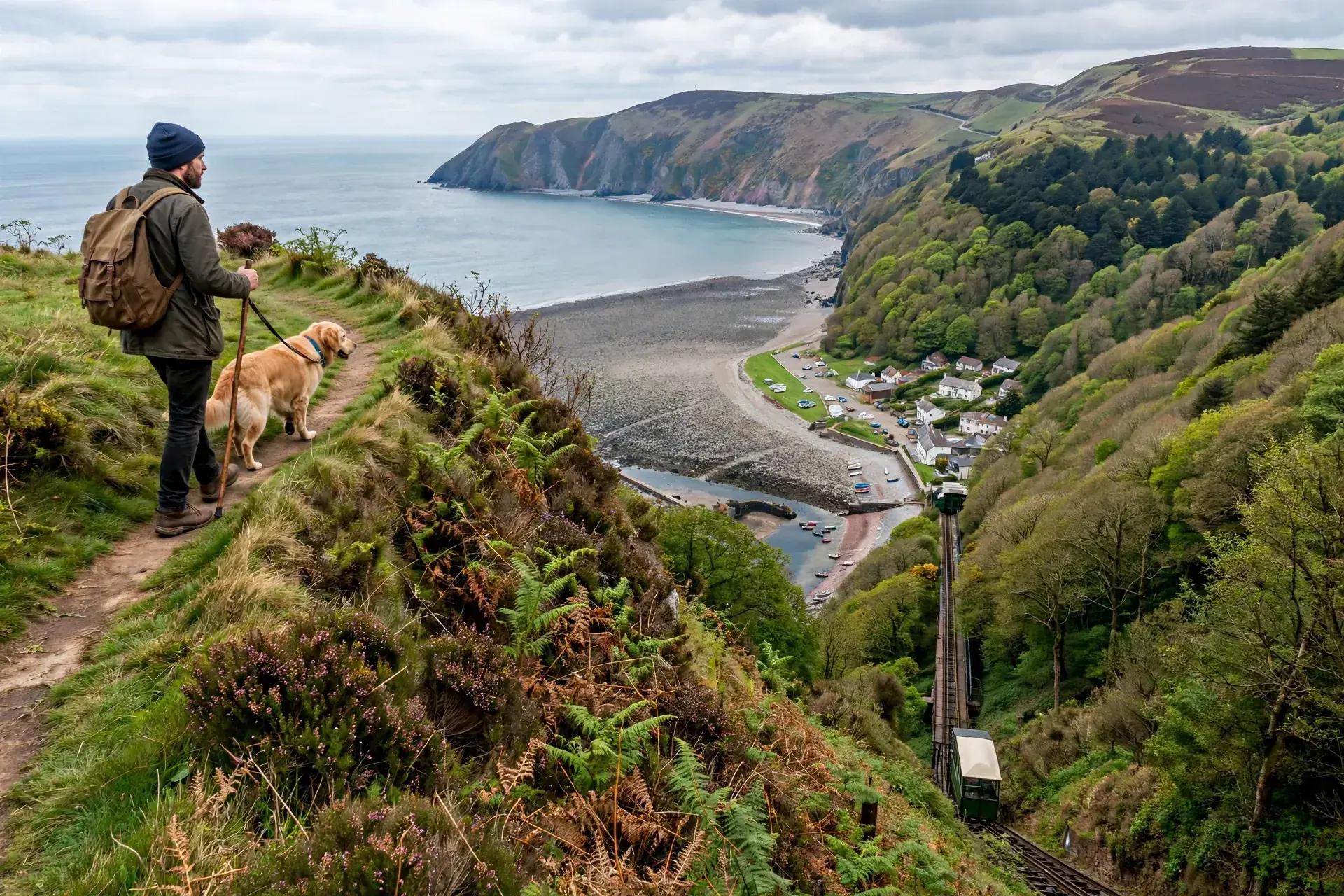
Above Lynmouth, on top of the cliffs, sits Lynton, the twin village. The two are joined by the Lynton and Lynmouth Cliff Railway, a water-powered funicular that has been running since 1890. Two cars are linked by a cable, and water tanks under the cars do the work: the car at the top fills its tank, grows heavier, and pulls the car at the bottom up the hill. It is a short ride, only a few minutes, but it climbs roughly 150 metres up a steep, wooded slope, and it is the easiest way for a dog owner to get between the two villages without tackling the hill on foot.
Dogs are generally welcome on the cliff railway, but this is one of those details you should confirm before you travel, because operating times, seasonal schedules and any dog rules can change. The cars are small and open-sided, with bench seating and a standing area, and the ride is steep enough that a nervous dog may not enjoy it. If your dog is calm and used to unusual transport, the railway is a treat: hold them on a short lead, keep them close to you, and sit or stand where you can brace them if the car jolts. If your dog is anxious, noise-sensitive or likely to try to jump, the walk is the better option, or you can drive the coast road between the villages instead. Never let a dog stand at the open edge of a car, and keep the lead short enough that it cannot tangle in the doors or the mechanism.
The alternative is to walk the hill. The direct paths between Lynmouth and Lynton are steep, stepped and demanding, and they are not a casual stroll for most dogs. The climb is roughly the height of a 50-storey building packed into a short distance, and the steps are uneven stone, often wet and slippery after rain. A fit, young dog will manage it happily; an older dog, a small dog, a brachycephalic breed or a dog with joint problems will struggle, and so will many owners. Take it slowly, stop often, carry water for both of you, and do not attempt the climb in the heat of the day. The gentler zig-zag paths take longer but are kinder on paws and knees, and they pass through woodland that gives shade and somewhere to rest.
Which village you sleep in changes the shape of the day. Staying in Lynmouth puts you beside the harbour, the rivers and the valley walks, with a flat start to every walk. Staying in Lynton puts you on top of the cliffs, close to the Valley of Rocks and the high moorland, but every walk back down to the river starts with a steep descent and ends with a steep climb. Many dog owners split the difference: they stay in Lynmouth, ride the railway up to Lynton for a morning on the high ground, and ride back down when the dog is tired. Our guide to Lynton with a dog covers the cliff-top village in detail, including the Valley of Rocks and the walks that start up there, so read the two guides together when you plan which village to base yourself in.
One practical note: the railway does not run all year round or all day, and it can close in bad weather or for maintenance. Check the official guidance before you travel, and have a plan for the day the railway is not running. The road between the villages is narrow and winding, and the walk is always there, but if your dog cannot manage the climb and the railway is closed, you will need the car. That is a small thing to plan for, and it avoids a tired dog and a long walk back up the hill at the end of the day.
River valley walks: Watersmeet and beyond
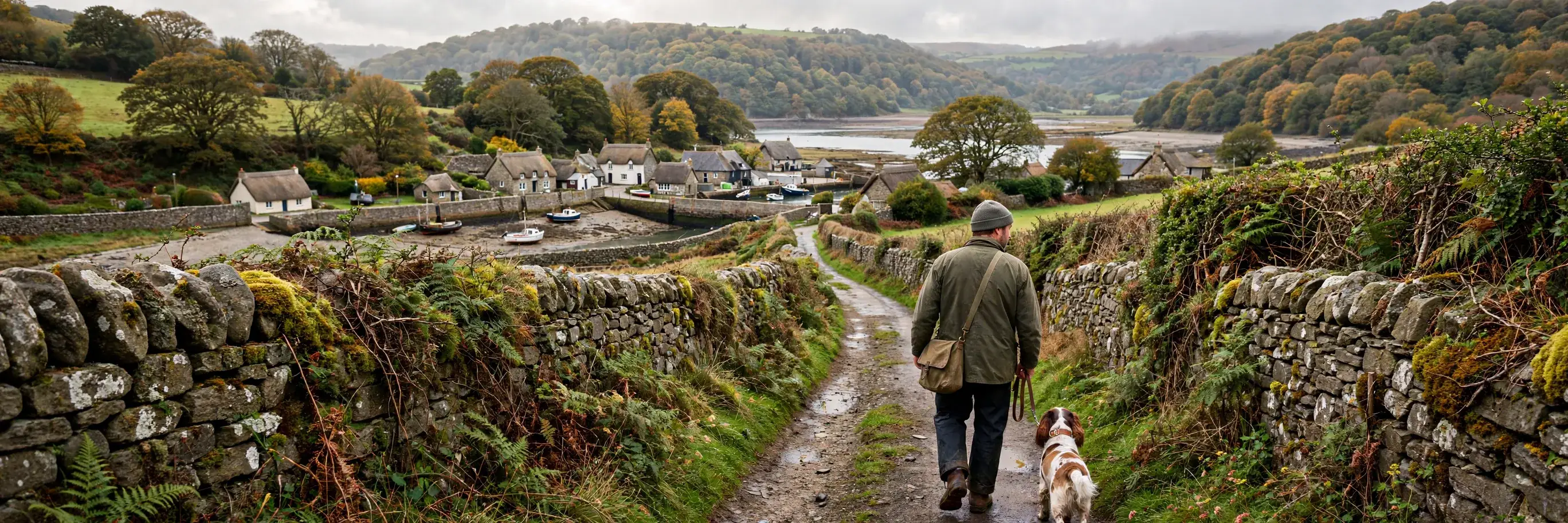
The best dog walking around Lynmouth follows the rivers inland, and the classic route is the East Lyn valley to Watersmeet. Watersmeet is the National Trust site where the East Lyn meets the Hoar Oak Water, about two miles upstream from Lynmouth, and the path there is one of the finest riverside walks in Devon. It follows the river through oak woodland, past flat rocks, small waterfalls and deep pools, with the water on one side and the wooded valley slope on the other. The path is mostly flat or gently rising, which makes it kinder than the cliff climb, but it is narrow, uneven and muddy in places, with stone steps, tree roots and sections where the path runs close to the water. Keep your dog on a lead for the narrow stretches and near the drops, and use a long line on the wider, flatter sections if your dog has good recall.
Allow two to three hours for the round trip to Watersmeet and back at a dog's pace, with stops for sniffing, paddling and a rest at the top. The tea room at Watersmeet is a natural turning point: dogs are welcome in the garden and the outdoor seating area, though indoor space is limited, so check the official guidance before you travel if you are planning to eat there. Bring water and a bowl even though the river is right beside the path, because river water is not always safe for dogs to drink, especially after rain when it carries silt and farm run-off. A collapsible bowl weighs nothing and saves you worrying about what your dog has just lapped up.
The West Lyn valley is the wilder of the two. The path up the West Lyn gorge is shorter, steeper and rougher, climbing through woodland beside a river that drops over rocks and small falls. It is a beautiful walk, but it suits confident walkers and sure-footed dogs better than the East Lyn route. The path can be slippery, the drops beside the river are more serious, and there are fewer places to turn back easily. If your dog pulls on the lead or is easily startled, keep them on a short lead the whole way, and do not let them scramble down the banks to the water. The gorge is also a good place to see dippers and grey wagtails working the river, and the sound of the water is loud enough that a dog that is nervous around noise may find it unsettling at first.
Beyond Watersmeet, the East Lyn valley continues upstream towards Brendon and the open moor, and the paths get quieter the further you go. This is where you can find the long, empty walks that Lynmouth itself cannot offer, but it is also where you need to be more self-sufficient: there are fewer places to buy water or food, mobile signal is patchy in the valleys, and the path can be rough underfoot. Carry a lead, water, a towel and a basic first-aid kit, and tell someone where you are going if you are walking alone. The valleys are also home to livestock in the fields beside the path, so keep your dog on a lead wherever sheep or cattle are grazing, and close every gate behind you.
Two details apply to every river walk here. First, the stepping stones and footbridges: some crossings are narrow, slippery or raised above the water, and a dog that is unsure of its footing may freeze or try to jump. Cross bridges one at a time, keep the lead short, and if your dog will not cross, turn back rather than dragging them. Second, the water itself: after heavy rain the rivers rise fast and the colour changes from clear to brown. That is your signal to stay out of the water entirely and to keep your dog on a lead well back from the bank. A dog that loves to swim in a calm pool in summer can be swept away by the same river in spate, and there is no safe way to rescue a dog from fast water.
Out onto Exmoor: moorland and the coast path
Lynmouth sits on the edge of Exmoor National Park, and the moor is the third kind of walking the village offers. From Lynton, the high ground opens out quickly: heather moorland, grassy ridges, and the South West Coast Path running east and west along the cliffs. The coast path east from Lynmouth climbs steeply out of the village and then follows the cliff tops towards Countisbury and beyond, with long views back over the bay and the harbour far below. The path west from Lynton runs towards the Valley of Rocks, a dry valley of strange rock formations where wild goats graze among the boulders. Both directions are spectacular, and both need respect: the coast path is narrow in places, the cliff edges are unfenced, and the wind can be strong enough to unsettle a small dog.
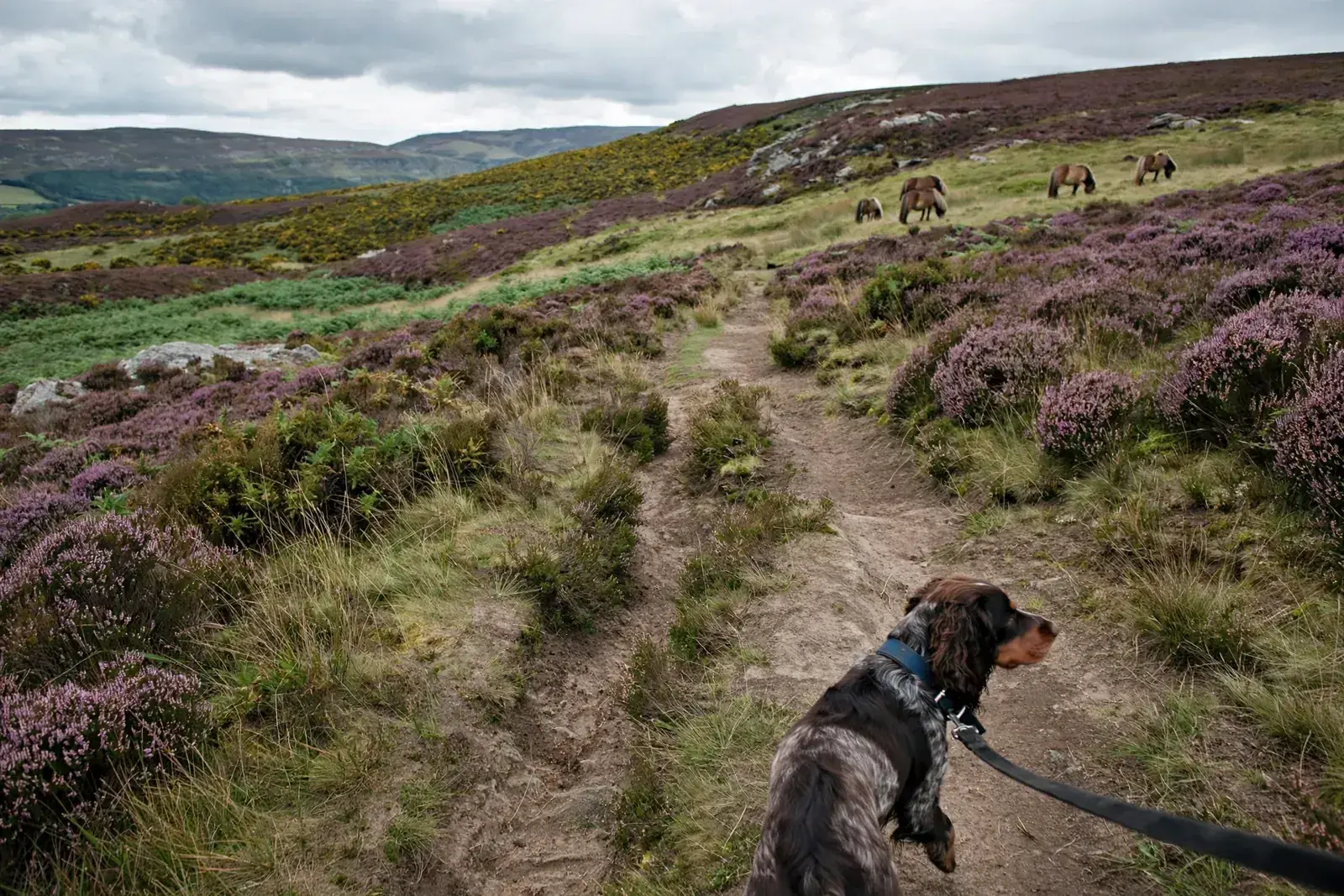
On the moor itself, the walking is open and exposed. There is little shade and little shelter, so on a hot day the sun beats down and on a wet day the wind drives the rain sideways. Dogs that love open running will be in their element, but they need to be under control. Exmoor is grazed by sheep, cattle and the famous Exmoor ponies, and it is home to red deer, the largest wild land animal in England. A dog that chases livestock can cause serious harm and can be shot by a farmer in the worst case, so the rule is simple and non-negotiable: keep your dog on a lead around livestock, ponies and deer, and keep them under close control even on open ground where animals may appear over a ridge without warning. Our Exmoor guide for dogs covers ponies, red deer, ticks and livestock rules in more detail, and it is worth reading before you head onto the moor.
Ticks are a real consideration on Exmoor, especially in the long grass and bracken from spring to autumn. Check your dog after every moorland walk, running your hands over their ears, neck, armpits and belly, and carry a tick remover. Use a vet-recommended tick treatment before you travel, and ask your vet about the timing if your dog is due a dose during the trip. Adder bites are rare but possible on sunny, rocky slopes, so keep your dog on the path in warm weather and away from basking spots on rocks. If your dog is bitten or stung and shows swelling, pain or unusual behaviour, contact a vet promptly rather than waiting to see if it settles.
The coast path deserves its own warning. The stretch between Lynmouth and Lynton, and the cliff-top paths in both directions, include steep drops, loose ground and sections where the path is only a metre wide. Keep your dog on a lead on the cliff sections, even if they are normally reliable off the lead, because a rabbit, a gull or a sudden gust can send a dog over the edge before you can react. If your dog is afraid of heights or unsteady on narrow paths, choose the valley walks instead and enjoy the coast from the harbour wall, where the views are just as good and the ground is flat.
Navigation matters on the moor. The paths are well marked on the coast and around the popular valleys, but on the open moor they can be faint, and mist can come down quickly. Carry a paper map or a downloaded offline map, because mobile signal is unreliable, and wear proper walking boots with ankle support. The ground is boggy in places even in summer, and a dog that runs ahead can find a deep bog or a hidden ditch. Walk the moor in the morning when the weather is settled, and save the valley walks for the afternoon if the cloud comes down.
Water, tides and the shore
Lynmouth does not have a sandy beach, and that surprises some visitors. The shore is steep shingle and pebbles, shelving quickly into the Bristol Channel, and the harbour sits at the mouth of two rivers. It is a dramatic place to walk a dog, but it is not a place to let a dog swim freely. The water is cold, the currents near the river mouths are strong, and the beach shelves so steeply that a dog can be out of its depth within a few steps. There is no lifeguard, and the tide comes in fast across the flat rock platforms at low water. Keep your dog on a lead near the water's edge, watch the tide times, and never let a dog chase a ball into the sea.
The safest water for dogs around Lynmouth is the river, not the sea. Upstream on the East Lyn, away from the harbour and the fast water, there are shallow, slow stretches where a dog can paddle and cool off on a warm day. Choose a spot where the water is clear, the current is gentle, and the bank is easy to get in and out of. Avoid the weirs, the harbour mouth, and any stretch where the water is brown or fast after rain. Even in a calm pool, keep an eye on your dog: river water can hide deep holes, broken glass and fishing tackle, and a dog that drinks from a river after rain can pick up stomach upsets. Rinse your dog with clean water after a river paddle if you can, and dry their ears, because damp ears are a common cause of ear infections in spaniels and other long-eared breeds.
Tides matter at Lynmouth because the harbour dries out at low water and the river channels shift. At low tide the harbour is a muddy basin with boats sitting on the sand, and the river runs in a narrow channel through the mud. Dogs love the mud and the smells, but the mud can be deep and sticky, and there may be sharp shells, broken pottery and old metal in it. Keep your dog on a lead on the harbour mud, and do not let them eat anything they find. At high tide the water comes right up to the harbour wall, and the quay can be slippery with weed and spray. Check the tide times before you plan a shore walk, and check the official guidance before you travel if you are unsure whether a particular stretch is safe at the time you want to walk it.
Blue-green algae is a risk in slow, warm, standing water, and it can be fatal to dogs. It is more common in lakes and ponds than in a fast-flowing river, but it is worth knowing the signs: a green or blue-green scum on the surface, a pea-soup colour, or a musty smell. If you see it, keep your dog out of the water and away from the bank, and do not let them drink from it. If your dog has been in water you suspect is affected and shows vomiting, diarrhoea, weakness or seizures, contact a vet immediately and tell them what the dog may have been exposed to. This is rare around Lynmouth, but it is the kind of thing that is worth knowing before you need it.
After any water walk, check your dog's paws. Shingle and pebbles can cut pads, and the salt water can dry and crack them. Rinse with fresh water, check between the toes for small stones, and apply a paw balm if your dog's pads are sore. A dog that is limping after a beach walk may have a cut you cannot see, so look closely before the next walk. Carry a spare lead and a towel in the car, because a wet, muddy dog in a car is a familiar Lynmouth problem, and a towel on the seat saves a lot of cleaning later.
Eating and drinking with your dog
Lynmouth is a small village, and its food and drink is concentrated in a handful of pubs, cafes and tea rooms around the harbour and the main street. Several of them welcome dogs, often in a bar area or on a terrace, but the details vary from place to place and can change with the season, so ask before you settle in rather than assuming. A pub that welcomes dogs in the bar in winter may restrict them to the garden in summer, when the terrace is busy, and a cafe that welcomes dogs on a quiet weekday may not have room for them on a crowded Saturday. The polite approach is to ask at the door, keep your dog on a lead and under the table, and bring a mat for them to lie on so they are not sprawled across a walkway.
Come prepared, because not every venue keeps dog bowls behind the bar. Carry a collapsible water bowl and a bottle of water, a few treats, and a chew or a stuffed Kong to keep a restless dog occupied while you eat. A tired dog is a good pub dog, so plan your meal for after a walk rather than before one, and choose a table near the door if your dog needs to pop out. If your dog barks at other dogs or at people passing the table, choose a quiet corner or a table outside, and keep the visit short. A dog that is stressed in a busy pub will not enjoy it, and neither will you.
For supplies, Lynmouth has small shops for the basics, but it does not have a large supermarket. If your dog eats a particular food, bring enough for the whole trip rather than hoping to find it locally. The nearest larger shops are in the surrounding towns, and a trip to buy dog food is a drive you do not want to make on a rainy evening. Pack a few extra days of food in case you decide to stay longer, and bring any medication your dog needs, with the prescription details in case you need a local vet to help. A small bag of your dog's usual treats is worth more than a new toy when you are trying to settle them in an unfamiliar pub.
Picnics are a good option in Lynmouth. Buy sandwiches and cake from a cafe, find a bench above the harbour or a flat rock beside the river, and eat with your dog beside you. The playing field and the riverside benches are good picnic spots, and the coast path above the village has viewpoints where you can sit and look back over the harbour. Take your rubbish with you, keep your dog on a lead while you eat, and do not leave food where another dog can grab it. If you are picnicking on the moor, remember that livestock may be nearby, so keep your dog close and do not let them wander off to investigate the sheep.
Staying overnight with a dog
Lynmouth has a mix of small hotels, guest houses, bed and breakfasts and self-catering cottages, and many of them accept dogs, but the details matter more than the headline. A hotel that accepts dogs may only accept them in certain rooms, may charge a fee per night, and may not allow them to be left alone in the room. A cottage that accepts dogs may have a garden that is not fenced, or a limit of one or two dogs, or a rule about dogs on the furniture. Ask for the written dog policy before you book, and get the fee, the room type and any restrictions confirmed by email. The cheapest room is not the best room if it is beside a busy road or up three flights of stairs with an older dog.
Think about the room itself from your dog's point of view. A ground-floor room with a door to the outside makes the last walk of the night and the first walk of the morning easy. A room with a hard floor is easier to clean than a carpeted one if your dog comes in wet from the river. A room with a view of the harbour may be lovely for you but noisy for a dog that watches every person and boat that passes. Bring your dog's own bed or blanket, so the room smells familiar, and bring a towel for the door so you can dry muddy paws before they reach the bed. If your dog sleeps in a crate at home, bring it: a familiar crate in an unfamiliar room helps a dog settle faster than anything else.
Self-catering is often the easiest option for dog owners in Lynmouth. A cottage gives you a kitchen, a garden or a yard, and the freedom to come and go without worrying about other guests. Check the garden before you let your dog off the lead in it: look for gaps in the fence, low walls, gates that do not latch, and neighbouring gardens with cats or other dogs. Ask the owner whether the garden is fully enclosed, and if it is not, use a long line. Also check where you can walk the dog at night. A cottage on a dark lane with no pavement is a different proposition at 11pm than a cottage beside the harbour, so ask about lighting and the nearest flat, safe toilet walk before you book.
Whatever you book, tell the host about your dog honestly. Mention the breed, the size, the age, and any behaviour that matters, such as barking when left alone or a tendency to chase cats. A host who knows what to expect can put you in the right room and warn you about the neighbour's cat; a host who finds out on arrival may not be so understanding. If your dog cannot be left alone, plan your days around that: choose places to eat where the dog can come too, and do not book a meal or an attraction that means leaving the dog in the room. A dog that barks in an unfamiliar room can disturb a whole guest house, and a host who has to deal with complaints is unlikely to welcome you back.
Practical planning: parking, vets and weather
Parking in Lynmouth is straightforward but limited. The main car park sits beside the East Lyn, a short walk from the harbour, and it fills up on fine weekends and during school holidays. Arrive early if you can, especially if you need a space close to the car for an older dog or for unloading. The car park is pay and display, so bring coins or check whether card payment is available before you arrive, and check the official guidance before you travel for current charges and any seasonal changes. Do not leave your dog in the car, even for a few minutes: a car parked in the sun by the harbour heats up fast, and a car parked in the shade by the river can still be too warm on a mild day. If you need to pop into a shop, take the dog with you or leave one person with the dog.
Getting to Lynmouth takes planning, because the village sits at the bottom of steep, narrow roads. The A39 coast road from the east and the roads down from Lynton are winding and single-track in places, with sharp bends and limited passing places. Drive slowly, expect oncoming traffic around blind corners, and allow extra time. If your dog is a nervous traveller, the winding roads can make them car sick, so give them a light meal before you travel, keep the car cool and ventilated, and stop for a break on the way. There is no train station in Lynmouth, and the bus services are limited, so most visitors arrive by car. If you are travelling by public transport, check the official guidance before you travel, because bus times and dog policies on local services can change.
Know where the nearest vet is before you need one. The closest practices are in the surrounding towns, and the drive can take twenty minutes or more on winding roads, longer in summer traffic. Save the number in your phone before you arrive, and note the opening hours and the out-of-hours emergency number. Bring your dog's vaccination record and any medication, and if your dog has a condition that might flare up — epilepsy, a heart problem, a recent injury — tell the vet practice when you arrive so they know you are in the area. A dog that cuts a paw on the shingle or eats something on the harbour will need help faster than you think, and a phone number saved in advance is worth more than a frantic search in the car park.
Weather is the last piece of practical planning, and it matters more in Lynmouth than in most places. Exmoor weather changes fast: a clear morning can turn into a wet, windy afternoon, and the valleys can be several degrees cooler than the coast. Pack for rain even if the forecast is good, and bring a waterproof coat for yourself and a drying coat for your dog. Check the forecast the night before and again in the morning, and have a wet-weather plan that does not depend on the sun: a short harbour walk, a drive to a covered attraction, a long lunch in a dog-friendly pub, and an early night. The valleys are beautiful in the rain, with the rivers running high and the woodland smelling of wet earth, but they are also slippery and muddy, so wear boots with a good grip and keep your dog on a lead on the narrow sections.
Finally, pack for the village you are actually visiting, not the holiday you imagined. Lynmouth is steep, wet, muddy and wonderful, and the dogs that enjoy it most are the ones whose owners packed a towel, a spare lead, a torch for the late walk, a tick remover, water and a bowl, and a little patience. The village rewards slow days and short walks, and it punishes anyone who tries to fit too much into a single afternoon. Arrive, walk the harbour, watch the rivers meet the sea, and let the dog set the pace.
A dog-shaped day in Lynmouth
A good day in Lynmouth starts early. Walk the harbour before the day visitors arrive, when the quay is quiet, the fishing boats are still, and the light is soft on the cliffs. Let your dog sniff the ropes and the lobster pots, watch the gulls, and do a slow loop along the East Lyn to the playing field and back. This is a settling walk, not an exercise walk: twenty minutes, on a lead, with plenty of sniffing, and then breakfast. A dog that has had a calm first walk will settle better for the rest of the day than a dog that has been rushed straight into a long hike.
After breakfast, take the valley walk. The East Lyn to Watersmeet is the obvious choice, and it is obvious for a reason: the path is beautiful, the river is beside you the whole way, and the tea room at the top gives you a reason to turn around. Walk at the dog's pace, stop for paddles in the shallow stretches, and carry water and a snack for both of you. If the weather is hot, start this walk early, because the valley is shaded but the climb back is still work, and a dog that overheats on the way up will need time to cool down. If the weather is wet, take the same walk but keep the dog on a lead on the muddy sections and be ready to turn back if the river rises.
In the afternoon, ride the cliff railway up to Lynton and explore the high ground. The Valley of Rocks is a short walk from the top station, and the views back down to Lynmouth are worth the ride alone. Keep your dog on a lead around the goats and the cliff edges, and choose a route that suits the dog's energy: a short loop around the Valley of Rocks if the dog is tired, or a longer stretch of the coast path if they still have energy. If the railway is not running, drive the coast road instead, or spend the afternoon in the village, wandering the shops and sitting on a harbour bench with a coffee while the dog watches the boats.
End the day the way you started it: a slow harbour loop, a last paddle in the river if the water is calm, and a meal in a dog-friendly pub with the dog asleep under the table. The last walk of the day should be short, flat and familiar, so the dog knows the routine and settles for the night. Lynmouth is at its best in the early morning and the early evening, when the day visitors have gone and the village belongs to the people who live there and the dogs that walk the harbour wall. That is the Lynmouth worth planning for.
If you have a second day, use it to go further afield. Head east along the coast path towards Countisbury, or drive to Porlock for a different kind of Exmoor village, with a tidal harbour at Porlock Weir and moor walks towards Dunkery Beacon. Both make good day trips from Lynmouth, and both are quieter than the village itself on a busy weekend. The point of a second day is not to see more, but to see the same place more slowly: a different valley, a different tide, a different light on the cliffs, and a dog that knows the harbour wall well enough to walk it like a local.
Practical questions
Before you go
Can dogs ride the Lynmouth cliff railway?
Dogs are generally welcome on the cliff railway, but the cars are small, open-sided and steep, so a nervous dog may prefer the walk. Keep your dog on a short lead, sit or stand where you can hold them securely, and check the official guidance before you travel, because operating times and any dog rules can change with the season.
Is Lynmouth beach dog-friendly all year?
Lynmouth's shore is a steep shingle beach beside a working harbour rather than a wide sandy bay, and it is usually open to dogs, but there is no lifeguard and the water shelves quickly. Keep your dog on a lead near the harbour mouth and the river channels, watch the tide, and check the official guidance before you travel for any seasonal restrictions.
How steep is the walk between Lynmouth and Lynton with a dog?
The climb from Lynmouth to Lynton rises roughly 150 metres over a short distance, and the direct paths are steep, stepped and hard work for older dogs, small dogs and anyone with sore knees. The cliff railway is the easy alternative, and the gentler zig-zag paths take longer but are kinder on paws and joints. Carry water and take the climb slowly in warm weather.
Where can my dog swim safely around Lynmouth?
The safest paddling is in the shallow, slow stretches of the rivers upstream, away from the harbour mouth, the weirs and fast water after rain. The sea at Lynmouth is cold, the beach shelves steeply and there are strong currents near the river mouths, so most dogs are better off with a river paddle than a sea swim. Never let a dog swim in spate water, and check the official guidance before you travel.
Are dogs welcome in Lynmouth pubs and cafes?
Several Lynmouth pubs and cafes welcome dogs, often in a bar area or on a terrace, but policies vary from place to place and can change with the season, so ask before you settle in. Bring a mat for your dog to lie on, keep them on a lead under the table, and carry water and a bowl, because not every venue keeps dog bowls behind the bar.
What should I do if the rivers are high after rain?
Stay out of the water and keep your dog well back from the banks. The East Lyn and West Lyn can rise very fast after heavy rain on Exmoor, turning shallow crossings into dangerous fast water, and riverside paths can flood or become slippery. Choose a higher route such as the coast path or the cliff railway, and check the official guidance before you travel.