This guide is independent and contains no paid placement. Venue dog rules change, so where this guide flags a check, please confirm the latest official information before you travel.
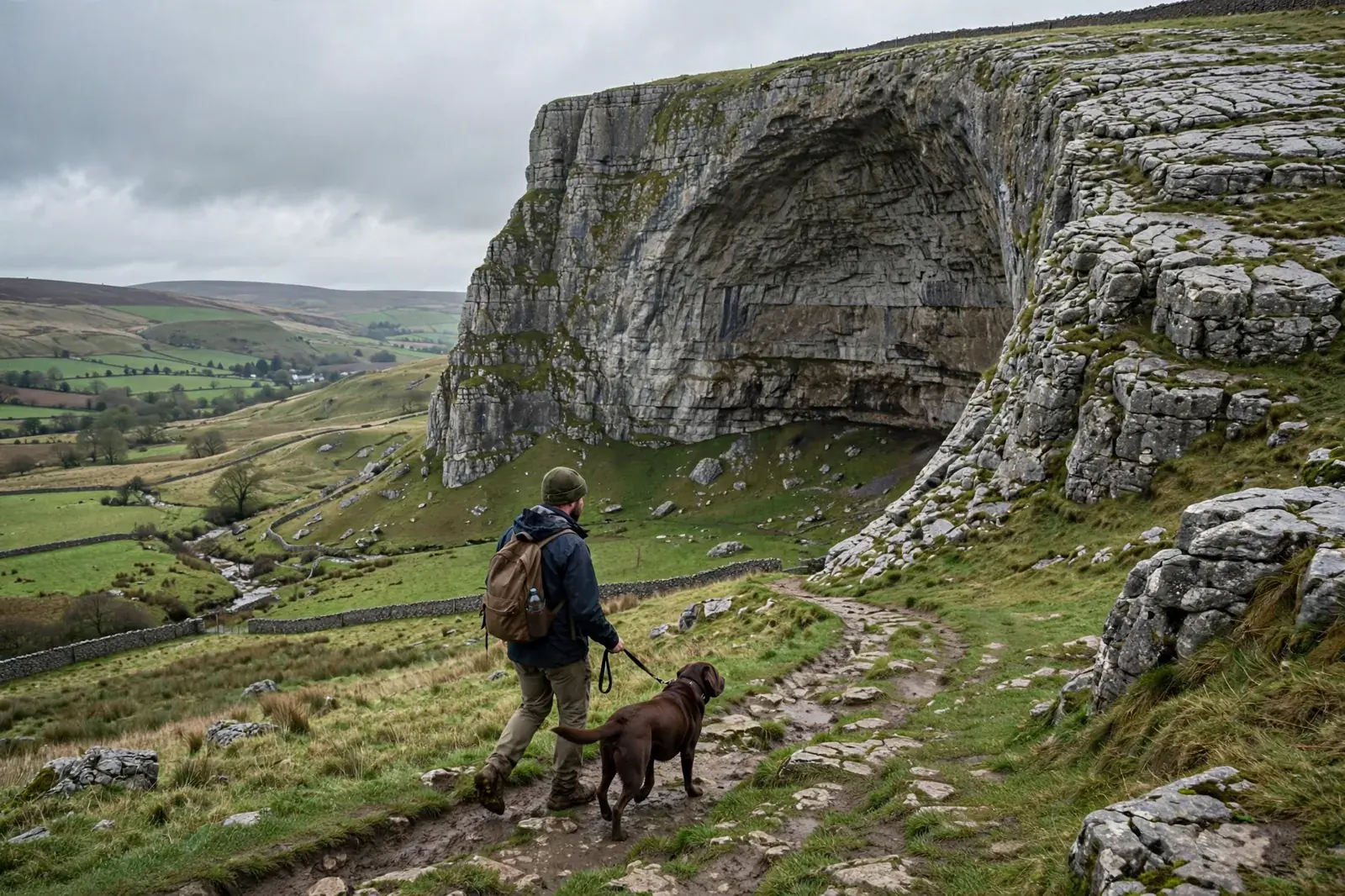
Malham rewards a cautious, lead-led day: walk the valley floor to the foot of Malham Cove, cross the limestone pavement slowly on a short lead or admire it from the edge, view Gordale Scar from below instead of scrambling up it with a dog, and keep Janet's Foss as a short, controlled stop rather than a swim. Sheep graze almost everywhere, so leads, closed gates and honest turn-back decisions matter more here than mileage.
Read the rock first: why Malham is different
Most dog-friendly villages ask you to manage crowds. Malham asks you to manage geology. The famous sights here — a towering curved cliff, a shattered limestone pavement, a deep gorge with a waterfall forcing its way through rock — are all natural, all spectacular and all capable of hurting an unmanaged dog in ways a market square never could. That is not a reason to stay away. It is a reason to plan Malham in the opposite order to most places: decide what the rock allows first, then fit the village, the food and the longer walk around those limits.
Think of the area as three linked bowls. At the centre is the village itself, small, stone-built and threaded by Malham Beck, with pubs, cafés, a visitor centre and the car park. North and east of the village the land rises into the classic circuit that most visitors come for: up the valley to the Cove, across or around the pavement on top, then east towards Gordale Scar and back down past Janet's Foss. South and west the walking softens into field paths and lanes towards Kirkby Malham and Airton, quieter ground that suits dogs who need space more than spectacle. A good day uses at least two of those bowls. A bad day tries to conquer all three before lunch with a young dog pulling towards every sheep.
Season changes the calculation sharply. In dry summer weather the limestone is grippy, the becks are low and the main hazard is heat on pale, shadeless rock. After prolonged rain the same limestone turns slick, Gordale Beck and Malham Beck run high and fast, field paths churn, and the waterfall routes need downgrading or dropping altogether. In winter, short daylight compresses everything: the full circuit that feels gentle in June becomes a race against dusk in December. Whatever the month, carry a paper map or a downloaded offline route, because signal is unreliable once you leave the village, and tell someone which circuit you are attempting if you are walking alone with your dog.
One habit will protect the whole visit: keep the lead in your hand, not in your pocket, for the entire classic circuit. There are short stretches where a well-trained dog under close control is acceptable, but sheep appear behind walls without warning, the pavement demands a lead, cliff edges demand a lead, and busy narrow paths demand a lead. Constantly clipping and unclipping teaches nobody anything. Malham is simpler, calmer and frankly more enjoyable as an on-lead walk from start to finish, with freedom saved for an enclosed garden or a stock-free field back at your base.
The Cove approach: the valley floor walk
The walk from the village to the foot of Malham Cove is the best introduction to the area and the most forgiving walk for dogs of almost any age. The path leaves the village alongside the beck, crosses grazing fields on clear tracks and brings the cliff into view gradually, so that by the time you stand beneath it the scale has had time to register. The Cove is a huge curved wall of white limestone, formed by ice-age meltwater, with a stream emerging from its base. Peregrine falcons nest on the cliff in season, and seasonal viewing arrangements and restrictions may apply, so follow any signs and keep dogs well back and on leads near the cliff base in spring and early summer — check the official latest guidance before you go.
Manage the fields on the way with care. The approach crosses working farmland where sheep, and sometimes cattle with calves, graze close to the path. Keep your dog on a short lead, walk calmly through rather than weaving around animals, and give any stock that has settled on the path a wide, quiet detour rather than pushing through the middle of the group. If cattle show more than mild curiosity, leave the field by the nearest gate and rejoin the route further on. No photograph of a cliff is worth a confrontation in a field, and farmers in this valley deal with thousands of visiting dogs every year — the ones they remember fondly are the ones they barely noticed.
At the cliff base itself, resist the urge to let your dog scramble over the boulders and fallen blocks for a better view. The rock is uneven, gaps are hidden, and other visitors cluster at the same viewpoints. Settle instead on the grass or the made path, give your dog water, and take the view in properly: the curve of the wall, the dark line of the pavement far above, and the beck slipping away towards the village. Puppies and older dogs can turn back here and have had a complete, satisfying outing. Fitter dogs continuing to the top face a very different proposition, which the next section covers honestly.
The climb to the top of the Cove follows a stepped path up the side of the cliff. The steps are stone, uneven in places and demanding for short legs, arthritic joints and any dog who lunges. Go up slowly, let faster walkers pass at wider points, and do not be carried by optimism: if your dog is struggling on the lower steps, the pavement above will be harder, not easier. Dogs who dislike heights or exposure sometimes freeze on stepped climbs, and carrying a medium or large dog down stone steps is a genuine injury risk for the human. Judge your own dog, not the cheerful collie who just trotted past.
On the limestone pavement: short lead, slow feet
The pavement on top of Malham Cove is the single most photographed surface in the Yorkshire Dales and the single most misunderstood dog surface in this guide. It is a broad platform of limestone blocks, called clints, split by deep fissures called grikes, weathered into a pattern that looks, from a distance, like a giant stone pavement waiting to be strolled across. Close up, the reality asserts itself: the fissures are ankle-deep to knee-deep, uneven and in places concealed by shadow, and the block tops vary in height and tilt. Humans in boots pick their way across it slowly. Dogs must do the same, or not cross at all.
The lead rule here is absolute in practice, whatever the legal minimum might be. Keep your dog on a short lead, close to your side, so that you choose the line and your dog cannot leap from block to block. A leap that lands short puts a leg into a grike, and a trapped, panicking dog can fracture a limb or injure its back before you can lift it clear. Walk at your dog's pace, not yours. Watch where your dog's feet are going rather than the view, save the view for the grass at the far side, and cross by the shortest sensible line instead of wandering across the full width for entertainment. Small dogs may cope better being carried across by a confident owner if they are used to being carried, but a wriggling small dog in arms above rock is its own risk, so decide based on your dog's temperament, not its size alone.
Know which dogs should not cross. Elderly dogs, dogs with hip, elbow or spinal problems, very young puppies whose joints are still developing, dogs recovering from injury and dogs who are visibly anxious on the rock should all admire the pavement from its edge and continue by the grassy paths that run alongside the Cove top. That is not a failed walk. The views from the top — down the valley towards the village, across to the scar country — are available without crossing the centre of the pavement, and a dog who arrives home sound has had the better day by every measure that matters.
Weather transforms the pavement more than any other surface here. Wet limestone is slippery limestone, and after rain, frost or ice the block tops offer poor grip for paws and boots alike. In those conditions, view the pavement, walk the edges and leave the crossing for a drier visit. In hot sun the pale rock reflects heat upwards, there is no shade and no water on top, so cross early in the day, carry water for your dog as well as yourself, and watch for the early signs of overheating: heavy panting, slowing down and seeking ground to lie on. The full legal picture behind lead use in sensitive country is covered in our guide to dogs on leads and the law in the UK, and Malham is one of the places where that law and simple physics point in exactly the same direction.
Gordale Scar: look, do not climb — the honest advice
Gordale Scar is a gorge of real drama: towering limestone walls closing in around a waterfall that tumbles through a cleft in the rock. The path into the lower gorge, following Gordale Beck from the Janet's Foss side or from the road, is a fine dog walk in its own right, atmospheric and mostly manageable on a lead, with care on wet stone and in narrow sections where passing other walkers takes patience. Stand in the lower gorge, feel how the temperature drops and the sound changes, look up at the falls, and you have experienced Gordale. For a dog owner, that should usually be the whole experience.
The route onwards and upwards, however, is a scramble directly beside the waterfall, over wet, polished rock, with climbing moves, exposure and nowhere sensible for a dog to put its feet. Some athletic dogs have been hauled or have scrambled up it, and you will occasionally see it done. This guide's position is plain: do not take your dog up the Gordale scramble. The combination of slippery rock, falling water, other climbers above and below, and a dog who cannot understand handholds creates a risk that is out of all proportion to the reward, and a slipped dog here falls onto rock, not grass. If a member of your party wants to climb the scar, split the party: one person climbs, the other stays below with the dog, and you rejoin by the longer route. Solo visitors with a dog should simply enjoy the gorge from below and take the alternative path described next.
The alternative is the longer, grassier route that climbs out of the valley away from the waterfall and crosses higher ground towards Malham Tarn or back towards the Cove top, depending on the circuit you are building. It is longer and less dramatic step by step, but it is honest walking: fields, tracks and open limestone country where a fit dog on a lead can settle into a rhythm. It also spreads visitors out, which matters, because Gordale on a sunny Saturday concentrates a remarkable number of people, dogs, picnics and selfie stops into a very narrow gorge. Go early, go on a weekday, or go in settled winter weather with proper footwear, and the scar country feels wilder and kinder. Whenever you go, check water levels first: after heavy rain Gordale Beck can make even the lower gorge approach impassable or dangerous, and the correct decision on those days is the village loop and a pub fire, not a negotiation with a flood.
Janet's Foss and Gordale Beck: a short stop, done well
Janet's Foss is the gentle counterpoint to the scar above it: a small, pretty waterfall dropping into a clear pool in a wooded glen on Gordale Beck, reached by a woodland path that is lovely in every season and magical after rain when the fall is full. The path in is narrow, often muddy and shared with a steady stream of visitors, many of them with dogs, so it is a short-lead, single-file, step-aside-and-wait kind of walk. That patience is part of the place's etiquette. Nobody's dog needs to reach the pool first.
At the pool, calibrate your expectations. On a quiet weekday morning your dog may be able to paddle at the shallow edge while you enjoy the glen. On a busy afternoon the pool surround is crowded with people sitting, swimming, photographing and picnicking, the banks are worn and slippery, and the kind thing — for your dog and for everyone else — is to look, let your dog sniff the woodland air, and walk on. Dogs shaking water over strangers' lunches and charging through a small pool where children are paddling are how dog access to pretty places gets restricted. If your dog needs a proper drink, offer your own carried water in a bowl rather than sending your dog into the beck among other visitors.
The woodland around the foss deserves its own slow ten minutes. In spring there are wild garlic and bluebells in the surrounding woods, in autumn the fungi and leaf colour are superb, and throughout the year the beckside path teaches young dogs valuable skills: walking past people on narrow paths, ignoring other dogs at close quarters, and settling while humans stand still and admire something. Train those skills here in short doses rather than demanding them for a full day. And take every scrap of litter and every poo bag back to the village bins. The glen has no bins of its own worth relying on, and bags left hanging on branches in a beauty spot are a particular disgrace that this valley, like every valley, can do without.
The village loop: beck, bridges and breathing space
Between the big geology, do not overlook the walk that will save your day at least once: the village loop. A gentle circuit following Malham Beck through and around the village, crossing its small stone bridges, passing the smithy area, the visitor centre and the church side of the settlement, gives dogs a low-stakes leg-stretch before breakfast, after dinner and whenever the hills are too wet, too hot or too crowded. It is also the right walk for arrival day, when your dog needs to learn the smells of a new base without also learning the limestone pavement.
Use the loop diagnostically. A dog who is wired, pulling and scanning on the village loop will not magically settle on the Cove circuit, so extend the loop, add sniffing time on the grassy areas away from traffic, and postpone the big walk by an hour. A dog who is stiff, slow or reluctant on the loop is telling you to shorten the day's ambition, and Malham is forgiving of shortened ambitions: the Cove approach alone, done slowly with café stops, fills a day for an older dog. Rescue dogs and nervous dogs often do best with two village loops and one short valley walk rather than one heroic circuit, and there is no prize board at the car park recording who did the full round.
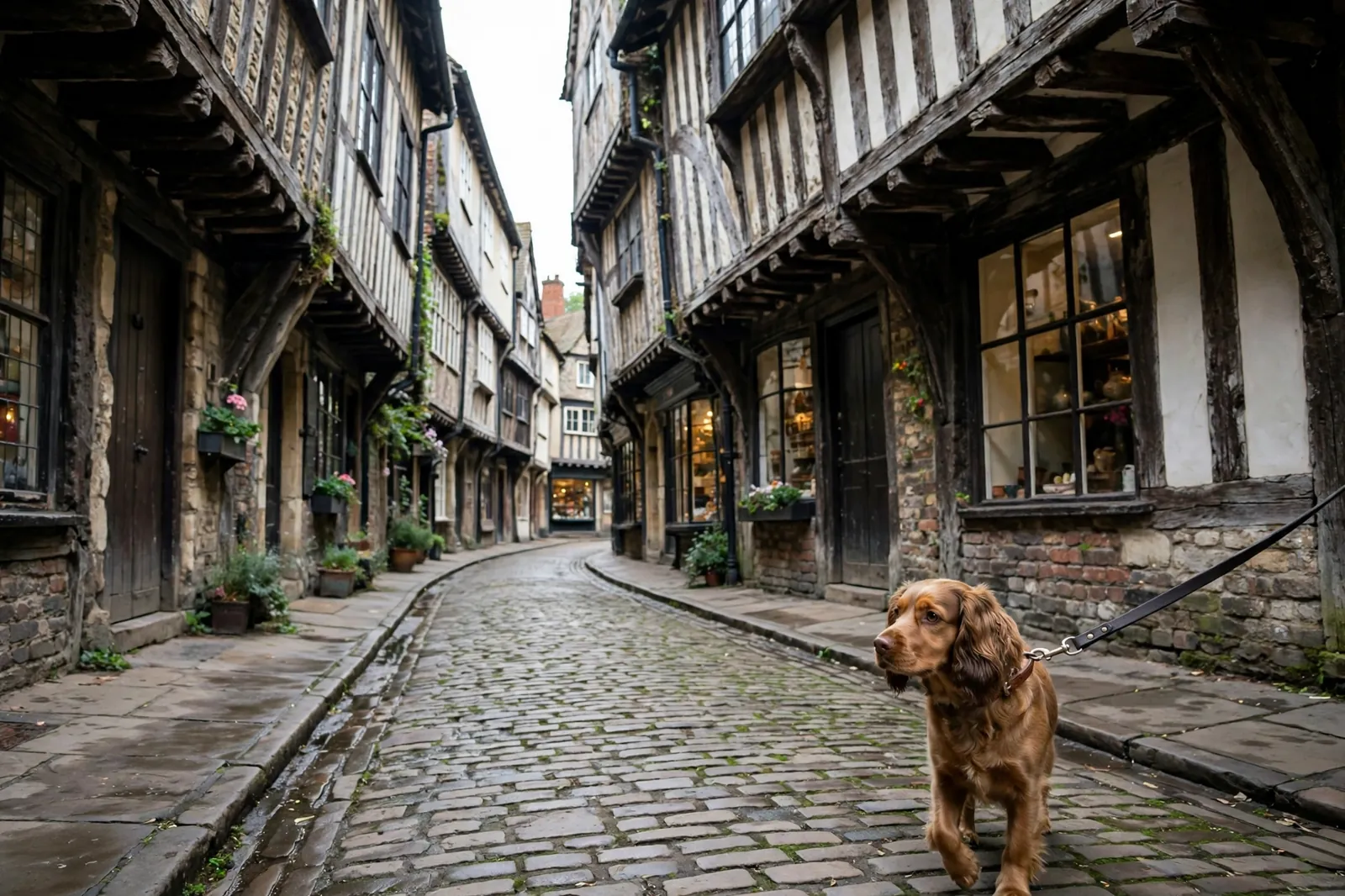
Practical village notes matter. The roads through Malham are narrow, largely without pavements, and busy with walkers, cyclists, farm vehicles and visitors looking for parking rather than at the road. Walk facing traffic where there is no pavement, keep your dog on the verge side, and use a short lead through the village even if your dog is normally trusted off lead at home. Bins are concentrated in the village and near the car park, so carry bags on every outing. If you are also planning a city day during the same Yorkshire trip, the contrast with York with a dog is instructive: York rewards early starts for crowds, Malham rewards early starts for weather and parking, and both punish anyone who leaves the dog in the car.
Stock, walls and stiles: working farmland rules
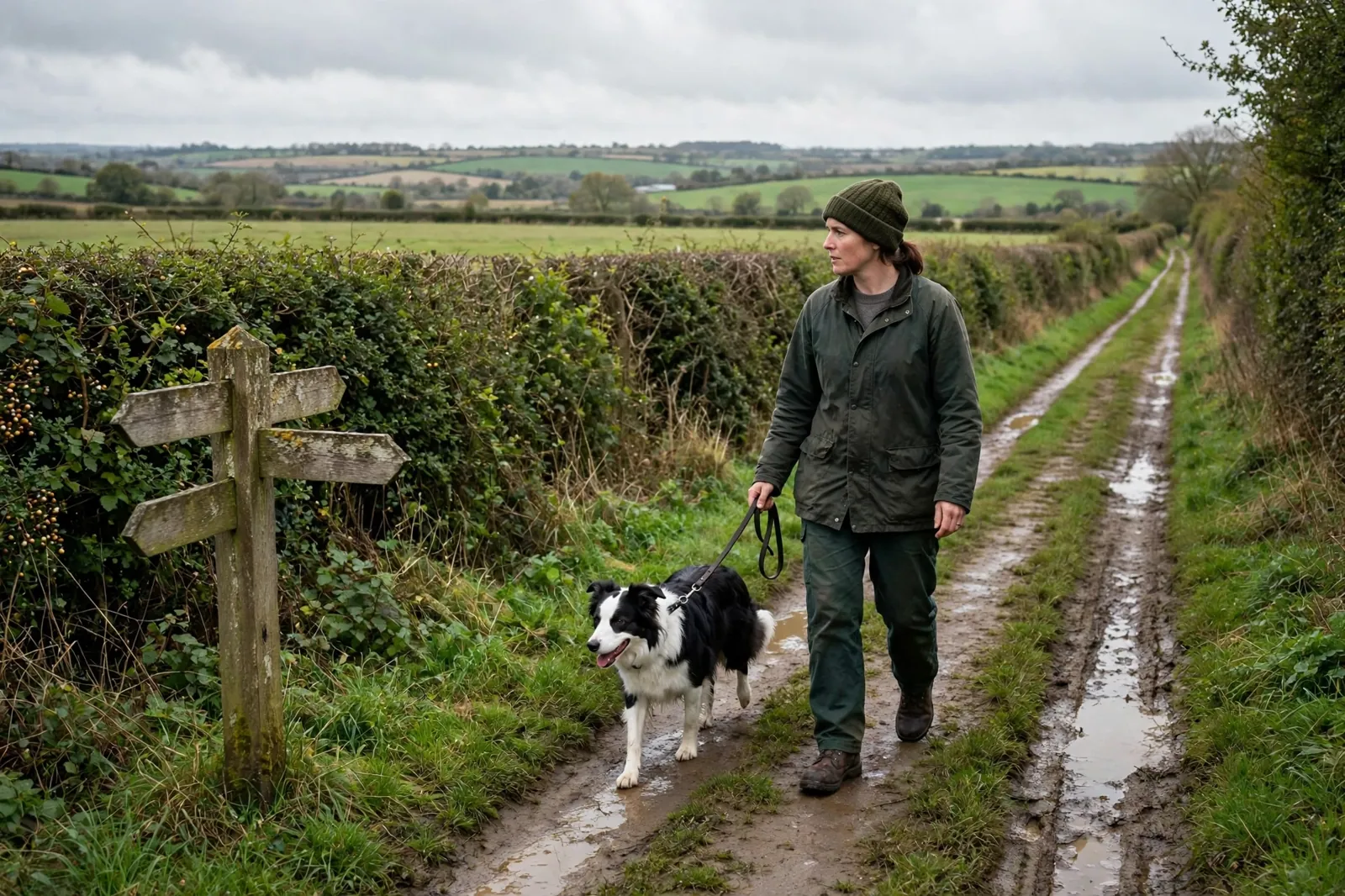
Malhamdale is not a park that happens to contain sheep. It is a farmed landscape that happens to contain famous scenery, and the distinction should govern every gate you open. Sheep graze the valley fields, the Cove approaches and much of the higher ground, cattle graze in rotation, and drystone walls divide everything into compartments, each with its own stock, its own gate logic and its own stile design. Our guide to dogs on leads and the law in the UK sets out the legal duties around livestock; Malham adds local texture to every one of them.
Stiles are the daily puzzle. Expect ladder stiles over walls, stone step stiles, gated gaps and the occasional stile with a dog gate beside it — and expect at least one on any longer route that your dog cannot or will not use. Before committing to a circuit, read a current route description and note the stile count honestly against your dog's size and agility. Lifting a muddy 30-kilogram dog over a ladder stile is a two-person job with injury potential; lifting a small dog is easy until it is the eighth stile and your arms are tired. Where a dog gate exists, use it and close it. Where none exists and the stile defeats you, turning back is a legitimate navigation decision, not a defeat.
Ground-nesting birds add a seasonal layer on the higher and rougher ground. Between early spring and late summer, birds such as curlew and lapwing nest on open ground in the wider dales, and signed requests or requirements to keep dogs on short leads in sensitive areas must be followed exactly. A dog ranging widely off the path in nesting season can destroy a nest without ever catching a bird. Keep to paths, keep the lead short where signed, and give displaying or alarm-calling birds a wide berth — the adults will tell you clearly when you are too close. Finally, close every gate, fasten it as you found it, and never climb walls where a gate or stile exists. A fallen wall costs a farmer days of skilled labour, and your dog going under a loose top stone helps nobody.
Food, rest and resetting a tired dog
Malham village supports its visitors well, with pubs, cafés and tearooms clustered near the centre and beck. Dog policies, as everywhere, belong to each business and change with ownership, season and how busy the day is: some welcome dogs throughout, some in a bar area or garden only, and some cannot admit dogs beyond assistance dogs. Ask at the door, accept the answer gracefully, and build your day so that a no costs you nothing — the village is small enough that another option is minutes away, and a takeaway eaten by the beck is a pleasure rather than a compromise in this setting.
Plan rest as deliberately as walking. The classic circuit is not long in miles, but between stone steps, pavement concentration and gorge paths it tires dogs — and humans — faster than the distance suggests. Build a genuine stop into the middle: a café garden, a bench by the beck, a half hour back at your accommodation. Dogs who are rested between efforts behave better around stock, negotiate stiles more willingly and are less likely to injure tired muscles scrambling on rock. Carry more water than feels necessary on limestone, because the becks are not always accessible, drinking from troughs is not acceptable, and pale rock country dehydrates everyone quietly.
Evenings in the village are part of the appeal. As day visitors leave, Malham settles into a small farming village again, and a slow beckside stroll before dark, followed by a pub visit where dogs are welcome if you have confirmed it, is the rhythm regular visitors aim for. Keep evening walks on a lead and use a light or reflective gear in winter, because unlit lanes, stone walls and livestock do not mix with an invisible black dog. If your dog is too tired for an evening stroll, that is the sign of a day well judged, not a day wasted.
Stays and parking: base yourself properly
Staying in or near Malham transforms the dog experience, because it gives you the early starts and late evenings that day visitors miss. The village and surrounding dale offer inns, bed and breakfasts, self-catering cottages, a youth hostel tradition, campsites and holiday parks in the wider area. As always, dogs welcome is a headline, not a detail: confirm the number of dogs allowed, any per-dog charge, whether dogs can be left alone in the property and on what terms, what the garden or yard security really is against a determined escapologist, and where the pre-breakfast toilet walk goes. A cottage opening onto a lane with fast farm traffic needs a different morning routine from one backing onto a walled garden.
Ask specifically about drying and washing facilities. Malham dogs get wet — in becks, in rain, in the kind of horizontal dale weather that soaks everything — and a host who can point you to an outside tap, a boot room or a stack of old towels understands the assignment. Check flooring and furnishings for the same reason, bring your own dog bedding and throws, and keep wet dogs off beds and sofas unless your host has explicitly said otherwise. Campsite users should confirm lead rules on site, exercise areas and noise expectations, and remember that a dog who barks at every passing walker will have a lot to bark at in this valley.
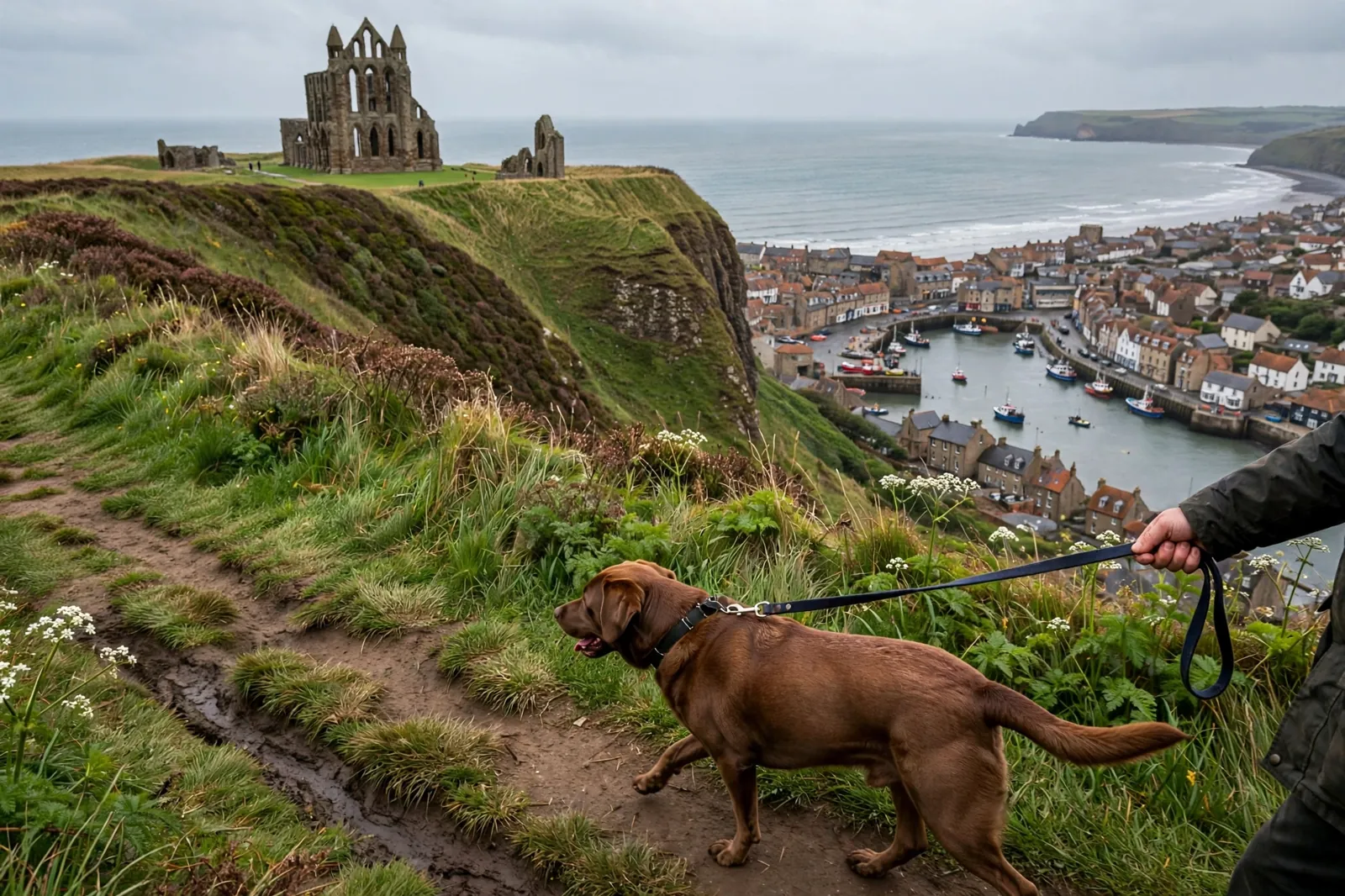
Day visitors should treat parking as the first walk of the day. The main visitor car park by the national park centre is the obvious base and it fills early on fine weekends, bank holidays and school holidays, sometimes uncomfortably early. Arrive before the rush, read the payment and time-limit signs as they stand on the day rather than trusting any guide's figures, and never leave your dog in the car while you walk — not for the Cove, not for a quick café stop, not in the shade that will have moved by the time you return. Overflow and roadside parking around the village lanes causes real problems for residents and farm access, so if the village is full, the grown-up options are a quieter southern walk from a different start point or a different day. For a coastal contrast on the same trip, many visitors pair Malham with Whitby with a dog, swapping limestone discipline for harbour crowds and beach rules.
Build your route: three honest options
Finish by choosing the route that fits the dog in front of you today, not the fittest dog you have ever owned. Option one, the gentle day: village loop in the morning, valley walk to the foot of the Cove and back, long café or pub stop, second village loop before dinner. That is a full and satisfying Malham day for puppies, older dogs, dogs in recovery and anyone visiting in poor weather. Option two, the classic circuit, for fit adult dogs in settled weather: village to the Cove, up the steps, carefully across or around the pavement, across the higher ground to Gordale, down into the gorge from the grassy side if your route allows without the waterfall scramble, then back past Janet's Foss to the village. Allow far more time than the mileage suggests, carry water and food, and start early.
Option three, the split day, suits groups where humans disagree: the dog party walks the valley and the foss woodland in the morning while the climbing party tackles the scar scramble, then everyone reunites in the village for food and does the village loop together in the afternoon. Splitting a party is not a failure of togetherness; it is how mixed-ability groups — which is what every group containing a dog actually is — have good days in serious country. Whichever option you choose, set a turn-back time and a turn-back trigger before you set off: a time of day, a weather change, a tired dog. Deciding in advance is what turns a potential epic into an anecdote.
Malham asks more of dog owners than most places in this series, and pays them back in proportion. The cliff, the pavement and the scar are genuinely extraordinary, and sharing them with a dog — slowly, on a lead, with respect for the farmers whose workplace they are — is one of the great Yorkshire experiences. Do the cautious version first. You can always come back for the longer circuit, and the limestone, which has waited a very long time indeed, will still be there.
Practical questions
Before you go
Can dogs walk on Malham Cove limestone pavement?
Dogs can cross the pavement area with you, but they should stay on a short lead throughout. The deep gaps between the limestone blocks, known as grikes, can trap a paw or a leg, so walk slowly, let your dog pick a careful line across the flat tops, and turn back if your dog is nervous, elderly or unsteady. Never let a dog run or jump across the pavement.
Should I take my dog up Gordale Scar?
For most dogs, no. The scramble beside the Gordale Scar waterfall involves wet rock, climbing and exposure that suits confident humans far better than dogs. View the scar from the lower gorge with your dog on a lead, enjoy the drama safely, and use the longer grassy route over the top if you want the views beyond. That is the sensible dog-friendly choice.
Can dogs swim at Janet's Foss?
The pool below Janet's Foss is small, popular and often busy with people, so it is not a reliable dog swimming spot. Keep your dog on a lead on the narrow approach path, let your dog paddle only at the edge if conditions and other visitors allow, and move on quickly at busy times. After heavy rain the beck runs fast and the banks are slippery, so skip paddling altogether.
Do dogs need to be on leads around Malham?
Yes, in most of the places that matter. Keep your dog on a lead around sheep and cattle, on the limestone pavement, near cliff edges at the Cove and Gordale Scar, and on busy village and valley paths. Between March and July, follow any signed requests for short leads where ground-nesting birds are present. Always check the official latest guidance before you go.
Where can I park in Malham with a dog?
The main visitor car park on the edge of the village is the usual starting point and fills early on sunny weekends and bank holidays. Arrive early, pay as signed on the day, and walk your dog on the grass verges away from traffic before heading into the village. Never leave a dog alone in a parked car while you walk to the Cove.