This guide is independent and contains no paid placement. If affiliate links are added later, they will be clearly marked and will not change our editorial checks.
Malmesbury suits a half-day visit with a dog: start at the abbey and its gardens, drop down to the River Avon for a flat riverside loop, climb back up for the Market Cross and High Street, and finish in a dog-friendly pub. The town is small, steep in places and best explored on foot, with the dog on a lead through the centre.
England's oldest borough
Malmesbury likes to call itself England's oldest borough, and the claim rests on solid ground: King Alfred the Great granted the town its first charter in around 880, and Malmesbury has been a borough ever since. That makes it older than most of the market towns around it, and the age shows in the street plan. The town sits on a steep-sided hill above the River Avon in north Wiltshire, close to the Gloucestershire border, and its centre still follows the shape it had when wool merchants and abbey monks ran the place. For a dog owner, the practical consequence is a town that is compact enough to explore entirely on foot, but with hills that demand a little planning if your dog is older or short-legged.
The town's story is bound up with its abbey. A monastery was founded here in the seventh century, and the abbey grew rich on the wool trade that made the Cotswolds famous. King Athelstan, the first king of all England, was buried at Malmesbury Abbey after his death in 939, and his tomb still stands inside the church. The twelfth-century historian William of Malmesbury lived and wrote here, and the town's most famous son, the monk Eilmer, is said to have strapped wings to himself and flown from the abbey tower in about 1010, landing some distance away and breaking both legs. The story is probably embellished, but the town embraces it: you will see the flying monk on signs, in the museum and in the name of at least one local business. It gives Malmesbury a character quite unlike the picture-postcard Cotswold villages to the north, and it is worth knowing the story before you arrive, because it explains half the things you will notice.
Getting there with a dog is straightforward by car. Malmesbury sits between the M4 and the A429, about fifteen minutes from junction 17 of the M4 near Chippenham, and the drive in from the south climbs gently through farmland before the town suddenly appears on its hill. There is no railway station in Malmesbury itself; the nearest is Kemble, about seven miles away on the line between Swindon and Gloucester, with buses connecting onward. If you arrive by bus, the stop on the High Street drops you right in the middle of things, which is convenient, though buses from Kemble and Chippenham are not frequent, so check the timetable before you travel. Drivers should head for Cross Hayes car park, beside the Market Cross in the centre, or the Station Road car park a short walk down the hill. Cross Hayes is the most convenient if your dog is happy in a busy town centre, while Station Road is calmer and a better choice for a nervous dog, since you can start with a quiet walk up through the lanes rather than straight into the market square.
Plan the visit as a loop rather than a list. The hilltop centre holds the abbey, the Market Cross and the High Street, while the River Avon curls around the base of the hill, and the walk between the two is where the town shows its best side. A sensible order is abbey and gardens first, while the morning is fresh, then down to the river for the flat stretch, then back up through the lanes to the Market Cross for lunch or a pub stop. The whole circuit is only a couple of miles, but the climb back up is steep enough that older dogs will want a slow pace and a water break at the top. In summer, the stone streets throw back the heat, so aim for the morning or late afternoon; in autumn, when the abbey gardens are at their best, the fallen leaves give dogs a whole new set of smells to work through, and the town is at its quietest.
The abbey and its gardens
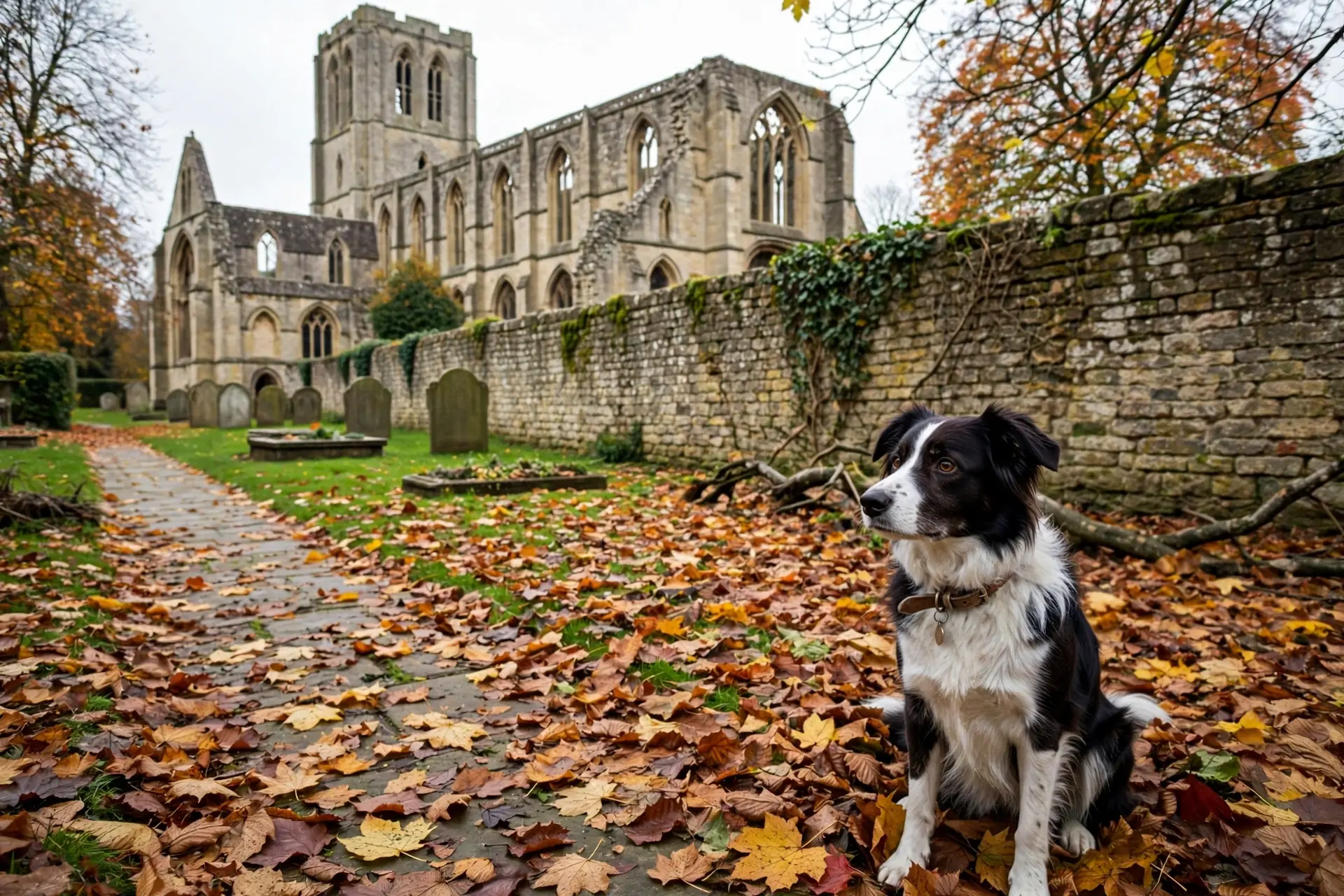
Malmesbury Abbey dominates the town, and it dominates a visit with a dog too, because the grounds around it are the best place in the centre to let a dog sniff, settle and watch the world go by. The abbey church that stands today is largely Norman, built in the twelfth century on the site of the earlier Saxon monastery, and its great south porch is one of the finest pieces of Norman carving in England, covered in biblical scenes that reward a slow look. The central tower collapsed in the sixteenth century, which is why the church has its slightly truncated, solid appearance today, and the tomb of King Athelstan stands inside, a reminder that this was once a place of national importance rather than a quiet parish church. The churchyard and the gardens around the abbey are open and grassy, with old stone walls, mature trees and views down over the rooftops to the river valley, and dogs on leads are welcome in the grounds.
Inside the church, the usual rule is assistance dogs only, which is worth knowing before you arrive so nobody is disappointed at the door. The practical approach is to take turns: one person steps inside to see the porch carvings, the Athelstan tomb and the flying monk window while the other stays outside with the dog in the gardens. The gardens themselves are the better half of the visit for a dog anyway. The lawns below the abbey slope gently down towards the town, and in autumn the fallen leaves pile up under the trees, giving dogs exactly the kind of scent-rich ground they love. There are benches where you can sit while your dog rests, and the old stone walls give the whole space a sheltered, enclosed feeling that helps a nervous dog relax. Keep your dog on a lead here, as the gardens are a place of quiet for visitors and worshippers, and the churchyard is still in use.
Next to the abbey stands Abbey House, whose gardens were for many years among the most celebrated private gardens in England, famous for their planting and for the abbots' garden that lay within the old monastic precinct. The gardens have changed hands and their public opening arrangements have varied in recent years, so check the official guidance before you travel rather than assuming they will be open on the day you visit. If they are open, they are worth an hour on their own, with winding paths, water features and planting that gives a dog a whole landscape of new smells. If they are closed, the abbey grounds and the churchyard still give you a generous green space in the middle of town, and the walk down to the river below supplies the rest of the greenery you need.
Look out for the smaller details while you are here. Daniel's Well, a spring near the abbey, is said to have been used by the monks, and the narrow lanes that run down from the abbey towards the river pass some of the oldest houses in the town, with stone walls, overhanging upper floors and doorways worn smooth by centuries of use. The abbey bells still ring out over the town, which can startle a noise-sensitive dog, so if your dog is unsettled by bells, time your visit outside service times and keep the first few minutes in the gardens short, letting the dog settle before you linger. The abbey also hosts concerts, markets and community events through the year, and these can make the grounds busier than usual, so a weekday morning is the calmest time to bring a dog.
The River Avon loop
The River Avon is the reason Malmesbury sits where it does, and the riverside walk is the best part of a visit with a dog. The town stands on a hill that the Avon wraps around on three sides, and the Tetbury Avon joins the main river just below the town, so the water is never far away. From the abbey, lanes drop down through the old town to the river meadows, where the ground flattens out and the path follows the water past willows, alders and the stone footbridges that cross the smaller channels. The full loop, down from the town, along the river and back up the other side, is roughly two miles, and it is the one walk in Malmesbury where a dog can properly stretch out after the lead-walking of the High Street.
The riverside stretch itself is mostly flat, which makes it the kindest part of the town for older dogs and for puppies that are still building up their walking. The path is a mix of grass, packed earth and short paved sections, and after rain it gets muddy in the low spots, so boots and a towel in the car are worth having from October to March. Kingfishers work the river in the quieter stretches, herons stand in the shallows, and in summer the meadows are full of butterflies and the smell of cut grass. The water is shallow in places and dogs will want to paddle, which is fine where the bank is gentle, but the current can be strong after heavy rain, so keep a close eye on enthusiastic swimmers and do not let a dog enter the water where the bank is steep or the river is in flood. The meadows are grazed in summer, so keep your dog on a lead where livestock are present and watch for the signs at the field entrances, which change with the grazing season.
There are a few ways to shape the walk to your dog. The simplest is an out-and-back along the river from the foot of the town, which avoids the steep climb entirely and suits a dog that tires quickly. A fitter dog can do the full loop, climbing back up through the lanes on the far side of the hill, where the views open out over the rooftops and the abbey tower. Either way, allow an hour rather than rushing it, because the river is the place to slow down: let the dog sniff along the bank, sit on one of the benches where the path crosses the smaller streams, and watch the light change on the water. In winter the river can flood the lowest meadows, and the path may be impassable in places, so check the official guidance before you travel if there has been heavy rain, and be ready to swap the riverside loop for the paved lanes around the abbey instead.
The river also explains the town's history in a way the High Street cannot. The abbey mills once ground corn on the Avon, the wool trade depended on the river for washing and fulling cloth, and the old bridges and weirs you pass on the walk are the working remains of that past. The confluence of the two Avons below the town is a good place to pause and look back up at the hill: from the meadows, Malmesbury looks like a town built for defence, with the abbey tower rising above the rooftops and the houses stepping down the slope. It is the view that makes the climb back up feel worthwhile, and it is also the view that explains why the town has stayed small. The river hemmed it in, and the hill kept it compact, and that is exactly what makes it such an easy town to explore with a dog.
Market Cross and the High Street
The Market Cross is the heart of Malmesbury and the natural meeting point for any visit. Built in about 1490, it is one of the finest medieval market crosses in England, an octagonal stone shelter with carved panels and a spire, raised so that market traders could shelter from the rain while they sold their goods. It still stands in the middle of Cross Hayes, where the market is held, and it is the first thing most visitors photograph. Dogs are welcome to wander around it on a lead, and the open square gives a dog room to move without the squeeze of a narrow pavement, which makes it a good place to pause, get your bearings and decide which way to walk first. The cross is also a useful landmark if you split up, since everyone in town can find it.
From the cross, the High Street runs in both directions, lined with the independent shops that give Malmesbury its character. This is not a town of chain stores: you will find a butcher, a baker, a bookshop, a handful of gift shops and cafes, and the kind of hardware shop that still sells things by the piece. The Athelstan Museum, a short walk from the cross, tells the town's story in a small, free museum, with displays on the flying monk, the abbey, the wool trade and the town's more recent history. Dogs are not usually allowed inside the museum, so plan a quick look while one person waits outside with the dog, or simply enjoy the building from the street and move on. The museum is small enough that a visit takes twenty minutes, and it is the best place in town to put the abbey, the cross and the river into one story.
Market day in Malmesbury is Friday, when stalls fill Cross Hayes and the town is at its busiest. A Friday visit is lively and full of local colour, with fresh produce, plants and crafts, and dogs that are comfortable in crowds will enjoy the extra smells and attention. A dog that finds crowds stressful will be happier on a weekday, when the High Street is quiet and you can browse without jostling. Either way, keep your dog on a short lead through the centre: the pavements are narrow in places, delivery vans squeeze through the lanes, and the market square has a lot going on at ground level, from dropped food to small children. The side lanes off the High Street, such as those running down towards the abbey and the river, are quieter and worth exploring for their old stone cottages and the glimpses of the countryside at the end of each lane.
Shopping with a dog in Malmesbury is a matter of asking at the door, since many of the independent shops welcome well-behaved dogs inside, but there is no single rule. The butcher and the baker are good places to pick up a treat for the walk home, and several of the gift shops stock dog-related goods, from locally made leads to treats. The charity shops on the High Street are worth a browse too, and they often have a water bowl outside for passing dogs. If you are staying in the area, the town's shops cover the basics for a self-catering break, including a small supermarket, and the Friday market is the best place to stock up on local produce before heading out to the surrounding villages.
Pubs and tea rooms
Malmesbury is a good town for a pub lunch with a dog, and its pubs are part of the reason people linger here longer than they planned. The Old Bell Hotel, on the abbey side of the town, claims to be the oldest hotel in England, with origins in about 1220, when it served pilgrims visiting the abbey. It is a handsome old building with low beams, stone walls and a garden, and dogs have been welcomed in its bar and garden areas, which makes it the natural first choice for a dog owner. The Angel, another historic inn on the High Street, has also welcomed dogs, and its position near the Market Cross makes it a convenient stop after a morning of walking. The Smoking Dog, a smaller pub with a memorable name, rounds out the trio, and its bar is the kind of place where a dog can settle under a table while you eat. Dog policies vary by room and season, and food service areas may have different rules from the bar, so always ask at the door and check the official guidance before you travel if a particular pub matters to your plans.
The practical rules for pub visits in Malmesbury are the same ones that work anywhere, applied with a little extra care because these are old buildings with low ceilings and tight corners. Bring a blanket or mat for your dog to settle on, since stone and flag floors are cold and hard, and keep the lead short so the dog is not underfoot in a busy bar. Order at the bar rather than expecting table service in the dog-friendly areas, and keep your dog's head away from other tables, since food and other dogs are both distractions in a small room. A tired dog settles far better than a fresh one, which is another reason to do the river walk before lunch rather than after: a dog that has had a good sniff along the Avon will sleep through a meal, while a dog that has been waiting in the car will not.
Tea rooms and cafes are the other half of the Malmesbury eating scene, and the town has several that suit a dog owner, particularly those with outdoor seating in the warmer months. The cafes on the High Street and around Cross Hayes put tables outside when the weather allows, and a dog is usually welcome at an outdoor table even where the indoor rule is stricter. The Old Bell also serves afternoon tea, which is a good option if you want something more leisurely than a pub lunch, and the garden is a pleasant place to sit with a dog in summer. In winter, when outdoor seating disappears, the pubs become the better bet, since their bars are warm and dog-friendly while the cafes narrow down to indoor tables. If you are visiting in the colder months, plan lunch around a pub rather than a cafe, and save the tea rooms for a coffee stop on a dry day.
If you are staying overnight, ask your accommodation about the nearest dog-friendly breakfast spot, since some of the pubs and inns that welcome dogs in the bar also serve breakfast to residents and their dogs. The town has a small range of places to stay, from the historic inns to bed and breakfasts in the lanes around the abbey, and several of them accept dogs, though the number of dog-friendly rooms is limited and they book up early in summer and at weekends. Book directly and confirm the dog arrangements in writing, including any charge and whether the dog can be left in the room while you eat. A good base in Malmesbury makes the whole north Wiltshire and Cotswold edge area easy to explore, and the town is quiet enough at night that a dog that has walked all day will settle quickly.
Day trips: Tetbury and the Cotswold edge
Malmesbury makes a good base for the Cotswold edge, and the easiest day trip is Tetbury, about seven miles to the north. The drive takes roughly fifteen minutes along country lanes, and Tetbury is a natural companion to Malmesbury: another wool town, built on the same trade, but with a different character. Its Market House, built in 1655 and still standing on its dolphin-topped pillars in the centre of town, is the landmark to head for, and the Chipping Steps, a steep flight of stone steps climbing between the old weavers' cottages, is the place for a photograph. Tetbury's lanes are quiet and dog-friendly to walk, and several of its cafes and pubs welcome dogs, though the gardens at Highgrove, the nearby royal estate, are not open to dogs, so plan the visit around the town itself rather than the gardens. A morning in Malmesbury and an afternoon in Tetbury is the classic pairing, and it works because both towns are small enough to enjoy in a couple of hours each.
Westonbirt Arboretum, about twenty minutes north of Malmesbury, is the other great day trip, and it is one of the best places in the region to walk a dog. The arboretum's Silk Wood welcomes dogs on leads, and the paths wind through one of the finest tree collections in the country, with spectacular autumn colour from October into November and fresh green growth in spring. The main visitor areas are busier, so head for the quieter woodland trails if your dog prefers space, and allow at least two hours, since the site is large. Dogs are not allowed in the Old Arboretum, so check the signs at the entrance and stick to the dog-friendly routes. Westonbirt is at its best on a weekday outside school holidays, when the paths are quiet and the light through the trees is at its best, and it pairs well with a morning in Malmesbury, since the two are close enough to combine without a long drive.
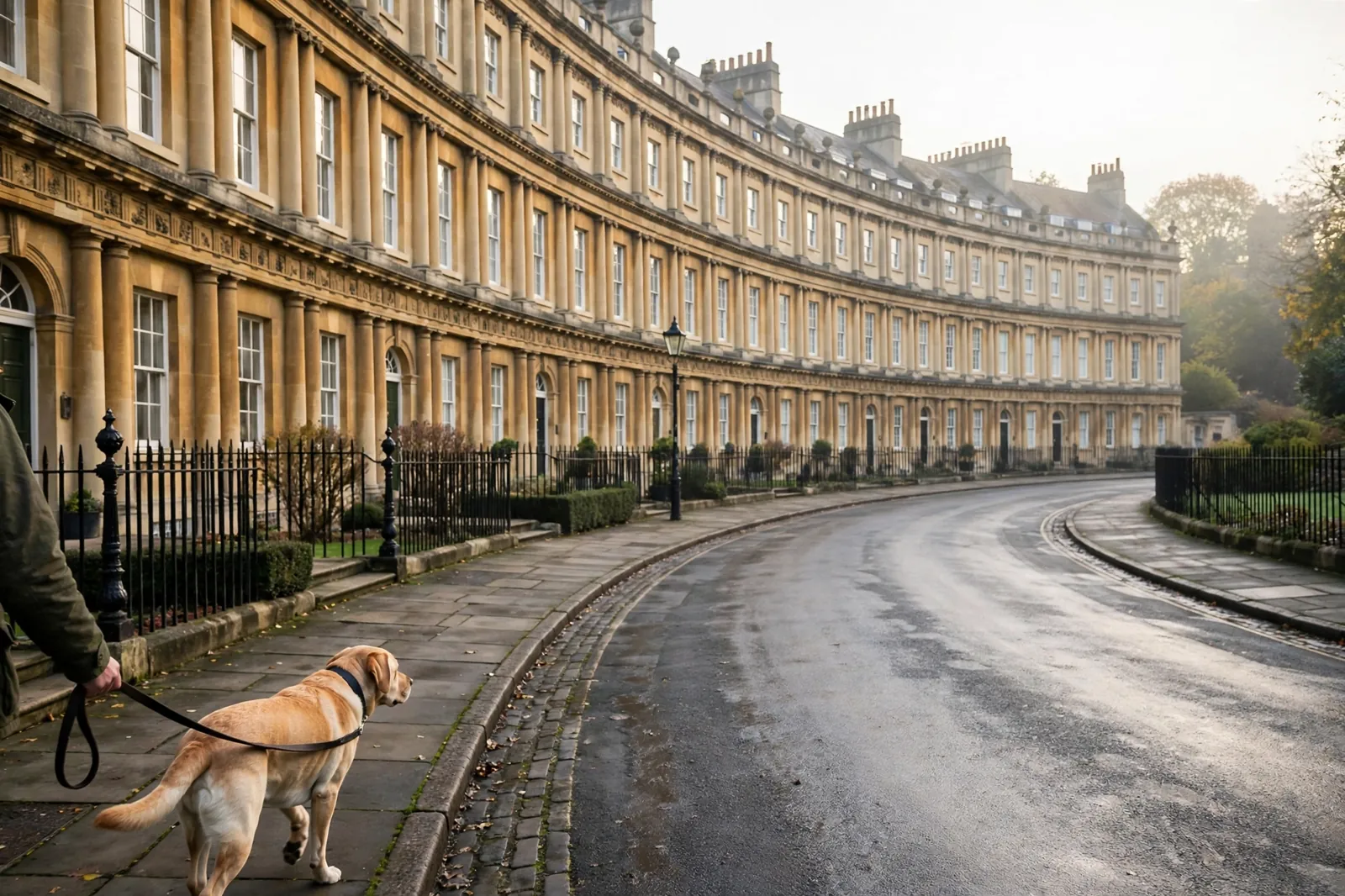
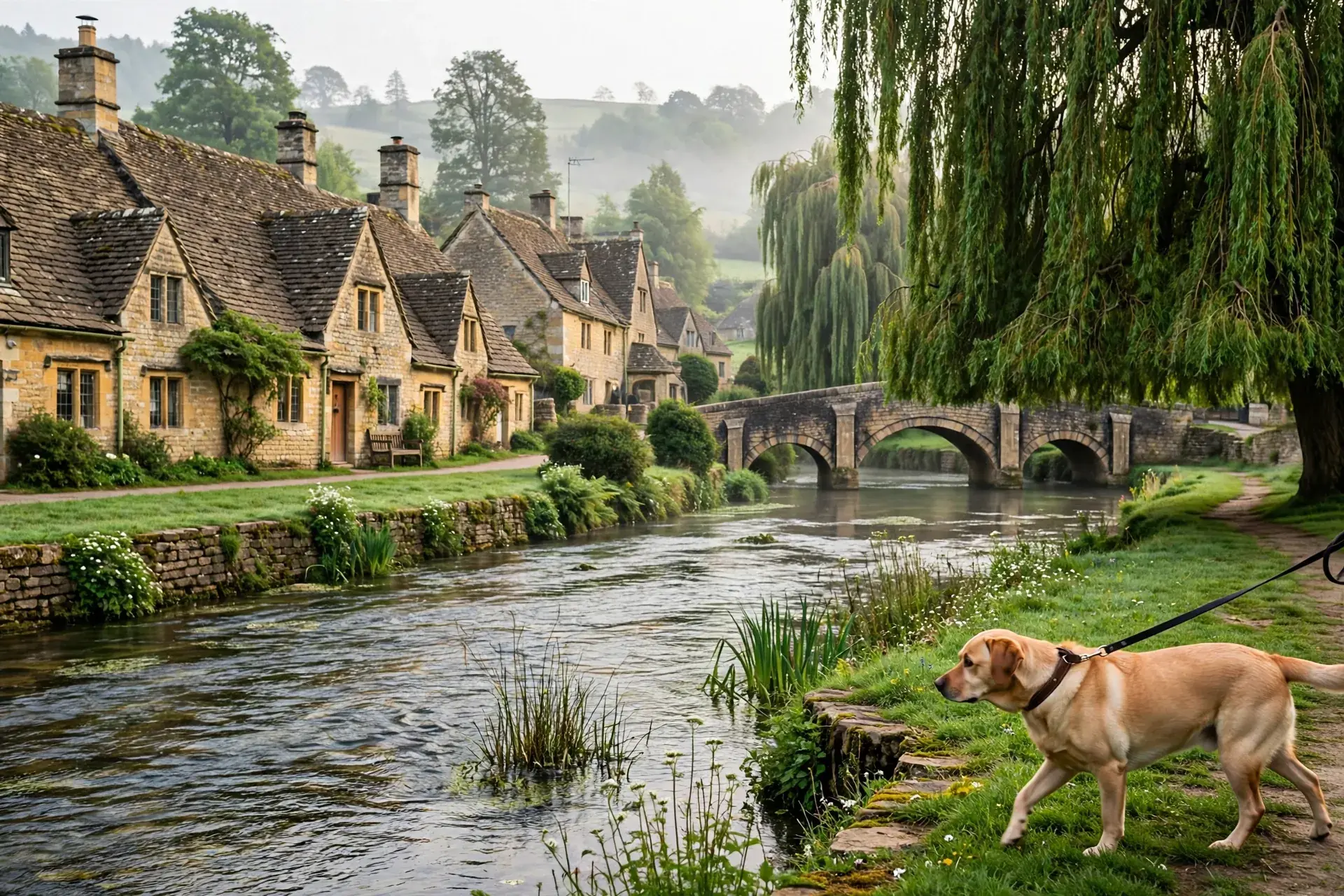
Closer to home, the villages around Malmesbury repay a short drive. Sherston, a few miles to the west, is a handsome stone village with a pub and a quiet green, and the lanes around it make a gentle half-hour walk. Castle Combe, often called the prettiest village in England, is about half an hour away, and its steep main street and old stone cottages are worth seeing, though it gets busy and the main street is narrow, so visit early or late in the day with a dog. To the south, the road towards Chippenham passes through farmland and small hamlets, and the market town of Chippenham itself has riverside walks along the Avon that link naturally with the Malmesbury river walk. For a longer walk, the Cotswold Way runs from Chipping Campden to Bath, and its southern stages pass within easy reach of Malmesbury, so you can sample a section of the trail as a day walk before returning to town. Bath itself, about an hour south, is the grandest day trip of all, and our guide to Bath with a dog covers the skyline walks, canal paths and dog-friendly stays that make the city work with a dog, while Bibury with a dog covers the famous village to the north if you want to see the Cotswolds at their most photographed.
Finish the day back in Malmesbury if you can. The town is at its best in the late afternoon, when the day visitors have gone, the light falls across the abbey tower and the High Street quietens down. A final short walk around the abbey gardens, a drink in one of the dog-friendly pubs and a slow drive home along the lanes is a better ending than rushing to the next town, and it is the part of the day your dog will remember: the same smells as the morning, but quieter, with time to linger. Malmesbury rewards the visitor who slows down, and a dog is the best excuse to do exactly that.
Practical questions
Before you go
Can dogs go inside Malmesbury Abbey?
Dogs on leads are welcome in the abbey grounds and gardens, where most visitors spend their time with a dog. Inside the abbey church itself, the usual rule is assistance dogs only, so plan on one person waiting outside with the dog while the other looks around, or enjoy the exterior, the Norman south porch and the churchyard instead. Check the official guidance before you travel, as arrangements for services and events can change.
Is the River Avon loop walk suitable for older dogs?
The riverside stretch below the town is mostly flat and gentle, which suits older dogs well, but the return climb back up to the High Street is steep, so take it slowly and allow extra time. A shorter option is to walk out along the river and back the same way, avoiding the hill entirely. In wet weather the riverside path gets muddy, so choose a dry day or stick to the paved lanes around the abbey and Market Cross.
Where can I park in Malmesbury with a dog?
The most useful car parks are Cross Hayes, right by the Market Cross in the centre, and Station Road car park a short walk down the hill. Cross Hayes puts you straight onto the High Street and the abbey, while Station Road is usually quieter and a better starting point if your dog finds busy town centres stressful. Check the official guidance before you travel for current charges and time limits.
Are dogs welcome in Malmesbury's pubs?
Malmesbury is a good pub town for dogs. The Old Bell Hotel, The Angel and The Smoking Dog have all welcomed dogs in their bars and garden areas, though exact rules vary by room and season, and food service areas may differ from the bar. Always ask at the door, keep your dog on a lead and bring a blanket for them to settle on. Check the official guidance before you travel, as dog policies can change.
Can I combine Malmesbury and Tetbury in one day with a dog?
Yes, easily. Tetbury is about seven miles north of Malmesbury, roughly a fifteen-minute drive, so a morning in Malmesbury followed by an afternoon wandering Tetbury's Market House, Chipping Steps and wool-town lanes works well. Both towns are compact, so two short visits feel fuller than one long one, and you can finish the day with a riverside walk back in Malmesbury if your dog still has energy.