This guide is independent and contains no paid placement. If affiliate links are added later, they will be clearly marked and will not change our editorial checks.
Mam Tor is a 517-metre hill above Castleton, and the classic dog walk is the Great Ridge loop of about 6 miles, taking three to four hours. Start in Castleton, climb through Cave Dale or from Mam Nick, walk the ridge to Lose Hill, and return to the village. Go early, keep the dog on a lead near the road and the summit crowds, and skip the ridge entirely on very windy days.
The ridge in numbers
Mam Tor stands 517 metres high at the western end of the Great Ridge, the grassy spine that runs east above Castleton to Lose Hill at 476 metres. The hill's name, the Shivering Mountain, comes from the landslips that scar its southern face, where the shale and gritstone crumble a little more every year. The ridge is one of the most walked in the Peak District, and on a fine weekend the summit can feel like a high street, which is the first thing a dog owner needs to know: this is a popular walk, not a wilderness, and the dog's day will involve other dogs, other people, and a lot of stopping and starting.
The classic loop is about 6 miles with roughly 350 metres of ascent, and it takes three to four hours with a dog, including time to stop at the summit and to let the dog drink. Shorter options exist: the climb from Mam Nick car park to the summit and back is under a mile each way, and the walk from Castleton up Cave Dale to the ridge and back is about 4 miles. Longer options exist too: the ridge continues west towards Edale, and the Pennine Way passes nearby, so a fit dog can extend the day considerably. The point is that Mam Tor is a walk you can scale to the dog, not a fixed expedition.
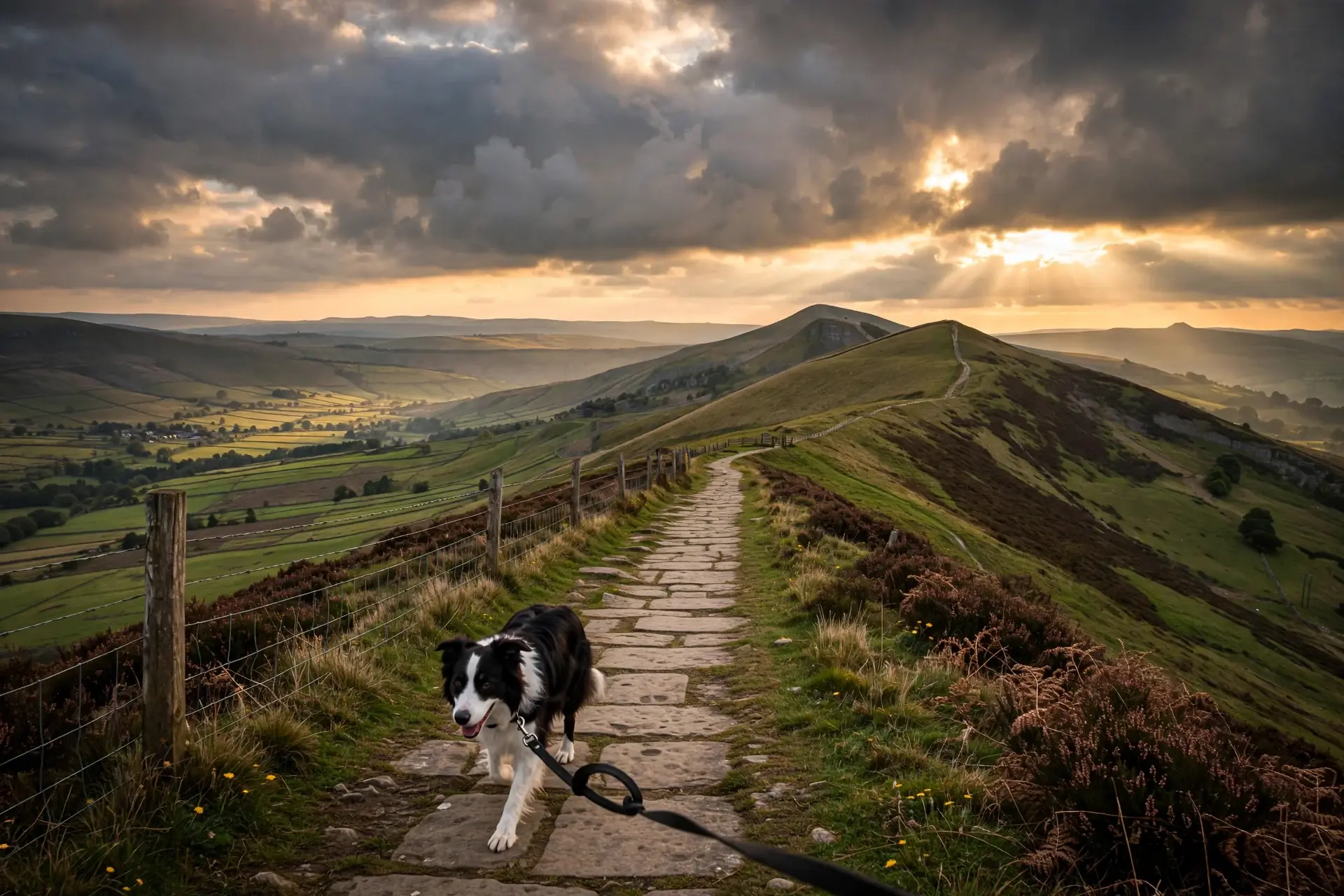
The surface is mostly grass and well-worn earth, with stone steps on the steepest sections and limestone pavement in Cave Dale. The ridge path is broad and easy to follow, and the waymarking is good, but the ground can be muddy after rain, and the stone steps are slippery when wet. The views are the reason to come: north across the Edale valley to Kinder Scout, south across the limestone dales, and east along the ridge itself, which is one of the finest short ridge walks in England. A dog that has climbed to the summit on a clear day has earned the view as much as its owner.
Walking the loop from Castleton
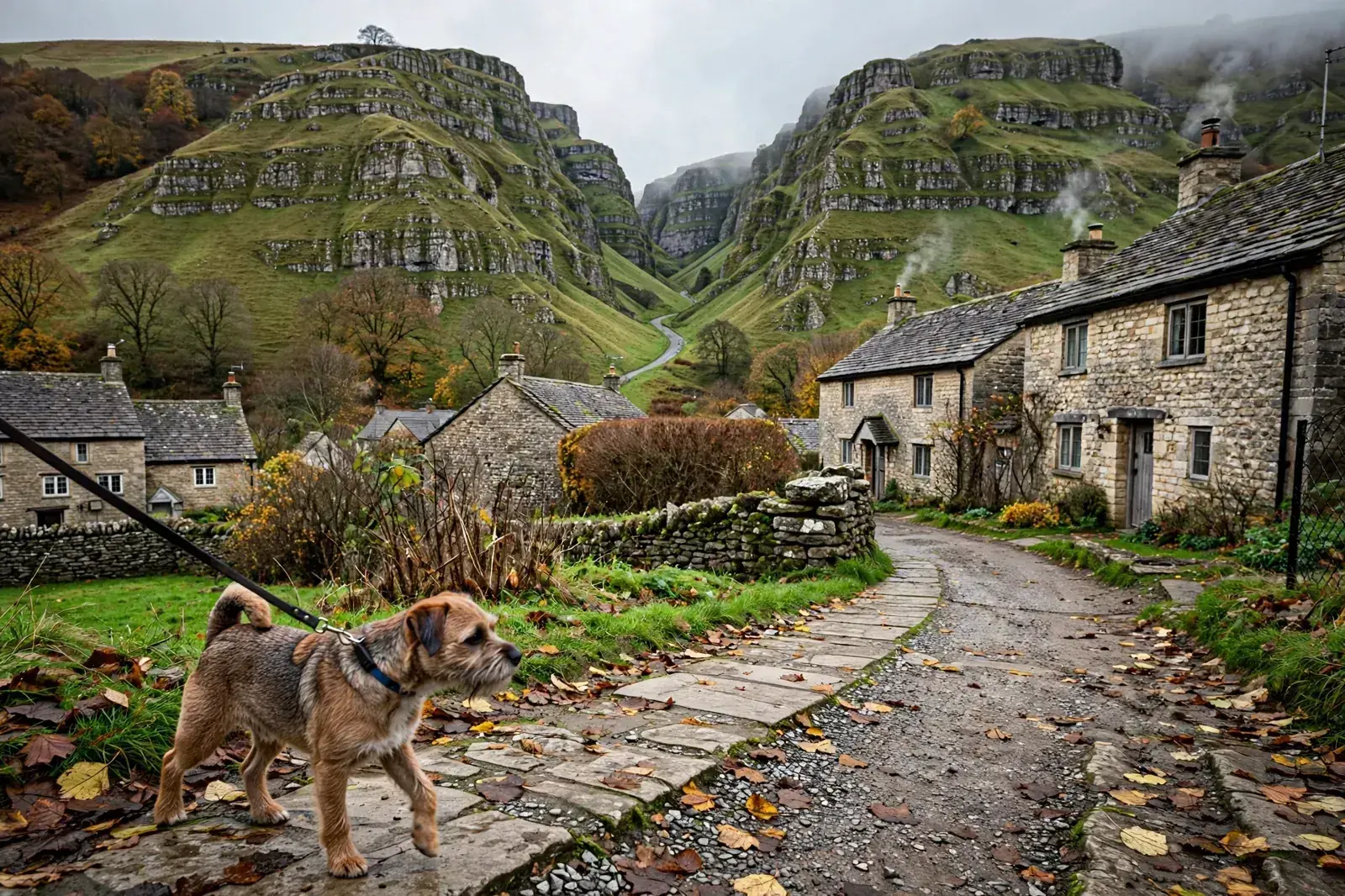
Begin in the village and walk out past the castle ruins, up the lane towards Cave Dale. The first mile climbs through a narrow limestone gorge, over boulders and along a dry valley floor that feels enclosed and green. Dogs love this stretch, because the rocks give them something to scramble over and the valley shelters them from the wind, but the boulders are hard on paws and the path is uneven, so keep the dog close and watch for stones that shift underfoot.
From the top of Cave Dale the path meets the ridge, and the walking changes completely. The ridge is open, grassy and exposed, with views in every direction, and a dog with solid recall can run free here. The first landmark is Mam Tor itself, a broad flat top with a trig point and a crowd. Give the summit a few minutes, take the photograph, and move on, because the finest walking is east along the ridge, where the crowds thin and the path rolls gently towards Hollins Cross and Lose Hill.
The way down from Lose Hill brings the loop back towards the village, and the last mile is a gentle walk through fields and lanes. Watch how the dog moves on this descent: an animal still trotting happily at the bottom has had a good day, and one that is lagging needs a shorter loop next time. Back in the village, offer water, find some shade, and let the dog rest before the drive home. A ridge walk needs an unhurried finish, not a rush to the car park.
Winnats Pass and the road problem
Winnats Pass is the dramatic limestone gorge west of Castleton, and it is the one part of the area that dog walkers need to think about carefully. The road through the pass is narrow, steep and busy, with blind bends and no pavement for much of its length. Walking a dog along the road is unpleasant and unsafe, and the verges are narrow and crumbling. The better approach is to walk the ridge above the pass, or to drive through it and admire it from the car, rather than to walk the road itself with a dog on a lead.
The pass does have a walking route above it, along the ridge from Mam Tor, and the views down into the gorge are spectacular. The path is close to the edge in places, so keep the dog on a lead and well back from the drop, and be ready for the wind, which funnels through the pass and hits the ridge hard. Photographers gather at the top of the pass at sunrise, and a dog that wanders into a photographer's shot at dawn will not be popular, so keep the dog close and give the tripod brigade a wide berth.
If the plan involves Winnats Pass at all, the safest version is to park at Mam Nick, walk the ridge to the pass viewpoint, and return the same way, without ever walking the road. The pass is a place to look at, not a place to walk through with a dog, and the ridge gives the better view anyway. Check the official guidance before you travel if the plan involves any road walking in the area, because the road is sometimes closed for repairs and the diversions are not dog-friendly.
Cave Dale: the quiet way up
Cave Dale is the best-kept secret of the Mam Tor walk, and it is the route that suits dogs best. The valley runs from Castleton up to the ridge, and it is sheltered, green and quiet, with limestone cliffs on both sides and a path that climbs over boulders and through grass. It is the opposite of the busy summit path from Mam Nick: there are fewer people, no road, and a sense of enclosure that dogs find reassuring. It is also the most interesting ground for a dog, with rocks to scramble over and smells in every crevice.
The valley floor is dry for most of the year, because the stream that carved it now runs underground, and the path is uneven, with boulders that need care. Small dogs may need a lift over the biggest rocks, and older dogs may find the scrambling tiring, so take it slowly and let the dog pick its own line. The limestone is sharp in places, so check the dog's paws at the top of the valley, and carry boots if the dog's pads are soft. The climb out of the valley onto the ridge is steep and grassy, and it is the first place where the wind hits, so be ready to clip the lead on as the valley opens out.
Cave Dale is also a good alternative on a windy day. When the ridge is too exposed, the valley offers a sheltered walk that still gives the dog a proper outing, and the return through the village makes a satisfying short loop. A dog that has walked Cave Dale and back has had a real walk, even if it never reached the summit, and there is no shame in choosing the valley over the ridge when the weather says so.
On to Lose Hill and back
Lose Hill, at 476 metres, is the eastern end of the Great Ridge, and it is the part of the walk that most people remember best, because the crowds have thinned and the ridge feels like a ridge again. The path from Mam Tor rolls gently east, with a dip at Hollins Cross, where the ridge is crossed by an old packhorse route, and then climbs again to Lose Hill's broad top. The views from Lose Hill are as good as from Mam Tor, and the summit is quieter, which makes it a better place to stop for lunch and to let the dog rest.
The descent from Lose Hill is the easiest part of the day, a grassy slope down towards Castleton that a dog can trot down happily. The path joins the lanes at the bottom, and the last half mile is a gentle walk back into the village. This is the part of the day to watch the dog's legs: a dog that is stiff on the descent has worked hard on the climb, and a shorter loop next time would suit it better. Give the dog water at the bottom, and let it rest in the shade before the drive home.
For a longer day, the ridge continues west from Mam Tor towards Edale, and the Pennine Way crosses nearby. A fit dog can extend the loop to Edale and back, but that turns a half-day walk into a full day, and the ground beyond Mam Tor is rougher and more exposed. Save the extension for a second visit, when the dog's fitness on the ridge is proven, and keep the first visit to the classic loop, which is the right length for most dogs.
An exposed ridge in bad weather
The Great Ridge is open to the sky, and the wind is the thing that most often turns a pleasant morning into a hard one. A westerly meets the ridge side-on, and the breeze on the summit can be far stronger than in Castleton below. A small dog can be pushed sideways by a gust, and a dog's ears suffer in driving rain. On a blustery day, keep the dog close, stay well away from the edges, and think about the sheltered valley walk instead. If the gusts are already strong at the car park, they will be worse on the top, and the ridge will still be there on a calmer day.
Rain makes the stone steps treacherous and the grass slippery, and the ridge path can run like a stream after a heavy shower. Proper waterproofs are essential, and a coat for the dog is worth packing if the breed chills quickly when wet. Fog is the other hazard: the ridge is easy to follow when it is clear, but in thick mist the path can be hard to see, and a dog that runs ahead can vanish. Keep the dog on a lead in fog and carry a map and compass, because the ridge is not a place to be lost with a tired dog.
Warm weather is the least expected danger on the ridge, because there is no shade and no water on the top. A sunny day with a dark-coated dog and an empty bottle is a real risk. Set out early, carry water for the dog, and watch for the warning signs: breathing that stays fast and heavy after a rest, a dog that slows and then stops, and a mouth that looks dry. When those signs appear, stop, wet the belly and paws, find what shade there is, and wait until the breathing settles. The ridge is a short walk, but heat illness does not care about distance.
What the ground does to paws here
Most of the ground on this walk is kind, but two surfaces deserve respect. The first is the limestone of Cave Dale, which is sharp and uneven and can cut pads that are already soft from a wet week. The second is the loose shale on the southern face of Mam Tor, where the landslips have left a slope of broken rock that shifts underfoot. Keep the dog on the path and off the scree, because a dog scrambling on loose rock can start a small fall of stone, and a dog that slips on shale can cut a pad badly.
Look at the feet at the summit and again at the foot of Lose Hill. Part the toes and check for grit and small stones, feel the pads for warmth and tenderness, and watch for the glossy pink patch that shows a pad is wearing thin. A pair of dog boots in the pack is cheap insurance, and a dab of paw balm at night helps the pads recover. Do not wait for a limp: by the time a dog is limping on a ridge, the day is already over and the car is a long way away.
Nails are part of the same picture. Long nails change how a foot lands and make a slip on wet stone steps more likely, so trim them before the trip and carry a small file for touch-ups. Dew claws need extra care on the rocky stretches, where a snag on a limestone edge can tear one. If the dog has never walked a ridge before, build up with a shorter hill walk first, so it learns the rhythm of climbing and coming down before it meets the Great Ridge.
Getting there and where to leave the car
Parking shapes the whole day on Mam Tor, because the car parks fill early. Mam Nick sits at the foot of the summit path and is full by mid-morning on a fine weekend, and it has no shade, so a dog left in a car there on a warm day is in danger. Castleton has several car parks that also fill, but the village has a bus service, and many walkers leave the car in the village and climb through Cave Dale, which is the better walk in any case.
The bus is a good alternative. Services run to Castleton from Sheffield and Buxton, and dogs are usually welcome, though a large dog may need to travel on the floor and a muzzle is a sensible precaution on a crowded bus. The bus also opens up a one-way option: ride to Castleton, walk the ridge to Edale, and take the train home, though that is a longer day than the classic loop. If you are staying in Buxton, our Buxton town guide covers the spa town's walks, gardens and dog-friendly stops, and it is a sound base for the Peak District generally.
Whatever the plan, arrive early. The ridge is at its best in the first hours of the day, when the light is low and the crowds are still in the village, and an early start means the dog walks in the cool of the morning, which matters in summer. A dog that reaches the summit at eight in the morning has a better day than one that reaches it at noon in a crowd, and the car park is far easier to deal with before the rush.
Castleton after the walk
Castleton is one of the friendliest villages in the Peak District for dogs, and the end of the walk is a pleasure rather than an afterthought. The pubs and cafes welcome dogs, most keep a water bowl by the door, and there is space for a tired animal to lie down. The village also has shops for a forgotten lead or a torn boot, and a choice of dog-friendly places to stay for walkers who want a second day on Kinder Scout. If you are planning the village in detail, our Castleton guide covers the caverns, the walks, the pubs and the lead rules street by street.
The show caves are the one thing the dog cannot join. Speedwell, Peak, Treak Cliff and Blue John are all underground, and dogs are not allowed in, so either one person stays outside with the dog or the caves wait for a day without one. The village's outdoor attractions are the real draw for a dog walker anyway: the castle ruins, the lanes, and the paths up to the ridge. A dog that has walked the ridge and then slept under a pub table has had the perfect Peak District day.
Feed the dog properly after the walk, but not too soon. A dog that has walked six miles needs water first, then rest, then food, and a meal given too soon after hard exercise can come straight back up. Wait an hour, let the dog settle and cool down, and then feed at the usual hour so the routine is not broken. The same applies to the walker: a pub lunch after the walk is a pleasure, but a dog that is still panting under the table needs water, not a shared chip.
Dogs that struggle: steps, stiles and crowds
Mam Tor is a popular walk, and popularity is a problem for some dogs. The summit path is crowded on a fine day, and a reactive dog will meet other dogs on leads every few minutes. The stone steps are steep and uneven, and a dog with arthritis or a bad back will find them hard. The ridge is exposed, and a nervous dog may not like the wind or the open ground. None of this rules the walk out, but it does mean the plan should fit the dog.
For a reactive dog, walk early, walk on a weekday, and use the Cave Dale route, which is quieter than the summit path. Keep the dog on a lead throughout, and use the wide grass of the ridge to give other dogs space. For an older dog, take the short version: park at Mam Nick, climb to the summit, and return the same way, which is under two miles and avoids the longer ridge. For a dog that struggles with steps, avoid Cave Dale's boulders and use the Mam Nick path, which is stepped but even, and take the steps slowly.
Stiles are a minor issue on this walk, because most of the route uses gates, but the field boundaries on the descent from Lose Hill have stiles that a large dog cannot jump and a small dog cannot climb. Check the route before setting off, and carry a lead that gives you control at each stile. A dog that has to be lifted over a stile needs an owner who can lift it safely, so do not attempt a stile with a dog that is too heavy to carry. The ridge is a walk for most dogs, but it is not a walk for every dog on every day, and the honest choice is to shorten the loop rather than to push a struggling dog.
Practical questions
Before you go
How long is the Mam Tor walk with a dog?
The classic Mam Tor and Great Ridge loop from Castleton is about 6 miles and takes three to four hours with a dog, including stops. The short climb from Mam Nick car park to the summit is under a mile and takes about 45 minutes return, while the full ridge to Lose Hill and back through Castleton is the day's work.
Can dogs walk off lead on Mam Tor?
On the open ridge, yes, where the dog has reliable recall, but the summit and the ridge path are busy, the edges are exposed, and sheep graze the slopes below. Keep the dog on a lead near the road at Mam Nick, near the summit crowds, and anywhere sheep are close to the path.
Is Mam Tor safe for dogs in windy weather?
The ridge is very exposed and the wind can be strong enough to push a small dog sideways. On very windy days keep the dog on a short lead, stay well back from the edges, and consider the sheltered Cave Dale valley walk instead. If the wind is gusting hard at the car park, it will be worse on the ridge.
Where do I park for the Mam Tor walk with a dog?
Mam Nick car park sits at the foot of the summit path and fills early on weekends and in summer. Castleton has several car parks and a bus service, so many walkers park in the village and walk up through Cave Dale or along the ridge from the village side instead.
Can I take the dog into the Castleton caverns after the walk?
Most of the show caves do not allow dogs underground, so plan for one person to stay outside with the dog or skip the caves on a dog day. The village itself is very dog-friendly, with pubs and cafes that welcome dogs, and the outdoor walks around Castleton are the real attraction.