This guide is independent and contains no paid placement. If affiliate links are added later, they will be clearly marked and will not change our editorial checks.
Margate works best as a short, slow day: check the beach rules before you set off, because Main Sands bans dogs from 1 May to 30 September; walk the Old Town early, use the neighbouring bays in summer, and treat Turner Contemporary as a take-it-in-turns stop, since pets are welcome in its cafe but not inside the gallery.
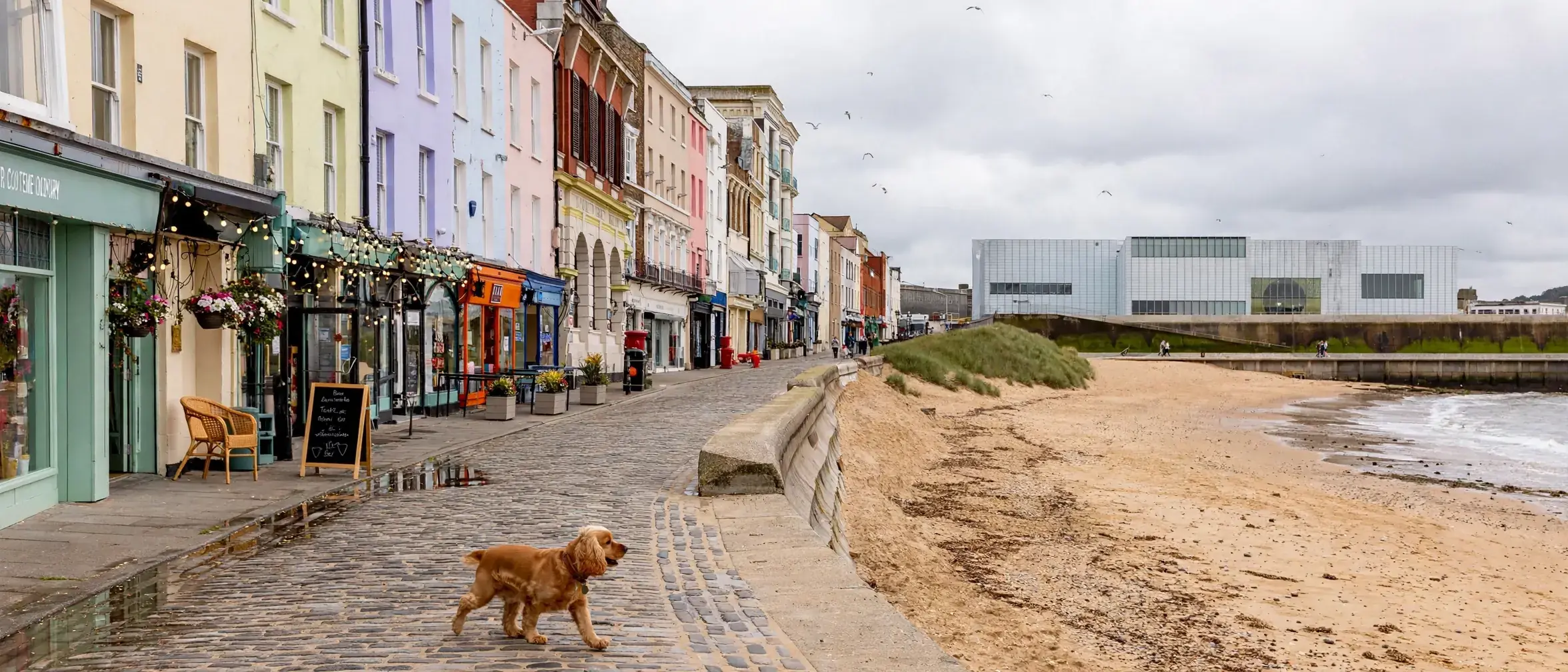
Before the shutters go up in Margate Old Town, the streets belong to delivery vans, gulls and the first dog walkers. The painted shopfronts are still closed, the air smells of salt and coffee from a cafe warming up, and the sea is audible at the end of every lane. It is the best time to see the town clearly: a small grid of colourful streets set between a wide sandy bay and a working harbour, with a large contemporary art gallery standing on the seafront where a boarding house once stood. A dog does not need to understand any of that. What matters to the dog is that the distances are short, the smells change every few metres, and the sea is never far away.
That early quiet does not last. By late morning the Old Town fills with browsers, the seafront fills with families, and the beach fills with deckchairs, ice creams and children. Margate is not a town to rush through with a dog in the middle of a hot Saturday. It is a town to plan around: beach first or beach last, Old Town early, the coastal path when the crowds thin, and a cafe stop built in before the dog gets tired. This guide follows that order. It starts with the bay and the rules that decide where a dog can actually go, then moves through the Old Town, the art on the seafront, the bays to the east and west, and the practical details of trains, parking, stays and wet weather. Read the beach section first even if you are only coming for the shops, because the seasonal dog ban on Main Sands shapes almost every summer plan in Margate.
Margate Main Sands and the seasonal rules
Margate Main Sands is the wide, golden beach in front of the town, backed by a promenade, the harbour arm at one end and low cliffs at the other. It is the beach most visitors picture when they think of Margate, and it is also the beach with the strictest dog rule in town. Dogs are not allowed on Margate Main Sands from 1 May to 30 September, at any time of day. From 1 October to 30 April, dogs are welcome if they are kept under control and owners clean up after them. That winter window is when the beach becomes one of the best dog walks in Kent: a long, flat stretch of sand close to the station, the Old Town and the cafes, with room to walk properly once the summer crowds have gone.
The rule is set by Thanet District Council under a Public Space Protection Order for dog controls, and the council can issue a fixed penalty of 100 pounds for a breach, rising to up to 1,000 pounds if the matter goes to court. Those figures are the ones published alongside the order, and they are a reminder that the ban is enforced rather than advisory. The order itself is renewed every three years, and a replacement was being decided around October 2026, so the dates above should be treated as the current published position rather than a permanent guarantee. Always read the signs on the beach on the day you visit, and check the official guidance before you travel, especially if you are planning a trip close to a renewal date or after a change in council policy.
Summer does not mean Margate has no beach for a dog. It means the dog beach is not the main beach. The neighbouring bays each have their own rule, and the differences matter. Palm Bay and Fulsom Rock are listed as allowing dogs all year round. Westbrook Bay and Walpole Bay, to the west and east of the town respectively, require dogs to be kept on a lead between 10am and 6pm from 1 May to 30 September. That lead-only window covers the busiest part of the day, which is exactly when a dog is most likely to meet children, swimmers and other dogs. Outside those hours, and outside the summer season, the rules relax, but the signs at each bay are the final word. Do not assume that a rule you read for one bay applies to the next one along the coast; in Thanet, bays a few hundred metres apart can have different restrictions, and a confident assumption is the fastest way to a fine.
The promenade needs a rule of its own. Dogs on promenades alongside the restricted beaches should be kept on a lead, and that applies even when the dog is not on the sand. In practice this is easy to follow and worth following: the lower promenade beside Main Sands is busy, narrow in places, and full of cyclists, scooters, children and people carrying food. A short lead keeps the dog out of trouble and keeps other people comfortable. It also makes the walk calmer for a nervous dog, which has enough to process in a seaside town without the added pressure of a long line tangling around a bench.
Tides change the beach as much as the calendar does. At low tide Main Sands opens up into a broad, flat expanse with rock pools at the edges, while at high tide the sand narrows and the water reaches the sea wall. Walpole Bay has a large tidal pool that is beautiful at low tide and barely visible at high water, and Fulsom Rock is visible only at low tide. Check tide times before you plan a beach walk, and never let a dog chase the tide out across wet sand and rocks without knowing how quickly the water returns. The Thanet coast also asks walkers to avoid beaches and lower promenades around high tide in the winter months, from October to March, to protect roosting coastal birds. That guidance covers roughly ninety minutes before high water to an hour after it, and it is worth respecting even when no sign is in front of you: a dog running through a roost can undo a whole winter of feeding in a few seconds.
Swimming needs the same care. The sea at Margate is generally shallow and sandy, which suits paddling dogs, but there are no lifeguards at the smaller bays, and seasonal RNLI patrols on Main Sands typically run only in the summer, when dogs are banned from the sand in any case. Never let a dog swim near the harbour arm, near rocks at low tide, or in rough water, and rinse a dog that has been in the sea, especially after a long swim. Salt water, sand in the paws and a wet coat on a cold day are a poor combination, and a dog that has swum hard will often be colder and more tired than it looks. Carry fresh water for the dog rather than letting it drink sea water, and watch for the early signs of over-exertion: heavy panting, a reluctance to keep moving, or a dog that suddenly wants to lie down on cold sand.
For a fuller explanation of how seasonal bans, lead-only hours and fixed penalties work across the country, see our guide to dog-friendly beaches in the UK, which explains the 2026 rules, how Public Space Protection Orders are enforced, and how to check a beach before you go. The Margate rules in this guide are the local application of that national picture, and they are the ones to follow on the day.
Old Town lanes, shops and cafes
Margate Old Town is the cluster of narrow streets just back from the harbour and the seafront, centred on Market Place, King Street and the lanes that run between them. It is the part of town that has changed most in recent years, filling with independent shops, vintage stores, galleries, bakeries and cafes, and it is also the part that suits a dog best. The streets are short, the traffic is slow, and a walk from one end to the other takes minutes rather than miles. That compactness is a genuine advantage: a dog can have a proper sniffing walk, with new smells at every doorway, without the long, dull stretches that make some town centres hard work.
Go early if you can. The Old Town is at its best before about 11am, when the pavements are still quiet enough for a dog to stop and sniff without blocking anyone, and when shopkeepers have time to say hello. By midday on a sunny weekend the lanes are busy, the pavements narrow, and a dog on a long lead becomes a trip hazard. If you arrive late, keep the lead short, walk on the quieter side streets first, and save the busiest lane for a quick pass-through rather than a slow browse. Dogs that are nervous in crowds will cope far better with a 9am wander than with a noon crush, and the town itself is more pleasant at that hour: the light is softer, the colours of the shopfronts are clearer, and the sea air has not yet been replaced by the smell of hot food and sun cream.
Most of the pleasure of the Old Town is in looking rather than buying. The shopfronts are painted in bright colours, the windows are full of ceramics, prints, vintage clothes and seaside curiosities, and the lanes reward a slow pace. Keep the dog close to the wall side of the pavement where the street narrows, and do not let a long lead trail across a doorway while someone is trying to get in or out with a pushchair. If a shop looks interesting, check the door before going in: many independent shops welcome well-behaved dogs, some welcome them only in the entrance or on the ground floor, and a few do not allow dogs inside at all. A quick look for a sticker on the door, or a polite question at the threshold, avoids an awkward moment inside. Never assume that because one vintage shop welcomed the dog, the next one will too.
Cafes are where the Old Town works hardest for dog owners. Many of the small cafes have outdoor seating, water bowls and staff who are used to dogs settling under a table, and a cafe stop is often the difference between a good morning and a tired, restless dog. Choose a table with space for the dog to lie down out of the main walkway, order something that does not need both hands and a balancing act, and give the dog a chew or a settled task while you eat. If the cafe is busy and the dog is restless, take the coffee to go and find a bench on the harbour arm or a quieter side street instead. A dog that has had a proper walk, a drink and a rest will settle far more easily than one that has been dragged from shop to shop without a break.
The harbour is a short walk from the Old Town and worth including in the loop. The harbour arm is a flat, open walkway with views back across the bay to the town, and it is a good place for a dog to feel the wind and watch the boats without the press of the beach. Keep the dog on a lead on the harbour arm, because the edge is open, the surface can be slippery when wet, and fishing lines, ropes and mooring bollards are all trip hazards for a dog that is not watching where it puts its feet. The steps down to the harbour and the slipway should be treated with care, especially for older dogs and small dogs that may struggle with steep, wet stone.
Two practical points complete the Old Town picture. First, the streets are mostly level, but the pavements are uneven in places and the kerbs can be high, so a dog with stiff joints or a pushchair will need a slower pace and a route that avoids the steepest side lanes. Second, the Old Town is a place where the dog is part of the street life rather than an exception, which means other dogs will be about. Keep greetings short and on a loose lead, and do not let a dog rush up to another dog that is clearly trying to avoid contact. A calm, brief hello, or no hello at all, is usually the kindest choice in a narrow lane.
Turner Contemporary and the seafront
Turner Contemporary stands on the seafront at the eastern end of Main Sands, on the site of the boarding house where the artist J. M. W. Turner once stayed. The gallery opened in 2011 and has become the most recognisable building in Margate: a pale, angular structure that catches the light off the sea and anchors the whole seafront. Entry is free, and the gallery is open Wednesday to Sunday, typically from 11am to 5pm, with longer hours on bank holidays. Those hours are worth checking before you travel, because the gallery closes over the Christmas period and opening times can change around exhibitions and holidays. Check the official guidance before you travel if the gallery is the reason for your visit.
The dog rule at Turner Contemporary is clear and easy to plan around. Pets are not allowed inside the gallery spaces, but they are welcome to join visitors in the cafe. Assistance dogs are welcome throughout the gallery. That means a dog owner who wants to see an exhibition needs to take turns: one person stays outside with the dog while the other goes in, then swap. It is not ideal, but it is workable, and it is far better than leaving a dog tied up outside or in a hot car. Plan the gallery as a short, focused visit rather than a long afternoon, and use the time outside to walk the seafront, sit on the steps, or have a coffee in the cafe with the dog.
The seafront around the gallery is one of the best dog walks in Margate, even without going inside. The promenade runs east from the gallery towards Cliftonville and west towards the harbour and the Old Town, and the views across the bay are open and unobstructed. On a clear day the light is extraordinary, which is part of why Turner painted here, and on a grey day the sea and sky merge into a single flat sheet that makes the town feel very far from London. Walk the promenade with the dog on a lead, stop at the benches, and let the dog watch the waves and the gulls. It is a walk that asks nothing of the dog except to be present, and that is often exactly what a dog needs after the stimulation of the Old Town.
Other Margate attractions have their own dog rules, and they are worth knowing before you promise a visit. The Shell Grotto, a small underground passage covered in shells, generally allows dogs only in its cafe rather than in the grotto itself, so it is another take-it-in-turns stop. The Crab Museum, a small museum devoted to crabs, has been described as welcoming dogs inside, but its policy should be confirmed at the door on the day. Margate Caves, an underground chalk cave system, allows only assistance dogs inside the caves themselves, although well-behaved dogs are welcome in the garden. Dreamland, the amusement park on the seafront, has its own rules for dogs on the site, and those rules can change with events and seasons, so check the official guidance before you travel rather than assuming a dog can go in. The pattern is consistent: Margate has plenty to look at from the outside, and plenty of cafes and gardens where a dog is welcome, but the indoor attractions themselves are mostly not dog-friendly. Build the day around the outside, and treat any indoor visit as a bonus rather than the plan.
That outside-first approach is also the most honest way to enjoy the art in Margate. The town itself is the gallery: the painted shopfronts, the murals, the sea light, the harbour, and the people. A dog does not need to see a painting to enjoy a town that was built around looking at the sea. Walk slowly, look up at the buildings, and let the dog set the pace. The art will still be there on a return visit, and the dog will remember the walk long after the exhibition has changed.
Bay-to-bay walks along the coast
The best dog walking in Margate is not on Main Sands in summer. It is on the coastal path that links the bays, and on the bays themselves outside the summer ban. The Viking Coastal Trail is a circular route of about 25 miles around the Isle of Thanet, connecting Margate, Broadstairs and Ramsgate, and it can be walked in sections rather than as a single long hike. The section most visitors use is the stretch from Margate to Broadstairs, which passes Palm Bay, Walpole Bay, Botany Bay and Joss Bay before reaching Broadstairs, and the longer stretch from Ramsgate to Margate is about 7 miles and takes three to four hours excluding stops. Both are described in detail by local walking guides, and both are best walked in one direction with a bus or train back, rather than as a there-and-back march that doubles the distance for a tired dog.
West of Margate, Westbrook Bay is the nearest alternative beach, a short walk along the promenade from the town centre. It is a sandy bay popular with local dog walkers, and it requires dogs to be kept on a lead between 10am and 6pm from 1 May to 30 September. That still leaves the early morning and the evening for a freer walk, and outside the summer season the bay is far quieter. The promenade to Westbrook is flat and surfaced, which makes it a good option for older dogs, dogs in buggies, and anyone who wants a straightforward out-and-back walk without steps or rough ground. There are benches along the way, and the walk back into town passes cafes and shops where a dog can have a drink and a rest.
East of Margate, the coast becomes more varied. Palm Bay, just beyond the Turner Contemporary, is listed as allowing dogs all year round, and it has a tidal pool and two steep slopes down to the sand. Walpole Bay, further east in Cliftonville, has a large tidal pool, a sandy beach and a promenade, and it requires dogs to be kept on a lead between 10am and 6pm in the summer season. Fulsom Rock, near the harbour arm, is listed as allowing dogs all year round but is visible only at low tide, so it is a walk to time carefully rather than a place to arrive at any hour. The point is not to memorise every bay, but to understand the pattern: the bays closest to the town centre have the strictest summer rules, while the smaller bays a short walk away are more permissive, and every bay has its own signs.
Botany Bay and Joss Bay, a little further east towards Broadstairs, are worth the walk on a quiet day. Botany Bay is known for its chalk stacks and its wide, sandy beach at low tide, while Joss Bay is a popular surfing beach with a large expanse of sand. Both are reached by the coastal path, and both need tide times checked before you drop down to the sand, because the cliffs and the tide can cut off the return route. Keep dogs on a lead on the cliff-top path, where the edge is unfenced in places and the wind can be strong, and do not let a dog chase birds or other animals on the beach. The chalk cliffs are also a reminder to keep dogs away from the base of the cliff after rain, when falls are more likely, and to stay on the marked path rather than scrambling down unofficial routes.
For a longer day, the walk to Broadstairs is the natural next step. Broadstairs has its own main beach, Viking Bay, which bans dogs from 1 May to 30 September, and its own smaller bays with different rules, so the same care applies there as in Margate. The walk itself is the reward: a series of bays, each with its own character, linked by a promenade and a cliff-top path that is mostly surfaced and mostly level. Allow two to three hours for the Margate to Broadstairs section with stops, carry water for the dog, and plan the return by bus or train rather than walking back along the same route. A dog that has walked four or five miles in the morning will not enjoy a second four or five miles in the afternoon, and a tired dog on a busy promenade is a dog that is more likely to snap at another dog or pull towards food.
Canterbury is a useful comparison and a useful next trip. It is about an hour away by train or car, and it offers a completely different kind of dog day: a historic city with medieval lanes, a river walk and a cathedral precinct with its own rules. Our guide to Canterbury with a dog explains the precinct rules, the river walks and the parking in detail, and it pairs well with this Margate guide for anyone planning a longer Kent break. Margate is the seaside half of that pair: open, windy and informal, where Canterbury is enclosed, historic and formal. A dog that enjoys one will usually enjoy the other, but for different reasons.
A practical day plan, hour by hour
A good Margate day with a dog is built around three blocks: a beach or coastal walk, an Old Town wander, and a cafe or seafront rest. The order depends on the season, and the season depends on the beach rules. In winter, when Main Sands is open to dogs, the beach can be the first block of the day. In summer, when Main Sands is closed to dogs, the beach block moves to a neighbouring bay, or to the promenade, and the Old Town becomes the first block instead. The plan below is for a summer day, because that is the harder case, and it can be adapted for winter by swapping the first two blocks.
Start at 8am, or as early as you can manage. Park near the station or the seafront, walk the dog to Westbrook Bay or Walpole Bay, and let the dog have its main walk before the heat and the crowds build. An hour on the beach or the promenade, with a swim or a paddle if the dog enjoys it, will tire most dogs out in a good way. Keep the dog on a lead where the summer rules require it, carry water, and watch the time: the lead-only hours start at 10am, and the beach gets busier from then on. By 9.30am, head back towards the town, rinse the dog if it has been in the sea, and give it a drink and a rest in the shade.
From 10am to midday, walk the Old Town. This is the time when the shops are opening, the cafes are serving coffee, and the lanes are still quiet enough for a dog to enjoy them. Walk slowly, stop often, and let the dog sniff. Choose one or two shops to look in properly rather than trying to see everything, and build in a cafe stop halfway through. A dog that has already had a beach walk will settle under a cafe table far more easily than one that has been waiting all morning for exercise. If the dog starts to flag, cut the Old Town short and head for the seafront, where there is more air and more space.
From midday to early afternoon, take the seafront. Walk the promenade past Turner Contemporary, sit on the steps or a bench, and let the dog watch the sea. If one person wants to see an exhibition, take turns at the gallery while the other stays outside with the dog. Eat lunch at a cafe with outdoor seating, or take food to go and eat it on a bench set back from the busiest part of the front. Avoid the hottest part of the day on the sand and the pavement, both of which can burn paws, and offer the dog water regularly. A dog that is panting heavily, seeking shade, or lying down on cool stone is telling you it needs a break, not a longer walk.
From mid-afternoon, either walk the coastal path or head home. A short walk east to Palm Bay or west to Westbrook Bay is a good final stretch, provided the dog still has energy and the tide times allow it. A longer walk to Broadstairs is only sensible if the dog is fit, the weather is cool, and you have a return plan by bus or train. Otherwise, use the afternoon for a slow wander back through the Old Town, a final coffee, and a calm drive or train home. The aim is to finish the day with a dog that is tired but not exhausted, and with a memory of a good walk rather than a long, hot slog.
In winter, the same structure works with the beach first. Arrive early, walk Main Sands while it is quiet, then wander the Old Town as the shops open, and finish with a seafront walk and a warm cafe. Winter days are shorter, so start earlier and finish earlier, and allow extra time for drying the dog after a wet beach walk. The winter light in Margate is often the best light of the year, and the town is quieter, which suits nervous dogs and older dogs that find summer crowds overwhelming. The trade-off is the weather: a winter day in Margate can be cold, wet and windy, and a dog that is wet and cold will need a warm car, a drying coat and a dry bed far more than it needs another hour on the beach.
For a weekend rather than a day, the plan expands rather than changes. Use the first day for Margate itself, the second day for a coastal walk to Broadstairs or Ramsgate, or for a trip inland to Canterbury, and keep one block of each day free for rest. Dogs do not need a new attraction every hour; they need a good walk, a good rest, and a familiar routine. Two short, good days will always beat one long, overfilled day, and a dog that has slept well will enjoy the second day far more than a dog that was kept going until it dropped.
Getting there, parking and arrival
Margate is one of the easiest seaside towns in Kent to reach without a car. Margate railway station is opposite Main Sands, about 200 metres from the beach, with regular trains from London and from Canterbury, Ramsgate and Broadstairs. The journey from London is typically around ninety minutes, depending on the route and the stops, and the station is step-free in the main areas, although it is worth checking the official guidance before you travel if step-free access matters for your dog or for anyone travelling with you. Trains can be busy on summer weekends, so travel early, choose a quieter carriage if you can, and give the dog space to settle under a seat rather than in the aisle.
Dogs travel free on most trains in Britain, provided they are kept on a lead and do not occupy a seat, and they should not be left unattended. A dog that is nervous on trains will cope better with a short journey, a familiar blanket, and a window seat where it can watch the world go by without being stepped on. If the dog is large, travel outside peak hours when the carriages are quieter, and avoid the busiest summer Saturday trains if you can. The walk from the station to the beach is short and flat, which makes the train a genuinely practical option for a day trip: step off the train, cross the road, and the dog is on the seafront within minutes.
By car, Margate is reached from the A299 and the A28, with routes from Canterbury, Ramsgate and the M2. The drive from London is typically around two hours, depending on traffic, and summer weekends can add significant delays on the approach roads. Allow extra time, and do not leave a dog in a parked car in warm weather, even for a few minutes. A car can heat up dangerously fast on a sunny day, and a dog left in a car is at risk of heatstroke even with a window cracked open. If you need to stop on the way, choose a shaded car park, park in the shade, and keep the stop short.
Parking in Margate is centred on the council car parks near the station and the seafront, including the car park by the station and the car parks along Marine Terrace. Charges vary by car park and by season, and some car parks have height restrictions or limited spaces for larger vehicles, so check the official guidance before you travel for current charges and restrictions. Arrive early on summer weekends, because the seafront car parks fill quickly, and be prepared to walk from a car park a little further from the front rather than circling the busiest streets looking for a space. A ten-minute walk from a quieter car park is far better for a dog than twenty minutes of circling in traffic with the engine running.
Arrival is worth planning as carefully as the walk itself. Park, let the dog out, offer water, and give the dog a short toilet walk before heading for the beach or the Old Town. Do not rush straight into the busiest part of town with a dog that has been in a car or on a train for two hours. A ten-minute settle-in walk, a drink, and a chance to sniff the new smells will make the rest of the day calmer. If you are staying overnight, check in first, let the dog see the room, and put its bed and water bowl down before going out again. A dog that knows where its bed is will settle far more quickly than one that is taken straight from the car to a crowded street.
Buses also serve Margate, with the Stagecoach Loop running along the seafront and connecting Margate with Broadstairs, Ramsgate and the surrounding villages. Buses can be a useful way to do a one-way coastal walk, catching a bus back from Broadstairs or Ramsgate rather than walking back. Dogs are generally allowed on buses at the driver's discretion, provided they are kept on a lead and do not block the aisle, but it is worth checking the operator's policy before you rely on a bus, and having a backup plan if the bus is full or the driver declines. A taxi is a more reliable backup, and several local firms will take dogs if you mention the dog when you book.
Where to stay with a dog
Margate has a growing number of places to stay, from hotels and guesthouses in the town centre to self-catering flats and cottages in the Old Town and Cliftonville. Many of them welcome dogs, but the details vary widely, and the phrase dog-friendly can mean anything from a dog welcome in a specific room with a fee, to a dog welcome throughout the property with no charge. Always confirm the dog policy in writing before you book, including the number of dogs allowed, any size or breed conditions, the fee, whether the dog can be left alone in the room, and whether dogs are allowed in the dining room, bar or garden. A policy that is clear in writing is far more useful than a reassuring phrase on a booking site.
Self-catering accommodation often suits dog owners best in Margate. A flat or cottage with its own entrance, a small garden or courtyard, and a kitchen means the dog can settle in a familiar space, eat at its usual time, and be left for a short period if the property allows it. Look for ground-floor accommodation if the dog struggles with stairs, and check whether the garden is enclosed, because a courtyard with a low wall is not the same as a secure garden. Ask where the nearest toilet walk is after dark, and whether there is a hose or an outdoor tap for washing sandy paws. Those small details matter far more than the view from the window.
Hotels and guesthouses in the town centre can also work well, especially for a short stay. Choose a room on the ground floor or near an exit if the dog needs frequent toilet trips, and ask whether the hotel has a dog-walking area or a nearby green space. Some hotels welcome dogs in the bar and the garden but not in the restaurant, which means planning meals around the dog rather than assuming the dog can come to dinner. If the hotel does not allow dogs to be left alone in the room, plan your meals and gallery visits around that rule, and do not leave a dog alone in an unfamiliar room hoping it will settle. A dog that barks in a hotel corridor will disturb other guests and may be asked to leave.
For a longer stay, consider basing yourself in Margate and using it as a hub for the rest of Thanet. Broadstairs, Ramsgate and Canterbury are all within an hour by train or car, and each offers a different kind of dog day. A self-catering stay of three or four nights, with one day in Margate, one day on the coastal path, and one day inland, gives the dog a varied but manageable routine, with a rest day built in. That is a better use of a week than trying to see every bay in Thanet in two days, and it leaves time for the dog to recover between walks.
Book early for summer weekends and school holidays, when dog-friendly rooms sell out quickly, and be honest about the dog when you book. A property that knows it is expecting a large, hairy dog that sheds will be far more welcoming than one that discovers it on arrival. Bring the dog's bed, blanket and bowls, even if the property provides them, because familiar smells help a dog settle in a new place. And leave the room as you found it: clean up hair, wipe sandy paws at the door, and report any damage honestly. Dog owners who leave a clean room make it easier for the next dog owner to be welcomed.
Rainy days and the seasons
Margate is a seaside town, and seaside weather changes fast. A sunny morning can turn into a wet, windy afternoon, and a forecast that promised rain can clear by lunchtime. The best approach is to plan for rain even on a sunny day, and to treat a wet day as a different kind of Margate day rather than a ruined one. The town has plenty to offer in the rain, provided the dog is warm, dry and comfortable, and provided you do not try to force a beach walk in a storm.
Spring, from March to May, is one of the best times to visit Margate with a dog. The beach ban starts on 1 May, so the weeks before that date offer the last chance for a dog to walk Main Sands before the summer, and the town is quieter than in the summer. The weather is changeable, with bright spells and sudden showers, and the sea is cold, so dogs that like to swim should be kept to a paddle rather than a long swim. Spring is also the time when the Old Town is at its most pleasant: the shops are open, the cafes have outdoor seating, and the streets are not yet crowded. Pack a waterproof coat for the dog if it has one, and a towel for the car.
Summer, from June to August, is the busiest and the hottest season, and the one that needs the most planning. Main Sands is closed to dogs, the town is crowded, and the pavements and sand can be hot enough to burn paws. Walk early in the morning or late in the evening, use the neighbouring bays, and keep the dog in the shade during the middle of the day. Carry water, offer it often, and watch for heatstroke: heavy panting, drooling, lethargy and vomiting are all signs to take seriously. Never leave a dog in a car in summer, and do not let a dog run hard on hot sand. Summer in Margate can be wonderful for a dog, but only if the day is built around the dog's comfort rather than the human timetable.
Autumn, from September to November, is often the best season of all. The beach ban lifts on 1 October, the crowds thin, the light softens, and the sea is at its warmest after the summer. October is a particularly good month for a dog walk on Main Sands, with long, quiet beaches and mild weather, although the wind can be strong and the rain can arrive quickly. November brings shorter days and colder weather, but the town is quiet, the cafes are warm, and a dog that enjoys a bracing walk will love the empty beach. Fireworks around early November can unsettle noise-sensitive dogs, so check whether local displays are planned and keep a nervous dog indoors or on a lead in a quiet area on those evenings.
Winter, from December to February, is the quietest season, and the one that suits a certain kind of dog best. Main Sands is open to dogs, the beach is empty, and the town is calm. The trade-off is the cold, the wind and the rain, and the shorter days. Dress the dog appropriately if it is a short-coated breed, dry it thoroughly after a beach walk, and plan a warm cafe stop rather than a long, exposed walk. Some shops and cafes have reduced winter hours, and the gallery may close over Christmas, so check opening times before you travel. Winter in Margate is not for every dog, but for a hardy dog that loves an empty beach, it can be the best time of year.
On a truly wet day, the plan changes. Skip the beach, walk the Old Town under the shop awnings, and use the cafes as shelters. A short, sharp walk in the rain, followed by a long, warm rest, is better than a long, miserable walk that leaves the dog cold and wet. Bring a drying coat, a towel and a change of clothes for yourself, and accept that the dog will get muddy. The Old Town lanes drain quickly, but the promenade can be slippery when wet, and the steps down to the beach and the harbour should be avoided in heavy rain. If the rain is persistent, consider a drive to Canterbury, where the covered lanes and the indoor cafes offer more shelter, or simply enjoy a slow morning in your accommodation and wait for a break in the weather.
Packing, safety and beach manners
Packing for Margate is packing for a seaside town with a town centre, a beach and a coastal path, all in one day. The list is short, but every item on it earns its place. Bring a short lead and a long line, so the dog can be kept close in the Old Town and given more freedom on the beach where the rules allow it. Bring a harness that fits well, because a dog that pulls on a collar on a busy promenade is a dog that is hard to control. Bring water and a collapsible bowl, because fresh water is not always available on the beach, and a dog that has been running on sand will need to drink often. Bring poo bags, more than you think you will need, and a bag to carry them in until you find a bin.
Bring a towel and a drying coat, even on a sunny day. A dog that has been in the sea will be wet, sandy and cold, and a towel in the car makes the journey home far more pleasant for everyone. Bring a blanket or a mat for the dog to lie on in a cafe, so it has a familiar place to settle rather than a cold, hard floor. Bring a chew or a toy for cafe stops, and a spare lead in case one breaks. Bring the dog's usual food, rather than relying on buying it locally, and bring any medication the dog needs, with the vet's number saved in your phone. The nearest vet in Margate should be identified before you travel, not after an emergency, and an out-of-hours number is worth saving too.
Safety on the beach is mostly common sense, but it is worth spelling out. Never let a dog eat sand, seaweed or dead fish, all of which can cause vomiting, diarrhoea or worse. Watch for broken glass, fishing hooks and sharp shells on the beach, especially after a storm, and check the dog's paws after a walk on rocks. Keep dogs away from cliff edges and from the base of cliffs after rain. Do not let a dog chase gulls or other birds, especially in winter when birds are roosting and need to conserve energy. And never let a dog off the lead near a road, a car park or a busy promenade, even if the beach itself allows off-lead walking. The transition from beach to road is where most accidents happen.
Beach manners are what make Margate welcoming for dog owners. Clean up after the dog every time, without exception, and carry the bag to a bin rather than leaving it on the sand or hanging it from a fence. Keep the dog under control at all times, even on beaches where off-lead walking is allowed, and recall the dog promptly when another dog, a child or a swimmer approaches. Not everyone on a beach loves dogs, and a dog that jumps up at a stranger, steals food or chases a child is a dog that makes life harder for every other dog owner. A well-behaved dog, on the other hand, is the best advertisement for dog-friendly beaches, and it is the reason towns like Margate keep their winter beaches open to dogs.
Finally, remember that Margate is a town where people live, not just a place to visit. The Old Town lanes are residential as well as commercial, the beaches are used by local dog walkers every day of the year, and the cafes and shops depend on visitors who respect the town. Walk quietly in residential streets early in the morning, keep barking to a minimum, and leave the beach cleaner than you found it. A dog owner who does those simple things will be welcomed back, and a town that welcomes dogs will keep welcoming them. That is the real test of a dog-friendly destination: not whether dogs are allowed, but whether they are welcomed, and Margate, on a good day, with a good plan, passes that test.
Practical questions
Before you go
Can dogs go on Margate Main Sands in summer?
No. Dogs are not allowed on Margate Main Sands from 1 May to 30 September. From 1 October to 30 April dogs are welcome if kept under control and cleaned up after. Always read the signs on the beach on the day, because the council order can change, and check the official guidance before you travel.
Where can dogs go on the beach in Margate in summer?
Use the neighbouring bays instead of Main Sands. Palm Bay and Fulsom Rock are listed as allowing dogs all year round, while Westbrook Bay and Walpole Bay require dogs to be kept on a lead between 10am and 6pm from 1 May to 30 September. Check the signs at each bay before letting a dog off the lead, and check the official guidance before you travel.
Are dogs allowed inside Turner Contemporary?
No, pets are not allowed inside the gallery spaces, although assistance dogs are welcome throughout. Dogs are welcome in the gallery cafe. Plan the visit in turns if everyone wants to see an exhibition, and check the official guidance before you travel.
Is Margate Old Town good for dogs?
Yes, for a short, slow walk. The lanes are compact, mostly level and full of places to pause, which suits a sniffing walk far better than a long march. Go early, keep the dog on a short lead where pavements narrow, and check each shop or cafe at the door, because dog policies vary from one business to the next.
How long is the coastal walk from Margate to Broadstairs with a dog?
The Margate to Broadstairs section of the Viking Coastal Trail is roughly 4 to 5 miles one way, depending on the exact route, and most walkers allow two to three hours with stops. The full Ramsgate to Margate section is about 7 miles and takes three to four hours excluding stops. Use the promenade and cliff-top path, keep dogs on a lead near roads and cliff edges, and check tide times before dropping to a beach.
Where should I park in Margate with a dog?
Start with the council car parks near the station and the seafront, then walk to the beach and Old Town rather than trying to park beside the busiest front. Arrive early on summer weekends, allow time to walk from the car park to your first stop, and check the official guidance before you travel for current charges and restrictions.