This guide is independent and contains no paid placement. If affiliate links are added later, they will be clearly marked and will not change our editorial checks.
Marlborough suits a dog break because the town itself does the work: an exceptionally wide High Street for easy strolling, the River Kennet at the bottom of the town, and Savernake Forest beginning a short walk to the south-east. Start on the High Street, walk the river to Manton, then climb into the forest and come back over Granham Hill.
Britain's widest High Street
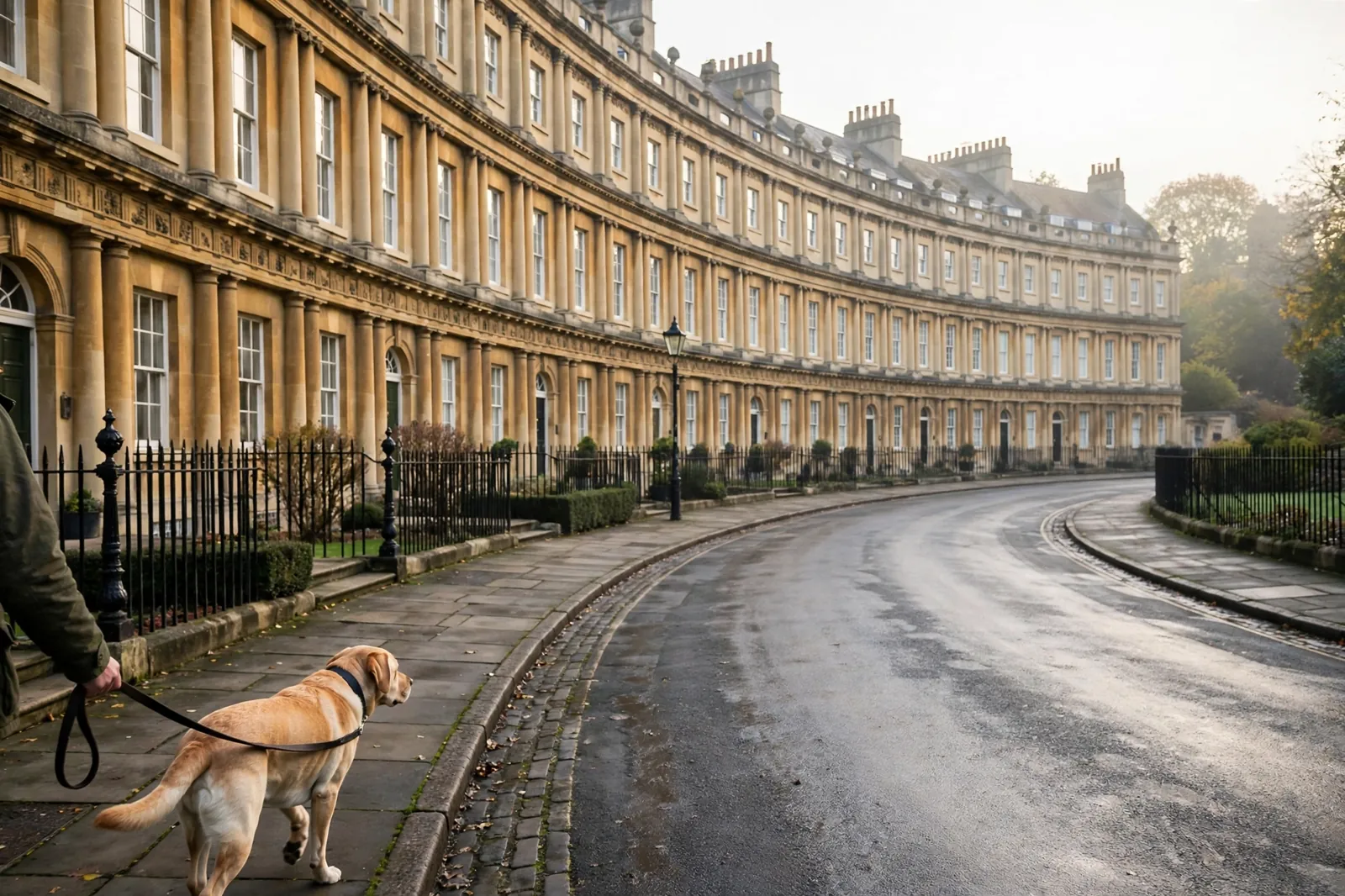
Marlborough's High Street is often described as the widest high street in Britain, and standing in the middle of it on a quiet weekday morning makes the claim easy to believe. The street runs in a long, gentle curve along the old London to Bath road, the A4, and it is wide because it was built as a market place as much as a road: stalls, coaches, carts and crowds all needed room, and the town never narrowed it back down. That width is exactly what makes it pleasant with a dog. Where most market towns squeeze walkers, dogs and shop displays into a narrow pavement, Marlborough gives you space to pass another dog without a stand-off, to let a nervous dog step aside, and to pause at a shop window without blocking the footway.
The street is lined with a mix that rewards a slow wander. Georgian and Victorian frontages stand beside timber-framed buildings, and the Merchant's House on the north side is a fine sixteenth-century silk merchant's house that opens to visitors on some days of the year. St Peter's Church stands at the eastern end of the High Street, and the Town Hall sits near the middle, a useful landmark if you are meeting someone or working out where you parked. The Castle and Ball, a former coaching inn, faces the street from the south side, and its garden and bar are natural first and last stops for a dog walk that starts and ends in town.
Market days fall on Wednesday and Saturday, and on those days the centre of the street fills with stalls selling food, plants, clothing and household goods. The market is worth timing a visit around if your dog is comfortable with crowds, because the stalls bring the town to life and give you a reason to linger. If your dog is not, the same width that makes the street easy on a quiet day becomes a crowd of legs and wheels on a market morning, and an early or late visit is the better plan. Either way, keep a short lead through the market itself: the stalls are close together, dogs weave between legs, and a long lead across a busy stall front is a trip hazard for everyone.
Practical details matter here more than in a village, because the A4 runs straight through the town. Traffic moves slowly along the High Street, but the junctions at either end are busy, and the road narrows again once you leave the wide stretch. Cross at the marked crossings, especially with a dog that pulls, and remember that the broad central area is partly used for parking, so cars are pulling in and out where you might expect only pedestrians. The George Lane car park, just off the High Street, and the Polly Gardens car park are the usual choices for a longer stay, and both leave you a short walk from the shops and the river. On a summer Saturday the town fills up, so arriving before ten in the morning is the simplest way to park close and walk the street while it is still calm.
One more thing the width buys you is shade and shelter in bad weather. The shop canopies along the High Street give dogs and owners somewhere to duck out of a shower, and the covered arcades and doorways mean a rainy browse is still possible without dragging a wet dog through every shop. Dogs are not generally expected inside the shops, but several High Street retailers keep a water bowl by the door in summer, and the cafes with pavement tables are used to dogs settling underneath. The street rewards the dog that can settle for ten minutes while you finish a coffee, and it is a good place to practise that skill precisely because there is room to sit a little apart from the flow of people.
Savernake Forest on the doorstep
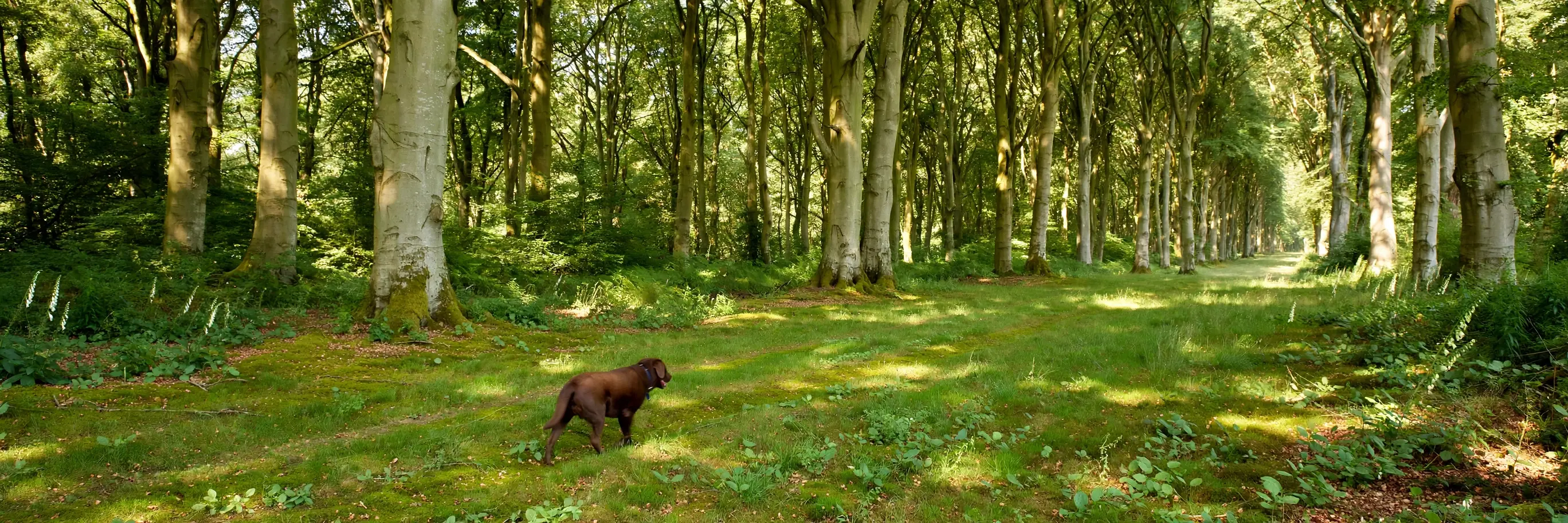
Savernake Forest is the reason many dog owners choose Marlborough over the dozen other Wiltshire market towns. The forest begins a short walk to the south-east of the town, and it covers roughly four and a half thousand acres of ancient woodland, most of it managed by Forestry England and free to enter on foot. The defining trees are beeches: tall, smooth-barked, and planted in long straight rides that were laid out in the eighteenth century. The most famous of these is the Grand Avenue, a beech-lined ride that runs for miles through the forest, and on a still autumn morning, when the leaves turn copper and the light comes through in shafts, it is one of the finest dog walks in southern England.
The forest is old in a way that is hard to miss. Some of its oaks are said to be around a thousand years old, and the best known is the Big Belly Oak, a vast, hollow-trunked tree near the A346 that has been a landmark for centuries. Fallow deer and roe deer live in the forest, and you are likely to see them at dawn or dusk, standing in the rides or moving through the bracken. That is the single most important thing to know before you let a dog off the lead here: a dog that chases deer is a danger to the deer, to itself, and to other forest users, and the forest is not the place to find out whether yours will. Keep dogs on a lead where deer are visible, and use a long line on the open rides if recall is not rock solid.
Getting into the forest is straightforward. The main car park is at Postern Hill, on the A346 south of Marlborough, and it is free, with room for cars and a straightforward walk into the trees from the gate. From the town centre you can also walk in along the lanes through Manton, which is the prettier way and the one this guide's circular walk uses. Forestry England maintains waymarked trails through the forest, including shorter loops near Postern Hill and longer rides that cross the whole wood. The surfaces are mostly natural — grass, leaf litter, earth and gravel — so they are easy underfoot in dry weather and properly muddy after rain, especially in the low, clay parts of the wood. In spring the forest floor fills with bluebells and wild garlic in the damper corners, and in summer the beech canopy gives deep shade that makes Savernake one of the coolest walks in Wiltshire on a hot day.
There is no cafe or shop inside the forest, and no water taps on the rides, so carry water for the dog and for yourself on a warm day, and plan your food stop for before or after the walk. Horses and cyclists use the same rides, and logging work moves around the forest through the year, so a lead is sensible on the main rides even when the forest looks empty. Forestry England closes some areas during felling, and the signs at the car park and at ride junctions are the reliable source for which parts are open — check the official guidance before you travel, because a ride you walked last year may be closed for a season while trees are thinned. The forest is also a working landscape of timber and game, so keep to the rides and tracks rather than pushing through dense undergrowth, and keep dogs out of the small ponds and streams where they are fenced or signed.
For dogs that need space, Savernake is generous in a way few forests are. The rides are wide enough for a dog to trot ahead on a long line without tangling with other walkers, and the side tracks are quiet enough that you can walk for an hour and meet only a handful of people. That is a real gift for a reactive dog, as long as you manage the moments that do bring other dogs into view: the car park, the Grand Avenue at weekends, and the junctions where trails meet. Arrive early, use the quieter eastern rides, and the forest feels like it belongs to you and the dog. Stay until late afternoon in autumn and the light through the beech canopy is worth the muddy boots on the way back.
Merlin's Mound and the college
Marlborough has a piece of prehistory sitting quietly in the middle of its most famous institution. Merlin's Mound stands in the grounds of Marlborough College, the public school founded in 1843, and it is a large, tree-covered mound that was long assumed to be the motte of a Norman castle. Research published in the late 2010s changed that story: radiocarbon dating of material from inside the mound suggested it was built in the Neolithic period, around 2400 BC, which would make it the second largest man-made mound in England after Silbury Hill, a few miles to the west near Avebury. Whether you call it a castle mound or a Neolithic monument, it is a remarkable thing to have at the centre of a school.
The important practical point is that the mound is not a visitor attraction. It stands inside the grounds of a working school, there is no general public access to it, and you should not try to reach it by climbing fences or crossing private land. You can see the college buildings and the mound's tree-covered shape from the road, and the story is worth knowing as you walk past, but the mound itself is one to admire from outside. If you want to stand on a prehistoric mound in this part of Wiltshire, Silbury Hill is the place to go: it is about seven miles west of Marlborough, beside the A4, and it is in the care of English Heritage, with the hill itself fenced off but the surrounding landscape open to walkers and their dogs.
Marlborough College shapes the town in other ways that a visitor will notice. The school's buildings, including the chapel and the Memorial Hall, give the southern side of the town a handsome, institutional character, and the college's playing fields and grounds run down towards the river. The school has educated generations of well-known pupils, and its presence is one reason the town has kept its bookshops, cafes and independent shops when other market towns have lost theirs. On school holidays the town is noticeably quieter, and on term-time weekends you will see pupils and families around the High Street. None of this changes the dog walk much, except that the lanes around the college are worth walking slowly: they are quiet, leafy, and a good way to link the High Street to the river and the forest without touching the A4.
The mound also connects Marlborough to the wider prehistoric landscape of the Marlborough Downs. The town sits at the edge of a chalk downland that holds Avebury stone circle, West Kennet Long Barrow, the Wansdyke earthwork and Silbury Hill, all within a short drive. If you are staying for a weekend, the natural pairing is a Marlborough day — High Street, river and Savernake — and an Avebury day, where the dogs can walk the stone circle and the Ridgeway with you. The Kennet valley links the two: the river rises on the downs above Avebury and flows east through Marlborough, so the water you see at the bottom of the town has already passed the stones.
The Kennet and the canal
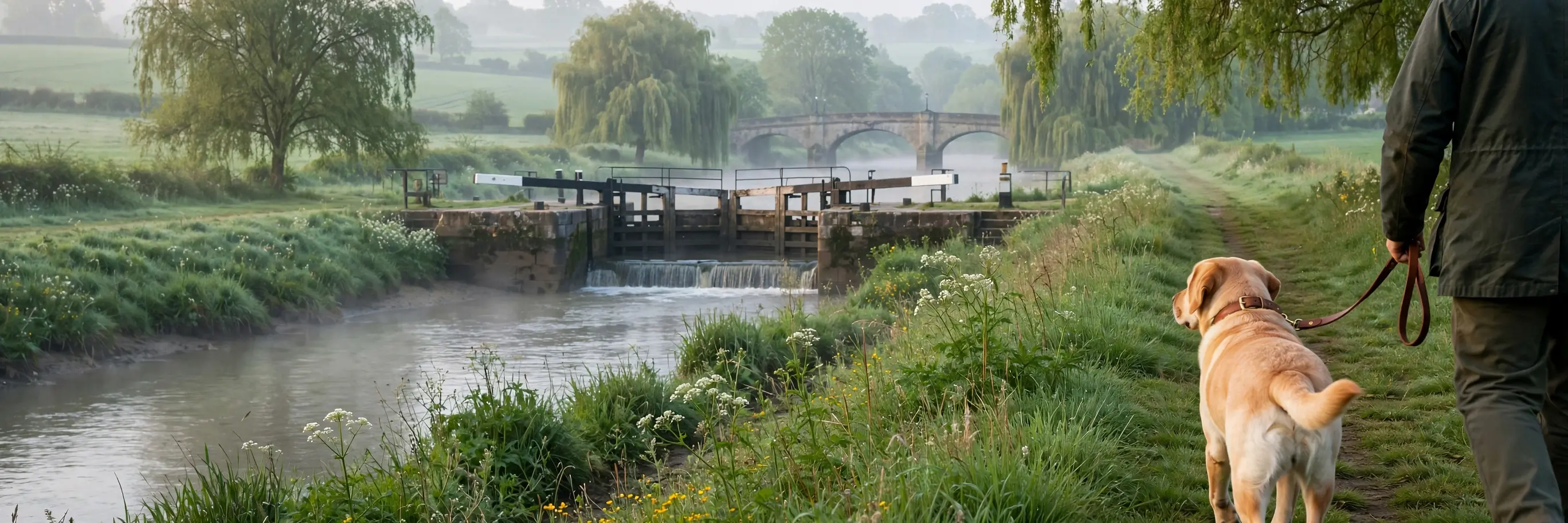
The River Kennet is the quiet thread that runs through a Marlborough dog walk. It is a chalk stream, which means the water is clear, cool and steady, fed by springs in the chalk downs rather than by surface run-off. It flows through the town near The Parade and St Peter's Church, then east past Manton and Mildenhall, and on through Hungerford and Newbury until it joins the Thames at Reading. Chalk streams are rare and fragile habitats, and the Kennet is one of the best known, famous for its trout and its water meadows. For a dog, the practical meaning is simple: clear water, shallow edges in places, and a river that stays cool in summer when other water is warm and stagnant.
The best place to meet the river in town is around The Parade, at the eastern end of the High Street, where the water runs beside the road and the churchyard. From there a footpath follows the river east towards Manton, a village that is effectively a suburb of Marlborough, with a church, a pub and a riverside that feels a world away from the A4. The path is level, grassy and easy, and it is the first leg of the circular walk in the last section of this guide. Dogs can paddle at the shallow edges where the bank is gentle, and many do on a warm day, but the river has deep pools and weirs, and the flow can be strong after rain, so choose a slow, shallow stretch and keep the dog away from weirs and fast water. Water levels change with the seasons, so check the official guidance before you travel, and be aware that the river is a working chalk stream with fishing rights and protected banks in places.
A few miles east of Marlborough, the Kennet meets its canal. The Kennet and Avon Canal was built in the late eighteenth and early nineteenth centuries to link the Thames at Reading with the Avon at Bath, and it opened in 1810. It runs through the Pewsey Vale, passing Wootton Rivers, Pewsey and Great Bedwyn, and it is now a leisure waterway of narrowboats, locks and towpaths. The nearest easy towpath walking to Marlborough is around Pewsey Wharf, about six miles east, and around Wootton Rivers, where a flight of locks climbs the hillside. The Crofton Beam Engines, near Great Bedwyn, are the canal's famous pumping station, and they steam on some weekends of the year.
Walking the towpath with a dog is straightforward but needs a lead. The towpath is narrow, cyclists use it, narrowboats pass close by, and the water is deep at the edge with steep banks in places. A dog that jumps in is hard to get out, and the canal is not a place for swimming: the water is slow, the banks are steep, and boats use it all year. Keep the dog on the towpath side, let boats pass before you, and use the wider spots at locks and wharves to pause. The locks themselves are worth stopping for: the gates, the beams and the water rushing through are a small piece of industrial history, and the lock-keeper's cottages and the wharf buildings give the canal a character that the river, for all its beauty, does not have.
The link between the river and the canal is also the link between Marlborough and two much longer walks. The Kennet joins the Thames at Reading, and from there the Thames Path runs for 184 miles to the sea, a walk our Thames Path guide covers in full. In the other direction, the canal runs west to Bath, where the Cotswold Way finishes after its 102 miles from Chipping Campden. Marlborough sits between those two long-distance routes, and it makes a natural base for a week that mixes a day on the Kennet, a day in Savernake, and a day on a longer trail further afield.
Pubs, cafes and stays
Marlborough eats and drinks well for a town of its size, and dogs are part of the picture rather than an afterthought. The Castle and Ball, the former coaching inn on the High Street, is the natural first choice: it has a bar where dogs are welcome, a garden for summer evenings, and rooms upstairs for an overnight stay. The Bear, also on the High Street, is another dog-friendly bar, and the Green Dragon, at the eastern end of the street, has long been a dog-friendly stop for walkers coming in from the river. All three are within a few minutes of each other, which means a wet afternoon can be spent moving between them without much walking at all. Policies change with seasons and management, so a quick call before you settle in is worth the minute it takes, and the bar rather than the dining room is usually the dog's place.
Outside the town, the Wellington Arms at Burbage, about four miles south of Marlborough, is worth the short drive after a Savernake walk. It is a thatched, dog-friendly pub with a garden, and it sits in a village that is itself a pleasant stop on the way back from the forest. In the other direction, the pubs at Manton and Mildenhall give you a riverside option at the end of the walk along the Kennet, and the canal-side pubs near Pewsey and Wootton Rivers are the reward for a towpath day. The pattern across all of them is the same: dogs are welcome in the bar and garden, water bowls appear without asking, and the busiest times are Sunday lunchtime and market-day Saturdays, when a table is worth booking.
For coffee and cake, the High Street cafes with pavement tables are the easy answer in summer, and several of them keep dogs in mind with bowls and a biscuit. The town also has bakeries and delis where you can buy sandwiches for a forest picnic, which is often the better plan on a Savernake day: the forest has no cafe, and a picnic on a beech ride beats a rushed lunch in town. Buy the food in Marlborough, walk to the forest, and eat it on a log at the side of a ride. The cafes are at their best on a rainy morning, when the town's covered doorways and the warm windows make a slow coffee a legitimate part of the day.
Staying overnight with a dog in Marlborough is straightforward. The Castle and Ball takes dogs in some of its rooms, and the Bear offers rooms too, so a night in the centre of town puts the High Street, the river and the forest all within walking distance. Beyond the hotels, the villages around the town — Manton, Mildenhall, Burbage and the hamlets on the edge of Savernake — have bed and breakfasts and self-catering cottages, some with enclosed gardens and direct access to the forest rides. When you book, the questions that matter here are specific to Marlborough rather than generic: is there a ground-floor room or a lift, because the old coaching inns have stairs; is the garden genuinely enclosed, because a terrier will test it; and how far is the nearest morning walk, because the best part of staying here is stepping out of the door and into Savernake before the town wakes up. A cottage near Postern Hill gives you the forest on your doorstep, while a room on the High Street gives you the pubs and cafes. Both work, and the choice is really about whether you want to wake to birdsong or to the market setting up.
One last practical note for an overnight stay: Marlborough is a small town, and the nearest vet is a short drive away, so save the number of the nearest practice before you need it, and keep it in your phone alongside the number of your own vet. The town's shops include a pet shop and a supermarket, so forgotten food or a spare lead is easy to replace, and the George Lane car park is close enough to the hotels that unloading a car full of dog things is not a chore. The town is compact enough that a weekend here never feels like a logistics exercise, which is exactly the point of choosing it.
A circular walk from the town
The best way to put Marlborough together is a single circular walk that links the High Street, the river, the forest and the downs. It is about seven miles long, it takes three to three and a half hours with stops, and it climbs gently rather than steeply, which makes it a fair day out for most fit dogs. Start from the George Lane car park, just off the High Street, and walk east along the street while the shops are still opening. Turn down towards The Parade and the river at the eastern end of the town, and follow the footpath east along the Kennet towards Manton. This first stretch is level and grassy, the river is on your right, and the church tower at Manton is your landmark. Keep the dog on a lead through the village itself, and let it paddle at a shallow edge only where the bank is gentle and the water is slow.
From Manton, climb south on the lanes towards Postern Hill. This is the steepest part of the walk, a steady pull up through fields and hedgerows, and it is where the town falls away behind you and the forest begins to close in ahead. At the top you reach the Postern Hill car park, the main gateway into Savernake, and from here the walk changes character completely: the lanes give way to wide, straight forest rides, the ground softens under leaf litter, and the beeches close overhead. Turn into the forest and follow the Grand Avenue west, a long beech ride that runs like a green corridor through the wood. If you have the time and the dog still has energy, detour to the Big Belly Oak, the ancient hollow oak near the A346, and back — it adds about a mile and it is the single most memorable tree in the forest.
The return leg leaves the forest over Granham Hill, to the south of the town. Climb out of the trees and the view opens up across the Kennet valley and the Marlborough Downs, and on a clear day you can see for miles. The Marlborough White Horse, a chalk hill figure cut into the hillside in 1804, stands on Granham Hill, and the viewpoint near it is a good place for a rest and a drink of water. The descent from Granham Hill brings you back down past the college and the mound, and from there the lanes lead you back to the High Street and the Castle and Ball. The last mile is the easiest of the day, downhill and familiar, and it is the right time for a slow finish rather than a rush.
A few warnings belong on this route rather than in general advice. The A346 cuts through Savernake Forest, and you will cross it or walk near it on the way to the Big Belly Oak, so keep the dog on a lead there and cross at a straight, clear stretch. Deer are present throughout the forest, most often at dawn and dusk, and a dog that chases needs a lead on the open rides. Sheep graze the downs around Granham Hill, so keep the dog close on the open chalk, and remember that the law expects dogs to be under control around livestock. The forest rides and the chalk paths are muddy after rain, especially in winter, and the clay sections of the forest hold water for days, so wear boots you do not mind getting dirty and carry a towel in the car.
If seven miles is too much, the walk shortens easily. Cut straight from the town to Postern Hill and back through the forest, which is about four miles and takes two hours, and still gives you the Grand Avenue and the best of the beeches. Or walk the river to Manton and back, which is about three miles on the flat and is the right choice for an older dog, a puppy, or a hot day when the forest shade is the point rather than the distance. In spring, time the walk for the bluebells; in autumn, for the beech colour; in summer, for the shade; in winter, for the clear views from Granham Hill and the empty rides. The town, the river and the forest are the same in every season, but the walk feels different in each of them, and that is a good reason to come back.
Marlborough rewards the visitor who treats it as a base rather than a stop. A day on the High Street, a day in Savernake, a morning on the Kennet and an afternoon on the canal towpath fill a long weekend without a car journey longer than twenty minutes. The town is small enough to learn in a day and deep enough to keep surprising you: a coaching inn, a Neolithic mound in a school, a chalk stream, a canal, and four thousand acres of beech forest, all within a few miles of each other. Bring a dog that likes to walk, a lead you trust, and a towel for the mud, and Marlborough will do the rest. If Bath is on your list as well, our Bath guide covers the Georgian city an hour to the west, where the Skyline and the canal walks make a natural second stop.
Practical questions
Before you go
Can my dog walk off the lead in Savernake Forest?
Yes, in much of the forest, as long as your dog is under close control and comes back when called. Keep the lead on near the car parks, the A346, and anywhere deer are visible, and use a lead on the waymarked trails when the forest is busy with horses, cyclists or logging work. Forestry England asks visitors to check the official guidance before you travel, because temporary closures and felling areas change through the year.
Is Marlborough High Street good for a dog walk, or is it just shops?
It works surprisingly well as a dog walk, because the street is so wide. The broad pavements and the central market area give dogs room to pass without being squeezed against shop fronts, which helps nervous and reactive dogs. Market days on Wednesday and Saturday are busy and noisy, so visit early or late if your dog dislikes crowds, and keep a short lead near the A4 traffic at either end of the street.
Where can my dog paddle near Marlborough?
The River Kennet has shallow, clear edges in places around the town and at Manton, and many dogs paddle there in warm weather. Water levels and flow change with the seasons, and the river is a chalk stream with deep pools and weirs in places, so choose a slow, shallow stretch, keep your dog away from weirs, and check the official guidance before you travel. The Kennet and Avon Canal is not a swimming spot: the water is slow, the banks are steep, and boats use it all year.
Are dogs allowed inside pubs and cafes on the High Street?
Several High Street pubs welcome dogs in their bars, including the Castle and Ball and the Bear, and most cafes with outdoor seating are happy to have a dog at an outside table. Policies change with seasons and management, and some places welcome dogs only in the bar or garden rather than the dining room, so it is worth a quick call before you settle in. The Wellington Arms at Burbage, a short drive south, is another reliable dog-friendly stop after a Savernake walk.
How long is the circular walk from Marlborough into Savernake Forest?
The full loop from the High Street, along the Kennet to Manton, up to Postern Hill, along the Grand Avenue and back over Granham Hill is about seven miles and takes most dogs three to three and a half hours with stops. A shorter version cuts straight from the town to Postern Hill and back, which is about four miles. Both routes mix surfaced forest rides with chalk paths on the downs, and both can be muddy after rain, so check the official guidance before you travel.
Can I visit Merlin's Mound?
Not as a public attraction. The mound stands inside the grounds of Marlborough College, which is a working school, and there is no general visitor access to it. You can admire the college buildings and the mound's tree-covered shape from the road outside, and the town's history is easy to follow from the High Street and the river instead. Do not climb fences or enter school grounds to reach it, and check the official guidance before you travel.