This guide is independent and contains no paid placement. If affiliate links are added later, they will be clearly marked and will not change our editorial checks.
Marlow is one of the easiest Thames towns to visit with a dog: everything a dog walker needs sits within a few minutes of the bridge. Cross Marlow Bridge on the pavement, let the dog stretch out in Higginson Park, walk the Thames Path toward Cookham or Henley, and finish in a riverside pub garden. Arrive by the branch line from Maidenhead or drive in via the M40, and park at West Street, Pound Lane or Liston Court.
A Thames town
Marlow sits on the north bank of the River Thames in Buckinghamshire, where the river bends sharply beneath a suspension bridge and the town has grown up around the crossing. It is a small place — a single High Street running back from the bridge, a church by the water, a riverside park, and houses climbing the hill behind — and that compactness is exactly what makes it work for a day out with a dog. Nothing on a sensible itinerary is more than a ten-minute walk from anything else, so a dog that has had a long walk can be back at the car or the station without a second expedition.
The town's history is tied to the river in a way that is still visible. Marlow was a market town and a coaching stop on the road between London and Oxford, and the Thames carried timber, grain and malt through it for centuries. The church of All Saints stands at the river end of the High Street, close to the bridge, and its tower is one of the landmarks you will use to orient yourself when you come back along the towpath. The Marlow Museum, in Court Garden House on Pound Lane, tells the town's story in a small space — it is worth a look if you are passing, though dogs will need to wait outside with one of your party, so check the official guidance before you travel if you plan to go in.
Getting to Marlow is straightforward. By train, the Marlow branch line runs from Maidenhead, where you change for services to London Paddington and Reading; the branch is a single-track line with a small two-carriage train, and Marlow station is a short walk from the High Street, just past the end of the shops. Dogs travel free on the train when kept on a lead, and the short hop from Maidenhead is one of the easier rail journeys you can make with a dog, because the platform at Marlow is quiet and the walk into town is level. By car, Marlow is reached from junction 4 of the M40 via the A404, or from the A4 at Maidenhead; the approach from the south crosses the river on the bridge itself, which gives you the town's best first view. Parking is in the town-centre car parks at West Street, Pound Lane and Liston Court. West Street is the most convenient for the riverside and Higginson Park, Pound Lane sits behind the High Street near the museum, and Liston Court is a short walk east of the centre. Charges, time limits and payment methods change, so check the official guidance before you travel, and arrive early on fine summer weekends, when the town fills with rowers, walkers and day-trippers.
Marlow works in every season, but it changes character through the year. In summer the riverside is busy with rowing boats, paddleboarders and swans, the pub gardens are full, and the town hosts the Marlow Regatta and the Marlow Town Regatta and Festival on the river in June — check the official guidance before you travel for exact dates, because the riverside paths get crowded and some stretches are fenced off for the events. In autumn the towpath is quieter, the trees along the river turn, and the town is at its most walkable. Winter brings low light across the water and far fewer people, which suits nervous dogs well, though the towpath can be muddy after rain and the meadows beside the river flood in wet winters, so check conditions before setting out. Spring is the season of goslings and ducklings along the bank, which means keeping a dog on a lead near the water's edge and resisting the urge to let an excited dog chase birds.
The shape of a good day in Marlow is simple and does not need improving. Arrive, cross the bridge on foot to take in the view, walk the dog through Higginson Park, take the Thames Path in one direction for an hour or two, come back along the High Street for coffee or lunch, and finish with a drink by the river. The rest of this guide works through each of those pieces in order, with the practical detail — where the lead goes on, where the shade is, where the water tap is, and which stretches are busiest — that makes the difference between a pleasant day and a frustrating one.
The bridge and the riverside
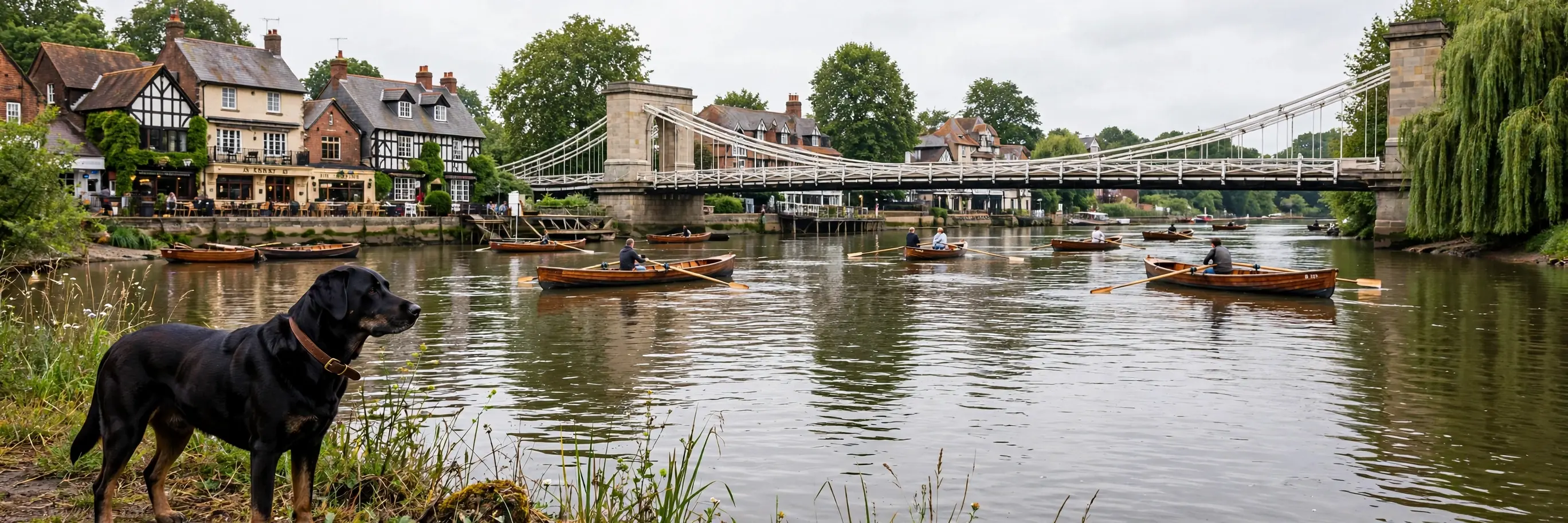
Marlow Bridge is the town's defining sight and the first thing most visitors cross, whether they arrive by car from the south or on foot from the station. It is a suspension bridge designed by William Tierney Clark and opened in 1832, and it is one of the most elegant river crossings in England: two stone towers, a deck hung from chains, and a view up and down the Thames that rewards anyone who stops halfway. Dogs can cross on the pavements on either side, on a lead, and the crossing is short enough that even a dog that dislikes bridges will manage it. Keep your dog on the pavement side, away from the roadway, because the road is narrow, traffic passes close, and the bridge carries a steady stream of cars, vans and cyclists. The pavement itself is not wide, so if your dog is large or tends to step sideways, walk on the inside and keep the lead short until you are off the bridge and onto the riverside path.
The view from the middle of the bridge is the photograph every visitor takes, and it is worth taking slowly. Looking downstream, the river bends away toward Bourne End and Cookham, with the weir and the lock below the bridge and the white frontage of The Compleat Angler hotel on the far bank. Looking upstream, the Thames runs toward Bisham and Temple Lock, with wooded banks and the occasional rowing eight gliding past. On a summer morning the river is busy with rowing boats from the Marlow Rowing Club and with pleasure craft, and the swans that live along this stretch of the Thames patrol the water beneath the bridge with complete confidence. Dogs notice all of this — the movement on the water, the ducks, the moored boats — so this is a moment to keep the lead short and the dog's attention on you, especially if your dog has a strong chase instinct or has never seen a swan at close range.
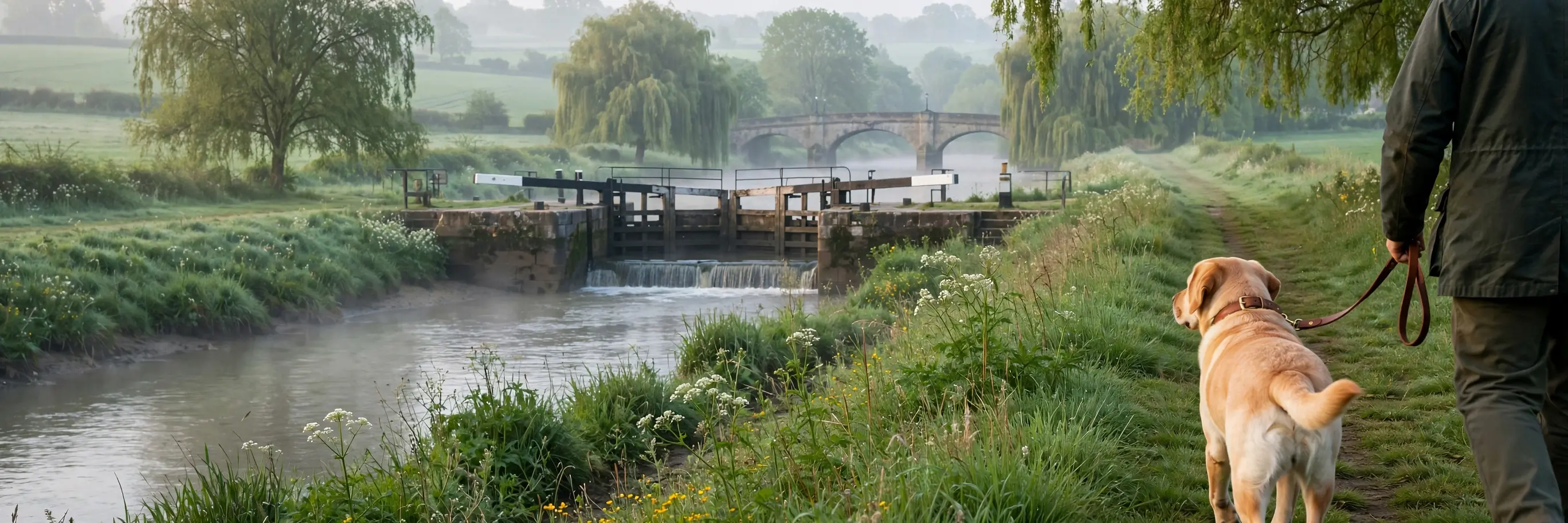
Below the bridge, Marlow Lock sits beside the weir, and the lock-keeper's garden and the lock gates are part of the riverside scene. Watching a boat go through the lock is one of the quiet pleasures of a Marlow morning, and dogs usually find the gates, the water and the lock-keeper's movements fascinating. Keep your dog well back from the lock edge and from the weir, where the water moves fast and the banks are steep, and never let a dog swim near a weir or a lock. The riverside path runs from the bridge down past the lock and along the bank, and it is a good place for a short lead walk before you decide which direction to take on the Thames Path proper.
The stretch of riverbank between the bridge and Higginson Park is where Marlow's social life happens. On a warm day there are families picnicking, children feeding the ducks, rowers carrying boats to the water, and dogs of every shape and size. The ground is mostly level grass and path, which suits older dogs and dogs that struggle with steps, but there are places where the bank drops to the water with no rail, so a dog that is likely to jump in needs to stay on a lead here. The Thames along this stretch is deep and the current is real, particularly after rain, and a dog that swims after a duck can be in trouble quickly. There are safer places for a dog to paddle further along the towpath, where the bank is shallow and the water is slow, and those are the places to use if your dog needs to cool off.
One practical point about the riverside: bins and water. There are litter bins along the riverside path and in Higginson Park, but they fill fast on summer weekends, so carry a spare bag and take waste with you if the nearest bin is full. There is no guarantee of a dog water tap on the bank itself, so carry water and a bowl, particularly in warm weather, and use the cafes and pubs on the High Street and by the river as your refill points. The riverside is at its best early in the morning, before the crowds arrive, when the light is low on the water and the only other walkers are dog owners doing the same circuit as you.
Higginson Park
Higginson Park is Marlow's riverside green, and it is the single most useful piece of open space for anyone visiting with a dog. The park runs along the north bank of the Thames just downstream of the bridge, a broad stretch of lawn with mature trees, a bandstand, a children's play area, a cafe and a riverside promenade. It is named after General Sir George Higginson, a Marlow resident and Crimean War veteran, and it has been the town's gathering place for generations — for fairs, concerts, regatta crowds and, on an ordinary weekday, for dog walkers.
For a dog, the park's appeal is simple: a large open lawn where a ball can be thrown, shade under the riverside trees, a flat path along the water for a lead walk, and other dogs to watch and greet. The park is not a fenced dog exercise area, and dogs are expected to be under control, so it is not the place to let a dog with poor recall run free among picnics and children. But for a dog on a long lead, or for a settled dog that stays close, it is an excellent place to burn off energy before a longer walk, or to wind down after one. The children's play area is fenced and separate, which helps, but keep your dog away from it and from the cafe terrace unless you are sure your dog will settle there.
The park's cafe sits near the river end and is a natural stopping point. It serves drinks and simple food, and on a fine day the terrace is busy with walkers. Dogs are generally welcome outside on the terrace, though arrangements can change with the season, so check the official guidance before you travel if the cafe is part of your plan. The bandstand hosts concerts in the summer months, and the park is the setting for the Marlow Town Regatta and Festival and for the town's fireworks and fairground events, so check the official guidance before you travel if you are visiting on an event day — the park can be fenced off in parts, the crowds are large, and a nervous dog will be much happier on the towpath away from the noise.
The practical details matter here. There are bins in the park, including dog waste bins, and the paths are level and mostly surfaced, which makes the park accessible for older dogs and for owners with pushchairs. The riverside edge of the park has no fence in places, so a dog that is tempted by the water needs a lead along the bank. In wet weather the lawn can be soft and muddy after heavy use, so bring a towel for the car if rain is forecast. The park is also the best place in Marlow to let a dog have a drink and a rest in the shade before you set off on the Thames Path, and it is where most local dog walkers start and finish their morning circuit — which means that if you are looking for local advice about where the path is muddy or where the swans are nesting, the other dog owners in Higginson Park are the people to ask.
One more thing the park does well is give a dog a sense of the town without the traffic. The High Street is a few minutes away, the bridge is visible from the lawn, and the river is always there, moving past at the bottom of the park. A dog that has had a run on the grass, a drink, and a sniff around the riverside path is a dog that will settle happily under a pub table afterwards, and that is the real purpose of Higginson Park in a Marlow day: it is the warm-up and the wind-down, and it makes everything else in the town easier.
The High Street
Marlow's High Street runs from the bridge and All Saints Church uphill and away from the river, and it is a handsome, well-kept shopping street rather than a grand one. The buildings are a mix of Georgian and Victorian frontages, many of them listed, with shopfronts that have been looked after. It is the kind of street where you can walk the whole length in ten minutes, stop for coffee, pick up supplies, and be back at the river before the dog has had time to get bored — and that is the right way to treat it with a dog: as a short, pleasant interlude between walks, not as a long shopping expedition.
The street's food shops are its strongest suit. There are independent butchers, bakers and delicatessens along the High Street and in the streets running off it, and a weekly market tradition that brings local produce into the town. For a dog owner, the useful purchases are practical ones: a bakery for sandwiches to take on the towpath, a deli for picnic supplies, and a pet shop or a shop that stocks dog treats for the walk home. Many of the High Street's smaller shops welcome dogs inside, particularly the independent ones, but there is no town-wide rule, so the polite approach is to ask before you step in with a dog, and to keep the dog close to your side in a narrow shop. A dog that will wait quietly by the door while you pop in for five minutes is a great deal easier to manage than one that has to be negotiated through every doorway.
Cafes and coffee shops line the High Street, and most have outdoor seating in the warmer months. The Ivy Marlow Garden, on the High Street, has a garden that is popular in summer, and there are several smaller cafes with pavement tables where a dog can sit beside you. The usual pattern in Marlow is that dogs are welcome outside and in some bar and cafe areas, but not everywhere, and the rules are set by each business rather than by the town, so check the official guidance before you travel if a particular cafe matters to you. If you are planning a long lunch, the riverside pubs covered in the next section are a better bet than a High Street cafe, because they are set up for dogs to settle for an hour or more.
The High Street also does the unglamorous jobs well. There are banks, a post office, pharmacies and a small supermarket within a short walk of the river, which means you can pick up anything you have forgotten — a lead, a towel, a bottle of water, a packet of treats — without driving anywhere. The streets running off the High Street, including West Street and St Peter's Street, are quieter and worth a wander with a dog: West Street leads to the West Street car park and to The Hand & Flowers and The Coach, two of the town's best-known pubs, and St Peter's Street runs down toward the river and The Two Brewers. Both streets are residential as well as commercial, so keep the dog on a lead, keep noise down, and remember that people live above the shops.
Parking and access on the High Street itself are worth a note. The High Street is a through road and it can be busy with traffic, so keep a dog on a short lead on the pavement and do not let the dog step into the road at crossings. The pavements are reasonably wide for a town of Marlow's size, but they narrow in places, and on a busy Saturday the combination of shoppers, pushchairs and dogs can make progress slow. If your dog is reactive or nervous in crowds, walk the High Street early in the morning or late in the afternoon, when it is quieter, and use the riverside path and Higginson Park for the main part of the day instead.
Pubs by the river
Marlow is famous for its pubs, and a dog owner visiting the town has a better choice than in most places of its size. The two riverside pubs are the obvious starting point. The Compleat Angler stands on the south bank by the bridge, a white-fronted hotel and restaurant named after Izaak Walton's book on fishing, with a terrace that looks straight across the river to the town and the bridge. Dogs are commonly welcomed in the bar and on the terrace, and the setting — boats on the water, swans drifting past, the bridge overhead — is the classic Marlow picture. The Two Brewers, at the river end of St Peter's Street on the north bank, is a smaller, more traditional pub with a riverside garden, and it is the kind of place where a dog can settle under a table while you have lunch. Both pubs are popular, both fill up on fine days, and both can change their dog arrangements with the season, so check the official guidance before you travel and ask staff where dogs are welcome when you arrive.
A short walk from the river, West Street holds two of the most celebrated pubs in the country. The Hand & Flowers, on West Street, holds two Michelin stars and is one of the best-known pubs in Britain; it is a dining pub rather than a drinking pub, and booking ahead is essential. The Coach, also on West Street, is its sister pub and holds a Michelin star of its own. Both are worth knowing about, but neither is a place to walk into casually with a muddy dog after a towpath walk — book ahead, ask about dogs when you book, and expect that the answer may be that dogs are welcome in the bar but not in the dining room. The Chequers, on the High Street, is another of the town's well-known pubs, and the George and Dragon on West Street is a more traditional local that is often a better fit for a dog owner who wants a straightforward pint and a quiet corner. The pattern across Marlow is consistent: the more food-focused the pub, the more likely dogs are restricted to the bar or the garden, and the more drink-focused the pub, the more likely a dog will be welcome inside.
The etiquette for taking a dog into a Marlow pub is the same as anywhere, but it matters more here because the pubs are busy and the tables are close together. Bring a mat or a blanket for the dog to lie on, so the dog has a defined place and is not sprawled across a walkway. Order at the bar rather than leaving the dog alone at the table, and keep the lead short and under your foot. If your dog barks at other dogs, choose a garden table or a corner away from the main route to the bar, and be ready to take the dog outside for a break. A dog that has had a good walk in Higginson Park or on the Thames Path will settle far more easily than one that has been in the car all morning, so time your pub stop after the walk, not before it.
Food in Marlow's pubs is generally good and often locally sourced, and the menus change with the season. The riverside pubs serve the kind of food that suits a walker's lunch — fish and chips, a ploughman's, a pie — while the West Street pubs are dining destinations in their own right. If you are visiting with a dog and you want a proper meal, the practical approach is to book a table in advance, tell the pub you are bringing a dog, and ask where dogs sit. That one phone call saves the awkward moment at the door when a dog that has walked three miles is told it cannot come in, and it also lets the pub put you at a table where the dog will be comfortable. In summer, the gardens are the easiest option: the dog has space, there is shade from the trees and umbrellas, and nobody minds a dog that is lying quietly under a table.
One last note on the riverside pubs: the river itself. The gardens of The Compleat Angler and The Two Brewers sit close to the water, and a dog that is off the lead in a garden can be at the riverbank in seconds. Keep the dog on a lead in a riverside garden unless you are certain the garden is fenced and the dog's recall is reliable, and never let a dog swim from a pub garden. The Thames here is deep, the current is strong after rain, and there are moored boats and swans to contend with. A lead, a mat and a bowl of water are all a dog needs to enjoy a Marlow pub garden safely.
Walks up the Thames Path
The Thames Path is the reason many dog owners come to Marlow, and the town is one of the best places on the whole trail to join it. The National Trail runs for 184 miles from the source of the Thames near Kemble to the Thames Barrier in London, and the stretch through Marlow is among the prettiest and the easiest: flat, well waymarked, and full of variety, with locks, meadows, wooded banks and village pubs. Our longer guide to walking the Thames Path with a dog covers the whole trail, including lead rules, flood-season advice and overnight stays, and it is worth reading if you are planning a multi-day walk. This section covers the walks you can do from Marlow in a day, in either direction, with a dog.
Downstream, the walk from Marlow to Cookham is about three miles and is the classic Marlow dog walk. Leave the town along the riverside path past Higginson Park, follow the Thames Path signs, and the path runs beside the river through meadows and past the houses at Bourne End, where the river bends and the path crosses the railway line. The walk is flat throughout, mostly on grass and surfaced path, and it takes about an hour each way at a dog's pace, with time to stop and watch the boats. Cookham itself is a quiet village with a church, a pub or two, and a green, and it is a good turning point for a walk of about six miles there and back. The path below Bourne End runs through meadows that can flood in winter, so check conditions before you set out in wet weather, and keep the dog on a lead where the path runs beside the river with no fence.
Further downstream, the path continues from Cookham to Maidenhead, passing under the Winter Hill woods and through more riverside meadow. This is a longer walk — Marlow to Maidenhead is about seven miles one way — and it is best done as a one-way walk with the train back from Maidenhead to Marlow, changing at Maidenhead for the branch line. The path is well waymarked throughout, and there are benches and locks to rest at along the way. Dogs should stay on a lead through the meadows where cattle graze in summer, and should be kept away from the riverbank where the path runs close to the water with a steep drop. The stretch between Cookham and Maidenhead is quieter than the Marlow to Cookham stretch, which makes it a good choice for a dog that is nervous around other dogs.
Upstream, the walk from Marlow toward Henley is longer and wilder. The Thames Path leaves Marlow past the lock and the weir, runs through Bisham, where Bisham Abbey stands on the far bank, and continues through Hurley and Medmenham toward Henley-on-Thames, about seven miles away. This is a full day's walk one way, and most people do part of it — Marlow to Hurley is about three miles, and Hurley has a riverside pub and a village green for a rest before the walk back. The upstream path is more wooded than the downstream path, with shaded stretches that are welcome on a hot day, and it passes Temple Lock and Hambleden Lock, both good places to stop and watch the boats. The ground can be muddy after rain, particularly in the wooded sections, so wear proper walking shoes and bring a towel for the dog.
Away from the river, Marlow has two shorter walks that are worth knowing. Quarry Wood, on the hill above the town, is a woodland walk with views back over Marlow and the Thames valley, and it is a good option when the riverside meadows are flooded or when you want shade and a change of scene. Marlow Common, to the south of the town across the river, is an open area of common land with paths through woodland and grass, and it is popular with local dog walkers. Both are shorter than a Thames Path walk and both can be combined with a riverside walk to make a circular route, though the paths are less well waymarked than the National Trail, so check the official guidance before you travel if you are unfamiliar with the area, and carry a map or a phone with a mapping app.
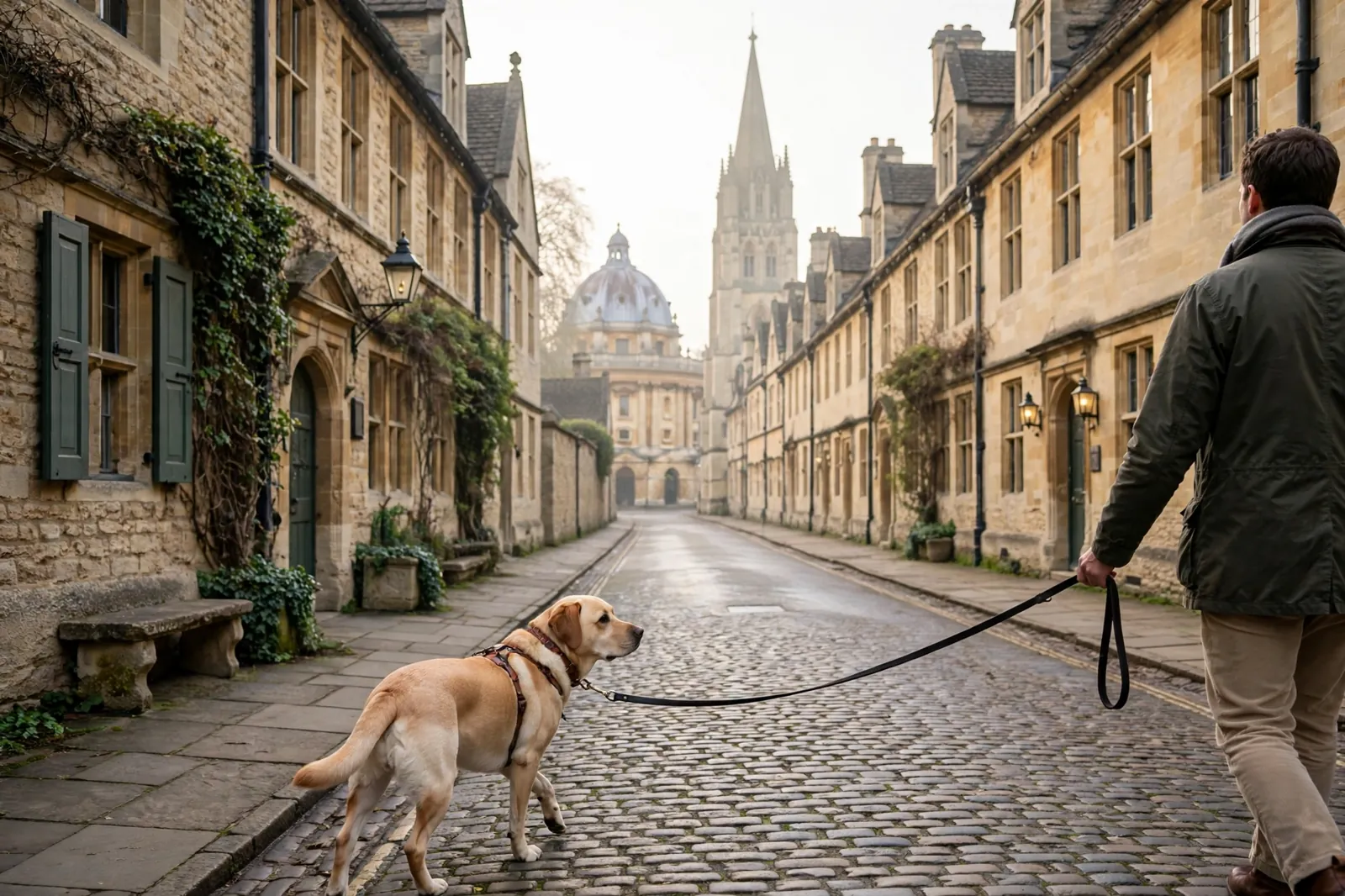
The practicalities of walking the Thames Path from Marlow are simple, but they are worth getting right. Carry water and a bowl, because there is no guarantee of a tap on the path itself, and the river water is not safe for a dog to drink in large quantities. Keep the dog on a lead near locks, weirs and roads, and near livestock — the meadows between Marlow and Cookham and between Marlow and Hurley are grazed, and the cattle are used to walkers but not to loose dogs. Pick up after your dog and use the bins in the town and at the locks, or carry waste home if the bins are full. In summer, watch for heat: the towpath has shade in places but the meadows are open, and a dog walking six miles in the midday sun needs regular water and rest stops. In winter, check the path conditions before you set out, because the riverside meadows flood and the path can be impassable after heavy rain. And if you are planning a longer walk — Marlow to Henley, or Marlow to Maidenhead and back by train — read our guide to Oxford with a dog for a sense of how a Thames town further upstream handles the same river, and how the walks, pubs and parking compare.
Practical questions
Before you go
Can dogs walk across Marlow Bridge?
Yes. Marlow Bridge is a public road bridge with pavements on both sides, and dogs on a lead can cross it. Keep your dog close on the pavement, as the roadway is narrow and traffic passes close by, and watch for cyclists using the bridge.
Are dogs allowed in Higginson Park?
Yes, dogs are welcome in Higginson Park. The park is a large riverside green with open lawns, paths and a cafe, and it is one of the easiest places in Marlow to give a dog a proper walk without leaving the town centre. Keep your dog under control around the children's play area and the cafe terrace, and check the official guidance before you travel for any seasonal event restrictions.
Where can I park in Marlow with a dog?
The most useful car parks for dog walkers are West Street, Pound Lane and Liston Court, all a short walk from the riverside and the Thames Path. Charges and time limits change, so check the official guidance before you travel, and arrive early on summer weekends and regatta days when the town fills up.
How far is the Thames Path walk from Marlow to Cookham?
The Thames Path from Marlow to Cookham is about three miles downstream, a flat and mostly easy riverside walk of around an hour each way at a dog's pace. It follows the river past Bourne End and the meadows below Winter Hill, and it makes a straightforward out-and-back walk or a one-way walk with a train or bus back.
Which riverside pubs in Marlow welcome dogs?
The Compleat Angler and The Two Brewers are the two best-known riverside pubs in Marlow, and dogs are commonly welcomed in their bar areas and gardens. Policies can change with the season and the time of day, so check the official guidance before you travel, and always ask staff where dogs are welcome when you arrive.
Is the Thames Path from Marlow suitable for older dogs?
Yes, the stretches either side of Marlow are among the easiest on the whole Thames Path: flat, mostly level towpath and meadow grass, with places to rest at locks and benches. The walk to Bourne End is about two and a half miles each way, so it suits an older dog well, and there is shade from riverside trees on warm days, though you should still carry water.