This guide is independent and contains no paid placement. If affiliate links are added later, they will be clearly marked and will not change our editorial checks.
Masham works best as a slow half-day or a relaxed overnight base: start in the market square, walk the River Ure loop on a lead, then settle into a brewery-town pub. Keep dogs on leads by the river and around livestock, arrive early on market days, and check the official guidance before you travel for market times, pub rules and abbey admission.
Market square and town centre
On a market morning, Masham wakes up in its square. Stalls go up around the wide, stone-paved centre, shoppers drift between them with baskets and dogs, and the smell of coffee and fresh bread moves through the air before the day has properly started. This is the best place to begin a visit with a dog, because the town shows itself all at once: the Georgian and Victorian stone frontages, the church of St Mary at one end, the narrow lanes running off the square, and the sense that this is still a working market town rather than a museum piece. Masham sits on the eastern edge of the Yorkshire Dales, where the River Ure runs past the town and the lower Dales begin to open out towards Wensleydale. That position explains much of its character. It is small enough to cross on foot in minutes, old enough that its market charter reaches back centuries, and practical enough that a dog owner can find water, shade, a bench and a quiet side street without much searching.
Start by walking the square slowly, on a short lead, before the stalls get busy. Dogs are commonly seen around the market, but a market is not a park. There are food stalls, low tables, children at dog height, other dogs on leads, and delivery vans pulling in and out at the edges. Keep your dog close to your side, on the pavement side of the stall line rather than in the middle of the flow, and watch for dropped food, which is the single most common cause of a market-day stomach upset. A dog that pulls, barks at other dogs or lunges at food will find the square hard work, and you will enjoy it far less. If that sounds like your dog, arrive early, do one calm circuit, and then slip away to the riverside while the square fills up. A calm dog that can settle at your feet will be far happier, and so will the stallholders.
The town centre rewards a slow look around. St Mary's Church, with its tall tower, anchors the square and gives you a landmark to navigate back to from any lane. The streets around it hold a mix of independent shops, cafes, a butcher, a bakery and a small supermarket, which makes Masham a useful place to stock up before a longer walk. Pop into shops one at a time rather than expecting to take a dog into every one: some welcome dogs, some do not, and policies can change, so ask at the door and be ready to wait outside with the dog while a companion browses. A dog that can wait calmly for five minutes outside a shop is a genuine asset in a town like this. Bring a mat for the pavement if the ground is cold or wet, and do not tie a lead to a stall, a signpost in a busy flow of people, or anything a passing dog could tangle with.
Look for the details that give Masham its brewery-town identity as you walk. Theakston's brewery has brewed here since the nineteenth century, and the Black Sheep Brewery, founded in the early 1990s, stands nearby. Their names appear on pub signs, shop windows and delivery lorries, and they explain why the town has more pubs than its size might suggest. The market cross and the old stone buildings are worth a pause, but do not let a dog climb on walls, drink from ornamental water or investigate cellar grates. Town centres hide hazards that look harmless: hot pavement in summer, grit and salt in winter, broken glass near bins, and food waste behind cafes. A quick scan of the ground ahead of your dog, especially a puppy or a determined scavenger, prevents most of the trouble before it starts.
Practical timing matters. Market days draw the biggest crowds and the fullest car parks, so a dog that dislikes crowds is better off visiting on a quieter weekday, when the square is calm, the lanes are empty and the riverside is yours. If you do come on a market day, aim for the first hour, when stallholders are setting out and there is still room to move. Bring water for the dog even on a cool day, because town walking with stops and starts is thirsty work, and there is no guarantee of a dog bowl at every cafe. Market days and stall times can change with the season, so check the official guidance before you travel rather than assuming the market you remember from a previous visit will run the same way.
Finally, treat the square as a base, not a destination in itself. Use it to get your bearings, buy supplies, and let the dog have a sniff and a settle, then head for the river. The best of Masham with a dog is not the shopping. It is the moment you leave the stone streets behind, cross towards the water, and hear the town go quiet behind you.
The River Ure riverside loop
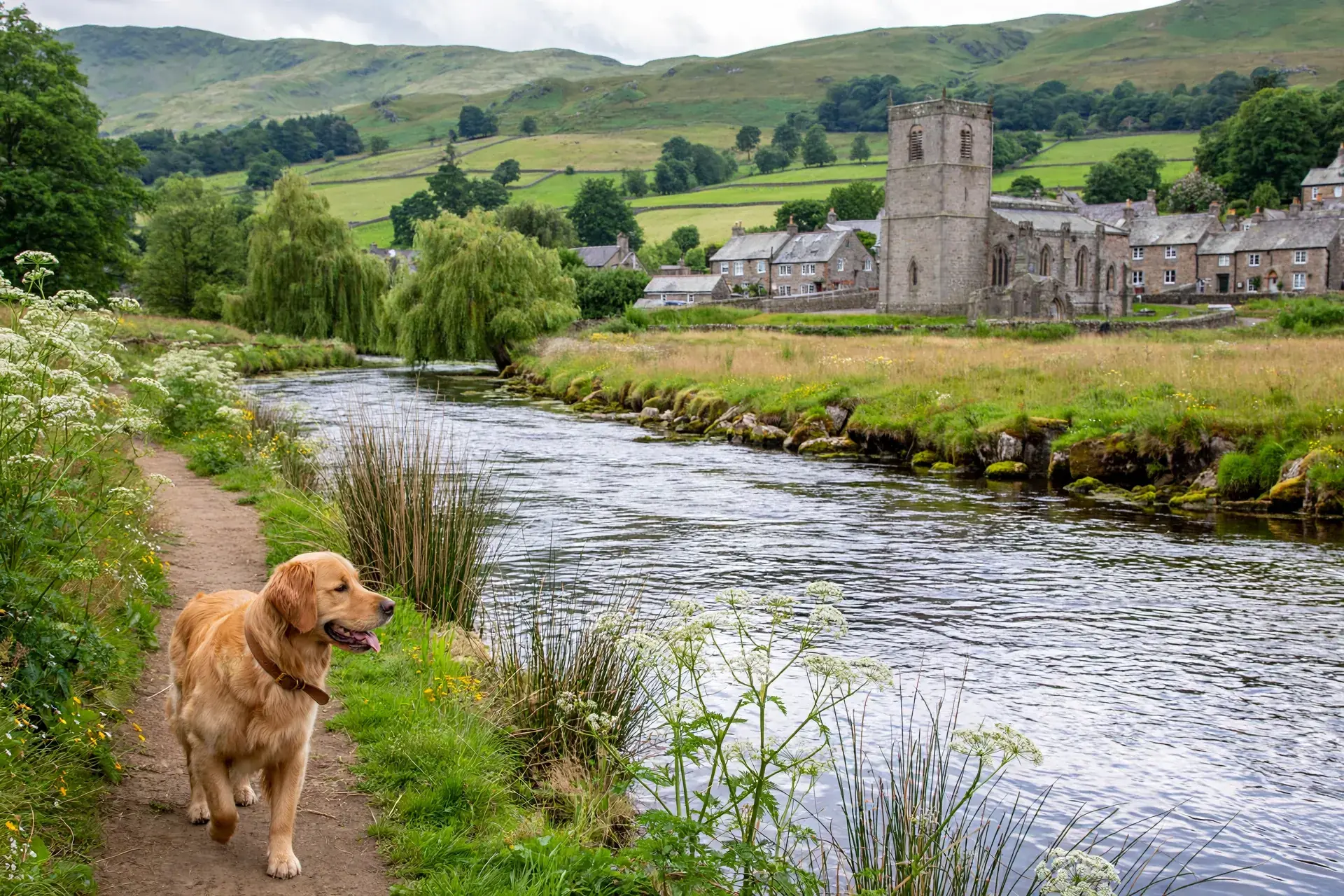
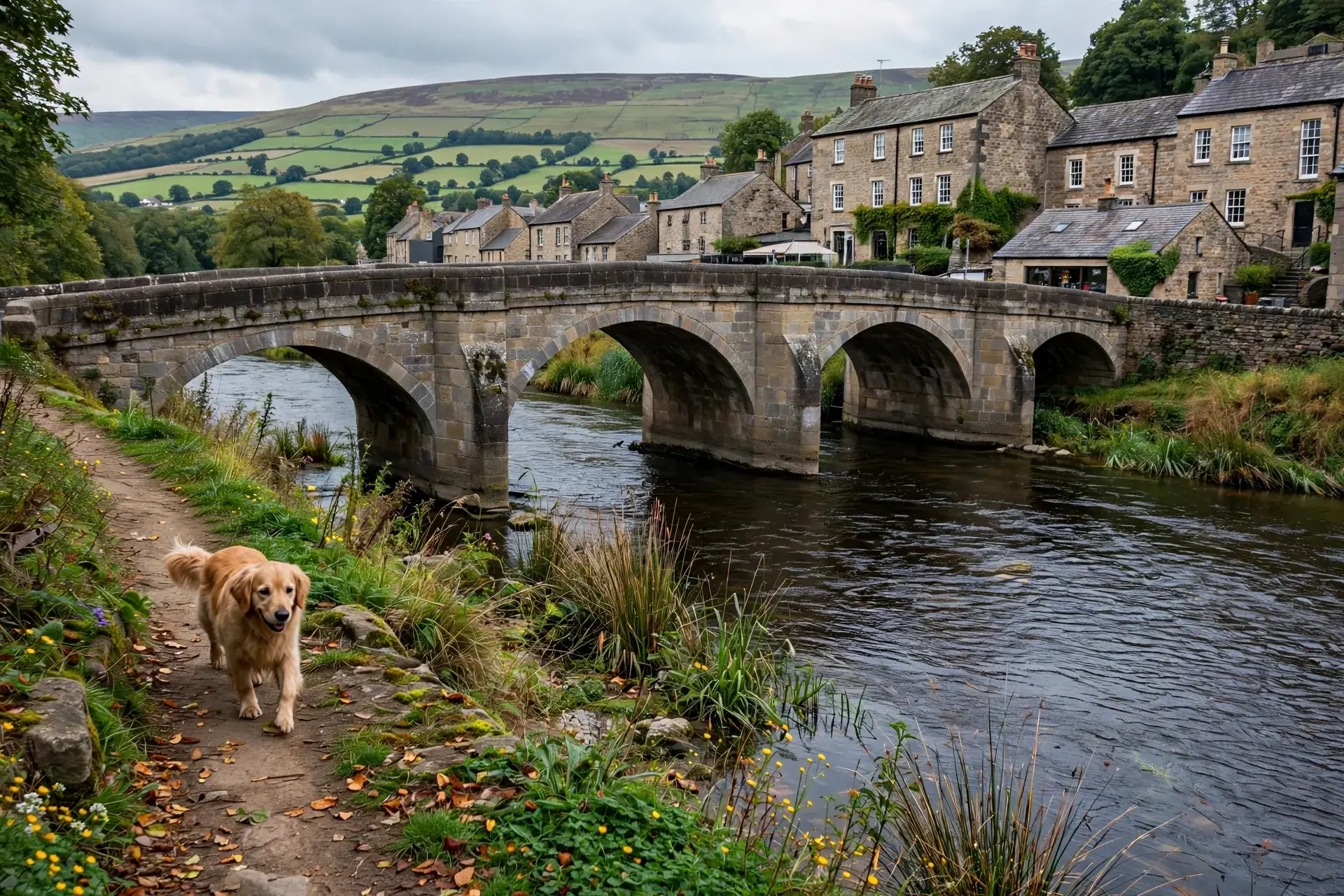
The River Ure is the walk that makes Masham worth the trip. The river runs past the town under a stone bridge, wide and calm in dry weather, fast and brown after rain, with grassy banks, riverside trees and views back towards the town and the hills beyond. The short loop from the town centre, down to the river and back, is the walk most visitors do first, and it is the right one: it takes roughly 45 minutes to an hour at a relaxed pace, it suits most reasonably fit dogs, and it gives you river, meadow, bridge and town in a single circuit. Start from the square, walk down towards the bridge, and follow the riverside path rather than the main road. Keep your dog on a lead from the start. The banks can be steep in places, the ground can be slippery after rain, and the river itself is deeper and stronger than it looks from the bank.
Water safety deserves a clear-headed paragraph, because rivers cause more dog emergencies than most owners expect. Do not let your dog swim in the Ure after heavy rain, when the current is strong and the water is high and cold. Do not let a dog jump from a bank or a bridge parapet into water of unknown depth, and do not assume a dog that swims well in a lake will cope with a river current. Watch for weirs, fast channels and submerged branches, and keep a lead on a dog that is tempted to chase ducks, swans or other water birds. A wet dog in a fast river can be swept downstream in seconds, and a person who jumps in after a dog is the second casualty in too many stories. If your dog does go in, call them to a shallow, sloping bank rather than wading in yourself, and carry a towel and a drying coat for the walk back. In summer, check the water for signs of blue-green algae before letting a dog paddle: if the water looks like green paint, has a scum on the surface or smells musty, keep the dog out entirely and check the official guidance before you travel for local warnings.
The loop itself is straightforward walking, but it changes with the seasons. In spring the banks are soft and the grass is long, which suits sniffing dogs and hides uneven ground, so watch a dog's footing on rabbit holes and tussocks. In summer the shade under the riverside trees is welcome, but the grass can hide ticks, so check your dog after the walk, especially around the ears, neck and belly. In autumn the leaves make the path slippery and the river often runs higher, and in winter the banks can freeze, the path can be muddy for weeks, and the light goes early. Good footwear matters as much as the dog's fitness: a riverside path that is a pleasant stroll in July can be a slide in January, and a dog that pulls on a lead will pull you over on mud. Use a lead with a comfortable grip, a harness that does not slip when wet, and a towel in your bag whatever the forecast says.
Livestock is the other rule of the riverside. Sheep graze in fields beside the Ure, and the law is clear that a dog worrying livestock can be shot by a farmer and the owner can be prosecuted. That sounds blunt, and it is meant to: keep your dog on a lead near any field with sheep, even if the sheep look far away, and never let a dog run through a field of livestock. Close every gate behind you, even if it was open when you arrived, and do not let a dog push under a fence to reach sheep. Birds nest on the banks in spring, and ground-nesting birds are easily disturbed by a dog running through long grass, so keep to the path in the nesting season and keep the lead short where the grass is tall. A dog on a lead is not a spoiled walk. It is the condition that keeps these paths open to dogs at all.
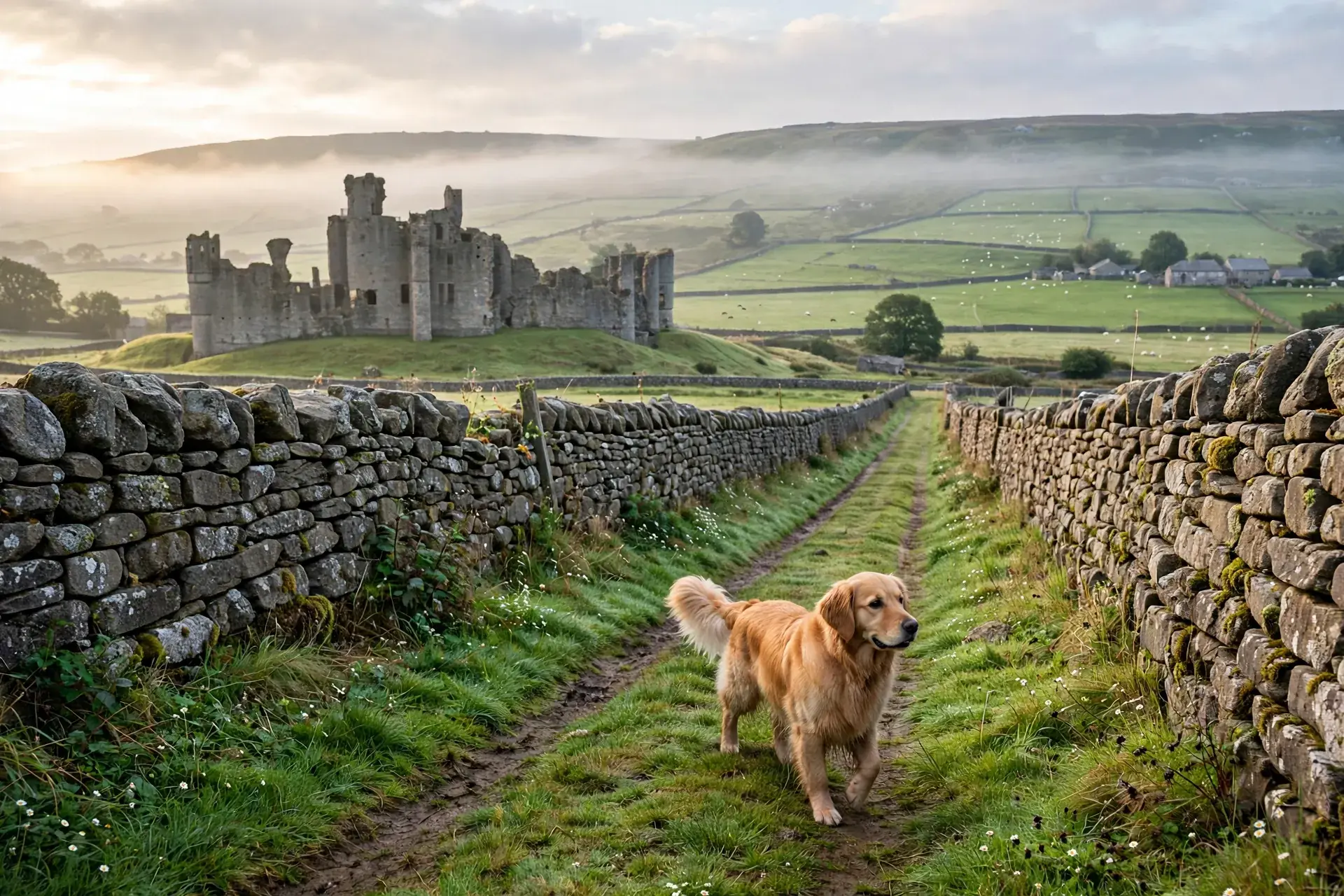
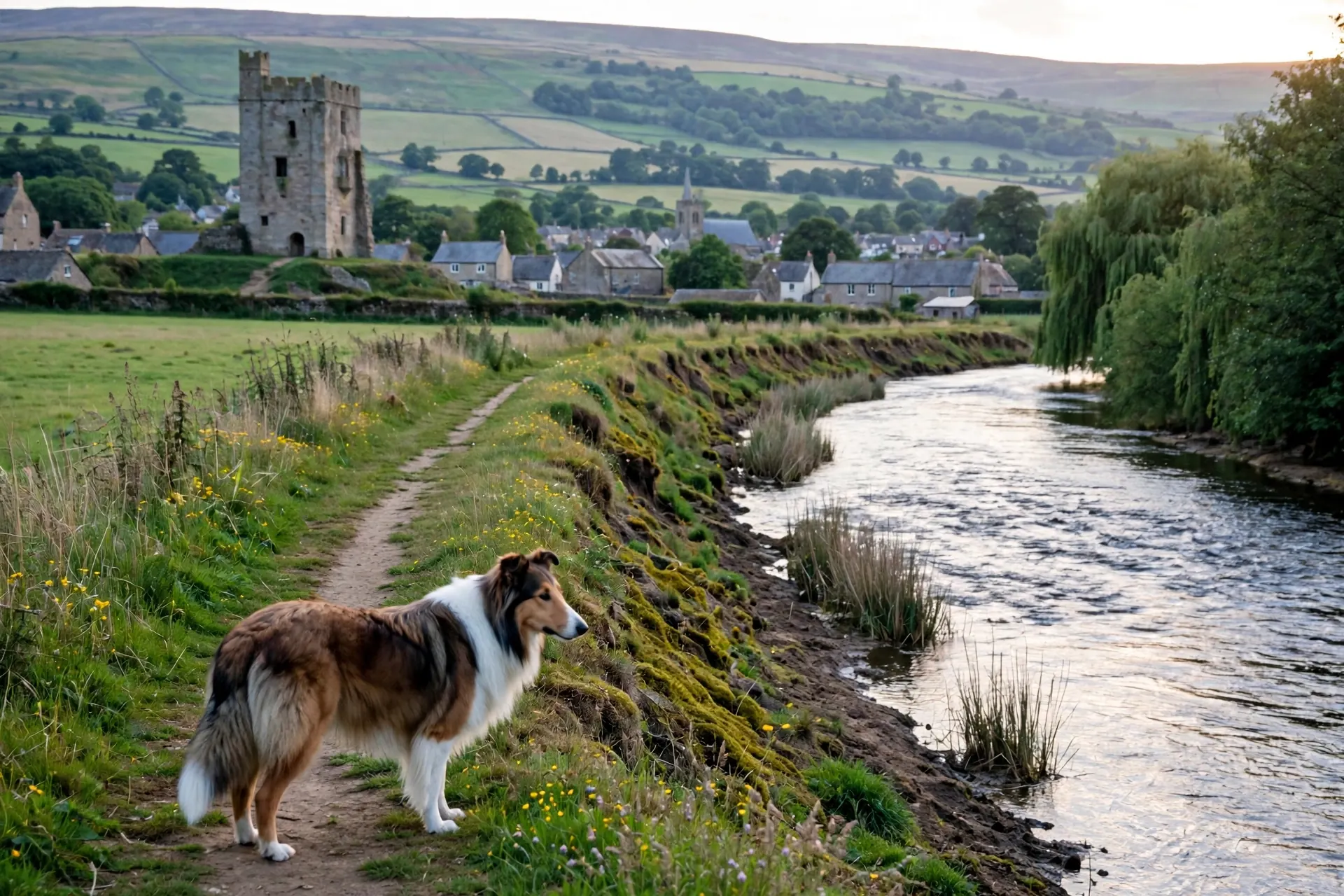
There are longer versions of the riverside walk for dogs that want more. Following the Ure downstream towards West Tanfield gives you a quieter, longer out-and-back walk through the valley, with the ruined Marmion Tower as a landmark at the far end. Following it upstream takes you towards the wider Dales and quieter lanes. Either direction can stretch a one-hour loop into two or three hours, but plan the turn-back point before you set off, carry water and a snack for the dog, and remember that a riverside path is not a circular route unless you know the return leg. A phone map, a charged battery and a note of where you parked will save a long, tired walk back along a road. If you are planning the West Tanfield direction, the guide to West Tanfield with a dog covers the riverside paths, the tower and the route back towards Masham in more detail.
End the loop the way you started it: slowly. Give the dog a drink, check paws for mud, grit and small cuts, and check for ticks if you have been through long grass. Let the dog settle on the bank for a few minutes before you head back into town, and use that pause to look back at Masham from the river. The view of the stone bridge, the church tower and the hills behind is the one most visitors remember, and it costs nothing but a few minutes of sitting still.
Breweries, pubs and food stops
Masham is unusual for a town of its size because it supports two breweries, and that shapes the whole visit. Theakston's has been brewing in Masham since 1827, and its Old Peculier is one of the best-known traditional ales in the north of England. Black Sheep Brewery was founded in 1992 by a member of the Theakston family, and its name is a deliberate joke about the family split. Both breweries sit close to the town centre, both run visitor experiences, and both give the town a working, industrial character that sits happily beside the market square and the river. For a dog owner, the practical question is not which beer to try. It is where the dog can sit while you try it, and whether the brewery visit itself welcomes dogs.
Brewery tours and visitor centres have their own rules, and they can change. Some welcome dogs in the shop or the bar area, some allow dogs only in outdoor areas, and some do not allow dogs on the tour itself because of moving vehicles, wet floors, hot equipment and food hygiene rules. Check the official guidance before you travel, and do not assume that a dog-friendly pub next door means the brewery tour is dog-friendly too. If a tour is not open to dogs, plan it as a human-only activity: one person tours while the other walks the dog by the river, or book a tour at a time when the dog can rest at your accommodation. A dog left in a car outside a brewery is never an acceptable plan, in any weather, and a dog tied up outside a visitor centre is a theft risk as well as a welfare problem.
The pubs are the easier and more rewarding part of the brewery story. Masham has several traditional pubs within a short walk of the square, and many welcome dogs in the bar area or on outdoor seating. That welcome is not a blanket rule, though. It varies by pub, by room and by time of day: a pub that welcomes dogs in the bar at lunchtime may ask dogs to stay out of the restaurant in the evening, and a pub that is quiet on a Tuesday may be too crowded for a dog on a Saturday night. Always ask at the door or check ahead, and accept a no gracefully rather than arguing the dog into a room where it is not wanted. A dog that can settle under a table on a mat, out of the way of staff carrying trays and food, will be welcomed back. A dog that barks at every person who walks past, begs from other tables or blocks the route to the bar will not.
Set your dog up for a good pub visit before you walk in. Exercise the dog first, so it is ready to settle rather than full of energy. Bring a mat or a blanket that smells of home, a water bowl or a collapsible bowl, and a chew or a stuffed toy that will keep the dog occupied without smelling strongly enough to bother other diners. Keep the lead short and under the table, not stretched across a walkway where a member of staff can trip over it. Order at the bar if that is the system, rather than leaving the dog alone at the table, and keep the dog's food and your food separate: pub floors collect dropped chips, bones and nuts, and a dog that scavenges under tables is at risk of choking or eating something harmful. If your dog is nervous in pubs, choose a quiet table near the door, keep the visit short, and leave while it is still going well rather than pushing through to the point where the dog starts to bark or pace.
Food stops beyond the pubs are worth planning too. Cafes in Masham vary in their dog rules, and many have outdoor seating where a dog is welcome even if the inside is not. Takeaway food eaten on a bench by the river is often the simplest and happiest option for a dog owner: the dog gets a riverside settle, you get a hot lunch, and nobody has to negotiate a crowded dining room. Buy from the bakery or the market stalls, bring a picnic, and sit somewhere the dog can lie down without blocking a path. Carry bags for rubbish and for dog waste, and leave the spot cleaner than you found it. If you do eat inside somewhere with the dog, check first whether dogs are allowed, whether there is a specific dog area, and whether the cafe provides water bowls. A cafe that welcomes dogs properly will have thought about all three, and a cafe that has not thought about them will tell you quickly by the look on the staff's faces.
A word on alcohol and dogs, because brewery towns invite a long lunch. Dogs should never be given beer, ale or any alcoholic drink, and a dog that laps spilled beer from a pub floor can become ill quickly. Keep the dog away from spilled drinks, and if you are drinking, plan your walk home rather than driving: Masham is a small town, and a slow walk back to your stay along a lit street is a better end to the day than a short drive with a tired dog and a driver who has had a pint. If you are staying overnight, ask your accommodation whether the dog can rest there while you have dinner in town, and whether there is a late toilet walk nearby, so the evening is planned rather than improvised.
Longer walks toward Jervaulx and Coverdale
Masham makes a good base for longer walks because it sits where the Dales begin. The two directions most dog owners ask about are south-east towards Jervaulx Abbey and west into Coverdale, and both reward a full morning or an unhurried afternoon. Neither is a short stroll from the square, so treat them as planned walks with a drive or a long out-and-back, rather than something to improvise after lunch. Check the weather, the ground conditions and the official guidance before you travel, carry water for the dog, and tell someone where you are going if you are walking alone in a quiet valley.
Jervaulx Abbey lies a few miles south-east of Masham, down the Ure valley towards East Witton and Middleham. The abbey is a ruined Cistercian monastery, founded in the twelfth century, and its standing stonework, grassy grounds and lakeside setting make it one of the most atmospheric ruins in the Dales. The walk from Masham is a long one, best done as a drive to the abbey followed by a walk in the grounds and the lanes around it, rather than a forced march along a busy road. Jervaulx is privately owned, with its own admission charges and dog rules, and dogs are generally welcome on leads in the grounds, but the details can change with the season and with events, so check the official guidance before you travel. Keep your dog on a lead among the ruins and other visitors, do not let dogs climb on the stonework, and keep them out of the lake and away from nesting birds. The grounds are a place to walk slowly and look, not a place to let a dog run free.
The lanes around Jervaulx and East Witton suit a longer, quieter walk. They are narrow, with passing places, stone walls and fields of sheep, and they reward a dog that walks well on a lead and a walker who is comfortable stepping into a gateway to let a car pass. The views open out towards the Dales, and the walking is gentler than the high fells, which makes it a good choice for older dogs and for dogs that are fit but not fell-fit. Pack a lead, a long line for safe open stretches, water, a snack and a towel, and plan a pub or cafe stop at the end rather than in the middle, so the dog is not asked to settle and then walk again on stiff legs. If you want to extend the day towards Middleham, the racing town a few miles further up Wensleydale, the guide to Middleham with a dog covers the castle ruins, the gallops, the river walks and the horse safety rules that matter there.
Coverdale, to the west of Masham, is a different kind of walk: a narrow, quiet dale with a beck running through it, stone villages, and a sense of being properly away from the main roads. The dale runs from the Ure valley up towards Carlton, Horsehouse and the higher moors, and the walking is a mix of riverside paths, lanes and open moorland edges. It suits a dog that is happy on varied ground and a walker who is comfortable with map reading, because the paths are less signed than the riverside loop in town. Keep your dog on a lead around sheep, which graze the dale freely, and be ready for ground-nesting birds in spring and for grouse moor management on the higher ground. The beck is shallow in places and tempting for a paddling dog, but it can be fast after rain, and the banks can be steep and slippery, so keep a lead on a dog that would jump in without thinking.
For a still longer day, the Ure valley itself is the thread that connects Masham to its neighbours. Walking downstream takes you through West Tanfield and on towards Ripon, while walking upstream takes you into Wensleydale, through Wensley and towards Leyburn. Wensley, a small village a few miles up the valley, has its own riverside paths, a historic church and a quiet, village-scale walk that pairs well with a Masham base. The guide to Wensley with a dog covers the village, the river paths and the fishing spots there, and it is worth reading if you plan to walk the valley in stages rather than doing one long day. Whichever direction you choose, remember that valley walking is not fell walking: the ground is lower and the paths are gentler, but the river, the livestock and the weather still set the rules.
Before any longer walk, run through a short checklist. Is the dog fit enough for the distance and the ground? Has it eaten and drunk before you set off, and have you packed water for the dog as well as for yourself? Are the dog's paws in good condition, with no cracks or sores that a long walk on stone tracks will worsen? Do you have a lead, a spare lead, poo bags, a towel, a first-aid kit and a charged phone? Do you know where the nearest vet is, and have you saved the number? And do you have a turn-back point, so that a dog that is tiring at the halfway mark is not forced to walk the same distance again? A longer walk that ends with a tired, happy dog and a quiet evening is a success. A longer walk that ends with a lame dog and a late, dark walk home is a lesson, and it is one you only need to learn once.
Parking, buses and arrival
Most visitors arrive in Masham by car, and the first practical question is where to park. There is public parking in and around the town centre, including spaces near the market square, but bays fill quickly on market days, at weekends and in the summer holidays. Arrive early if you can, especially if you need a space close to the riverside path so a dog does not have to cross the town in the heat or the rain. Check the official guidance before you travel for current charges, time limits and any changes to the car parks, because parking arrangements in small towns can change with little notice. Park with shade in mind in warm weather, leave windows open only if the dog is with you and the car is supervised, and never leave a dog in a car on a warm day: a car can reach dangerous temperatures in minutes, even with a window cracked open, and a dog in a hot car is an emergency, not a wait.
Arriving by bus is possible, but it needs planning. Masham is served by local bus routes that connect it to Ripon, Leyburn and the wider Dales, but services are infrequent, especially on Sundays and in the winter, and timetables can change. Dogs are generally allowed on local buses at the driver's discretion, usually on a lead and on the floor rather than on a seat, but the rules vary by operator, and a large dog on a busy bus can be refused. Check the official guidance before you travel, have a backup plan if the bus is full or cancelled, and be ready to walk the last stretch. A bus that drops you in the square is a good start to a walk, but a bus that does not turn up is a long wait with a dog in the rain, so carry a phone, a coat and a plan B.
The drive to Masham is part of the trip, and it is worth preparing the dog for it. The roads into the town are narrow in places, with stone walls, blind bends and farm traffic, and the last stretch from Ripon or Leyburn can be slow behind a tractor. Give the dog a toilet stop before the narrow lanes, secure the dog properly in the car with a harness, crate or guard, and keep the car cool and ventilated. A dog that travels badly will arrive stressed and will need time to settle before it can enjoy a walk, so build in a quiet half-hour on arrival: park, walk the dog gently around the square, offer water, and let it sniff and settle before you ask it to do anything else. A calm arrival sets the tone for the whole visit.
Once you are in town, the best way to get around is on foot. Masham is small, the square, the river, the breweries and the pubs are all within a short walk, and a car is more trouble than it is worth for moving between them. Leave the car parked, walk everywhere, and use the car only for the longer walks to Jervaulx or Coverdale. If you are staying overnight, ask your accommodation where to park for the duration of your stay, whether there is a charge, and whether the parking is close enough to unload a dog and luggage without a long carry. A parking space beside the door is a small thing that makes a large difference when you arrive with a tired dog in the rain.
Where to stay
Masham works well as an overnight base, because a single night turns a rushed day trip into a proper break. The town has pubs with rooms, bed and breakfasts, self-catering cottages and farm stays in the surrounding villages, and many of them welcome dogs. The right choice depends on your dog more than on the view. A dog that settles quietly in a room will be happy in a pub or a bed and breakfast. A dog that needs a garden, a dog that barks at noises in the corridor, or a household with two dogs will usually be happier in a self-catering cottage with its own outdoor space and a door that closes.
When you book, ask the questions that actually decide whether the stay works. How many dogs are allowed, and is there a charge per dog per night? Is there a garden or an enclosed area, and how high is the fence? Can the dog be left alone in the room for a short time, and if so, for how long and under what conditions? Are dogs allowed in the breakfast room or the bar, or do they need to stay in the bedroom? Is there a charge for damage or extra cleaning, and what counts as damage? Get the answers in writing with the booking confirmation, and keep them with you. A place that answers clearly and specifically has thought about dogs properly. A place that answers with a vague reassurance has not, and you will discover the difference at 11pm when the dog needs a toilet walk and the garden gate does not shut.
Pack for the stay as carefully as you pack for the walk. Bring the dog's own bed or blanket, so the room smells familiar, and a crate if the dog uses one at home. Bring food, a water bowl, a spare lead, poo bags, a towel and a drying coat, and a chew or a toy that will keep the dog occupied in the evening. Check the room on arrival for hazards: cleaning products under the sink, chocolate or biscuits left as a welcome gift, trailing cables, low windows and gaps under doors that a small dog could slip through. Photograph any existing damage and tell the host straight away, so you are not blamed for it later. Keep the dog's routine as close to home as possible: same feeding time, same last walk, same bedtime, and a quiet first evening rather than a late pub session that leaves the dog alone in a strange room.
Think about the morning as well as the evening. A good dog-friendly stay has a practical toilet walk from the door, without a road crossing or a long walk through the town in the dark. Ask the host where that walk is, and walk it on arrival so you both know the route. If the stay is in a village outside Masham, check whether the lanes are lit, whether there is a pavement, and whether livestock graze the fields beside the path. A self-catering cottage with a garden is worth more than a prettier room without one, because the garden is where the dog will spend the early morning and the late evening, and it is where a nervous dog will settle fastest.
Finally, be a good guest, because dog-friendly stays in small towns depend on it. Clean up after the dog, inside and outside. Keep the dog off the beds and the furniture unless the host has said it is allowed. Tell the host if the dog has had an accident, rather than hiding it. And leave a review that says honestly how the stay worked for a dog, so the next dog owner can make a better choice. Masham has a limited number of dog-friendly rooms, and a host who has a bad experience with one dog owner may stop welcoming dogs altogether. The stay you enjoy this year depends on the guests who came before you, and the stays available next year depend on you.
Vets and practical safety
Save the nearest vet's number before you need it. Masham has veterinary care in the town and in nearby Ripon and Leyburn, but opening hours, emergency cover and out-of-hours arrangements can change, so check the official guidance before you travel and save the number in your phone. Rural practices can be twenty minutes away by car, and the nearest emergency vet at night may be further still, so do not leave this until the dog is ill. Note the address as well as the phone number, because a satnav that cannot find a rural practice in the dark is no help at all. If your dog takes regular medication, bring more than you need for the trip, keep it in its original packaging, and carry a note of the dose and the prescribing vet's details.
Carry a small dog first-aid kit on every walk, not just the long ones. At a minimum, it should hold a spare lead, poo bags, a towel, a tick remover, saline solution for flushing eyes or wounds, a bandage and a muzzle that fits your dog, because even a gentle dog may bite when it is in pain. Know the basics: how to check for a tick and remove it cleanly, how to flush a cut, how to keep a dog warm after a cold-water swim, and how to recognise heatstroke, which can develop quickly in a thick-coated dog on a warm day. Signs of heatstroke include heavy panting, drooling, confusion, vomiting and collapse. If you suspect it, move the dog to shade, cool it with water on the belly and paws, offer small amounts of water to drink, and call a vet at once. Do not cover the dog in ice or plunge it into cold water, and do not wait to see if it improves on its own.
Sheep, cattle and horses are the most common animal hazards around Masham. Keep your dog on a lead around all livestock, even cattle that look calm, because a dog that runs at cattle can be kicked or trampled, and a cow with a calf can charge without warning. Do not let a dog chase horses on the lanes or on bridleways, and give horse riders a wide berth: step off the path, shorten the lead, keep the dog still and quiet, and let the horse pass before you move on. Adders live on the moors and the rough grassland of the Dales, and a dog that noses into a sunny bank in spring or summer can be bitten. If your dog yelps, swells around the face or a leg, or becomes suddenly lethargic after a walk on moorland, call a vet immediately and keep the dog calm and still on the way there. Do not try to suck out the venom or apply a tourniquet.
Other hazards are smaller but still worth knowing. Ticks are common in long grass and woodland from spring to autumn, and they can carry disease, so check your dog after every walk and remove any tick with a proper tick remover, twisting gently rather than pulling. Blue-green algae in the river in warm weather can be fatal to dogs, so keep dogs out of water that looks green, scummy or musty. Fallen fruit, mushrooms and fungi in autumn can be toxic, so do not let a dog eat anything it finds on a walk. And in winter, grit and road salt can burn a dog's paws, so wash paws after a walk on treated roads and check for cracks or soreness. A dog that is limping, licking its paws constantly or refusing to walk is telling you something, and the kindest response is to stop, check and rest, not to push on.
Identification and control are the quiet backbone of safety. Make sure your dog is microchipped, that the chip details are up to date, and that the dog wears a collar with an ID tag showing your phone number. In the UK, a dog in a public place must wear a collar with the owner's name and address, or a tag with those details, and the owner can be fined for failing to do so. Keep the lead on in town, on roads, on riverside paths and near livestock, and use a long line rather than a free run on open ground where you cannot see what is ahead. A dog that is under control is a dog that can be trusted with more freedom, and a dog that is out of control is a dog that will lose it.
Seasonal notes
Masham changes with the seasons, and the best visit depends on what your dog enjoys. Spring is the season of lambs, nesting birds and soft ground. The river runs high, the grass grows fast, and the lanes are quiet before the summer visitors arrive. Keep dogs on leads around lambs and nesting birds, watch for muddy paths after rain, and check for ticks as the grass grows. Spring is a good time for the riverside loop and for the lanes around Jervaulx, when the light is soft and the town is calm.
Summer is the busiest season, and the one that needs the most planning. Market days are crowded, car parks fill early, and the river draws swimmers, paddlers and picnics. Walk early in the morning or late in the evening, when the ground is cool and the paths are quiet, and rest the dog in the shade at midday. Never leave a dog in a car, carry water on every walk, and watch for hot pavement, which can burn paws in minutes. Check the river for blue-green algae before letting a dog paddle, and keep a lead on a dog that would chase ducks or swans. Summer evenings in a pub garden are one of the pleasures of Masham, but a pub garden at midday in a heatwave is no place for a thick-coated dog, so choose the shade, the water bowl and the early start.
Autumn is, for many dog owners, the best season in Masham. The crowds thin, the light turns golden, the leaves fall on the riverside path, and the pubs are warm and quiet. The river often runs higher after autumn rain, and the paths can be muddy for days, so pack a towel and a drying coat and choose footwear that grips on wet leaves. Mushrooms and fallen fruit appear in the woods and hedgerows, so keep a scavenging dog on a lead and do not let it eat what it finds. Fireworks around early November can unsettle noise-sensitive dogs, so check whether there are displays in the town or nearby, and plan a quiet evening indoors if your dog is afraid of bangs.
Winter in Masham is quiet, cold and beautiful, and it suits a dog that is happy in the cold and a walker who is prepared for it. The square is empty, the river is high and fast, and the hills are white on the coldest days. Walk in daylight, because the light goes early and the riverside path is not lit, and carry a torch and a charged phone. Grit and salt on the roads can sore a dog's paws, so wash them after a walk, and check an older dog's joints after a cold, damp walk: arthritis stiffens in winter, and a shorter walk on a level path is kinder than a long walk on frozen ground. Pubs with fires are the reward for a winter walk, and a dog that can settle by a fire on a mat is a dog that has had a good day. Check the official guidance before you travel in winter, because weather, road conditions and opening hours can all change at short notice, and a walk that is pleasant in November can be impassable in January.
Whatever the season, the rule that holds Masham together is simple: plan around the dog you have, not the dog you wish you had. A puppy, an older dog, a reactive dog and a fell-running collie will all have a different best day in this town, and the town is generous enough to give each of them one. Start in the square, walk the river, eat well, and leave the long walks for the days when the dog is fit and the weather is kind. Masham will still be there tomorrow, and the river will still be running.
Practical questions
Before you go
Can dogs go off lead by the River Ure at Masham?
In most places, no. Keep your dog on a lead on riverside paths, near the bridge, on farmland and wherever livestock may be present. The riverbank can be steep and slippery, the current can be strong after rain, and sheep graze in nearby fields, so a lead is the safe default. Use a long line only on open, quiet stretches where you have a clear view and no livestock, and recall your dog well before any gate, stile or road.
Is Masham market dog-friendly?
Dogs are commonly seen around the market square, but it is a working market with stalls, shoppers, food and delivery vehicles, so keep your dog on a short lead, close to your side, and out of the way of stalls. Visit early if your dog dislikes crowds, bring water, and be ready to step into a quiet side street if the square gets busy. Market days and stall times can change, so check the official guidance before you travel.
Which pubs in Masham welcome dogs?
Masham is a brewery town with several pubs, and many welcome dogs in the bar area or on outdoor seating, but policies vary by pub, by room and by season. Always ask at the door or check ahead before you settle in, keep your dog on a lead under the table, and bring a mat and water bowl. If a pub is busy or only has a restaurant area open, have a quieter backup in mind.
How long is the riverside walk from Masham?
The short riverside loop around the town takes roughly 45 minutes to an hour at a relaxed dog-walking pace, depending on how often you stop. Longer out-and-back walks along the River Ure towards West Tanfield or up towards the Dales can stretch to two or three hours. Allow extra time after rain, when paths are muddy and the river is high, and plan your turn-back point before you set off.
Is Jervaulx Abbey dog-friendly?
Jervaulx Abbey is a privately owned ruin with its own admission and dog rules, and dogs are generally welcome on leads in the grounds, but the details can change with the season and with events. Check the official guidance before you travel, keep your dog on a lead among the ruins and other visitors, and do not let dogs climb on the stonework or disturb wildlife in the grounds.
Where can I park with a dog in Masham?
There is public parking in and around the town centre, including spaces near the market square, but bays can fill quickly on market days and at weekends. Arrive early, park with shade in mind in warm weather, and never leave a dog in a car on a warm day. Check the official guidance before you travel for current charges, time limits and any changes to the car parks.