This guide is independent and contains no paid placement. If affiliate links are added later, they will be clearly marked and will not change our editorial checks.
Middleton-in-Teesdale is a waterfall walk first and a village break second. Start at the gentle rapids of Low Force, follow the Tees upstream to the great drop of High Force, and save Cauldron Snout for a longer, wilder day. Keep your dog on a lead near every fall, stay on the marked paths through the hay meadows, and check the river level before you set out.
The three falls, in river order
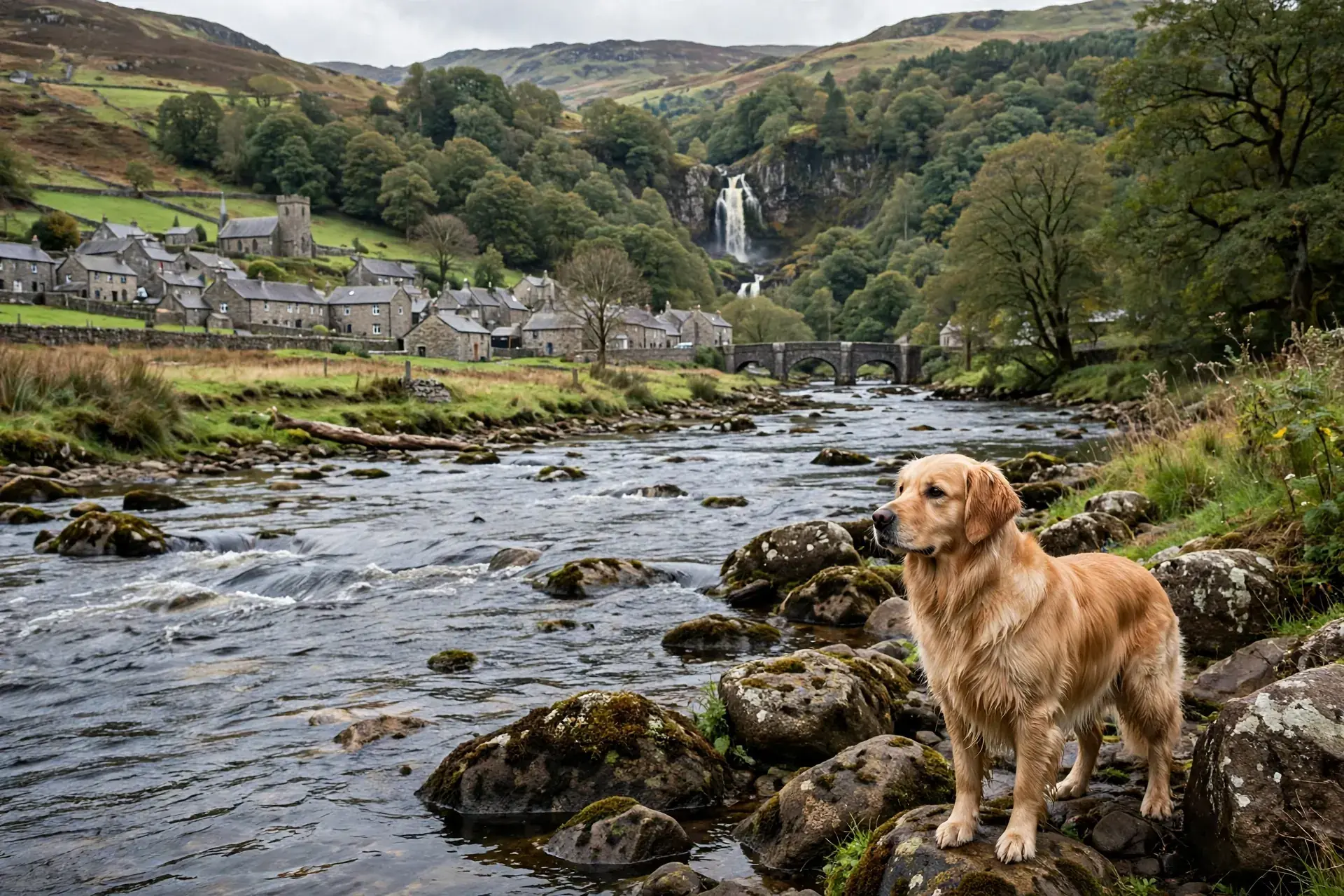
Most British river walks give you one waterfall and a long stretch of ordinary bank. The Tees at Middleton-in-Teesdale does something different: it drops three times in a short run of valley, and each drop has a different character. Understanding the order of the falls is the fastest way to plan a day with a dog, because the river changes as it falls, and the rules for your dog change with it. The falls run in this order as you walk upstream from the village: Low Force first, then High Force, then, much further up the valley, Cauldron Snout. Low Force is a scramble of ledges and channels rather than a single plunge. High Force is the famous one, a sheer drop of about 21 metres where the whole river pours over a lip of dark rock. Cauldron Snout is the longest waterfall in England, a cascade that tumbles for roughly 180 metres down a rocky staircase below Cow Green Reservoir. Three falls, three moods, and three different distances from the car park.
The reason the Tees falls so dramatically here is written into the rock. The river crosses the Whin Sill, a great sheet of dolerite, a hard dark igneous rock that was forced between layers of softer limestone and sandstone millions of years ago. The softer rock underneath wears away faster, so the hard dolerite is left standing proud as a lip, and the river has to drop over it. At High Force the effect is at its most theatrical: the water slides across a broad shelf of dolerite and then falls in one clean sheet into a deep, echoing pool. At Low Force the same rock breaks into a series of low steps, and the river splits into channels that braid around boulders and islands of grass. At Cauldron Snout the dolerite forms a long staircase, and the river descends it in a chain of white rushes rather than a single fall. Dogs do not care about geology, but the geology decides where the ground is slippery, where the spray reaches, where the path has to climb, and where a dog can safely stop for a drink.
Low Force is the easiest fall to reach and the best first stop. From the Bowlees Visitor Centre car park, a short riverside path leads downstream to a viewpoint where the river spreads across the rock in a lacework of small drops. The walk takes about fifteen to twenty minutes at a dog's pace, and the path is mostly level, which makes it a good warm-up for an older dog or a first visit. The falls here are low enough that the sound is a rush rather than a roar, and there is open grass nearby where a dog can settle while you look at the water. The rock at the water's edge is smooth and often wet, so keep your dog on a lead and do not let them pick their way across the ledges. The Wynch Bridge, a narrow suspension bridge a short distance downstream, crosses the Tees here, and crossing it on a lead is part of the experience: the deck moves slightly underfoot, some dogs hesitate at the open sides, and it is worth letting a nervous dog watch another dog cross first.
High Force is the centrepiece, and it deserves a slower approach. From Low Force, the riverside path follows the Tees upstream for about a mile, rising gently through trees and open bank until the sound of the fall reaches you before the sight of it does. The path is well worn and easy to follow, but it narrows in places, and the bank drops steeply to the river on one side, so a lead is essential. The main viewpoint sits across the valley from the fall, giving you the full width of the drop in one view: the dark cliff, the white water, the plume of spray that rises from the pool and drifts across the path on a windy day. There is also a lower viewpoint closer to the pool, reached by steps down through the trees. The steps are stone, often wet, and the spray can make them treacherous, so take them slowly, keep your dog close, and do not attempt them in icy conditions. The High Force Hotel stands nearby, a useful landmark and a place to ask about current path conditions, and the car park there gives an alternative starting point for visitors who want a shorter walk to the fall.
Cauldron Snout is a different kind of day altogether. It sits high in the valley, below Cow Green Reservoir, and the walk to it from the reservoir car park is about three miles each way across open moorland on the Pennine Way. The path is rougher, the weather is more exposed, and there are no cafes or shelters along the way, so this is a walk for a fit dog, a settled day and a proper pack. The reward is scale: instead of one dramatic drop, the river descends a long rocky slope in a continuous white rush, and the sound builds gradually as you approach, growing from a distant hiss to a full-throated roar. The path stays above the cascade for the most part, which is safer for dogs, but the ground near the edge is uneven and the wind can be strong, so keep your dog on a lead and well back from the lip. Many walkers combine Cauldron Snout with a look at Cow Green Reservoir itself, where the wide water and the open sky make a striking contrast with the enclosed, wooded valley lower down.
The three falls also change with the seasons, and the change matters for dogs. In summer, when the river is low, Low Force spreads thin across the rock and the pools between the ledges are shallow and clear, while High Force narrows to a thinner sheet and the spray barely reaches the path. In autumn and winter, after rain, the river swells, the falls grow louder and wider, and the spray at High Force can soak the viewpoint. In a hard frost, the edges of the pools freeze and the rock steps become glass. None of this makes the falls less worth seeing, but it changes what you ask of your dog: a summer visit is a gentle riverside stroll with a famous view, while a winter visit is a proper upland walk that needs warm layers, a torch and a willingness to turn back. Check the official guidance before you travel for current access, path closures and any seasonal restrictions.
Reading the river: safety distances and spray
Water is the whole point of a visit to Middleton-in-Teesdale, and it is also the main hazard. Dogs are drawn to moving water in a way that has nothing to do with caution: they chase spray, they wade after sticks, they drink from the edge and they do not understand that a river above a waterfall is a different thing from a river below it. Your job on this walk is to be the cautious one, and the rules are simple enough to hold in your head for a whole day. Stay back from the edge. Keep the lead short near any drop. Never let your dog swim or paddle above a fall, and never let them into a plunge pool. Bring your own drinking water so your dog does not need to drink from the river at all.
The danger at a waterfall is not only the drop itself. The rock around a fall is polished smooth by years of water and spray, and a surface that looks dry can be slick with algae or a thin film of moisture. Dogs slip on wet rock just as people do, and a dog that scrambles down to the water's edge can find itself on a ledge with no easy way back up, while the current pulls at its legs. At Low Force the risk is a tumble across the ledges and a soaking in fast, shallow water. At High Force the risk is far more serious: the pool below the fall is deep, the current is powerful, and the rock sides are steep and wet. The fencing and railings at the viewpoints are there for a reason, and they mark a line you should not cross with a dog on either side of it. If your dog is the sort that lunges at moving water, use a harness and a short lead, and keep them on the path side of the fence at all times.
Spray deserves more respect than most walkers give it. On a breezy day at High Force, the spray drifts across the viewpoint in a fine mist that soaks jackets, fogs glasses and turns the stone steps into a skating rink. For a dog, the spray is confusing: it smells of river, it stings the eyes, and it makes the ground unpredictable underfoot. Small dogs and short-coated dogs chill quickly when they are wet in wind, so a drying coat is worth packing even in summer, and a towel in the car is essential after a visit to the lower viewpoint. If the wind is driving spray across the path, enjoy the fall from the upper viewpoint instead, where you are further back and drier, and save the lower steps for a calmer day.
The river above each fall deserves a separate warning, because it looks deceptively calm. Above High Force the Tees runs broad and smooth across the dolerite shelf, and a dog could easily mistake it for a paddling place. It is not. The water is moving faster than it looks, the rock beneath it is smooth, and the lip of the fall is only a short distance downstream. The same applies above Low Force, where the river splits into channels that look shallow and inviting but run fast over slippery rock. The safe rule is absolute: no paddling above a fall, no exceptions, however hot the day or however keen the dog. Save the paddling for the slow, shallow stretches well below the falls, where the river has spread out, slowed down and lost its force, and even then only when the level is low and the water is clear.
It is also worth thinking about what is in the water, not just how fast it moves. After heavy rain the Tees runs brown with peat and soil washed off the moor, and it carries twigs, branches and occasionally larger debris. A dog that drinks from a river in spate swallows more than water, and a dog that chases a stick into fast water can be struck by floating wood. In dry weather the river is usually clear and clean, but the habit of carrying drinking water and a collapsible bowl is worth keeping on every visit, whatever the season. Offer water at regular stops, especially on warm days, and watch for the signs of a dog that has drunk too much river water or swallowed too much spray: coughing, retching or a sudden reluctance to keep walking are all reasons to stop, rest and watch them closely.
Finally, think about the other river users your dog will meet. Anglers fish the Tees, and a dog crashing through a quiet pool ruins their morning and can tangle a lead in a line. Canoeists and kayakers use the river in higher water, and a dog on the bank barking at a boat is a distraction nobody needs. Keep your dog close when you pass an angler, give them a wide berth, and do not let your dog chase birds along the bank: kingfishers, dippers and grey wagtails all work this stretch of river, and a dog splashing through their feeding ground does real harm. A lead solves most of these encounters before they start, and a short pause to let others pass costs you nothing.
Hay meadows, wildflowers and ground-nesting birds
Between the waterfalls, Teesdale offers something quieter and just as remarkable: hay meadows that are among the richest in England. The valley floor around Middleton-in-Teesdale is a patchwork of old meadows that have never been ploughed or heavily fertilised, and the result is a density of flowers that surprises first-time visitors. In late spring and early summer the fields turn yellow with meadow buttercup, purple with wood crane's-bill, and white with the nodding heads of globeflower, while rarer plants hide among them: spring gentian, a tiny deep-blue flower that grows in only a handful of places in Britain, and bird's-eye primrose, a delicate pink flower of damp, lime-rich ground. The meadows are not a garden and they are not a nature reserve with boardwalks and signs at every turn; they are working fields, cut for hay once a year, and the flowers are there because of the farming, not in spite of it.
The season runs roughly from late May to early July, and it changes week by week. Early in the season the damp hollows are at their best, with marsh marigold and cuckooflower in the wet corners and the first globeflowers opening on the drier banks. By mid-June the meadows are at full height, the grasses are waist-high, and the colour is at its strongest, with oxeye daisies, red clover, yellow rattle and meadow vetchling mixed through the sward. By early July the first fields are being cut, and the smell of new hay drifts across the valley. After the cut, the fields look suddenly bare and ordinary, which catches some visitors by surprise, but the cut is the point: without it, coarse grasses would smother the flowers within a few years. If you are planning a trip specifically for the flowers, aim for the second half of June, check the official guidance before you travel for current conditions, and accept that a wet spring or an early cut can shift the peak by a week or two in either direction.
Walking a dog through the meadows means walking with the farming calendar in mind. The fields are private land, and access is by public footpath, not by wandering at will. Stay on the marked paths, keep your dog on a lead, and do not let them run through the standing hay: a dog charging through waist-high grass flattens the crop, disturbs the insects that live in it, and can trample the very flowers you came to see. The paths themselves are usually mown or worn clear, and they give you a perfectly good view without leaving them. Pick up after your dog everywhere, and be particularly careful in the meadows: dog waste left in a hay field can contaminate the crop and spread disease to livestock, and farmers notice. Carry bags, carry them out, and use the bins in the village rather than leaving a bag tied to a fence post.
Grazing is part of the meadow system, and you will meet it. Sheep graze the valley fields for much of the year, and cattle are turned out onto some meadows after the hay cut. A dog that has never seen a cow can be startled by the size of one, and a dog that chases sheep is a danger to the flock and to itself. The law is clear that a farmer may shoot a dog that is worrying livestock, and the practical advice is simpler still: keep your dog on a lead whenever livestock are in sight, give grazing animals a wide berth, and never let your dog run between a cow and her calf. If your dog is nervous around cattle, cross the field at the far side, keep talking calmly, and do not pick a small dog up at face height, which can make a curious cow more interested rather than less.
The meadows and the moor above them are also nesting ground, and the breeding season changes the rules. From roughly March to July, ground-nesting birds such as curlew, lapwing, snipe, redshank and golden plover lay their eggs in shallow scrapes on the ground, often in exactly the kind of rough grass a dog loves to explore. The parent birds are easy to spot when they are alarmed: a curlew rises with its long, down-curved bill and its bubbling call, and a lapwing tumbles through the air with its broad wings and its pee-wit cry. If you see birds behaving like this, or a bird feigning a broken wing to draw you away, you are near a nest, and the right response is to put your dog on a lead, move away promptly and give the area a wide berth. Dogs off the lead in the breeding season are the single biggest avoidable disturbance to these birds, and a nest abandoned after repeated disturbance is a nest lost for the year.
Summer in the meadows brings smaller hazards that are easy to overlook. Ticks live in the long grass and bracken, and a dog that has spent a day brushing through the sward can pick up several, so check your dog thoroughly after every walk, paying attention to the ears, the armpits, the groin and between the toes, and carry a tick remover. Adders are present in the North Pennines, though they are shy and bites are uncommon; the sensible precaution is to keep your dog on the path rather than letting them nose into sunny banks and stone walls, and to know the signs of a bite, swelling, pain and lethargy, and the location of the nearest vet. Grass seeds are the most common summer complaint of all: the sharp awns of meadow grasses work their way into ears, between toes and under eyelids, so check paws and ears after a meadow walk and remove any seeds before they burrow in.
The village: market place, cafes and stays
Middleton-in-Teesdale itself is a small market town with a wide market place at its heart, stone houses climbing the hillside, and a feel that is more working Dales town than tourist honeypot. The market place is the natural centre of any visit: it is where you will park, where you will meet other walkers, and where you will find the shops, cafes and pubs that make the village a practical base rather than just a starting point for the falls. The town grew on lead mining and quarrying, and the stone buildings, the broad streets and the church of St Mary all carry that history in a quiet, unshowy way. There is no single grand attraction in the village, and that is part of the charm: the pleasure is in the scale of it, a place small enough to cross on foot in a few minutes, with the fells rising on every side.
For a dog owner, the village works best as a base camp. Start the day with a short loop around the quieter streets and the churchyard edge so your dog can settle and empty before the main walk, then head for the river. Come back in the afternoon for a late lunch or a drink, when the dog is tired and happy to lie under a table. The cafes and pubs around the market place generally welcome dogs, usually in the bar area or on outdoor seating, with water bowls provided, but policies change with the season and the management, so check the official guidance before you travel and ask at the door rather than assuming. A tired dog that lies quietly under a table is welcome almost everywhere; a restless dog that barks at every passer-by is not, so time your visit for after the walk, not before it, and bring a mat for your dog to settle on.
Eating out with a dog in a small village rewards a little planning. Order at the bar or the counter where that is the system, keep your dog on a short lead and out of the walkway, and avoid the busiest tables near the door where every arrival means a new distraction. If your dog is a beggar, feed them before you sit down and bring a chew or a stuffed toy to keep them occupied. If your dog is reactive to other dogs, choose a table in a corner and be ready to leave promptly if another dog arrives; a short, calm visit that ends well is worth more than a long lunch that ends in a scene. Takeaway food eaten on a bench in the market place is a perfectly good fallback on a fine day, and it suits many dogs better than a crowded room.
Staying overnight turns Middleton-in-Teesdale from a day trip into a proper break, and the village and the valley around it offer the usual Dales mix: pubs with rooms, bed and breakfasts, self-catering cottages and campsites, with larger hotels in Barnard Castle about eleven miles down the valley. When you book, ask the questions that matter for your particular dog rather than accepting a general promise of dog-friendliness. Ask how many dogs are accepted and whether there is an extra charge, ask whether the dog can be left alone in the room and for how long, ask whether there is a garden or an enclosed area, and ask where the nearest late-night toilet walk is. A cottage with a walled yard and a ground-floor bedroom suits an older dog far better than a first-floor room in a busy pub, however charming the pub. If you are comparing market towns for a longer Dales break, our guide to Middleham with a dog covers another racing and market town with a different kind of walking, and the contrast is a useful way to decide which valley suits your dog.
The practical geography of the village is simple, but worth knowing before you arrive. Parking is in the village car park near the market place, and it fills early on fine weekends and in school holidays, so arrive before mid-morning or be ready to use the car parks at Bowlees or High Force instead. The shops in the village cover the essentials, a small supermarket, a butcher, a bakery and an outdoor shop, but they are not open late, so buy dog food, bags and any forgotten kit before the afternoon. Mobile signal is patchy in the valley and disappears altogether on the high moor, so download your maps before you leave the village and do not rely on a live connection for navigation. The nearest vet is in Barnard Castle, so save the number before you need it and know the drive time from where you are staying.
Evenings in the village are quiet, and that suits most dogs. A short evening loop, a drink in a dog-friendly bar, and an early night is the pattern that works, and it leaves you fresh for a longer walk the next day. If you are staying for several days, the village makes a good base for exploring the wider North Pennines: the moor roads over to Alston and the South Tyne valley, the reservoirs at Cow Green and Grassholme, and the market town of Barnard Castle with its castle and riverside walks. Each of these is a separate day out with its own parking, its own lead rules and its own weather, so plan them one at a time rather than trying to stack them into a single long drive.
The waterfall loop, step by step
The best way to see both falls in one walk is a loop, and the loop works because the Tees gives you two different banks to walk on. The outward leg follows the river upstream on the northern bank, close to the water, through trees and open meadow. The return leg climbs higher, crosses the river, and brings you back along the southern side with wider views across the valley. Done from the village, the loop is a full day: roughly eight to nine miles, with around 250 metres of climbing, most of it in short pulls rather than one long ascent. Done from the Bowlees car park, it shortens to about four to five miles and becomes a comfortable half day. Either way, allow five to six hours from the village at a dog's pace, with stops, and carry food and water for both of you. Check the official guidance before you travel for current path conditions, closures and distances, because the riverside paths change with the seasons and after floods.
Step one is the walk out of the village to Bowlees. Leave the market place on the road west towards the waterfalls, then pick up the riverside path where it leaves the road and drops towards the Tees. This first stretch is gentle and open, with the river on your left and meadows on your right, and it is a good place to let your dog settle into a rhythm. Keep them on a lead: the path runs close to the road in places, and the fields beside it hold sheep. The walk to Bowlees takes about forty minutes, and the visitor centre there is a natural first stop, with information, toilets and a car park. If you started at Bowlees, this is where your walk begins, and the same advice applies: settle the dog, check the map board, and make sure you have water before you set off.
Step two is Low Force, and it is the easiest part of the day. From Bowlees, follow the riverside path downstream for a few minutes to the viewpoint over the ledges. Take your time here. The falls are at their best when you stop and look properly: the river splitting into channels, the water sliding over each step, the dippers working the rocks below. Let your dog have a drink from your bottle, not from the river edge, and keep them on the lead while you look. The path here is level and the ground is open, so it is a good place for a photograph, but remember that the rock is wet and the edge is unfenced in places, so keep your dog well back from the lip of the ledges.
Step three is the crossing of the Wynch Bridge, and it deserves a paragraph of its own because it catches dogs by surprise. The bridge is a narrow suspension bridge, and its deck moves slightly as you walk across it. Most dogs cross happily if you walk steadily and do not stop in the middle, but some hesitate at the sight of the water below through the gaps in the deck, and a few refuse altogether. If your dog balks, do not drag them. Let them watch another walker cross, encourage them with a treat held just ahead of their nose, and cross in one calm movement. If they will not cross at all, turn back and use the road bridge instead; there is no shame in it, and a frightened dog on a swaying bridge is a danger to both of you. Keep the lead short and the dog on the side away from the open edge, and do not let them stop to look down.
Step four is the riverside path from Low Force to High Force, the heart of the walk. The path leaves the open ground at Low Force, enters trees, and climbs gently as it follows the river upstream. The trees give shelter from wind and sun, and the path is soft underfoot, but it narrows where the bank is steep, and there are places where the drop to the river is sharp and unfenced. Keep your dog on a short lead through this stretch, and be ready to step aside for walkers coming the other way: the path is popular, and a dog on a long lead across a narrow path is a trip hazard. About halfway along, the trees open and you get your first glimpse of the valley above the falls, a wide green bowl with the river running through it. The sound of High Force reaches you before the sight does, a low rumble that grows as you approach, and dogs often prick their ears at it long before you can see the water.
Step five is High Force itself, and it is worth arriving with a plan. Go to the main viewpoint first, the one across the valley, where you get the whole fall in a single view. Let your dog settle on the grass while you look, and take your photographs from behind the fence. Then, if the steps are dry and your dog is steady, walk down to the lower viewpoint for a closer look at the pool and the rock face. The steps are stone and often wet, so go slowly, keep your dog on a short lead on the uphill side, and do not attempt the descent if the steps are icy or if the spray is driving across them. The lower viewpoint is impressive, but it is also the wettest and slipperiest part of the walk, and the upper viewpoint gives you the better photograph anyway. Allow at least half an hour at the fall, longer if you want to eat your packed lunch on the grass above it, where the ground is dry and the dog can rest.
Step six is the return, and it is where the loop earns its name. From High Force, instead of retracing your steps along the river, climb the path on the southern side of the valley, which rises through open ground with views back across to the fall and down the valley towards the village. The climb is the steepest part of the day, a steady pull of a few hundred metres that will have most dogs panting, so take it slowly, offer water at the top, and let your dog rest in the shade. The path then contours along the hillside, past dry stone walls and through pasture, before dropping back towards the river at a higher crossing point. This is the quietest part of the walk, and it is where you are most likely to meet sheep and ground-nesting birds in the breeding season, so keep your dog on a lead and stay on the path. The views from this side are the reward for the climb: the whole valley laid out below you, the river a silver thread, and the fells rising on either side.
Step seven is the descent back to the village, and it needs care. The path down is steeper than the climb, and after rain it can be muddy and slippery, so shorten the lead, keep your dog close, and take the descent in stages rather than hurrying. Watch for tired dogs here: a dog that has walked happily for five miles can start to flag on a steep descent, when the braking work falls on the shoulders and the pads are already sore. If your dog is slowing, stopping often, or limping, slow down, offer water, and consider whether the last stretch is better walked on the road, which is longer but flatter. The final approach to the village is along quiet lanes and the riverside path, and it is a good place for a last drink and a last look back at the valley before you reach the market place and the end of the day.
A few practical notes apply to the whole loop. Carry more water than you think you need, because there is nowhere to refill between Bowlees and High Force, and a dog walking for five hours in sun needs regular drinks. Pack a collapsible bowl, a spare lead, a towel and a small first-aid kit with paw balm, tick remover and a bandage. Wear boots with a good grip, because the rock steps and the muddy banks are treacherous in trainers. Check the weather before you leave the village and be ready to shorten the walk if the forecast turns: the loop is enjoyable in a shower, but it is miserable and potentially dangerous in a full Pennine storm, when the wind drives rain horizontally across the open hillside and the river rises while you are still on the path. For walkers planning a longer northern break, our guide to Northumberland with a dog covers castles, beaches and Hadrian's Wall walks further north, and the two regions pair well across a week.
After rain, in winter and in spate
The Tees is a spate river, which means it rises fast after rain on the moors and falls again almost as quickly. A river that is ankle-deep and clear in the morning can be knee-deep, brown and thundering by the afternoon after a storm over Cross Fell, and the change is easy to miss if you are walking in a wooded valley where you cannot see the sky. Learning to read the river before you set out, and while you are on the path, is the most important skill this valley teaches a dog owner. Check the forecast for the upper catchment, not just for the village: rain on the high moor forty miles upstream reaches Middleton-in-Teesdale within hours. If heavy rain is forecast for the fells, assume the river will rise, and plan a shorter walk on higher ground instead.
The signs of a rising river are worth knowing. The water turns brown with peat, the sound grows louder, the speed increases, and debris, twigs, leaves and the occasional branch, starts to travel downstream. Low sections of the riverside path go under water first, usually in the dips near Low Force and on the lower approach to High Force. If you find water across the path, do not wade through it with a dog: the depth is hard to judge, the current is stronger than it looks, and the path underneath may have been scoured away. Turn back, take the higher path, or cut the walk short. A dog that has to swim across a flooded path is a dog in danger, and a walk that ends with a wet, cold dog and a long walk back to the car is a walk that should have been shortened an hour earlier.
Cow Green Reservoir, high in the valley above Cauldron Snout, adds another factor. Water is released from the reservoir at times, and a release raises the level of the river below it, including at Cauldron Snout and, to a lesser extent, at the falls lower down. The releases are managed and announced, but the information is not always easy to find on the day, so treat the river below the reservoir with extra caution and check the official guidance before you travel if you are planning a walk to Cauldron Snout. The reservoir also explains why the river can rise even on a day when it has not rained in the village: the rain fell on the moor, or the water was released upstream, and the valley below is the last to know.
Winter changes the valley in ways that go beyond the river. Daylight is short, and a walk that takes five hours in June takes the same five hours in December, but the light goes at four o'clock, so start early and carry a torch and a headlamp for the dog as well as for yourself. Ice forms first on the shaded stone steps at High Force and on the deck of the Wynch Bridge, and a morning frost can leave them treacherous long after the sun has reached the valley floor. Wind is the other winter factor: the open moor above the valley is exposed, and a wind that is a breeze in the village can be a gale on the tops, chilling a wet dog fast. A dog coat is worth packing from October onwards, and a dry towel and a warm car at the end of the walk are not luxuries but part of the plan.
Mud is the winter constant, and it is worth planning for rather than fighting. The riverside paths hold water after rain, the field paths turn to deep mud, and a dog that has walked five miles in Teesdale mud will arrive at the car looking like a different animal. Bring two towels, a drying coat, and a waterproof sheet for the boot or the back seat. Wash the mud off at the outdoor tap if there is one, or wait until you are home, but do not let a wet, muddy dog sit in a cold car for an hour while you have lunch. If your dog's paws are sore from the grit and the cold, a paw balm before the walk and a check between the toes afterwards will catch the small cuts and the impacted grit that cause limping the next day.
The last winter rule is the simplest: be willing to turn back. The falls will still be there next week, and a walk abandoned halfway is not a failure. If the light is going, if the wind is rising, if the river is brown and loud, or if your dog is tired and cold, turn around and walk back the way you came. The valley rewards patience and punishes stubbornness, and the best dog walks in Teesdale are the ones that end with a dry dog, a warm pub and a plan to come back in better weather.
Planning the practical parts
A good day in Teesdale is mostly decided the night before, in the kitchen, with a map and a packing list. The walk itself is straightforward once you know the falls, the meadows and the village, but the details that make or break it are practical: where to park, what to carry, what to do if something goes wrong, and how to get help if your dog is hurt. This section gathers those details in one place, so you can check them off before you leave home rather than discovering them on the path.
Parking is the first decision. The village car park near the market place is the best base for a full day from Middleton-in-Teesdale, and it puts you at the start of the riverside path. The Bowlees Visitor Centre car park is the best base for a shorter walk to Low Force and High Force, and it has the advantage of information and toilets. The High Force car park on the B6277 is the closest to the main fall and suits visitors who want the shortest possible walk to the viewpoint. All three fill early on fine weekends, in school holidays and during the wildflower peak, so arrive before ten in the morning or be ready to wait. Never leave a dog in a parked car on a warm day, even in the shade and even with the windows open: the temperature inside a car rises far faster than most people expect, and a dog left in a car in Teesdale in July is in real danger.
The kit list for this valley is longer than for a lowland walk, and it is worth packing properly. Water and a collapsible bowl come first, because there is no reliable refill between Bowlees and High Force. Food for the dog, in a sealed bag, comes second, because a five-hour walk burns more energy than a dog's normal day and a hungry dog is a distracted dog. A spare lead, a harness, a towel and a drying coat follow, then a small first-aid kit: paw balm, a tick remover, a bandage, and any medication your dog takes. Add a torch and a headlamp in winter, sun cream for a pink-nosed dog in summer, and a whistle, which carries further than a shout if your dog runs off on the open moor. Boots with a good grip matter more than any other item of clothing, because the wet rock and the muddy banks punish smooth soles.
Getting help in the valley is straightforward if you plan for it, and difficult if you do not. Mobile signal is patchy in the valley and absent on the high moor, so do not rely on a phone call from the path. Tell someone where you are going and when you expect to be back, especially if you are walking alone. Save the number of the nearest vet in Barnard Castle before you leave, and know the drive time from each car park. If your dog is injured on the path, the first steps are the same as anywhere: stop the bleeding with pressure, keep the dog warm and still, and carry them if you can. A large dog that cannot walk needs two people and a makeshift stretcher, which is another reason to walk with a companion on the longer routes and to keep to the marked paths, where help can reach you.
Finally, think about the dog you actually have, not the dog you wish you had. A young collie will bound up the climb to the southern path and ask for more; an older labrador may find the same climb hard on the joints and prefer the shorter walk from Bowlees. A spaniel will want to be in the water at every opportunity and needs a lead near the falls; a greyhound will feel the cold in the spray and needs a coat. A nervous rescue may find the Wynch Bridge frightening and the crowded viewpoint overwhelming, and will be happier on a quiet weekday morning than on a busy bank holiday. Plan the walk around the dog in front of you, be ready to shorten it, and remember that a good day in Teesdale is measured in a tired, happy dog at the end of it, not in miles covered or viewpoints ticked off.
Practical questions
Before you go
Can I take my dog to the High Force viewpoint?
Yes, dogs on a lead are welcome on the riverside paths and at the High Force viewpoint. Keep your dog on a short lead near the edge, stay behind the fencing and railings, and do not let your dog scramble on the wet rock below the falls. The viewpoint is a place to look and take photographs, not a paddling spot, and the ground stays slippery long after rain.
Does my dog need to be on a lead near the waterfalls?
Yes. Keep your dog on a lead at Low Force, High Force and Cauldron Snout, on the riverside paths between them, and wherever livestock or ground-nesting birds may be present. The banks are steep, the rock is polished and wet, and the current above a fall gives a dog no room for a mistake. A short lead and a harness give you control if your dog lunges at spray, birds or other walkers.
When is the best time to see the Teesdale wildflower meadows with a dog?
Late May to early July is the peak for the hay meadows, when globeflower, wood crane's-bill, meadow buttercup and rarer plants such as spring gentian and bird's-eye primrose are in flower. Walk on the marked paths, keep your dog on a lead through the meadows, and remember that many fields are cut for hay in mid to late summer, so the display changes quickly. Check the official guidance before you travel for current access and grazing.
Can my dog swim or paddle in the River Tees?
Paddling is safest in the slow, shallow stretches well away from any fall, weir or fast water, and only when the river is low and clear. Never let a dog swim above a waterfall or in spate, and keep dogs out of the plunge pools at Low Force and High Force. After heavy rain the river rises fast and carries debris, so if the water is brown, loud or fast, keep your dog on the bank. Bring drinking water so your dog does not need to drink from the river.
How long is the waterfall loop from Middleton-in-Teesdale, and how much climbing is involved?
The full loop from the village to Low Force and High Force and back is roughly eight to nine miles with around 250 metres of climbing, mostly in short pulls rather than one long ascent. Starting at the Bowlees car park shortens it to about four to five miles. Allow five to six hours from the village at a dog's pace with stops, and check the official guidance before you travel for current path conditions and distances.
What happens to the paths after heavy rain or in winter?
After heavy rain the riverside paths become muddy and the rock steps beside the falls turn very slippery, while the river can rise quickly and cover low sections of path. In winter expect ice on shaded stone, short daylight and strong wind on the open moor above the valley. Shorten the walk, keep your dog on a lead, carry a torch and extra layers, and turn back if the water is rising or the path is under water.