This guide is independent and contains no paid placement. If affiliate links are added later, they will be clearly marked and will not change our editorial checks.
Mold works best as a two-part day: Bailey Hill and the market square in the morning, then a drive out to Loggerheads or Moel Famau for the big walk. Dogs on leads are welcome on the mound and around the market, and the town has dog-friendly cafes, pubs and accommodation — but the Clwydian hills are sheep country, so a lead stays on near livestock and on the open ridge.
Bailey Hill and the market square: where Mold begins
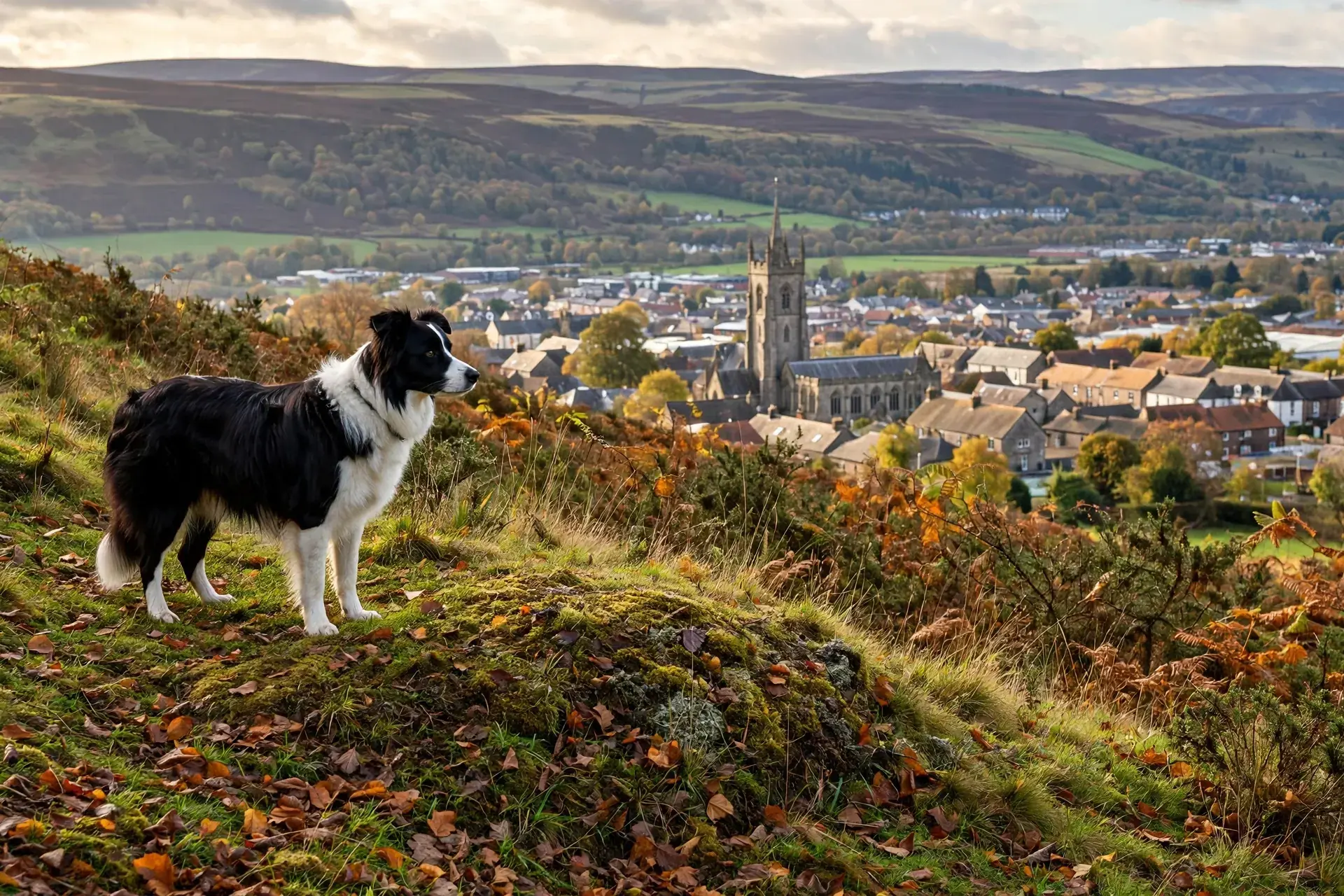
Most market towns ask you to choose between history and daily life. Mold does not. Stand at the top of Bailey Hill and the whole arrangement of the town opens up below you: the parish church of St Mary the Virgin with its tall tower, the rooftops of the High Street, the market square, and beyond the houses the long green ridge of the Clwydian Range. The mound itself is the remains of a Norman castle, built in the years after the Norman arrival in north-east Wales, and its grassy top is now a public green space where dogs on leads are a normal sight. It is the single best place to start a visit with a dog, because in ten minutes of climbing you get your bearings, your dog gets a proper sniffing walk, and you can see exactly where everything else in town sits.
The castle that once stood here was a timber motte-and-bailey fortress, and the earthwork that survives is the motte — the steep mound — and the bailey, the flatter enclosure beside it. No stone walls remain standing, which is part of the charm: instead of queuing to look at ruins behind a fence, you walk straight up onto the mound and stand where the castle keep would have been. Interpretation boards around the site explain the history in more detail, and it is worth pausing to read them, because the story of Mold Castle is the story of the Welsh Marches in miniature — a border fortress fought over, rebuilt and eventually abandoned as the town below it grew into a market centre. Dogs do not care about any of that, of course. What they care about is the open grass, the views, and the scents carried up from the market square on the wind.
From the top, look down towards the market square and the High Street and you can plan the rest of the morning without a map. The church sits at one end of the town centre, the market square at its heart, and the main shopping streets run between them. On market days the square fills with stalls and the sound carries uphill — a useful reminder that Mold is a working market town first and a visitor destination second. That matters for dog owners, because a working market town has a different rhythm from a heritage attraction: shops open early, cafes fill with locals, and the streets are busiest on Wednesday and Saturday mornings, then quieten in the afternoon. Plan around that rhythm and the town is easy; fight it and you will be threading a nervous dog through crowds.
The practical advice is simple. Arrive early, climb the mound first while the town is still waking up, and let your dog burn off the car journey on the grass before you head down into the streets. Bring a lead you can shorten quickly — the paths up the mound are shared with other walkers, joggers and children — and carry water in warm weather, because there is no shade on the top of the mound and the climb, short as it is, is steep enough to make a dog pant. In wet weather the grass paths can be slippery, especially on the descent, so take the steps and surfaced paths rather than cutting across the slope. And remember that this is a Green Flag Award-winning park space, which means it is looked after to a recognised standard: bins are provided, paths are maintained, and the expectation is that dog owners pick up after their dogs and keep them under control.
One more thing the view from the top tells you: Mold is a gateway town, not a dead end. The Clwydian Range rises to the west, the Dee valley runs to the east, and the town sits exactly where the lowland roads meet the hills. That is why the castle was built here, why the market grew here, and why Mold still works so well as a base for dog walkers today. Everything in this guide follows from that geography — the mound, the market, the hills — and the best days in Mold use all three in that order.
Climbing the mound and walking the town
The climb up Bailey Hill takes most people five to ten minutes from the town centre, and for a dog it is the perfect warm-up: short, interesting and rewarding. There are several ways up, and the choice depends on your dog. The surfaced paths from the town side are the most direct and the easiest underfoot, with steps in the steepest sections. The grassy slopes are gentler in places but can be muddy after rain, and a dog that pulls will make the descent harder than it needs to be. If your dog is older, arthritic or simply not a hill climber, take the gentlest path, go slowly, and let them set the pace — the view from halfway up is nearly as good as the view from the top, and there is no prize for reaching the summit quickly.
At the top, the flat grass of the mound is a good place for a pause. Give your dog water, let them sniff the wind, and take in the panorama. To the west the Clwydian Range runs in a long line — Moel Famau, the highest point of the range, is the obvious landmark — and on a clear day you can pick out the Jubilee Tower on its summit. To the east the land falls away towards the Dee valley and the Cheshire plain. The church tower directly below you is St Mary the Virgin, a large and handsome parish church that anchors the town centre; its churchyard is a quieter spot for a slow walk, though dogs should be kept on leads and under close control in churchyards out of respect for other visitors.
Coming down, the walk continues naturally into the town. A sensible loop runs from Bailey Hill down to the church, along the High Street to the market square, and back through the quieter side streets. The whole town centre is compact — you can walk from one end to the other in about fifteen minutes — which makes Mold unusually easy with a dog. There is no long trudge between sights, and you are never far from a cafe, a bench or a patch of grass. The streets are mostly level once you are off the mound, so this is a good town for older dogs and for puppies that are still building up their walking distance.
Pay attention to the details as you walk, because Mold rewards slow looking. The High Street has a good run of independent shops, the market square has its own character, and the side streets hide small courtyards and older buildings that are easy to miss at a brisk pace. Dogs tend to set exactly the right pace for this: they stop, they sniff, they look around, and they make you notice things. Let the walk be a wander rather than a route march. If your dog is reactive to other dogs, the quieter streets behind the High Street are calmer than the main shopping drag, and early morning — before the shops open — is the easiest time of all.
For a longer town walk, head out towards the edges of Mold and back. The lanes around the town give you hedgerows, gardens and glimpses of the surrounding countryside without leaving the built-up area, and they are a useful option when the hills are too wet or too windy for a proper walk. Keep your dog on a lead on pavements and near roads, as you would anywhere, and watch for cyclists on the shared paths. In autumn, fallen leaves can hide uneven ground and the occasional dropped conker or acorn, so keep an eye on what a puppy is picking up. In summer, the pavements can get hot enough to be uncomfortable for paws in the middle of the day — test the surface with your own hand, and if it is too hot for you, walk in the shade or wait until the evening.
One practical note: Bailey Hill is a public park, not a dog exercise field, and the rules are the ordinary ones — dogs on leads, pick up after your dog, and keep your dog under control around other people. There is no enclosed area for off-lead play on the mound, and letting a dog run free across the slopes is not fair on other visitors or on the grass. If your dog needs a proper off-lead run, save it for the countryside walks covered later in this guide, where there is space to do it safely and legally.
Market days and independent shops
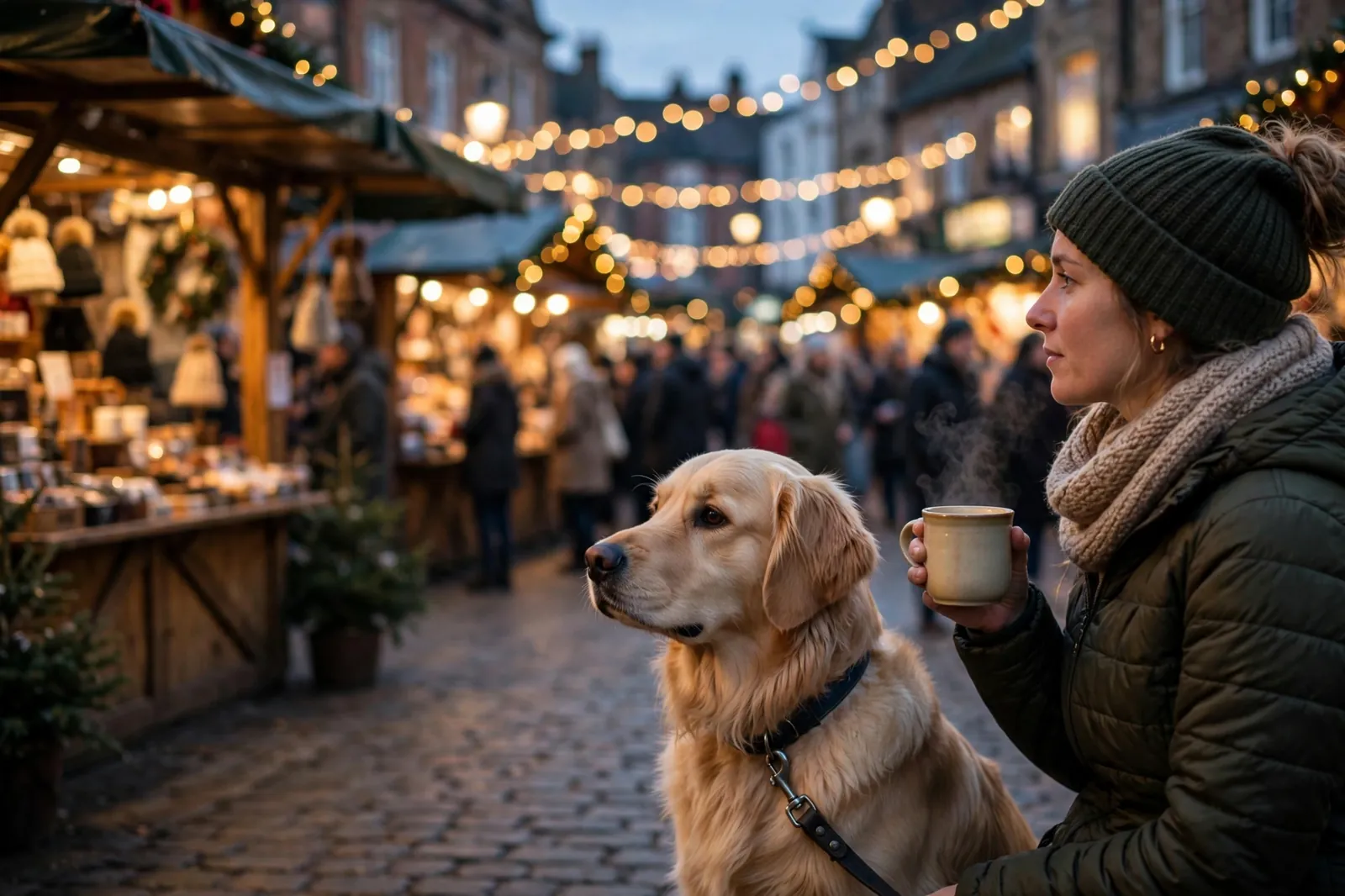
Mold's market is the beating heart of the town, and it is also the part of a visit that needs the most planning with a dog. The main market days are Wednesday and Saturday, when stalls fill the market square and the town is at its busiest. A farmers' market and specialist markets run on other days through the year, so it is worth checking the official guidance before you travel to confirm which market is on during your visit and what time it starts. The stalls sell the things you would expect from a Flintshire market town — local produce, meat, cheese, bread, plants, crafts and household goods — and the atmosphere is lively rather than touristy: this is a market for the town and the surrounding villages, and visitors are welcome but not the main event.
Dogs on leads are a familiar sight at the market, but the square is not a comfortable place for every dog. The stalls are close together, the aisles narrow, and on a busy Saturday the crowd moves slowly in both directions. A confident, sociable dog that is used to crowds will enjoy it — there are smells everywhere, and stallholders are generally friendly. A nervous dog, a reactive dog, or a dog that guards food will find it stressful, and the honest advice is to leave that dog out of the market itself and enjoy the town another way. If you do take your dog in, go early, when the stalls are setting up and the crowds have not yet built, keep the lead short, and stay on the edges of the square where you can step out easily. Never let your dog approach a food stall unsupervised, and ask before offering your dog anything — some stallholders will offer a treat, but not all food is safe for dogs, and a busy stallholder may not notice a dog helping itself.
The market is also a good test of your dog's lead manners, and it is worth being honest about them before you go in. A dog that pulls towards every interesting smell will drag you into stalls; a dog that barks at strangers will draw attention you do not want; a dog that is frightened by crowds will be miserable for an hour. None of this is a reason to avoid Mold — it is a reason to plan. Walk the dog first, so they are not bursting with energy, visit the market briefly, and have an exit plan: a quiet side street, a cafe with outdoor seating, or the car. A short, successful market visit beats a long, stressful one, and you can always come back for the things you missed.
Beyond the market, Mold's independent shops are one of the town's real strengths, and they are generally more dog-friendly than the big chain stores. Bookshops, gift shops, butchers, bakers, delis and craft shops line the High Street and the streets around the square, and many of them welcome dogs inside or at least tolerate a well-behaved dog at the door. Policies vary from shop to shop and can change, so the reliable approach is to ask at the door, watch for a dog-friendly sticker or a water bowl, and never assume. A small shop with a narrow aisle and breakable stock is not the place for a large, enthusiastic dog, however welcome the owner makes you feel — use your judgement, keep the lead short, and be ready to wait outside with the dog while your companion goes in.
For dog owners, the practical shops matter as much as the pretty ones. A good butcher or deli can supply picnic food for the hills, a bakery can supply the morning's bread, and a pet shop or general store can cover anything you forgot to pack. Stock up in town before you head out to Loggerheads or Moel Famau, because the countryside car parks have no shops and the nearest village store may be a drive away. And if you are staying overnight, the town's supermarkets and convenience stores cover the basics — check opening hours, because smaller shops in a market town can close earlier than you expect, especially on Sundays.
The market square itself is worth a slow look even on a non-market day. Without the stalls it is an open space where you can see the shape of the town, and it is a useful meeting point and a good place to sit with a coffee while your dog rests. The buildings around the square tell the story of Mold's development as a market centre, and the town hall and the older commercial buildings give the square a sense of enclosure that makes it feel like a proper town centre rather than a traffic junction. On quiet days it is also the easiest place in town to practise loose-lead walking with a young dog, because there is space, there are distractions at a manageable level, and there is always a bench to sit on when you both need a break.
The Clwydian Range on the doorstep: Loggerheads and beyond
Mold's real advantage as a dog-walking base is what lies a short drive to the west: the Clwydian Range and Dee Valley National Landscape, a protected landscape of heather moorland, limestone valleys and long ridge walks. The range runs in a chain of hills from Prestatyn on the coast down to Llangollen, and Mold sits at its eastern edge, which means the hills are a ten-minute drive rather than a day trip. The easiest way in is Loggerheads Country Park, a wooded valley where the River Alyn runs between limestone cliffs, and it is the walk most Mold visitors with dogs should start with.
Loggerheads is a proper country park, with a car park, a visitor centre, toilets and a cafe, and a network of waymarked trails that suit different dogs. The riverside paths are the gentlest option: flat, shaded, and full of interesting smells, with the river running alongside and the limestone cliffs rising above. The woodland trails climb through the trees and are a good choice on a hot day, when the shade matters. The climb to Devil's Gorge, a narrow limestone cleft, is steeper and rockier, and it is worth saving for a fit dog on a dry day — the steps and uneven ground are hard work for older dogs and for puppies. Whichever trail you choose, keep your dog on a lead in the car park and around the visitor centre, and be ready for other dogs, children and cyclists on the main paths.
From Loggerheads you can also reach the ridge itself. The climb up to Moel Famau, the highest hill in the Clwydian Range at 554 metres, starts from the Loggerheads side or from the car parks on the Bwlch Pen Barras road, and it is one of the classic North Wales hill walks. The path is well made and the views from the top — over the Dee valley, the Cheshire plain and, on a clear day, to Snowdonia and the Irish Sea — are among the best in the region. For a dog, it is a serious walk: the climb is steady rather than steep, but the top is exposed, the wind can be strong, and there is no shelter or water on the ridge. Take plenty of water, a windproof layer for the dog if they feel the cold, and a lead for the whole walk. The Jubilee Tower on the summit is a useful landmark and a good place to stop, but the ground around it is rocky and uneven, so watch your dog's paws.
The single most important rule on the Clwydian Range is the one about sheep. This is working farmland as well as a national landscape, and sheep graze the open hillside all year round. Dogs must be kept on leads near livestock — and in practice that means on a lead for most of the open ridge, because sheep can appear over a rise at any moment and a dog that chases can cause serious harm, including the death of ewes and lambs. The law is clear that farmers may take action against a dog worrying livestock, and the responsible choice is never to give them a reason to. Keep your dog on a lead, keep the lead short when sheep are in sight, and if your dog has a strong chase instinct, choose the woodland and riverside trails at Loggerheads instead of the open hill. This is not a restriction to resent; it is the condition that keeps these hills open to dog walkers at all.
Offa's Dyke Path, the long-distance National Trail that runs along the Welsh-English border, also passes through this landscape, and sections of it make excellent day walks from Mold. The path follows the line of the eighth-century earthwork and crosses the Clwydian ridge, so a walk on Offa's Dyke combines history, views and proper hill walking in a single outing. You do not need to walk the whole trail — pick a section, walk out and back, or arrange a lift at the far end. Check the official guidance before you travel for the current state of the path, because sections can be closed for maintenance or diverted, and the ground can be very wet after rain. The path is waymarked, but it is a hill path, not a pavement, and you should carry a map or a downloaded route rather than relying on phone signal, which can be patchy on the ridge.
Weather is the other thing to plan around. The Clwydian hills are exposed, and conditions on the ridge can be very different from conditions in Mold: windier, colder, wetter, and with visibility that can drop quickly. Check the forecast before you set out, dress for the hill rather than the town, and be prepared to turn back. A dog that is happy on a sheltered valley walk can be miserable on a wet, windy ridge, and there is no shame in cutting a walk short. The valley walks at Loggerheads are the wet-weather fallback — sheltered, lower, and enjoyable in rain that would make the ridge unpleasant — and they are a better choice than a forced march in bad weather. In summer, the open ridge has little shade and no water, so carry more water than you think you need and watch for signs of overheating, especially in thick-coated or brachycephalic dogs.
After the walk, the practicalities matter. Check your dog for ticks, especially after woodland and bracken, and check their paws for cuts from rocky ground. Carry a towel in the car, because the River Alyn and the muddy valley paths will leave most dogs wet and dirty, and a wet dog in a car is nobody's idea of a good end to a walk. There is usually a tap or a stream at Loggerheads for a quick rinse, but do not rely on it — bring your own water and a towel as a matter of routine. And remember to take your litter and your dog waste bags home or use the bins provided: the country park is a protected landscape, and the standard you leave it in is the standard the next dog walker finds.
Theatr Clwyd and cafe culture
Mold's cultural centre is Theatr Clwyd, one of Wales's major producing theatres, set on a hill above the town with views across the rooftops towards the Clwydian Range. It is a large and ambitious venue — two theatre spaces, a cinema, galleries and a restaurant — and it draws audiences from across North Wales and the north-west of England. For a dog owner, the theatre itself is not the destination: dogs are not allowed inside the auditoriums, and a theatre performance is not a place for a dog. But the area around Theatr Clwyd is very much worth a visit, and the building's hilltop setting makes it a natural extension of a walk from Bailey Hill.
The grounds and the approach to the theatre are open and green, with paths and grass where a dog on a lead can stretch its legs, and the views from the hill are some of the best in town. It is a quieter spot than the market square, which makes it a good place for a calm walk with a dog that finds the town centre too busy. Check the official guidance before you travel for the current access arrangements, because the theatre has been through a major redevelopment and the layout of the site, the car park and the public areas may have changed since older guides were written. If you are attending a performance, plan for the dog separately — leave them in dog-friendly accommodation, with a sitter, or take turns with your companion — and do not leave a dog in a car while you are inside.
The cafe and restaurant at Theatr Clwyd are popular with theatregoers and locals alike, and they are worth knowing about even if you are not seeing a show. Policies on dogs in the cafe and restaurant areas can change, so ask before you sit down with a dog, and be prepared for the answer to be that dogs are welcome on outdoor seating but not inside. That is the usual pattern in Mold, and it is worth planning around rather than arguing about: the outdoor seating in good weather is pleasant, the views are good, and a dog that can settle under a table outside is a dog that is enjoying the trip.
Back in the town centre, Mold's cafe culture is one of its quiet pleasures, and it is also where the town's dog-friendly credentials are most visible. The High Street and the streets around the market square have a good spread of cafes, coffee shops, bakeries and pubs, and a surprising number of them welcome dogs. The pattern is familiar from other market towns: some cafes welcome dogs inside, some offer outdoor seating where dogs are welcome, and some have a specific dog-friendly area. The only reliable way to know is to look for the signs — a water bowl by the door, a dog biscuit on the counter, a sticker in the window — or to ask. Policies change, staff change, and a cafe that welcomed dogs last year may have changed its mind, so check the latest information before you settle in, and never assume.
The unwritten rules of taking a dog into a cafe apply in Mold as they do everywhere. Choose a table at the edge rather than in the middle of the room, keep the lead short and the dog under the table or beside your chair, and bring a mat or blanket for the dog to lie on — it helps them settle and it keeps their hair off the furniture. Order before you sit down if you can, so you are not leaving the dog unattended at the table. And be honest about your dog: a calm dog that sleeps under a table is welcome almost anywhere; a dog that barks at every stranger, begs at other tables or tries to climb onto chairs is not, and no amount of dog-friendly policy changes that. If your dog is having a bad day, take the coffee away and drink it on a bench outside — the town is small enough that you are never far from a good bench.
The pubs of Mold deserve a mention too, because they are part of the town's character and many of them welcome dogs, particularly in the bar area or on the terrace. A pub lunch after a morning on the hills is one of the great pleasures of a walking holiday, and Mold has pubs that suit it well. The same rules apply: ask first, keep the dog close, and be ready to sit outside if the inside is crowded or the dog is unsettled. And remember that a pub is a working business, not a dog park — a dog that is welcome is a dog that is under control, quiet, and not under other people's feet. If you are staying overnight, ask your accommodation for their recommendation: locals know which pubs are genuinely dog-friendly and which merely tolerate dogs, and the difference matters.
Where to stay and where to park
Mold is a small town, and its accommodation is correspondingly small-scale: bed and breakfasts, guest houses, self-catering cottages in the town and the surrounding villages, and a handful of pubs with rooms. There are no large hotels in the town centre, and that is part of the appeal — but it also means that dog-friendly rooms are limited and can book up early, especially on market days, during school holidays and when Theatr Clwyd has a popular production on. Book ahead, confirm the dog policy in writing, and ask the specific questions that matter for your dog rather than relying on a generic "dog-friendly" label.
The questions to ask are the ones this site returns to again and again, because they are the ones that cause trouble when they are not asked. How many dogs are allowed, and is there a charge per dog per night or per stay? Is the dog allowed in all areas of the property or only in specific rooms? Is there an enclosed garden or a secure outdoor space? Where is the nearest practical place for a last walk at night? What happens if the dog barks — is there a policy, or just a hope that it will not happen? And what is the cleaning charge, if any? Get the answers in writing with the booking confirmation, and keep them with you. A property that answers these questions clearly and specifically is a property that has thought about dogs properly; a property that answers vaguely is a property to be cautious about.
Self-catering cottages in the villages around Mold are often the best option for dog owners, because they give you space, a kitchen, and usually a garden. The trade-off is that you need a car, and you need to check the garden properly: a low fence, a gap in a hedge or a gate that does not latch can turn a relaxing evening into a search party. Ask for the fence height and the garden layout before you book, and walk the boundary when you arrive before you let the dog off the lead. Bed and breakfasts in town are a good alternative if you want to walk to the market and the cafes, but check whether the dog can be left in the room while you eat breakfast, and whether there is a secure place for the dog during the meal — some hosts are happy for the dog to join you, others are not, and it is better to know before you arrive.
Parking in Mold is straightforward by the standards of a market town, but it needs a little planning on market days. There are several public car parks in and around the town centre, including the car parks near the market square and on the edges of the centre, and on-street parking on the quieter streets. On Wednesday and Saturday mornings the town-centre car parks fill early, so arrive before the market gets busy or be prepared to park a short walk away. Check the official guidance before you travel for current charges and time limits, because tariffs and the maximum stay can change, and some car parks have different rules on market days. Pay-and-display machines and app-based payment are both common, so carry coins as a backup and have the payment app ready before you arrive.
Never leave a dog in a parked car in warm weather, even for a few minutes and even with the windows open — the temperature inside a car rises far faster than most people expect, and a dog can overheat quickly. In cold weather a dog left in a car can also become chilled, and a car is not a safe place to leave a dog for any length of time. If you need to go into a shop or a cafe that does not allow dogs, take turns with your companion, use a dog-friendly venue, or plan the stop for a time when the dog is with someone else. This is a rule without exceptions, and it applies in Mold as it does everywhere.
For the countryside walks, parking is a separate consideration. Loggerheads Country Park has a large car park that fills on sunny weekends and school holidays, so arrive early or be prepared to wait. The car parks at Bwlch Pen Barras and the other Moel Famau access points are smaller and can fill even earlier, especially on a clear day. Check the official guidance before you travel for current charges — some country park car parks charge, some do not — and have payment ready. And remember that a car park at the foot of a hill is not a destination in itself: leave enough time for the walk, the drive back, and a stop in Mold for a coffee before you head home.
Finally, think about the journey to Mold itself. The town is on the A494, the main road between Chester and the North Wales coast, and it is an easy drive from Chester, Wrexham and the M53 and M56 motorways. There is a bus service to Mold from Chester and Wrexham, and the nearest railway stations are at Chester and Wrexham, with a bus connection onward. If you are travelling by public transport with a dog, check the operator's policy before you travel — dogs are generally allowed on buses and trains in the UK, but the rules vary, and a large dog on a busy bus is a different proposition from a small dog in a carrier. Driving gives you the most flexibility, and it also gives you somewhere to store the towels, the water and the muddy boots that a day in the Clwydian hills will produce.
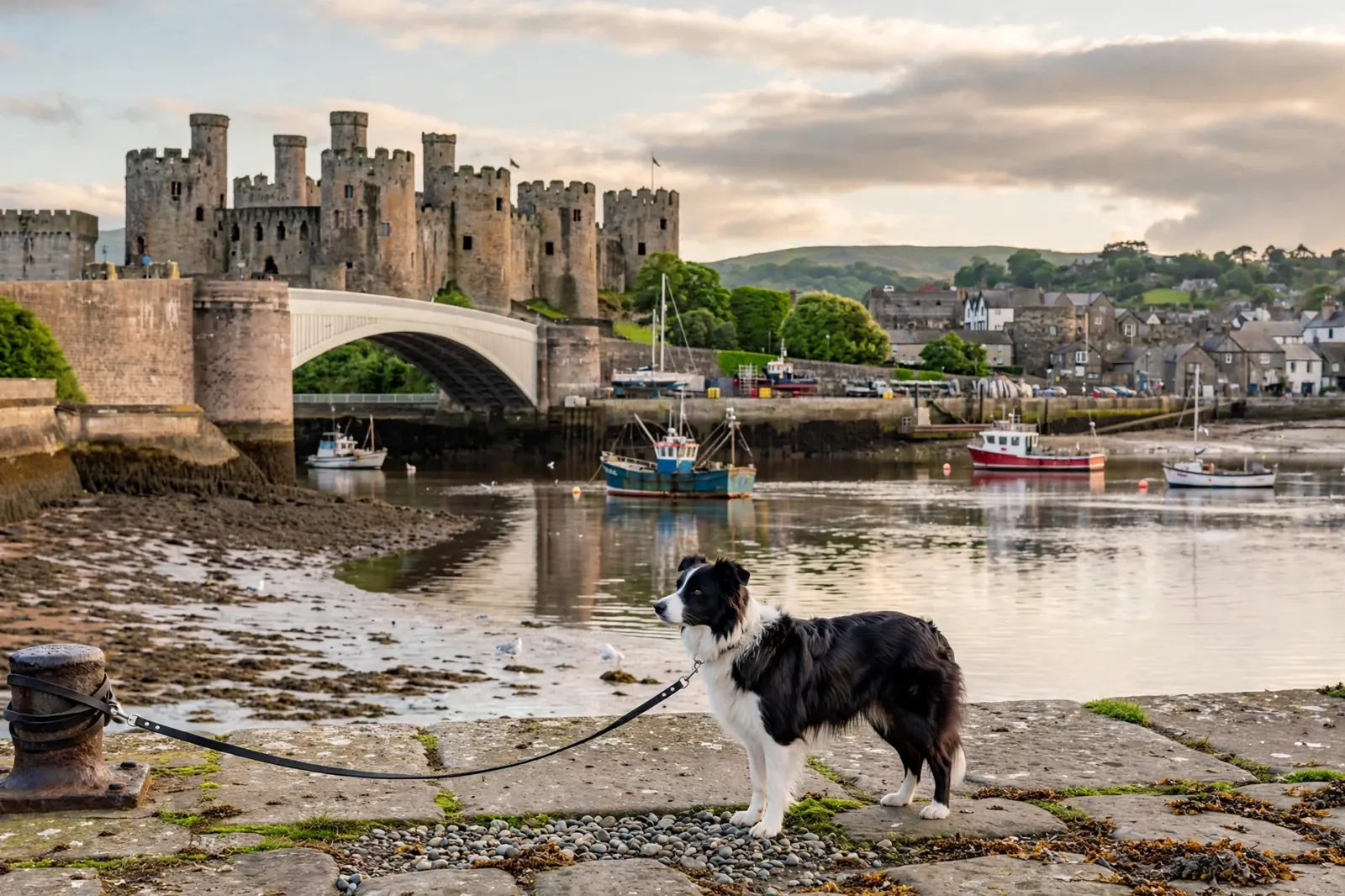
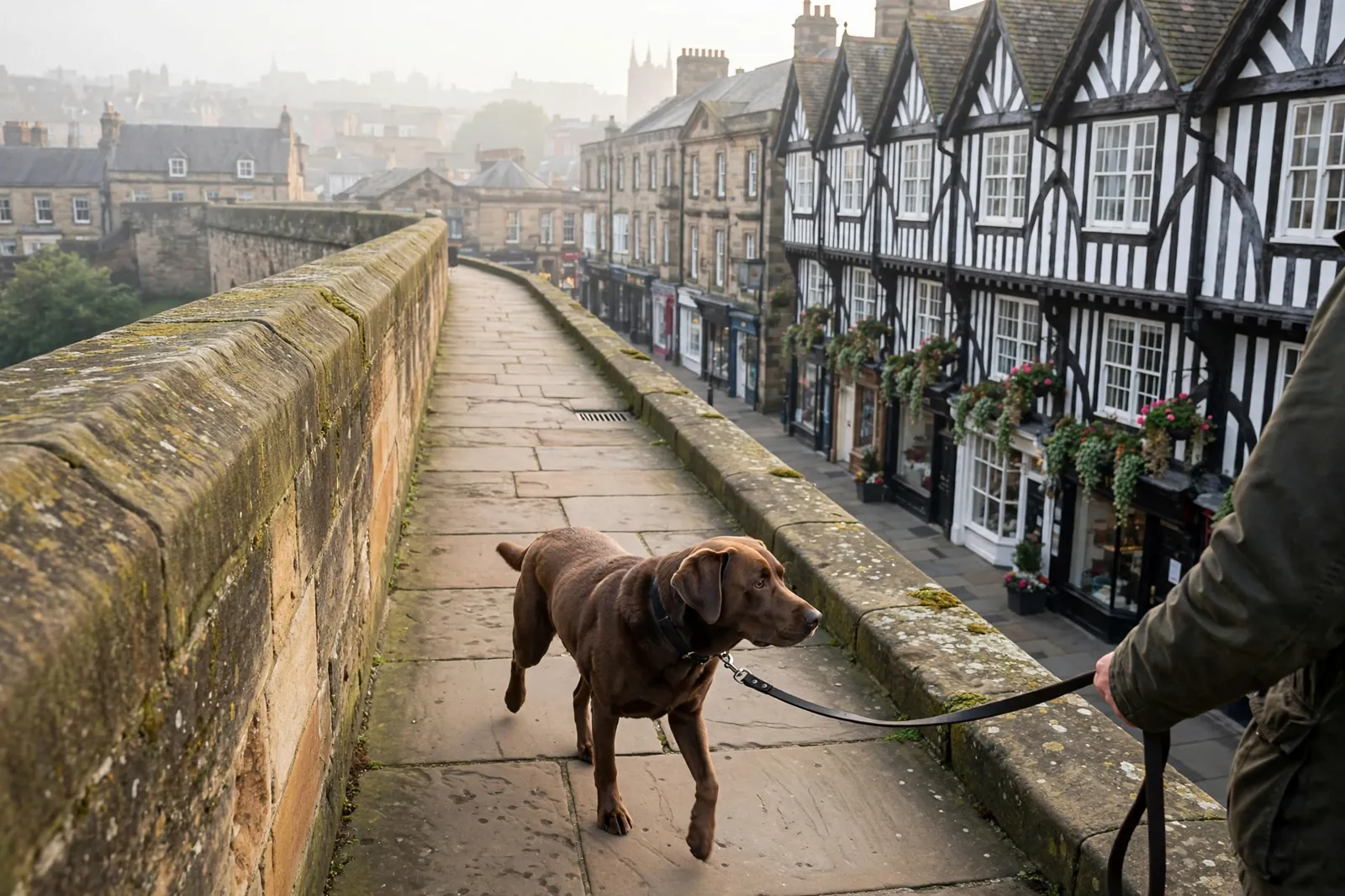
If you are planning a longer stay in the area, Mold makes a good base for exploring the wider region with a dog. Conwy, with its castle, town walls and harbour walks, is an easy day trip to the west, and Chester, with its full circuit of city walls and the River Dee meadows, is a short drive to the east. Both towns are covered in detail in our other guides, and both pair well with a Mold base: a day in the hills, a day in a walled town, and a market morning in between is a holiday that suits most dogs and most owners.
A sample day in Mold with a dog, and the seasons
Putting the pieces together, here is how a good day in Mold with a dog actually runs. Start early — before the shops open if you can — and drive straight to Bailey Hill. Park, walk up the mound while the town is still quiet, and let your dog have the grass and the views to themselves. Spend twenty minutes up there: water the dog, read the interpretation boards, pick out the church tower and the market square below, and look west to the Clwydian ridge so you can see where the afternoon is heading. Then walk down through the church and the High Street as the town wakes up, and if it is a Wednesday or a Saturday, drift into the market while it is still setting up. Buy the picnic food now — bread, cheese, something for the hills — and have a coffee at a dog-friendly cafe before the crowds arrive.
By late morning, drive out to Loggerheads. The riverside paths are the right choice if the dog is already tired from the town, and the woodland trails are the right choice if they still have energy to burn. Eat the picnic at one of the benches or grassy spots, check the dog for ticks and mud, and decide whether the afternoon is a ridge walk or a valley walk. If the weather is clear and the dog is fit, the climb to Moel Famau is the afternoon's reward: a steady path, a tower on the summit, and views that make the whole day feel bigger. If the weather has turned, stay in the valley — the river, the gorge and the trees are enjoyable in rain that would make the ridge miserable, and there is no prize for being wet and cold on a hilltop. Either way, be back in Mold by late afternoon, when the town has quietened again and the cafes and pubs are at their most relaxed. A pub terrace with a tired dog asleep under the table is the right way to end a Mold day.
That pattern works in every season, but the details change. Spring is the best time for the town itself: the market is full, the days are lengthening, and the hills are greening, but the ground on the ridge can still be wet and the lambing season means sheep and young lambs are everywhere — keep the lead on and keep it short. Summer brings the longest days and the warmest weather, but also the biggest crowds at Loggerheads and the hottest pavements in town, so start early, carry extra water, and use the shaded woodland trails rather than the exposed ridge in the middle of the day. Autumn is many people's favourite season in Mold: the Clwydian hills turn gold and russet, the light is low and warm, the market has autumn produce, and the crowds thin out. It is also the season when the leaves hide uneven ground and the paths get slippery, so watch your footing on the descent from Bailey Hill and on the woodland steps at Loggerheads.
Winter in Mold is quieter and, in its own way, just as good. The town is calm, the cafes are warm, and a clear winter day on Moel Famau — with frost on the heather and views for miles — is one of the best walks in North Wales. But winter also brings the shortest days, the coldest wind on the ridge, and the earliest sunsets, so plan the hill walk for the middle of the day, carry a torch in case you are caught out, and dress the dog for the cold if they are short-coated, older or very small. Check the forecast before you set out, because hill fog can arrive quickly in winter and the ridge is no place to be when visibility drops. And remember that some cafes and attractions reduce their hours in winter, so check the official guidance before you travel rather than assuming summer opening times still apply.
Whatever the season, the packing list for a Mold day is short and worth getting right. Bring a lead you can shorten and lengthen, a water bottle and a collapsible bowl, a towel, poo bags, and a mat or blanket for the dog to lie on in a cafe. Bring a coat for the dog if they feel the cold, and a drying coat if they are going to swim or get wet. Bring a map or a downloaded route for the hills, because phone signal is unreliable on the ridge. And bring patience: Mold is a small town, and the best of it comes slowly — a market stall you did not expect, a view from the mound you did not plan, a cafe that turns out to welcome dogs properly. Let the dog set the pace, and the town will do the rest.
One last piece of advice, and it is the one that matters most for a first visit: do not try to do everything in a single day. Mold rewards a second look. The mound is worth climbing twice — once in the morning light and once in the evening, when the town below is quieter and the Clwydian ridge turns blue. The market is worth visiting on both a Wednesday and a Saturday if you can, because the stalls and the crowds are different. And the hills are worth walking in both directions, because the view back towards Mold from the ridge is a different view from the one you get looking out from the mound. If you can stay for a second day, use it for the things you missed: a longer stretch of Offa's Dyke Path, a slow morning in the cafes, or a drive to one of the neighbouring towns. Mold is small, but it is a gateway, and gateways are for passing through slowly — with a dog beside you, a lead in your hand, and no particular hurry to be anywhere else.
If you are travelling with children as well as a dog, Mold is an easy town to manage. Bailey Hill is a good first climb for young legs, the market square has space to move, and the riverside paths at Loggerheads are flat enough for a family walk. Keep children and the dog together on the mound and in the market, and agree in advance who holds the lead when the crowd thickens. At Loggerheads, the visitor centre and the cafe give everyone a base, and the shorter trails are a better choice than the ridge when small children are in the party. The same logic applies to older visitors: the town centre is level and compact, the cafes are close together, and the mound can be enjoyed from halfway up without any need to reach the top. Mold works for a mixed group precisely because it does not demand that everyone does the same thing at the same pace — the town, the market and the hills each offer something different, and a good day is one where each person, and each dog, finds their own version of it.
Practical questions
Before you go
Can dogs go up Bailey Hill in Mold?
Yes. Bailey Hill is a public green space with paths up the castle mound, and dogs on leads are welcome. The climb is short but steep in places, so take it slowly with older dogs, keep to the paths, and bring water on warm days.
Are dogs allowed at Mold market?
Dogs on leads are commonly seen at Mold's outdoor Wednesday and Saturday markets, but stalls are close together and the square gets busy. Go early, keep your dog close, and ask stallholders before letting your dog approach food or produce.
Where is the best dog walk near Mold?
Loggerheads Country Park, a short drive from Mold, is the easiest starting point: riverside paths, woodland trails and the climb to Devil's Gorge. From there you can reach the Clwydian Range ridge, but keep dogs on leads around sheep and check the official guidance before you travel.
Do cafes in Mold allow dogs?
Several cafes and pubs in Mold welcome dogs, usually in specific areas or on outdoor seating. Policies change, so check the cafe's latest information or ask at the door before settling in with your dog.
Is Mold a good base for walking the Clwydian Range with a dog?
Yes. Mold sits at the eastern edge of the Clwydian Range and Dee Valley National Landscape, with Loggerheads, Moel Famau and Offa's Dyke Path all within a short drive. It works best as a base if you plan around livestock, weather and parking, and keep your dog on a lead near sheep.