This guide is independent and contains no paid placement. If affiliate links are added later, they will be clearly marked and will not change our editorial checks.
Moreton-in-Marsh works best as a train-arrival market town, not as a drive-through stop. Arrive by the Cotswold Line, let the dog settle with a short town loop, time a Tuesday visit for the market if your dog copes well with crowds, and save the longer walk for the Evenlode Valley. For gardens such as Batsford Arboretum and Sezincote, check the official guidance before you travel rather than assuming dogs are admitted.
Arriving by train and stepping out of the station
Moreton-in-Marsh is unusual among smaller Cotswold towns because the railway is part of the plan, not an afterthought. The town has a station on the Cotswold Line, and that single fact changes the shape of the whole trip. Instead of planning around a car park, a satnav route and a driver who cannot enjoy the walk, visitors can plan around a timetable, a platform and a short walk into the centre. For dog owners, that matters in practical ways: the dog travels in one contained phase, then walks, then rests, rather than spending the day waiting in a car between stops.
Start by checking the timetable for the exact day of travel, including the return services, before leaving home. Cotswold Line services connect Moreton-in-Marsh with places in both directions, including Oxford to the south-east and Worcester and Hereford country to the north-west, but frequencies, stopping patterns and engineering work vary by day and season. A timetable that looked convenient on a weekday may not apply on a Sunday, and a late service that exists in summer may not exist in winter. Screenshot or save the return options as well as the outward journey, because the most stressful part of a car-free dog day is usually not the walk itself but the uncertainty about getting home.
Train rules for dogs also need a check on the day. In general, dogs travel on many British train services under the operator conditions in force at the time, often with expectations about leads, keeping the dog off seats, and keeping other passengers comfortable. Those conditions can differ between operators and can change, so check the official guidance before you travel rather than relying on a memory of a previous journey. If your dog is nervous on trains, practise short local journeys first, choose a quieter service where possible, and bring a familiar blanket or mat so the dog has a defined place to settle at your feet.
The first walk after arrival should be deliberately short. Dogs that have been still on a train, especially puppies, older dogs and dogs that find stations noisy, benefit from a calm toilet break, water and a few minutes of sniffing before any longer route. Moreton-in-Marsh rewards that slow start: the centre is compact, the High Street is broad, and a gentle loop gives the dog a chance to learn the smells, sounds and pavements of a new town without being asked to walk for miles straight away. Keep the lead short near the station approach and any road crossings, and let the dog set the pace for the first ten minutes.
Packing for a rail arrival is different from packing for a car trip, and the difference is worth thinking through before the station. A car lets owners carry spare towels, extra food, a crate and a change of clothes without noticing the weight. A train day means carrying everything, so prioritise a lead and a spare, poo bags, water and a collapsible bowl, a towel for muddy paws, and any medication the dog needs. A lightweight drying coat earns its place on a wet day, while a bulky bed usually does not. If the plan includes a longer valley walk later, pack the walking kit in a small rucksack from the start rather than trying to reorganise bags on a station platform.
Finally, think about the dog that is travelling, not an idealised dog. A confident adult spaniel may trot happily from platform to High Street and on to a valley path. A rescue dog on its first rail trip, a small dog that is easily startled by luggage trolleys, or an older dog with stiff joints may need a much gentler version of the same day: a shorter town loop, more rest stops, and an earlier train home. There is no prize for covering the most ground. A successful car-free day in Moreton-in-Marsh is one where the dog returns to the station calm, dry enough, and ready to settle again on the train.
Tuesday market and the wide High Street
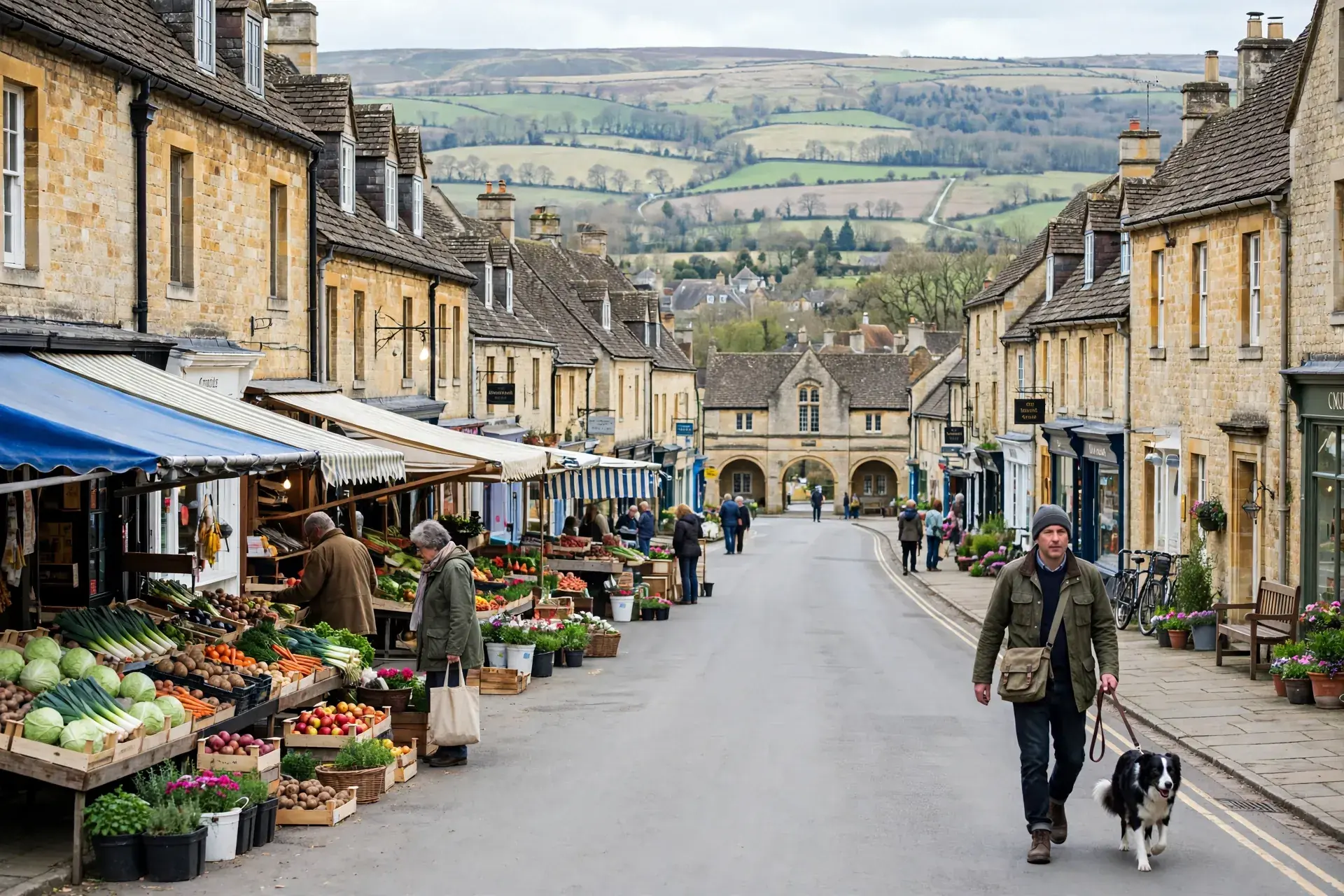
The High Street is the first thing most visitors notice about Moreton-in-Marsh, and it is also the reason the town suits dogs better than many prettier but narrower Cotswold villages. The street is notably wide, a legacy of its history as a market and coaching town, and width changes the dog-walking experience completely. On a narrow pavement, a dog, a pushchair, a shopper with bags and another dog on a lead can become a tangled negotiation every few metres. On a wide street, there is room to step aside, to let another dog pass at a comfortable distance, and to pause without blocking everyone behind. That extra space does not remove the need for a short lead and good manners, but it lowers the background pressure for the whole walk.
Tuesday is the traditional market day, and it gives the town a different character from a quiet weekday. Stalls, shoppers, conversations and the smell of food and produce fill the High Street, and for a sociable, steady dog that can be an enjoyable outing. For a reactive dog, a nervous dog, or a dog that guards food, the same scene can be too much. The honest approach is to match the day to the dog. If the dog loves people and copes well with bustle, plan the Tuesday visit and arrive early, before the densest crowds build. If the dog finds markets stressful, choose another weekday, enjoy the same wide street at a calmer pace, and treat the market as something to observe from a quieter edge rather than a route to push through.
Market-day dog etiquette is mostly about space, food and exits. Keep the lead short enough that the dog cannot lunge toward a stall or snatch dropped food, and watch for food on the ground near produce and takeaway stalls. Small dogs are easily stepped on in a crowd, so consider whether a carrier or a raised vantage point is kinder for a very small or elderly dog, and be ready to lift the dog out of a crush rather than dragging it through. Always know where the nearest quiet side street is, so a dog that becomes overwhelmed can be moved to calm air within a minute instead of being marched onward because the plan said so.
Beyond market day, the High Street is worth exploring slowly. Moreton-in-Marsh is a working market town as well as a visitor destination, so the street mixes everyday shops, cafes, places to eat and services with the honey-coloured stone that visitors associate with the Cotswolds. That working-town quality is a strength for dog owners: there are practical places to buy water, snacks and supplies, and the town does not close down into a purely picturesque shell outside peak hours. Walk both sides of the street where pavements allow, cross at sensible points rather than weaving between parked vehicles, and remember that a wide street can still carry through traffic, so road awareness matters even when the pavements feel generous.
Shopping with a dog requires a plan for each shop, because policies differ from business to business and from room to room. Do not assume that a shop that welcomed a dog last year, or that welcomed a friend's dog, will welcome yours today. Check the official guidance before you travel where a business publishes its policy, ask at the door before entering with a dog, and accept a polite refusal gracefully. A dog left tied outside a shop is a poor solution in a busy market town: it risks theft, stress and conflict with passers-by, so take turns if travelling as a pair, or save shopping for a moment when one person can wait outside with the dog.
A useful High Street routine for a dog day is to walk, rest, and then walk again. Start with a loop of the street, find a bench or a quiet corner for water and a rest, and only then decide whether to extend the day toward the valley or keep it town-based. Dogs that rest well in town usually walk better afterwards, and owners who have already seen the centre are less tempted to rush the afternoon. If the dog is flagging, a short town day is a complete day. Moreton-in-Marsh does not need a long walk to justify the train fare; a calm market morning and a relaxed lunch stop can be the whole point.
The Four Shires Stone and the story of the town
To understand Moreton-in-Marsh, it helps to know that this is a town shaped by routes and boundaries. It grew as a market town on a main road through the north Cotswolds, serving surrounding farms and villages, and its wide High Street reflects that trading past. Coaching traffic, agricultural markets and later the railway all reinforced the same pattern: Moreton-in-Marsh was a place people passed through, stopped in, and traded in, rather than a secluded hamlet built for scenery alone. For modern visitors, that history is still visible in the scale of the street and the practical, working feel of the centre.
The Four Shires Stone is one of the most talked-about landmarks associated with the town, and it is worth seeking out with a clear sense of what it is. The stone stands near Moreton-in-Marsh at a point historically associated with the meeting of four counties, and it marks an old boundary idea that visitors often find fascinating: a single stone that once spoke to four different shires. County boundaries have changed over time, so the stone is best understood as a historic marker rather than a precise present-day administrative line. Check local visitor information for the current access route before setting out, because the stone is not a town-centre pavement attraction in the same way as the High Street, and the approach may involve roads or paths that need care with a dog on a lead.
If the walk to the stone does not suit the dog, the weather or the available time, there is no need to force it. The value of the Four Shires Stone for a dog day is as a talking point and a reason to look at the landscape with fresh eyes, not as a tick-box that must be completed at any cost. A dog that is tired, wet or unsettled will not enjoy a boundary stone more because it is historic. A better plan is to treat the stone as an optional extension: enjoy the town first, check the route and ground conditions, and only add the stone if the dog is still comfortable and the light and weather allow a relaxed return.
History also helps explain why Moreton-in-Marsh feels different from the classic picture-postcard Cotswold village. Villages further south in the Cotswolds are often celebrated for a single perfect row of cottages or a village green, and many of them are best reached by car. Moreton-in-Marsh, by contrast, offers a market-town scale: a station, a broad street, a market tradition and a hinterland of farms and valleys. That contrast is exactly why this guide treats the town separately from a general Cotswolds overview. Readers planning a wider trip may still want the broader context in our Cotswolds with a dog guide, but the Moreton-in-Marsh day itself should be judged on its own terms: train access, market rhythm, town walking and valley walking, in that order.
When explaining the town to children or to first-time visitors, the stone and the market together tell a simple story: people have met, traded and crossed county lines here for a long time, and dogs have presumably trotted beside them for much of that history too. That story is more useful than a list of dates. It reminds owners that a market town is a shared space, not a dog park, and that the courtesies that make markets work — short leads, clean pavements, room for other people — are part of the town's long tradition of shared use, not a modern imposition on a dog day.
The Evenlode Valley walk towards Batsford
Once the town walk is done, the Evenlode Valley offers the longer, greener half of a Moreton-in-Marsh day. The River Evenlode runs through the rolling country around the town, and the valley landscape toward Batsford gives walkers a classic north Cotswolds mix: open fields, hedgerows, woodland edges, farm tracks and quieter lanes. This is not a manicured park walk with a cafe at every turn. It is working countryside, and that is precisely its appeal for dogs that love to sniff, explore and stretch their legs after a town morning.
Route choice matters more than distance. A valley walk that looks short on a map can become long in practice if the ground is wet, if a path is overgrown, or if livestock forces a detour. Before setting out, check a current map, note the intended turning point, and agree a latest return time that leaves a comfortable margin for the train home. Carry a phone with charge, water for the dog as well as for people, and a lead that can be shortened quickly. In lambing season, near livestock at any time of year, and wherever signs ask for dogs to be kept on a lead, keep the dog on a lead without exception. The countryside code expectation is clear in spirit: dogs under close control, livestock undisturbed, gates left as found, and waste bagged and binned.
Batsford, a small village and estate area to the south-east of Moreton-in-Marsh, is a natural direction for a valley walk, and it is also the location associated with Batsford Arboretum, which is discussed in the next section. It is important to keep two ideas separate: walking in the valley toward Batsford is not the same as entering a paid garden attraction. A public footpath walk and a garden visit have different rules, different entry points and different dog policies. Do not assume that because a valley path is open to dogs on a lead, a nearby garden will admit dogs in the same way. Plan the valley walk as a complete outing in its own right, so that a garden refusal or a change of plan does not leave the day without a walk.
Ground conditions in the Evenlode Valley change quickly with the seasons, and dog owners should read the ground as carefully as the map. After rain, riverside meadows and clay paths can be deep in mud, and a dog that runs happily on dry grass may struggle on slippery banks or through standing water. In summer, the same valley can be dry, dusty and hot, with limited shade on open stretches and a greater need for water and rest. In both cases, the kindest choice is often a shorter loop on firmer ground rather than a longer linear route that commits the group to miles of difficult terrain with no easy exit.
Wildlife and farm animals deserve the same attention as the route itself. The valley is home to birds, deer and farm livestock, and a dog that chases can cause serious harm even on a first offence. Keep recall honest: if the dog does not reliably return when distracted by a pheasant, a rabbit or a sheep, keep the dog on a long line in open country rather than trusting an off-lead freedom that the dog cannot yet handle. A long line gives the dog room to sniff and explore while keeping livestock and wildlife safe, and it is a far better choice than an off-lead walk that ends in a chase.
End the valley walk the way the day began: gradually. Give the dog water, check paws for mud, grit, thorns or cuts, and towel down before re-entering town. A dog that arrives back in Moreton-in-Marsh clean, watered and calm is much easier to settle in a cafe doorway, on a station platform or on a train than a dog that is still buzzing from a long run. If the walk has been longer than planned, use the town loop as a cool-down rather than adding another attraction. The station, the High Street and a bench in the shade are the right ending for a valley day, not a rushed final stop.
Nearby gardens: check the rules before you go
Moreton-in-Marsh sits within easy reach of several well-known gardens and houses, and visitors often ask about Batsford Arboretum and Sezincote in the same breath as the town itself. Both are part of the wider north Cotswolds story, and both deserve a careful, separate check before any visit with a dog. This guide deliberately does not give a fixed yes-or-no answer for either attraction, because dog admission, lead rules, seasonal restrictions and the difference between garden and house access can change, and a guide that guesses risks ruining a day that a two-minute check would have saved.
Batsford Arboretum, near Moreton-in-Marsh, is a large collection of trees and plants that changes dramatically with the seasons, from spring blossom to autumn colour. That seasonal drama is exactly why dog owners are tempted to add it to a Moreton-in-Marsh trip. Before doing so, check the official guidance before you travel for the date of the visit: whether dogs are admitted at all, whether they must be on a lead throughout, whether there are restricted areas, and whether any seasonal event changes the normal rule. Also check practical details such as opening hours, last entry, parking arrangements and whether the visit is primarily a garden walk or includes indoor spaces with different rules.
Sezincote, also in the wider Moreton-in-Marsh area, is a house and garden with a distinctive character, and the same discipline applies with even greater force. Houses often have stricter dog rules than gardens, and a garden that admits dogs may still exclude them from the house, from a cafe interior, or from particular terraces and rooms. Do not assume that a dog admitted to one part of a property is admitted to all of it. Check the official guidance before you travel for Sezincote separately from Batsford Arboretum, and read the house and garden rules as two different questions, not one.
The practical way to handle gardens on a Moreton-in-Marsh trip is to make them a planned option, not a default assumption. Decide in advance which garden, if any, is the priority, check its current dog policy and opening details, and keep the valley walk or town walk as the fallback. If the garden admits dogs, plan the visit around the dog: arrive when the dog is settled rather than overtired, bring water and a towel, keep the lead short in planted areas, and be ready to leave if the dog becomes stressed by crowds, peacocks, other dogs or unfamiliar sounds. If the garden does not admit dogs on the chosen date, the day is still complete, because Moreton-in-Marsh itself and the Evenlode Valley already provide a full outing.
Families travelling with children and dogs should also check whether a garden visit works for the whole group, not just the dog. A long garden walk with no shade, no water points and no easy exit can be hard for young children and older dogs alike. A shorter garden visit combined with a town lunch often works better than trying to see every part of a large arboretum in one go. Again, the official guidance is the source of truth for opening times, facilities and dog rules; a travel guide can suggest the questions to ask, but it cannot replace the attraction's own current information.
Finally, be wary of second-hand certainty. Social media posts, older blog articles and even well-meaning recommendations from friends can describe a dog policy that has since changed. If a source does not give a date, treat it as background only. The rule for this trip is simple and worth repeating: for Batsford Arboretum, Sezincote and any other nearby garden or house, check the official guidance before you travel, and plan a town or valley alternative for the same afternoon.
Eating and staying with a dog
Eating out with a dog in a market town is a negotiation, not a right, and Moreton-in-Marsh is no exception. Some cafes, pubs and restaurants welcome dogs in certain rooms, on terraces or at particular times, while others do not admit dogs indoors at all. Policies can differ between a bar and a dining room in the same building, between summer terrace season and winter, and after a change of management. This guide therefore does not name a particular business as dog-friendly, because a named claim that is out of date is worse than no claim at all. Check the official guidance before you travel where a business publishes its policy, look for clear signage at the door, and ask staff before entering with a dog.
The most reliable eating plan for a dog day has three layers. First, a preferred indoor or terrace option that has been checked in advance for the date and time of the visit. Second, a takeaway or outdoor-seating backup that works even if the first choice is full, closed or unwilling to admit the dog on the day. Third, a simple picnic option using supplies bought on the High Street, which works in good weather and gives the dog a calm rest on a bench or grass verge away from crowds. With those three layers, a refused entry becomes a minor change of plan rather than a spoiled day.
Inside any eating place, the dog's behaviour matters as much as the policy. A dog that can settle under a table on a mat, ignore food smells and other dogs, and stay quiet while owners eat will be welcomed back in spirit even where no formal promise exists. A dog that barks, pulls toward other tables or begs loudly will strain even a generous policy. Bring a mat or blanket so the dog has a defined place, keep the lead short and under a chair leg or held securely, offer water but not food from the table, and be ready to step outside for a toilet break before the dog becomes restless. If the dog cannot settle, finishing quickly and leaving gracefully is kinder than persisting through a stressful meal.
Staying overnight in or near Moreton-in-Marsh needs the same specific checking as eating out. Accommodation that describes itself as dog-friendly may still limit the number of dogs, the size of dog, the rooms that accept dogs, or the areas where dogs may go. Some places welcome dogs in a bar but not in a restaurant, in a garden room but not in a main bedroom, or on a ground floor but not upstairs. Ask for the exact room, the exact dog charge, the cleaning expectations, and the rule about leaving a dog unattended, and get the answers in writing with the booking. A dog left alone in an unfamiliar room is a common source of barking complaints, so plan as if the dog will be with the owners throughout the stay unless the accommodation explicitly confirms otherwise.
For a longer Cotswolds stay, Moreton-in-Marsh can work as a base, but the base should be chosen for the dog, not just for the owners. A base near the station suits a car-free trip, while a base on a quiet edge of town may suit a noise-sensitive dog better than a room above the High Street on market night. Think about the after-dark toilet walk: is there a lit, safe, short loop from the accommodation, or does every outing mean a road crossing in the dark? Think about drying space after a valley walk, storage for muddy boots and towels, and a vet practice within reasonable reach. Those unglamorous details shape an overnight stay far more than a pretty bedroom photograph.
Travellers combining Moreton-in-Marsh with a city day may find it useful to compare the market-town pace with a larger centre. Our Oxford with a dog guide covers a university city where station arrival, college-area rules and riverside walks create a different set of dog decisions, and the contrast helps owners decide whether to add a city day or keep the whole break in market-town and valley country. Either way, the principle is the same: check the specific business, the specific room and the specific date, and do not transfer a dog policy from one town, one business or one year to another.
Parking, buses and the return journey
Even a train-based guide needs a parking section, because many visitors will arrive by car, combine Moreton-in-Marsh with a driving tour, or meet friends who drive. The wide High Street does not mean unlimited parking, and market day in particular brings extra vehicles, delivery vans and shoppers competing for the same space. Check current parking information before travelling, note any time limits and charges, and never leave a dog in a parked car, even for a short stop. A car in sunshine heats dangerously fast, and a car in a busy market town also leaves the dog exposed to noise, passers-by and stress.
If driving, park once and walk. Moreton-in-Marsh is compact enough that a single well-chosen parking stop can serve the High Street, the market and the start of a town walk, and repeated short drives around the centre only add traffic to the street that walkers are trying to enjoy. Note the location of the car, take a photograph of any parking signs and restrictions, and allow extra time to return to the car before a ticket expires. For a valley walk, do not assume that a rural lane or a garden car park is a suitable starting point without checking: some car parks are for attraction visitors only, some lanes have no safe parking at all, and a dog walk that starts with an awkward parking manoeuvre rarely starts well.
Buses can fill gaps that trains and walking cannot, especially for reaching nearby villages or returning from a linear valley walk, but rural bus services need the same timetable discipline as trains. Frequencies may be low, Sunday services may be sparse or absent, and a missed bus in the countryside can mean a long walk back. Check the official guidance before you travel for the route and date in question, confirm whether dogs are carried and under what conditions, and keep a walking fallback for any bus leg that is essential to the plan. A bus that exists on paper but not on the day is not a plan.
The return journey deserves as much attention as the arrival. Dogs that have walked in the valley, explored a market and met many new people are often more tired than they appear, and tired dogs can become restless, thirsty or unsettled on a train. Offer water and a toilet break before reaching the station, towel down muddy paws, and settle the dog on its familiar mat before the train departs. If the return service is delayed, use the station waiting facilities where available rather than pacing the platform, and keep the dog on a lead at all times near tracks and moving trains.
A final practical point is to leave a margin. Plan to arrive back in town at least half an hour before the intended train, rather than timing a valley walk to finish at the platform. That margin absorbs muddy paws, a slow dog, a queue for water, a wrong turn on a footpath, or a simple desire to sit on a bench for ten minutes. Car-free travel rewards people who build in slack, and it punishes people who treat a timetable as a challenge. Moreton-in-Marsh is a forgiving town for a relaxed return; it is much less forgiving for a sprint to a departing train with a tired dog.
Seasons, ground conditions and dog comfort
There is no single best season for Moreton-in-Marsh with a dog, only seasons that suit different dogs and different plans. Spring brings longer days, blossom and the wider garden season, but also wet paths, lambing livestock and the need for strict lead control in fields. Summer brings market bustle, long valley evenings and terrace eating, but also heat, crowded streets and the risk of a dog overheating on a long walk. Autumn brings colour, quieter weekdays and firmer walking after a dry spell, but also early darkness, wet leaves on paths and the start of fireworks season. Winter brings crisp town walks and empty streets, but also short days, muddy ground and the need to plan around early sunsets and limited garden opening.
Heat deserves special attention in any season when temperatures rise. Dogs do not cool themselves as efficiently as people, and a wide High Street in full sun, a valley walk with no shade, or a wait on a station platform can all become uncomfortable quickly. Walk early or late on hot days, carry more water than seems necessary, watch for heavy panting, drooling or reluctance to walk, and never leave a dog in a car or a conservatory-like space. If the dog is a brachycephalic breed, an older dog, or a dog with a heart or breathing condition, shorten the walk further and prioritise shade and rest over distance. A hot day in Moreton-in-Marsh is best enjoyed as a short town morning, not a long valley expedition.
Cold and wet weather brings the opposite set of problems, and they are just as real. Muddy valley paths stain cars, trains and accommodation, and a wet dog that is not dried properly can become chilled, especially if the dog is small, elderly or short-coated. Pack a towel and a drying coat, check paws after every walk, and allow time for the dog to dry before a train journey or a meal indoors. Ice and frost on pavements and rural paths need care for both dogs and owners, and salted roads can irritate paws, so rinse paws after a town walk on a gritted day if the dog shows discomfort.
Fireworks, agricultural shows and other seasonal events can unsettle dogs that are otherwise confident in town. Around early November and at other celebration periods, check whether local events include fireworks or loud displays, and plan accordingly: a quiet evening indoors, a familiar routine, and a toilet walk timed before the noise begins are usually kinder than hoping a nervous dog will ignore explosions. Similarly, during lambing and nesting seasons, keep dogs on leads in fields and near hedgerows, and respect any temporary path closures or local notices that protect livestock and wildlife.
The seasonal checklist for a Moreton-in-Marsh trip is therefore short but worth running through every time: timetable and return services for the date, market day or quiet day according to the dog, garden rules checked separately for each attraction, valley route and ground conditions, water and drying kit packed for the weather, and a fallback town walk if the longer route proves unsuitable. With that checklist, the town works in every season, because the plan adapts to the dog and the day rather than forcing the dog to adapt to a fixed itinerary.
Above all, let Moreton-in-Marsh be what it is: a working market town with a station, a wide street, a Tuesday market, a historic boundary stone, and a valley that rewards unhurried walking. Dogs do not need a packed itinerary to enjoy such a place. They need water, space, a lead that is handled well, rest when they are tired, and owners who are willing to change the plan when the dog says so. Arrive by train, walk the town, respect the market crowds, check the garden rules, and let the Evenlode Valley provide the longer walk only when the dog, the weather and the timetable all agree.
Practical questions
Before you go
Can I visit Moreton-in-Marsh with a dog without a car?
Yes, in principle, because Moreton-in-Marsh has a station on the Cotswold Line and a compact, walkable centre. Check the timetable for your travel day, confirm the return services before you leave home, and keep the first walk short so your dog can settle after the train. Dogs on trains are subject to the operator rules in force on the day, so check the official guidance before you travel.
When is the Moreton-in-Marsh market?
The town market is traditionally held on Tuesdays, and the wide High Street is the natural focus for market day. Market dates, stall numbers and opening hours can change, so check the official guidance before you travel and plan a quieter weekday visit if your dog finds crowds difficult.
Are dogs allowed at Batsford Arboretum and Sezincote?
Do not assume a single rule for nearby gardens. Dog admission, lead rules, seasonal restrictions and house-versus-garden differences vary by attraction and can change. Check the official guidance before you travel for Batsford Arboretum and Sezincote separately, and have a valley walk or town-based alternative ready if dogs are not admitted on your date.
What is the best short dog walk from Moreton-in-Marsh?
A town-centre loop followed by a gentle stretch toward the Evenlode Valley suits most dogs, because it mixes pavement, open air and a clear way back to the station. Keep dogs on a lead near roads, livestock and other walkers, carry water, and shorten the route in wet or hot weather rather than pushing on to a fixed turning point.
Where can I eat with a dog in Moreton-in-Marsh?
Do not rely on a general claim that a particular cafe or pub welcomes dogs, because policies differ by room, season and management and can change without notice. Check the official guidance before you travel, ask at the door before entering with a dog, and keep a takeaway or outdoor-seating backup plan so a refused entry does not spoil the day.