This guide is independent and contains no paid placement. If affiliate links are added later, they will be clearly marked and will not change our editorial checks.
Morpeth is a small county town built around the River Wansbeck, and that is exactly what makes it easy with a dog: a flat riverside path, a large town park, a compact market square and cafes within a few minutes of each other. Come for a half day of river and park, stay for lunch, and use it as a base for the wider county.
Why Morpeth works for dogs
Morpeth is the county town of Northumberland, but it behaves like a market town that never got too big for its boots. The centre is compact enough to cross on foot in ten minutes, the River Wansbeck runs right through it, and the town's main park sits a short stroll from the shops. For a dog owner, that combination matters more than any single attraction: you can park once, walk the river, let the dog stretch out on the park grass, browse the market and sit down for lunch without ever needing the car again.
The town's shape is the first thing to understand. The Wansbeck flows roughly east to west through Morpeth, crossed by the old bridge near the town centre and by the wider Telford Bridge a little downstream. North of the river sits the historic core around the Market Place and the Clock Tower, with Bridge Street running down to the water. South of the river, Carlisle Park spreads along the bank, and the streets beyond it are mostly residential. This means almost every walk in town starts at the river and comes back to it, which makes navigation simple even on a first visit.
Morpeth suits a particular kind of dog day out. It is not a wild moorland hike or a long beach run; it is a civilised half day or full day of gentle, flat walking with plenty of places to stop. Older dogs, puppies finding their feet, dogs recovering from injury and owners who prefer a level path will all find it comfortable. The riverside path is mostly flat and surfaced in its busiest stretches, the park has benches everywhere, and the town centre has cafes, water and shade within easy reach. If your dog needs a big off-lead run, you will want to add a drive to the coast or the countryside afterwards, but for a relaxed town day Morpeth is hard to beat.
There is also a rhythm to the town that rewards planning around it. Market days bring the square to life with stalls, shoppers and other dogs, which is enjoyable for a confident, sociable dog and a lot to take in for a nervous one. Quiet weekday mornings, by contrast, belong to local dog walkers, commuters cutting through the park and the ducks on the river. Choose your timing to match your dog: a busy Saturday for the social butterfly, a Tuesday morning for the dog that prefers space.
The town's history adds texture without demanding a full sightseeing programme. Morpeth grew up as a market town on the Great North Road, and the buildings around the Market Place, the Chantry and the old bridge carry that history in stone. William Turner, often called the father of English botany, was born in Morpeth, and the town remembers him in the William Turner Garden inside Carlisle Park. You do not need to know any of this to enjoy the walk, but it explains why the town feels older and more settled than its size suggests, and why the park and the riverfront have been looked after for generations.
The Wansbeck riverside walk
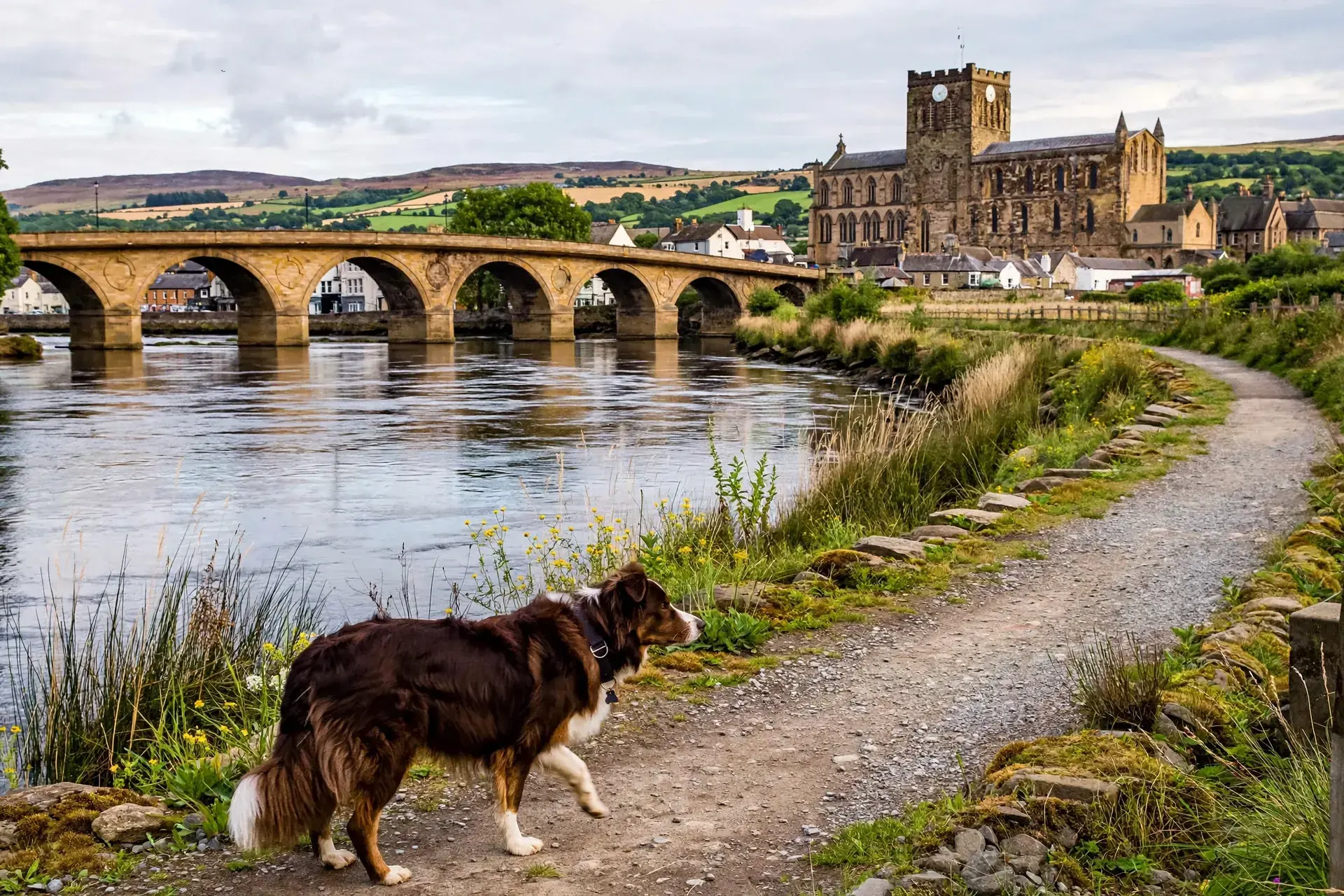
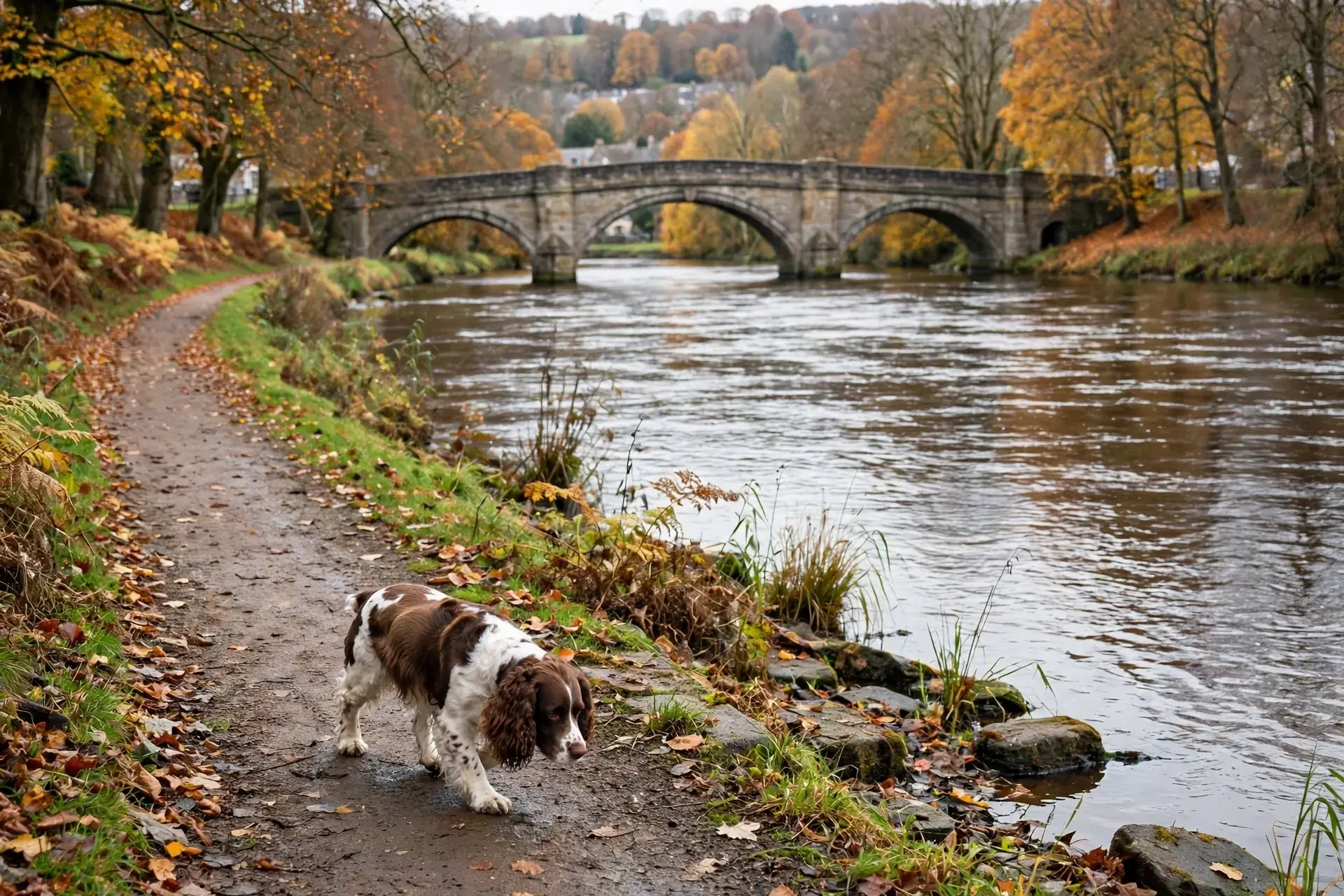
The riverside path is the walk to start with, and it sets the tone for the whole visit. From the old bridge in the town centre, paths run along both banks of the Wansbeck, threading between the park, the meadows and the town. The river here is a proper Northumbrian river rather than a stream: wide enough for ducks and the occasional heron, fast enough after rain to make a pleasant sound, and lined with mature trees that turn the path into a green tunnel in summer and a blaze of colour in autumn.
A good first loop starts at the old bridge, follows the south bank downstream through Carlisle Park, and returns along the north bank or through the town centre. The whole circuit is short, flat and easy to shorten or extend, which makes it ideal for a first walk in an unfamiliar town. If the dog is still full of energy, keep going upstream instead: the path continues west out of town towards meadows and woodland, and the river grows quieter with every hundred metres. The further you walk from the centre, the fewer people you meet, and the more the walk feels like countryside rather than town.
Water safety deserves a clear-headed look before you let any dog near the bank. The Wansbeck is not a paddling stream in most of its town stretch: the banks are steep in places, the current picks up after rain, and the water is cold even in summer. Dogs that love to swim should be kept on a lead until you find a safe, shallow entry point well away from the town centre, and even then only if the water level is low and the flow is gentle. After heavy rain, keep the dog well back from the edge entirely, because the river can rise quickly and the banks become slippery. A long line gives a keen swimmer some freedom without the risk of a dog being swept downstream or scrambling out on a muddy bank it cannot climb.
Wildlife is part of the walk, and it needs managing. Ducks and swans use the river all year, and a dog with a strong chase instinct will need a firm lead and a distraction ready. Herons fish the shallows at dawn, and kingfishers flash along the river in summer, so the path rewards a dog that can walk calmly and an owner who watches the water. In spring, keep the dog out of the long grass on the banks where ground-nesting birds may be present, and check the official guidance before you travel for any seasonal restrictions on the paths you plan to use.
Season changes the riverside more than most town walks. In spring the path is edged with wild garlic and the first leaves; in summer the tree canopy gives deep shade and the river is at its most inviting; in autumn the leaves turn and the path crunches underfoot; in winter the river runs high and fast and the bare trees open up views across the valley. Each season has its own hazards too: summer brings midges near the water at dusk, autumn brings slippery leaf litter on the slopes, and winter brings mud and the risk of flooding on the lowest stretches. Pack accordingly, and if the path is closed or flooded, use the park and the town centre instead rather than picking your way along a closed riverside.
For dogs that need more distance, the riverside path is the start of longer routes rather than the end of them. Upstream towards Mitford, the walk lengthens into a proper country ramble, covered in the section below. Downstream, the river continues towards the coast, although the path becomes less formal and the walk needs more planning. Either way, the town stretch is the warm-up: a flat, forgiving introduction that tells you how your dog is feeling today before you commit to anything longer.
Carlisle Park, the town's green heart
Carlisle Park is the reason many local dog owners never need to leave town for a daily walk. It sits just south of the river, a few minutes from the Market Place, and it packs an unusual amount into a town park: open lawns, mature trees, formal gardens, a paddling pool in summer, tennis courts, a bowling green, a skate park and the William Turner Garden, a walled garden that celebrates the Morpeth-born botanist. For a dog, the important parts are simpler: grass to sniff, shade to lie in, space to move and a steady stream of other dogs to watch from a comfortable distance.
The park works best as a slow, sniffy walk rather than a destination in itself. Enter from the river side and follow the paths through the trees, letting the dog set the pace. The open lawns near the centre of the park are the best place for a game or a training session when the park is quiet, while the tree-lined paths around the edges suit a calmer circuit. The formal gardens, including the William Turner Garden, are the part to treat with most care: keep the dog on a short lead, stay on the paths and do not let the dog into the planted beds. The gardens are small, popular and carefully maintained, and a dog crashing through them is the fastest way to annoy everyone in the park.
Lead rules in the park deserve a plain statement, because this is where visitors most often get it wrong. Carlisle Park is a shared public space used by families, children, sports players and other dog owners, and there is no fenced area set aside for dogs. The safe assumption is that dogs stay on a lead in the formal gardens, around the paddling pool, play areas and tennis courts, and anywhere near other visitors. On the open grass, local owners do let well-behaved dogs off lead when the park is quiet, but that is a judgement call rather than a right: it only works if your dog's recall is reliable, the park is not crowded, and you can see other dogs and children approaching in time to clip the lead back on. If any of those conditions fails, keep the lead on and enjoy the walk anyway.
Children and other dogs are the two things that shape a park visit most. The play areas and the paddling pool draw families in summer, and the paths fill with scooters, balls and excited children. A dog that is calm around children will enjoy the atmosphere; a dog that jumps up or chases needs to be kept on a short lead and steered to the quieter edges of the park. Other dogs are everywhere, on and off lead, and the park's open sightlines usually make introductions easy to manage, but the narrow paths between the gardens can create sudden face-to-face meetings. If your dog is reactive, use the wider lawns and the riverside paths where you can see ahead, and avoid the pinch points around the garden entrances at busy times.
The park changes through the day in ways worth knowing. Early morning is the dog walkers' hour, when the park belongs mostly to locals and their dogs and the atmosphere is relaxed. Midday brings lunch-break walkers and families, especially in school holidays. Late afternoon and early evening bring sports on the courts and the bowling green, and the park fills with teenagers around the skate park. None of this is a problem if you pick the right time for your dog, but a nervous dog will have a much better visit at eight in the morning than at two on a Saturday in August.
Facilities in and around the park are practical rather than luxurious, which is exactly what a dog walk needs. There are benches throughout, bins for dog waste, and water from the river is not a substitute for a bottle and bowl, so carry both. Toilets are available in the town centre a short walk away. In summer the paddling pool is a magnet for children, and the sound of splashing carries across the park, so a dog that is unsettled by water noise is better walked on the far side of the lawns. In winter the park can be muddy after rain, particularly under the trees, so bring a towel and a drying coat if the dog is likely to roll.
Market Place and the town centre
The Market Place is the centre of Morpeth in every sense: a broad, open square surrounded by shops, pubs and cafes, with the Clock Tower standing at one end and the Chantry, a thirteenth-century chapel that now houses the tourist information centre and a craft centre, at the other. On market days the square fills with stalls selling local produce, plants, baked goods and crafts, and the whole town seems to pass through. On quieter days it is a calm, handsome space where a dog can walk at a steady pace and take in the smells of a working town.
Market days are the best and the busiest time to visit the square, and the difference matters for dogs. The traditional market days are Wednesday and Saturday, with a farmers' market usually held on the first Saturday of the month, although you should check the official guidance before you travel because market schedules can change. On a market morning, arrive early if your dog is nervous: the stalls are still being set up, the crowds are thin, and the dog can sniff its way around the square before the shoppers arrive. By late morning the square is busy, noisy and full of food smells, which is a delight for a confident dog and a lot to manage for a reactive one. Keep the lead short, keep the dog close to your side rather than trailing behind you, and watch for dropped food, which is the single most common problem on market days.
Bridge Street, which runs from the Market Place down to the river, is the town's main shopping street and the most useful stretch for a dog owner. It has the practical shops a day out needs: a supermarket, a pharmacy, a pet shop for emergency supplies, and cafes with outdoor seating. The street is narrow and the pavements are not wide, so walk on the side with the most space and be ready to step into a doorway to let a pushchair or another dog pass. The street slopes gently down to the river, which makes it easy walking in both directions, and the old bridge at the bottom is a good place to pause and look back up the street.
Shopping with a dog in Morpeth follows the usual British pattern: most shops will not admit dogs indoors, with the exception of assistance dogs, but many are happy for a dog to wait outside with one person while the other pops in. If you are travelling alone with the dog, plan the shopping around the shops that do welcome dogs, and use the market stalls, which are outdoors and generally happy to have a well-behaved dog browsing alongside. Never tie a dog up outside a shop and leave it unattended in a busy street, even for a few minutes: it is stressful for the dog, it blocks the pavement, and it invites trouble from passers-by.
The town's historic buildings reward a slow look rather than a formal tour. The Chantry is worth a pause for its age and its position overlooking the river, and the Clock Tower is the town's landmark, built in the early eighteenth century and still marking the centre of town life. Morpeth Castle survives as a gatehouse above the town, now a holiday let, and St Mary's Church stands on the hill to the south with views over the valley. None of these is a dog attraction in itself, and dogs will not be admitted inside, but they give the walk a sense of place and they make good backdrops for a photograph on the way past.
One practical point about the town centre is the traffic. Morpeth sits on the old Great North Road, and although the A1 now bypasses the town, Bridge Street and the roads around the Market Place still carry steady traffic. Keep the dog on the pavement side of the road, use the crossings rather than jaywalking with a dog on a long lead, and be careful at the junctions where the pavements narrow. The town centre is small enough that you will rarely need to cross a busy road more than a couple of times, but each crossing deserves attention.
Cafes, pubs and lunch stops
Lunch is where a market town day out either comes together or falls apart, and Morpeth is generous on this point. The town has a good range of cafes, tea rooms and pubs, and many of them welcome dogs, particularly in outdoor seating areas and on the ground floor. The pattern is familiar from other Northumberland towns: the places that welcome dogs tend to welcome them warmly, with a water bowl appearing without being asked and a biscuit offered at the till, while the places that do not will usually say so clearly at the door. If you are unsure, ask before you sit down rather than settling in and discovering the rule afterwards.
Outdoor seating is the safest bet for a dog, and Morpeth has plenty of it in the warmer months. Cafes around the Market Place and along Bridge Street put tables outside when the weather allows, and a dog can settle under a table and watch the town go by. Bring a blanket or a mat for the dog to lie on, because pavement and flagstones are cold and hard, and a dog that has somewhere comfortable to settle is a dog that will stay quiet through lunch. A chew or a stuffed Kong, brought from home, is worth its weight in gold during a long lunch: it gives the dog a job and keeps it from watching every plate that passes.
Pubs are the other half of the Morpeth lunch scene, and they suit dogs well in winter. A pub with a fire, a flagstone floor and a corner table is a good place to dry off after a riverside walk, and many of Morpeth's pubs welcome dogs in the bar area. The etiquette is simple and worth following carefully: keep the dog on a lead and under the table, do not let it wander between tables, and do not let it beg from neighbouring diners. If the pub is busy or the dog is restless, a shorter visit is kinder than a long one. A dog that has had a good walk first will usually settle quickly; a dog that has been in the car all morning will not.
Ordering food with a dog at your feet needs a small amount of planning. Check whether you order at the bar or at the table before you sit down, because a dog tied to a chair while you queue is a dog that can get tangled or upset. If the cafe is counter service, one person orders while the other stays with the dog, or choose a table-service place instead. Water for the dog is usually available on request, but carrying your own bottle and collapsible bowl removes the uncertainty. Avoid feeding the dog from your plate, however tempting it is: rich cafe food upsets many dogs' stomachs, and a dog that learns to expect scraps will beg at every table for the rest of the trip.
If the weather turns or the dog is tired, takeaway is a perfectly good option in Morpeth. Several cafes and bakeries sell food to take away, and a bench in Carlisle Park or on the riverside is a fine place to eat it. This is often the best choice for a dog that has had enough of people and noise: a sandwich on a park bench, with the dog lying on the grass beside you, is a better lunch than a stressful hour in a crowded cafe. Buy the food, walk to the park, and let the dog decompress while you eat.
One more point about cafes and pubs: policies change. A cafe that welcomed dogs last year may have changed hands, redecorated, or tightened its rules, and a pub that was dog-friendly in summer may restrict dogs in winter. Check the official guidance before you travel, and have a second option in mind. Morpeth has enough choice that a closed door is a minor inconvenience rather than a ruined day, but only if you are not counting on a single place.
Beyond the town: Mitford and the valley
Morpeth's best longer walk starts where the town walk ends. Upstream from the town centre, the Wansbeck leaves the park behind and runs through meadows and woodland towards the village of Mitford, about two to three miles away. The walk is gentle, mostly flat and easy to follow, and it turns a town day out into a proper country walk without needing the car. It is the walk to choose when the dog has energy left after the river and the park and you want to stretch the day without driving anywhere.
The route follows the river west out of town, past meadows where cattle and sheep graze, through stretches of woodland and along field edges. The path is a public footpath for most of its length, but it is a country path rather than a park path: after rain it can be muddy, the ground can be uneven, and some stretches cross farmland where livestock may be present. Keep the dog on a lead near animals, and never let a dog chase or worry livestock, which is an offence as well as a danger to the dog. Check the official guidance before you travel for the current state of the path, because river levels and field conditions change with the seasons.
Mitford itself is a small, quiet village with a church and the ruins of Mitford Castle, a medieval fortress that was largely destroyed by fire in the fourteenth century. The castle ruins stand on a mound above the village and make a good turning point for the walk: a place to pause, look back down the valley towards Morpeth, and decide whether to walk back the way you came or take a different route. The village has no shops to speak of, so carry water and snacks for both of you, and do not count on finding a cafe at the far end.
The return walk is the same distance, so the round trip is roughly four to six miles, which is a solid half day for most dogs. If that is too far, walk out for an hour and turn back at any point: the path is out-and-back for most of its length, so there is no penalty for cutting it short. If the dog is still going strong, the walk can be extended further upstream, although the path becomes less formal and the route needs more careful navigation. Whatever distance you choose, allow time for the walk back: the light fades early in winter, and the riverside path is not lit.
For drivers, Morpeth is also a useful starting point for the wider county. The coast at Blyth and Newbiggin is a short drive east, with beaches that are generally more relaxed about dogs outside the summer season, and the castles and beaches of the north Northumberland coast are an easy day trip up the A1. To the west, Hexham and the Tyne valley offer a different landscape of riverside towns and fell walks, and our guide to Hexham with a dog covers the abbey town in the same detail as this guide covers Morpeth. To the north, Alnwick is the county's other great market town, and our guide to Alnwick with a dog covers its castle, gardens and riverside walks. If you are planning a longer stay, our Northumberland county guide pulls the whole county together, from the coast to the Cheviots.
Wallington Hall, the National Trust property a short drive north-west of Morpeth, is another worthwhile addition to a longer stay. Its gardens and parkland offer a different kind of walk from the town riverside, although dogs are restricted in the house and in some garden areas, so check the official guidance before you travel for the current rules. The same applies to any National Trust or English Heritage property you plan to visit from Morpeth: the grounds are often dog-friendly, the interiors are not, and the details change, so check before you go rather than assuming.
Arriving and parking
Morpeth is easy to reach. It sits just off the A1, about fifteen miles north of Newcastle, and the drive from the city takes around half an hour in normal traffic. The railway station is on the East Coast Main Line, with regular trains to Newcastle, Edinburgh and London, and the station is a short walk from the town centre, although the walk from the station to the river involves a hill and a busy road, so a dog that is nervous around traffic will need a steady hand. Buses also serve the town from Newcastle and the surrounding villages, and the bus station is close to the Market Place.
For drivers, the most useful car parks are the ones within a short walk of the river and Carlisle Park, including the town-centre car parks off Bridge Street and around the Market Place, and the parking near the park itself. On market days and in school holidays, the central car parks fill early, so arrive before late morning or be prepared to park a little further out and walk in. Check the official guidance before you travel for current charges, time limits and payment methods, because these change and the signs at the car park are the final word.
Parking with a dog in the car needs the usual care. Never leave a dog in a parked car on a warm day, even for a few minutes, and never leave a dog unattended in a car in a busy car park where it can be seen and heard. Plan the day so the dog comes out of the car as soon as you arrive: park, get the lead on, and start the walk. If you need to stop in Morpeth on a longer journey, use the town as a leg-stretch break rather than a place to leave the dog while you shop.
Arriving by train or bus with a dog is straightforward, but the walk from the station deserves a note. The station is south of the town centre, and the route into town crosses the river and climbs gently. It is a pleasant walk on a quiet day, but the roads around the station are busy and the pavements are narrow in places. Keep the dog close, use the crossings, and allow ten to fifteen minutes to reach the Market Place. If you are carrying luggage as well as a dog, a taxi from the station is worth considering, and you should confirm with the driver that the dog is welcome before the journey starts.
Where to stay with a dog
Morpeth has a small but useful range of places to stay with a dog, from hotels and inns in the town centre to self-catering cottages and bed and breakfasts in the surrounding villages. The town-centre hotels and inns are the most convenient for a short stay: you can walk to the river, the park and the restaurants, and the dog is never far from a familiar walk. Self-catering cottages a few miles outside town offer more space, a garden and a quieter night, at the cost of a drive into town each morning.
Booking a stay with a dog in Morpeth follows the same rules as anywhere else in Britain, and they are worth stating plainly. Confirm in writing that the specific room or property accepts dogs, how many dogs it accepts, and what the charge is, because a hotel that accepts dogs in its ground-floor rooms may not accept them in its upper rooms, and a cottage that accepts one dog may charge extra for a second. Ask whether dogs can be left alone in the room, because many places prohibit it, and ask where the nearest practical toilet walk is for the last outing at night. A place that answers these questions clearly is a place that has thought about dogs; a place that answers vaguely is a place to avoid.
Charges for dogs vary widely. Some hotels charge nothing, some charge a flat fee per stay of ten to twenty-five pounds, and some charge per dog per night. Self-catering properties often charge a weekly pet fee, and some add a refundable damage deposit. Get the total in writing before you pay, and check what it covers: a cleaning charge is not the same as a damage deposit, and a fee that seems high may be reasonable if it includes a dog bed, bowls and towels.
Staying in town has one clear advantage over staying outside it: the evening and early morning walks. A dog that can step out of the hotel door and onto the riverside path within minutes will settle far more easily than a dog that has to wait for a car journey. Morpeth's riverside and park are at their best in the early morning, when the town is quiet and the river mist is still lifting, and an evening stroll along the Wansbeck after dinner is a good way to end the day. If you stay in town, build both walks into the routine.
For longer stays, Morpeth works as a base for the county, and the choice of accommodation should reflect that. A self-catering cottage with a garden and a drying area is a better base for a week of coastal and country walks than a hotel room, because wet dogs, muddy boots and drying coats need space. A hotel in the town centre is a better base for a short break built around the town itself. Either way, book early for school holidays and for the summer months, because the dog-friendly rooms and cottages are the first to go.
Wet days and winter visits
Morpeth in the rain is a different town from Morpeth in the sun, and it is worth planning for both. The riverside path drains reasonably well on its surfaced stretches, but the unsurfaced sections and the park's paths under the trees become muddy after sustained rain, and the lowest parts of the riverside can flood when the Wansbeck is high. On a wet day, shorten the riverside walk, use the surfaced paths through the park, and spend more time in the town centre, where the shops, the Chantry and the cafes give you somewhere dry to pause.
A wet-weather kit makes the difference between a miserable day and a good one. Pack a drying coat for the dog, two towels, a waterproof mat for the car boot, and a spare lead, because a wet lead is an unpleasant thing to hold for an hour. A dog that is dried off before getting back in the car will be happier, and the car will smell better for it. If the dog is likely to get muddy, a portable dog wash or a bottle of water and a cloth will do the job in the car park before the drive home.
Winter brings its own character to Morpeth. The town is quieter, the park is emptier, and the low winter light over the river is beautiful on a clear day. The trade-offs are shorter days, colder water and muddier paths. Dogs that are older or have arthritis will feel the cold more, so a coat is worth packing, and the walk should be shorter and closer to the car. Check the official guidance before you travel in winter, because the riverside path can be closed after flooding and the park's surfaces can be icy on frosty mornings.
Christmas and the festive season are a pleasant time to visit, when the town centre is decorated and the shops are busy, but the crowds and the fireworks around early November and New Year can unsettle noise-sensitive dogs. If your dog is frightened by fireworks, avoid Morpeth on the nights around the fifth of November and New Year's Eve, when displays in the town and the surrounding villages can be heard across the valley. A quiet weekday in December, by contrast, is one of the best times to see the town at its most attractive.
Summer has the opposite problem: heat. Morpeth is not a hot town by southern standards, but a sunny July afternoon can still be too warm for a thick-coated dog, and the riverside path's shade is patchy in places. Walk early in the morning or in the evening, carry water and a bowl, and use the park's trees for shade during the middle of the day. Never let a dog swim in the Wansbeck to cool off without checking the water level and the current first, and remember that blue-green algae can affect rivers and ponds in warm weather: if the water looks green or scummy, keep the dog out of it and check the official guidance before you travel.
A practical checklist
A good Morpeth day out needs less kit than a mountain walk, but the right kit still matters. Start with the basics: a lead and a spare, a long line for the riverside, a water bottle and a collapsible bowl, poo bags and a holder, a towel and a drying coat, and a blanket or mat for the dog to settle on in a cafe. Add a chew or a stuffed Kong for lunch, a first-aid kit with tick removers, and the number of the nearest vet saved in your phone before you leave home.
Timing is the second part of the checklist. A market-day visit should start early, before the square fills, and a quiet visit should aim for a weekday morning, when the park belongs to the local dog walkers. In summer, walk the river in the morning and eat lunch in the shade; in winter, walk in the middle of the day when the light is best and the paths are driest. Allow two to three hours for the town walk and lunch, and four to five hours if you add the walk to Mitford.
Health and safety checks deserve a line of their own. Make sure the dog's vaccinations are up to date and its flea and tick treatment is current, because riverside grass and woodland are tick country from spring to autumn. Check the dog's paws after a walk on the riverside path, where stones and mud can hide thorns and cuts. If the dog swims anywhere, rinse it off afterwards and watch for stomach upsets in the following day or two. If the dog shows any sign of illness after a river swim, contact a vet promptly and mention the swim.
Etiquette is the final item, and it is the one that keeps Morpeth welcoming for the next dog owner. Pick up after your dog every time, without exception, including on the riverside path and in the park. Keep the dog on a lead in the formal gardens, around children and near livestock. Do not let the dog jump up at strangers, beg at cafe tables, or bark at other dogs from the car. The town is small and the local dog walkers notice: a well-behaved dog is welcomed back, and a badly behaved one is remembered.
Morpeth rewards the dog owner who takes it slowly. It is not a place to tick off in an hour; it is a place to walk the river in the morning, sit in the park, browse the market, eat a long lunch and walk the river again in the late afternoon light. The dog will tell you when it has had enough: a dog that is lying down in the park, watching the ducks, is a dog that is having a good day. Let it lie there a while longer.
Practical questions
Before you go
Can dogs go off lead in Carlisle Park?
Carlisle Park is a shared public park, so the safe assumption is that dogs stay on a lead in the formal gardens, around the paddling pool, play areas and tennis courts, and anywhere near other visitors. Some open grass areas are used by local owners for a run, but there is no fenced dog exercise area, so only let a dog off lead if you are confident about recall and the park is quiet. Check the park signs and the official guidance before you travel, because rules for individual areas can change.
Is the Wansbeck riverside path suitable for reactive dogs?
It depends on the time of day. Early mornings and weekday evenings are usually quiet, with long sightlines along the river that let you see other dogs coming and move aside. Market days, school holidays and sunny weekends bring more dogs, children, cyclists and runners, so a reactive dog will find those times harder. Keep the dog on a lead throughout, use the wider stretches near the park for passing, and have a plan to step off the path onto the grass if you need space.
Are dogs allowed in Morpeth's cafes and pubs?
Many cafes and pubs in Morpeth welcome dogs, especially in outdoor seating areas and on ground floors, but policies vary from place to place and can change with the season. Some allow dogs throughout, others restrict them to a terrace or a specific room. Always ask before sitting down, keep the dog on a lead and under the table, and bring a blanket for the dog to settle on. If a place is full or the dog is restless, takeaway coffee and a bench by the river is a good fallback.
Where is the best parking in Morpeth with a dog?
The most useful car parks for dog owners are the ones within a short walk of the river and Carlisle Park, such as the town-centre car parks off Bridge Street and around the Market Place, and the parking near the park itself. Arrive before late morning on market days and in school holidays, when the central car parks fill early. Check the official guidance before you travel for current charges and time limits, and leave nothing visible in the car.
Can I walk from Morpeth to Mitford with a dog?
Yes, there is a well-used riverside route from Morpeth towards Mitford, following the Wansbeck upstream past meadows and woodland to the village and its castle ruins. It is a gentle, mostly flat walk of around two to three miles each way, but parts can be muddy after rain and some stretches cross farmland where livestock may be present, so keep the dog on a lead near animals and check the official guidance before you travel for the current path conditions.
Is Morpeth a good base for a longer Northumberland trip with a dog?
Yes, Morpeth works well as a base because it sits just off the A1, close to the coast at Blyth and Newbiggin, to the castles and beaches further north, and to the Tyne valley to the west. You get a real town with shops, vets and cafes, plus river walks on the doorstep, and you can reach the coast, Hadrian's Wall country and the Cheviots as day trips. Our Northumberland county guide covers the wider county, and our Alnwick and Hexham guides cover the two most useful next stops.