This guide is independent and contains no paid placement. If affiliate links are added later, they will be clearly marked and will not change our editorial checks.
Visit Muker for the meadows first and the walking second. Keep your dog on a lead through the hay fields and near sheep, stick to marked paths, save Kisdon Force for a dry day, and arrive early — this is a small village with limited parking and a working farming landscape, not an open dog park.
Start with the meadows, not the car park
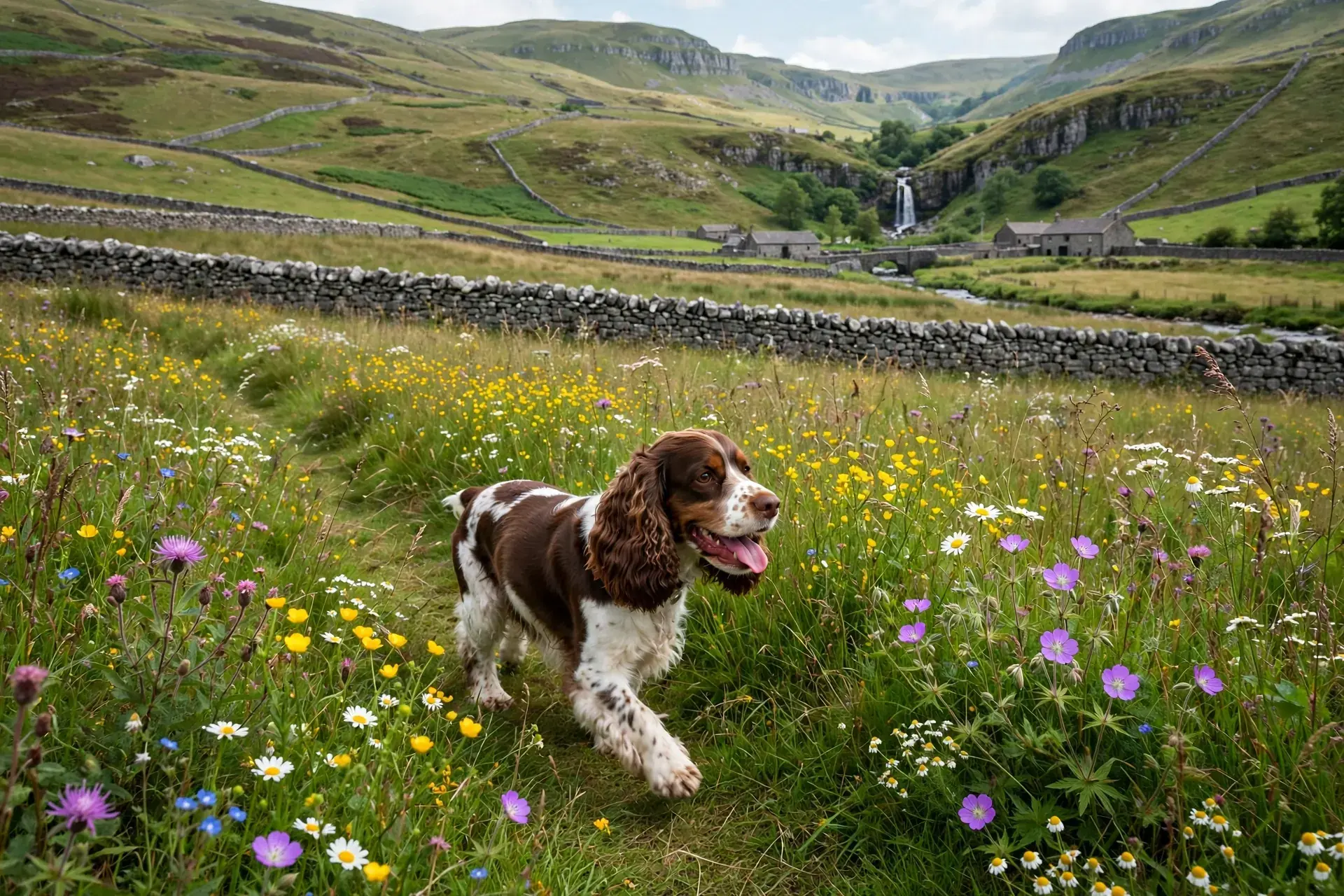
Most Dales villages are visited for their walks, their pubs or their views. Muker is different: people come here for the fields. The hay meadows around the village are among the finest surviving examples of traditionally managed upland meadow in the Yorkshire Dales, and in early summer they turn into a wash of colour — wood cranesbill, meadow buttercup, yellow rattle, great burnet, pignut and red clover growing thick among the grasses, with skylarks singing above them and Swaledale sheep grazing the edges. It is the single most beautiful thing about the village, and it is also the thing most easily damaged by a careless dog walk.
The meadows are a crop, not a park. The grass is left to grow long through spring and early summer so that the flowers can set seed, then it is cut for hay, dried in the field and baled for winter feed. That cycle shapes everything about a dog walk here. In May, June and early July the grass stands waist-high in places, the flowers are at their best, and the ground is full of nesting birds and young wildlife that a loose dog can disturb in seconds. From late July onwards the fields are cut, the colour fades, and the walking becomes easier — but the flowers are gone until next year, so timing matters more here than in almost any other Dales village.
Plan your visit around the meadow calendar rather than the weather forecast. The best flower display usually runs from late May into early July, with the peak shifting a week or two either way depending on how cold the spring has been. A warm, dry June gives the fullest show; a wet spring delays it. If you are travelling specifically for the flowers, check the official guidance before you travel for the current season, and have a backup walk in mind — the waterfall and the riverside paths are worth the trip even in a year when the meadows are late or already cut.
Walking through the meadows with a dog is straightforward if you follow three simple rules. First, stay on the marked paths and the field edges rather than striking across the middle of a field. The flowers are fragile, the grass is a farmer's winter feed, and a dog charging through tall grass flattens both. Second, keep your dog on a lead while the grass is growing. A long line gives a keen sniffer room to investigate the field edge without letting them crash into the crop. Third, watch where your dog toilets: pick up after them even in a field, because dog waste contaminates hay and can carry disease that harms livestock. None of this is onerous, and it is what keeps the meadows worth visiting.
Photography is part of the pleasure here, but it deserves the same care. The classic Muker photograph — a dog sitting in a sea of flowers with dry stone walls behind — is taken from the path, not from the middle of the field. Crouch low at the field edge and the flowers will frame the shot for you. Never pick the flowers, and never let a dog trample a patch so you can get a cleaner picture. The meadows have survived because generations of farmers managed them lightly; a few minutes of care from each visitor is a small price for keeping them that way.
One more thing the meadows change: your dog's fitness for the day. Tall grass, soft ground and warm sun tire a dog faster than a surfaced path, and the walk back to the village can feel much longer than the walk out. Bring water even on a short meadow loop, watch for overheating in a thick-coated dog, and plan a shaded rest before you set off on a longer trail. The meadows reward a slow pace — stop, look, let the dog sniff the field edge — and that slow pace is the whole point of coming here.
Kisdon Force: the waterfall at the end of the lane
A short walk downstream from Muker, the River Swale drops through a rocky gorge at Kisdon Force, a waterfall that is modest in height but dramatic in setting. The river narrows between dark rocks, the water turns white, and the sound carries up the valley long before you can see it. It is the natural destination for a dog walk from the village, and it is also the place where the day needs the most care.
The path to the falls follows the river through riverside meadow and woodland, and it is easy underfoot in dry weather. After rain it changes character: the ground becomes slick, the river rises, and the rocks around the gorge turn treacherous. The Swale is a spate river, which means it can rise fast after heavy rain on the fells, and a waterfall that looked gentle in the morning can be a different river by the afternoon. If the river is running high, brown and fast, enjoy the falls from the path and do not try to get closer. Check the official guidance before you travel if recent weather has been wet.
Keep your dog on a short lead around the gorge. The rocks are steep, wet and uneven, and a dog that slips on a mossy ledge can be hurt badly before you can reach them. Do not let your dog scramble down to the plunge pool, and do not let them drink from the river immediately below the falls, where the current is strongest and the water is at its most turbulent. A calmer stretch of river upstream or downstream is a far better place for a paddle, and the dog will enjoy it just as much.
The waterfall rewards patience. Arrive early and you may have the gorge to yourself; arrive at midday on a fine summer weekend and you will share it with a queue of walkers. Dogs that are nervous around strangers or other dogs will cope better at the quieter end of the day. Bring a towel in your pack — dogs that do paddle in the Swale come out wet and muddy — and check paws afterwards, because the rocks here are rough and can cut pads that are used to softer ground.
If Kisdon Force is busy or the river is too high, the walk is still worth doing. The riverside path itself is one of the prettiest stretches of the Swale, with alder and ash trees overhanging the water, dippers working the shallows, and dry stone walls running down to the bank. Turn back before the gorge if conditions look wrong, and treat the walk as the destination rather than the waterfall. A dog does not care whether you reached the falls; it cares about the sniffs, the water and the walk.
Hay time: what June and July change
Haymaking is the busiest fortnight in Muker's year, and it changes the village for a dog walker. The hay cut usually falls in late June or July, when a spell of dry weather lets the grass be cut, turned, dried and baled. The exact dates depend on the weather and vary from field to field, so one meadow may be cut while the next is still standing. During this window, tractors and trailers are working the narrow lanes, gates are open that are normally shut, and the fields are full of activity from early morning until evening.
The practical effect is simple: give the machinery room, keep your dog on a lead, and do not walk through a field that is being cut or where cut grass is drying in rows. The drying grass — the rows of cut hay left in the sun — is easily spoiled by a dog running through it, and a loose dog around moving machinery is a danger to the dog, the driver and anyone else on the path. If a path is closed or diverted for haymaking, follow the diversion rather than arguing with it; the closure is usually short-lived.
Hay time also changes what your dog will smell and eat. Cut grass is tempting to some dogs, and dried hay can irritate a dog's nose, eyes and throat. Watch for sneezing, pawing at the face or rubbing the eyes after a walk through a cut field, and rinse your dog's face with clean water if they seem uncomfortable. Grass seeds are the bigger hazard: the awned seeds of meadow grasses can work their way into ears, between toes and under the skin, especially in spaniels and other long-coated breeds. Check ears and paws after every meadow walk in high summer, and check the official guidance before you travel if you are unsure what to look for.
There is a reward for visiting just after the hay cut, too. Once the fields are cut and the bales are gathered, the meadows open up again: the walking is easier, the ground is firmer, and the views across the valley — to the fells above Keld and the dry stone walls stepping up the hillsides — are at their widest. The flowers are gone, but the landscape is still beautiful, and the village is quieter. If the flowers are your priority, come in June; if easy walking and empty paths are your priority, come in late July or August.
Sheep, lambs and dry stone walls
Swaledale is sheep country, and Muker sits in the middle of it. The hardy Swaledale sheep — black-faced, horned, and perfectly at home on rough fell — graze the meadows and the open moor around the village for most of the year. Lambs arrive in spring, and by early summer the fields hold ewes with young lambs at foot. This is the single most important thing to understand before walking a dog here: your dog is a guest in a working sheep landscape, and the rules are not optional.
Keep your dog on a lead whenever sheep are in the field or nearby, even if your dog has never chased anything in its life. A dog does not need to catch a sheep to do serious harm: a chase can separate lambs from their mothers, drive pregnant ewes into walls and fences, and cause injuries and miscarriages that the farmer only discovers days later. The law is blunt about it. Farmers have legal powers to act against dogs that worry livestock, and a dog owner can be liable for the damage. None of that is a reason to stay away — it is a reason to walk with a lead in your hand and your attention on the field ahead, not on your phone.
Spring needs extra care. Lambing runs roughly from April into May, and during that window the ewes are at their most protective and the lambs at their most vulnerable. A dog off lead in a lambing field is a serious incident waiting to happen, even if the dog only wants to play. If you visit in spring, choose the riverside and lane walks where livestock are behind walls, keep the lead short, and be ready to turn back if a field holds ewes with very young lambs. The meadows will still be there in June.
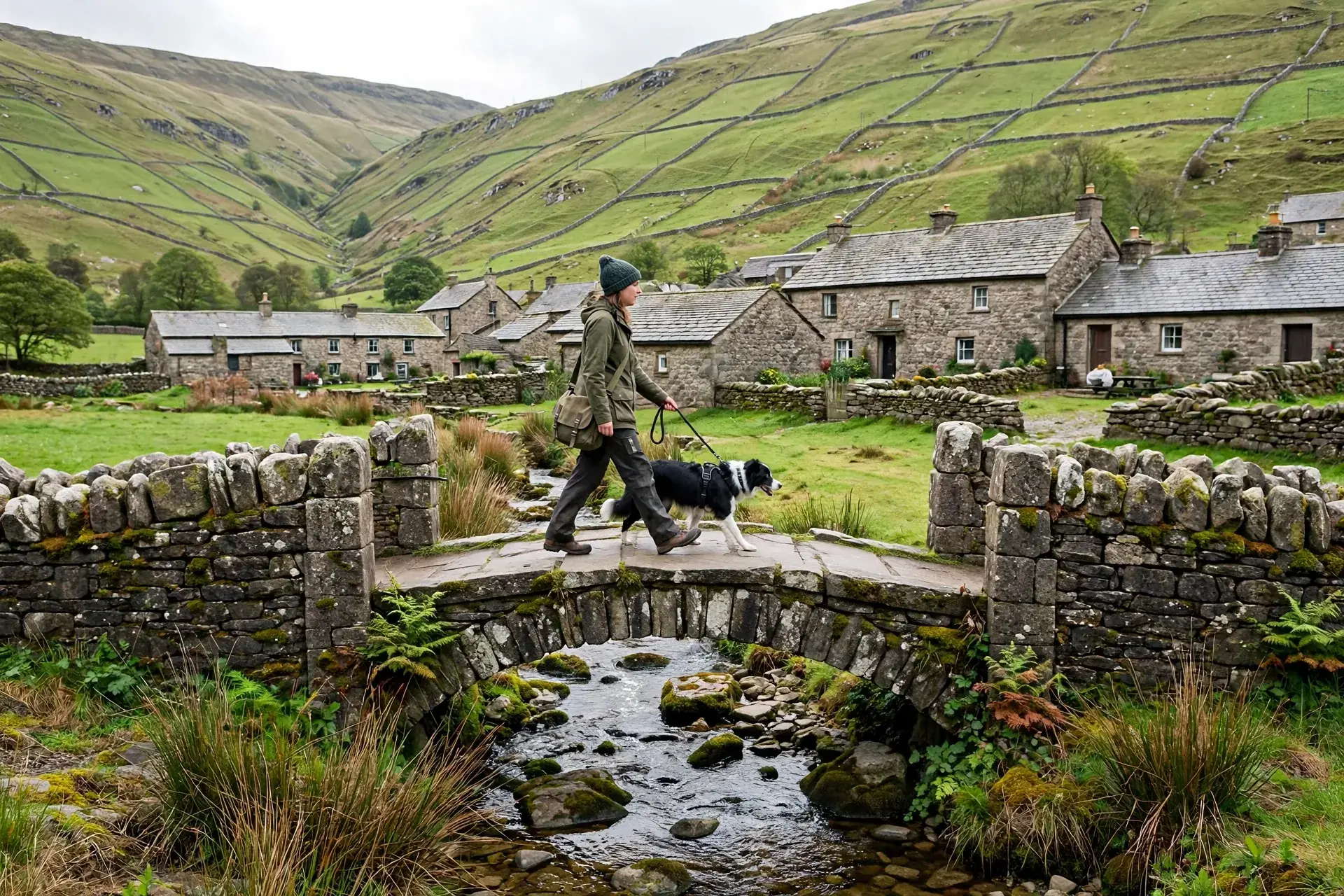
Dry stone walls are the other feature that shapes a dog walk in Swaledale. The walls are built without mortar, stone on stone, and they are both boundary and habitat: they shelter sheep, mark ownership and hold back the hillside. A dog that jumps a wall can knock stones loose, and a loose wall is a repair job for the farmer. Teach your dog to use gates and stiles instead, and lift a small dog over a stile rather than letting it scramble. If a wall looks newly built or freshly repaired, give it a particularly wide berth.
Gates deserve the same respect. In this part of the Dales, the rule is simple: leave a gate as you find it. If it is shut, shut it behind you; if it is open, leave it open — the farmer left it that way for a reason. A gate left open by a walker can let sheep onto a road or into a field of growing hay, and it is one of the easiest mistakes to make and one of the most annoying to fix. Make shutting the gate part of the routine: dog through first, then the gate, then carry on.
The village lanes: a short loop from the green
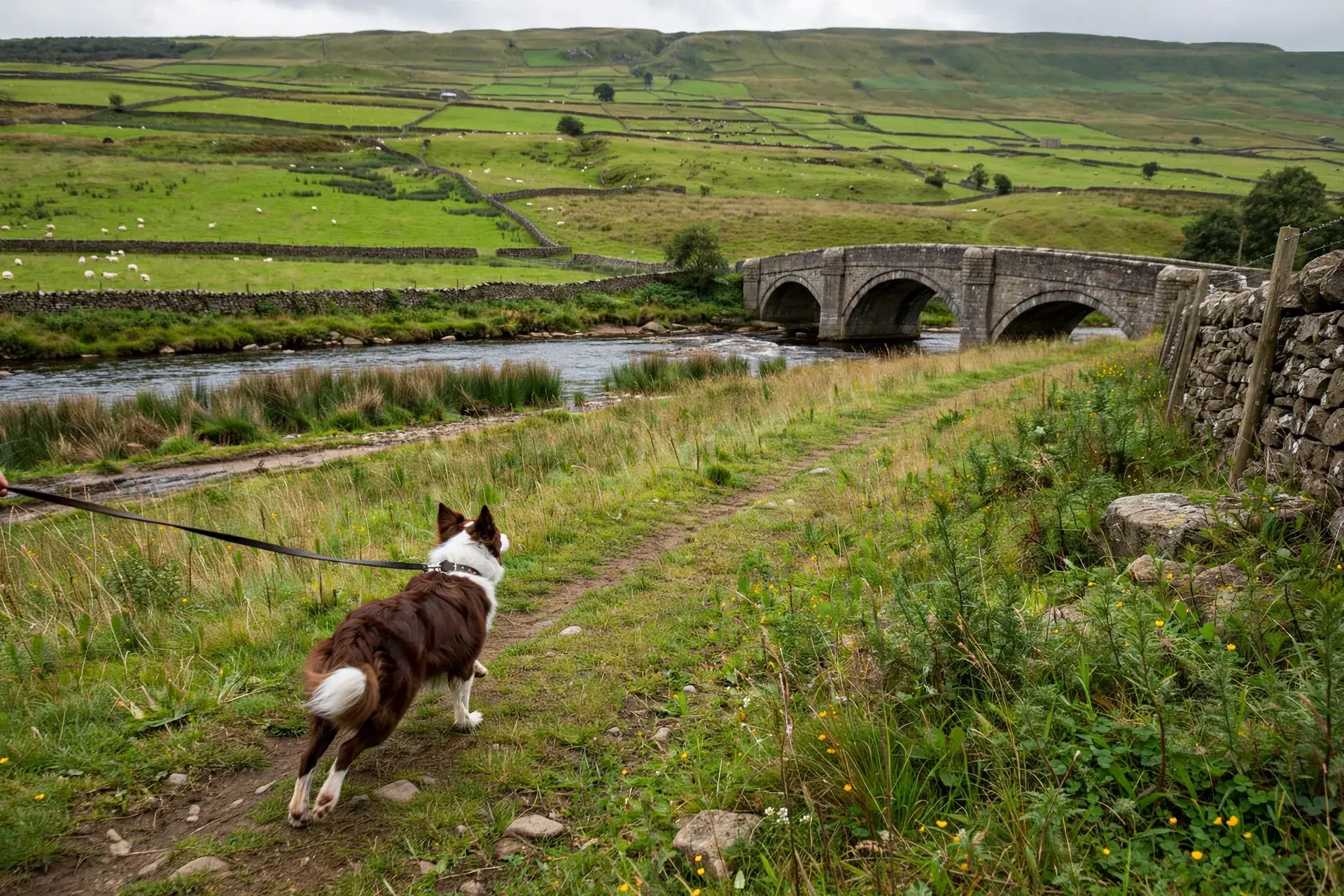
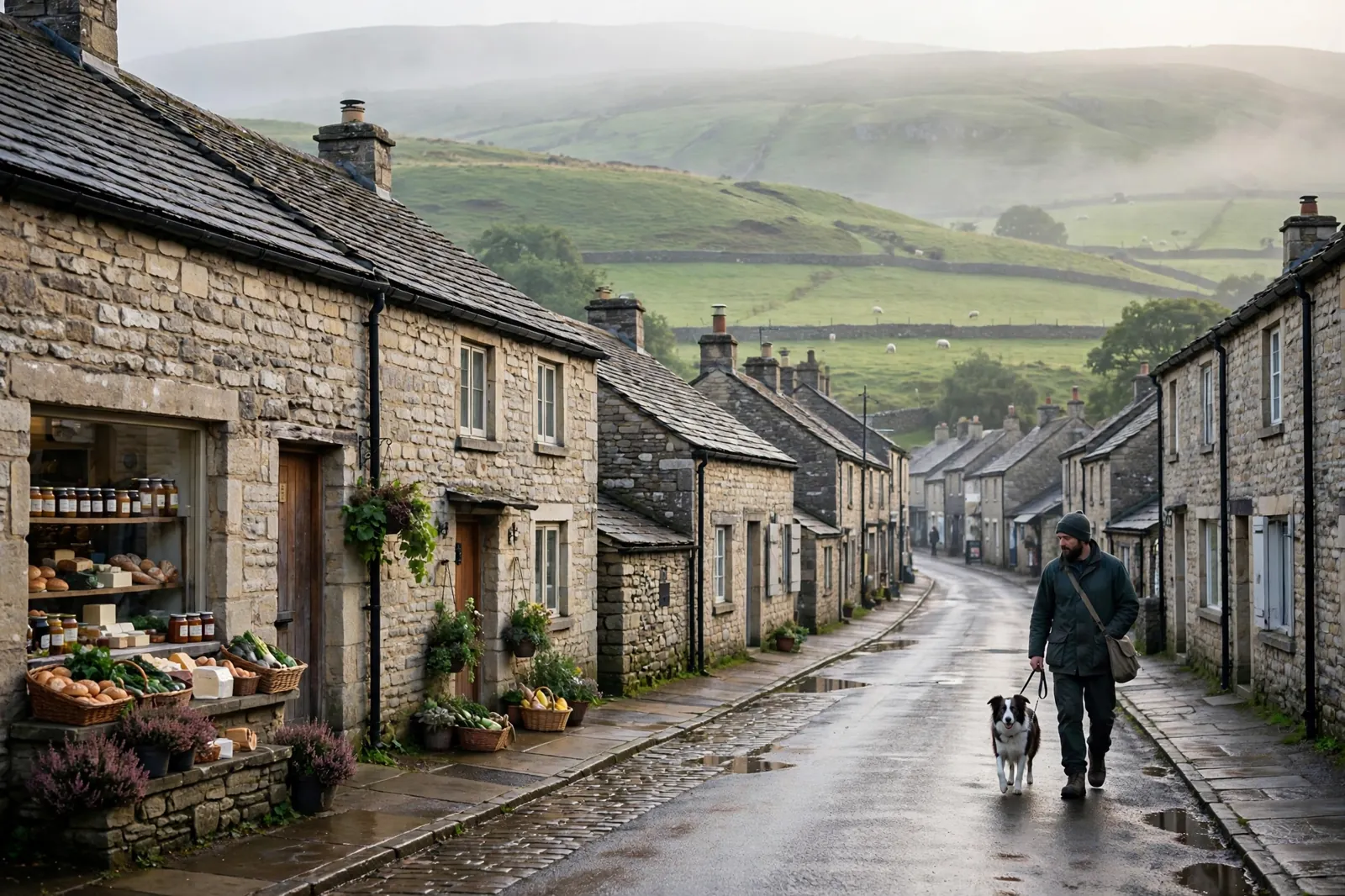
Muker itself is small enough to walk around in a few minutes, and that smallness is part of its charm. The village green sits at the heart of it, with the church of St Mary the Virgin at one end, stone cottages along the lanes, and the old packhorse routes radiating out towards Keld, Thwaite and the fells. A short loop from the green, down the lanes and back along the river, is the right first walk for a dog that is new to the village: it lets the dog learn the smells and sounds of the place before you ask it to tackle a longer trail.
The lanes are narrow, with high stone walls on either side and very little pavement. Traffic is light but real — farm vehicles, delivery vans and the occasional car looking for a parking space — and a dog on a long lead can be in the road before you notice. Keep the lead short on the lanes, walk on the side facing oncoming traffic where you can, and step into a gateway or passing place when a vehicle approaches. It is the kind of walking that feels old-fashioned because it is: the lanes were built for packhorses, not cars, and they still work best at walking pace.
The churchyard is worth a quiet look, but keep your dog on a lead there and out of the planted areas. Churchyards in the Dales are often havens for wildflowers and old trees, and they are also places where people come to sit quietly. A calm dog on a short lead is welcome; a dog charging across the graves is not. The same applies to the village green itself: it is a shared space, not a dog exercise area, so keep the dog close, pick up after them, and move on to the fields for the real running.
Look up as you walk the lanes, too. The barns and field barns that dot the valley — the small stone buildings that once stored hay — are one of Swaledale's most distinctive sights, and Muker has more of them than almost anywhere else in the Dales. They are private farm buildings, so admire them from the lane and do not let your dog wander into a barn yard. The walls, the barns, the green and the church together make Muker feel like a village that has kept its shape, and that shape is best appreciated slowly, on foot, with a dog trotting at your side.
The River Swale: paddling, currents and common sense
The River Swale runs through Muker and shapes every walk from the village. It is a fast, clear, upland river, born on the fells above Keld and running down the valley past Muker towards Reeth and Richmond. In summer it is shallow and inviting, with gravel banks where a dog can paddle and cool off. After rain it is a different river entirely: brown, fast and strong enough to knock a person off their feet, let alone a dog.
Choose your paddling spot with the same care you would choose a swimming spot for a child. Look for a shallow, slow stretch with a gravel bank and an easy exit, well away from waterfalls, weirs and narrow channels. Let the dog paddle in the shallows rather than swim in the current, and never throw a ball or a stick into fast water — a dog that chases a toy into a strong current may not be able to get back. If the river is running high, skip the paddle altogether and walk the bank instead.
River safety is also about what you cannot see. The Swale's bed is rocky and uneven, with sudden deep pools beside shallow gravel, and the stones are slippery with algae even in dry weather. A dog that jumps in without checking the depth can land badly, and a dog that cannot climb out of a steep bank can panic quickly. Walk the bank first, find the easy entry and exit points, and keep the dog on a long line until you know the spot. If you are unsure about the river on the day, check the official guidance before you travel or ask locally — the pub and the village shop are good sources of up-to-date local knowledge.
After a river walk, check your dog over. Wet paws on rough rock can cut pads, and river water can carry grit into small cuts. Dry the dog thoroughly, especially the ears of a spaniel or any long-eared breed, because damp ears are a common cause of ear infections after river swims. A quick check of paws, ears and belly at the car takes two minutes and saves a vet visit later in the week.
The river is also a wildlife corridor, and it deserves the same respect as the meadows. Dippers, grey wagtails and kingfishers work the Swale, and otters have returned to the upper valley in recent years. A dog crashing through the shallows scatters every bird for a hundred metres. Keep the dog close on the bank, let them paddle in one chosen spot, and leave the rest of the river to the wildlife. The best river walks are the ones where you see the dipper as well as the dog.
Longer trails from Muker: Keld, Thwaite and the Coast to Coast
Muker sits on one of the great long-distance walking routes in England: the Coast to Coast path, which crosses the country from the Irish Sea to the North Sea and passes through the village on its way from Keld to Reeth. That single fact makes Muker a natural base for a longer day with a dog, because the path is well waymarked, the walking is varied, and you can follow it in either direction and come back by a different route.
The classic longer walk from the village is the stretch to Keld, about three miles upstream along the Swale. The path follows the river through meadow and woodland, climbs gently past Kisdon Force, and arrives at Keld, a tiny hamlet at the head of the valley where the river is born. It is a there-and-back walk or a loop, depending on how much time and energy your dog has, and it is one of the prettiest river walks in the Dales. Allow at least half a day, carry water for the dog, and remember that the return leg is mostly downhill but still long for a small or older dog.
The other direction, downstream towards Thwaite and then Reeth, is gentler and more open. The valley widens, the river slows, and the path runs through riverside meadow with the fells rising on either side. Our guide to Reeth with a dog covers the village at the other end of this stretch, including its green, its swing bridge and its riverside walks, and it pairs naturally with a Muker day if you are staying in the valley for more than one night. Thwaite, the tiny village between Muker and Keld, is a good halfway point for a shorter loop: walk out to Thwaite, stop for a rest, and come back along the river.
For a full day, the Coast to Coast stage from Keld to Reeth passes through Muker and gives a sense of the whole upper valley in one walk. It is a long day — around ten miles — and it is too much for most dogs unless they are fit, used to distance and comfortable on rough ground. Break it up instead: walk Muker to Keld one day, Muker to Reeth the next, and let the dog rest in between. A tired dog on the last mile of a long day is a dog that makes mistakes on stiles and slips on rocks, and there is no prize for finishing a long walk with an exhausted animal.
Navigation on these longer trails is straightforward but not foolproof. The Coast to Coast is waymarked, but the riverside paths can be muddy, overgrown or diverted after flooding, and the fell paths above the valley are exposed in bad weather. Carry a paper map as well as a phone, because signal in the upper valley is patchy and a dead battery leaves you with nothing. Tell someone your route if you are walking alone, and check the official guidance before you travel for any path closures. The Dales are forgiving country in good weather and unforgiving in bad, and the difference between the two can be an hour.
Eating and drinking with your dog in Muker
Muker is a small village, and its eating and drinking options are correspondingly small — but what it has, it does well. The village pub, the Farmers Arms, has long been the walkers' pub of upper Swaledale, serving food and drink to people coming off the fells and the Coast to Coast path. It has traditionally welcomed dogs, but pub policies can change with the season and the landlord, so ask staff about the current dog policy before you settle in with your dog. A blanket for the dog to lie on, a lead kept short under the table and a bowl of water will make the visit easy for everyone.
Plan your meals around the village's size. There is a small village shop for supplies, and the pub serves food at set times rather than all day, so do not arrive at three in the afternoon expecting lunch. If you are walking a long day, carry food for yourself as well as the dog, and treat the pub as a welcome stop at the end of the walk rather than a midday refuelling point. On fine days the outdoor seating is the easiest option with a dog: the dog can lie in the shade, you can keep an eye on them, and nobody has to navigate a crowded bar with a lead.
If you are staying in the valley for a few days, the wider area gives you more choice. Hawes with a dog covers the market town over the hill in Wensleydale, with its cheese town, its cafes and its dog-friendly places to eat, and it makes a good rainy-day alternative when Muker's lanes feel too quiet. The drive over the Buttertubs Pass from Swaledale to Wensleydale is itself one of the great Dales drives, but it is narrow and winding, so allow plenty of time and do not attempt it in bad weather with a nervous dog in the car.
A word about picnics, because Muker is a picnic village more than a restaurant village. The riverside meadows and the village green are natural picnic spots, and a packed lunch eaten beside the Swale with the dog at your feet is often better than any pub meal. Bring everything you need, take everything away with you, and do not leave food waste where sheep or dogs can find it. A dog that has just eaten a picnic is a dog that needs a toilet break before the walk home, so plan a short stop at the end of the meal.
Arriving and parking: the practical details
Muker is reached by a single narrow road up Swaledale from Reeth, and the drive itself is part of the experience: the valley narrows, the walls close in, the river runs beside the road, and the fells rise on either side. Allow more time than the map suggests, because the road is single-track in places, with passing places, and you will meet farm vehicles, walkers and sheep. Drive slowly, use the passing places properly, and never park in one — a passing place is for passing, not for parking.
Parking in the village is limited. There is a small car park and a handful of roadside spaces near the green, and on a fine summer weekend they fill early. Arrive before mid-morning if you can, and if the village is full, do not circle the lanes hoping for a space — drive on to Thwaite or Keld, where there is more room, and walk back to Muker along the river. Parking only in marked spaces matters here more than in a town: a car blocking a farm gate or a field entrance can hold up a tractor, a vet or an emergency vehicle, and it is the kind of thing that makes a village less welcoming to the next visitor.
Public transport to Muker is limited, so most visitors arrive by car. Buses run up the valley from Richmond and Reeth on some days, but the service is infrequent and the timetable changes with the season, so check the official guidance before you travel if you are planning to come by bus. If you do use the bus, remember that dogs travel at the driver's discretion on most rural services, so keep the dog on a lead, sit where the driver asks, and be ready to walk if the bus is full.
Arrive with the dog ready for the day. That means a toilet break before you leave the car park, water in the pack, a lead that works, and a plan for the walk that takes account of the dog's age and fitness. The meadows and the river are both within a few minutes of the village, so you do not need to drive anywhere once you have parked — and that is one of Muker's great advantages. Park once, walk everywhere, and let the village do the rest.
Staying overnight with a dog near Muker
Muker and the upper valley offer a small number of places to stay, and they book up early for the summer meadow season. Self-catering cottages in the village and in the neighbouring hamlets are the most common option, and many of them accept dogs — but the details matter. Ask how many dogs are allowed, whether there is a pet fee, whether the garden is enclosed, and whether the cottage has a secure place to dry a wet dog. A cottage with a stone-flagged floor and a boot room is worth more than a pretty cottage with white carpets and no drying space.
Bed and breakfasts and small guesthouses in the valley also take dogs, though often only in selected rooms and only by prior arrangement. Book directly and be honest about your dog: their size, their behaviour, whether they are used to staying in other people's houses. A host who knows what to expect will give you the right room and the right advice; a host who discovers a large dog at check-in will not. The same applies to campsites: some sites in Swaledale welcome dogs and some do not, and the ones that do may restrict dogs to certain pitches or require a lead at all times.
When you stay overnight, think about the dog's evening as well as your own. A dog that has walked all day needs a quiet place to sleep, a last toilet walk that is short and familiar, and water within reach. Ask your host where the nearest practical toilet walk is after dark, and walk it with a torch on the first evening so the dog learns the route. The lanes are dark and the walls are high, and a dog that knows the way to the toilet spot will settle far faster than one that is guessing.
Booking early is not just advice here; it is the difference between staying in Muker and staying twenty miles away. The summer weekends, the meadow season and the Coast to Coast walking season all overlap, and the dog-friendly cottages are the first to go. If you are planning a trip for June or July, book in winter or early spring, and confirm the dog policy in writing when you book. A cottage that says "dogs welcome" on a listing site may mean one small dog, not two large ones, and the time to discover that is before you pay, not on arrival.
What to pack for a meadow-and-waterfall day
A day in Muker needs a slightly different kit from a standard Dales walk, because the meadows, the river and the sheep each add their own requirements. The list below is a starting point — adapt it to your dog, the season and the length of the walk — but do not leave the car park without the first five items on it.
- Water and a collapsible bowl. There is river water, but a dog should not rely on it, and the meadows offer no water at all. Carry more than you think you need on a warm day.
- A short lead and a long line. The short lead is for the lanes, the gorge and any field with livestock; the long line is for the meadow edges and the riverside paths where a little more freedom is safe.
- Poo bags, and a way to carry them. There are bins in the village but not on the trails. A clip-on bag holder or a small dry bag keeps the walk pleasant for everyone.
- A towel and a drying coat. River paddles, wet grass and summer showers all leave a wet dog, and a wet dog in a car is a smell that lingers for weeks.
- A tick remover and a basic first-aid kit. Long grass means ticks in summer. Check the dog at the end of the walk and remove any tick promptly with a proper remover, not your fingers.
- A blanket or mat for the pub. A dog that has somewhere to lie is a dog that settles, and a pub that sees a well-behaved dog on a blanket is a pub that stays dog-friendly.
- Sun protection for the dog. Pale-nosed and thin-coated dogs can burn on a bright June day in an open meadow. A pet-safe sun block on the nose and ears is worth packing.
- A paper map. Phone signal in upper Swaledale is patchy. A map does not run out of battery, and it shows the field boundaries and paths that a phone screen hides.
Pack for the season as well as the day. In June, the meadows mean grass seeds, pollen and insects: check ears and paws after the walk, watch for sneezing or rubbing, and carry water for rinsing eyes. In autumn, the ground is softer and the river higher: pack a second towel and allow extra time for the walk. In winter, the fells are exposed and the lanes can ice over: a coat for a short-coated dog, a torch for the early dark, and a shorter walk are all sensible. The valley does not change much between seasons, but the dog's needs do.
Finally, pack patience. Muker is not a place to rush. The meadows ask you to slow down, the river asks you to stop and look, and the village asks you to walk at its pace rather than yours. A dog that is allowed to sniff the field edge, paddle in the shallows and lie in the shade of a dry stone wall will have a better day than a dog that is marched from car park to waterfall and back. The best kit you can bring is time — and the willingness to let the dog set the pace.
Practical questions
Before you go
Can my dog walk through Muker's hay meadows in summer?
Yes, but only on the marked paths and with your dog on a lead while the grass is growing. The meadows are a working hay crop, not open parkland, and the flowers that make Muker famous need the long grass left standing until the hay cut. Stick to the field-edge paths, keep your dog out of the tall grass, and check the official guidance before you travel if you are unsure which routes are open.
Is Kisdon Force safe for dogs?
The waterfall itself is safe to look at from the path, but the rocks around it are steep, wet and slippery, and the River Swale rises quickly after rain. Keep your dog on a lead near the gorge, do not let them scramble down to the plunge pool, and turn back if the river is high or the rocks are slick. A short lead and a calm approach matter more here than at most Dales waterfalls.
When is hay cut in Muker, and does it change the walks?
The hay cut usually falls in late June or July, depending on the weather, and the exact date varies from field to field. During cutting, farm machinery is working, some field paths may be closed or diverted, and cut grass is left to dry in rows before it is baled. Give machinery a wide berth, keep your dog on a lead, and check the official guidance before you travel for the current season's arrangements.
Do I need to keep my dog on a lead around sheep near Muker?
Yes. Sheep graze the meadows and the open fell around Muker for most of the year, and lambs are especially vulnerable in spring. Keep your dog on a lead whenever livestock are in the field or nearby, even if your dog has never chased anything. Farmers have legal powers to act against dogs that worry livestock, and a single chase can end a day out very badly for everyone involved.
Where can I park in Muker with a dog?
Muker is a small village with limited parking, and the spaces near the green fill early on fine weekends. Arrive before mid-morning if you can, park only in marked spaces, and never block a farm gate, a field entrance or a passing place on the narrow lanes. If the village is full, consider walking in from a nearby village such as Thwaite or Keld instead of circling the lanes.
Are dogs welcome in Muker's pub?
The village pub has traditionally welcomed walkers and their dogs, but policies can change with the season and with the landlord, so ask staff about the current dog policy before you settle in. Bring a blanket for your dog to lie on, keep them on a lead inside, and be ready to sit outside if the bar is busy or the weather allows.