This guide is independent and contains no paid placement. If affiliate links are added later, they will be clearly marked and will not change our editorial checks.
Mundesley is an easy north Norfolk day out with a dog, provided you plan around two things: the seasonal beach restrictions that apply to parts of the sand in summer, and the tide, which narrows the beach sharply at high water. Walk at low tide, read the signs at your access point, and use the cliff-top paths when the beach is busy or the tide is in.
The beach year: when dogs can run
Mundesley does not have one single beach rule for the whole year, and that is the first thing to understand before you promise your dog a run. Like many Norfolk beaches, it has stretches where dogs are welcome at all times and stretches where seasonal restrictions apply during the summer months, typically covering the main bathing area in front of the village. The exact zones and dates are set locally and can change from season to season, so the sign at the slipway or steps you actually use is the rule that matters on the day. Check the official guidance before you travel, and re-check the sign when you arrive, because a zone that was open in October may be restricted in July.
The practical pattern through the year is straightforward. Outside the summer restriction season, the beach is at its most generous: long empty stretches of sand, few other dogs, and room to let a reliable dog run off lead where it is permitted and safe. Winter mornings in Mundesley are genuinely quiet, and for many dogs this is the best version of the village. During the restriction season, the answer is not to stay away but to shift your walk: use the unrestricted stretches, walk early or late when the beach is quieter, and combine a shorter beach section with the cliff-top paths. Dogs that are happy on a long line lose nothing from this approach, and dogs that need a proper run can still get one on the open stretches.
What counts as the restriction season, and which stretch it covers, is exactly the kind of detail that changes between years, so this guide deliberately does not print a fixed date range as fact. Instead, treat the seasonal pattern as a planning habit: in spring, check whether restrictions are about to start; in summer, plan the walk around them; in autumn, expect them to lift and the beach to open up again. If you are visiting with a dog that cannot cope with being put back on a lead mid-walk, choose the unrestricted stretches from the start rather than hoping the restricted zone will be empty. The beach is long enough that a little planning removes the whole problem.
One more seasonal note: school holidays transform the village. The beach, the cafes and the car parks all fill up, and the dogs that cope best are the ones whose owners arrive early, walk before the crowds, and retreat to the cliff-top paths by late morning. Half-term and summer weekends are the times when a lead, a short walk and a quiet cafe table beat a long ambitious route. If your dog is noise-sensitive or reactive, a weekday visit in term time is a completely different, much calmer trip.
Reading the shore: tides, cliffs and groynes
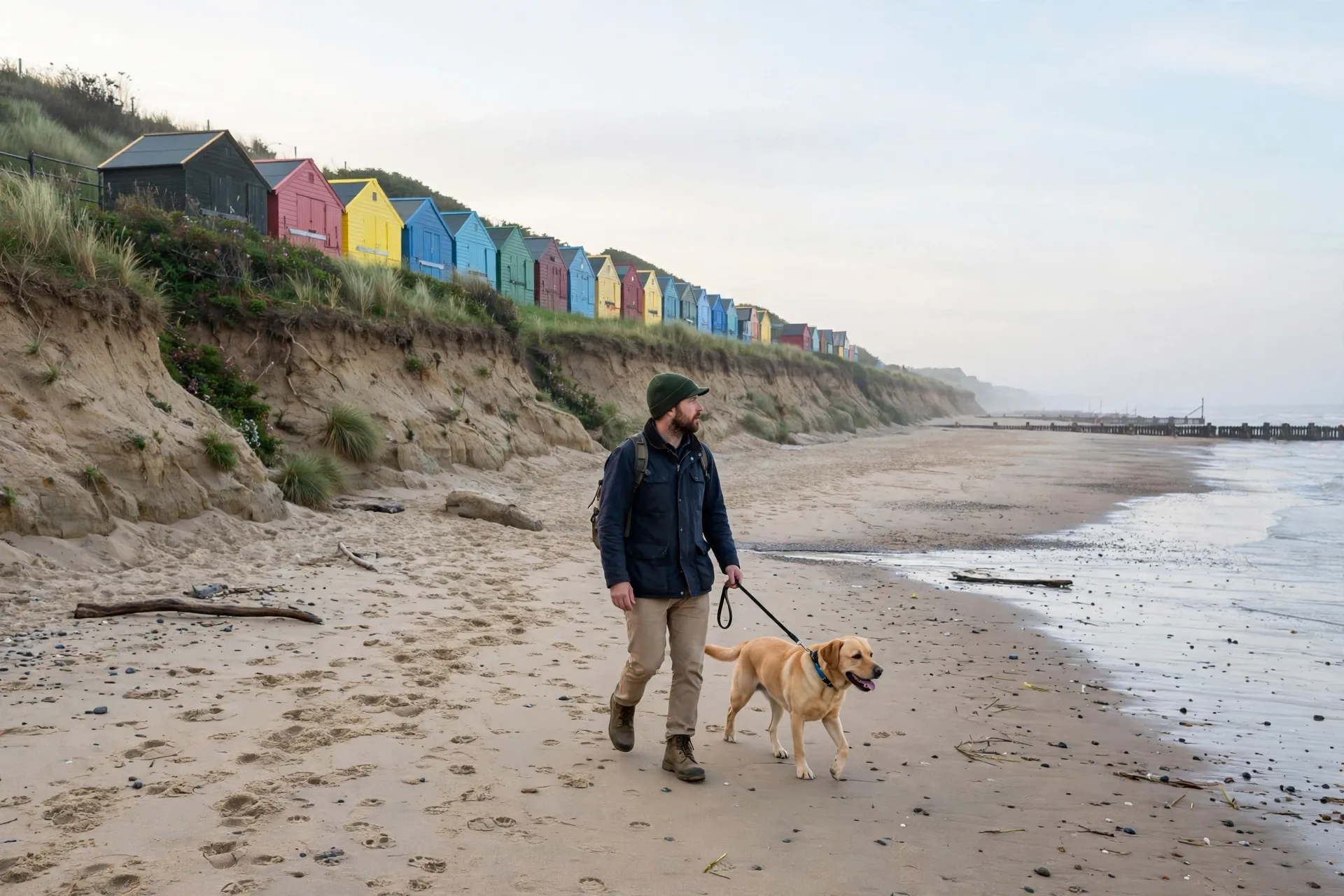
Mundesley beach sits below low sandy cliffs, protected by groynes and sea defences, and the tide shapes every walk here more than the distance does. At low tide there is a wide, flat expanse of sand that suits fetch, paddling and long-line sniffing walks. At high tide the water reaches the defences and the usable sand shrinks to a narrow strip or disappears altogether on some stretches. Always check tide times before you set out, and plan the walk for the falling or low tide rather than squeezing it in as the water comes back. A walk that starts generously can end with you picking your way along the base of the defences with a wet dog and nowhere to turn.
Groynes deserve a specific mention. The wooden groynes that run out into the sea are slippery when wet, barnacled at the base, and tempting for dogs to jump from. Keep dogs on a lead around them, and do not let a dog chase a ball across a groyne field at speed: a slip on wet timber can mean a cut paw or a fall. The same applies to the slipways and concrete ramps, which get slick with weed and sand. After storms, check for debris washed onto the beach, including fishing line, broken shell and timber, and keep a close eye on dogs that scavenge.
The cliffs themselves are part of the scenery and part of the risk. Norfolk cliffs are soft and crumbly, and falls of sand and clay happen, especially after heavy rain. Keep dogs away from the cliff base, do not let them scramble up the cliff face, and stay off the cliff edge on the top path where the ground is undercut. If you see fresh falls or warning signs, take them seriously and move along the beach. This is also why the cliff-top walk, covered below, is best enjoyed from the path itself rather than from the edge for a photograph.
Water safety rounds out the picture. The North Sea here is cold even in summer, and currents along the Norfolk coast can be strong. Most dogs are happy paddling at the edge, but do not throw a ball into deep or fast-moving water, and watch for the moment a confident swimmer starts to tire. After a swim, rinse sandy paws and check between the toes, because sand packed between pads can irritate skin on the walk home. A dog that has swum in cold water should be dried and warmed before a long car journey, especially in winter.
The village loop: beach, cliff top and back
The most satisfying Mundesley walk with a dog is a loop rather than a straight line: beach one way, cliff top the other, with the village in the middle for a stop. Start at the beach access near the village, walk along the sand while the tide allows, then come up to the cliff-top path and return along the top with the sea on your other side. The cliff-top section is mostly level, well walked and easy underfoot in dry weather, which makes it a good option for older dogs and for dogs that find the beach itself overstimulating. Keep dogs on a lead on the cliff-top path where it runs close to the edge or to roads, and be ready for other walkers, joggers and dogs coming the other way.
Distance is flexible, which is the point of a loop. A short version of twenty to thirty minutes suits puppies, older dogs and first visits, while a longer version can stretch along the coast in either direction for an hour or more. Do not commit to a long linear walk that forces you to retrace the whole route if your dog tires or the tide turns. Loops and out-and-back sections are kinder: you can shorten at any point, and you always know how far you are from the car. If you want a longer coastal day, combine Mundesley with a neighbouring stretch of the Norfolk coast rather than pushing one walk further than your dog enjoys.
For dogs that need to run, the beach at low tide is the place, not the cliff-top path. A long line gives a dog freedom without the risk of a dash towards the cliff edge or another dog's picnic, and it keeps you in control near groynes and other beach users. For dogs that need calm, the reverse works: walk the cliff top first, when the beach is busy, and drop down to a quiet stretch of sand later when the crowds thin. The loop lets you match the walk to the dog in front of you rather than to a fixed route.
Finish the walk in the village rather than at the car. A slow wander past the shops, a drink of water from a bowl you carry, and a few minutes of sniffing on a quiet street help a dog settle before the journey home. Dogs that go straight from a beach run into a car often arrive home wired and sandy; dogs that get a calm wind-down travel better. This is also the moment to check paws, remove sand from ears and coats, and deal with any small cuts before they become a problem on the drive.
Eating out with a dog in the village
Mundesley is a small village, and its cafes and pubs are part of the day out rather than an afterthought. Several places welcome dogs, usually in a defined area: a terrace in summer, a bar area or a specific dog-friendly room inside. The arrangement can differ between lunch and evening, and between weekdays and busy weekends, so ask before you sit down rather than assuming the dog-friendly table you used last year is still the rule. Staff will almost always say yes if you ask politely and your dog is settled, and they will appreciate a dog that lies on a mat under the table rather than wandering between tables.
Pack for the cafe stop as carefully as you pack for the beach. A familiar mat, a water bowl, a chew or a stuffed toy for a longer wait, and a lead short enough to keep the dog close all make the difference between a relaxed stop and a stressful one. Avoid the busiest tables near the door, where every arrival is a new excitement, and choose a corner where the dog can watch the room without being in the flow of people. If your dog cannot settle after ten minutes, it is kinder to take food away or cut the stop short than to push through a long meal with a restless dog.
For dogs that find indoor spaces hard, the village still works well. Takeaway food eaten on a bench above the beach, or a picnic on the cliff top away from the main path, gives you the same break without the pressure of a busy room. Bring your own water and a bowl either way, because not every cafe has a dog bowl outside, and never leave a dog tied up alone outside a shop or cafe while you go in. A dog left alone in a strange place is a dog at risk of theft, escape or distress, however quick the errand feels.
One habit that helps everywhere in the village: clean up after your dog, including on the beach and the cliff-top paths, and use the bins provided. Dog fouling on a small village beach is noticed quickly, and it is the behaviour that most often turns a welcoming place into a restricted one. Carry more bags than you think you need, and if a bin is full, take the bag with you rather than leaving it beside the bin.
Parking and arrival without the stress
Arrival sets the tone for the whole visit, and Mundesley rewards a calm start. The village has car parks near the seafront and the cliff top, and the walk from car to beach is short, which matters when you are unloading a dog, a bag and a lead in a busy place. On summer weekends and in school holidays, arrive early: the closest spaces fill first, and a late arrival can mean a longer walk with an already excited dog. If the first car park is full, a short drive to a quieter spot and a longer walk in is often calmer than circling for a space by the beach.
Before you open the car door, have the lead on and a plan for the first five minutes. Dogs that leap out of the car straight onto a busy road or a crowded promenade start the day over-aroused, and it can take the whole walk to bring them back down. Instead, let the dog out on a lead, give them a minute to sniff and toilet in a quiet spot, and walk the first stretch slowly. The same applies at the end of the day: a calm last few minutes before the car makes the journey home much easier.
Never leave a dog alone in a parked car, even for a short stop and even with a window open. Cars heat up fast in sun and cool down fast in winter, and a dog alone in a car in a seaside car park is also a target for theft. If you need to visit a shop that does not allow dogs, take turns with another adult or skip the shop. The same rule applies at the beach itself: do not leave a dog tied to a post or a fence while you go for a swim or into the water. If your dog cannot come with you, the activity needs to change.
For visitors arriving without a car, the village is served by buses along the coast road, and the walk from the bus stop to the beach is short. Check the timetable before you travel, because rural services can be infrequent, especially on Sundays and in winter. If you are combining Mundesley with other Norfolk coast villages, our guide to Holt, Norfolk with a dog covers a useful inland base, and the Norfolk Broads with a dog guide covers the very different water-based days inland.
Wet weather and plan B
Norfolk weather changes quickly, and a Mundesley day that starts in sunshine can end in a sea fret or a sharp shower. The beach itself is still enjoyable in light rain if your dog likes it, but the cliff-top paths get slippery and the wind on the top can be strong. On a wet day, shorten the beach walk, keep to the firmer sand near the top of the beach, and build the day around a longer cafe stop and a drive to a sheltered inland walk rather than a long exposed coastal route.
Wet-weather kit is simple but worth packing properly: a drying coat or two towels, a waterproof mat for the car, a spare lead in case one gets soaked, and a bag for wet gear so the car stays dry. Dogs with short coats and older dogs feel the cold after a wet walk, so dry them before the journey home and consider a coat for the walk itself in winter. After rain, check the cliff-top path surface before committing an older dog to it, because mud on a slope is a slipping risk for stiff joints.
A genuinely wet day is also the day to use the village properly. A slow browse of the shops, a long lunch in a dog-friendly cafe, and a short walk between showers can still be a good day out, and dogs often enjoy the novelty of a different routine. If the weather is severe, with strong winds or a storm surge, stay off the beach and the cliff edge altogether: waves can reach the defences, and debris on the beach after a storm is a hazard for paws and for scavengers. The sea will still be there tomorrow.
Dogs that need more space
Not every dog wants a busy beach, and Mundesley can be adapted for dogs that need distance from other dogs, children and noise. The key is timing and stretch selection: walk early in the morning or late in the afternoon, choose the quieter stretches away from the main access points, and keep the walk short and successful rather than long and stressful. A dog that has a calm twenty-minute walk and goes home happy has had a better day than a dog that endures an hour of triggers.
On the beach, distance is your friend. Walk at the waterline rather than at the top of the beach where families gather, and keep a long line rather than letting the dog run free into a group of other dogs. On the cliff-top path, step aside at a wide point when another dog approaches, and use a bend or a gap in the hedge as a visual block while the other dog passes. These small choices cost nothing and change the whole walk for a reactive dog.
If your dog is reactive, tell other dog owners early and clearly. A friendly "my dog needs space, please" said before the dogs meet is far more effective than a panicked recall after they have already met. Most walkers on the Norfolk coast are used to this and will call their dog back. For dogs that are anxious rather than reactive, the same timing and distance choices apply, plus a familiar mat and a calm routine at the cafe stop. The goal is a walk the dog can repeat happily, not a walk that tests their limits.
Staying over: what to ask first
Mundesley and the surrounding villages have a range of places to stay that accept dogs, from cottages and bed and breakfasts to caravan and lodge sites nearby. The questions that matter are the same ones that matter everywhere, but they are worth asking before you book rather than discovering the answers on arrival. Ask how many dogs are allowed per booking, whether there is a pet charge and what it covers, whether the dog can be left alone in the accommodation and for how long, and whether there is an enclosed garden or a safe toilet area for last thing at night.
Also ask about the practical details that shape a stay: is the accommodation near a road, does the garden fence have gaps a small dog could slip through, and is there a place to dry a wet dog after a beach walk? A cottage with a tiled floor and a hose outside is a very different stay from a carpeted room with nowhere to deal with sand. For longer stays, check the nearest vet and save the number before you arrive, and find out which local beaches have restrictions in your dates so you can plan each day's walk in advance.
If you are staying for a week, use Mundesley as one base among several rather than the only walk every day. The north Norfolk coast has many beaches and villages within a short drive, and rotating between them keeps the week interesting for both of you. Our guide to dog-friendly beaches in the UK explains how seasonal bans and local rules work across the country, which is useful when you are choosing which beach to visit on which day.
The Mundesley packing list
A day at Mundesley needs less kit than a mountain walk but more than a park visit, because sand, salt water and wind all leave their mark. Start with the basics: a lead and a long line, a harness that fits well when wet, poo bags, water and a bowl, and a towel or drying coat. Add a ball or a toy that floats and is easy to spot on sand, a spare lead, and a first-aid kit with tweezers for thorns and a way to flush a cut paw. Sun protection matters too: dogs with pink noses and thin coats can burn, and a shaded rest on a hot day is as important as water.
For the car, pack a waterproof seat cover or a crate liner, a brush for sand, and a bag for wet towels so the drive home does not smell of wet dog for a week. In winter, add a dog coat, a warm blanket for the car, and a flask of warm water for rinsing sandy paws before the journey. In summer, add extra water, a shade cloth or a beach shelter if you plan a long stay on the sand, and never rely on the sea as your dog's drinking water: salt water in quantity causes vomiting and dehydration.
Finally, pack the information, not just the kit. Tide times for the day, the number of the nearest vet, the location of the car park you plan to use, and a note of the beach restriction signs you expect to see are all worth having before you leave home. A Mundesley day goes well when the planning is done in advance and the day itself is left free for the dog to enjoy. That is the whole point of a village like this: it is small, calm and easy, and it rewards visitors who arrive prepared and leave nothing behind but paw prints.
Practical questions
Before you go
Can dogs go on Mundesley beach all year round?
It depends on the stretch of beach and the time of year. Parts of Mundesley beach are covered by seasonal dog restrictions during the summer months, while other stretches stay open to dogs year-round. Check the signs at the beach access point you use and the official guidance before you travel, because restriction zones and dates can change.
Is Mundesley beach safe for dogs at high tide?
At high tide the sand narrows sharply against the sea defences and cliff base, and there may be little dry sand left for a comfortable walk. Check tide times before you go, aim for the hours either side of low tide, and keep dogs on a lead near groynes and slipways where the water arrives first.
Where can I park in Mundesley with a dog?
The village has car parks close to the seafront and the cliff top, with the walk down to the beach taking only a few minutes. Arrive early on summer weekends and school holidays, because the closest spaces fill first. Never leave a dog alone in a parked car, even for a short stop, and keep a lead ready before you open the car door.
Are there dog-friendly places to eat in Mundesley?
Several cafes and pubs in the village welcome dogs, often in a specific area such as the terrace, bar or a dog-friendly room. Policies can change with the season and the time of day, so ask before you sit down, keep your dog on a lead under the table, and bring a mat and water bowl so the visit works for staff as well as for you.
What should I do if my dog eats something on Mundesley beach?
Keep your dog close and watch for what was eaten: fish remains, discarded food and bait can all cause trouble. If you suspect something harmful, call a vet promptly rather than waiting for symptoms, and note the time and what the dog swallowed. Carry the number of the nearest vet before you set out, and check the official guidance before you travel for current local advice.
Is the cliff-top walk from Mundesley suitable for older dogs?
The cliff-top paths are mostly level and well used, which suits many older dogs, but the ground can be uneven after rain and the route back down to the beach involves steps or a slope. Choose a short out-and-back section rather than a long linear walk, build in rest stops, and turn back while your dog is still enjoying it rather than when they are tired.