This guide is independent and contains no paid placement. If affiliate links are added later, they will be clearly marked and will not change our editorial checks.
New Quay is the best place in Britain to watch dolphins from dry land with your dog beside you. The harbour wall is the viewing platform, the main beach has a summer dog restriction, the quieter southern beach welcomes dogs all year, and the coast path in both directions rewards a lead, water and sensible shoes.
Why dolphins make New Quay different
Most British seaside towns ask your dog to be content with a beach and a promenade. New Quay offers something no other town in Britain can match: a resident population of bottlenose dolphins that feeds in Cardigan Bay so close to the shore that people regularly watch them from the harbour wall, often without binoculars, sometimes while a dog sits at their feet. Cardigan Bay is one of only two places in the UK with a resident bottlenose dolphin population, and New Quay sits on the edge of the bay where the animals come inshore to hunt. That single fact changes the whole shape of a visit. You are not planning a beach day with a dolphin trip bolted on; you are planning a dolphin-watching trip that happens to have a very good harbour town attached.
The dolphins are wild animals, not a show, and that is exactly what makes the experience worth building a trip around. They appear on their own schedule, feeding on fish in the bay, sometimes alone, sometimes in small groups, and sometimes with calves alongside the adults. Sightings are frequent in the warmer months and far from guaranteed on any single morning, which is why this guide spends so much time on when and where to look rather than promising a sighting. A dog changes the rhythm of the watching in a useful way. Dolphins do not appear on demand, so the best strategy is to settle somewhere comfortable, keep the dog happy, and let the bay come to you. A harbour wall with a coffee, a dog that has already had a walk, and an hour of patient scanning beats a frantic dash between viewpoints every time. Regular watchers keep a simple log of the time, the tide and the weather on each visit, and over a few trips that log becomes the best local guide you own.
New Quay itself is a small, steep harbour town on the Ceredigion coast in mid Wales, between Aberystwyth to the north and Cardigan to the south. The town grew up around fishing and shipbuilding, and the harbour is still a working place: fishing boats, pleasure boats, kayaks and the occasional visiting yacht share the water, and the town's colourful cottages climb the hill behind the quay. Dylan Thomas lived here for a time, and the town has kept the slightly bohemian, unhurried feel that draws writers and walkers. For a dog owner the geography is kind. Everything is compact. The harbour, the beach, the cafes and the coast path are all within a short walk of each other, which means you can build a day around the dog's energy rather than around driving. A morning on the harbour wall, a midday walk along the coast path, an afternoon on the southern beach and an evening meal on a harbourside terrace is a full day that never asks a dog to spend long in a car.
Before the practical detail, one honest note about expectations. New Quay is a small town, and in high summer it fills up. The harbour wall gets busy, parking gets tight, and the dolphins do not check the calendar before deciding whether to feed inshore. The town is at its best in late spring and early autumn, when the weather is warm enough to sit outside, the crowds have thinned, and the light over the bay is at its most dramatic. If you can only visit in August, go early in the morning, accept the crowds, and treat a dolphin sighting as a bonus rather than a promise. If you can choose your dates, aim for May, June or September, and give yourself at least two days: two mornings on the harbour wall roughly doubles your chances, and the town rewards a slower pace.
The rest of this guide follows the order a real visit tends to follow. It starts with the dolphins themselves — where to watch from land, when to go, and how boat trips work — because that is the reason most people come. Then it covers the harbour and the beaches, where the dog rules matter and a wrong turn on a summer afternoon can end a beach walk early. After that comes the coast path, the cafes and pubs, and finally the practical business of staying over and parking, which is where most small-town trips are won or lost.
Watching dolphins: shore, boat, season and tide
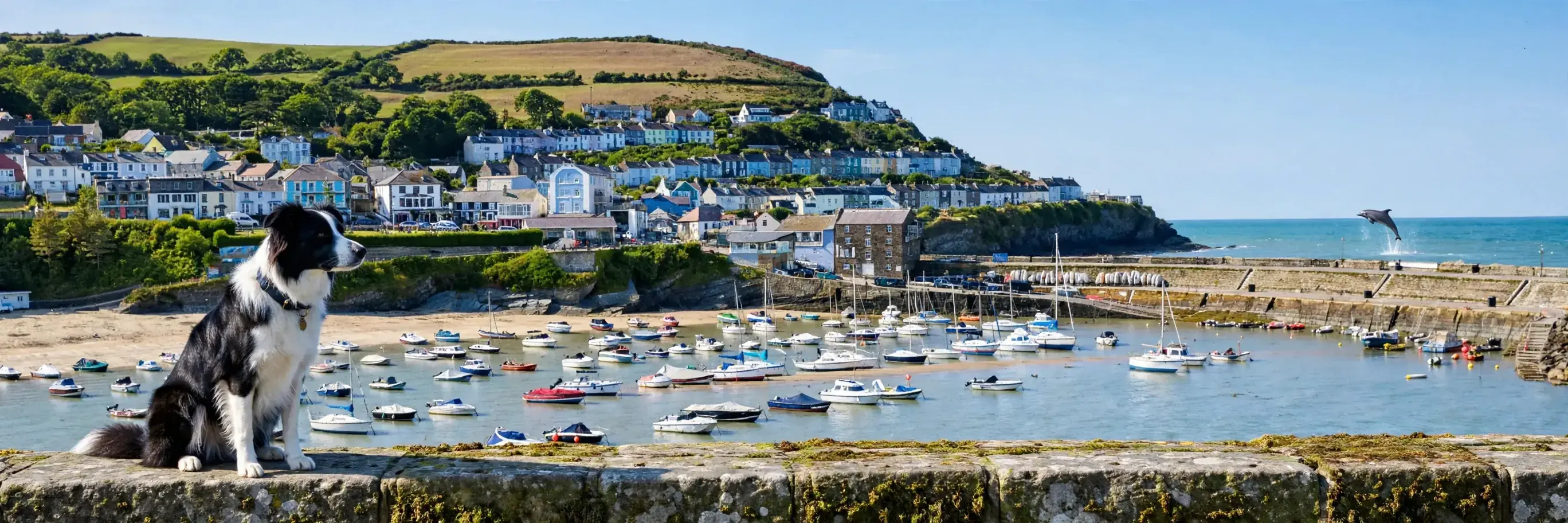
The harbour wall is the heart of New Quay dolphin watching, and it works because of the shape of the bay. The water off the pier drops away quickly, and the dolphins come inshore to feed on fish driven towards the shore. From the wall you are only a few metres above the water, close enough to see a dorsal fin break the surface, hear the blow of a surfacing animal on a calm day, and watch the dark curve of a back roll through a wave. The pier itself extends further into the bay and gives a wider view, which helps when the animals are feeding a few hundred metres out. Both spots are free, open all day, and perfectly suited to a dog that can settle on a lead — which is why they should be your first stop, before you spend money on a boat.
Good shore watching is mostly about patience and position. Arrive with the dog already walked, so the animal is ready to settle rather than pulling at the lead. Pick a spot on the wall where the dog can sit or lie in shade on a warm day, and where you can scan a wide arc of water without turning constantly. Binoculars help enormously: a pair of compact 8x42 binoculars turns a distant splash into a recognisable fin, and lets you follow an animal between surfacings. Watch for birds as well as fins. Gulls and gannets diving in a tight group often mark the same shoals of fish the dolphins are hunting, and a sudden gathering of birds is one of the best early warnings that dolphins are nearby. Scan slowly, in sections, rather than sweeping the whole bay at once. Dolphins surface for only a few seconds at a time, and a slow, methodical scan catches far more than a restless one.
Timing matters more than luck. The best months for dolphin watching in Cardigan Bay are generally late spring through early autumn, roughly May to September, when the animals are most active inshore and the weather lets you sit on the wall comfortably. Winter sightings do happen, but the sea is rougher, the days are shorter, and the wall is a cold place to wait. Within a day, early morning and late afternoon are often the most productive, when the light is low and the water is calmer. Tide plays a part too: many regular watchers report better sightings on a rising tide, when fish are pushed towards the shore, although this is a tendency rather than a rule, and a calm sea matters more than the exact state of the tide. A flat, glassy sea is the single best condition, because a fin is easy to spot on still water and almost invisible in whitecaps. If the wind is up and the bay is choppy, save your patience for the boat trip or come back the next morning.
Boat trips are the second way to meet the dolphins, and they are worth doing at least once. Several operators run from New Quay harbour in the season, offering trips of one to two hours out into the bay, and the boats get you close enough to see the animals properly — the size of them, the way they move, the calves staying tight to their mothers. Most trips run from late spring to early autumn, and they are weather-dependent: a trip can be cancelled at short notice if the sea turns rough, so do not build your whole day around a single sailing. Book ahead in the summer, because the popular trips fill up, and ask about the dog policy when you book rather than assuming. Some operators welcome well-behaved dogs on board, others do not take dogs at all, and policies can change between seasons. If your dog is coming, bring a lead, water, a non-slip mat or blanket for them to lie on, and be honest about whether your dog is comfortable on a boat. A nervous dog on a moving boat is miserable, and the harbour wall is a genuinely good alternative — plenty of regular watchers never go to sea at all.
Whatever you choose, treat the dolphins with the respect wild animals deserve. Do not try to swim out to them, do not feed them, and do not encourage a boat to chase them. The licensed operators in New Quay follow a code of conduct that keeps a sensible distance and lets the animals approach on their own terms, and that is one reason to book with an established operator rather than an unlicensed trip. On the wall, keep your dog on a lead at all times, not just for the dog's safety but because a loose dog on a busy harbour wall is a hazard to other watchers. Bring water for the dog, and sun protection for both of you: there is almost no shade on the wall, and a still, sunny afternoon burns fast. If the dolphins do not show, the wall is still a fine place to spend an hour. The boats come and go, the gulls work the harbour, and the bay itself, on a good day, is reason enough to sit still.
The harbour and the beaches: dog rules
New Quay has two beaches, and knowing which one you are on matters more than almost anything else in this guide. The main harbour beach, the stretch of sand right beside the pier and the town, is the pretty one — golden sand, rock pools at low tide, and the harbour wall as a backdrop. It also carries a seasonal dog restriction. During the summer months, usually from 1 May to 30 September, dogs are not allowed on this beach, and the restriction is enforced with signs at the access points and, in the busiest weeks, by patrols. The exact dates can change from year to year, so check the signs at the beach entrance and check the official guidance before you travel rather than relying on last year's dates or a memory of a previous visit. Outside the restricted season the harbour beach welcomes dogs, and on a quiet October morning it is one of the nicest dog beaches in Wales.
The second beach is Traeth y Dolau, the longer stretch of sand to the south of the town, reached by a short walk along the coast path or down the steps from the headland. This is the beach most dog owners end up using in summer, because it is generally dog-friendly all year round. It is quieter, wilder and less manicured than the harbour beach, with more space for a dog to run, a long line of sand at low tide, and fewer people. It is also more exposed: there is little shelter from the wind, the sea can be rough, and the walk back up the steps is steep enough to notice after a long swim. Bring water, because there is no fresh water on the beach itself, and keep an eye on the tide — the beach narrows considerably at high tide, and a dog that has run a long way down the sand may find the way back cut off by rocks.
Between the beaches, the harbour itself is a working waterfront and deserves a dog owner's full attention. Fishing boats come and go, ropes and nets lie on the quay, and the water is deep right beside the wall. Keep your dog on a lead around the harbour at all times, and do not let them drink from the harbour — the water carries fuel, fish waste and general harbour grime. The slipway and the pier steps are slippery with weed and algae, especially at low tide, so watch your footing as well as the dog's. At low tide the harbour beach exposes rock pools, which are wonderful for a careful sniffing walk but treacherous underfoot; the rocks are sharp, the weed is slick, and a dog that charges into a pool can cut a paw or slip badly. A lead and a slow pace turn the rock pools into a pleasure instead of a vet visit.
Swimming deserves a paragraph of its own. Many dogs will want to swim in Cardigan Bay, and on a calm day the water off the southern beach is inviting. But this is the open Atlantic-facing coast of Wales, not a sheltered lake, and the sea here has currents, a noticeable swell even on a fine day, and cold water even in August. Let your dog swim only in calm conditions, close to shore, and never near the harbour mouth, the pier legs or the boat channel, where currents run fastest. Watch for the dog tiring: a dog that swims happily for ten minutes may be exhausted after twenty, and the walk back up the beach with a wet, tired dog is harder than it looks. Carry a towel and fresh water for rinsing off salt, and check your dog's ears after a swim, because salt water and sand are a common cause of ear irritation. If in doubt, a paddle in the shallows is a better day than a long swim in a swell.
Toilet rules on the beach are simple and non-negotiable. Pick up after your dog everywhere, including on the sand, and use the bins provided around the harbour and the car parks. Sand hides mess badly, and a beach that looks clean at a glance can be unpleasant underfoot. The town provides dog waste bins near the main access points; if a bin is full, bag the waste and carry it to the next one rather than leaving it beside an overflowing bin. The same standard applies on the coast path, where livestock graze the cliff-top fields and a bag left hanging on a fence is worse than no bag at all. New Quay is a small town that depends on visitors, and dog owners who clean up properly are the reason the beaches stay open to dogs at all.
If you want a wider picture of how beach rules work across the country, including seasonal bans, public space protection orders and fines, our guide to dog-friendly beaches in the UK explains the system in full. The key point for New Quay is the same as everywhere else: the rules are local, they change, and the sign at the beach entrance is the authority, not a guidebook or a memory.
The Ceredigion Coast Path from New Quay
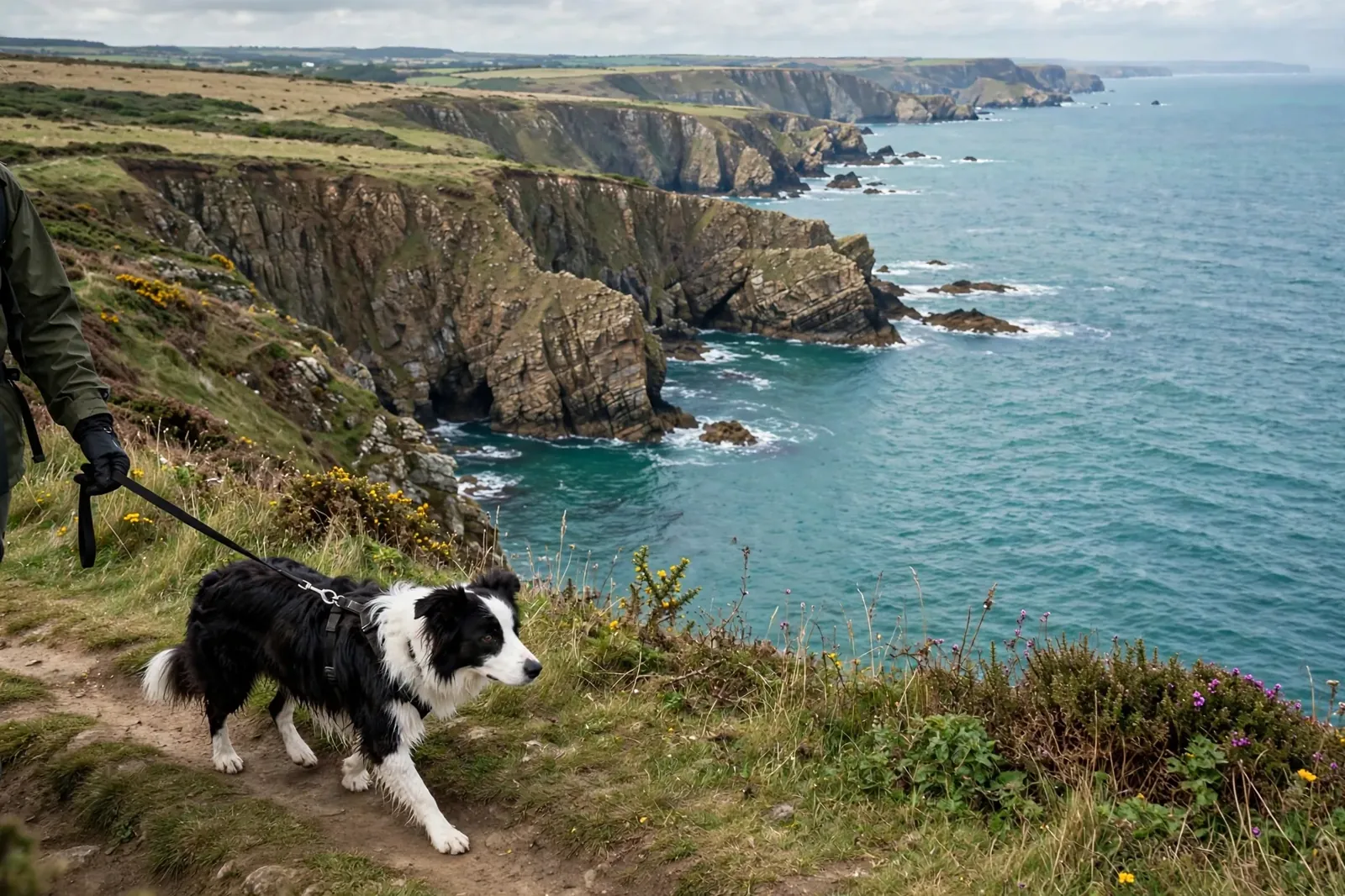
The Ceredigion Coast Path runs for about 60 miles along the coast of Cardigan Bay, and New Quay sits near its middle, which makes the town an excellent base for day walks in either direction. The path is part of the Wales Coast Path, the long-distance route that follows the entire Welsh coastline, and the sections around New Quay are among its most rewarding: high cliff tops, hidden coves, seabird colonies and, in the right season, dolphins visible from the cliffs. For a dog, it is a proper walk — varied ground, new smells, sea air and the occasional sheep — and for the owner it is a chance to see a stretch of coast that most visitors never reach, because the path climbs away from the town within minutes and leaves the crowds behind.
The easier direction from New Quay is north towards Aberaeron. This stretch is gentler than the southern section, with a mix of cliff-top grass, field paths and a few wooded dips, and it makes a good half-day walk of roughly four to five miles each way, depending on where you turn back. Aberaeron itself is a small harbour town with a colourful waterfront and several dog-friendly cafes, which makes it a natural turnaround point: walk out, have lunch, walk back, or catch a bus one way if the dog has had enough. The path is well waymarked with the familiar acorn symbol, but it is still a cliff path — keep your dog on a lead near the edges, and be ready for livestock, because the cliff-top fields are grazed by sheep and occasionally cattle. The walking is undulating rather than flat, with short, sharp climbs in and out of the small valleys, so allow more time than the distance suggests and carry water for both of you.
The southern direction, towards Llangrannog, is wilder and harder. The path climbs steeply out of New Quay, drops into coves and climbs again, and the walking is rougher underfoot, with rocky steps and sections that are slippery after rain. It is a magnificent walk — the views back towards New Quay and across the bay are among the best on the whole Ceredigion coast — but it is a walk to attempt when the dog is fit, the weather is dry and you have a full day. Llangrannog itself is a small village with a beach and a pub, and it makes a satisfying destination, but the return journey is just as steep, so many walkers arrange a lift or a bus one way. Either direction rewards an early start: the light on the cliffs in the morning is beautiful, the path is quieter, and the dog will be fresher for the climbs.
Preparation for a coast path walk is straightforward but worth doing properly. Wear proper walking shoes or boots with grip, because the cliff-top grass is slippery when wet and the rocky sections are unforgiving in trainers. Carry more water than you think you need — there are few reliable sources on the cliff tops, and a dog working hard in the sun drinks a surprising amount. Pack a lead and a long line: the lead is for cliff edges, livestock and narrow sections, and the long line is for the open cliff-top stretches where a dog can range safely without being off lead near a drop. Bring a basic first-aid kit for the dog, including something to clean a cut paw, and a phone with charge, because mobile signal is patchy along the cliffs and you do not want to discover that at the moment you need it. Tell someone where you are going and when you expect to be back, especially on the longer southern section.
Safety on the cliffs is the one subject this guide will not soften. The Ceredigion coast path follows the cliff edge in places, the drops are real, and the ground can crumble near the edge after rain. Keep your dog on a lead whenever you are near an edge, and do not throw a ball or a stick anywhere near a drop — a dog chasing a toy does not check where the ground ends. If your dog is a keen chaser of birds or rabbits, keep the lead on for the whole walk rather than risking a sudden sprint towards the edge. The same caution applies to livestock: sheep are everywhere on the cliff-top fields, and a dog that chases sheep is a danger to the sheep, to itself and to your legal position. A lead is a small inconvenience that prevents a large problem.
For walkers who want to plan a longer coastal trip, our Pembrokeshire Coast Path guide covers the longer, wilder path to the south, with section-by-section advice on cliff safety, livestock and multi-day planning that applies just as well to the Ceredigion sections. The two paths share the same logic: walk the dog's walk, not the distance on the map, and turn back while the dog still has energy in reserve.
Cafes and pubs with sea views
New Quay is a town for eating outside with a dog at your feet. The harbour front is lined with cafes, ice cream parlours, fish and chip shops and pubs, and most of them have outdoor seating with a view of the water — which is where the dogs are. A harbourside table, a coffee or a pint, a dog settled under the table and dolphins in the bay is the town's signature pleasure, and it is worth planning your day around it rather than treating it as an afterthought. The practical rule is simple: assume dogs are welcome outside, ask before going inside, and never assume that one visit's policy will still hold next year.
The cafes around the harbour open early and are the natural first stop after a morning on the wall. Most have a terrace or a few pavement tables facing the water, and a dog that has already had a walk will usually settle quickly with a bowl of water — many cafes will bring one without being asked, but it never hurts to ask. Breakfast and brunch are the best meals to eat out with a dog, because the terraces are quieter, the dog is fresher, and a coffee and a pastry take less time than a full dinner. If your dog is reactive to other dogs, pick a table at the end of the terrace rather than in the middle, and keep the lead short and the dog on your side of the table rather than in the walkway, where every passing dog becomes an event.
Fish and chips is the town's default lunch, and it is also the most dog-compatible meal in New Quay. The chippies around the harbour do takeaway, which means you can buy your food, find a bench on the wall or a spot on the beach, and eat with the dog beside you and the bay in front of you. It is a better plan than a long sit-down meal with a restless dog, and it is cheaper too. The usual cautions apply: keep chips, batter and anything with bones away from the dog, and do not let the dog beg from neighbouring tables, however hopeful the look. A stuffed Kong or a chew kept for the meal will keep a dog occupied far better than a repeated "leave it".
The pubs around the harbour are the evening option, and several welcome dogs inside as well as on their terraces. Policies vary by pub and by season — a pub that welcomes dogs in the quiet months may restrict them to the terrace in August — so check at the door rather than marching in with a wet dog. When a pub does welcome dogs inside, the etiquette is the same everywhere: the dog lies under the table or at your feet, stays on a lead, does not approach other tables, and does not bark at the bar. Bring a blanket or a mat for the dog to lie on, because pub floors are cold and hard, and a dog with a defined spot settles faster than a dog left to choose its own place among the chair legs. Order food with the dog in mind: a pub that serves food will usually be busier and noisier than a drinking pub, and a nervous dog will be happier on the terrace than in a crowded bar.
A few practical habits make eating out with a dog in New Quay much smoother. Eat earlier than the crowds — a 6pm dinner is a different experience from an 8pm one, for both you and the dog. Bring the dog's own water bowl if you have a collapsible one, because not every terrace keeps dog bowls to hand. Bring a chew or a lick mat for the long waits between ordering and eating, and bring a towel: a dog that has been on the beach will be sandy and damp, and a terrace chair is no place for wet sand. If the dog will not settle, take the meal as takeaway and eat on the harbour wall instead — nobody in New Quay will think less of you for it, and the dog will be happier for it. The best meal in the town is often the simplest one: fish and chips on the wall, dog at your feet, bay in front of you.
Staying over and parking
Staying overnight in New Quay is worth it, and not just because two mornings on the harbour wall double your chances of seeing dolphins. The town changes character in the evening, when the day visitors leave, the light over the bay turns gold, and the harbour settles into a quieter rhythm. A dog that has had a full day of walking, swimming and watching will sleep well, and you will wake to a town that belongs to its residents for a few hours before the visitors return. The practical question is where to stay, and the answer depends on your dog, your budget and how much you mind stairs.
Self-catering cottages are the most popular option for dog owners in New Quay, and the town has a good range of them, from small harbour-side cottages to larger houses on the hill above the town. Look for the practical details rather than the photographs: an enclosed garden or yard, a ground-floor bedroom if your dog struggles with stairs, a hard floor rather than cream carpet, and a clear statement of the pet policy, including any fee, any limit on the number of dogs, and whether dogs can be left alone in the property. Book early for the summer, because the genuinely dog-friendly cottages with enclosed gardens are the first to go, and confirm the policy in writing before you pay — "dogs welcome" on a listing can mean one small dog, not two large ones. If the cottage has a garden, check the boundary when you arrive: a low wall or a gate that does not latch is a common surprise, and a quick check on arrival is easier than a search of the neighbourhood at midnight.
Bed and breakfasts and small hotels are the second option, and several in New Quay welcome dogs in selected rooms. The trade-off is space: a hotel room is smaller than a cottage, and a dog that needs room to settle may struggle. Ask the specific questions that matter: is there a room on the ground floor, is there somewhere to walk the dog late at night, is breakfast served in a room where dogs are allowed, and is there a charge per dog per night. Caravan and camping sites near the town offer a third option, with more space and a lower price, and the fields around New Quay suit a dog that likes open ground — but check the site's dog policy, the distance to the town on foot, and whether the site has a dog-walking area, because a site a mile from the town on a busy road is a different proposition from one with a direct footpath.
Parking in New Quay is the one subject that catches visitors out. The town is small, the streets are narrow and steep, and the car parks fill up quickly on a sunny summer day. The main car park is close to the harbour and the beach, and it is the obvious choice, but it is also the first to fill. Arrive early — before 10am in the summer — or be prepared to park further out and walk in. On-street parking exists but is limited, and some streets are residents-only, so read the signs rather than assuming a space is available. If you are staying overnight, ask your accommodation about parking before you arrive: some cottages have a dedicated space, some have none, and a cottage without parking on a steep hill is a genuine inconvenience with a dog and luggage. Blue badge holders should check the location of accessible bays in advance, because the town's slopes make the distance from a car park to the harbour a real consideration.
Getting to New Quay is straightforward but worth planning. The town is reached by road from Aberystwyth to the north or Cardigan to the south, and the coastal roads are scenic but winding, with few places to overtake and a speed that rewards patience. If you are travelling from further afield, the nearest railway stations are at Aberystwyth and Carmarthen, with bus connections onward — check the bus times in advance, because services are infrequent, especially on Sundays, and not every service is equally convenient with a dog. If you are driving, plan a comfort stop for the dog on the way: a tired, restless dog in a car on a winding coastal road is unhappy, and a ten-minute leg stretch at a lay-by or a village green makes the last half hour far easier. Fill up with fuel before you arrive, because New Quay has no petrol station of its own, and the nearest one is a drive away.
For a wider Welsh trip, New Quay pairs naturally with Aberystwyth, about an hour's drive north along the coast. Our Aberystwyth dog guide covers its two beaches, the promenade and harbour walks, the cliff railway and the town's dog-friendly stays, and the two towns together make a good long weekend: Aberystwyth for scale and variety, New Quay for dolphins and quiet. Pack for the Welsh coast rather than the forecast: layers, a waterproof for both of you, a drying coat for the dog, and a towel that lives in the car. The weather over Cardigan Bay changes fast, and a day that starts in sunshine can end in rain — but the dolphins do not mind, the harbour wall is still there, and a dog that has been walked in the rain will sleep just as well as one that has been walked in the sun.
A sample day in New Quay with your dog
A good day in New Quay is built around the tide, the light and the dog's energy, not around a list of attractions to tick off. The shape below works for most dogs and most seasons, and it can be stretched or shortened without losing its logic. The principle is simple: do the watching early, walk in the middle of the day, eat outside, and finish with a short evening stroll while the harbour is at its quietest.
Start at first light, or as close to it as the dog allows. Walk the dog first, before the harbour wall, because a dog that has already stretched its legs and emptied itself will settle for an hour of watching. A gentle loop around the quieter streets above the harbour, or a short stretch of the coast path towards the south, works well: it wakes the dog up without tiring it out, and it gives you a sense of the weather and the sea state before you commit to a long sit. Then settle on the harbour wall with a coffee from one of the early-opening cafes. This is the first dolphin watch of the day, and it is often the best one: the light is low, the water is calm, and the animals are frequently feeding inshore after the night. Give it a full hour. Bring a blanket for the dog if the wall is cold, and keep the lead short — the wall is a working harbour, and other watchers will be arriving.
Late morning is for the walk. If the dog is fit and the weather is dry, take the coast path north towards Aberaeron for a couple of hours and turn back when the dog is ready, or walk south towards Traeth y Dolau and spend the late morning on the beach. If the dog is older, less fit or simply not a long-distance walker, the harbour and the town itself are enough: a wander along the quay, a sniff around the boats, a slow circuit of the steep lanes above the harbour, and a stop at a cafe. The point of the midday walk is to give the dog a proper outing, so that the afternoon is calm rather than restless. Dogs that have walked well in the morning settle under a pub table in the afternoon; dogs that have not, do not.
Lunch is best eaten outside, and the harbour front gives you the choice: fish and chips on the wall, a cafe terrace, or a pub garden. Eat slowly. The afternoon is the part of the day most visitors waste by rushing to the next thing, but in New Quay the afternoon is the reward: the light over the bay in the early afternoon is at its brightest, the water is at its bluest, and a second, shorter watch from the wall or the pier often produces a sighting missed in the morning. If the dog is tired, this is the time for a rest — back at the cottage, in the car with the windows down in the shade, or simply lying on the beach while you read. A tired dog that rests properly will be good company in the evening; a tired dog that is dragged around all afternoon will not.
Evening in New Quay belongs to the harbour. As the day visitors leave, the wall empties, the boats settle, and the light turns the cottages gold. A short evening walk along the quay, a drink on a terrace, and a final watch for dolphins as the light fades is a better end to the day than any checklist of sights. The last outing for the dog should be short and familiar — the same quiet streets as the morning, the same patch of grass — so the dog knows the day is ending. If you are staying a second day, the routine repeats, and the repetition is the point: the same wall, the same water, the same dog at your feet, and a slightly better chance of a dolphin each morning.
If the weather turns, the shape of the day changes but the logic does not. A wet morning is a good morning for a shorter coast path walk in waterproofs, a longer cafe stop, and a watch from under a sheltered spot on the quay. A windy day is a poor day for boat trips and a good day for the southern beach, where the wind keeps the crowds away. A foggy morning is a poor morning for dolphin watching and a good morning for the town itself: the lanes, the harbour, the shops and the cafes. New Quay is a small town, and its pleasures are small ones — a wall, a bay, a dog, a coffee — which is why it survives bad weather better than a town built around a single attraction.
What to pack for the coast
Packing for New Quay is mostly a matter of remembering that the Welsh coast is wetter, windier and colder than the forecast suggests, and that a dog that is comfortable will behave better than a dog that is cold, wet or thirsty. The list below is short on purpose: these are the items that actually get used, not the items that sit in the car boot all weekend.
For the dog, the essentials are a lead and a long line, a collapsible water bowl and at least a litre of fresh water, a drying coat or two large towels, a blanket or mat for settling on terraces and pub floors, a chew or a lick mat for meals out, poo bags — more than you think you need — and a basic first-aid kit with something to clean a cut paw. A drying coat earns its place on every trip: a wet dog in a car or a cottage dries slowly, smells strongly and leaves sand everywhere, and a coat that wicks the water away in twenty minutes changes the whole evening. If your dog swims, pack a second towel specifically for ears and paws, and check the dog's ears after a swim for sand and salt water. A spare lead is worth carrying too, because leads break at the worst moments, usually on a cliff path or a beach, and a broken lead with a loose dog is a problem that a two-pound spare would have prevented.
For yourself, the essentials are layers rather than a single heavy coat, a waterproof jacket that actually keeps the rain out, walking shoes or boots with grip for the coast path, and a hat and sun protection for the harbour wall, which has almost no shade. Binoculars are the single most useful piece of equipment for dolphin watching, and a compact pair that fits in a jacket pocket is better than a large pair left in the car. A small rucksack carries the water, the bowl, the bags and the binoculars without occupying your hands, which matters on a cliff path and on a harbour wall alike. A phone charger or a small power bank is worth packing, because mobile signal is patchy along the cliffs and a phone that is searching for signal drains its battery fast.
One last packing note: bring cash or a card that works offline, because the town's smaller cafes and the harbour car park machines do not always behave well when the signal drops, and a phone with no signal cannot pay for a coffee. A paper map of the coast path is a useful backup for the same reason — the path is waymarked, but a map turns a wrong turn into a five-minute correction instead of a half-hour detour. And pack a torch, even in summer: the lanes above the harbour are dark after sunset, the steps down to the beach are uneven, and a small torch in a pocket is the difference between a pleasant evening walk and a careful shuffle home in the dark.
Finally, pack the paperwork that saves a trip when something goes wrong. Save the number of the nearest vet before you travel, and note the opening hours of the nearest out-of-hours practice — rural practices can be twenty minutes away and close early, and the time to discover that is not the moment your dog has cut a paw. Carry your dog's vaccination record if you are staying in a cottage or a hotel that asks for it, and keep a note of your dog's microchip number and your own phone number on the dog's collar or tag. If your dog takes medication, pack a day's extra supply in a separate bag, in case the main supply is lost or the trip is extended by a day. None of this is dramatic; it is the ordinary preparation that turns a small problem into a footnote instead of a ruined weekend.
Practical questions
Before you go
Can dogs go on the beach at New Quay?
Yes, but the rules change with the season. The main harbour beach has a seasonal dog restriction in the summer months, usually from 1 May to 30 September, while the quieter Traeth y Dolau beach to the south is generally dog-friendly all year. Check the signs at each beach entrance and the official guidance before you travel, because dates and boundaries can change.
Where is the best place to see dolphins at New Quay with a dog?
The harbour wall and the pier are the classic land-based spots, because the bottlenose dolphins of Cardigan Bay often feed close inshore. Stand on the wall in calm weather, keep your dog on a short lead, and scan the water for a dark curved back or a splash. Early morning and late afternoon on a rising tide are often the most productive times.
Can dogs go on boat trips from New Quay?
Some boat operators welcome well-behaved dogs on dolphin-watching trips, but policies vary by operator and by trip, and some boats do not take dogs at all. Ask the operator when you book, mention your dog's size and temperament, and bring a lead, water and something for your dog to lie on. If your dog is nervous on boats or prone to seasickness, watching from the harbour wall is the better option.
Is the Ceredigion Coast Path from New Quay suitable for dogs?
Yes, the coast path sections around New Quay are popular with dog walkers, but they are undulating cliff paths with livestock nearby, so keep your dog on a lead near cliff edges and sheep. The stretch towards Aberaeron is the easier option, while the path towards Llangrannog is steeper. Carry water, because there are few reliable sources on the cliff tops.
Are there dog-friendly places to eat in New Quay?
Yes. Several cafes and pubs around the harbour have outdoor seating with sea views where dogs are welcome, and some welcome dogs inside too. Policies change, so check with each place before you sit down, keep your dog under the table or at your feet, and bring a blanket or mat for your dog to settle on.