This guide is independent and contains no paid placement. Fireworks rules, display listings and road information change each year, so check latest official guidance and local listings before you travel.
New Year's Eve is one of the loudest nights of the year, so a successful New Year break with a dog is not found, it is engineered. Pick the quietest geography you can — far from town displays, function venues and party houses — then pick a property inside it, ask the host specific questions about last New Year, and run a deliberate Eve routine: a long daylight walk, curtains closed before dark, a prepared safe room, and no normal evening walk. Do that, and midnight becomes a muted, manageable hour rather than the centre of the holiday.
Geography first, property second
New Year's Eve is one of the loudest nights of the year. That is not a warning tucked at the end of this guide; it is the starting point for every decision in it. Fireworks are not confined to a single organised display at midnight. In most towns and many villages they begin in the early evening, pop up from gardens in bursts through the night, peak around midnight and can restart without warning in the small hours. For a dog that copes badly with sudden bangs, the pretty details of a cottage — the wood burner, the enclosed garden, the welcome hamper — count for very little if the cottage sits two streets from a riverside display or next door to a house that loves a party.
So reverse the usual booking order. Most people search for a property, fall for the photographs and only afterwards wonder how loud the area might be. For this one week of the year, choose the geography first. Decide what kind of place is likely to be quiet: a scattered hamlet rather than a village with a green and a pub garden, open farmland or moorland edge rather than a harbour town, a single dwelling rather than a row, a converted barn on its own rather than a courtyard of lets that will all be celebrating at once. Only when an area passes that test does it make sense to compare properties inside it, because a slightly less charming cottage in a genuinely quiet valley will give a nervous dog a better night than a beautiful one in the wrong postcode.
This framing also helps owners of confident dogs, not just anxious ones. Even a dog that sleeps through fireworks at home is sleeping in an unfamiliar building, with unfamiliar smells, floorboards and night sounds. Add a midnight barrage and a garden they do not know, in the dark, and a normally steady dog can panic in a way they never would at home. Geography-first planning is therefore not about wrapping a dog in cotton wool. It is about removing the one variable you cannot control once you have arrived — other people's fireworks — as far as you reasonably can, and then managing everything else with routine.
Keep expectations honest as you plan. No stay in Britain can be guaranteed silent on 31 December, and any host who promises total silence is guessing. What you are buying with careful geography is distance and dilution: bangs that are further away, less frequent and shorter-lived, in a building you have prepared. For most dogs that difference is the difference between a restless evening and a frightening one. If your dog has a severe noise phobia, discuss the plan with your vet well in advance rather than relying on location alone, and read our dedicated dogs and fireworks guide alongside this one — it covers preparation in the weeks before a big fireworks night in more detail.
How to judge an area for fireworks
Start with a map, not a listing site. Find the property's exact location if you can, or the village and road if the full address is only released after booking, and work outwards in rings. In the immediate ring — the same lane, the neighbouring houses, the nearest farm — ask what could make noise at close range. In the middle ring, look for the village hall, the pub, the sports club, the school playing field and any hotel or wedding venue, because those are the places that host organised or semi-organised New Year events. In the outer ring, identify the nearest town display, harbour celebration or castle and riverside event, and judge distance realistically: sound carries a long way on a still, cold night, and further across water and up a valley than a map distance suggests.
Distance from a town display is the single most useful measure, but it needs interpreting. A property three miles from a large midnight display, with a hill in between, will usually hear it as a dull, brief rumble. A property one mile away across flat water may hear it sharply. Properties on high ground can pick up sound from surprisingly far off, while a cottage tucked behind a wood on the far side of a ridge may hear very little. None of this is precise, which is exactly why the map is a screening tool, not a verdict. Use it to reject the obviously exposed — beside the display field, on the harbour, in the centre of a party town — and to shortlist places where the geography itself is working for you.
The harder lesson is that rural does not always mean quiet. A lone cottage feels like the safest possible choice, and often it is, but the countryside has its own New Year risks that a town search would never reveal. Farms and large houses hold private displays that never appear on any listing, and a single enthusiastic neighbour with a box of garden fireworks fifty metres away is worse for your dog than a professional display half a town away. Barn conversions that share a yard with other lets multiply the risk: four cottages, four celebrations, one shared enclosed space. Game shoots, clay shoots and farm machinery are daytime rather than midnight concerns, but they tell you something about the soundscape a dog will meet on walks. None of this rules out rural stays — they remain the best bet for most dogs — it simply means the postcode alone proves nothing. The questions in the next section are how you test it.
Also check the less obvious calendar around your dates. Some places hold their main community display between Christmas and New Year rather than on the night itself, some hotels run party nights on 30 December, and some towns have a tradition of fireworks on New Year's Day evening. A stay that is quiet at midnight but loud on the evening you arrive, when the dog is least settled, is a poor trade. Local council event pages, parish newsletters and venue social pages are the places these dates surface; listings change every year, so check latest official guidance and local sources close to the time rather than relying on last year's pattern.
Questions to ask hosts about local displays
Hosts are your best source of local truth, but only if you ask questions that cannot be answered with a reassuring generality. “Is it quiet there?” will almost always get a yes. The questions below are designed to produce specifics, and a good host — especially one who welcomes dogs knowingly — will answer them easily. Ask by email where you can, so the answers form part of your booking record, and ask before you pay a balance rather than after.
- What happened here last New Year's Eve? This is the single most revealing question. “We heard the town display faintly for about ten minutes at midnight” is usable information. “I wasn't here” or “it's always quiet” is not.
- Is there an organised display, and how far away is it? Ask for the place, not just a distance in miles, so you can find it on your map and judge the ground between you and it.
- Do neighbours, the farm or nearby houses set off their own fireworks? Private displays are the main blind spot in rural stays, and only someone local can warn you about the house that does it every year.
- Does the property, the site or a nearby venue hold a party or event that night? A function barn, a pub garden celebration or a holiday park event changes the noise picture completely, even without fireworks.
- Which room is furthest from the road and the neighbours, and does it have curtains or blinds that fully close? You are scouting for your safe room in advance, and for light flashes as well as sound.
- Is the garden genuinely enclosed, lit, and usable after dark without crossing a road? This answer shapes your midnight toilet plan, and vague answers here tend to mean shared or partial fencing.
- Are other units occupied that week, and do they allow dogs too? A courtyard of celebrating strangers, or of other unsettled dogs, raises the background stress for everyone.
Weigh the pattern of the answers, not any single one. A host who describes last year honestly, admits the distant display and tells you which bedroom is quietest is giving you a workable stay, even if the answer is not perfect silence. A host who dismisses the whole topic may simply never have considered it — which means the property has never been thought through for a noise-sensitive dog at all. If your dog is also uneasy with unfamiliar people and dogs, combine this shortlist with the principles in our reactive dog holidays guide: low footfall, your own entrance and space from other guests matter on this holiday more than on any other, because every other guest is also up late and celebrating.
Booking lead time for the Christmas–New Year window
The week between Christmas and New Year is the most contested booking window of the winter, and quiet dog-welcoming properties are the most contested slice of it. Owners who find a genuinely peaceful stay tend to rebook it for the following year before they leave, which means the best remote cottages can disappear from public availability a full year ahead. You do not need to plan quite that far in advance, but you should understand what each stage of lateness costs you, so you can decide deliberately rather than discovering it in November.
As a working pattern, searching in spring or early summer gives you the widest real choice: multiple regions, enclosed gardens, one-level properties for older dogs and prices that have not yet absorbed the festive premium. By early autumn the genuinely remote, single-dwelling stays are thinning out, and what remains skews towards larger properties, shared sites and places nearer towns — precisely the geography this guide tells you to avoid for a sensitive dog. Late bookings do still succeed, especially if you can be flexible on region, accept a shorter stay that starts after Boxing Day, or consider a cancellation. What late booking rarely allows is all three of quiet, enclosed and affordable at once, so decide in advance which one you would trade.
Pricing in this window needs a cool head. Nightly rates for the New Year nights are commonly well above the surrounding winter weeks, minimum stays of three to seven nights are normal, and dog fees, cleaning charges and refundable deposits sit on top. Compare the all-in figure for the exact dates, including every dog-related charge, rather than a headline nightly rate multiplied in your head. Check the cancellation schedule with particular care: festive bookings often carry stricter terms than the same property's standard policy, and illness — yours or the dog's — is the most common reason winter plans change. If the total is large, cancellation-covering travel insurance is worth pricing properly rather than assuming.
One practical tip that suits dog owners specifically: contact hosts of promising but booked properties and ask to be told about cancellations. Quiet cottages in this window do come back, usually when another party's plans change in autumn, and a polite email from someone who has clearly thought about fireworks and gardens marks you out as exactly the guest a careful host wants. If you are combining the trip with the Christmas days themselves, our Christmas dog-friendly stays guide covers the earlier part of the festive window — visitors, food hazards and hosting pressures — and the two guides together make a complete plan for the whole period.
The New Year's Eve night routine
A good New Year's Eve with a dog is won in daylight. The centrepiece is one early, long walk — late morning or early afternoon, on a route you have already walked since arriving, long enough and sniff-rich enough to produce a genuinely tired dog by evening. This is not the day for a brand-new route, an exposed hilltop in fading light, or a walk timed to finish at dusk as the first fireworks begin. Build the day backwards from darkness: in late December it is dark by late afternoon in most of Britain, and earlier still in the north, so a walk that would be a relaxed teatime outing in October is a night walk at New Year. Feed the main meal a little earlier than usual too, so digestion and a last proper toilet opportunity both happen well before the evening closes in.
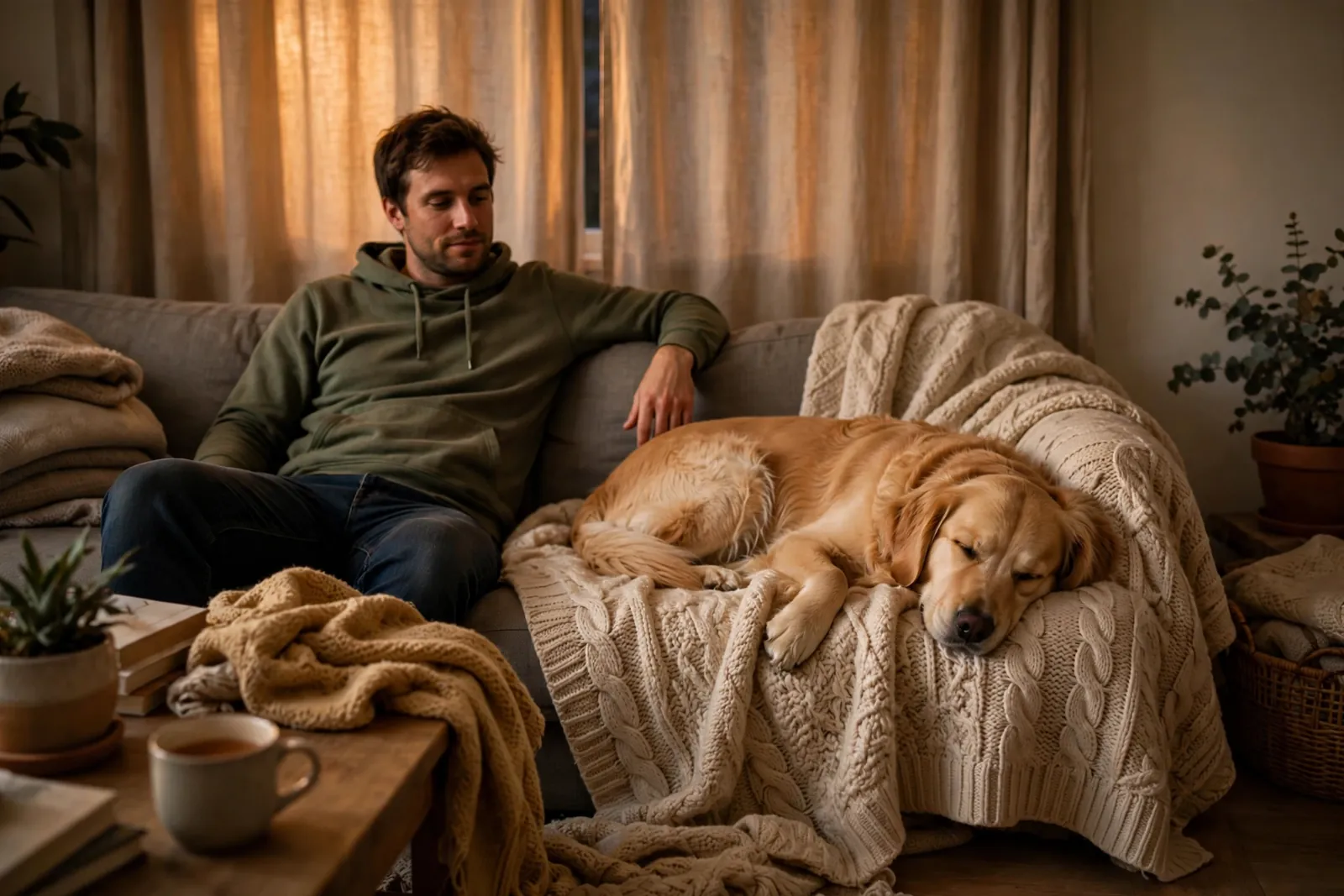
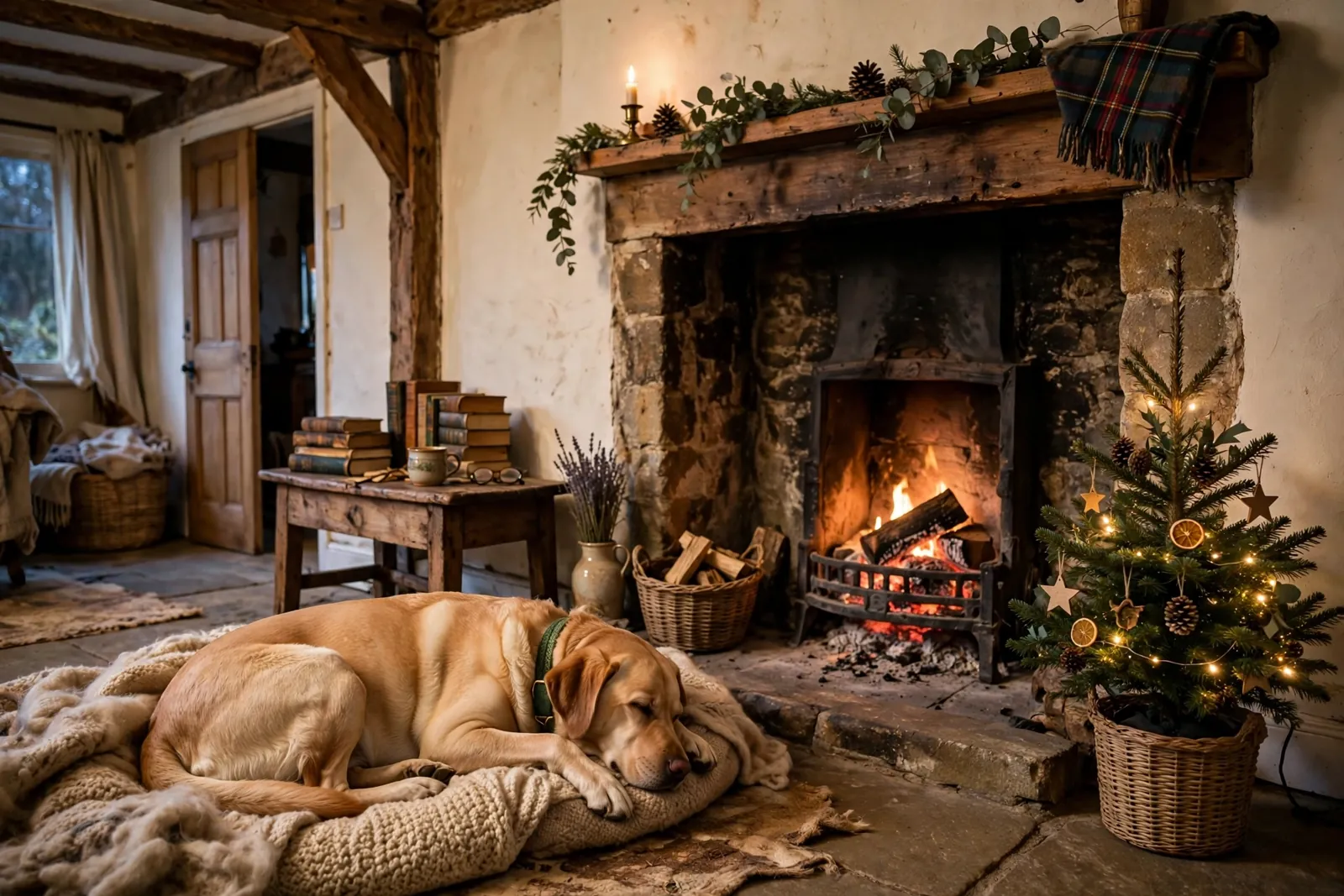
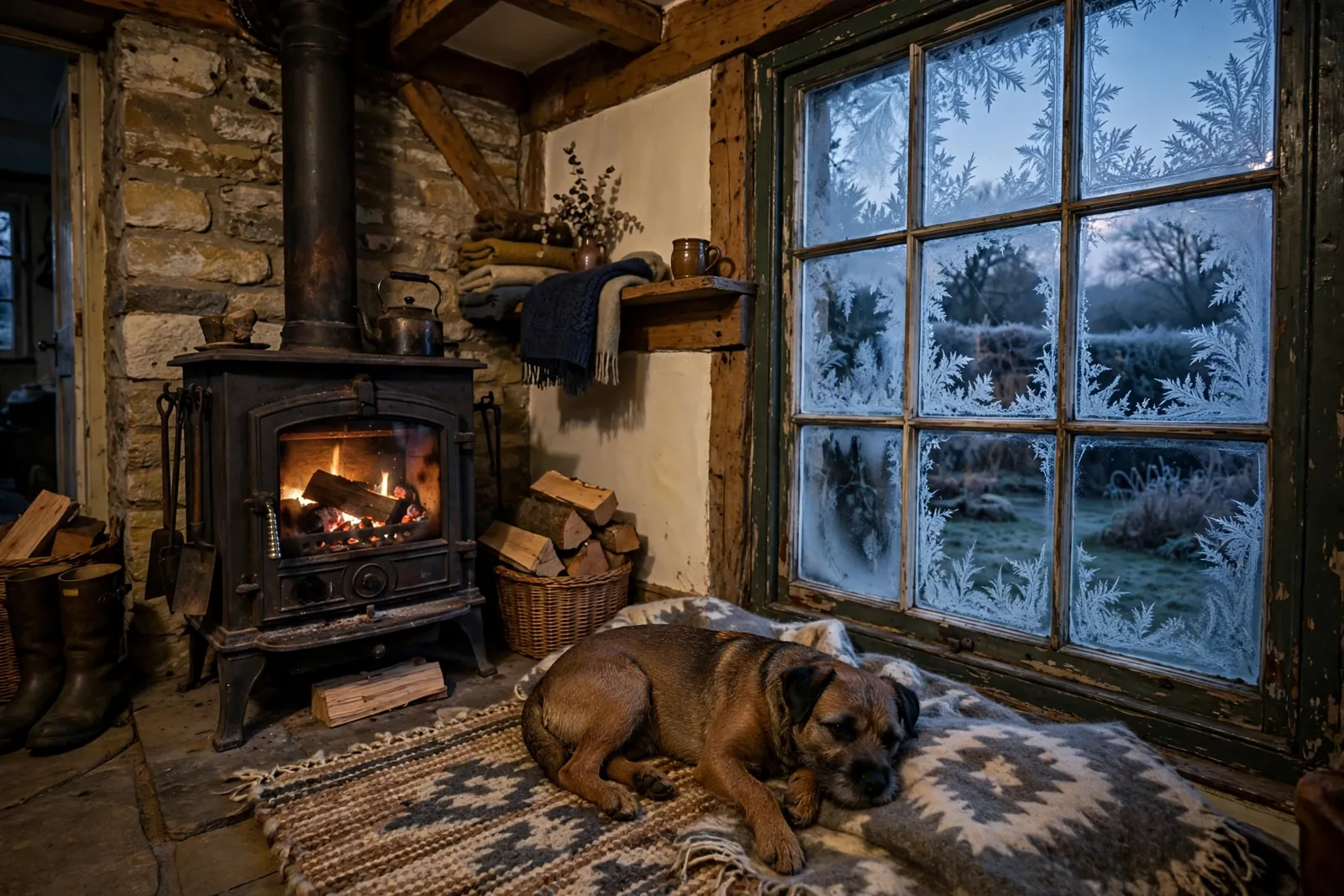
As light fades, prepare the property in a set order, and do it calmly rather than in response to the first bang. Close curtains and blinds throughout, especially in the room you have chosen as the safe room — flashes through glass unsettle many dogs as much as sound. Set that room up in advance: familiar bedding brought from home, water, a long-lasting chew or lick mat if your dog uses them, and sound masking ready to go. Sound masking means an ordinary, familiar background — a television or radio at a normal, comfortable volume, started before any fireworks so its presence is not itself a signal that something is wrong. Classical music and steady speech radio are popular choices because their volume stays even; what matters most is that the sound is continuous and unremarkable, not that it is any particular programme.
The safe room itself should be the most interior, best-insulated room you have: furthest from the road, the neighbours and the garden from which bangs will seem loudest, with a door that closes. Then let the dog choose. Some dogs want their bed in the corner of the room everyone is in; some want a den under a table or behind a sofa; some want to be pressed against a person and some pointedly do not want fussing. All of those are acceptable coping strategies. Provide the options, stay nearby and unhurried, and resist the urge to constantly stroke, reassure or offer food to a dog that is turning away — calm company beats anxious attention. Never punish panting, pacing or whining, and never leave a distressed dog alone in the property while you go out to celebrate; if the human plan for the night requires being elsewhere, this is the wrong stay, however quiet the valley.
Keep the rest of the household's evening deliberately low-key inside that structure. Visitors arriving late, doors opening to the night, raised voices at midnight and trips in and out to watch displays all undo the routine at exactly the wrong moments. If people are staying up for midnight, do it in the safe room's part of the house, with the masking sound still on and the curtains still closed. Many owners find the honest version of a dog-friendly New Year is a good meal, a film and an early night with one eye on the clock — and wake on New Year's Day having actually enjoyed it, rather than having managed a crisis until 2am.
The midnight toilet trip strategy
The toilet trip is where careful New Year plans most often come unstuck, because a dog that has been settled indoors for hours will, at some point, need to go out — and that point can easily be half past eleven. The strategy is to make every night-time outing short, familiar and already rehearsed, so that going outside never involves novelty, distance or decisions in the dark. Start on your first evening, not on the 31st: identify the smallest workable patch — ideally a genuinely enclosed garden, at worst a few metres of familiar ground beside the door — and use exactly that patch, on a lead, for every after-dark outing of the stay. By New Year's Eve the routine is boring, and boring is the whole point.
Timing matters as much as place. Offer a proper toilet opportunity in the early evening, before displays are likely to begin in earnest, even if the dog does not seem desperate; a dog encouraged out at half past six is far less likely to be frantic at half past eleven. If a later outing is needed, pick your moment by listening rather than by the clock: wait for a lull between bursts where you can, keep the outing to minutes, stay on the lead even in an enclosed garden — a sudden close bang can make the calmest dog bolt for a gap it has ignored all week — and come straight back in without turning it into a game or a wander. A torch, a coat by the door and shoes you can step into quickly should be staged in advance, so nobody is crashing around the house searching while the dog waits and worries.
For properties without enclosed outdoor space, the planning burden is higher and should be settled at booking, not on arrival. Walk the intended night route in daylight: is it lit, does it cross a road, does it pass the pub or the houses most likely to be celebrating, and is there a nearer, duller alternative — a car park edge, a lane verge, the ground beside the bins — that gets the job done in two minutes? Short and dull beats scenic and exposed every time after dark. Puppies, older dogs and dogs on medication may need more frequent outings, so factor that honestly into whether a property suits you; a house where every toilet trip is a five-minute walk along a lane is a poor New Year choice for a dog that needs to go out at 10pm, midnight and 3am. If an accident happens indoors despite the plan, clean it without drama and adjust the timing next time — the dog has had a hard night, not a training failure.
New Year's Day walks and hangover-crowd timing
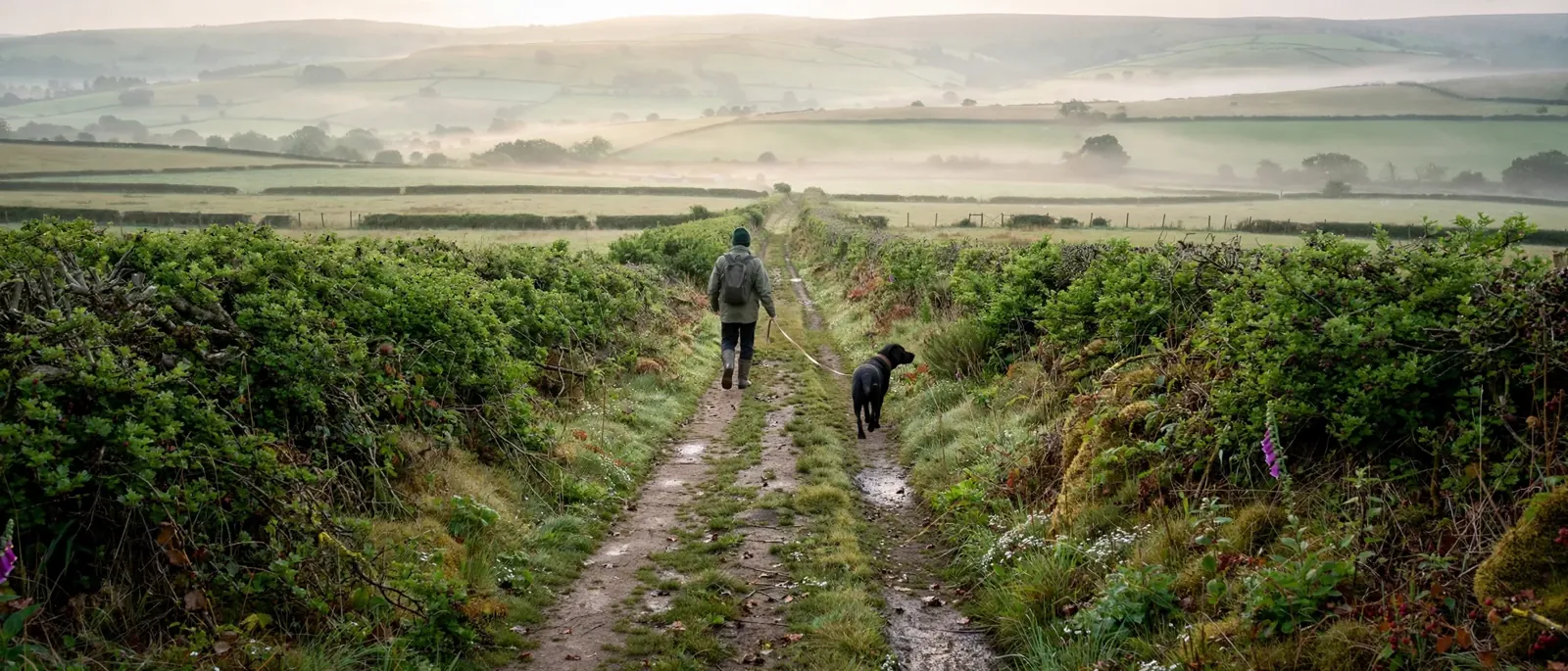
New Year's Day has its own rhythm, and walking well on it is mostly a matter of timing. The early morning is the quietest walking of the entire festive week: most of the country is asleep, displays are long finished, and dogs that had a rough night can have a gentle, decompressing walk in near-empty lanes and fields. A short, calm outing at first light suits a tired dog better than a heroic expedition — last night's stress often shows up the following day as clinginess, a poor appetite or an unusual need to sleep, and the kindest plan respects that rather than marching it off. Let the dog set the distance, favour sniffing over mileage, and keep meetings with other dogs low-key; every dog you meet has also had a strange night.
By late morning the pattern reverses, and this is where the hangover-crowd effect catches people out. New Year's Day is one of the most popular walking days of the year: organised group walks, charity dips and swims, parkrun-style events, packed pub lunches and every household in Britain taking the same advice about blowing away the cobwebs, all at roughly the same time. Beauty spots, coastal paths, reservoir circuits and town parks that were deserted at 8am can be at their busiest of the winter by noon, with car parks full and narrow paths slow with families and off-lead dogs. If your dog is reactive, elderly or simply wrung out from the night before, that surge is best avoided entirely — either walk early, or wait until mid-to-late afternoon when the crowds thin again, accepting that the light will be going as you finish.
Winter daylight is the hard limit underneath all of this planning, and it deserves to be treated as a fixed appointment rather than a vague awareness. At the turn of the year, usable daylight in southern Britain runs roughly from 8am to 4pm, and in northern Scotland the window is an hour or more shorter at both ends. A walk planned as “a couple of hours after lunch” can easily end in darkness on unfamiliar ground, with a torch you did not bring, on paths that have been mud or ice since morning. Plan Day walks by their finish time, not their start time: be back at the car or the cottage door well before dusk, carry a torch and a lead light anyway in case of delay, and treat short, low-level local routes as the sensible default for this week. Ice on untreated lanes, flooded fields after winter rain and swollen streams are ordinary late-December conditions, so check conditions locally, keep away from fast water, and check latest official guidance for any organised walks or events you plan to join.
Travelling on quiet roads and using motorway services well
Travel is the one part of a New Year break that the season genuinely makes easier — if you pick your hours. Roads on New Year's Eve morning and on New Year's Day morning are among the quietest of the year, and a journey that would be a stop-start ordeal on a normal weekend can be smooth and unhurried, which suits a dog far better than a hot, delayed car. The traps are at the edges of those windows: the late-afternoon rush on the 31st as everyone travels to parties, and the afternoon of New Year's Day when the whole country drives home at once. Where you have a choice, travel early on either day, in full daylight, and arrive with time to walk the property's boundaries, find the night toilet patch and settle the dog long before evening — arriving at a strange house in the dark on New Year's Eve itself, with fireworks already starting, is the single worst opening move available, and worth changing dates to avoid.
Motorway services need a dog plan in winter, because the obvious routine — a wander on the grass while everyone stretches their legs — meets cold, salt, darkness and crowds. Choose your stop by its dog provision rather than by the coffee brand: many larger services have a marked dog-walking area or a usable perimeter path, while smaller ones offer little more than a verge beside the car park. Keep the dog on a short lead anywhere near traffic, be alert for dropped festive food, chicken bones and litter around bins, and wash or wipe paws afterwards if grit and de-icing salt are heavy on the ground, since dogs lick it off and it can irritate feet and stomachs. A stop of ten unhurried minutes, with water offered in the car park rather than a shared bowl, serves a dog better than twenty fraught ones weaving through a crowded concourse — and dogs are not permitted inside most services buildings beyond assistance dogs, so plan for one person to stay with the dog rather than discovering it at the door.
The return journey deserves the same care as the outward one, especially if New Year's Eve went badly. A dog that barely slept may travel worse than usual, so rebuild the car's familiar setup exactly — same bedding, same restraint, same ventilation — offer a calm walk and a toilet opportunity before you set off rather than at the first services, and schedule an extra stop rather than pushing through to save half an hour. Check your route for winter disruption before leaving, since a single closure on quiet holiday roads can add a long, unlit diversion, and keep the in-car essentials — water, a towel, spare lead, any medication and the vet's number — in the cabin rather than buried under luggage. Arrive home to the old routine at the old times, and most dogs close the festive week as if it were simply a strange few days. Which, if the geography, the questions and the Eve routine all did their jobs, is exactly what it should have been.
Practical questions
Before you go
Where in the UK is quietest for dogs at New Year?
The quietest stays tend to be well away from towns, villages with organised midnight displays, pubs with gardens and large holiday parks that run their own events. Look for scattered settlements, no function venue nearby and a host who can describe the previous New Year in specific terms. Distance from a display matters more than a rural postcode on its own, so check a map before you book.
Are rural cottages always quiet on New Year's Eve?
No. A single farm, barn conversion or neighbouring house holding a private party with garden fireworks can be louder for a nearby dog than a town display several streets away. Rural also means sound travels across open fields and valleys with little to absorb it. Always ask the host directly about private displays, shoots and parties nearby, not just official events.
What time should I walk my dog on New Year's Eve?
Plan the main walk for late morning or early afternoon, well before dusk, and a last short toilet outing in daylight or very early evening before any fireworks are likely. Once darkness falls, keep outings to a brief, on-lead trip to the nearest patch of ground you have already checked in daylight. Do not aim for a normal evening walk at the usual time if local displays start early.
How early should I book a New Year break with a dog?
For the Christmas to New Year window, the best quiet, dog-welcoming properties are often booked many months ahead, and returning guests frequently rebook first. Starting your search in spring or early summer gives you the widest choice of genuinely remote stays. Later bookings can still work, but you will usually trade location, enclosed outdoor space or price, so be flexible on region.
What should I do if fireworks start near our stay?
Stay calm, keep the dog indoors on a lead if you are outside, close curtains and doors, and settle in the pre-prepared quiet room with familiar bedding, water and sound masking such as a television or radio at a normal volume. Let the dog choose where to settle, offer a long-lasting chew if they will take it, and avoid fussing or punishment. If distress is severe or prolonged, contact a vet for advice and check latest official guidance.