This guide is independent and contains no paid placement. If affiliate links are added later, they will be clearly marked and will not change our editorial checks.
Newbury suits a dog day out because the walking is flat and starts in the town centre: the Kennet and Avon towpath runs straight out of the Wharf, Donnington Castle sits on a grassy hill ten minutes north, and the commons at Greenham and Snelsmore give open ground for dogs that need space. Come on a Thursday or Saturday to add the market, and check the official guidance before you travel for race days, market dates and any towpath closures.
A market town on the Kennet
Newbury sits where the River Kennet meets the Kennet and Avon Canal, in the west of Berkshire, and that meeting of river and canal shapes almost everything a dog owner needs to know about the town. The centre is compact: the Market Place, the pedestrianised stretch of Northbrook Street, the Wharf beside the canal and Victoria Park beside the river all sit within a few minutes' walk of one another, so a dog can be exercised, fed, watered and settled without a car once you have parked. The railway station is on the Reading to Taunton line, the M4 runs just north of the town at junction 13, and the A34 passes to the west, which makes Newbury a practical stop between London, Oxford and the south-west — and a useful base for a longer Berkshire stay.
The town's history is visible in layers, and most of them are dog-walkable. Newbury grew rich on cloth in the Tudor period, when the Cloth Hall — now the West Berkshire Museum — stood at the heart of the trade, and it grew again as a coaching town on the old Bath Road, which is why the centre still has so many wide streets and old inns. The Civil War left its mark twice: the First Battle of Newbury was fought in 1643 around Wash Common and the Second in 1644 around Donnington Castle and Shaw House, and both battlefields are still open ground you can walk with a dog today. The Kennet and Avon Canal arrived in the early nineteenth century, the railway followed, and in the twentieth century the town became known for the racecourse and, at Greenham Common, for the airbase and the peace camp that occupied it through the 1980s. None of this needs a history degree to enjoy: the point for a dog owner is that Newbury has old streets to wander, water to follow and hills to climb, all within a small radius.
Start at the Wharf, where the canal basin sits beside the town centre and the towpath begins. From there the river and the canal run roughly parallel east and west, the Market Place is a short stroll up through the shopping streets, and Victoria Park lies just south of the canal, with the river running along its edge. That geography gives a natural shape to a day: towpath in the morning, town and market in the middle of the day, and the commons or the castle hill in the afternoon when the dog still has energy. If your dog is the sort that settles better after a proper walk than after a car journey, Newbury rewards arriving early and walking first, because the towpath is at its quietest before the midday shoppers and cyclists appear.
One practical note before anything else: Newbury is a working town, not a theme park, and its dog rules are the ordinary English ones — leads near roads, livestock and horses, courtesy around other towpath users, and cleaning up after your dog everywhere. The canal towpath is shared with cyclists and, in places, with anglers; the commons are shared with grazing animals and ground-nesting birds in season; the racecourse is a working sporting venue. None of that is a problem if you plan for it, and the sections below take each place in turn so you can match the walk to the dog you actually have.
The canal towpath walk
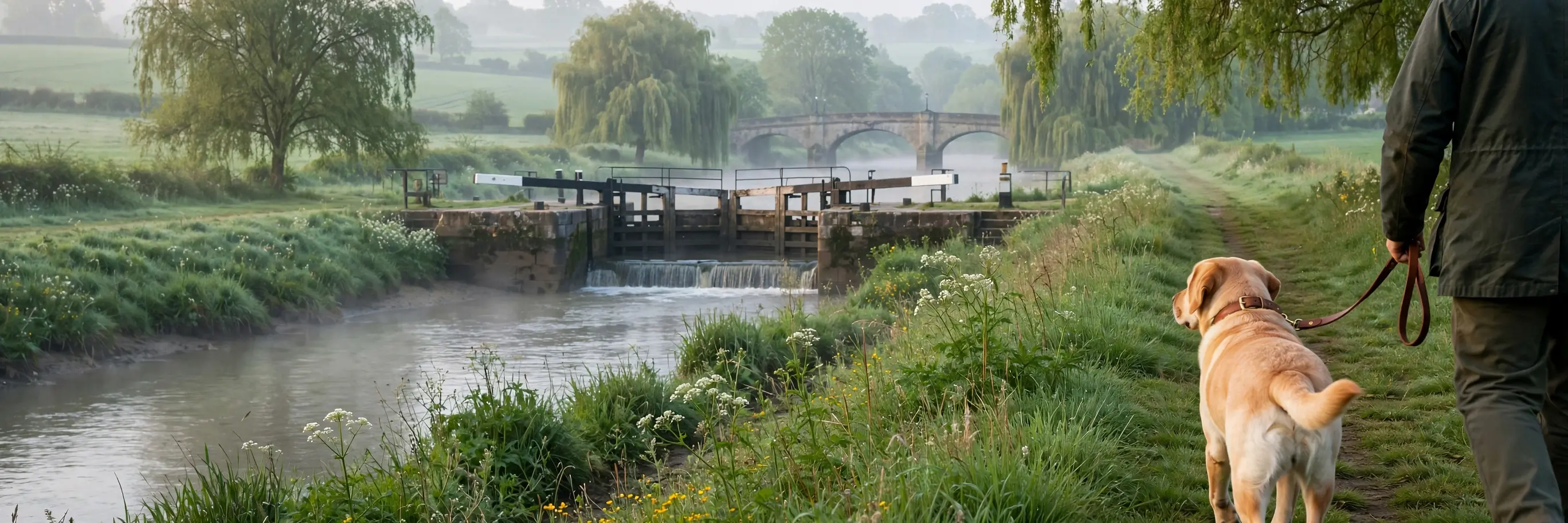
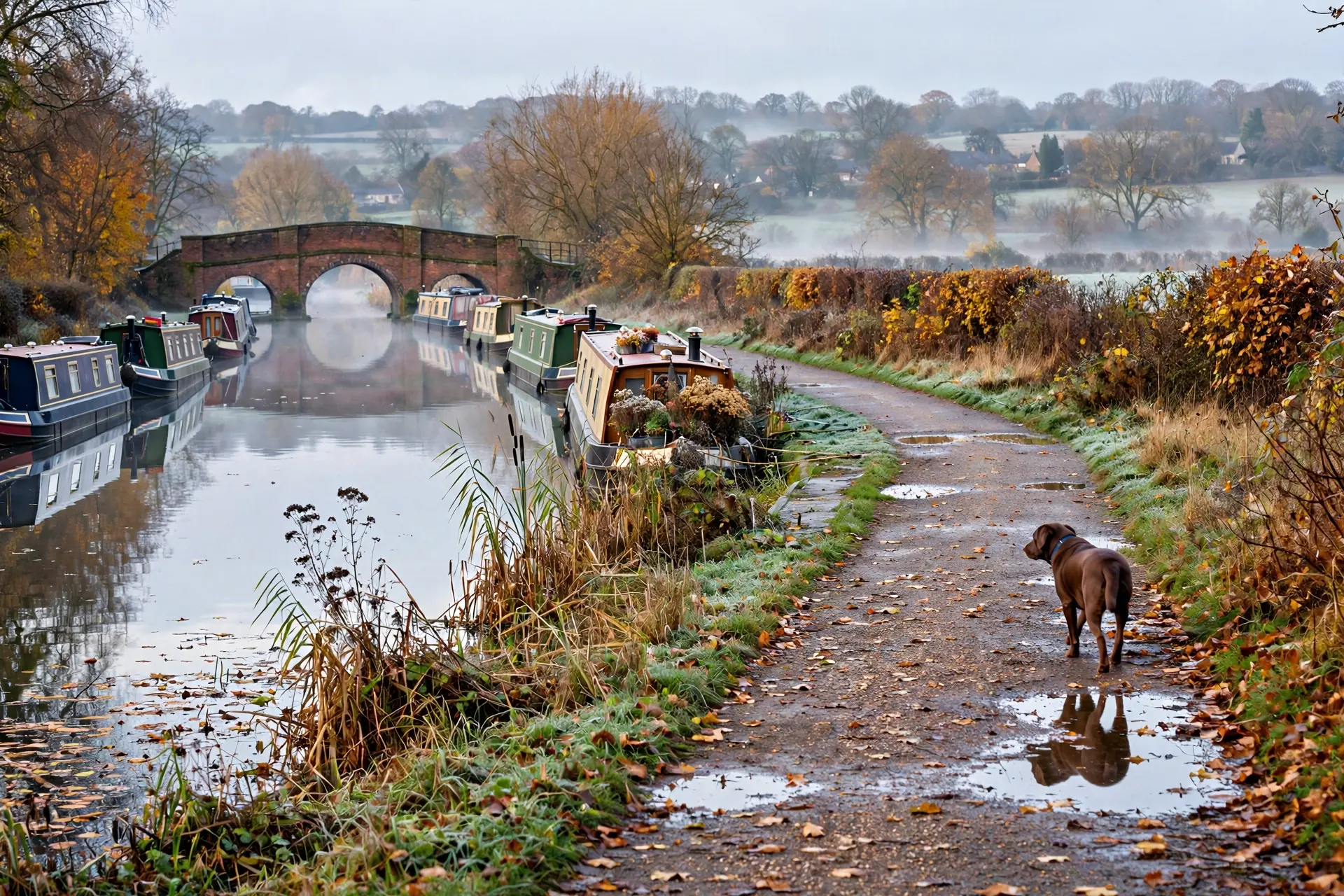
The Kennet and Avon Canal runs for 87 miles between Bath and Reading, and the stretch through Newbury is one of its most useful sections for dog owners because it is flat, largely surfaced near the town, and easy to join and leave. The towpath follows the canal from the Wharf in the town centre, past the locks and the moored narrowboats, and out into open countryside in both directions, so you can choose a twenty-minute leg-stretch or a half-day walk without changing your starting point. Westwards the towpath runs towards Kintbury, about four and a half miles away, and on towards Hungerford, about eight miles from Newbury; eastwards it runs towards Thatcham, about three miles, and on towards Aldermaston and Reading. The distances are honest towpath miles — flat, with a lock every so often and a bridge where the path crosses from one bank to the other — and they suit dogs that like steady walking and sniffing more than dogs that need hills to tire them out.
For a first visit, walk west from the Wharf towards Speen and Kintbury. The path leaves the town quickly: within ten minutes the shops give way to riverside meadows, the canal widens into the long pound between locks, and the narrowboats thin out to occasional moorings. Monkey Marsh Lock, just west of the town, is worth a pause — it is one of the few remaining turf-sided locks on the canal network, with grassy banks instead of brick or stone walls, and it shows how the canal looked when it was built. Dogs should be kept on a short lead at every lock: the ground is uneven, the water is deep beside the lock gates, and a dog that slips in at a lock has nowhere easy to climb out. The same rule applies at the bridges, where the towpath narrows and ducks under the road, and where cyclists appear suddenly from the other side.
Eastwards from the Wharf, the towpath towards Thatcham is the gentler option for older dogs and for anyone with a pushchair or a dog that struggles with stiles, because the surface stays good and the locks are spaced further apart. The canal here runs beside the River Kennet through water meadows, and in spring and early summer the banks are full of the small details that make a dog walk interesting — kingfishers along the quieter stretches, moorhens in the reeds, and the smell of the water meadows after rain. The towpath is also the route that links Newbury to the longer riverside walking in the Thames valley, and readers planning a multi-day walk can pick up the Thames Path downstream at Reading, which our guide to the Thames Path with a dog covers in full.
Water needs care. The canal looks calm, but the navigation channel is deep, the water beside locks and weirs moves faster than it appears, and a dog that jumps in after a duck can be swept towards a lock gate. Let dogs paddle only at the shallow, slow edges away from locks — the margins near Victoria Park and the quieter pounds east of town are the usual spots — and never let a dog swim where narrowboats are moving or moored. After heavy rain the River Kennet runs fast and brown, the towpath's unmade sections turn to deep mud, and the low-lying meadows beside the canal can flood; on those days the surfaced stretch through the town itself is the sensible choice, and the commons give a drier alternative. In summer, the canal water can carry the usual warm-weather risks, so discourage drinking from the canal and carry water for the dog instead — the canal-side pubs and cafes are happy to refill a bottle, and the Wharf has taps and seating where you can stop.
Cyclists are the towpath's main hazard, and the etiquette is simple: keep your dog on your left, away from the centre of the path, use a short lead rather than a long line, and step aside at bridges and blind bends. Early mornings are the quietest, and the towpath is at its busiest on sunny weekend afternoons, when families, runners and hire boats all use the same narrow strip. If your dog is reactive to bikes, walk early, choose the wider sections west of Monkey Marsh Lock, and be ready to move off the path onto the grass at the approach of a cyclist. Anglers fish the canal in places, especially in the quieter pounds, so keep dogs from investigating tackle boxes and bait, and give anyone fishing a wide berth.
The towpath also works as the town's green corridor for dogs that need a walk before a long car journey home. A loop from the Wharf west to the Speen moorings and back takes about an hour at a dog's pace with stops, and it passes the Speen recreation ground and the open ground around the River Lambourn's confluence, where there is room for a ball throw away from the water. A shorter loop runs from the Wharf east to the Victoria Park footbridge and back along the river, which takes about forty minutes and gives a dog water, grass and shade in one circuit. Either loop can be combined with a stop at the canal-side cafes near the Wharf, where dogs are usually welcome outside, and both leave the dog tired enough to settle for the drive home.
Donnington Castle and the Civil War hill
Ten minutes north of the town centre, on a hill above the village of Donnington, stand the ruins of Donnington Castle — a fourteenth-century gatehouse with two towers, battered by cannon fire in the Civil War and left open to the sky ever since. The castle is managed by English Heritage, entry is free, and dogs on leads are welcome in the grounds, which makes it one of the best short dog walks in Newbury: a steep but short climb, a grassy hilltop with views across the Kennet valley, and ruins that are interesting enough to hold a human's attention while the dog works through the smells of the hill.
The history is worth knowing before you climb, because it explains why the castle looks the way it does. Donnington was built in the late fourteenth century and was held for the Royalists during the Civil War; in 1644 it was besieged, and its walls were damaged by Parliamentarian artillery during and after the Second Battle of Newbury, which was fought on the ground below the castle. What survives is the twin-towered gatehouse and fragments of the curtain wall, standing on a mound above the village, with the earthworks of the siege still visible in the grass. The site has no visitor centre, no cafe and no toilets, so it is a place to visit for an hour rather than a whole afternoon — bring water for the dog, and plan the cafe stop for afterwards, back in the town or at the pub in Donnington village.
The walk up from Donnington village is the direct route: park considerately in the village, follow the footpath up the hill, and allow ten to fifteen minutes for the climb, which is steep in places and can be slippery after rain. Dogs that cope with hills will enjoy the open grass at the top, where there is room to move on a long lead; dogs with sore joints or breathing problems will find the climb hard work, and for them the better option is the gentler approach from the north, along the lane from Snelsmore Common, which arrives at the castle with less of a gradient. Whichever way you come, keep dogs on a lead around the ruins themselves — the walls are old, the ground falls away sharply on the south side, and the earthworks have hidden dips that can catch a running dog.
From the castle hill the views open out across the Kennet valley towards Newbury, and on a clear day you can pick out the racecourse, the town's church towers and the ridge of the North Wessex Downs beyond. It is a good place to get a sense of the Civil War landscape: the Second Battle of Newbury was fought on the low ground between the castle and Shaw House to the east, and the open fields below the hill are still farmland and common, so the shape of the ground has changed less than the town itself. Shaw House, the Elizabethan mansion that served as a Royalist headquarters during the battle, stands about a mile east of the castle, and its grounds are open parkland where dogs on leads are welcome — the two sites pair naturally into a single walk if your dog is up for the distance and you are happy to use the footpaths between them rather than the main road.
After the castle, the footpaths continue north to Snelsmore Common, a heathland common of gorse, heather and birch that gives dogs a very different walk from the canal: open, dry underfoot in summer, and full of ground-nesting birds in spring. Keep dogs on a lead or under close control on the common in the breeding season, watch for adders basking on warm paths in summer, and check the official guidance before you travel for any seasonal access notices. The common is also the start of longer walks into the North Wessex Downs, and a dog that has done the castle hill and the common in one outing will have earned a long rest.
The racecourse and its green spaces
Newbury Racecourse has been part of the town since 1905, and on race days it draws crowds from across the south of England — which is exactly why a dog owner needs to know how it works before turning up with a dog. Dogs are not generally admitted to the enclosures on race days, and the rules change from meeting to meeting, so check the official guidance before you travel rather than assuming a quiet midweek fixture will be different. The racecourse is a working sporting venue with horses, crowds, loudspeakers and hospitality areas, and it is not a place to bring a dog on the off chance. The good news is that the green spaces around the racecourse, and the commons beyond it, give dogs plenty of open ground without ever going through the gates.
The best of those spaces is Greenham Common, south-east of the town, which was a military airbase for much of the twentieth century and is now one of the largest areas of open common land in Berkshire. The common is heathland and grassland, crossed by the old runways and by a network of paths, and it is managed for wildlife — nightjars in summer, Dartford warblers in the gorse, and grazing animals that keep the heath open. Dogs are welcome and the space is enormous, which suits dogs that need room to run, but the scale is also the risk: the common is big enough to lose a dog in, the grazing cattle and ponies need a wide berth, and the old runway concrete gets hot in summer. Keep dogs under close control, carry water — there is little shade and no cafe on the common itself — and use a lead near the grazing animals and near the car parks, where the paths meet the roads.
Closer to the town, Victoria Park is the everyday green space, lying between the canal and the river just south of the centre. It has lawns, mature trees, a bandstand, a play area and the river running along its southern edge, and it is where Newbury's dogs are exercised on ordinary weekdays. The park suits dogs that like company: there are always other dogs, children, joggers and picnics, so it is a good test of a dog's manners and a poor choice for a reactive dog at busy times. Early morning is the quiet window, and the river edge gives a shallow paddling spot for dogs that like water, though the current picks up after rain and the bank is steep in places.
West of the town, Wash Common is the other piece of Civil War ground that doubles as dog-walking land. The First Battle of Newbury was fought here in 1643, and the common is still open grassland with wide views towards the town and the downs. It is less manicured than Victoria Park and less wild than Greenham, which makes it a good middle ground: enough space for a ball, enough paths for a proper walk, and close enough to the town to reach on foot from the centre. The Falkland Memorial, which marks the spot where Lucius Cary, Viscount Falkland, was killed in the first battle, stands on the common and is a natural turning point for a loop walk. Keep dogs on a lead near the roads that cross the common, and remember that the ground is exposed — there is little shelter in wind or rain, and no water on the common itself.
For dogs that need enclosed space, the town's recreation grounds and the fenced play areas are worth knowing about, but Newbury has no large dedicated dog park of the kind some towns now provide, so the practical answer is to use the commons with a long lead and good recall, or to book a private enclosed field on the edge of town if your dog cannot be let off safely in open country. Several farms and smallholdings around Newbury hire secure fields by the hour, and they are worth the small fee for a dog with poor recall or a strong chase instinct — check the official guidance before you travel, because availability and prices change with the season. The same logic applies to the racecourse area itself: the paths around the outside of the course, and the bridleways that run from the racecourse towards Greenham, are public rights of way that stay open on non-race days, and they give a flat, grassy walk with the horses visible in the distance — but keep dogs on a lead whenever horses are being exercised nearby, and never let a dog approach a stable yard or a horsebox.
Market day with a dog
Newbury's general market runs on Thursdays and Saturdays in the Market Place, with a farmers' market on the first Sunday of the month, and the market is the town at its most characterful — and its most crowded. The Market Place is a broad, paved square in the middle of the old town, overlooked by the Corn Exchange and the parish church of St Nicolas, and on market days it fills with stalls selling fruit and vegetables, bread, cheese, flowers, clothes and household goods. Dogs on leads are a normal sight among the stalls, and most traders are happy to see them, but the market is a place to plan around your dog rather than to drag your dog through: arrive early, before the late-morning crowds, keep the dog close through the narrow gaps between stalls, and leave promptly if the dog shows signs of stress.
The practical details matter more than the atmosphere. The paved square holds heat on sunny days, so on a warm Thursday or Saturday the dog's paws are on hot stone by midday — walk the dog on the grass in Victoria Park first, carry water, and keep the market visit short. The stalls sell food at dog height, and a hungry spaniel can clear a table of samples faster than a trader can react, so keep the lead short and the dog on the far side of you from the food. The market is also the place where your dog will meet more people in ten minutes than on a whole canal walk, which is good socialisation for a confident dog and a bad idea for a nervous one; if your dog is noise-sensitive, come on a Thursday, which is usually quieter than Saturday, and avoid the busiest hour between eleven and one.
Beyond the market stalls, the shopping streets around the Market Place are worth a wander with a dog. Northbrook Street is pedestrianised, and many of the shops keep a water bowl by the door; the Parkway shopping centre has covered walkways that give shade on hot days and shelter on wet ones, though dogs are not admitted to all of its indoor areas, so check the official guidance before you travel if you plan to shop indoors. The streets around the Market Place also hold the town's older buildings — the Cloth Hall, now the West Berkshire Museum, the Corn Exchange, and the timber-framed fronts that survive along Cheap Street and Bartholomew Street — and the museum is worth a look for the human half of the party, though dogs cannot go inside and one of you will need to wait outside with the dog. Plan the day as a split visit: one person in the museum while the other walks the dog along the canal, then swap.
The farmers' market, on the first Sunday of the month, is the better market day for a food-loving dog owner, because the stalls are local producers — Berkshire cheese, bread, meat, honey and vegetables — and the atmosphere is slower than the general market. It is also the day when the Market Place is fullest with dogs, because Sunday morning is when local owners bring their dogs into town, and the square becomes an informal meet-and-greet for the town's dogs. The same rules apply: early is better, the lead stays short, and the dog's welfare comes before the shopping list. If the farmers' market is the reason for your visit, pair it with a morning walk on the towpath first, so the dog has already had its exercise and is content to stand beside a stall while you queue.
One more market-day tip: the car parks fill up on Saturdays, and the streets around the Market Place are closed or restricted on market days, so park at the Wharf or the Kennet Centre and walk in, rather than circling the centre with a dog in the car. The walk from the Wharf to the Market Place takes about five minutes, passes the canal basin and the town's older warehouses, and gives the dog a chance to settle before the crowds. If you are staying for lunch, the pubs around the Market Place — the Hatchet Inn on the square itself, and the Catherine Wheel on Cheap Street — are the natural choices, and the next section covers where to eat and sleep with a dog in Newbury.
Pubs and stays
Newbury's pubs are one of the town's strengths for dog owners, because the old coaching inns and market-town locals were built for travellers, and most of them still welcome dogs in at least part of the building. The Hatchet Inn, on the Market Place itself, is the most central option: a timber-framed inn with a bar that welcomes dogs, and a position that makes it the natural stop after the market or before the walk back to the car. The Catherine Wheel, on Cheap Street a minute from the Market Place, is another old inn with a dog-friendly bar, and the Bacon Arms, on the Oxford Road north of the centre, is a proper locals' pub with a garden that suits a dog that prefers open air to a crowded bar. None of these pubs guarantees the same policy on every visit — dog rules change with landlords, seasons and refurbishments — so check the official guidance before you travel, and always ask at the bar rather than assuming the dog can follow you into the dining room.
The practical rules for pubs with dogs are the same in Newbury as anywhere else, and they are worth stating because they decide whether the visit works. Choose the bar rather than the restaurant, sit near the door rather than in the middle of the room, keep the dog on a lead and under the table, and bring a mat or a blanket for the dog to lie on — cold pub floors are uncomfortable for an older dog, and a settled dog is a welcome dog. Order at the bar and eat quickly rather than settling in for a long lunch if the dog is restless, and take the dog out for a short walk before you sit down, so it has already been to the toilet and is ready to rest. The canal-side pubs and cafes near the Wharf are the best choice on a warm day, because the dog can sit outside beside the water, and the walk back along the towpath gives a natural end to the meal.
For an overnight stay, Newbury has options at several levels, and the dog policy is the detail to confirm in writing before you book, not the detail to discover at check-in. The Hare and Hounds at Speen, just west of the town on the old Bath Road, is a country-house hotel with gardens that suit dogs, and the Donnington Valley Hotel and Spa, north of the town near the castle, is a larger hotel with grounds and a spa — both accept dogs in selected rooms, and both charge a fee per stay, so ask for the total in writing with the pet fee itemised. The Premier Inn Newbury Town Centre, beside the canal, is the straightforward budget option, with dog-friendly rooms and a position that puts the towpath and the Market Place within a few minutes' walk. Smaller bed and breakfasts and self-catering cottages in the villages around Newbury — Kintbury, Hungerford, Speen and Stockcross — often give dogs more space than a town-centre hotel, and the villages put you straight onto the canal towpath or the downs in the morning, so they are worth considering for a stay of more than one night.
When you book any stay with a dog in Newbury, ask the same four questions you would ask anywhere, but ask them about this specific room: does the room accept dogs, or only selected rooms; is there a charge, and what does it cover; where is the nearest place to walk the dog after dark; and can the dog be left alone in the room, and for how long. The answers matter more in Newbury than in a rural cottage, because a town-centre hotel room is small, the corridors are busy, and a dog that barks at every footstep will not settle. If the hotel cannot give you a ground-floor room near an exit, or if the after-dark walk involves crossing a busy road, choose a different room or a different property — the saving is not worth a sleepless night for the dog or for the guests next door.
Finally, plan the practicalities of a stay around the town's geography. The railway station is a ten-minute walk from the Market Place, and dogs travel on trains without a ticket, so a car-free trip to Newbury is straightforward — arrive by train, walk to the hotel, and use the towpath and the commons on foot. If you drive, the Wharf car park is the most useful for a dog owner, because it puts you beside the canal; the Kennet Centre and Parkway car parks are the most useful for shopping, because they put you beside the Market Place. Veterinary practices are in the town if something goes wrong, and the nearest out-of-hours cover is signposted at every practice — save the number when you arrive rather than searching for it in an emergency. And if the weather turns, as it often does in Berkshire, the covered walkways of the Parkway, the canal-side cafes and the dog-friendly pub bars give you somewhere dry to wait out a shower before the next walk.
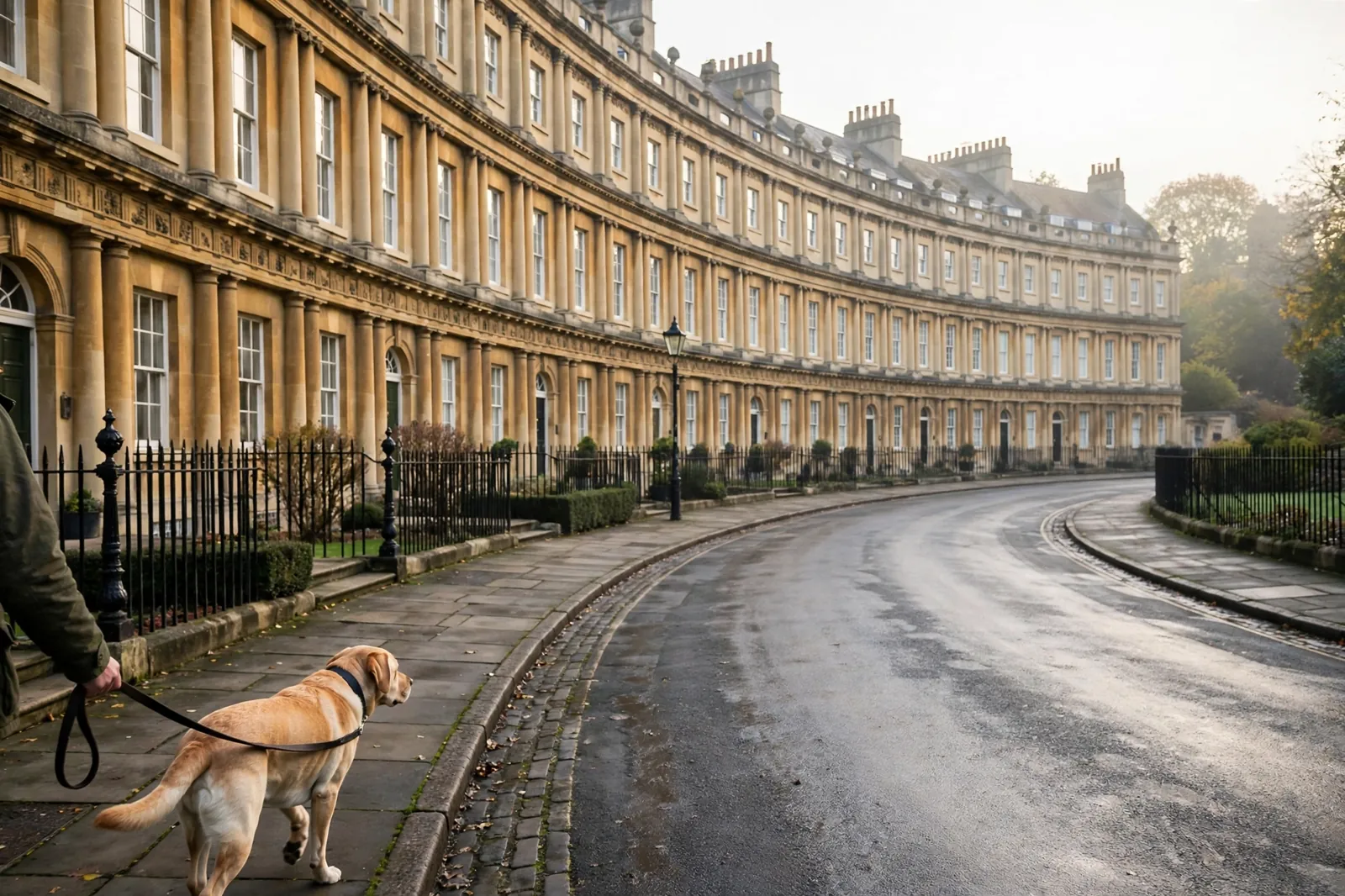
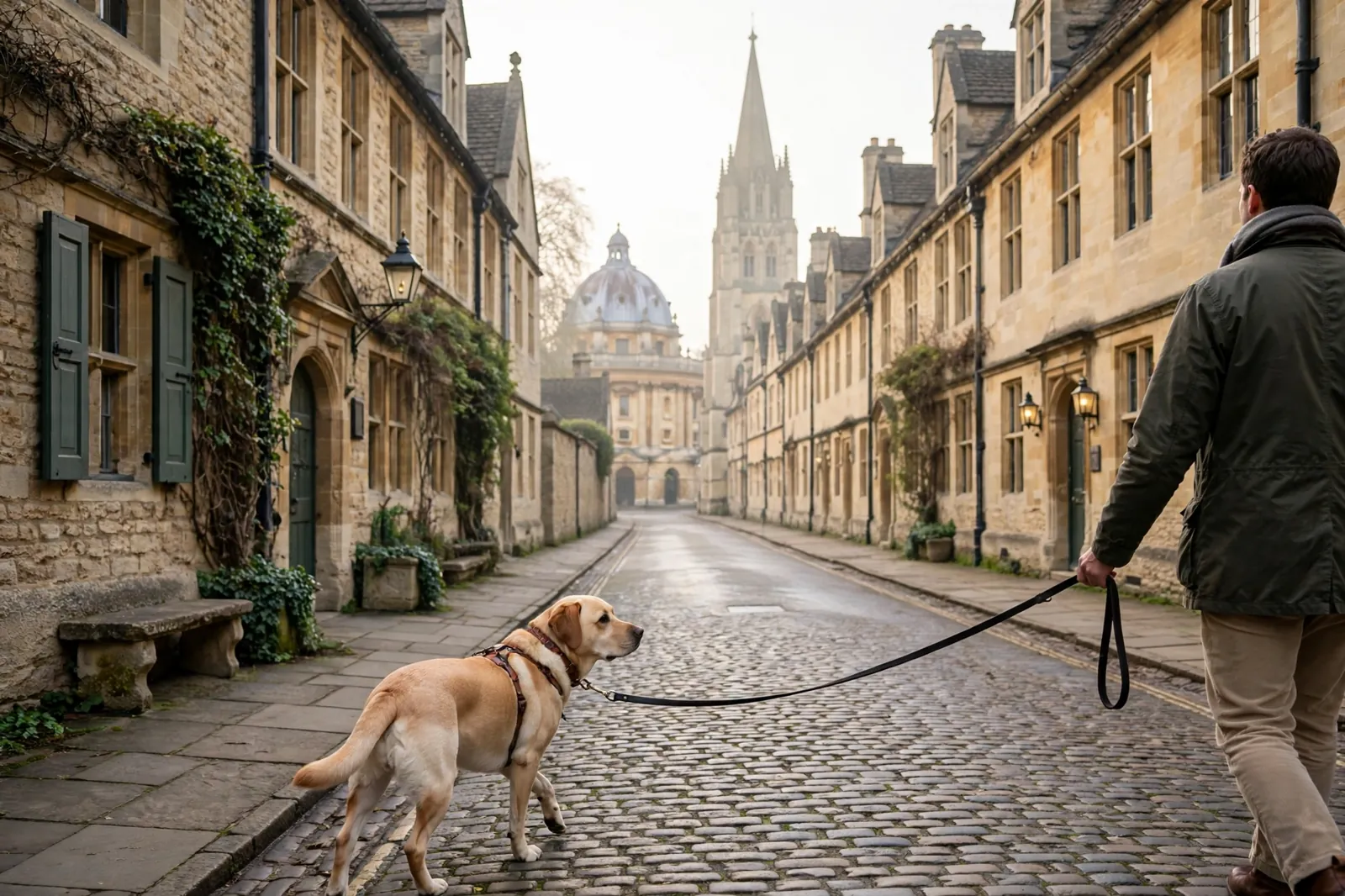
Newbury rewards a dog owner who treats it as a walking town rather than a driving town: park once, walk the towpath in the morning, take the market square in the middle of the day, climb to Donnington Castle or cross Greenham Common in the afternoon, and finish in a pub bar with the dog under the table. It is not the grandest town in Berkshire — that is the subject of our guide to Bath with a dog, and the dreaming spires are a short train ride away in our Oxford with a dog guide — but it is one of the most practical, because the canal, the castle, the commons and the market are all within walking distance of one another, and a dog can enjoy all of them in a single day.
Practical questions
Before you go
Can dogs walk the Kennet and Avon towpath through Newbury all year?
Yes, the towpath through Newbury is open all year, and the flat, surfaced stretches beside the Wharf and Victoria Park suit dogs of most ages. After heavy rain the unmade sections towards Kintbury and Thatcham can turn muddy, and the towpath narrows at bridges and locks, so keep your dog on a short lead there and give cyclists room to pass. Check the official guidance before you travel if there are canal maintenance closures.
Is Donnington Castle free to visit with a dog?
The castle ruins are managed by English Heritage and are free to enter, and dogs on leads are welcome in the grounds around the gatehouse. There is no visitor centre or cafe on the hill, so bring water for your dog, and keep dogs close around the ruined walls and the steep earthworks. The climb from Donnington village is short but steep in places, so it suits dogs that cope with a hill better than dogs with sore joints.
Can I take my dog to Newbury Racecourse?
Dogs are not generally admitted to the racecourse enclosures on race days, and raceday rules change from meeting to meeting, so check the official guidance before you travel. Outside race days the green spaces and paths around the racecourse area, and the routes across to Greenham Common, give dogs plenty of open ground, but keep dogs on a lead near roads, stables and any horses being exercised.
Which days does Newbury market run, and can dogs go?
Newbury's general market runs on Thursdays and Saturdays in the Market Place, with a farmers' market on the first Sunday of the month. Dogs on leads are a normal sight among the stalls, but the market gets crowded late in the morning, so arrive early, keep your dog close through the narrow gaps between stalls, and skip the visit on very hot days when the paved square holds the heat.
Where can dogs paddle near Newbury?
The safest paddling spots are the shallow edges of the River Kennet in Victoria Park and the quieter canal stretches east of the town, where the water is slow and the banks are easy to reach. Avoid the canal near locks and the deeper navigation channel, and never let a dog swim where narrowboats are moving. After heavy rain the river runs fast and murky, so wait for the level to drop, and check the official guidance before you travel.
Where should I park in Newbury with a dog in the car?
The Wharf car park puts you beside the canal towpath, and the Kennet Centre and Parkway car parks put you a short walk from the Market Place and Northbrook Street. On warm days do not leave a dog in a parked car at all; take the dog straight out to the towpath or Victoria Park, and use the shaded streets and the park's trees rather than leaving the car as a base. Check the official guidance before you travel for current charges and any height or time limits.