This guide is independent and contains no paid placement. If affiliate links are added later, they will be clearly marked and will not change our editorial checks.
North Berwick is one of the easiest seaside days out in Scotland with a dog: a short train ride from Edinburgh, wide sandy beaches, a harbour to wander, and the Law to climb for the view. The three things that decide whether the day works are the beach rules on the day, the tide times, and whether your dog is fit enough for the steep, rocky climb up the Law.
The shape of the town
North Berwick sits on the East Lothian coast, looking out across the Firth of Forth towards Fife. It is a small town, and that is the first reason it works so well with a dog. The station, the high street, the harbour and the beaches are all within a short walk of one another, so you can arrive by train, drop nothing, and be on the sand within minutes. There is no long drive through the town to reach the coast, and no complicated navigation once you are there. The town is built around its bay, with the harbour at one end and the beaches curving away on either side, and the cone of North Berwick Law rising behind the rooftops as a constant landmark. If you can see the Law, you know roughly where you are.
The second reason the town suits dogs is variety in a small area. A dog that loves open sand gets West Bay and East Bay. A dog that prefers a steady walk on a path gets the harbour and the John Muir Way. A dog that needs a proper climb gets the Law. A dog that is happiest sniffing around a town gets the high street and the harbourfront. You can mix two or three of these in a single day without ever getting in the car, which matters when you are travelling with a wet dog and a bag full of towels. Most visitors plan one main activity and let the rest of the day fill itself in around the edges of the town, and that is usually the right approach.
The third thing to understand is that North Berwick is a popular place, especially on sunny weekends and during school holidays. The beaches are wide enough to absorb a crowd, but the harbour, the high street and the smaller car parks fill up quickly, and the Law path can feel busy on a fine day. An early start changes the whole experience: the beaches are quieter, the light is better, parking is easier, and a nervous dog has far less to cope with. If you can only visit on a Saturday in summer, aim to arrive before mid-morning, do the busiest part of the day first, and save the quieter coastal walk for the afternoon when the day-trippers start to thin out.
The beaches: West Bay, East Bay and Milsey Bay
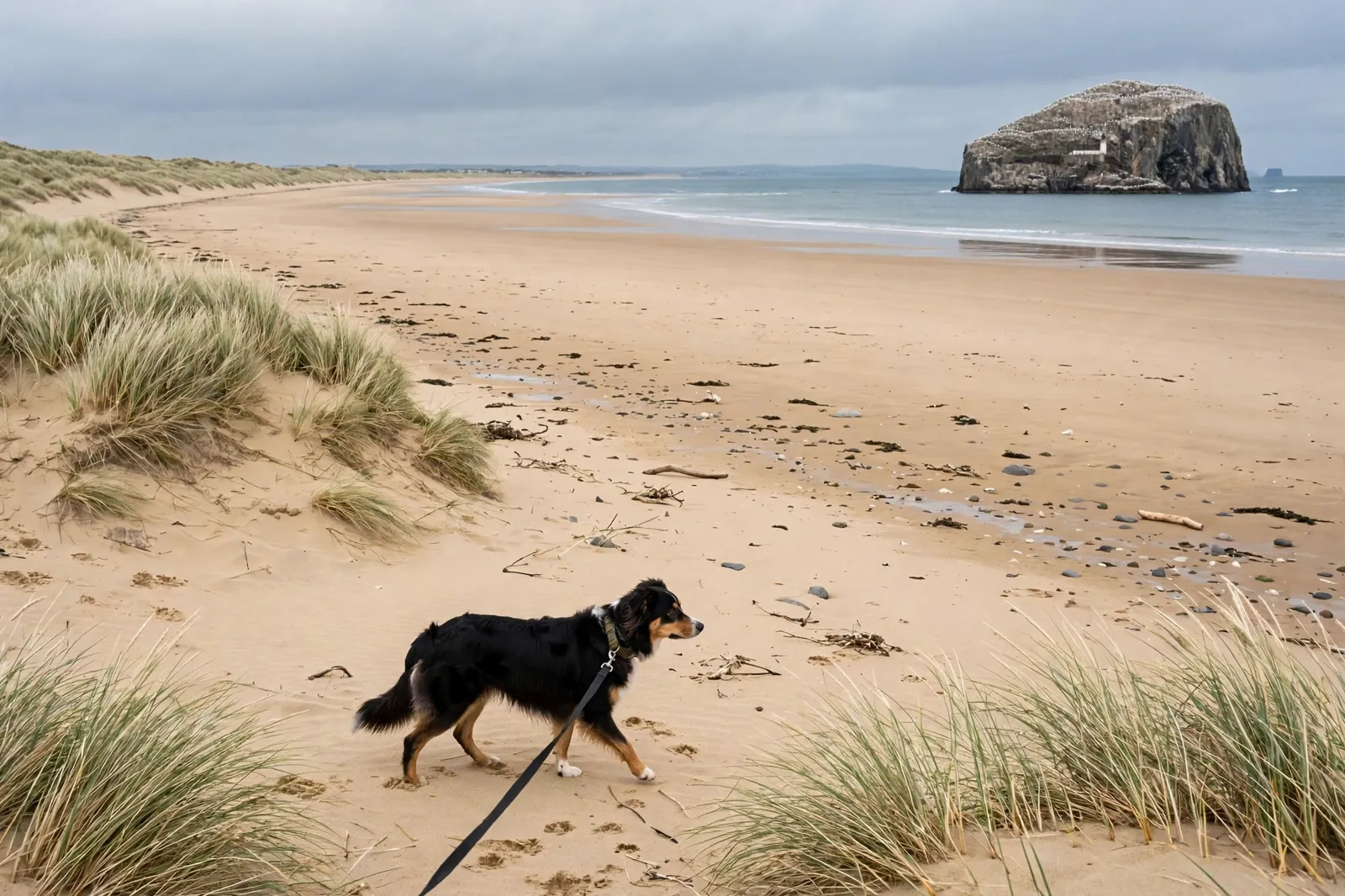
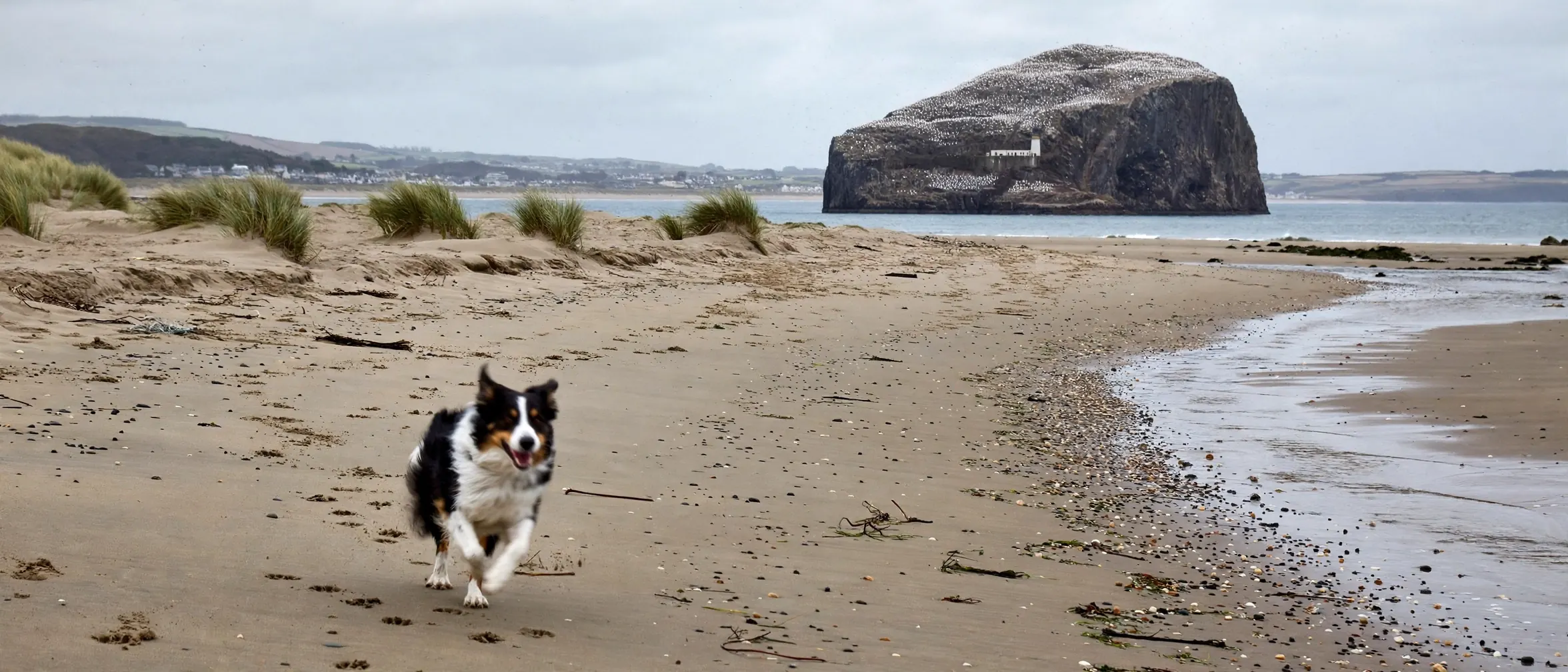
North Berwick has three distinct stretches of sand, and they suit different dogs and different moods. West Bay is the broad sweep of beach to the west of the harbour, curving towards the golf course and the open coast. It is the beach most people picture when they think of North Berwick: wide, flat, pale sand with room to run, and the Bass Rock sitting offshore like a white-capped island. At low tide the sand stretches a long way out, which gives a ball-chasing dog a huge safe area, and gives a nervous dog space to keep its distance from other dogs. The western end feels quieter and wilder, and it links naturally into longer coastal walks.
East Bay sits on the other side of the harbour, curving eastwards towards the rocks and the headland. It is a little more sheltered and a little closer to the town, which makes it the easiest beach to reach for a quick run between other plans. The sand here is just as good, and at low tide there are rock pools to investigate, which many dogs love and some owners find a reason to keep a close eye on a dog that eats things it should not. The rocks at the eastern end are worth treating with care: they are slippery when wet, and a dog that scrambles over them can cut a paw or get stuck, so keep your dog on the sand unless you are confident about the ground.
Milsey Bay is the smaller, rockier bay tucked near the harbour, and it is the one most visitors walk past without noticing. It is not a running beach in the way West Bay is, but it is a lovely spot for a calmer dog that prefers paddling and sniffing around rock pools to full-speed sprints. The water here is shallow and sheltered at the right tide, and the bay has a quieter, more enclosed feel than the open beaches. It is a good choice for a first outing with a puppy or an older dog, or for a late-afternoon wind-down after a longer walk. All three beaches are best enjoyed with an eye on the tide, which is covered in detail later in this guide, because the character of each bay changes completely between high and low water.
Between the beaches, the town itself offers plenty of sniffing. The walk from the station down to the seafront passes the high street, where dogs are a familiar sight, and the promenade along the front gives a level, easy route between West Bay and the harbour. For dogs that cannot manage a long beach run, a gentle promenade walk with a few stops to watch the boats is a perfectly good day out on its own. The key point is that you do not need to do everything: pick the beach that fits your dog, and let the rest of the town fill in around it.
Beach rules and seasonal restrictions
Beach rules in North Berwick, as elsewhere in Scotland, are not fixed forever. Local bylaws, seasonal restrictions and temporary notices can all change what is allowed on a particular stretch of sand, and the signs at the beach entrance on the day are the authority that matters. Before you travel, check the official guidance before you travel, and when you arrive, take a minute to read the notice boards at the access points. This matters most in the summer months, when some beaches introduce seasonal dog restrictions to keep the busiest areas clear for families, and when the rules can differ between one bay and the next. A beach that welcomes dogs freely in October may have a restricted zone in July, and assuming last year's rules still apply is the most common way visitors get caught out.
Beyond the formal rules, there are the unwritten ones that make a beach work for everyone. Keep your dog under close control whenever other people are nearby, and use a lead in the busier sections even if off-lead is allowed. Not every beach user loves dogs, and children, picnics and other dogs all deserve space. If your dog is not reliable at recall, a long line gives it freedom to run without the risk of it charging off towards a stranger or another dog. Clean up after your dog every time, and carry spare bags: beach bins can be full on busy days, so be prepared to carry waste until you find a bin that has room.
Wildlife adds another layer of rules that is easy to miss. Parts of the East Lothian coast are important for birds, and during the breeding season some areas carry extra guidance about keeping dogs on leads near nesting sites. The same applies around the harbour, where seals haul out on the rocks and need undisturbed rest. The general principle is simple: if you see birds behaving anxiously, circling or calling loudly, or seals on the shore, give them a wide berth and keep your dog on a lead. For a fuller picture of the wider coastline, our guide to East Lothian dog beaches covers Gullane, Yellowcraig and Belhaven Bay as well as North Berwick, including parking, the John Muir Way and the wildlife rules that apply along the whole coast.
One more practical point about beach rules: they are enforced by people, not just signs. Beach wardens, harbour staff and other dog owners all notice when a dog is out of control, and a single bad encounter can sour a whole day. The dogs that get the most freedom on North Berwick's beaches are the ones whose owners have done the groundwork: solid recall, a calm greeting with other dogs, and an owner who watches the dog rather than the phone. If your dog is still learning, there is no shame in keeping it on a long line and choosing the quieter western end of West Bay, where there is room to practise without pressure.
Climbing North Berwick Law with a dog
North Berwick Law is the town's landmark: a steep, conical hill that rises to about 187 metres behind the town, crowned by a whale jawbone arch at the summit. The climb is short but sharp, and it rewards you with one of the best views on the east coast — the Bass Rock, the Firth of Forth, the town below and, on a clear day, the hills of Fife across the water. For a fit dog, it is a wonderful walk. For an unfit dog, an old dog, or a dog with joint problems, it is a walk to skip, and there is no shame in that: the beaches and the harbour are a full day on their own.
The route starts from the town and climbs steadily through grass and then onto rockier ground. The path is well used and generally clear, but it gets steep, uneven and in places rocky towards the top, with loose stones underfoot and sections where you need to watch your footing. Dogs handle this better than people in some ways — four legs and a low centre of gravity — but a dog that pulls on the lead can unbalance you on a steep descent, and a small dog may need a lift over the rockiest steps. Keep your dog on a lead for the whole climb: there are sheep and other livestock in the surrounding fields, ground-nesting birds in the breeding season, and other walkers on a narrow path. A lead also stops an excited dog from charging ahead over a rocky edge it cannot see.
Allow around an hour to ninety minutes for the round trip at a comfortable pace, including time at the top, and longer if your dog likes to stop and sniff. Take water for both of you, because there is no water on the hill and the climb is exposed to sun and wind. On a hot day, go early or late rather than at midday: the hill offers almost no shade, and a dark-coated dog can overheat quickly on the climb. On a wet or windy day, the rocky top becomes slippery and the wind at the summit can be strong enough to unsettle a small dog, so check the forecast and be ready to turn back. The summit itself is a small, rocky area with the whale jawbone arch and a trig point; it is not a place to let a dog run loose, so keep the lead on, take your photographs, and enjoy the view.
The whale jawbone at the top deserves a mention, because it is the detail everyone asks about. The arch is made from a whale's jawbone and has stood on the summit for many years, replaced when the original wore out. It is a piece of the town's seafaring history, and it makes a good landmark for a photograph with your dog — from a sensible distance, on a lead, without letting the dog climb on the monument itself. If the Law sounds like too much for your dog, there is a gentler alternative: the lower slopes and the paths around the base of the hill offer a good walk with views, without the steep rocky finish. You still get the sense of the place, and your dog still gets a proper walk.
The harbour and the coastal path
The harbour is the working heart of North Berwick, and it is one of the most enjoyable places in town to walk a dog. Fishing boats, pleasure boats and trip boats come and go, gulls wheel overhead, and the harbour walls give you a place to stand and watch the water. Dogs on leads are a normal sight here, and the flat, level ground suits dogs of all ages. Keep your dog close near the water's edge and the harbour steps, because the stone can be slippery with seaweed and the drop into the water is not one you want a dog to take unexpectedly. The harbour is also where you will find the boat trips that go out towards the Bass Rock and the other islands; dogs are generally not taken on these trips, so check the official guidance before you travel if you were hoping to go out on the water together.
From the harbour, the John Muir Way runs along the coast in both directions, and it is the backbone of the longer walks around North Berwick. To the west, the path heads towards Yellowcraig and Gullane along a coast of beaches, dunes and woodland, and to the east it heads towards Tantallon and the cliffs beyond. You do not need to walk the whole way: even a short section of the John Muir Way gives you a proper coastal walk with sea views, and you can turn back whenever your dog has had enough. The path is generally well surfaced near the town and becomes rougher further out, so wear proper footwear and keep your dog on a lead where the path runs close to cliff edges or through fields with livestock.
The coastal path also teaches you something about the East Lothian coast that the beaches alone do not show: how quickly the landscape changes. Within a single walk you can go from sandy bay to rocky shore to grassy clifftop, and the wildlife changes with it. Oystercatchers and curlews work the shore, gannets stream past offshore, and in the right season you may see seals hauled out on the rocks below. Keep your dog on a lead near cliff edges and nesting areas, and do not let it scramble down to rocks it cannot climb back up. A dog that is used to beaches can be surprised by how different a rocky shore is underfoot, so watch for cut paws and take it slowly.
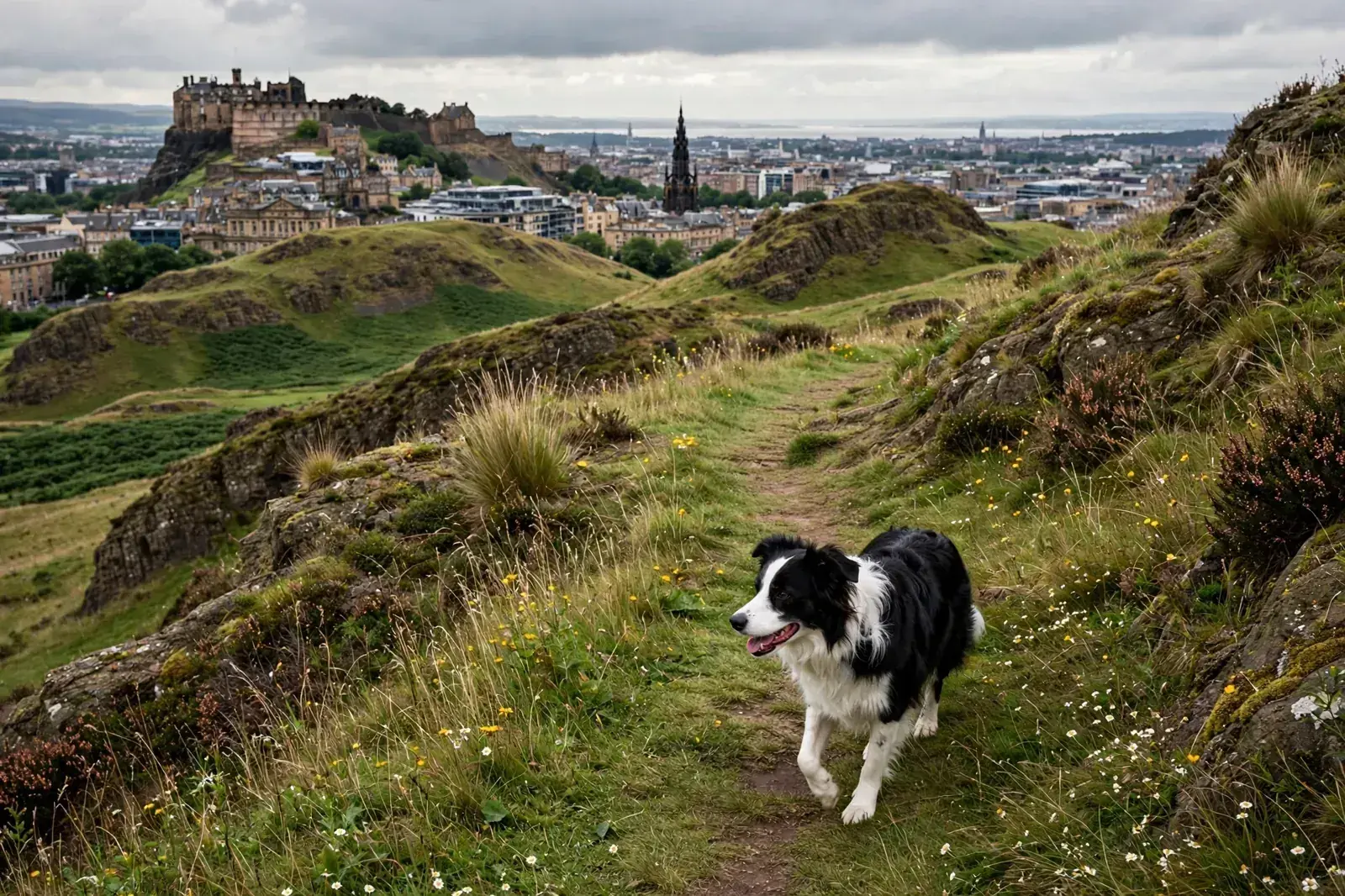
If you are staying for more than a day, the John Muir Way is also your route to the wider coast. A day trip west to Gullane or east towards Tantallon Castle makes a natural second day, and the train line gives you an easy way back if your dog is tired. For ideas on combining North Berwick with a city break, our guide to Edinburgh with a dog covers Arthur's Seat, Holyrood, the Water of Leith and the practicalities of a city stay with a dog, which pairs well with a quieter day on the East Lothian coast.
Seabirds, seals and watching wildlife well
North Berwick is famous for its seabirds, and the Bass Rock is the reason. The rock, a steep-sided island a few miles offshore, is home to one of the largest northern gannet colonies in the world, and on a clear day you can see the white mass of birds around it from the shore. Gannets are big, white birds with black wingtips and a yellowish head, and they dive into the sea from height in a way that is unmistakable once you have seen it. Bring binoculars if you have them: the view from the harbour or the beach is good with the naked eye, but binoculars turn a distant white rock into a living colony, and they let you watch without needing to get close.
The Bass Rock is not the only wildlife worth watching. The Firth of Forth is used by seals, porpoises and a wide range of seabirds, and the rocky shore around North Berwick is a good place to see waders and ducks at low tide. Seals haul out on rocks around the harbour and along the coast, and they are easy to disturb without meaning to: a dog running loose on the rocks can send a whole group of seals splashing into the water, which costs them rest and energy they need. The rule is to keep your dog on a lead whenever seals are visible, stay well back, keep your voice down, and never let your dog approach a seal on the shore. If you find a seal pup alone on a beach, do not touch it and do not let your dog near it; the mother is often nearby in the water, and the pup needs to be left alone.
Nesting birds need the same care. During the breeding season, ground-nesting birds on the dunes and the grassy areas near the coast are easily disturbed by a dog running through the vegetation, and a single disturbance can be enough to make a bird abandon its nest. Stick to the paths during the breeding season, keep your dog on a lead near dunes and grassland, and watch for signs asking you to keep to the path. The same applies to the cliffs and rocky areas where seabirds nest: keep your distance, keep your dog close, and enjoy the spectacle from the path rather than trying to get nearer.
There is also a practical side to wildlife watching with a dog: dogs get excited. A dog that has never seen a gannet colony or a seal may bark, pull and strain at the lead, and that is normal. The trick is to manage the excitement rather than fight it. Let your dog look from a distance first, reward calm behaviour, and move on before the excitement builds into frustration. A short, calm wildlife stop is worth far more than a long, barking one, for your dog and for the wildlife. If your dog is very reactive to birds, choose a spot where you can watch from a distance with a clear view, and keep the session short.
The Scottish Seabird Centre and the town centre
The Scottish Seabird Centre sits on the harbourfront, and it is the town's main visitor attraction. It tells the story of the seabirds of the Firth of Forth, with live cameras on the Bass Rock and the other islands, and it is a good wet-weather stop if you are travelling without a dog. With a dog, the situation is different: dogs are generally not allowed inside the centre, so plan on one person staying outside with the dog while others go in, or enjoy the harbour and the views from outside instead. Check the official guidance before you travel, as policies can change, and assistance dogs are usually treated separately from pet dogs. The area outside the centre is still worth a visit: the harbour, the views across to the Bass Rock, and the seabird sculptures and information boards along the front give you a sense of the place without going indoors.
The town centre itself is compact and walkable, with a high street of independent shops, cafes and places to eat. Dogs are a familiar sight on the high street, and many shops are happy to welcome a well-behaved dog, though it is always worth asking before you walk in with a wet, sandy animal. The high street is also where you will find the practical things a dog trip needs: a shop for extra poo bags, a place to buy water, and somewhere to pick up a towel if yours is already soaked. The streets are generally quiet and the pavements are wide enough for a dog on a lead, but keep your dog close near the road, especially on a busy day when the pavements fill up.
Ice cream is a North Berwick tradition, and the town has a reputation for it. If you stop for one, remember that dogs should not eat ice cream made for people, and that a dropped cone on a hot pavement is a magnet for a dog that is already excited. Keep your dog on a short lead while you eat, and give it a drink of water rather than a taste of your ice cream. The same applies to the fish and chip shops and the cafes along the front: a dog that is used to being given food from a table will find the smell hard to resist, so settle it with a chew or a mat before you sit down, and keep it from begging from neighbouring tables.
The town centre also has the advantage of being close to everything else. From the high street you can walk to the harbour in a few minutes, to East Bay in a few more, and to the station just as quickly. This makes it easy to build a day that mixes a beach walk, a harbour wander and a cafe stop without ever needing the car. If the weather turns, the town centre gives you a place to shelter and regroup, and if your dog is tired, the short walk back to the station or the car park is never far away.
Getting there: train, car and parking
The train is the easiest way to reach North Berwick with a dog, and it is one of the reasons the town works so well as a day trip. North Berwick station sits at the end of a branch line from Edinburgh, and trains run regularly through the day. The journey from Edinburgh takes roughly half an hour, and the station is a short, level walk from the high street, the harbour and the beaches. Dogs are normally welcome on trains in Britain, but check the official guidance before you travel, keep your dog on a lead on the platform and on the train, and choose a quieter service if your dog is nervous in crowds or unsettled by the noise of a busy carriage. A dog that travels well on the train will find this journey easy: it is short, the stations are small, and the walk at the other end is flat.
If you are driving, North Berwick is reached from Edinburgh by the main road east through East Lothian, and the drive is straightforward. The town has several car parks, but they fill up quickly on fine days, especially at weekends and during school holidays. Arrive early if you can, and have a second car park in mind in case your first choice is full. Some car parks are closer to the beaches and some are closer to the town centre, so think about what your dog needs: a car park near the beach is better if you are carrying a lot of gear or if your dog is older and cannot walk far, while a town-centre car park is better if you plan to spend the day wandering between the harbour, the shops and the cafes. Parking charges and time limits can change, so check the official guidance before you travel rather than relying on what you remember from a previous visit.
Once you have parked, the town is best explored on foot. The distances are short, the ground is mostly level except for the Law, and the pavements are wide enough for a dog on a lead. If you are arriving by train, you do not need a car at all for a day in North Berwick, and that is a genuine advantage: no parking stress, no hot car to worry about, and a dog that can settle on the train home after a good day. If you do drive, remember the golden rule of dogs and cars in summer: never leave a dog in a parked car on a warm day, even with the windows open, and even for a few minutes. A car heats up far faster than most people expect, and a dog in a hot car is in danger within minutes.
For a longer stay, North Berwick also works as a base for exploring the rest of East Lothian. The train line and the coastal road both run west towards Dunbar and east towards the Borders, and the John Muir Way links the town to a chain of beaches and villages that are all worth a visit with a dog. If you are staying for a weekend, consider one day in North Berwick itself and one day further along the coast, using the train to get there and back. That way your dog gets a new beach each day without a long drive, and you get a proper sense of how varied this short stretch of coast really is.
Cafes, pubs and places to stay
North Berwick has a good range of cafes and pubs, and many of them welcome dogs, but the details matter and they change. Some welcome dogs throughout, some only on an outdoor terrace, some only in a designated area, and some only outside the busiest hours. The safest approach is to check ahead with the individual venue before you set off, and to have a second option in mind. A venue that welcomed dogs last summer may have changed its policy, and a terrace that is lovely on a warm day is no use in the rain. When you arrive, ask before you sit down with a dog, and respect the answer even if it is not the one you hoped for: the staff know their space, their other customers and their insurance, and a polite question costs nothing.
When you do find a dog-friendly place to eat, a little preparation makes the visit work for everyone. Settle your dog on a mat or a blanket before you order, give it something to chew or a small treat to keep it occupied, and keep the lead short and under your chair or your foot so it cannot wander into the path of staff carrying hot food. A tired dog that has just had a beach run is usually a good cafe dog; a fresh, excited dog that has been in the car all morning is often not. If your dog is reactive to other dogs, choose a quieter table away from the door and away from other dogs, and be ready to leave early if the room fills up. Most venues would rather you left quietly than stayed and struggled.
For an overnight stay, North Berwick has hotels, guest houses, self-catering cottages and bed and breakfasts, and a good number of them accept dogs. The same rule applies as with cafes: confirm the dog policy in writing before you book, and ask the specific questions that matter for your dog. How many dogs are allowed, and is there an extra charge? Are dogs allowed in the bedroom, or only in certain rooms? Is there a garden or an enclosed area where the dog can go out last thing at night? What happens if the dog barks? A place that answers these questions clearly is a place that has thought about dogs properly. A place that answers vaguely is a place where you may find a surprise on arrival.
Self-catering accommodation often suits dogs best, because it gives you a kitchen, a garden and the freedom to come and go on your dog's schedule. If you are staying in a cottage, ask about the garden boundary before you book: a low wall or an open gate is no use for a dog that likes to explore, and a secure garden makes the whole stay calmer. Also ask about the nearest beach and the nearest vet, and about where you can walk the dog after dark. A good host will know all of this and will be happy to tell you. Book early for weekends and school holidays, because the genuinely dog-friendly places in a popular town like North Berwick are booked well in advance.
Tides, weather and safety
The tide is the single most important safety factor on a North Berwick beach, and it is the one most visitors underestimate. The Firth of Forth has a large tidal range, which means the sea comes in fast and covers a long way, and a beach that is wide and inviting at low tide can be a narrow strip of sand at high tide. Check the tide times before you go, and plan your beach time around them. The best time for a dog to run is usually the two or three hours either side of low tide, when the sand is at its widest and there is room to play. Avoid walking out onto sandbanks or rocky areas as the tide turns, and never let your dog swim in an outgoing tide or in water with a strong current.
Rocky areas and the harbour walls carry their own risks. Wet rock is slippery, and a dog that scrambles over rocks can cut its paws on barnacles or get trapped by a rising tide. Keep your dog on the sand unless you are confident about the ground and the tide, and check its paws after a walk on rocky ground. The same applies to the cliffs along the coastal path: keep your dog on a lead near cliff edges, and do not let it chase birds or other animals towards a drop. A dog that is focused on a gull does not notice a cliff edge, and the consequences of a fall are serious.
Weather on the East Lothian coast can change quickly. A sunny morning can turn into a windy, rainy afternoon, and the wind off the Firth of Forth can be cold even on a warm day. Dress for the coast, not for the town: a windproof layer, a hat, and proper footwear make a big difference, and a drying coat for your dog is worth its weight after a beach run in a sea breeze. In summer, watch for heat: dogs overheat faster than people, and a dark-coated dog running on sand in the midday sun needs shade, water and rest. Offer water regularly, watch for heavy panting and slowing down, and stop the activity before your dog has to tell you it is too hot.
Finally, think about the basics of beach safety for dogs. Salt water is not drinking water, and a dog that drinks too much sea water can become ill, so bring fresh water and offer it often. Sand in the coat, ears and paws is normal after a beach day, but rinse your dog with fresh water when you get home and check its ears and paws for irritation. Watch for broken glass, fishing hooks and discarded food on the beach, especially near the harbour, and keep a close eye on a dog that scavenges. A first-aid kit with saline, bandages and tweezers is a sensible addition to your beach bag, and it is worth knowing where the nearest vet is before you need one. North Berwick has veterinary practices in the area, but check the official guidance before you travel for the nearest option and its opening hours.
A practical one-day plan
A good North Berwick day with a dog does not need to be complicated, but it does need a rough order. The plan below assumes a train arrival in the morning and a return in the late afternoon, and it can be shortened or stretched to fit your dog. Start with the beach, because that is what most dogs want most, and because the beaches are quietest in the morning. Head for West Bay first, give your dog a proper run and a swim if it likes the water, and let it burn off the excitement of the journey. An hour on the sand is enough for most dogs, and it sets the tone for a calm rest of the day.
From the beach, walk along the front to the harbour. This is a natural wind-down: the ground is flat, the pace is slow, and there is plenty to look at. Stop at the harbour, watch the boats, and look out towards the Bass Rock with binoculars if you have them. This is also a good moment for a cafe stop, because your dog is now tired enough to settle. Choose a dog-friendly cafe, settle your dog on a mat, and have a proper break. If your dog is still full of energy, a shorter cafe stop and a longer harbour walk is a better choice than trying to force a tired dog to settle in a busy room.
After lunch, decide between the Law and the coastal path. If your dog is fit and the weather is good, the Law is the afternoon's main event: a steady climb, a rest at the top, and a slow descent. If your dog is older, tired, or not suited to steep ground, take the John Muir Way west towards Yellowcraig instead, and walk as far as your dog wants before turning back. Either way, keep the afternoon shorter than the morning: a dog that has had a beach run, a harbour walk and a climb is a dog that needs rest, not another hour of activity. Finish the day with a gentle walk back through the town, a final drink of water, and a quiet train or drive home.
If you are staying overnight or visiting for a second day, the plan changes. Use the second day for the things you missed: the coastal path in the other direction, a longer walk to Gullane or Tantallon, or a slower morning on East Bay with time for rock pools and paddling. A second day also lets you try a different cafe or a different beach, and it gives your dog time to recover from the first day's excitement. Dogs, like people, enjoy a place more on the second visit, when the smells are familiar and the routine is understood. Do not try to fit everything into one day: North Berwick rewards a slower pace, and your dog will thank you for it.
What to pack for a North Berwick day
Packing for a beach town with a dog is a matter of thinking through the day in order and packing for each stage. Start with the beach: a long line as well as a short lead, a ball or a toy your dog will actually bring back, poo bags with spares, fresh water and a collapsible bowl, and a towel for the end of the beach session. A drying coat is worth bringing if your dog swims or if the wind is cold, and a blanket or mat gives your dog somewhere to settle at the cafe. Pack the beach gear in a bag you can carry easily, because you will be walking with it from the station or the car park to the sand.
For the Law, add sturdy footwear for yourself, water for both of you, and a treat or two for the summit. A harness can be more comfortable than a collar on a steep climb, because it spreads the load if your dog pulls, and it gives you something secure to hold on a rocky descent. If your dog is small or older, think about whether you need to carry it for any part of the climb, and whether that is realistic on steep ground. A dog that needs carrying up a hill is a dog that should not be climbing it, and the beaches and the harbour are a better plan.
For the town and the journey home, pack a spare lead, a few treats, and something to keep your dog occupied on the train: a chew or a familiar toy. Bring a plastic bag for wet towels and sandy gear, because a wet towel in a bag is a small problem and a wet towel on a train seat is a bigger one. If you are driving, a car seat cover or a boot liner protects the car, and a bottle of fresh water for rinsing sandy paws before the journey home makes the drive more pleasant for everyone. Finally, pack your own layers: the coast is colder and windier than the town, and a day that starts warm can end cold. A windproof jacket and a spare layer are worth more than an extra toy.
One last packing tip: pack light enough to carry everything comfortably. North Berwick is a walking town, and you will be carrying your bag between the station, the beach, the harbour and the cafe. A heavy bag makes you slow and tired, and a tired owner makes for a tired dog. Choose the gear that earns its place, leave the rest at home, and remember that the town has shops if you forget something small. The most important things you bring are water, a lead, poo bags and a towel; everything else is a bonus.
Practical questions
Before you go
Can dogs go on North Berwick beaches all year round?
Access varies by beach and by season, and local rules can change, so check the official guidance before you travel. In general, the wide sands around North Berwick are welcoming to dogs outside the busiest summer period, while some sections may carry seasonal restrictions. Always read the signs at the beach entrance on the day, keep your dog under close control near other beach users, and clean up after your dog.
Is North Berwick Law a suitable walk for dogs?
For a fit, reasonably agile dog, yes, and it is one of the best short climbs on the East Lothian coast. The route is steep in places, with rocky and uneven ground near the top, so it is not a good choice for very old dogs, dogs with joint problems, or dogs that struggle on steps and loose rock. Keep your dog on a lead, carry water, and allow plenty of time to come back down slowly.
Can dogs visit the Scottish Seabird Centre?
Dogs are generally not allowed inside the Scottish Seabird Centre itself, so plan on one person staying outside with the dog while others go in, or enjoy the harbour and the views from outside instead. Check the official guidance before you travel, as policies can change, and assistance dogs are usually treated separately.
How do I get to North Berwick with a dog by train?
North Berwick has its own station with regular trains from Edinburgh, and the walk from the station into the town centre and down to the beaches is short and level. Dogs are normally welcome on trains, but check the official guidance before you travel, keep your dog on a lead on the platform, and choose a quieter service if your dog is nervous in crowds.
Where can dogs go in North Berwick town centre?
Many cafes and pubs in North Berwick welcome dogs, often on outdoor terraces or in designated indoor areas, but policies vary from place to place and can change with the season. Check ahead with the individual venue before you set off, and have a backup plan in case your first choice is full or has changed its policy.
What should I do if my dog meets seals or nesting birds?
Put your dog on a lead straight away, move calmly away, and give the wildlife plenty of space. Seals resting on rocks or sand need undisturbed rest, and nesting birds can abandon a nest if they are repeatedly disturbed. Never let your dog chase birds or approach seals, and report an injured animal to the appropriate local wildlife organisation rather than handling it yourself.