This guide is independent and contains no paid placement. If affiliate links are added later, they will be clearly marked and will not change our editorial checks.
Start at the castle mound, where the grass loop gives you the whole shape of Orford at a glance: the keep above, the church and village below, the quay to one side and the long shingle line of Orford Ness across the water. Then walk down to the quay, follow the Alde bank as far as the tide and the path allow, and finish back through the village lanes. The Ness itself is not a walk you can simply add on, so treat it as a view, check the official guidance before you travel, and let the tide decide how far the bank walk goes.
The castle grass loop: reading Orford from its high point
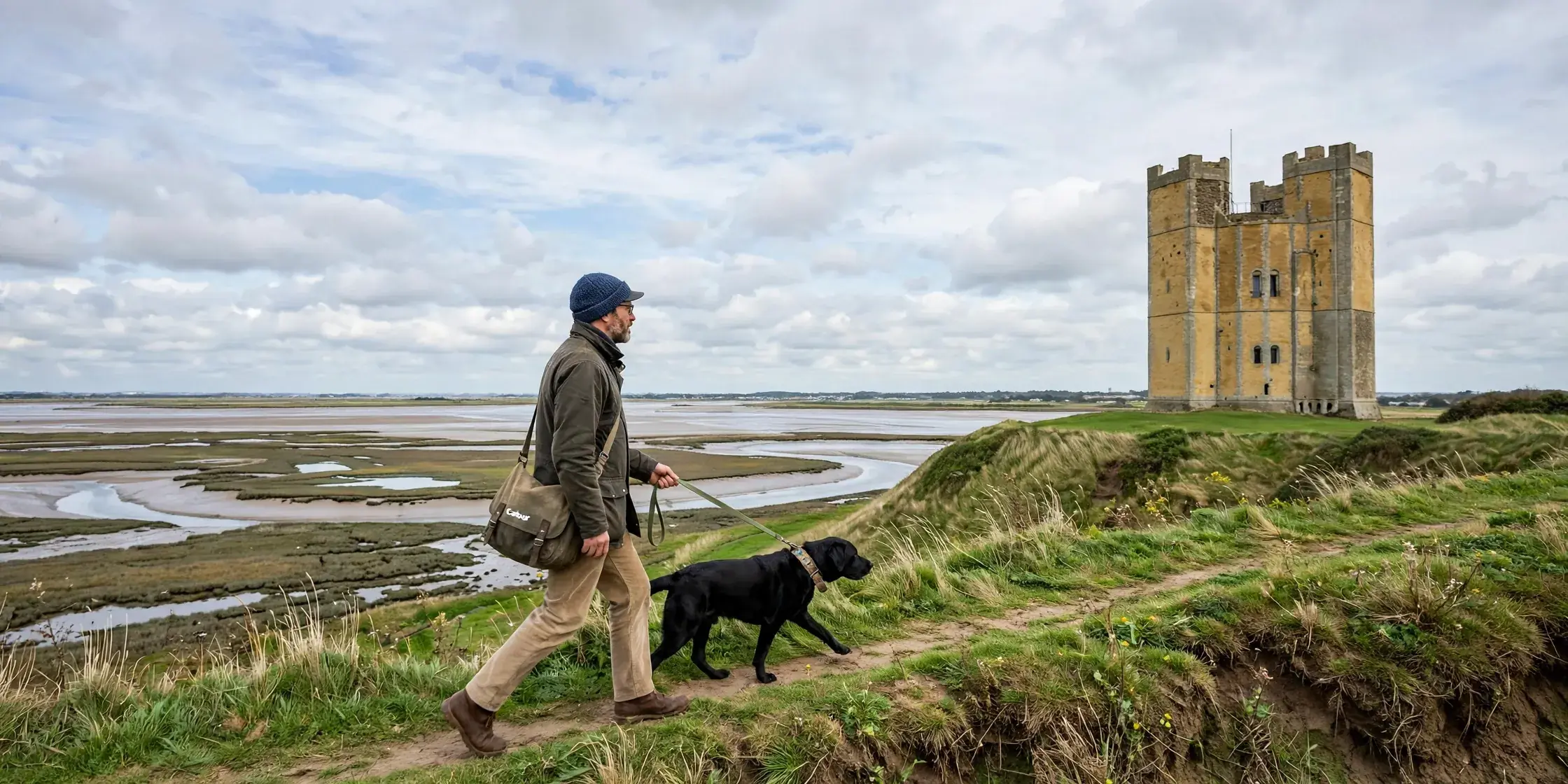
Orford Castle sits on its mound like a compass point for the whole village, and that is exactly how to use it on a dog walk. Begin on the grass around the keep rather than in the village streets, because from the mound you can pick out the church tower, the roofs of the lanes, the masts at the quay and the flat, pale line of Orford Ness beyond the river. The 12th-century keep is unusually polygonal, with a tall, rounded silhouette that looks different from almost every other castle keep in England, and the grass ring around it is wide enough for a proper sniffing circuit without squeezing past other visitors. Walk the loop slowly first, let the dog settle into the new smells and sounds, and only then decide which direction the rest of the day should take.
The ground itself needs a little attention. The mound is steep in places, the grass can be slippery after rain, and the paths around the castle mix close-cut turf with gravel and worn stone, so a lead is the sensible default even for a dog that is reliable off lead elsewhere. Keep the lead short on the steeper side of the mound, watch for small dogs darting between legs on the narrower stretches, and avoid letting a dog charge up or down the slope at full speed, because a slip on wet grass at the top of a mound is a worse fall than the same slip on flat ground. Older dogs will prefer the gentler circuit at the base of the mound, where the grass is level and the views are still good, while fitter dogs can handle the climb in short stages with pauses to look out over the marsh and river.
What the castle grass gives you, beyond the walk itself, is orientation that saves the rest of the day. Looking south-east you see the river bending towards the quay and the Ness; looking inland you see how small Orford really is, with the village lanes folding around the church and the fields opening out behind them. That matters because Orford is easy to misjudge: it feels like a place with a beach attached, when in fact the open water is an estuary, the far shore is a restricted spit, and the best long walk runs along the bank rather than across sand. A ten-minute loop on the castle grass fixes that picture before any tired legs or wrong turns, and it gives a reactive or excitable dog a contained first outing before the busier quay. If the keep itself is on your list, check the official guidance before you travel for the current dog rules inside, and plan on the grass loop as the dog's part of the visit either way.
The quay and the boats: Orford at working pace
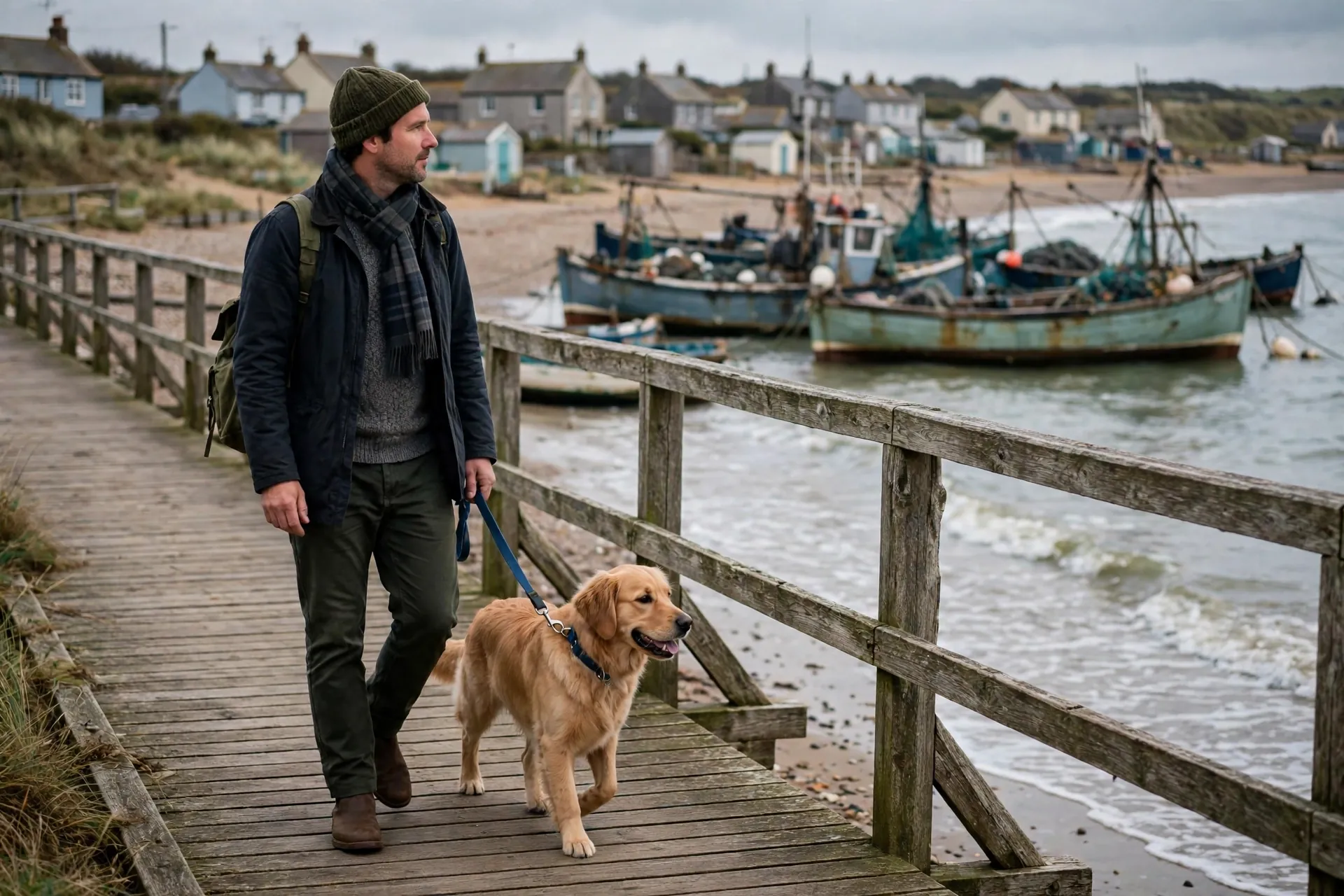
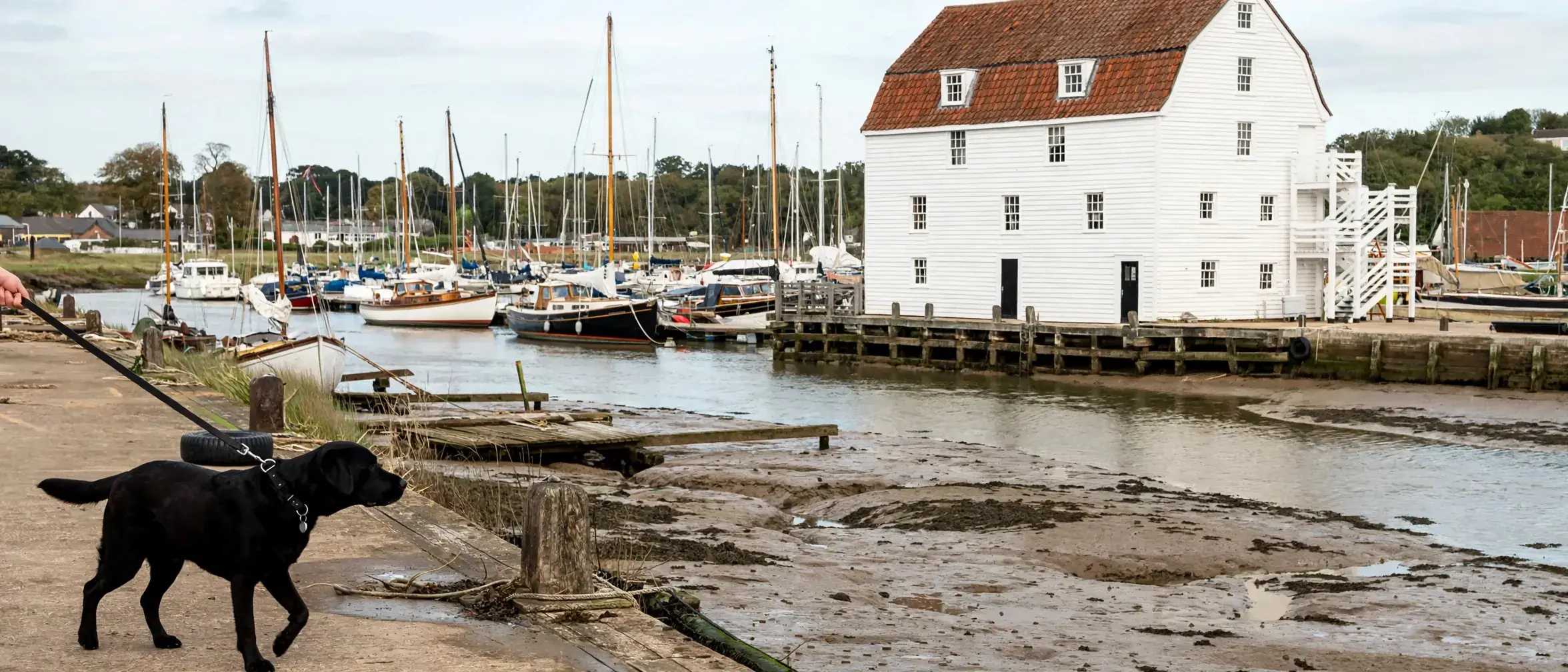
Down from the castle, Orford Quay is the village's working edge rather than a polished marina, and dogs tend to enjoy it precisely because it is busy in a low-key, purposeful way. Fishing boats, sailing boats and small working craft moor along the river, ropes and nets are part of the furniture, and the air carries salt, diesel and fish in proportions that change with the tide. Walk the quay on a lead, because the edge is a real working edge with water, mooring lines and moving vehicles, and because a dog that lunges at gulls or chases a rope across the ground can cause trouble in a space where people are handling boats. The reward for keeping it calm is a short, rich walk: masts, rigging, the slap of water against hulls, and the wide estuary opening out beyond the moorings.
The quay is also where Orford's food story is most visible, with smoked fish associated with the village and small outlets near the water, and it is worth slowing down here rather than treating the quay as a corridor to somewhere else. Stand for a few minutes and watch how the river behaves: at high water the boats float level with the quay edge, at low water they settle into the mud and the whole scene drops several feet, exposing banks and slipways that were underwater an hour earlier. Dogs notice this change too, and a dog that was calm beside floating boats may be far more excited by the smells and birds of a low-tide mudflat, so keep the lead on and keep a hand free for the moment a heron lifts off the far bank. Bring water for the dog, because there is little shade on an open quay in summer, and rinse muddy paws before getting back in the car, since estuary mud is fine, clinging and very good at finding its way onto seats.
Time the quay for the quieter parts of the day if your dog struggles with crowds, machinery or other dogs in close quarters. Mid-morning on a fine weekend brings visitors, cars turning in a confined space and dogs meeting nose to nose on a narrow walkway, which is a lot of stimulation in a small area. An earlier start, or a late-afternoon return when the light softens over the river, gives the same boats and water with more room to pass. If you are combining the quay with the bank walk, use the quay as the decision point: check the tide, look at how much bank is showing, and decide whether the dog has enough energy left for the longer stretch or whether a short quay circuit and a village lane loop is the better shape for the day.
Along the Alde bank towards the river mouth
The bank walk from Orford follows the River Alde as it winds towards its mouth, and it is the closest thing the village has to a long, open dog walk, with a very different feel from a beach. The path runs along a raised bank with the river on one side and grazing marsh on the other, so the dog gets wind, wide sky and the constant movement of water, while you get a flat, easy gradient that suits most fitness levels. The surface is generally grass and worn earth along the bank top, with softer and muddier patches after rain and where side paths drop towards the water, so sturdy shoes matter more than walking boots, but flimsy shoes will regret a wet week. Keep dogs on a lead for the stretches nearest the water and the marsh edge, both because the bank is narrow in places and because the marsh holds birds and livestock that a loose dog should not be chasing.
Distance on this walk is best judged by time and tide rather than by a fixed turning point, because the bank keeps going and the temptation is to walk further than the return comfortably allows. A good rule for a first visit is to walk out for twenty to thirty minutes, note a clear landmark such as a bend, a gate or a change in the bank's height, and turn back while the dog is still keen rather than tired. The views reward that restraint: the river widens, the Ness grows longer and lower on the horizon, and the sense of remoteness increases with every bend, even though the village is never far behind you. In spring and summer, watch for nesting birds on the marsh and keep the dog close through the sections where the bank runs nearest to grazing land; in autumn, the light turns the reed beds gold and the walk feels quieter, with fewer boats and more wind.
The bank is also where Orford's scale becomes clear. This is not a circular promenade with cafes every few hundred metres, and there is no shelter, tap or bin for long stretches, so carry water, bags and a towel, and do not count on buying anything until you are back in the village. That self-sufficiency is part of the appeal for dogs that like a long, sniffing walk without constant interruptions, but it means a puppy, an elderly dog or a dog that needs frequent toilet stops should be given a shorter out-and-back rather than the full bank. If the wind is strong off the estuary, the bank is fully exposed, so a short-coated dog may need a coat in winter and a thick-coated dog will welcome the breeze in summer; either way, the wind is the weather on this walk, and it decides how far feels pleasant.
Village lanes and the church: the quiet middle of Orford
Between the castle and the quay, Orford's village lanes are the part of the day that dogs often enjoy most, because the pace drops and the smells multiply. The lanes are narrow, quiet and residential, with flint and brick cottages, small gardens and walls at nose height, and the church of St Bartholomew standing as the village's other great landmark after the castle. Walk these lanes on a lead and at a wandering pace, because cars use the same narrow carriageway, gates open directly onto the street, and a dog that darts around a blind corner meets traffic with no pavement to protect it. The churchyard is a calm pause point, but treat it as a place of respect: keep the dog on a lead, stay on the paths, and do not let a dog run across graves or dig in the borders, even if the ground looks inviting.
The lanes also solve a practical problem that the bank and quay cannot, which is shade, shelter and a toilet stop in a village with few public facilities. A loop through the lanes after the bank walk lets a dog cool down in the shadow of walls and hedges, find a grass verge for a final toilet break, and arrive back at the car or a cafe without a long, exposed return. In summer, the lanes stay cooler than the quay and the bank, and in winter they break the estuary wind, so a lane loop is the right shape for a midday pause or a last outing before driving on. Look for the small details that make Orford distinct from its Suffolk neighbours: the castle's bulk appearing suddenly at the end of a lane, the glimpse of masts between rooftops, and the way the village seems to end abruptly at fields and marsh, with no suburban fringe to dilute it.
For dogs that find the quay too busy or the bank too exposed, the lanes plus the castle grass make a complete, satisfying visit on their own, and there is no need to feel that a day without a long bank walk has been wasted. A nervous dog, in particular, will often settle better on a lane loop than on an open bank, because the walls and hedges give a sense of enclosure and the encounters are brief and predictable: a person at a gate, another dog passing on a lead, a cat watching from a wall. Keep those encounters short and polite, move on before excitement builds, and use the lanes as the decompression walk between the two more stimulating parts of Orford, the castle mound and the quay.
Orford Ness: the boundary rules, stated plainly
Orford Ness is the long, wild shingle spit that you see across the river from Orford, and it is the single most misunderstood part of a visit here, so it deserves a plain statement. The Ness is not an extension of the village walk, not a beach you can wander onto, and not a place to take a dog for a run. Access to the spit is controlled, numbers and routes are managed, and the arrangements for getting there have changed over the years, so anything more specific than that risks being out of date by the time you read it. The only safe rule is to check the official guidance before you travel, and to build your Orford day on the village side of the river, with the Ness as a view rather than a destination.
There are good reasons for the controls, and understanding them helps a visit feel less frustrating. The Ness is a fragile shingle landscape with rare plants, nesting birds and a military history that has left structures and restricted areas, so free roaming would damage both wildlife and visitors. A dog, even a well-behaved one, adds disturbance to ground-nesting birds and to the delicate shingle vegetation, and the spit has no shade, no fresh water and long distances between any facilities, which makes it a poor environment for a dog in heat or on a long, hot day. None of this is a criticism of Orford as a dog destination; it is simply the reason the village side, with its grass, lanes and bank, is where the dog day belongs.
What you can do instead is enjoy the Ness properly from Orford. From the castle grass and the bank, the spit reads as a long, low, almost treeless horizon, changing colour with the light from pale shingle to dark vegetated ridges, and it gives the estuary its sense of wildness even when you never set foot on it. Photograph it from the quay at low water, when the river narrows and the spit feels close enough to touch, and explain to children that the far shore is a protected place, which is why it still looks so empty. If a crossing is genuinely important to your trip, check the official guidance before you travel, confirm whether any access is operating on your dates and whether dogs are permitted on it at all, and do not promise the Ness to the rest of your party until that check is done.
Places to eat and pause: pubs, cafes and smoked fish
Orford eats well for its size, and the village's reputation for smoked fish means a food stop here is part of the visit rather than a refuelling afterthought. The pubs and cafes in the village centre and near the quay are the natural pauses between the castle loop and the bank walk, and the best approach with a dog is to ask at the door, because dog policies can differ between a bar, a garden and a dining room in the same building, and they can change with the season. A dog that settles under a table on a lead, with water and a chew, will be welcome in far more places than a dog that paces, barks at every arrival or begs from neighbouring tables, so the pause is a training moment as much as a meal. Bring a blanket for the dog to lie on, especially in a pub with a cold stone or wooden floor, and keep the lead short enough that staff can pass without tripping.
Plan the food stop around the tide and the walk, not the other way round. A late-morning coffee after the castle grass loop sets up the bank walk nicely, and a longer lunch after the bank walk gives a tired dog time to rest before the drive onward, while a rushed meal squeezed between two long walks leaves everyone short-tempered. If you are buying smoked fish or other village produce to take home, remember that the car will warm up quickly in summer and that fish needs to stay cool, so buy at the end of the visit rather than at the start, and keep a cool bag in the car. Dogs should not be given smoked fish scraps, which are salty and rich, and the same applies to any rich pub leftovers; a small piece of plain food from home is a safer reward after a good walk.
For a longer day, the eating pattern that works best is a light stop in Orford itself, with the main meal elsewhere, because the village's food places are small and popular, and a large party with several dogs can overwhelm a small room at lunchtime. Smaller groups, or a single dog that settles well, will find Orford's pubs and cafes perfectly comfortable, especially outside the summer weekend peak. If the place you hoped for is full or not dog-friendly on the day, the fallback is simple and pleasant: a takeaway eaten on a bench near the quay, with the dog beside you and the boats in front of you, which is arguably the most Orford-like meal of all, provided you keep the dog on a lead and clear up scrupulously.
Parking and getting there: arrive once, walk everywhere
Orford rewards the driver who parks once and then walks, because the village is small, the lanes are narrow, and every part of the dog day lies within a short walk of the centre and the quay. The practical parking sits around the quay area and the village centre, with the castle, the lanes, the church and the river bank all reachable on foot from a single stop, so there is no need to move the car between the castle loop and the quay. That single-stop pattern also suits dogs, which settle better when the car becomes a base they return to only at the end, rather than a series of short, unsettling hops around a village that is barely a mile across.
Arrive early on fine weekends and bank holidays, because the quay is the first place to fill and the lanes leave little room for turning or for queuing cars. A late arrival on a summer Saturday can mean circling narrow streets while the dog barks at the delay, which is a poor start to a day that should be calm. Check the current parking arrangements and any charges before you travel, since village parking can change with the season, and do not block lanes, gateways or turning areas while you work out where to go; a blocked lane in Orford inconveniences the whole village quickly. If you are travelling by public transport, plan the last leg carefully, because Orford is a rural village without the frequent bus and rail connections of a larger Suffolk town, and a dog on a long, uncertain connection is a different prospect from a dog on a short drive.
For the drive itself, the approach to Orford runs through Suffolk countryside and small villages, with single-track stretches and agricultural traffic, so allow more time than the map suggests and give the dog a comfort break before the final approach rather than on arrival. Pack the car so the dog's water, bowl, towel and bags are accessible without unpacking luggage, because the first thing a dog needs after a rural drive is water and a toilet stop, not a search through the boot. When you leave, the same logic applies in reverse: a final lane loop, a drink, and a settled dog in the car make the drive to Aldeburgh, Snape or Woodbridge far calmer than a hurried departure straight from a long bank walk.
Tides, mudflats and estuary safety
The tide is the safety story of Orford, and it deserves more attention than any other single factor on a dog day here. The River Alde is tidal at Orford, which means the water level, the width of the bank path's margin and the exposure of the mudflats all change through the day, and a walk that felt spacious at low water can feel pressed against the bank at high water. Check tide times before you set out, and plan the bank walk for a falling or low tide if you want the widest margin and the most interesting birdlife, while keeping in mind that low water also exposes the mud that dogs must not run onto. A rising tide is the one to respect most: it can cover a low stretch of bankside ground faster than it appears to, and a dog that has wandered down to the water's edge may need to be called back across ground that is already wet.
Mudflats are the specific hazard to name clearly. Estuary mud looks firm from the bank and behaves nothing like a beach: it is deep, soft, clinging and, in places, genuinely dangerous for a person or a dog that becomes stuck, and the tide returns over it. Never let a dog run out onto the mudflats, never follow a dog onto the mud to retrieve it, and keep the lead on whenever the dog shows interest in the mud edge, especially at low water when birds are feeding out there and the temptation is greatest. If a dog does get muddy paws and belly from the bank edge, rinse with fresh water back at the car or the village, check between the toes for cuts from shells and sharp debris, and watch for any limping after a walk that included a muddy scramble. The same caution applies to the quay slipways at low water, where algae and mud make surfaces slippery for both dogs and people.
Other estuary hazards are quieter but worth listing. Strong currents run in the main river channel even when the surface looks calm, so no dog should swim in the Alde at Orford, however keen a swimmer it is at home. Fishing lines, hooks and discarded tackle can appear near the quay and the bank, so a quick scan of the ground where the dog sniffs is worth the effort, and a dog that picks up unknown objects should be trained to drop on command before a riverside visit. In summer, check the dog for ticks after marsh and bank walks, and in winter, watch for cold wind chill on the exposed bank, where a wet dog cools fast once the walk stops. None of this should put you off Orford; it should simply put the lead, the tide table and a towel at the top of the packing list, ahead of anything decorative.
Rainy days and winter visits: when Orford shrinks to its best size
Rain changes Orford less than it changes an open beach town, because the village's walks are short, the shelters are close together, and a wet day can be shaped as a series of brief outings rather than one long exposure. The pattern that works is a short castle grass loop in a dry gap, a long pause in a dog-welcoming pub or cafe, a lane loop when the rain eases, and a brief quay look to watch the river in wet weather, when the water darkens and the boats ride higher and the whole estuary feels more dramatic. Dogs that hate rain will accept this shape far better than a forced bank walk, and dogs that love rain will enjoy the puddles and smells of the lanes without the wind chill of the open bank. Pack a drying coat and two towels, because a wet dog in a pub is welcome only if it is not dripping across the floor, and a towel dried dog settles faster in the car afterwards.
Winter is Orford's quiet season, and for many dogs it is the best season of all, provided the wind and the short days are respected. The village is calm, the quay is uncrowded, the castle grass is empty, and the low winter light over the estuary is some of the finest in Suffolk, with long shadows and a pale, clear sky that makes the Ness stand out sharply. The trade-offs are real: daylight ends early, so a bank walk must start by mid-afternoon at the latest, the wind off the river cuts through a thin coat, and muddy paths stay muddy for days after rain. A short-coated dog needs a proper coat in winter, an elderly dog needs a shorter bank walk and a warmer pub pause, and every dog needs paws checked for mud, grit and salt after a winter outing. Fireworks and festive noise are less of an issue in a small village than in a town, but a noise-sensitive dog should still be checked against local event dates before a winter weekend.
The wet-weather fallback beyond Orford is also worth planning before you need it. If rain settles for the whole day, a drive to a covered or semi-covered stop, such as the shops and concert hall buildings at Snape Maltings, gives the day a second act without forcing a miserable bank walk, and Woodbridge offers a market-town alternative with quayside streets and indoor pauses of its own. The point of a fallback is not to abandon Orford at the first shower, but to have a dignified retreat that keeps the dog dry and the day pleasant, so that the next dry day can be given to the full bank walk. Save the longest, most exposed walk for the best weather, and let Orford's compact village do the work on the days when the weather refuses to cooperate.
One day: Orford, Aldeburgh and Snape, in the right order
Orford pairs naturally with its Suffolk neighbours, because the three places are close together and each gives a dog a different kind of walk, so a single day can feel varied without becoming a driving marathon. The order that works best is Orford first, while the village is quiet and the tide is on your side, then Snape for a covered pause and a riverside stretch, and finally Aldeburgh for the late-afternoon promenade and a fish-and-chip stop, with the dog tired enough by then to settle under a table. This order also respects the light: Orford's castle grass and quay are at their best in morning light, Snape's buildings suit a midday pause, and Aldeburgh's shingle and sea look their best as the day softens, when the crowds thin and the dog can walk the promenade with more room.
Keep the driving legs short and the walks distinct, because three similar walks in one day blur together and tire a dog without giving it anything new to sniff. Orford gives the castle mound, the quay and the estuary bank; Snape gives the Maltings buildings, the reed beds and the River Alde in its narrower, inland form; and Aldeburgh gives the open sea, the shingle beach and the promenade, which is a completely different sensory world from an estuary bank. Between stops, give the dog water, a toilet break and a few minutes to settle in the car, rather than lifting a tired dog straight from one walk into the next. If the day is hot, reverse the emphasis: do the open Aldeburgh beach walk early, keep Orford for the cooler late afternoon, and use Snape's shade and buildings for the hottest hours.
For a slower, two-day version, base the trip on Orford and the wider coast rather than racing through all three places in one day, and use our Suffolk coast guide to fill the second day with a beach that suits your dog's season and temperament. A second day could take in Woodbridge's tidal quay and market-town streets, or return to Orford for the full bank walk that the first day only sampled, with the tide timed differently so the same path feels like a new walk. The mistake to avoid is treating Orford as a ten-minute photo stop on the way to somewhere bigger: the village earns a half day on its own, and the neighbours earn their time too, so a day that gives Orford a proper morning, Snape a proper pause and Aldeburgh a proper evening will feel generous rather than rushed, for the dog most of all.
Practical questions
Before you go
Can my dog go inside Orford Castle?
The grass around the castle mound is the reliable dog walk, while entry to the keep itself depends on the current site rules, so check the official guidance before you travel. Treat the castle as a place to circle, sniff and admire from the outside unless the day's notice says otherwise. Keep the lead short near the entrance and the steep mound, and plan the longer riverside walk for after the castle loop.
Is Orford Ness open to dogs?
Orford Ness is a restricted shingle spit across the river, not an open beach, and access is controlled rather than freely available. Dogs are not part of a casual walk across to the Ness, and any crossing depends on the operator's current arrangements, so check the official guidance before you travel. Enjoy the Ness as a distant, wild skyline from the Orford bank instead of planning a day around landing there.
How do tides affect a walk along the Alde estuary bank?
The tide changes the whole character of the Alde bank: at low water wide mudflats appear, and at high water the river presses close against the bank path. Keep dogs on a lead near the mud edge, never let a dog run out onto the mudflats, and check tide times before you set out. A rising tide can cut off a low stretch faster than it looks, so turn back while the bank is still comfortably wide.
Where is the easiest place to park in Orford with a dog?
The quay area and the village centre hold the most practical parking for a dog day, with the castle, lanes and river bank all within a short walk. Arrive early on summer weekends and bank holidays, when the quay fills first and the village lanes are narrow for turning. Park once, walk the whole village on foot, and leave the car until you are ready to drive on to Aldeburgh or Snape.
What should we do in Orford on a rainy day with a dog?
Rain suits Orford better than it suits an open beach, because the village is compact and the walks are short between shelters. Do a brief castle grass loop, duck into a dog-welcoming pub or cafe for a long pause, and try the church lane and quay in a dry gap rather than forcing a long bank walk. If the rain settles in, drive to a covered stop such as Snape Maltings and save the full estuary bank for a drier day.