This guide is independent and contains no paid placement. If affiliate links are added later, they will be clearly marked and will not change our editorial checks.
Orkney with a dog starts with a ferry choice. Pentland Ferries runs the shortest car crossing, from Gills Bay to St Margaret's Hope; NorthLink sails from Scrabster to Stromness and on a longer route from Aberdeen to Kirkwall; the John O'Groats ferry is a seasonal passenger service. Dog policies differ by operator and must be checked before booking. On the islands, expect dogs on leads at historic sites and around livestock, wonderful coastal walking, and bases in Kirkwall or Stromness. Official source: Orkney.com: dog-friendly Orkney (checked October 2026).
Start with the ferry: three crossings compared
Most island guides save transport for the last page. For Orkney, that order is backwards, because the ferry you choose decides where you land, how long your dog spends at sea, what time you arrive and how much of your first day survives. Put the three mainland crossings side by side before you book anything else. Pentland Ferries sails from Gills Bay, near John O'Groats in Caithness, to St Margaret's Hope on South Ronaldsay, which is linked to the Orkney Mainland by the Churchill Barriers. It is the shortest vehicle crossing, at around an hour, and for a dog that dislikes long sailings that brevity is a genuine welfare advantage. You land in the south, a comfortable drive from Kirkwall, with the Italian Chapel and the east Mainland on your way north.
NorthLink Ferries offers two different propositions. The Scrabster, near Thurso, to Stromness crossing takes around ninety minutes and lands you directly in Orkney's second town, ideal if you are basing in the west Mainland or want the dramatic approach past the Old Man of Hoy on a clear sailing. The Aberdeen to Kirkwall route is a much longer sailing, typically overnight northbound, and suits travellers coming from further south who would rather sleep on a ship than drive to Caithness — but for a dog it is a serious commitment, involving either a pet-friendly cabin or kennel arrangement where offered, or a long stay in the vehicle, depending on the operator's current rules. The third option, the seasonal John O'Groats passenger ferry to Burwick, carries foot passengers only, so it works for a day trip or a car-free holiday based near the south, not for most dog owners touring with a car full of walking kit.
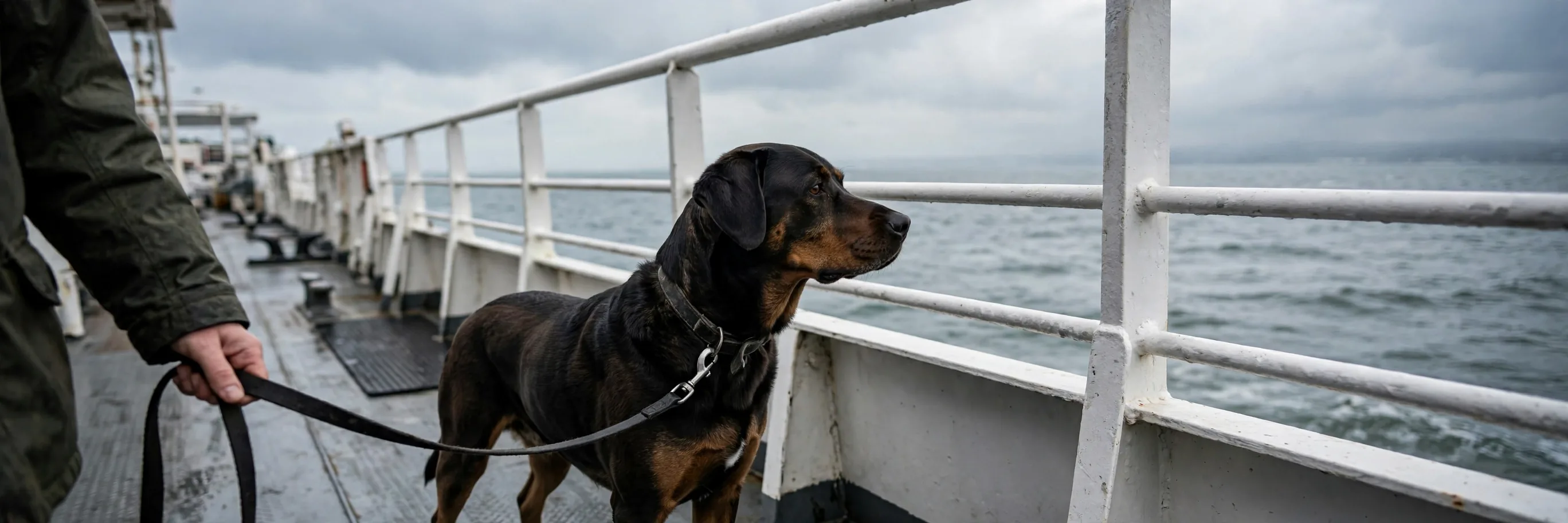
Now the part that matters most, and the part that changes: dog policies are not standardised across these operators. Depending on the operator, the vessel and the sailing, dogs may travel in designated pet areas, may need to stay in your vehicle, may be charged a fare or travel free, and may need to be booked in advance because pet spaces are limited. None of that should be guessed from a forum post or an old review. Check the current dog policy on the operator's own site when you book, note what you were told, and check again before you travel if your sailing is months away. Our dogs on UK ferries guide explains the general patterns — pet lounges, kennels, cabins and car stays — that help you read any operator's small print with confidence.
Prepare the crossing itself with the same care. Exercise and toilet the dog thoroughly before boarding, feed a light meal well in advance rather than a full bowl at the harbour, carry water and a familiar blanket for scent comfort, and never leave departure to the last minute: island ferries run to capacity in summer, check-in closes well before sailing, and a missed boat can mean a missed day. In rough weather sailings can be delayed or cancelled, so keep the first night's plan flexible, keep dog food and medication in the cabin bag rather than the boot, and treat the timetable as weather-dependent in a way mainland transport rarely is. That sounds cautious; in practice it is simply how Orcadians plan, and copying them is the fastest route to a calm crossing.
Neolithic Orkney with a dog: what the rules really mean
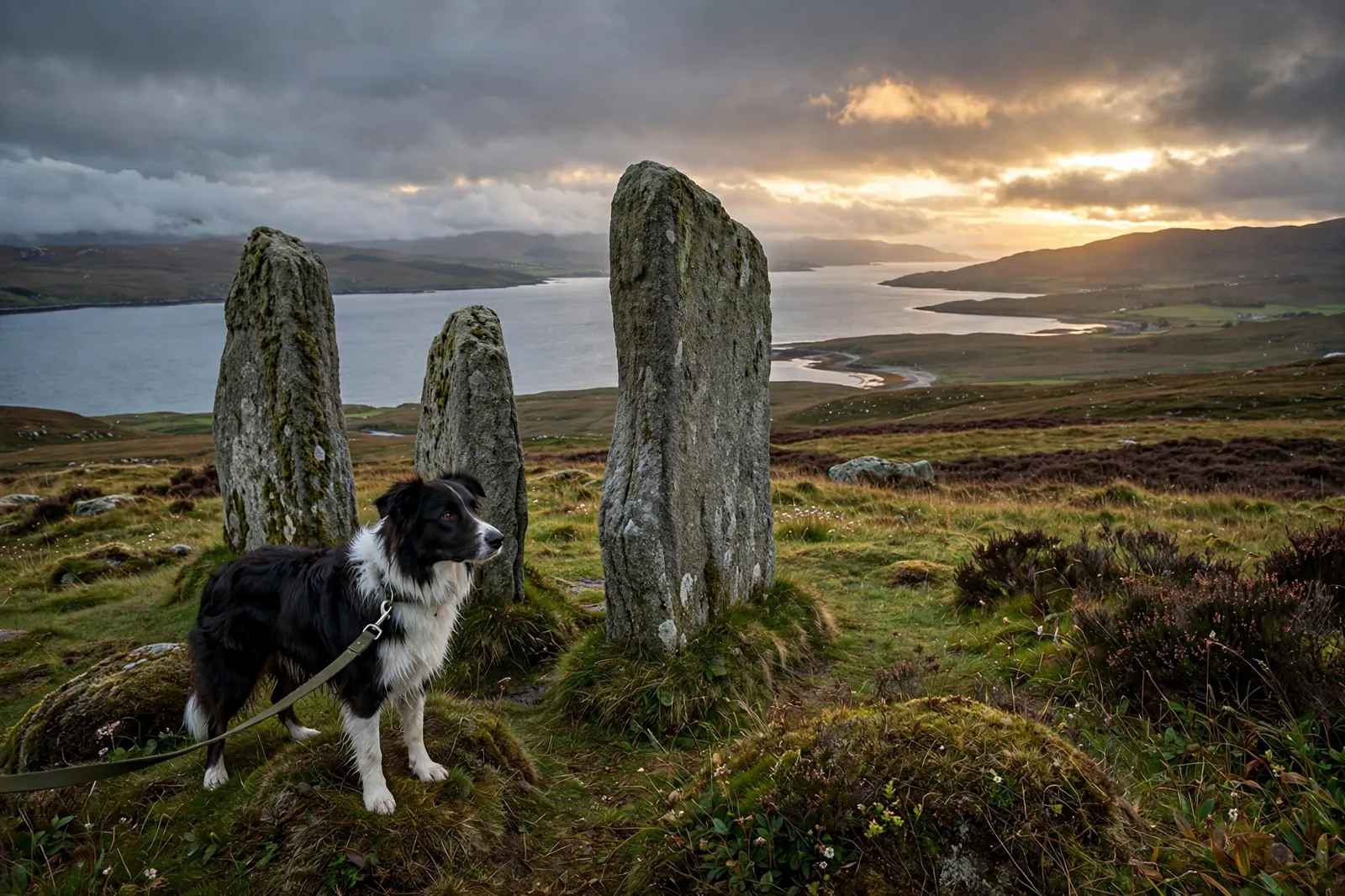
People cross an ocean of time to reach Orkney's stones, and the good news is that much of that landscape is outdoors, open and walkable with a dog on a lead. The Heart of Neolithic Orkney, a UNESCO World Heritage Site in the west Mainland, groups the Ring of Brodgar, the Stones of Stenness, the Ness of Brodgar area and Skara Brae within a few miles of each other, set between the Loch of Harray and the Loch of Stenness. The Ring of Brodgar, a great circle of stones on a narrow strip between the two lochs, is experienced entirely outside: a dog on a short lead can walk the surrounding path with you, feel the wind that has crossed this place for five thousand years, and be photographed at a respectful distance from the stones themselves. Keep off the monument, keep the lead short around other visitors, and let the scale do the work.
Skara Brae needs a more careful reading. The remarkably preserved Neolithic village is viewed from pathways above and beside the excavated houses, while its visitor centre, exhibitions and replica house are indoor spaces. At many staffed historic sites in Scotland, dogs are welcome in outdoor areas on a lead but are not admitted to indoor displays, enclosed monuments or cafes, with assistance dogs excepted — and the exact line varies by site. Maeshowe, the chambered tomb entered by a low passage, is an obvious example of a monument a dog cannot enter, whatever its manners. The Italian Chapel on Lamb Holm, built by Italian prisoners of war, is likewise an interior visit. The practical pattern for couples is to take turns: one person explores inside while the other walks the dog in the surrounding landscape, which in Orkney is rarely a hardship duty.
Because site rules, opening arrangements and seasonal access genuinely change, treat every specific in this section as a prompt to verify rather than a promise. Before you travel, check the latest official guidance for each site you plan to visit — Historic Environment Scotland manages many of the principal monuments — and before you set out for the day, check opening hours and any timed-entry requirements. Follow signs on the day over anything written here. That discipline protects the monuments, which are fragile despite their stone, and it protects your day from the particular disappointment of arriving at a locked gate with a patient dog and nowhere nearby to walk.
Beyond the famous names, Orkney rewards a slower archaeological walk. The Brough of Birsay, a tidal island with Pictish and Norse remains, is reached by a causeway at low tide and combines ruins, cliffs and seabirds in one outing — check tide times carefully and leave a generous margin, because being cut off is a real risk, not a colourful warning. Burial mounds, brochs and standing stones dot farmland across the Mainland and the outer isles, many accessible on signed paths where a lead near livestock is the only toll. Give every monument the same courtesies: no climbing, no digging paws in soft archaeology, waste carried away, and gates left as found. A dog that walks quietly among stones older than Stonehenge's main phase is participating in something remarkable; help it behave accordingly.
Kirkwall or Stromness: choosing your base
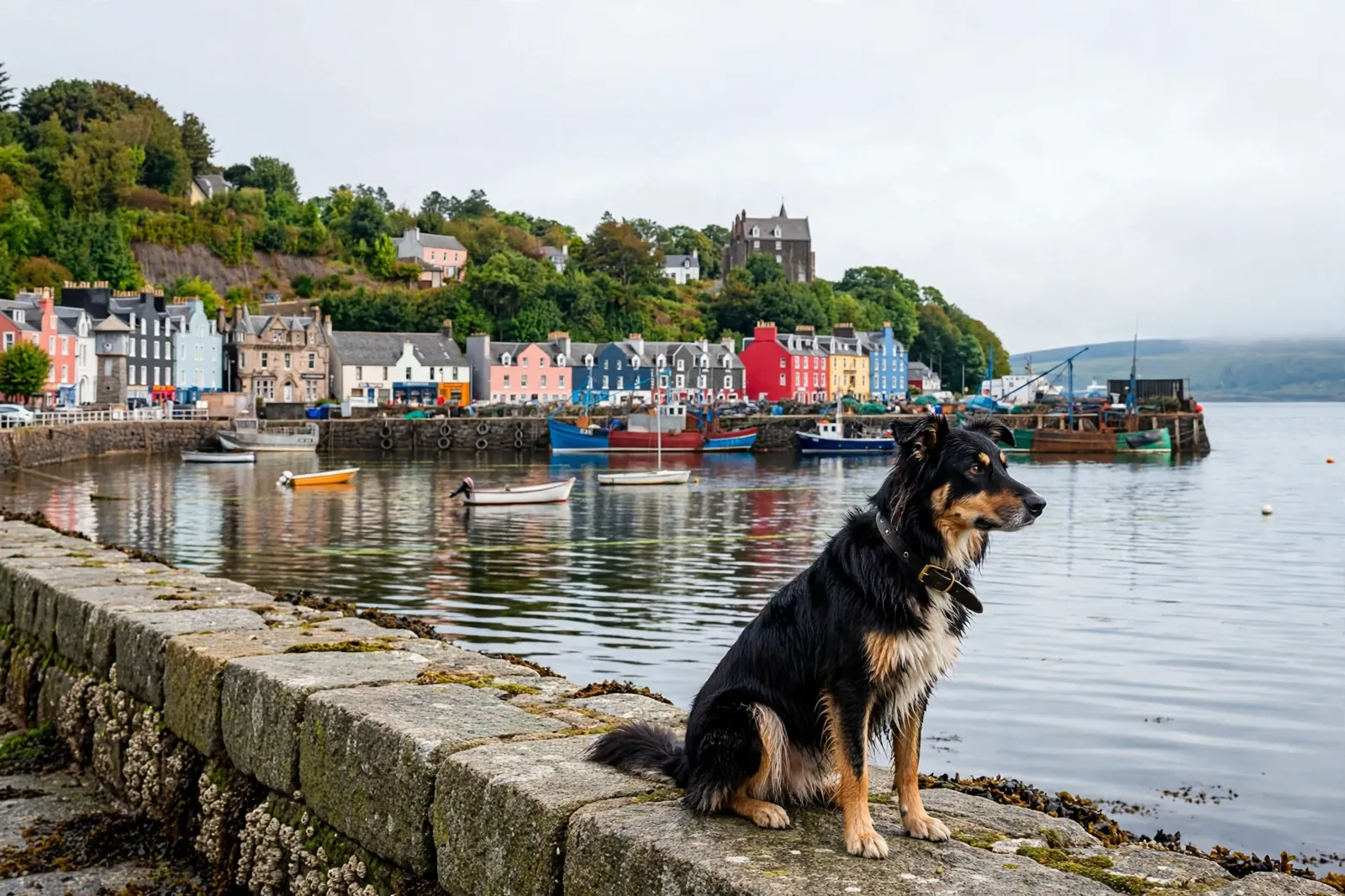
Orkney's Mainland is small enough that one base serves the whole trip, and the choice is between two harbour towns with different temperaments. Kirkwall, the capital, concentrates the widest range of accommodation, supermarkets, independent shops, places to eat, fuel and veterinary services, plus St Magnus Cathedral — a magnificent red sandstone building whose surrounding streets make a handsome lead-walk even if you only admire the exterior together. From Kirkwall the roads fan out logically: west to the World Heritage sites and Stromness, south across the Churchill Barriers to South Ronaldsay, and east to the quieter parishes and the ferry for the northern isles. For a first visit, especially with a dog that needs a predictable evening routine, Kirkwall's services earn their keep.
Stromness answers with character. Its long, flagstone main street winds between stone houses and small piers, the harbour stays busy with ferries and dive boats, and the west Mainland's cliffs and lochs begin almost at the town edge. Dogs that find busier centres stressful may settle better here, and owners who walk before breakfast will enjoy harbour loops in northern light that feels endless in June. The trade-off is a smaller choice of shops and eating places, so stock up deliberately and confirm dog arrangements at each venue rather than assuming — policies on dogs inside cafes and pubs vary across Orkney just as they do everywhere else.
Wherever you book, run the standard dog questions before you pay a deposit, because island rebooking at short notice is rarely possible in season. Ask about the dog charge and how many dogs are accepted, whether there is enclosed outdoor space for a late-night toilet break, whether floors are carpeted or easy-clean, where the nearest safe off-pavement walk begins, and whether dogs may join you at breakfast or must wait in the room. Self-catering suits many dog owners best here: early starts for ferries and tides, muddy returns from cliff paths, and a washing machine are worth more than a hotel breakfast. Also ask about parking — harbour towns have narrow streets, and a car you cannot park near the door becomes a daily negotiation with a tired dog.
Evenings deserve planning in a place where summer daylight stretches towards midnight and winter darkness arrives in the afternoon. In high summer, an after-supper walk along a Kirkwall shore or a Stromness pier can be the best hour of the day, with low golden light and empty paths. In the darker months, build the big walk into the middle of the day, carry a torch for the last lane back, and use reflective gear for both of you: Orkney roads are quiet, which makes drivers less expectant of pedestrians, not more. A base that works after dark is a base that works for the whole holiday.
Cliffs, stacks and tidal islands: the great coastal walks
Orkney's coast is where dogs earn their ferry fare. The west Mainland cliffs between Stromness and Birsay offer the classic sequence: red sandstone edges, sea stacks, geos carved by the Atlantic and, in season, cliffs loud with nesting seabirds. Yesnaby is the name most walkers start with — a short drive from Stromness, dramatic stacks including the Yesnaby Castle sea stack, and paths that demand respect for edges in wind that can arrive sideways. Marwick Head, further north, adds a memorial, wide sea views and serious bird colonies. These are lead walks, without exception or apology: cliff edges, nesting birds, sudden gusts and unfenced drops leave no room for a dog that chases a scent over an edge, and a long line is a hazard rather than a compromise in gusty conditions.
Balance the drama with Orkney's walkable headlands and shore paths. The Brough of Birsay walk, tide permitting, mixes archaeology with cliff scenery at a gentler scale. Around Scapa Flow, the great natural harbour ringed by islands and wartime history, shores are lower and walks can be chosen to suit older dogs and shorter days, with the Churchill Barriers themselves offering a strange, stirring lead-walk between causeways, blockships and beaches — on a short lead, well away from traffic. Mull Head and the east Mainland around Deerness give quieter cliff and shore walking for days when the west coast wind is at its most theatrical. Always match the walk to the forecast rather than the itinerary: in Orkney, swapping Tuesday's cliffs for Tuesday's lochs because of wind direction is good planning, not defeat.
Seabird season changes the etiquette. From roughly spring into summer, fulmars, guillemots, razorbills, puffins in smaller numbers than Shetland, skuas and terns occupy cliffs and moorland edges, and some species — Arctic terns and skuas especially — defend nests on the ground by diving at intruders, dogs included. Keep to paths, keep the dog close, and move through defended ground calmly and promptly rather than stopping for photographs. A dog that flushes a colony burns energy the birds cannot spare in a short northern breeding season. Outside breeding season the same cliffs belong to winter storms and grey seals hauled out below; binoculars for you and a settled mat settle for the dog turn a viewpoint into an hour well spent.
Kit for Orkney coastal walking is unglamorous and specific. Waterproofs that actually seal, a warm layer even in July, a dog coat for thin-coated or older dogs standing in wind at viewpoints, fresh water because coastal burns can run brackish or through farmland, and a towel in the car for the sand-and-seawater combination every Orkney beach seems to apply to dogs as a condition of entry. Check tide tables for any causeway or shore route, tell your accommodation your rough plan on big walk days, and remember that mobile signal, while generally reasonable on the Mainland, is not a safety plan. The cliffs will still be there tomorrow; walk them in weather that lets both of you enjoy being small against the Atlantic.
Beaches, lochs and farmland: the gentler Orkney
Not every Orkney day needs a cliff edge. The islands hold fine sandy beaches where a dog can have a simpler kind of pleasure: the Bay of Skaill beside Skara Brae, where a world-famous village overlooks a broad sweep of sand; Waulkmill Bay near Orphir, a sheltered tidal bay with saltmarsh and wading birds; the beaches along the Churchill Barriers on South Ronaldsay and Burray; and the long sands of the east Mainland and Deerness. Beach rules are mostly common sense rather than formal bans, but read local signs, keep dogs away from hauled-out seals — a resting seal and an interested dog are a dangerous combination for both — and keep well clear of nesting birds on shingle and dune systems in spring and summer. If seals are present, the kindest and safest choice is the lead and a different stretch of sand.
Inland, the lochs of Harray and Stenness frame the World Heritage landscape and give level, scenic walking on lanes and paths where the dog interest is waterfowl, wildflowers and the ever-changing northern sky rather than swimming. Treat loch water as you would any farmed lowland water: algal blooms can occur in warm settled spells, livestock use the same shores, and currents are not the issue so much as water quality — carry drinking water and offer that instead. The farmland between loch and coast is Orkney's working fabric, some of the most fertile in Scotland, and it explains the islands' other constant: cattle and sheep close to roads, beaches and even campsites. The Scottish Outdoor Access Code gives walkers responsibilities alongside rights, and in practice that means leads around livestock, wide detours around cows with calves, and no feeding of anything, however hopeful the audience at the fence.
This gentler Orkney suits the dogs that headline holidays sometimes forget. Senior dogs can manage short shore sections, viewpoint stops and harbour strolls separated by car rests, and still absorb the essence of the place — space, light and sea air. Puppies building their travel confidence get manageable novelties here: first ferry, first beach, first standing stone, each in doses you control. Reactive dogs benefit from Orkney's defining resource, which is room: beaches and lanes where other dogs are visible at a distance, walks timed for early morning, and the simple absence of the crowded honeypot pressure found further south. Choose the quiet parish over the famous car park on peak days and Orkney becomes one of Britain's most forgiving island destinations for a dog that needs space to relax.
One local pleasure deserves a warning label of pure practicality: Orkney's farm and shore lanes can be muddy, its beaches windy enough to sandblast a picnic, and its weather capable of using all four seasons before lunch. None of this diminishes a well-prepared day. Build each outing as a loop of options — a beach if the wind drops, a lochside lane if it does not, a harbour town cafe stop if the rain wins — and the dog will read the day as a success whatever the sky decided. Flexibility is not a backup plan in Orkney; it is the plan.
A day on another island: Hoy, Rousay and beyond
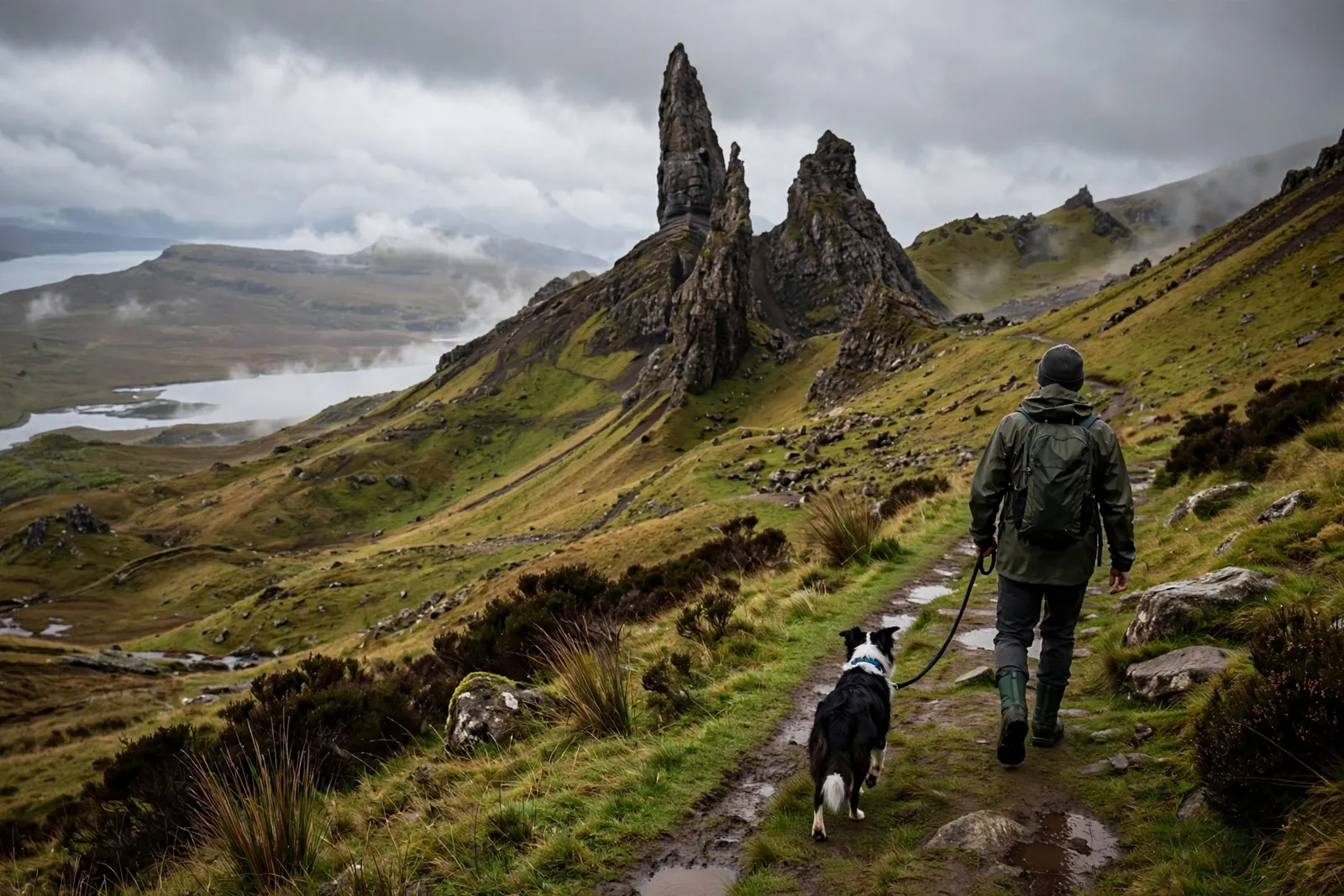
Staying on the Mainland does not mean seeing one island. Orkney Ferries runs the inter-island network linking Hoy, Rousay, Egilsay, Wyre, Shapinsay, Sanday, Stronsay, Eday, Westray, Papa Westray and North Ronaldsay, and a day trip with a dog adds a whole second geography to the holiday. Hoy is the dramatic choice: hills unlike anywhere else in Orkney, the road to Rackwick Bay beneath great cliffs, and the Old Man of Hoy offshore — a substantial walk that must be matched honestly to your dog's fitness and the day's wind. Rousay offers a compact archaeological day, with chambered tombs and a broch around a small island circuit. Shapinsay, visible from Kirkwall and reached by a short crossing, is the gentle introduction: a harbour village, farmland, shore walks and an easy return.
Inter-island ferries are working boats serving island communities, and their dog arrangements are typically simpler and more utilitarian than the mainland routes — expect vehicle decks, designated areas or staying in the car depending on the vessel, and always check the current arrangements for your specific sailing rather than assuming the mainland pattern applies. Book vehicle spaces ahead in season, arrive early, and respect that for islanders these sailings are the bus, the delivery van and the ambulance route combined: tourists with dogs are welcome, but freight, livestock and residents take the timetable's priority for granted, and so should you.
Plan the day around the return sailing, not the outward one. Timetables on some routes are sparse, a missed return can mean an unplanned night without your luggage or the dog's food, and weather can cancel afternoon sailings. Carry the full day kit — water, food, medication, warm layers — even for a short hop, walk with time in hand, and be back at the pier early enough to watch the boat load, which in Orkney is entertainment in itself. If your dog is a nervous traveller, choose one island day rather than three; a single well-judged trip to Shapinsay or Hoy will add more to the holiday than a frantic circuit of piers.
Travellers combining archipelagos should read our Isle of Skye with a dog guide and Isle of Mull with a dog guide with profit: the contrast teaches the lesson. Skye and Mull are reached by bridge or short CalMac crossings and feel like extensions of the mainland; Orkney is a sea voyage away and feels like a country of its own, Norse in its place names and place sense. That separateness is precisely its gift to a dog holiday — fewer crowds, bigger skies, and the feeling, rare in Britain, of having genuinely travelled somewhere.
Wind, daylight and island logistics
Ask an Orcadian about the weather and the honest answer is wind, in several directions, sometimes in one day. Orkney sits where Atlantic and North Sea influences meet, and while its temperatures are milder than the latitude suggests, the wind chill is the figure that matters for dogs standing on headlands and owners reading maps on exposed paths. Dress for a season colder than the forecast claims, secure hats and map cases, and be thoughtful about elderly, very young, small or thin-coated dogs on winter cliff walks — turning back early is a skill here, not a failure. Summer brings the opposite extreme of daylight: around midsummer it barely gets fully dark, the famous simmer dim, which delights evening walkers but can unsettle a dog's sleep routine in accommodation without blackout curtains; a familiar blanket and a maintained routine help.
Winter deserves its own honest paragraph. Daylight shrinks to a few usable hours, sailings are more vulnerable to weather, some attractions close or reduce hours, and yet a settled winter week offers empty sites, huge skies, possible aurora on dark clear nights — Orkney is far enough north for the northern lights, known locally as the mirrie dancers — and beaches entirely to yourselves. The dog will not care about the aurora; it will care about short, well-timed walks, warm drying space afterwards, and an owner who plans distances around the light rather than discovering sunset on a cliff path. Torch, reflective lead or collar light, and a hard finish time are winter essentials, not accessories.
Logistics on the islands are simple but unforgiving of assumptions. Fuel, supermarkets and pharmacies concentrate in Kirkwall and Stromness, so tour with a topped-up tank and a stocked boot rather than expecting a shop in every parish. Veterinary cover exists on the Mainland, but know the location and out-of-hours arrangement of the practice nearest your base before you need it, and travel with your dog's medication, vaccination record and microchip details as you would for any remote trip. Mobile coverage is fair around towns and thinner in places elsewhere; download maps, tide tables and ferry timetables for offline use. Cash is rarely essential now, but small island ferries, honesty boxes and local produce stalls reward travellers who carry some.
Finally, driving itself is part of the Orkney experience and mostly a pleasure: quiet roads, courteous local habits, and views that keep pulling eyes from the tarmac. The Churchill Barriers drive, with water on both sides and wartime blockships rusting alongside, is unforgettable in good light. Watch for livestock near unfenced roads, cyclists on narrow lanes, and agricultural vehicles in season, and keep the dog secured in the car as the law and common sense require — a loose dog in a car on unfamiliar roads is a distraction with a heartbeat. Arrive at each destination unhurried and the islands will do the rest.
Three days and five days: patterns that work
For three days, resist the urge to circumnavigate daily. Day one belongs to arrival and orientation: cross by your chosen ferry, settle into Kirkwall or Stromness, walk the harbour and stock up, and let the dog decompress from travel before any sightseeing is demanded of it. Day two is the World Heritage day — Brodgar and Stenness in the morning light, the Bay of Skaill and Skara Brae's exterior landscape with turn-taking for indoor elements, then a lochside evening walk. Day three goes south: the Churchill Barriers, the Italian Chapel exterior and surroundings, South Ronaldsay beaches and a slow return, timed to your sailing home or a final harbour supper. That pattern gives a first visit the essential Orkney — stones, sea and sky — without a single day that exhausts the dog.
Five days unlock the islands' depth. Add a west coast cliff day, moving between Yesnaby and Marwick Head with weather-led timing and a Stromness afternoon, and an outer isles day chosen by temperament: Hoy for hill fit dogs and ambitious walkers, Rousay for archaeology in miniature, Shapinsay for an easy confidence-building crossing. Keep the fifth day deliberately loose — a Deerness and east Mainland circuit, a return to whichever beach the dog loved most, or a Kirkwall day of cathedral streets, shore walks and shops while the dog rests between outings. Holidays improve when one day has no headline; dogs, who experience trips as a sequence of walks and naps rather than sights, will vote for the loose day every time.
Whatever the length of stay, leave Orkney as carefully as you explored it. Check the sailing status before you set out for the terminal, exercise the dog properly before boarding, and keep the return crossing's kit — water, blanket, medication, a spare lead — in the cabin rather than buried in luggage. Then, on the mainland drive south, expect the quiet recalibration every island traveller knows: roads feel busier, skies feel smaller, and a dog asleep in the back has carried home the smell of salt, stone and northern grass. Book the return visit in your head before the motorway; most people who bring a dog to Orkney once spend the journey home planning how to do it again, slower.
Practical questions
Before you go
Which ferry is best for taking a dog to Orkney?
For most drivers the shortest Pentland Ferries crossing from Gills Bay to St Margaret's Hope keeps time at sea low, while NorthLink from Scrabster to Stromness suits travellers who want to land in the west Mainland. The seasonal John O'Groats passenger ferry is for foot passengers only. Dog areas, vehicle rules and charges differ by operator and sailing, so check the current dog policy with the operator before you book.
Can dogs visit Skara Brae and the Ring of Brodgar?
Dogs on a short lead are generally welcome in many outdoor historic areas in Orkney, but they are not usually allowed inside visitor centres, museums or enclosed monuments such as chambered tombs, with assistance dogs excepted. Rules vary by site and can change, so check the current Historic Environment Scotland guidance for each site before you travel and follow signs on the day.
Where is the best base in Orkney with a dog?
Kirkwall is the practical base, with the widest choice of stays, food, shops and vets, plus easy road links in every direction. Stromness is smaller and quieter, with a characterful harbour and good west Mainland walks nearby. Wherever you book, confirm dog charges, enclosed outdoor space, and whether dogs can join you where you eat.
Do dogs need to be on a lead in Orkney?
Yes around livestock, on cliff paths, near nesting birds and at historic sites, and under close control everywhere else. Orkney farmland is unfenced in many places, sheep and cattle graze close to roads and beaches, and ground-nesting birds use moor and coast in spring and summer. Follow the Scottish Outdoor Access Code and any local signs requesting leads.
When is the best time to visit Orkney with a dog?
Late spring to early autumn gives the longest daylight, the fullest ferry timetables and the best chance of settled weather, though Orkney wind is a year-round companion. Winter brings very short days, possible ferry disruption and dramatic skies. Whatever the season, pack waterproofs and a dog coat, book ferries and stays early, and check sailing updates on the day of travel.
Can my dog stay in the car on the ferry to Orkney?
Yes. Your dog can stay in the car on all the ferries from mainland Scotland and Shetland, and you do not have to pay for an on-board kennel or cabin. The car decks are enclosed or shaded, but still leave water, open the windows a little and disable your alarm, and give your dog a good walk before boarding. Orkney’s official visitor site sets out the options here: Orkney.com: dog-friendly Orkney (checked October 2026).